They Called the Old Farmer Confused Until Water Rose Beneath the Land They Planned to Sell
Chapter 1: The Sale Stakes Appeared Before the Rain Stopped
The survey stakes had gone into Samuel Miller’s lower field before the rain quit.
Bright orange ribbons snapped above the flattened soybean stubble, running in a crooked line from the county road to the sycamore at the south boundary. Samuel stood at the kitchen window with one hand braced against the sink and counted eleven of them.
The twelfth stood beside the shallow depression where water used to gather when he was a boy.
He pulled on his brown plaid shirt, dark overalls, and work boots without turning on the kitchen light. Catherine had left a folder open on the table. A yellow tab marked the signature page.
LOWER PARCEL—PROPOSED SALE.
Samuel closed the folder.
Catherine came in carrying two mugs and stopped when she saw his coat already buttoned.
“Don’t pull those stakes.”
“I wasn’t planning to.”
“You were looking at them like fence posts that offended you.”
“They’re in the wrong place.”
“They’re exactly where the surveyor put them.”
Samuel took one of the mugs but did not drink. “Then the surveyor’s wrong.”
Catherine set hers down harder than she meant to. She had been back on the farm for fourteen months, long enough for the city softness to leave her hands and not long enough for Samuel to stop acting as though she were visiting.
“The bank gave us thirty days,” she said. “Patricia isn’t threatening us. She’s telling us what happens next.”
“What happens next is you sell the only field with water under it.”
Catherine shut her eyes for a moment. “There is no documented spring.”
“There was a stone house over it.”
“There is no stone house.”
“Not aboveground.”
She looked at him then, searching his face for something he resented her looking for. Confusion. Forgetfulness. The weakness of age.
Samuel hated that he noticed.
“The lower parcel gives us enough to bring the operating note current,” she said. “We keep the house, the barns, and the north fields. That is better than losing all of it.”
“You think a buyer will stop at the stakes?”
“A deed will.”
“A deed stopped nothing when the creek shifted in ’seventy-eight.”
“This isn’t nineteen seventy-eight.”
“No,” Samuel said. “Now people believe paper before land.”
Catherine picked up the folder and tucked it under her arm. “Benjamin will be here at nine to open the drainage line. The appraiser comes this afternoon. Please don’t make either of them part of this.”
“Part of what?”
“Whatever argument you think you’re having with me.”
She left through the mudroom. Samuel remained by the table, holding the untouched coffee until its heat faded through the ceramic.
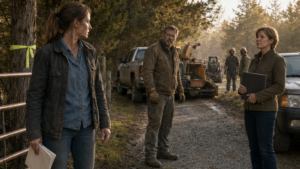
By eight-thirty, rain still whispered off the barn roof. Benjamin Hall’s excavator came down the lane behind a flatbed, its steel tracks clotted with mud from another job. Two crewmen climbed out and began unloading trench shields and orange cones.
Benjamin found Samuel at the edge of the lower field.
“You planning to supervise from there?” he asked.
“Depends how poorly you dig.”
Benjamin smiled, but it did not reach his eyes. He was fifty-three now, thick through the shoulders, his beard going gray beneath the chin. At seventeen, he had followed Samuel through county ditches carrying grade rods and pretending not to be afraid of snakes.
Now he owned the equipment and carried liability insurance.
“Catherine hired us to trace the collapsed drain,” Benjamin said. “We’re not hunting old springs.”
“You’ll cross the cap if you follow the wet line.”
“What cap?”
“The stone outlet.”
Benjamin studied the slope. “You tell Catherine that?”
“She knows what I told her.”
“That isn’t what I asked.”
A pickup approached from the house. Catherine parked beside the flatbed and came toward them in rubber boots, the bank folder sealed inside a clear plastic sleeve.
“Start at the marked line,” she told Benjamin. “Two test cuts. If the tile is broken, replace it. If it’s not, backfill.”
Samuel pointed past the nearest stake. “Six feet west.”
Catherine did not look at him. “The county map puts the drain here.”
“The county map was redrawn after the lower ditch was filled.”
Benjamin shifted his weight. “I can angle the first cut a little.”
“No,” Catherine said. “We are paying for drainage work, not a memory excavation.”
One of the crewmen pretended to inspect a chain binder. The other climbed into the excavator cab.
Samuel walked away before Catherine could mistake silence for surrender.
He followed the line of stakes to the shallow depression. Rain had gathered there in a thin brown sheet. He crouched, pushed his gloved fingers beneath a mat of leaves, and felt along the ground.
Clay. Root. Gravel.
Then a hard edge.
He scraped with both hands until a flat gray surface emerged, too straight to be natural. The stone showed a chisel mark beneath the mud.
“Benjamin.”
The excavator engine idled behind him.
Benjamin came over slowly, Catherine a few steps behind.
Samuel cleared another six inches. The stone continued in a line beneath the soil.
Benjamin knelt and pressed his thumb into the exposed seam. “Hand-laid.”
Catherine looked from the stone to Samuel. “Could be an old foundation.”
“It is,” Samuel said. “For the springhouse.”
Benjamin glanced toward the excavator. “There might be enough here to justify widening the test cut.”
Catherine’s expression hardened, not because she disbelieved the stone but because belief had suddenly acquired a price.
“How much?”
“If we keep it narrow, a couple hours.”
“We don’t have a couple hours.”
“We have thirty days,” Samuel said.
“We have invoices due Friday. We have diesel on account. We have a bank appraisal today, and I already signed the excavation authorization based on the mapped drain.”
Samuel stood. Mud streaked the knees of his overalls.
“You signed for work on land you haven’t sold.”
“I signed because it is still our land, and someone has to make decisions while it is.”
The words landed quietly.
Benjamin looked away.
Samuel understood then that Catherine no longer considered him the final authority on Miller ground. She had not asked permission because she believed permission was now one more thing the farm could not afford.
He turned toward the excavator.
“Open it.”
Catherine stepped in front of him. “Benjamin works for me.”
Benjamin rubbed the back of his neck. “I work for the farm.”
For a long moment, no one moved.
Then Catherine unfolded the county drainage sketch on the hood of her pickup. She studied the wet line, the exposed stone, and the survey stakes dividing the field.
“One cut,” she said. “Along the mapped drain. If the wall continues west, we stop and decide what it means. No chasing.”
Benjamin raised two fingers toward the operator.
The excavator bucket bit into the field.
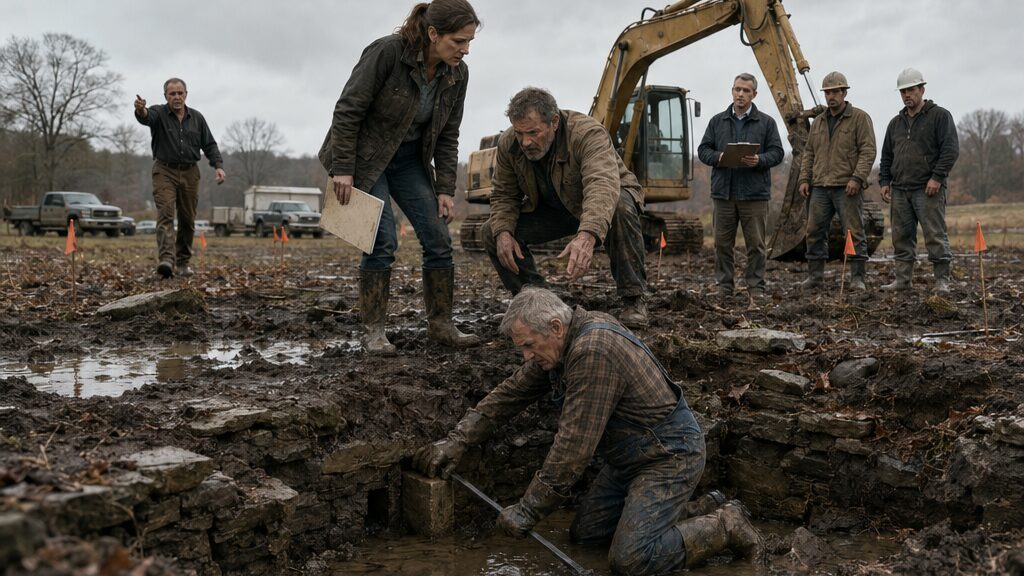
Dark soil folded back in heavy slabs. At three feet, the bucket struck stone with a dull knock that Samuel felt through his boots. Benjamin signaled the operator to slow down.
Another layer came away.
A vertical face appeared beneath the mud—gray blocks fitted without mortar, their edges rounded by age. The bucket cleared the corner, then a second wall running at a right angle.
It was not a loose foundation stone.
It was a buried room.
Chapter 2: The Buried Outlet Answered One Question and Opened Three More
“You’ve got twenty minutes,” Benjamin told Samuel. “Then I put the dirt back.”
The excavation had filled ankle-deep with brown water while the crew broke for a late lunch. Three sides of the old stone chamber stood exposed, their tops crushed inward by decades of machinery and frost. A black opening showed near the bottom of the western wall, half hidden behind collapsed rock.
Catherine stood above the trench beside the bank’s appraisal contractor. His clean boots had already acquired a rim of mud, which seemed to offend him more than the delay.
“There is no safe entry plan,” Catherine said.
Samuel tightened the straps on his gloves. “Floor’s firm.”
“You cannot see the floor.”
“I know where it is.”
“That is the problem. You think knowing where something used to be means it is still there.”
The appraiser glanced at his watch. Benjamin’s crew waited beside the excavator, trying not to appear interested.
Samuel looked at Benjamin. “One bucket-width off the west wall.”
Benjamin shook his head. “That wall rolls, you’re under it.”
“It won’t roll. The corner stones key inward.”
“You haven’t seen those stones in forty years.”
“Forty-three.”
Catherine let out a breath that was almost a laugh, except there was no humor in it. “We are not spending more money chasing a memory.”
Samuel did not answer her. He climbed down the cut bank using the excavator teeth as steps.
“Dad.”
The word stopped him for half a second. She rarely called him that when other people were near.
Then he lowered himself into the water.
Mud closed over his boots. He braced one hand against the north wall and shifted sideways. The stones were cold even through his glove. Beneath the water, his toe found the raised lip of the old floor exactly where he expected it.
He pointed toward the west side. “There. Take the loose fill. Not the wall.”
Benjamin stared down at him. “If anything moves, you get out.”
“If anything moves, I’ll tell you before you see it.”
“That right there is why nobody likes working with you.”
But Benjamin climbed into the cab.
The bucket descended with painful slowness. Samuel guided it by inches, one palm raised, until the teeth slipped into the soft fill outside the chamber. Clay peeled away. A flat capstone appeared above the dark opening.
Samuel’s heart struck hard once.
He had spent years avoiding this place. Now the shape of every stone returned to him before the mud released it.
“Stop,” he called.
The engine dropped to idle.
Samuel knelt in the brown water. He reached below the surface and felt along the outlet. Silt packed the opening. Behind it stood something broad and flat, its edge deliberately wedged beneath two smaller stones.
Catherine moved closer to the trench.
“What is it?”
Samuel did not answer.
His gloved fingers slipped. He dug deeper, shoulder almost touching the water, and found the notch cut into the blocking stone. He had made that notch himself with a masonry chisel.
The memory came with unwelcome precision: his younger hands, Daniel shouting from the boundary, his wife standing in the rain with a bank envelope beneath her coat.
Samuel set both hands into the notch.
“Give me the pry bar,” he said.
Benjamin passed one down.
The bar scraped against stone. Samuel leaned his weight into it. For several seconds nothing changed. Then the blocking slab shifted with a low grinding sound.
A thin line of clear water appeared through the black mud.
One of the crewmen said, “There it is.”
Samuel pulled again.
The slab tipped outward.
Water struck his forearm in a sudden cold surge. It rushed through the opening, clear at first, then clouded with loosened silt. The trench surface shivered. Brown water rolled away from the outlet as the stream strengthened.
The appraiser stepped to the edge and raised his phone, not to film but to photograph the exposed structure.
Catherine said nothing.
Samuel removed the slab completely and let it fall beside his knee. The spring pushed out in a steady stream, splashing against his boots and cutting a pale channel through the mud.
For one clean moment, he felt only relief.
The chamber had remembered even when no one else had.
He looked up at Catherine. Rain spotted her hair and the shoulders of her jacket. Her face held no triumph, no apology—only the stunned recalculation of someone watching a fact overturn the room inside her head.
“I told you,” Samuel said.
It was the wrong thing.
He saw that as soon as her expression changed.
The appraiser crouched near the edge. “Flow rate would need measurement. Water rights, quality testing, permitted use—”
“It can feed the lower irrigation line,” Samuel said.
“Provided it is legally accessible and doesn’t discharge across another parcel.”
“It doesn’t.”
The denial came too quickly.
Benjamin heard it. His eyes narrowed.
Then a truck horn sounded from the county road.
Daniel Scott’s pickup came through the field entrance faster than the mud allowed. It slid sideways near the survey stakes before stopping. Daniel climbed out without a coat, his work shirt dark at the shoulders from rain.
He was sixty-two, lean and stiff-backed, with the look of a man who had arrived already angry and spent the drive sharpening it.
“Shut it,” he called.
No one moved.
Daniel crossed the field, staring at the water streaming from the exposed wall.
“I said shut it.”
Catherine stepped toward him. “Daniel, we found an old springhouse.”
“I can see what you found.”
“We’re only evaluating it.”
“That water runs south.”
Samuel climbed out of the chamber, slower than he had entered. Mud pulled at his boots. Benjamin offered a hand, but Samuel ignored it until the bank crumbled beneath one foot. Then he took it.
“The old channel’s gone,” Samuel said.
Daniel looked at him. “Because you filled it.”
The appraisal contractor closed his folder.
Catherine turned from Daniel to Samuel. “What channel?”
“An old drainage cut,” Samuel said. “Nothing usable now.”
Daniel pointed toward the water gathering in the trench. “It found my bottom field once. It’ll find it again.”
“That was flood rain.”
“That was your spring and a blocked culvert.”
“The culvert failed.”
“You knew it was failing.”
Catherine’s voice dropped. “Dad?”
Samuel pulled off one glove. Mud had worked through the seam and blackened his palm. The spring continued behind him with a sound too clean for the field around it.
Benjamin stepped between the outlet and the low trench that angled south. “We need a pump basin before this overtops.”
Daniel faced Catherine. “You want your appraisal, tell him to put that stone back.”
Catherine looked at Samuel. A few minutes earlier, he had been the man who remembered what no one else believed. Now every person in the field was waiting for him to explain why Daniel spoke as though the discovery were not a miracle but a returning threat.
Samuel bent, picked up the flat blocking stone, and held it against his muddy leg.
Daniel’s voice was quieter when he spoke again.
“Ask him who sealed that outlet, Catherine.”
She did.
Samuel looked at the stone in his hands.
Daniel answered for him.
“He did.”
Chapter 3: The Water Reached a Boundary Samuel Refused to Name
By sunrise, the spring had filled the excavation again.
Benjamin’s crew had wedged the blocking stone over the outlet, packed clay around it, and left a portable pump running into a temporary basin. Sometime after midnight, the pump clogged with leaves. Water rose over the chamber floor and spread into the fresh trench, stopping ten yards short of the south swale.
Samuel stood at the edge with a shovel while the pump coughed uselessly below.
Catherine’s truck came down the lane. She did not park beside him.
Daniel arrived five minutes later with a county soil-and-water technician in the passenger seat.
“You filed already,” Samuel said.
Daniel shut his door. “I filed before breakfast.”
The technician wore a reflective vest over a canvas jacket and carried a measuring rod. He studied the pooled water, the exposed stonework, and the faint depression running toward Daniel’s boundary.
“No discharge until we establish the historic route and current outlet,” he said.
“There is no current outlet,” Samuel replied.
Daniel gave a short, bitter laugh. “That’s what I’m worried about.”
The technician placed the rod in the basin. “We’ll need the county drainage maps, any private easements, and records of alterations.”
Samuel pushed his shovel into the mud. “Maps won’t show half of it.”
“Then we need whatever will.”
Catherine stood on the far side of the trench, arms folded. She had not asked Samuel another question since Daniel’s accusation. Her silence felt less like restraint than a ledger still being totaled.
The technician walked the low ground south. Samuel followed. Water had always chosen that route before machinery flattened it—past the sycamore, through a shallow cut, then east along the boundary.
At the fence, the technician stopped.
“This swale continues onto Mr. Scott’s parcel.”
“It used to.”
“Where did it go?”
Daniel pointed toward a raised strip of earth. “Miller filled his side. I tiled mine after the flood.”
The technician looked at Samuel. “Did you file an alteration notice?”
“It wasn’t county-maintained.”
“That wasn’t my question.”
Samuel’s grip tightened on the shovel handle.
Catherine answered from behind him. “We’ll check the records.”
The county office occupied the ground floor of a brick building beside the courthouse. By ten, the five of them had crowded around a wide table while a records clerk brought out rolled maps smelling of dust and damp cardboard.
The newest drainage map showed a blue line entering the Miller farm from the north and disappearing near the lower field. The springhouse was absent.
“Earlier,” Samuel said.
The clerk found a map from 1976. On that sheet, a narrow dashed channel ran from the stone springhouse across the Miller property and curved along what later became Daniel’s field.
“There,” Samuel said.
Catherine leaned over the map. “It’s been erased on the updated version.”
“Not erased,” the technician said. “Retired, probably. We need the amendment.”
The clerk searched a metal drawer and returned with a thin file. Inside was a photocopied request to remove a private drainage route after repeated flooding. The signature page was missing.
Daniel tapped the date. “That was the year after my father lost the lower corn.”
Samuel kept his eyes on the map.
The technician traced the dashed line with one finger. “Mr. Miller’s description was correct. The springhouse, outlet, and channel align with the present grade. His memory isn’t the issue.”
The words should have felt like vindication.
Instead Samuel saw Catherine reading the alteration date.
“What happened that year?” she asked.
“Wet spring.”
“Daniel said the flood came from the outlet.”
“Water came from everywhere.”
Daniel leaned across the table. “Tell her about the wall you built across the cut.”
Samuel looked at him. “Your father wanted it stopped.”
“My father wanted his field protected. He didn’t ask you to bury the whole system and pretend it never existed.”
Patricia Allen called Catherine while they were still at the table. Catherine put the phone on speaker because the technician needed to hear the bank’s position.
Patricia’s voice was calm and exact.
“Until the county determines whether the water feature increases value or creates liability, the revised appraisal is suspended.”
“The original appraisal?” Catherine asked.
“Still scheduled, but the lower parcel cannot be marketed as irrigable acreage. Any active dispute or unpermitted alteration must be disclosed.”
Samuel stared at the old map.
“How long does review take?” Catherine asked.
“Best case, several weeks.”
“We don’t have several weeks.”
“I understand. The recovery timeline has not changed.”
When the call ended, Catherine folded her arms tightly against herself. “So finding the spring just made the parcel harder to sell.”
“It made the truth visible,” Samuel said.
“No. It made one truth visible.”
The records clerk was examining the thin file again. “There may be a related loan reference.”
Catherine turned. “What loan?”
“Drainage repair, maybe private agricultural credit. The notation is incomplete.”
The clerk disappeared into the back room.
Samuel felt the room narrow.
He remembered his wife at the kitchen table, hair still wet from rain, turning an envelope facedown when Catherine came home from school. He remembered telling her they would replace the money after harvest. He remembered not replacing it.
The clerk returned carrying a brown folder held together with a frayed cloth tie.
“Found it under emergency land repair,” she said. “The primary borrower name is partly smeared.”
Catherine opened the folder.
The first page held an invoice for grading Daniel’s lower field, replacement seed, culvert work, and stone fill. Beneath it was a payment schedule extending across nine years.
Samuel watched Catherine’s eyes move down the page.
Then she stopped.
In the bottom margin, beside a handwritten approval note, were two initials she had seen on birthday cards, grocery lists, and every jar put up in the Miller kitchen.
Her mother’s.
C.M.
Chapter 4: His Wife’s Ledger Changed the Meaning of Every Dry Year
The payment schedule continued six years past Catherine’s mother’s funeral.
Catherine sat alone in the farm office with the brown county folder open beneath the desk lamp. Rain marks had spread through several pages, feathering the ink into pale blue veins. The last three installments were written in Samuel’s hand, though the original borrower line carried her mother’s initials.
C.M.
Catherine had seen those initials on preserved-peach labels, school permission slips, and the notes her mother tucked into lunch bags. Never on a loan tied to another man’s ruined field.
A delivery truck slowed on the road, then continued past the farm. The sound pulled Catherine’s attention to the window, where the lower acreage lay beyond the barns, sectioned by orange survey flags.
She turned back to the file.
The invoices were plain enough: replacement seed, grading, a culvert, stone fill, rented equipment. The total was larger than she had expected and smaller than the damage it had caused. Interest had stretched it until every payment seemed to consume something else.
At the bottom of one invoice, her mother had written: Delay north irrigation replacement one season.
Catherine found the north irrigation estimate in Samuel’s farm ledger. It had been delayed the next year too, then crossed out entirely.
By morning, she had built a timeline across the office floor.
Flood repair. Loan payment. Failed pump. Deferred tile replacement. Lower yields. Another operating note.
Every dry season she remembered had been shaped by water they could not use because her parents were still paying for the year they had failed to control it.
Samuel entered without knocking. He stopped when he saw the papers arranged around her chair.
“You took those from the county.”
“They made copies.”
“You shouldn’t leave records on the floor.”
“You shouldn’t leave them hidden for thirty years.”
He removed his cap and placed it on the filing cabinet. His mud-stained gloves remained tucked into one overall pocket.
Catherine held up the original loan agreement. “Why is Mom’s name on this?”
“She handled the household accounts.”
“This wasn’t a grocery account.”
“No.”
“Did she borrow the money because you couldn’t?”
Samuel looked past her toward the dark window.
“She had cleaner credit.”
The answer was so direct it took the force out of the question.
Catherine lowered the page. “Did she agree to it?”
“She signed.”
“That is not what I asked.”
His jaw tightened.
Catherine stood. “Daniel’s father lost a crop. You paid for it. Fine. That explains the loan. It does not explain why no one told me.”
“You were sixteen.”
“And after sixteen?”
“There was no use burdening you.”
“You kept paying after she died.”
“Yes.”
“With what?”
“Farm income.”
“What farm income?”
Samuel’s face changed slightly.
Catherine crossed to the old steel cabinet and pulled open the bottom drawer. Behind seed receipts and equipment manuals, she found a second ledger with a cracked green cover. Several pages had swollen from water damage.
Samuel moved toward her. “Leave that.”
She stepped back before he could take it.
The ledger showed transfers from the capital account—money set aside for irrigation improvements, machinery replacement, and later her mother’s medical bills. Some entries were coded by initials. Others had no description at all.
Catherine looked at the amounts, then at him.
“You used the modernization reserve.”
“We needed to keep Daniel from filing suit.”
“You chose to seal the spring.”
“It was the fastest way to stop the water.”
“You could have rebuilt the channel.”
“We couldn’t afford it.”
“Because Mom had already borrowed to repair the flood.”
Samuel said nothing.
The room seemed to hold every sound from outside: a loose gutter tapping the siding, grain shifting in the bin, the far pump motor clicking on and off.
Catherine ran one finger over a brown water stain crossing the page.
“You let me come home and tell you the farm was failing because we had outdated equipment.”
“It was failing for more than one reason.”
“You let me make budgets without the real numbers.”
“I gave you current numbers.”
“You gave me whatever numbers made you look less responsible.”
He flinched, not visibly enough for anyone else to notice, but Catherine had spent her childhood learning the difference between his silences.
She closed the ledger.
At the feed store that afternoon, two customers stopped talking when she entered. The clerk behind the counter handed her the unpaid diesel statement and did not mention the spring. That was worse. News moved through the county by what people politely avoided.
Benjamin stood near the seed display, buying hydraulic fluid.
“Your father saved Daniel’s place from a lawsuit,” he said after the others drifted toward the back.
“He caused the damage.”
“The culvert failed.”
“He knew it might.”
Benjamin turned the bottle in his hands. “Your mother came to my father’s shop after dark. Asked him to grade Daniel’s field before anybody called an attorney.”
“You knew?”
“I knew there was work. I didn’t know how they paid.”
“Did everyone know except me?”
“No.” Benjamin’s gaze stayed on the label. “Most people knew there’d been water. Samuel made sure the rest looked like storm damage.”
That gave Catherine the first small piece of mercy she had found in the file. Samuel had not buried the spring only to protect himself. He had protected Daniel’s family from a public fight and the farm from immediate seizure.
He had still decided all of it alone.
When she returned, Samuel was in the office, gathering the copied papers into neat stacks.
“Patricia called,” Catherine said. “The appraisal remains frozen.”
He kept sorting. “We’ll find another way.”
“No. We will not keep saying that.”
He stopped.
“The sale proceeds unless you sign financial control to me,” she said. “All operating accounts. All lender communication. All contracts over five thousand dollars.”
His eyes lifted slowly.
“You want my name off my own decisions.”
“I want your decisions where someone else can see them.”
“This farm was mine before you were born.”
“And the debt will be mine after you’re gone.”
Samuel’s fingers rested on the water-stained ledger.
Catherine placed the authorization form beside his gloves.
“You have until the county meeting,” she said. “Sign control to me, or I move forward with the lower-field sale exactly as planned.”
Chapter 5: The Farm Could Keep Its Water Only by Admitting the Damage
“The spring is useful only if both landowners sign.”
The county technician said it without looking up from the diagram spread across the meeting-room table. A blue line marked the proposed holding basin on Miller land. A narrower line crossed the boundary through a monitored spillway before reconnecting with Daniel’s tile system.
Samuel studied the measurements instead of the people around him.
Catherine sat to his left with the green ledger in her bag. Daniel sat opposite, arms folded. Benjamin stood near the wall because every chair had been taken by maps, soil reports, and application forms.
The technician tapped the blue square.
“This basin would capture normal spring flow and storm surges. The Millers could pump limited irrigation from here. Excess water would enter Mr. Scott’s tile only after the level reaches the controlled outlet.”
Daniel leaned forward. “And when the control fails?”
“It gets inspected.”
“By whom?”
“The county annually. The owners after major rainfall.”
Samuel pointed at the outlet elevation. “Raise it four inches.”
The technician frowned. “That reduces storage.”
“It keeps pressure off Daniel’s western tile.”
Daniel looked at him for the first time.
Samuel continued. “Move the emergency spillway north. Line it with stone, not bare clay.”
Benjamin left the wall and bent over the diagram. “That could work. More excavation, but less erosion at the turn.”
The technician made two notes. “Technically possible. More expensive.”
Catherine asked, “How much more?”
Benjamin gave a figure.
She did not react, but Samuel saw her thumb press hard into the edge of the table.
“The bank may allow it as a capital improvement,” the technician said. “That depends on the restructuring.”
Daniel pushed the diagram away.
“You all keep drawing like the problem was a bad ditch.”
Samuel felt the room shift.
“The old flood was unusual,” he said.
Daniel looked at Catherine. “Did he tell you he came to our house afterward?”
Catherine shook her head.
“He stood on the porch with mud to his knees. My father asked if the springhouse gate had been checked before the storm.”
Samuel stared at the new basin line.
Daniel’s voice remained controlled. “Samuel said the rain took it. Said nobody could have known.”
“The culvert collapsed,” Samuel said.
“And you knew it was narrowing.”
“I knew it needed work.”
“You knew for two seasons.”
Benjamin stepped back from the table.
Catherine’s hand stopped moving.
Daniel leaned toward Samuel. “You paid for the field. You filled the channel. You did everything except say you were wrong.”
The technician cleared his throat. “The easement does require acknowledgment of prior alteration and shared maintenance responsibility.”
“That’s paper,” Daniel said. “I’m talking about him.”
Samuel looked at the room’s narrow windows. Beyond them, courthouse traffic moved through wet streets. A grain truck waited at the light, its brakes hissing.
For years, Samuel had thought payment was admission enough. He had repaired Daniel’s land, accepted the debt, sealed the outlet, and never once asked anyone to praise him for it. Saying the words had seemed unnecessary.
Worse than unnecessary. Weak.
Catherine opened her bag and removed the green ledger.
Samuel watched her place it beside the proposed easement.
Daniel’s face softened by no more than a fraction. “My father died thinking you blamed him for asking to be made whole.”
“I didn’t blame him.”
“You never told him that.”
Samuel’s first answer rose automatically: He knew.
But Daniel’s father had not known. Catherine had not known. His wife had carried the loan because Samuel believed action excused explanation, and now the farm was split by the same silence.
Benjamin tapped the basin drawing.
“For what it’s worth, the design is sound,” he said. “With the raised outlet and stone spillway, I’d put my company on it.”
“That isn’t the same as living below it,” Daniel replied.
“No,” Benjamin said. “It isn’t.”
The technician gathered the pages into a single packet. “I can submit the plan for conditional approval. I cannot approve water use without both signatures.”
Catherine looked at Samuel. “Then we know what is required.”
He heard the demand beneath her calm voice. Not only Daniel’s signature. Hers.
They met again that afternoon at the edge of Daniel’s lower field. The old flood line was still visible in the trees, a pale scar of silt above the roots. Daniel’s tile outlet emptied weakly into the ditch.
Samuel walked the proposed route with the technician’s measuring tape. Catherine followed, recording elevations. They worked without speaking until they reached the place where the new spillway would cross the boundary.
Catherine drove a marker into the ground.
“You were right about the spring,” she said.
Samuel waited.
“You were right about the chamber, the grade, and the old channel.”
“But.”
“You keep treating being right about one thing as permission not to answer for another.”
He looked toward Daniel’s house beyond the field.
“I fixed what happened.”
“You paid for what happened.”
“Same result.”
“No.” Catherine’s voice sharpened. “Mom carried your shame in her name. Daniel carried your silence as blame. I carried a farm budget built on missing pages. Those are results too.”
Samuel pulled off his gloves. The palms were damp.
“What do you want me to say?”
“The truth without making someone drag it out of you.”
Daniel approached from the fence line. He held the unsigned easement folded in one hand.
“I’ll accept the design,” he said. “I won’t sign today.”
Catherine’s shoulders dropped.
Daniel looked only at Samuel. “I want you to tell her what happened. Not the version where the weather did everything. The whole thing.”
Samuel felt his old resistance harden, then fail to support its own weight.
“All right,” he said.
Daniel studied him, uncertain whether the word meant anything.
Samuel put his gloves back on. “At the bank meeting.”
Catherine stared at him.
“Bring the county file,” Samuel said. “Bring your mother’s ledger. Bring the operating books from the locked cabinet.”
“There are more?”
“Yes.”
“How many?”
“Enough.”
Her face tightened, but she did not turn away.
Samuel looked from the marker at the boundary to the holding-basin stakes.
“Bring every account book,” he said. “Nothing stays hidden this time.”
Chapter 6: Samuel Opened the Books Before He Opened the Channel
Samuel arrived at the bank without the farm deed.
Catherine noticed before he sat down. He carried a cardboard records box under one arm and the flat blocking stone from the springhouse in the other. His mud-stained gloves rested on top of the box.
Patricia Allen looked at the stone, then at Catherine.
“I assume that is not collateral.”
Samuel set it on the conference table. “It’s the reason we’re here.”
Catherine had expected him to bring the deed as a weapon—to remind Patricia how long Miller land had remained under one family name, as though history could alter a payment schedule. Instead he opened the box and removed four ledgers, two folders of receipts, and a sealed envelope bearing Catherine’s name.
Daniel waited near the window with the unsigned easement. Benjamin and the county technician occupied the far end of the table.
Patricia folded her hands.
“We have ninety minutes before the credit committee call,” she said. “I need a complete operating picture, a signed management structure, an approved water plan, and evidence the farm can service revised debt.”
“You’ll have the complete picture,” Samuel said.
Catherine had never heard him say that without qualification.
He opened the oldest ledger.
“The spring flooded Daniel’s lower field twenty-seven years ago. The culvert had been narrowing for two seasons. I knew it needed replacement.”
Daniel’s eyes remained on the window.
Samuel continued. “I delayed because the north pump was failing and we could not pay for both. When the storm came, the culvert collapsed. The springhouse gate jammed open. Water crossed the boundary.”
Catherine watched his hands. They lay flat on the ledger, empty of their usual movement.
“I told Daniel’s father it was the rain,” Samuel said. “That was not the whole truth.”
Daniel turned.
“I knew the system was weak. I chose not to repair it. After the flood, my wife borrowed in her name because my credit was tied up in the operating note. We repaired Daniel’s land, filled the old channel, and sealed the spring.”
“Why hide the loan from Catherine?” Patricia asked.
Samuel looked at his daughter.
“Because I thought if she knew how close we were, she would leave and never come back.”
Catherine felt the answer like a hand closing around something old.
“I did leave,” she said.
“Yes.”
“And I came back.”
“Yes.”
“You let me think I came back too late.”
Samuel lowered his gaze. “I thought blame would keep you here longer than fear.”
No document in the box could have surprised her more.
Catherine had believed he judged her for building a life elsewhere. She had believed every unpaid account was his proof that she had abandoned the farm. Now she saw the cruelty in his choice, but also the fear beneath it: not that she would fail the land, but that she would discover failure had begun with him.
Samuel slid the sealed envelope toward her.
Inside was a limited financial power-of-attorney form, already signed, granting Catherine shared control over operating accounts, contracts, lender negotiations, and capital expenditures.
She read the first page twice.
“You signed this yesterday.”
“Yes.”
“Before knowing what Patricia would offer.”
“Yes.”
Patricia leaned forward. “Mr. Miller, are you transferring control as a condition of restructuring?”
“No. I’m transferring it because it should have happened when she came home.”
The room remained still.
Samuel placed his gloves beside the document.
Catherine looked at them. The leather had molded to his fingers over years of fencing, machinery repair, and wet stone. Without them on his hands, he appeared older.
Patricia reviewed the ledgers while the county technician summarized the basin plan. Benjamin supplied a construction estimate and a schedule contingent on dry weather. Catherine presented revised crop projections based on limited irrigation, reduced acreage, and her continued bookkeeping work off the farm.
Patricia listened without promising anything.
At last, she closed the financial packet.
“The spring does not rescue this operation,” she said. “Even under favorable yield assumptions, the margin is narrow.”
“We know,” Catherine replied.
“The bank can suspend the parcel sale and restructure the operating note for one season. One season only. The farm must meet quarterly reporting, complete the approved drainage work, and hit the minimum revenue target.”
Samuel asked, “And if we miss?”
“The lower acreage returns to sale consideration. Possibly more.”
No one mistook the offer for mercy.
Catherine looked at Samuel. He did not argue about the terms. That frightened her almost as much as his old refusal would have.
Patricia turned to Daniel. “The easement remains the final obstacle.”
Daniel unfolded the pages but did not sign.
Samuel stood.
“I caused the flood,” he said. “Not the storm alone. Not your father’s field grade. Not the county map. I delayed the repair, and when it failed, I hid behind the weather.”
Daniel’s jaw moved once.
Samuel continued. “Your father had a right to be angry. You had a right to know. I paid because I owed it. I stayed quiet because I was ashamed, not because he was wrong.”
For several seconds, Daniel looked at the blocking stone on the table.
“My father would have preferred hearing that from you.”
“I know.”
“No,” Daniel said. “You know now.”
Samuel accepted the correction with a small nod.
Daniel signed the easement.
The sound of the pen against paper was almost nothing, yet Catherine felt the room change around it.
Back at the farm, late light stretched across the lower field. The spring remained capped beneath the temporary clay plug. Survey stakes still divided the parcel, but the auction representative’s sign had been removed from the gate.
Catherine placed the signed management papers on the office desk.
Samuel set the blocking stone beside them.
“What am I supposed to do with that?” she asked.
“Remember what it costs to stop a thing without understanding where it needs to go.”
She looked at his gloves lying across the desk blotter.
“And those?”
Samuel flexed his bare fingers.
“Keep them until the channel’s open.”
Catherine touched one cracked leather cuff but did not pick the gloves up.
Outside, Benjamin’s excavator came down the lane carrying the first load of stone for the holding basin. Daniel’s truck followed behind it.
The farm had not been saved. It had been given one season in which to prove it deserved another.
Samuel stood beside Catherine as the machines turned toward the lower field, and for the first time, he did not tell her where they should begin.
Chapter 7: The First Controlled Stream Did Not Wash the Past Away
The new gate shuddered before Catherine had opened it an inch.
A metallic knock traveled through the restored springhouse and into the stone floor beneath Samuel’s boots. Water pressed against the steel panel on the other side, not violently, but with the steady weight of something that had waited months for permission.
“Stop,” Samuel said.
Catherine froze with both hands on the wheel.
Benjamin looked down from the top of the chamber. “Gate’s seated square.”
“It pulled left.”
“The indicator hasn’t moved.”
“I heard it.”
Catherine glanced at Samuel, then at the handwritten notes clipped to the control post. She wore his old work gloves. The leather was loose around her fingers, darkened where morning mist had settled into the cracks.
The county technician stood beside the holding basin with a measuring rod. Daniel waited at his boundary fence, close enough to see the spillway but far enough to leave the Millers their side of the test.
Catherine crouched and inspected the lower guide.
“A stone chip,” she said.
She reached into the channel, removed a sliver of fresh limestone, and held it up.
Benjamin exhaled. “That would’ve cleared.”
“Or wedged,” Samuel said.
Catherine tossed the chip onto the bank. “That is why we stopped.”
She returned to the wheel before he could tell her how far to turn it.
Early spring had left the lower field raw and green in patches. The holding basin lay between the restored springhouse and Daniel’s property, its sloped banks armored with stone. Beyond it, narrow rows waited for the first planting the farm could afford under Patricia’s one-season agreement.
Not all the old acreage had survived the new budget. The western hay ground had been leased. Two unused machines had been sold. Catherine still drove into town three days a week to keep the bookkeeping job she had once planned to leave.
The farm had been made smaller so it might remain a farm.
“Ready?” the technician called.
Catherine looked at Samuel.
It was not permission she wanted. He understood that now.
He nodded once.
She turned the wheel.
The gate opened with a low scrape. A finger-width of water slid beneath it, clear enough to show the dark stone floor. The stream entered the first channel, struck the measuring box, and spread into the basin with a soft, continuous rush.
Samuel watched the surface rise against the marked stakes.
“Half turn,” Catherine said to herself.
She adjusted the wheel.
The flow strengthened. Water moved through the chamber that had spent twenty-seven years sealed beneath clay. It no longer burst uncontrolled into a forgotten cut. It passed through steel, stone, gauges, and a route recorded in three offices and signed by two landowners.
The sound was different from what Samuel remembered.
Or perhaps he was.
The technician read the gauge. “Normal spring rate. Holding steady.”
Benjamin walked the basin edge, checking the liner. “No wash at the north turn.”
Daniel remained at the fence.
For twenty minutes, the water behaved exactly as the drawings promised. It gathered in the basin, settled, and fed the irrigation intake. Catherine recorded each measurement on a clipboard.
Then the level began climbing faster.
Samuel saw it first in the way the floating marker leaned toward the spillway.
“Rate’s up,” he said.
The technician checked the springhouse gauge. “Only slightly.”
“Basin’s receiving more than that.”
Benjamin looked toward the south bank. “Ground seepage.”
Water appeared in a thin line near Daniel’s boundary, darkening the soil below the spillway.
Daniel stepped away from the fence.
Catherine reached for the wheel.
“Close it,” Samuel said.
She did not move.
“Catherine.”
She looked at the notes clipped beside her. “If we close fully, pressure rises behind the gate.”
“Not enough to matter.”
“The basin has capacity.”
The dark line spread another foot.
Samuel started toward the control.
Catherine put one gloved hand over the wheel.
“Dad.”
The word held him more firmly than an argument.
She pointed to his own notation: At boundary seepage, reduce one-quarter turn. Do not close unless marker reaches red stake.
The marker remained three inches below red.
Samuel looked toward Daniel. Daniel’s attention was fixed on the wet ground, his jaw rigid.
“Quarter turn,” Catherine said.
She reduced the opening.
The stream thinned. For several long seconds, the basin continued rising. Water reached the first stones of the emergency spillway, slipped between them, then slowed.
The marker stopped below the red stake.
The dark line at Daniel’s boundary widened no farther.
No one spoke until the technician crossed the basin with the measuring rod and pushed it into the wet soil.
“Contained inside the easement,” he said. “Subsurface settlement, not overflow.”
Daniel came through the gate. He inspected the line himself, then followed it to the spillway.
“My tile’s taking it,” he said.
“Within design?” Catherine asked.
The technician nodded. “Within design.”
Daniel looked at Samuel, but the expression on his face was not accusation. It was tired relief.
Samuel turned back to the control wheel. Catherine had adjusted it correctly. She had used his measurements without surrendering to his fear.
The small payoff should have felt like pride. Instead it loosened something inside him that pride had held tight for years.
“You knew not to close it,” he said.
“You wrote it down.”
“I would’ve shut it.”
“I know.”
There was no triumph in her answer.
By noon, the water level stabilized. The technician signed the test sheet. Daniel approved the boundary reading. Benjamin’s crew removed the temporary pump that had rattled beside the springhouse all winter.
Catherine opened the intake to the first irrigation line.
Water moved beneath the field through new pipe, emerging at the head of the planted rows in an even, measured flow. She walked ahead, checking each valve.
Samuel followed until the ache in his hip forced him to stop beside the old sycamore.
Catherine noticed and came back.
“You all right?”
“Ground’s softer than it looks.”
“You said that before we started.”
“It was true then too.”
She waited.
Samuel watched Benjamin load tools onto the flatbed. Daniel had already returned to his field. The county truck disappeared up the lane, leaving only the sound of water and wind moving through new leaves.
“I can’t manage another season alone,” Samuel said.
Catherine’s face did not change immediately. That made the admission easier.
“I wasn’t asking you to,” she said.
“I know that now.”
She removed one glove and held it out to him.
He looked at the familiar cracked leather.
“Keep them,” he said.
“They don’t fit.”
“They will.”
She slid her hand back inside and flexed the fingers.
The farm would still need a profitable crop. Patricia would still expect quarterly reports. A failed pump, a dry summer, or one bad market could return the survey stakes to the lower field. Nothing flowing through the new channel erased the debt, his wife’s sacrifice, Daniel’s lost crop, or the years Catherine had spent believing his silence meant judgment.
The water had not washed the past away.
It had only given them a route through it.
Catherine walked toward the rows again, clipboard beneath one arm, Samuel’s gloves on both hands. At the first valve, she turned and called back a reading.
Samuel wrote it in the new field notebook.
Then she continued ahead without waiting for him.
He remained beneath the sycamore, listening as the spring moved through the stone chamber, into the holding basin, and beneath the land in two controlled directions.
For the first time, the sound did not belong to what he remembered.
It belonged to what they had agreed to carry forward.
The story has ended.