She Let the Last Goats Leave Her Family Farm, Then Followed Them to the Stone Her Father Buried
Chapter 1: The Truck Passed Beneath the Family Sign
The truck started moving before Timothy reached the gate.
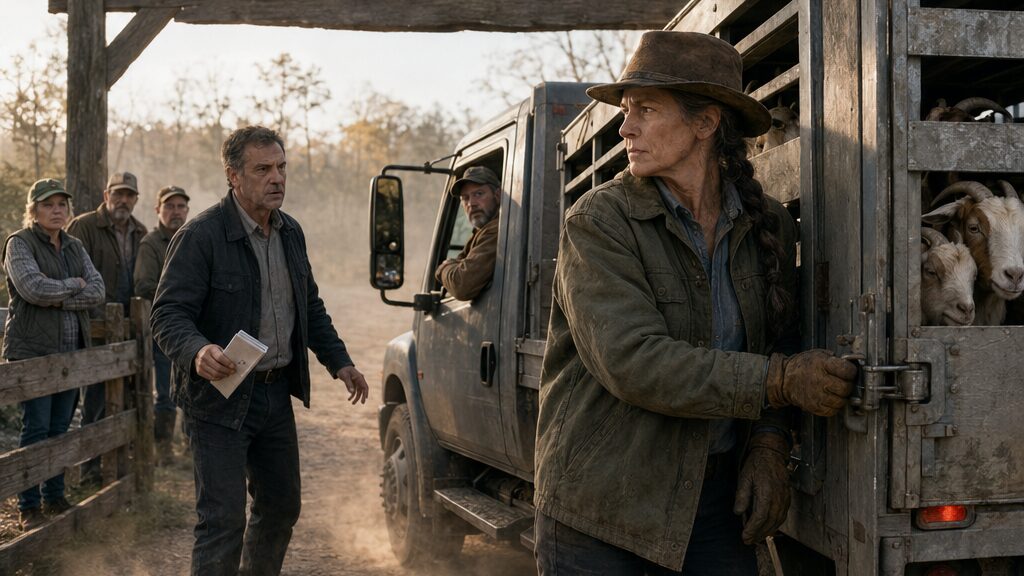
Rachel heard his pickup grinding over the washboard road behind her, but Paul had already eased the livestock truck into gear. Thirty-eight goats shifted inside the slatted bed, hooves knocking against the boards in a rough, uneven rhythm. One of the younger does pushed her nose through the gap and bleated toward the barn.
Rachel kept one hand on the rear latch until the chain drew tight.
“Go slow past the culvert,” she told Paul through the open window.
He leaned across the passenger seat. His face looked pinched from a night without sleep. “You sure about the north road?”
Rachel looked past him at the truck bed. White backs, brown ears, yellow tags. The whole herd pressed together beneath a sky the color of unwashed wool.
“The mountain gate’s open,” she said.
Paul studied her for one second longer than necessary. Then he nodded.
Behind Rachel, Timothy slammed his pickup door.
“What are you doing?”
The truck rolled forward.
Rachel stepped aside as its front bumper passed beneath the wooden sign her father had hung thirty-two years earlier. HILL FAMILY FARM, EST. 1957. The left chain had loosened over winter, and the sign shivered when the truck’s exhaust struck it.
Timothy came down the road at a half run, his work shoes slipping in the mud.
“Paul!” he shouted. “Hold up.”
Paul did not stop.
Two vehicles waited on the shoulder beyond Timothy’s pickup. Debra King stood beside one with her arms folded. Two neighboring farmers remained by the other, pretending not to watch closely. Rachel had seen the rumor arrive before the people did. By seven that morning, half the valley apparently knew the Hill herd was going to auction.
Timothy reached the gate as the rear wheels crossed the cattle guard.
“You told me Friday,” he said, breathless. “You said we’d decide Friday.”
“I said we’d talk Friday.”
“You moved every goat.”
Rachel checked the road beyond the truck. Paul turned left at the mailbox.
North.
A small pressure released behind her ribs. She had not realized how tightly she had been holding herself until then.
Debra called from the shoulder, “Rachel, I’m sorry.”
Rachel looked at her.
Debra’s expression held the careful sympathy people used when they wanted credit for kindness but still hoped for details. “I know what that herd meant to your daddy.”
“They’re not dead,” Rachel said.
Nobody answered.
Timothy followed the truck with his eyes until it disappeared behind the sycamores. “Where is he taking them?”
Rachel closed the gate.
The hinges protested. Mud had risen around the right post, hardening in thick ridges from the last rain. She put her shoulder into it until the latch caught.
“Somewhere they can eat without tearing up more ground.”
“That is not an answer.”
“It’s the one I have.”
Timothy’s face changed—not softer, exactly, but less startled. Anger settled into its usual place.
“You let people think they were headed to auction.”
“I didn’t tell people anything.”
“That has always been your answer.”
Debra glanced toward the neighbors. One of them looked down at his boots.
Rachel wiped her palm on her jacket. She could still feel the latch’s cold metal against her skin.
Timothy lowered his voice. “You moved jointly owned livestock off jointly owned land without telling me where.”
“They needed to go.”
“So did half the herd last year. You wouldn’t hear it then.”
Rachel’s jaw tightened.
From the barn came a silence that felt louder than the truck had. No feed pans scraping. No kids calling through the kidding pens. No old buck hammering his horns against the stall door at the sound of a diesel engine.
Only wind through the empty lot.
Timothy looked toward the barn and then back at her. “Did the buyer take them?”
“No.”
“Did Paul?”
“Paul hauled them.”
“To where?”
Rachel watched the road.
Paul would be past the old church by now. Another twelve miles to the ridge turnoff, then six miles climbing. If the service track had not washed out. If the temporary fencing held. If the spring still ran.
Too many ifs to say aloud.
“The north road,” she said.
Timothy gave a short, humorless laugh. “That could mean three counties.”
“It means they’re together.”
His eyes narrowed. “You promised Dad that.”
Rachel turned toward him.
Timothy knew he had found the exposed place. She saw regret flicker across his face, but he did not take the words back.
Their father had been too weak to lift his own water glass when he made Rachel promise. His voice had barely crossed the room.
Don’t let them scatter.
At the time she had believed he meant the goats.
She had built the next four years around those five words.
Timothy reached into his pickup and removed a manila folder.
“I didn’t come here to watch a truck leave,” he said. “I came because I heard you were moving stock without signing the sale authorization.”
Rachel did not take the folder.
“What authorization?”
“I contacted a buyer.”
“You contacted one.”
“Yes.”
“For the goats?”
“For the farm.”
Debra shifted near the roadside. Rachel saw Timothy notice her and wish, briefly, that they were alone.
He held out the folder again. “This isn’t final. It’s an offer framework. He buys the house, barn, low pasture, upper woodlot, equipment sheds. Everything as one tract.”
“The mountain parcel?”
Timothy paused.
Rachel felt the answer before he gave it.
“It’s listed with the rest.”
“No.”
“You haven’t even read the number.”
“No.”
“The bank won’t care how you feel about the number.”
“The mountain parcel isn’t part of the working farm.”
“It is on the deed.”
“It was Dad’s summer range.”
“It hasn’t been used in years.”
Rachel looked down the road where the truck had gone.
Timothy followed her gaze. “That’s where you sent them.”
She said nothing.
The recognition on his face came slowly, sharpened by betrayal.
“You put them up there without checking with me.”
“I checked what mattered.”
“You checked what you wanted.”
Debra opened her car door quietly. The neighbors did the same. Now that the misunderstanding had become a family quarrel, sympathy had lost its entertainment value.
Timothy stepped closer and pressed the folder against Rachel’s chest until she took it.
“You have kept every bad number in this place to yourself,” he said. “Feed bills. Vet bills. Pasture loss. Now the herd. You don’t get to hide the land too.”
Rachel held the folder by one corner.
The truck was gone. The gate was shut. The farm sign had stopped trembling.
For the first time that morning, she allowed herself the smallest smile.
Paul had taken the north road.
Timothy mistook the smile for defiance.
“Read it,” he said. “The offer covers the entire farm.”
Chapter 2: The Pasture Failed Before Anyone Admitted It
Carolyn Mitchell pulled a strip of grass from the drainage channel and held it up by the roots.
The blades looked green from a distance. In her hand, the lower stems were gray and slick, and the roots had gone black.
“This isn’t frost damage,” she said.
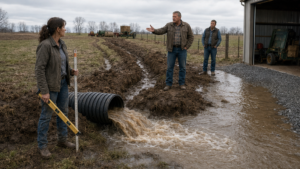
Rachel stood on the bank with Timothy ten feet behind her. Mud had gathered around the old gatepost in hard, hoof-shaped layers, though no goats remained to make fresh ones.
Carolyn dropped the grass into a sample bag. “The runoff sat too long. You lost oxygen in the soil, then the roots rotted.”
“It’ll drain,” Rachel said.
“It did drain. Into Debra King’s lower creek.”
Timothy looked across the fence toward the neighboring property. “Is that why she called the county?”
“She called after she found algae in a stock tank,” Carolyn said. “I would have come anyway.”
Rachel watched her drive a narrow probe into the channel. Carolyn wore clean rubber boots and a county jacket with a faded patch on one shoulder. Her movements were efficient, almost impatient, but not careless.
“How bad?” Timothy asked.
Carolyn pressed the probe deeper. “Bad enough that grazing stays suspended until we have a plan.”
“The goats are gone,” Rachel said.
Carolyn looked up. “Temporarily?”
Rachel did not answer.
Timothy did. “Apparently.”
Carolyn pulled the probe free. Dark water clung to its grooves. “Then moving them was the right immediate decision.”
Rachel felt Timothy glance at her.
It was not approval. It was surprise that anyone had said she was right about anything.
Carolyn walked uphill toward the south pasture. Rachel followed, keeping her boots in the narrow path between hoof-cut channels. Without the goats, the field’s damage was impossible to ignore. Bare slopes shone through the grass. Ruts carried last week’s rain toward the ditch. The lower fence leaned where saturated ground had loosened the posts.
At the edge of the pasture, Carolyn stopped beside a patch of crushed clover.
“How many head were you carrying?”
“Thirty-eight.”
“For how long?”
“Most of the year.”
Carolyn looked toward the barn. “The rotation plan allowed twenty-four on this acreage during wet months.”
“The upper pasture wasn’t usable after the storm took the bridge.”
“So you reduced the herd?”
Rachel said nothing.
Timothy stepped around her. “She didn’t.”
Carolyn’s gaze moved between them. “Did you supplement feed?”
“Yes.”
“How much?”
“Enough.”
“That’s not a number.”
Rachel shoved her hands into her jacket pockets. “The feed supplier kept delivering.”
“On credit,” Timothy said.
Rachel turned. “You don’t know that.”
“I called him this morning.”
The wind lifted Carolyn’s clipboard pages. She caught them with one gloved hand.
Timothy continued, “He said the account is four months behind.”
“Three.”
“He said four.”
“One invoice is disputed.”
Carolyn looked back toward the drainage channel. “Whether it’s three or four doesn’t change what the ground can carry.”
Rachel felt the old reflex rise in her—the need to hold every line, defend every choice, give nobody enough information to take anything from her.
It had kept the farm moving through her father’s illness. It had also left her standing in a dead pasture while two people listed the things she had refused to say.
Carolyn opened her field folder.
“I sent a preliminary warning in November,” she said.
Rachel kept her eyes on the slope.
Timothy asked, “What warning?”
Carolyn withdrew a sheet inside a clear sleeve. The bottom half was stained tan where damp had entered the folder. She held it toward him.
“Recommended immediate herd reduction, temporary exclusion from the lower channel, and an engineering review of the crossing.”
Timothy read the page.
Then he looked at Rachel.
Her signature sat at the bottom in blue ink.
“You got this in November?”
“It wasn’t an order.”
“That wasn’t my question.”
“The ground was still holding then.”
Carolyn shook her head once. “It was already failing. The warning was meant to keep it from reaching this point.”
Rachel looked at the signature. She remembered signing the paper against the hood of Carolyn’s county truck while sleet tapped the metal. She had told herself she would move twelve goats after Christmas.
Then feed prices dropped for two weeks. One doe kidded early. The bridge washed out. Her father’s old truck needed a transmission. Every delay had arrived wearing the shape of necessity.
Timothy folded the page along an existing crease. “Why didn’t you tell me?”
“You weren’t here.”
“I own half.”
“You come twice a month and ask what the place is worth.”
“I ask what it costs.”
Carolyn stepped between their lines of sight without physically moving between them. “The immediate issue is the land. Family accounting can happen somewhere else.”
Timothy gave her the report. “What happens now?”
Carolyn slid it back into the sleeve. “I submit today’s findings. If the county issues an emergency restriction, no livestock returns to the low pasture. That can become longer-term if there’s no restoration plan.”
“And the mountain parcel?” Rachel asked.
Carolyn’s expression changed slightly. “You found access?”
“Maybe.”
“Maybe is not a legal route.”
“The goats are safe.”
“That matters,” Carolyn said. “But safe today isn’t the same as a viable operation.”
The words followed Rachel to the farmhouse.
In the kitchen, the manila folder Timothy had brought lay unopened beside the sink. Carolyn spread maps across the table while Timothy called the bank from the porch. Rachel filled the kettle, though nobody had asked for coffee.
Carolyn tapped the lowland parcel with one finger. “This section needs rest, drainage work, and probably permanent exclusion along the creek.”
“How much land?”
“Enough to reduce the grazing base by nearly half.”
Rachel set down the kettle too hard.
Carolyn did not flinch. “The mountain tract could help, but I need to see the deed, the water source, fencing, access rights, and carrying capacity.”
“It held more animals when Dad used it.”
“How long ago?”
“Twenty years.”
“That is not a current assessment.”
From the porch, Timothy said, “Yes, she’s here.”
Rachel turned.
He stood in the doorway holding out the phone.
“The bank.”
She did not take it.
Timothy put the call on speaker.
A loan officer’s voice filled the kitchen, thin and formal. The farm’s operating note was past due. The equipment loan had entered review. The bank was aware of the county inspection and would not extend additional credit without a viable plan covering land use, herd placement, and debt reduction.
“How long?” Timothy asked.
“Ten calendar days.”
Rachel looked at Carolyn’s map. The lowland farm was outlined in black. The mountain parcel sat above it like an afterthought, separated by a road that did not appear to connect to anything.
The loan officer continued, “If we do not receive a plan, we will proceed with the remedies available under the agreements.”
The call ended.
Nobody spoke for several seconds.
Carolyn rolled up one map and left the other open. “I can meet you at the mountain parcel tomorrow.”
Timothy leaned against the doorframe. “Assuming she tells us where it is.”
Rachel turned off the kettle before it boiled.
The empty barn showed through the kitchen window. Beyond it, the old gate stood in mud, holding back nothing.
Ten days.
That was how long they had to prove the farm could survive without the pasture that had carried it for sixty-eight years.
Chapter 3: The North Road Ended at a Locked Gate
Rachel heard the goats before she could see them.
Their calls drifted down through the trees, scattered and impatient, close enough to raise relief in her chest and far enough to make the chain across the mountain gate feel deliberate.
A new padlock hung from it.
Paul stood beside his truck with both hands in his coat pockets. “Wasn’t there yesterday.”
Rachel pulled the chain once. It rattled against the galvanized gate.
“Who put it on?”
“Could be the timber company. Could be whoever thinks they’re the timber company.” Paul nodded toward a small metal notice wired to the post. “No name.”
The notice said PRIVATE ACCESS in block letters. No company, phone number, or parcel reference appeared beneath it.
Carolyn’s county vehicle stopped behind Rachel’s pickup. Timothy climbed out of the passenger side before Carolyn had shut off the engine.
“You brought them through here?” he asked Paul.
“No.”
Timothy looked at Rachel. “Then how are they up there?”
Paul glanced toward the ridge.
Rachel heard another bleat, then the dull clank of a goat testing wire.
“There’s an old service track on the west side,” Paul said.
Carolyn removed a map tube from the back seat. “The west track crosses two parcels before reaching this one.”
“It crossed gravel and brush,” Paul said. “Nobody stopped me.”
“That doesn’t make it legal.”
“It made it possible.”
Timothy stared uphill. “You drove a loaded livestock truck over an unverified road?”
Paul’s face tightened. “I drove slow.”
Rachel stepped away from the gate. “How far to the enclosure?”
“Half a mile from here. Less from the service track.”
“Then we walk.”
Timothy looked at the chain. “That’s trespassing.”
“It’s our parcel.”
“You don’t know that this gate opens onto our parcel.”
Rachel started along the fence line.
The path climbed sharply beneath spruce and tulip poplar. Damp leaves slid beneath her boots. Carolyn followed with the map tube; Timothy came behind her, muttering once when a branch struck his shoulder. Paul remained last, carrying bolt cutters he had not yet used.
After ten minutes the trees thinned.
The enclosure appeared across the slope in pieces: a low stone wall, weathered posts, white bodies moving through broom sedge. Then the herd lifted its heads.
The goats came toward Rachel in a wave.
For the first time since the truck had left the farm, she breathed without counting what might go wrong.
The oldest doe reached her first and pressed a hard forehead against Rachel’s hip. Two yearlings crowded close, nosing her jacket pockets for grain. Beyond them, the herd spread across the rocky pasture, grazing among blackberry canes and dry grass. Their bellies were not tucked. Their coats were dry. The temporary water trough Paul had set beneath the spring line was full.
“They’re all here,” Rachel said.
Paul gave a tired shrug. “I told you.”
Timothy stood near the wall, taking in the animals. Some of the anger left his posture.
“You weren’t selling them.”
Rachel scratched behind the old doe’s ear. “No.”
“You could have said that.”
“You would have stopped the move.”
“I would have asked whether we had the right to make it.”
“You’d already called a buyer.”
“For land we can prove we own.”
Carolyn walked to the trough, checked the float valve, then studied the slope. “The spring is active. Fencing needs work. Browse is decent, but this won’t carry thirty-eight year-round without rotation.”
“It was seasonal range,” Rachel said.
Carolyn nodded. “That makes more sense.”
The words loosened a memory.
Rachel was nine the first time her father brought her up the ridge. She had complained about the climb until he placed her hand on a rectangular stone set apart from the wall.
This one matters more than the gate, he had said.
At nine, Rachel thought he meant the stone was older.
Now she saw it near the upper corner of the enclosure, half buried in dark soil. Several goats stood around it, rubbing their shoulders against its squared edge.
She walked toward it.
Timothy followed. “You remember this?”
“Yes.”
“I don’t.”
“You were too young.”
“That’s your answer for everything before I left.”
Rachel knelt beside the stone. Moss covered the top, but one face remained unnaturally flat. Her father had cleared it every summer with a wire brush.
Carolyn crouched on the other side. “This doesn’t match the wall stone.”
“It’s a marker.”
“Maybe.”
Rachel brushed away loose earth with her glove. The soil beside the lower corner had been disturbed by hooves. A tan doe lowered its head and sniffed the shallow gap.
Paul came closer. “Your dad used to kneel there.”
Rachel looked up. “You saw him?”
“Couple times. Figured he was checking the spring line.”
Timothy’s attention sharpened. “When?”
“Before he got sick. Maybe ten years ago.”
Carolyn unrolled the county map across the stone. The paper showed the mountain parcel as an uneven shape, bounded east by forest and west by a dashed line that ended before reaching the public road.
Rachel pointed. “The access ran here.”
“The current map doesn’t show it,” Carolyn said.
“It was always there.”
“A road being used isn’t the same as an easement being recorded.”
“My father hauled stock through that gate.”
Carolyn looked downslope toward the locked entrance. “Then we need the deed language or an older survey.”
Timothy tapped the blank space between the road and parcel. “This is what I’ve been trying to tell you. Memory is not paperwork.”
Rachel’s hand remained against the stone.
It was colder than the surrounding earth.
She dug deeper along the bottom edge. Her glove caught on metal.
At first she thought it was wire from the old fence. She cleared another handful of soil and exposed the rounded top of an iron pin, orange with rust but driven vertically into the ground.
Carolyn leaned close. “Don’t move it.”
“What is it?” Timothy asked.
“Possibly a survey monument.”
Rachel sat back on her heels.
The goats pressed around them, unconcerned. One climbed onto the low wall and looked down the slope toward the locked gate.
Carolyn photographed the pin, the stone, and their position relative to the enclosure. Then she folded the map.
“This proves somebody marked something,” she said. “It does not prove what.”
Rachel looked at the flat face of the stone and remembered her father’s hand covering hers.
This one matters more than the gate.
All those years, she had believed he was teaching her where the farm ended.
Now, with the recorded road missing and a stranger’s lock below, she wondered whether he had been trying to show her where something else began.
Chapter 4: Her Father’s Map Was Missing One Line
The county clerk found the mountain deed in twelve minutes.
The road took the rest of the morning and still did not exist.
She laid three documents beneath the fluorescent light: the original transfer to Rachel’s grandfather, a corrected boundary description from 1974, and the deed that had placed both the lowland farm and mountain tract in Rachel and Timothy’s names after their father died.
“There’s your parcel,” the clerk said, tapping the legal description. “Seventy-three acres, more or less.”
Rachel leaned over the counter. “Show me the access.”
The clerk traced the western boundary with a capped pen. “It doesn’t grant one.”
“It has a gate onto the county road.”
“It has a gate near the county road.”
“It has had that gate since before I was born.”
The clerk gave her a patient look. “I can only tell you what was recorded.”
Timothy stood beside Rachel with his arms folded. Carolyn waited near a metal cabinet, holding the photographs she had taken of the stone and rusted pin.
“What about the dashed line on the tax map?” Rachel asked.
“That indicates a possible service route. Tax maps aren’t surveys.”
“My father drove livestock through there.”
The clerk turned to another page. “There’s a reference to an agreement with the former timber owner, but the attachment is missing.”
“Missing from where?”
“The record.”
Timothy let out a slow breath. “So we own land we may not legally reach.”
“You can reach it,” Rachel said. “We did yesterday.”
“By crossing somebody else’s property.”
“Paul crossed an old road.”
“Without permission.”
The clerk slid the documents toward them. “You’ll need a title search or surveyor to determine whether an easement exists outside these records.”
Rachel stared at her father’s signature on the 1974 correction. His handwriting had been broad then, nothing like the cramped marks from his final years.
Beside his name was a rough sketch of the parcel. A small square marked the stone. A line ran from it toward the western edge—and stopped before reaching the road.
One missing inch of pencil had become half a mile of uncertainty.
Carolyn bent over the sketch. “May I?”
Rachel handed it to her.
Carolyn compared the drawing with the photographs. “The stone may be a private survey monument.”
Timothy looked at her. “Meaning?”
“Meaning someone placed it to mark a corner, reference point, or change in boundary. The iron pin supports that. But it doesn’t establish road rights by itself.”
“It establishes Dad knew where the parcel began,” Rachel said.
Carolyn looked directly at her. “That was never the only question.”
They left the courthouse carrying proof that the mountain land belonged to them and no proof that they could keep using the route Paul had taken.
In the parking lot, Timothy stopped beside Carolyn’s county vehicle.
“Assume we find access,” he said. “Can the goats stay?”
“Seasonally, perhaps.”
Rachel heard the qualification. “What would permanent use require?”
Carolyn opened the map tube across the hood. She placed one finger on the mountain parcel and another on the lowland creek.
“A whole-farm conservation agreement. Rotational paddocks above. Protected springhead. A maintained buffer along the lowland channel. No grazing on the damaged section until it recovers, and possibly never on the steepest part.”
Timothy’s face hardened. “What does the agreement do to resale?”
“It restricts future land use.”
“For how long?”
“Depending on the program, ten years or permanently.”
“No.”
Rachel turned to him. “You haven’t seen the terms.”
“I’ve heard enough.”
Carolyn rolled the map halfway closed. “Without restrictions, the county cannot recommend assistance for fencing, water, or restoration.”
“We don’t need assistance,” Rachel said.
Carolyn looked at her boots, her jacket, and the old pickup behind her. Not contemptuously. That made it worse.
“You have ten days because the bank believes you do,” she said.
Timothy walked away.
Rachel followed him to the pickup. “We could restrict only the creek ground.”
“You mean my half.”
“It isn’t divided.”
“That has never stopped you from treating it like yours.”
He opened the passenger door, then paused. “Do you remember Dad’s herd schedule?”
Rachel did not answer.
Timothy’s hand remained on the door. “The one he wrote after the wet summer. Twenty-four through winter. Thirty-two only when the upper pasture and mountain range were both open.”
“He changed it.”
“When?”
“When the bridge washed out.”
“That was after he died.”
Rachel looked toward the courthouse windows.
Timothy stepped closer. “You kept thirty-eight on the low ground.”
“I bought feed.”
“Feed doesn’t keep hooves from tearing a saturated slope.”
The words sounded like Carolyn’s because they were true in the same place.
Back at the farmhouse, Rachel searched the filing cabinet in her father’s room. The top drawer held insurance papers and machinery receipts. The second held veterinary records tied in bundles with baling twine.
She found the herd schedule beneath a stack of old breeding logs.
Her father had drawn twelve boxes, one for each month. Beside them he had written pasture limits, kidding dates, and expected rainfall. In the margin next to November through March, he had underlined twenty-four twice.
At the bottom, in darker ink, he had added:
If south field stays wet, move early or sell down. Don’t ask ground to carry what it can’t.
Rachel sat on the edge of the bed.
She remembered reading the page after his funeral. She had treated it as advice written for weaker years, before improved feed and portable fencing. When Carolyn warned her in November, Rachel had known exactly where the schedule was.
She had not forgotten it.
She had decided she knew better.
A truck door closed outside.
Timothy came into the room holding his phone.
“The buyer can inspect Monday.”
“That’s three days from now.”
“He wants time before the bank deadline.”
Rachel folded the schedule. “You invited him?”
“I scheduled an inspection.”
“Of the lowland farm?”
“Both properties.”
“You can’t promise the mountain tract.”
“I promised nothing. I’m showing him what we own.”
Rachel stood. “Carolyn said the parcel can work.”
“With restrictions that may cut its value for the rest of our lives.”
“It can keep the herd together.”
“And the herd is not the only thing Dad left.”
Timothy’s voice did not rise. That gave the sentence more force.
He looked at the schedule in Rachel’s hand and understood where she had found it.
“You knew,” he said.
Rachel could have told him about the washed-out bridge, the feed deliveries, the winter births, every small event that had allowed one delay to become another. Instead she held the page tighter.
Timothy nodded once.
“Monday at nine,” he said. “The buyer is inspecting everything.”
Chapter 5: The Buyer Came While the Goats Were Gone
The buyer was measuring the barn before Rachel knew he had arrived.
She came around the equipment shed carrying a coil of hose and found him stretching a tape across the foundation while Timothy stood near the open doors. A clean utility vehicle waited beside the empty goat lot.
Rachel dropped the hose.
“What are you doing?”
The buyer let the tape retract. “Looking at the structure.”
“You’re on private property.”
Timothy stepped between them. “I told you he was coming.”
“You said Monday.”
“It is Monday.”
Rachel looked at the kitchen clock through the window and realized she had lost an hour repairing the mountain trough before dawn.
The buyer glanced inside the barn. “Roof needs work. Foundation looks sound.”
“You can stop looking.”
He remained polite. “I’m not here to force anything.”
“No. You’re here to put a price on it while it’s empty.”
Timothy’s mouth tightened. “That is exactly why we moved the herd before inspection.”
“We did not move them for him.”
“I know that now.”
The words carried no forgiveness.
The buyer walked toward the yard, giving them distance without leaving. Rachel watched him examine the farmhouse, the rusted gate hinges, and the drainage slope beyond the fence. He saw acreage. Repairs. Liability. Perhaps potential.
He did not see her father teaching her to trim hooves in the barn aisle or her mother hanging sheets between the maples. That did not make him cruel. It only made him a buyer.
Timothy took a folded packet from his jacket.
“The offer is better than the first estimate.”
“I don’t care.”
“You need to.”
He handed her a page. Rachel saw the total, then looked away before the number could become tempting.
“It clears the operating note,” Timothy said. “Pays the equipment balance. Covers the feed account and taxes. There would be enough left to split.”
“And then?”
“Then neither of us spends another year waiting for the bank to decide what Dad’s land is worth.”
Rachel folded the paper. “The mountain parcel stays out.”
“The buyer won’t take the low farm without it.”
“Why?”
“Because the lowland pasture is restricted and the mountain tract is the only useful grazing ground.”
“So he understands its value.”
“He understands the package.”
Rachel looked toward the gate. The heritage sign hung above an empty road, its letters darkened by age.
“What do you want with the money?” she asked.
Timothy gave a short laugh. “That’s your question?”
“It’s a fair one.”
“My daughter starts college next year.”
“You’ve saved.”
“Yes.”
“How much?”
His face closed.
Rachel recognized the motion because she had used it against him for years.
Timothy walked to his pickup and opened the glove compartment. He returned carrying a thick envelope, its corners softened from handling.
He emptied it onto the hood.
Receipts slid across the metal.
Hospital invoices from their father’s final year. Payments to the feed supplier. A property-tax notice stamped PAID. A bank transfer to cover the tractor note three months after the funeral.
Rachel picked up the oldest receipt.
The amount was almost exactly what Timothy had received when he sold his first house in town.
“You paid this?”
“I paid what was due.”
“Why didn’t you tell me?”
He stared at her.
The irony landed between them with no need for explanation.
“I asked what the farm needed,” he said. “You said nothing.”
Rachel moved through the receipts. Some were eight years old. Others came from months when she remembered believing the operation had finally carried itself.
“Dad said the medical bills were handled.”
“They were.”
“By you.”
“Yes.”
“You should have told me.”
“You would have called it charity.”
“I would not.”
“You wouldn’t even let me replace the barn roof because you said I’d start acting like an owner.”
Rachel remembered saying it. She had been standing on a ladder with rain dripping through a seam above her. Timothy had driven two hours with estimates from a contractor. She had accused him of trying to modernize the place for sale.
He had left before supper.
The buyer approached slowly. “I can come back.”
Timothy gathered the receipts. “We’re already here.”
The buyer opened a survey packet. “My offer depends on both tracts transferring together. The lower acreage alone carries too much restoration cost.”
Rachel looked at him. “What would you do with the mountain land?”
“Seasonal livestock. Possibly lease hunting rights on the wooded section.”
“The spring?”
“Maintain it.”
“The stone enclosure?”
He consulted the map. “I don’t know it.”
Of course he did not.
He had never stood among the goats while the old doe pressed her forehead against his side. He had never watched Rachel’s father brush moss from the rectangular stone as if cleaning a name from a grave.
The buyer turned to Timothy. “If the mountain tract is excluded, I would revise the offer substantially.”
“How substantially?” Timothy asked.
The number he gave would pay the urgent debts but leave little beyond them.
Timothy went still.
Rachel understood then that the sale was not greed, nor even escape. He had built a calculation around his daughter’s future, the money he had already put into the farm, and the fear that one more bad year would erase both.
The understanding did not make the full sale acceptable.
It made refusing it costlier.
Carolyn’s county truck entered the drive.
She stepped out carrying a folder. “I have the preliminary restoration options.”
The buyer introduced himself. Carolyn listened, then opened her papers across the hood beside Timothy’s receipts.
“The damaged low section can be divided,” she said. “Roadside acreage could transfer separately. The creek corridor could enter conservation. The farmhouse and barn could remain outside.”
Timothy scanned the map. “And the mountain tract?”
“It supports a seasonal operation if access is resolved and the covenant covers stocking limits.”
“So every solution ties our hands.”
“Every solution acknowledges the land has limits.”
Rachel looked at the outlined sections. For the first time, the farm did not appear as one indivisible shape. It appeared as pieces with different burdens.
The roadside frontage could be sold.
The creek ground could rest.
The mountain parcel could carry the herd.
The house and barn would remain, though without enough land to justify them forever.
Not salvation. A division.
Timothy pointed at the mountain tract. “Half of that is mine.”
“I know,” Rachel said.
“You did not know last week.”
“I knew on paper.”
“That isn’t the same.”
“No.”
The single word stopped him.
Rachel faced the buyer.
“The mountain parcel is not for sale.”
Timothy turned sharply. “You cannot decide that alone.”
“No,” she said. “But I’m not signing it away before I give you another plan.”
“What plan?”
“I don’t have all of it yet.”
The buyer closed his folder. “Then my offer stands until Friday.”
He left without anger. Gravel cracked beneath his tires, then settled.
Timothy remained beside the hood, looking at the conservation map.
“You just cut the offer by more than half,” he said.
“I heard him.”
“You have four days to show me something better than hope.”
Rachel gathered her father’s herd schedule and the photograph of the boundary stone.
“I’m going back up the mountain.”
Timothy looked at the picture. “For what?”
“To find out what Dad thought mattered more than the gate.”
Chapter 6: Rachel Lifted the Stone and Told the Truth
One of the young does was pawing at the boundary stone when Rachel entered the enclosure.
The goat scraped twice, exposed a strip of dark soil, then hopped aside as if satisfied with the damage.
Rachel stopped.
She had seen that shallow hollow before—not yesterday, but years ago, when her father still climbed the mountain with a walking stick. He would kneel beside the stone and clear soil from its lower face while the herd grazed around him.
Timothy came through the gate behind Carolyn and Paul.
“You said there was proof,” he said.
“I said there might be.”
“That is not why I took off work.”
Rachel crouched beside the stone. The rusted survey pin remained where Carolyn had marked it with orange flagging. On the stone’s eastern side, roots and packed earth concealed a narrow seam.
Paul set down a pry bar. “Your father used to carry one up here.”
“You remember everything except what he was doing?” Timothy asked.
Paul accepted the rebuke. “I thought he was fixing fence.”
Carolyn photographed the stone before Rachel touched it. “We document every position. If this is a survey marker, we reset it exactly.”
The four of them cleared soil by hand. Rachel’s gloves darkened. Timothy worked opposite her, first reluctantly, then with the same stubborn rhythm he had used as a boy digging postholes.
The stone did not move until Paul wedged the bar beneath its lower edge.
“Slow,” Carolyn said.
They lifted together.
The stone tilted only a few inches, but something pale appeared beneath it.
Rachel reached into the hollow and removed a short length of capped plastic pipe, sealed at both ends with weathered tape.
Timothy stared at it. “You knew that was there?”
“No.”
Rachel cut the tape with her pocketknife.
Inside was a rolled sheet of survey paper and a smaller page folded around it. The paper smelled of damp earth despite the seal. Her father’s handwriting crossed the outside.
For Rachel and Timothy.
Timothy looked away toward the herd.
Rachel unfolded the survey first. A numbered line ran from the stone westward to the county road. Beside it was a reference to a recorded access agreement and a book-and-page number absent from the current deed packet.
Carolyn copied the reference.
“This could establish the easement,” she said. “It still needs verification, but this is specific.”
Timothy barely reacted. His attention remained on the folded page in Rachel’s hand.
“Read it,” he said.
Rachel opened it.
Their father had written in short lines, as though he expected the reader to be standing where they stood.
The mountain ground rests the low ground.
The low ground pays for the mountain when it can.
Neither piece carries everything every year.
Keep the spring clean. Keep the herd inside what the land can feed.
If an acre has to go so the rest can live, let it go.
Rachel stopped.
The goats moved through the grass behind her, bells sounding softly from two older collars.
Timothy held out his hand. She gave him the page.
He read the final lines aloud.
“‘Do not keep every board, field, or animal just to prove you stayed. Keep faith with what is living. That is the farm.’”
Nobody spoke.
There was no hidden money. No second deed granting Rachel sole control. No instruction that Timothy surrender his share.
Only limits her father had understood before she did.
Rachel sat back on her heels.
“I read his schedule after the funeral,” she said.
Timothy continued holding the note.
“I knew twenty-four was the winter limit. When Carolyn warned me, I knew she was right.”
Carolyn’s face remained still.
Rachel pressed her dirty glove against her knee. “I told myself the bridge would be repaired. Then I told myself bought feed made up for lost pasture. Then I told myself one more wet month wouldn’t matter.”
“You told me the farm was stable,” Timothy said.
“I lied.”
The word seemed too plain for four years of damage, but anything softer would have been another concealment.
“I thought if I reduced the herd, I was breaking the promise I made Dad. If I moved them, I was admitting I couldn’t keep his farm. So I kept too many goats on ground I knew was failing.”
Timothy looked toward the slope. “And you let me believe the problem was prices.”
“That was part of it.”
“It was the part that wasn’t your fault.”
Rachel nodded.
Paul shifted his weight but did not rescue her from the silence.
Carolyn unfolded the conservation map on the stone’s exposed base. “The mountain parcel can support rotational seasonal grazing. Not the current herd year-round without supplemental feed, but enough to keep it together while the low ground recovers.”
“What does the covenant require?” Timothy asked.
“A protected spring area, capped stocking rates, maintained fencing, and permanent retirement of the worst creek section. Selling the roadside acreage could cover immediate debt and part of the restoration.”
“And if we refuse?”
“The county restriction remains. The bank likely proceeds. The buyer’s full offer may be your only clean exit.”
Timothy looked at Rachel. “Your proposal?”
She had rehearsed numbers on the drive up. Now they felt less important than saying what they cost.
“Sell the roadside frontage and equipment shed. Put the creek corridor into conservation. Keep the farmhouse and barn outside for now. Use the mountain tract for the herd under the covenant.”
“That leaves me with restricted land and less cash.”
“Yes.”
“And you keep farming.”
“Yes.”
“What do I get besides another promise?”
Rachel looked at the herd, then back at him.
“A recorded share of the lease income if we take seasonal boarding. Half the proceeds if the farmhouse sells later. And authority with me over any future land transfer.”
Timothy’s expression did not change.
Rachel continued. “You also get the truth before decisions are made. Not after.”
“That should not sound like an offer.”
“It shouldn’t.”
He folded their father’s note along its old creases.
“My daughter’s tuition doesn’t wait for creek grass to grow.”
“The frontage sale covers the first year if Carolyn’s estimate is close.”
“And after that?”
“I don’t know.”
There it was: the sentence Rachel had spent years refusing to say.
Timothy studied her as if uncertainty sounded stranger from her than any confession.
Carolyn pointed toward the lower portion of the map. “There may be restoration payments, but I won’t promise approval. Rachel would need to demonstrate compliance first.”
“No special treatment,” Rachel said.
Carolyn met her eyes. “There never was.”
They reset the survey paper inside its tube but kept their father’s note. Paul and Timothy lowered the stone while Rachel guided it back against the marked soil. It settled with a heavy, final sound.
The flat face now seemed less like a boundary and more like a burden placed correctly.
Timothy brushed dirt from his palms.
“I’ll review the numbers,” he said.
Rachel nodded.
He started toward the gate, then stopped beneath the temporary wire.
“If we divide the property,” he said, “I want the family sign.”
Rachel felt the request like a hand closing around the old gatepost.
“You don’t live there.”
“That sign isn’t proof you stayed.”
He looked back at the stone.
“It is proof I came from there too.”
Then he walked down the slope, carrying their father’s folded note in his pocket.
Chapter 7: The Sign Faced a Different Road
The workers removed the old gate before Rachel reached the end of the lane.
One post lay across the ditch with its concrete footing still attached. The other leaned from a chain looped to a small excavator. Above the opening, the heritage sign hung from one remaining hook, tilted enough that HILL FAMILY FARM seemed to slide toward the ground.
Rachel parked beside Carolyn’s county truck and got out.
“Stop a minute,” she called.
The operator lowered the bucket.
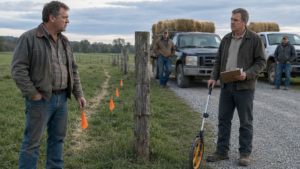
A survey stake marked the new boundary fifty yards beyond the barn. Everything between the county road and that line—the open frontage, equipment shed, and failed strip beside the drainage channel—now belonged to the buyer. The creek corridor behind it had entered the conservation agreement. No livestock would graze there again.
The farmhouse and barn remained with Rachel and Timothy, at least for now.
The arrangement had cleared the operating note and feed account. It had paid the overdue taxes and left enough for Timothy’s daughter’s first year of college, though less than the full sale would have provided. The restoration funds Carolyn helped them apply for were still pending.
The solution had not rescued everything.
It had decided what they were willing to lose.
Carolyn walked over holding a clipboard. “They need the entrance widened for the frontage parcel.”
“I know.”
“You signed the plan.”
“I know that too.”
Rachel looked at the sign.
For three months she had passed beneath it while the house emptied of things no one used. Her father’s room had been boxed. The machinery shed had been cleared. The old kitchen table remained because neither sibling wanted to decide who should take it.
The sign was the last piece still pretending nothing had changed.
A truck approached from the road.
Timothy’s pickup turned into the lane with something long wrapped in moving blankets resting across the bed. His daughter sat in the passenger seat, one hand braced against the dashboard as he crossed the rough shoulder.
Rachel stiffened.
Timothy had asked for the sign as part of his share. Rachel had agreed because refusing would have meant proving she had learned nothing at the stone.
She had expected him to take it quietly.
Instead, he parked beside the fallen gatepost and opened the tailgate.
“What happened to the sign?” Rachel asked.
“Nothing permanent.”
He pulled back the blankets.
The wood had been cleaned but not refinished. The faded lettering remained. A carpenter had replaced the rotted upper edge with a narrow strip of oak and fitted new iron brackets at both ends.
Rachel ran her thumb along one bracket. “You repaired it.”
“It wouldn’t have survived another winter.”
“You said you wanted it.”
“I did.”
Timothy lifted one end. “Help me load it properly.”
“Load it where?”
He looked toward the mountains.
His daughter smiled but said nothing.
Rachel stared at him. “You’re not keeping it?”
“I’m keeping what it says.”
“That sounds like something Dad would say.”
“It isn’t. He would have made it longer.”
The operator unhooked the sign from the last chain. Rachel and Timothy carried it between them to Paul’s flatbed trailer, which had arrived behind Timothy’s pickup. Paul climbed down and secured the brackets with rope.
“You told him?” Rachel asked.
Timothy tightened one knot. “I needed somebody with a trailer.”
Paul looked from one sibling to the other. “I was told not to speak unless the load shifted.”
The old gatepost came free with a crack of soil and stone. Rachel watched the excavator set it beside the ditch.
Carolyn handed her the final covenant packet.
“Once you sign this page, the stocking limits become effective,” she said. “Spring buffer, rotation schedule, annual inspection. The low creek section remains retired regardless of ownership.”
Rachel took the pen.
Three months earlier, those restrictions had sounded like surrender. Now she saw the restored grass beginning at the edge of the channel. Debra had helped seed it after admitting that her calls to neighbors had done more than protect her water. She still complained about Rachel’s fencing, but she had spent two Saturdays repairing it.
Rachel signed.
Carolyn added her own signature. “The mountain access agreement was recorded this morning. The timber company removed its lock.”
“So the road is ours?”
“The easement is. The road still belongs to whoever is willing to maintain it.”
Paul muttered, “That means us.”
The lowland gate disappeared behind them as they drove north.
At the mountain entrance, fresh posts stood on either side of the repaired road. Debra and two neighboring farmers had set them the previous week. The posts were not as thick as the originals, and the new wire shone too brightly, but the gate opened cleanly.
Beyond it, the goats moved across the upper paddock.
Rachel counted them automatically.
Thirty-eight.
The herd had survived the summer without scattering. Seasonal boarding from a nearby farm had brought in enough income to cover part of the winter feed. It would not make the operation comfortable. Nothing in the new plan promised comfort.
Paul backed the trailer between the posts.
Timothy’s daughter climbed onto the flatbed and helped release the ropes. Together, they raised the sign. Rachel steadied the left side while Timothy fastened the right bracket.
For a moment, the old words faced backward, toward the enclosure.
Timothy loosened the bolts.
“No,” he said. “It should face the road.”
Rachel helped him turn it.
HILL FAMILY FARM, EST. 1957 now looked down a different lane.
The letters did not name the lowland acreage. They did not name the farmhouse, barn, creek, or mountain parcel. Rachel had always known that and had behaved as if the opposite were true.
Timothy stepped back.
“There,” he said.
Rachel looked through the gate toward the rectangular stone inside the enclosure. It had been reset at the surveyed corner, its flat face cleared of moss. The weatherproof tube remained beneath it, holding the survey copy. Their father’s note was no longer there.
Timothy had made copies. He kept the original.
Rachel had not asked for it back.
“What about the house?” he said.
The question had waited beneath every practical victory.
The farmhouse stood outside the covenant and outside the frontage sale. Its roof still needed work. Without the lower fields, it was larger than Rachel needed and more expensive than either sibling wanted to admit.
“We decide next year,” she said.
“That is what we said last month.”
“I know.”
He looked at her, testing whether delay had returned under a different name.
Rachel continued, “We get an appraisal before winter. We look at renting it, selling it, or keeping only the barn access. Together.”
Timothy nodded once.
Not forgiveness. Not yet.
But agreement.
A goat pushed against the mountain gate from inside. Another crowded beside it, then a third. Rachel opened the latch before they could bend the new wire.
The herd moved through in a narrow stream, hooves striking the road and turning uphill toward the fresh paddock. Paul stepped aside. Carolyn watched the spacing, already judging whether Rachel was following the rotation plan.
The oldest doe paused beside Rachel.
Rachel placed a hand against its forehead, feeling the familiar pressure.
Then she walked to the boundary stone.
Soil had collected along one edge after the last rain. She knelt and cleared it away, not because she feared losing the line, but because markers needed tending if they were to remain useful.
Timothy came to stand behind her.
“You set it crooked,” he said.
Rachel looked along the stone’s top.
“Half an inch.”
“Dad would notice.”
“He would tell us after we’d put the tools away.”
Timothy crouched and took the opposite side.
Together they shifted the stone until it sat square with the survey pin. No hidden paper waited beneath it. No inheritance appeared that could spare them the work ahead.
When they stood, the old sign was visible through the open gate.
Rachel looked from it to the herd climbing the slope. Thirty-eight white and brown shapes spread across ground that could carry them because other ground had been allowed to rest.
She had not kept every acre.
She had not kept every promise in the form she first understood it.
But nothing living had been scattered to prove she could stay.
Rachel returned to the gate and opened it wide enough for the last goat to pass.
The herd moved uphill beneath the sign, and this time she followed.
The story has ended.