They Laughed When Rachel Freed the Hens, Until Her Empty Market Jar Changed Everything
Chapter 1: The Barn Laughed Before Rachel Finished Speaking
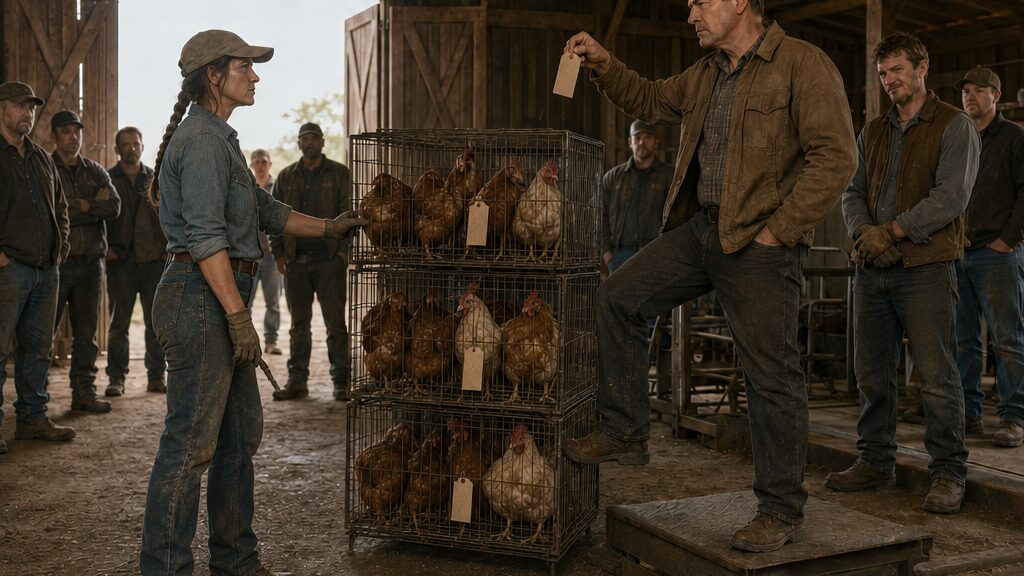
Thomas Wilson would not let the first cage touch the scale.
He planted one boot against its metal base and raised a hand toward Jacob before Jacob could roll the platform beneath it. The hens shifted inside the stacked wire cages, claws scraping over bent mesh, wings striking one another in the confined space.
“Don’t bother,” Thomas said.
The Saturday intake line had already backed up behind Rachel’s truck. Farmers stood beside trailers and pickup beds, waiting to unload calves, goats, and poultry beneath the low rafters of Wilson Livestock Barn. Several turned at the sound of Thomas’s voice.
Rachel kept both hands on the cage cart.
“You haven’t looked at them,” she said.
“I’ve looked.”
He had not. He had glanced at the top cage while speaking to a cattle buyer and then turned away.
Rachel’s birds were not uniform. She knew that before she drove them there. Some were heavier than others, and two had pale combs after a difficult winter. But they were healthy, clean-legged, and well-fed. She had records folded inside her coat pocket, along with feed receipts and the figures she had worked out three nights in a row at her kitchen table.
“I’m not asking you to buy the whole flock,” she said. “I’m asking whether I can use the barn’s cold room and sell prepared orders through the Saturday pickup.”
Thomas looked at her then.
For half a second, his expression held no humor. Only calculation.
Then one of the barn hands gave a low whistle.
“Prepared how?” Thomas asked.
“Cooked.”
The whistle turned into a laugh. Another man joined it. Jacob looked down, but the corner of his mouth moved before he caught it.
Thomas leaned his forearms on the top cage. The hens recoiled from the shadow of him.
“Rachel, these are yard hens.”
“They’re pasture-raised.”
“They’re not inventory.”
A buyer nearby laughed into his coffee. Someone behind Rachel said, “Maybe she’s opening a restaurant.”
Heat climbed from the collar of Rachel’s coat to her face.
She had rehearsed this conversation without an audience. In every version, Thomas asked about quantities, dates, liability, storage fees. She answered calmly. He frowned but listened. Perhaps he said no. Perhaps he offered one trial Saturday.
She had not prepared for laughter.
“I have twenty-six birds ready now,” she said. “Another forty within six weeks. I can take pre-orders. I would pay for the cold-room time.”
Thomas shook his head slowly, performing patience for everyone watching.
“You have mixed weights, no processing agreement I’ve seen, no licensed kitchen, and no established customer list. You’re asking me to put the Wilson name beside a plan you made at your table.”
“I asked for terms.”
“You asked me to carry the risk.”
The laughter had thinned, but the silence that replaced it felt worse. Rachel saw two men watching her with the blank interest people gave a truck stuck in mud.
She reached for the paperwork in her pocket.
Thomas lifted his voice before she could pull it free.
“Anybody buying birds today needs to understand these haven’t been accepted through this barn.”
The words traveled easily beneath the rafters.
Rachel stared at him. “I didn’t ask you to announce that.”
“I’m preventing confusion.”
A trailer rattled into the receiving bay. Four crates of poultry came off it, birds pressed breast to back, several with missing feathers around their tails. Jacob wheeled them toward the scale.
Thomas stepped aside to let them pass.
Rachel looked from the ragged birds to him.
“You’ll weigh those.”
“They’re from an approved supplier.”
“One of them can barely stand.”
“The supplier meets volume and documentation requirements.”
“So this isn’t about the birds.”
Thomas’s jaw tightened. “It’s about whether a business is a business.”
That landed harder than the laughter.
Rachel felt the folded notice inside her coat pocket as if the paper had grown hot. The bank had given her until the next loan review to demonstrate additional farm income. She had told no one. Not the feed-store clerk who had extended her account by ten days. Not the neighbor who had noticed she was repairing fence with salvaged wire. Certainly not Thomas.
Her father had brought birds through this barn for twenty-three years. Thomas’s father had taken his calls after supper and carried balances through dry months. By the end, none of that had saved the farm from shrinking acre by acre.
Rachel had promised herself she would never stand at another man’s desk waiting to be granted enough room to survive.
Yet here she was.
A hen thrust her head through the wire and gave a harsh, indignant cry. Rachel bent to secure the lower cage door. The latch had jammed during loading, and she had tied it with baling wire for the drive.
Behind her, one of the barn hands said, “Careful. Your restaurant’s escaping.”
The men laughed again.
Rachel worked the wire loose without looking up. Her fingers trembled once. She closed them around the metal until the tremor stopped.
Thomas had clipped three yellow intake tags to the cages when she arrived, before asking what she wanted. She removed the first tag. Then the second. The third tore at the corner, so she pulled until the paper ripped through the hole.
Thomas straightened. “What are you doing?”
“Keeping you from carrying the risk.”
She placed the torn tags on the scale.
Jacob’s eyes met hers. He looked as if he wanted to say something, but Thomas was beside him, and the other workers were listening.
Rachel gripped the cart handle and pulled.
The wheels resisted at the lip of the scale platform. The cages shuddered. Feathers drifted through the bars. For one humiliating second, the loaded cart would not move, and the strain showed in her shoulders.
Then Jacob nudged the platform with his boot.
The wheel dropped free.
Rachel did not thank him.
She dragged the cages down the center aisle while conversations resumed behind her in lowered voices. The doors stood open at the far end of the barn, framing a strip of white winter daylight. Each wheel strike against the uneven boards sounded louder than the laughter had.
Outside, she loaded the cages alone.
The lower latch cut her thumb when she tightened the wire. A bead of blood surfaced. She wiped it on the inside of her coat where no one would see.
Thomas came as far as the doorway.
“You’ll lose money trying to prove a point,” he called.
Rachel secured the last strap across the cages.
“Then it’ll be my money.”
His face changed slightly. Not softened. Closed.
“You put unsafe food in front of people, it won’t stay your problem.”
Rachel climbed into the truck without answering.
The hens settled once the engine started. In the rearview mirror, Wilson Livestock Barn shrank behind a blur of dust and bare trees. Thomas remained in the doorway until she turned onto the county road.
At the intersection four miles later, the left turn led home.
Rachel slowed.
The foreclosure warning lay against her ribs. Thomas’s words moved through her mind with the rhythm of the cage wheels: no licensed kitchen, no customer list, not a business.
She switched on her right signal.
Instead of taking the road back to the farm, Rachel drove toward the county market office.
Chapter 2: The Open Cage Was Easier Than Asking
The last hen refused to leave.
Rachel crouched in the damp grass beside the open cage while the rest of the flock spread through the repaired pasture run, scratching beneath dead leaves and testing the new wire with quick, suspicious pecks. The reluctant bird remained in the darkest corner, body pressed low, staring at daylight through the open door.
“You wanted out yesterday,” Rachel muttered.
The hen did not move.
Rachel reached inside. The bird flapped hard enough to strike her wrist, then wedged itself behind the feeder cup. Rachel withdrew her hand and sat back on her heels.
The lower cage latch hung open beside her. Two days earlier she had fought it in front of Thomas and half the county’s buyers. Now, with no one watching, it moved easily.
She scattered a line of cracked corn from the cage threshold into the grass.
The hen stretched its neck. One step. Then another. It hopped down, shook its feathers, and hurried after the others as though it had never been afraid.
Rachel closed the empty cage door but did not fasten it.
The farm looked larger with the chickens moving freely across it and poorer everywhere else. A section of barn roof had lost three shingles. The back field remained unplanted because seed cost more than the return she could expect. Along the driveway, fence posts leaned at different angles, each repair postponed in favor of feed or fuel.
Inside the house, an envelope waited beneath the sugar jar.
She had moved it there from the table, then from the counter, as though changing its location could alter its contents. The bank had not used the word foreclosure. It had used phrases like delinquency review, revised collateral position, and required evidence of supplemental revenue.
The final paragraph gave her twenty-eight days.
Rachel slid the notice into a kitchen drawer and shut it beneath dish towels.
At the county market office that afternoon, a coordinator with silver-framed glasses handed her a six-page application.
“Poultry meat or live birds?” the coordinator asked.
“Prepared food.”
The pen paused above the form. “Prepared where?”
“My kitchen.”
“Is it inspected?”
“It’s a kitchen.”
The coordinator looked up.
Rachel heard the defensiveness in her own voice and disliked it. “It’s clean.”
“I’m not questioning whether you clean it.”
“I have a separate sink.”
“That isn’t the same thing.”
The office occupied two rooms behind the county extension building. Through the open door, Rachel could see a bulletin board covered in notices for hay auctions, equipment repair, and seasonal farm labor. A bright green poster announced the spring market opening in three weeks.
Three weeks was sooner than the bank review.
Rachel straightened the application. “What do I need?”
The coordinator pulled a printed checklist from a drawer.
“For cooked poultry, you’ll need proof of processing through an approved facility or exemption documentation, cold-chain records, liability insurance, and access to an inspected commercial kitchen. You’ll also need a temporary-food permit until the seasonal vendor review is complete.”
“I’m selling fried chicken, not opening a factory.”
“You’re selling a time-and-temperature-controlled food to the public.”
“My grandmother sold plates at church every summer.”
“Church suppers fall under different rules, depending on frequency and sponsorship.”
Rachel looked at the checklist. Every line seemed to require another office, another fee, another person’s permission.
“What about the cottage-food law?”
“Doesn’t cover meat.”
The answer was quick, practiced, and final.
Rachel thought of Thomas leaning against her cage. No licensed kitchen.
She hated that he had been right about anything.
The coordinator turned the application around and pointed to the first section. “You can submit this provisionally. That reserves review order, not a booth.”
“How many applications are ahead of mine?”
“For prepared foods? Four.”
“How many spaces?”
“Two, possibly three.”
Rachel began filling in her address.
When she reached the line asking for average monthly farm revenue, she stopped. The honest figure made the idea look small. The figure she needed would be a lie.
She wrote the honest one.
The coordinator checked the first page and stamped the top corner PROVISIONAL.
The sound of the stamp gave Rachel a brief, unreasonable lift.
“There,” the coordinator said. “You’re in the process.”
Rachel held the paper by its edges. It was not approval. It did not give her a kitchen, insurance, or customers. Still, it was the first thing anyone had accepted from her since she had rolled the cages into Wilson’s barn.
“Do you keep a list of inspected kitchens?”
“Two churches rent theirs. The high school stopped. There’s a cooperative kitchen beside the old fairgrounds, but its schedule is full.”
“Who runs it?”
“A five-member agricultural board.”
Rachel waited.
The coordinator glanced at her application again, perhaps recognizing the last name.
“Thomas Wilson sits on it.”
The lift vanished.
Rachel folded the checklist once, then forced herself to unfold it. “Are there any others?”
“Not within thirty miles at a rate a first-season vendor usually wants to pay.”
Outside, she sat in the truck with the provisional application on the steering wheel.
She could call Thomas. She could tell him she understood the requirements now and ask what it would take to qualify. The sensible version of Rachel did exactly that.
The real Rachel started the engine.
She spent the next two days making lists. Equipment she owned. Equipment she could borrow. Ingredients by batch. Fuel cost. Oil cost. Packaging cost. She called the county health office and wrote down the inspector’s available dates. She called an insurance agent and nearly hung up when she heard the premium.
She did not call Thomas.
On Thursday evening, she placed an empty glass jar on the kitchen table and dropped in the twelve dollars she had made selling eggs at the feed store. The bills looked lonely against the wide bottom.
She pictured the jar full at a market stall.
Then she calculated how many meals she would need to sell merely to cover the permit, insurance, kitchen rental, packaging, and feed already consumed by the birds.
She turned the jar around so she would not have to see the money.
Her phone rang as she was carrying a sack of flour from the pantry.
The number was local but unfamiliar. Rachel let it ring twice before answering.
“This Rachel Carter?”
“Yes.”
“My name is Sharon Mitchell. I heard you’re trying to sell fried chicken at the spring market.”
Rachel set the flour on the counter. “Who told you?”
“The coordinator said there might be a new vendor. She didn’t give me anything private.”
“What do you need?”
“I help arrange the church fundraiser meals. We buy from local cooks when we can.”
Rachel looked at the empty jar.
“How many plates?”
“That depends.”
“On what?”
“Whether your food’s any good and whether your process is safe.”
Rachel’s grip tightened around the phone. “I know how to cook chicken.”
“I didn’t say you didn’t.”
The woman’s tone was not warm, but it was not mocking either.
“I can come by Tuesday,” Sharon said. “You show me how you plan to move from raw bird to finished plate. If it works, I may place an order.”
Rachel stared at the provisional stamp on her application.
“And if it doesn’t work?”
“I’ll tell you that too.”
The line went quiet.
Rachel almost refused. She had not asked for an inspection from a stranger. She did not need another person standing in her kitchen, naming everything she lacked.
Outside, a hen struck the wire run with a burst of wings. Rachel glanced through the window toward the open, empty cage.
“Tuesday,” she said.
Chapter 3: The First Batch Failed Before Anyone Tasted It
Sharon caught Rachel’s wrist before the fork reached the tasting plate.
“Stop.”
The word cracked through the church annex kitchen.
Rachel froze with a browned piece of chicken suspended over a white paper plate. Oil ticked in the skillet behind her. Steam fogged the lower edge of the window above the sink.
Sharon released her wrist but did not step back.
“What?”
“You touched the refrigerator handle with that glove.”
Rachel looked at her right hand. The disposable glove shone with oil where she had turned the chicken.
“I was getting the buttermilk.”
“After handling raw pieces.”
“I changed gloves.”
“Before or after you opened the refrigerator?”
Rachel tried to remember. The question irritated her partly because she could not answer it.
“I wiped the handle.”
“With the towel beside the cutting board?”
Rachel glanced toward the folded towel.
Sharon closed her eyes briefly.
She was in her late sixties, broad-shouldered, gray hair pinned at the nape of her neck. She wore no official badge, only a plain navy cardigan and shoes with thick rubber soles. On the counter sat a small notebook in which she had written almost nothing.
Rachel set the chicken back onto the rack.
“You said you wanted to taste it.”
“I do.”
“Then taste it.”
“Not from this batch.”
The words struck harder because Sharon said them quietly.
Rachel turned off the burner. “There’s nothing wrong with it.”
“I didn’t say the recipe was wrong.”
“You haven’t tasted the recipe.”
“I watched you rinse raw chicken in a sink beside clean trays. I watched you use one towel for your hands and the counter. Your thermometer was in the drawer until I asked for it. And you carried the cooler in through the same door you plan to use for customers.”
“This isn’t a restaurant.”
“No. At a restaurant, somebody would have stopped you sooner.”
Rachel pulled off the gloves and dropped them beside the sink.
The church had allowed her two hours in the annex as a favor to Sharon, provided no food was served publicly. Rachel had arrived early, scrubbed every surface, labeled containers, and arranged ingredients in neat rows. She had expected questions about seasoning and portion size.
She had not expected Sharon to watch where her elbows went.
“My family has cooked poultry for generations,” Rachel said.
“So have families who made people sick.”
“That’s not what happened here.”
“Nothing happened because nobody ate it.”
Rachel faced her. “Thomas sent you?”
Sharon’s expression changed.
Not guilt. Offense.
“Thomas Wilson doesn’t send me anywhere.”
“He sits on the cooperative board. You show up right after I apply, and now every move I make is wrong.”
“I called because the church needs two hundred meals next month and I prefer paying someone local.”
“Then why does this feel like another rejection?”
Sharon’s gaze shifted to the paper plate and the untouched piece of chicken.
“Because you came here expecting either praise or insult,” she said. “You left no room for information.”
Rachel’s face went hot.
The empty glass jar sat at the far end of the counter beside a stack of unused serving trays. She had brought it to estimate how much change she would need for a market morning. Now it looked foolish, a container prepared for money before she had learned to move safely across a kitchen.
Sharon opened a cabinet and took out a clean metal pan.
“Throw out the first batch.”
“No.”
“Then take it home for yourself. But it isn’t what I’m evaluating.”
Rachel almost packed everything and left. She could feel the decision gathering in her shoulders, the same motion she had made before pulling the cages from Thomas’s barn.
Leaving had felt like strength then.
Here it would be easier than staying.
Sharon set the pan on the preparation table. “Wash your hands. We start with zones.”
“We?”
“If you still want the order.”
Rachel looked at her.
Sharon removed her cardigan, folded it over a chair, and washed her hands to the elbows.
For the next hour, she made Rachel slow down.
Raw product stayed on one side of the kitchen. Clean trays stayed on the other. Towels were replaced with sanitizer buckets and paper rolls. The thermometer remained on the counter. Sharon asked Rachel to say each temperature aloud and write it down.
Rachel resented every correction until she began noticing how often she reached for the wrong thing by habit.
At one point she carried a bowl toward the clean table, stopped herself, and turned back.
Sharon nodded once. It was the closest she came to encouragement.
The second batch emerged darker and more even than the first. Rachel rested it on a clean rack while Sharon checked the temperature of the thickest piece.
“Safe,” Sharon said.
Rachel waited.
Sharon took a bite.
The crisp coating broke audibly. She chewed without expression, then took another bite from nearer the bone.
“Well?”
“You use paprika.”
“And black pepper.”
“More than most people around here.”
“My grandmother did.”
“Keep it.”
Rachel had expected relief to feel larger. Instead, it came as a loosening in her chest.
Sharon took a third bite.
“The recipe is good,” she said. “Better than the fundraiser supplier we used last year.”
Rachel glanced toward the discarded first batch cooling near the sink.
“But?”
“But a good recipe doesn’t clean a refrigerator handle.”
The relief remained, though it no longer felt like victory.
Sharon opened her notebook and wrote several lines. “You need an inspected kitchen. Not borrowed church access whenever someone feels generous. Reliable hours, storage rules, cleaning logs.”
“The cooperative is full.”
“Did you apply?”
“I know who sits on the board.”
“That wasn’t my question.”
Rachel did not answer.
Sharon tore a page from the notebook. On it she had listed three dates, an estimated kitchen rental rate, and the name of the county health inspector.
“The church has one temporary slot before the fundraiser,” she said. “You can use it for a supervised sample run after you file your permit. That might help your application.”
“Why would you do that?”
“I haven’t done anything yet.”
“You just spent an hour showing me how not to poison people.”
Sharon’s mouth tightened, almost a smile.
“I managed school cafeterias for thirty-one years. I have stopped more dangerous things than your kitchen towel.”
Rachel folded the page.
“What happens after the sample run?”
“If you pass, I’ll consider fifty meals. Not two hundred.”
“Fifty won’t cover much.”
“It will cover more than pride.”
The sentence stayed with Rachel after Sharon left.
She cleaned the kitchen alone. She washed the glass jar and set it upside down to dry. The first batch went into a container for her own supper, but she could no longer look at it without seeing the refrigerator handle.
At home that evening, Rachel filed the temporary-food permit online. She uploaded her provisional market application, insurance quote, and Sharon’s sample-run letter.
The final required field asked for commercial kitchen authorization.
Rachel opened the cooperative website.
A calendar showed every rentable block filled through the spring market’s first month. Beneath it was a link marked WAITING LIST AND APPROVAL.
She clicked.
Five board members appeared at the top of the form.
The first four names meant little to her.
The fifth was Thomas Wilson.
Below the names, in smaller print, the form stated that scheduling priority could be adjusted by board review for operational risk, supplier history, and community agricultural value.
Rachel read the sentence twice.
Thomas had not merely warned her about a problem.
He had a hand on the only affordable door through it.
Chapter 4: Thomas Had a Reason, But Not an Excuse
“Your father said the same thing.”
Thomas spoke before Rachel had fully entered the cooperative kitchen office.
She stopped with one hand on the door. The room was narrow and overbright, with a filing cabinet pressed against one wall and laminated sanitation charts taped beside a calendar crowded with colored blocks. Thomas sat at the desk as though he had expected her. An application bearing her name lay open beneath his hand.
“I didn’t mention my father,” Rachel said.
“You didn’t have to.”
He pointed to the chair opposite him. Rachel remained standing.
The kitchen hummed beyond the office wall. Metal pans struck a counter. A ventilation fan rose and fell with a tired rattle. Someone was using the space Rachel had been told was full.
“I completed the food-safety course,” she said. “The inspector approved the church sample run. My insurance binder is attached.”
“I saw.”
“And Sharon Mitchell submitted the meal order.”
“I saw that too.”
“Then I qualify.”
Thomas folded his hands over the application.
“You meet minimum requirements to join the waiting list.”
“The coordinator said priority could be adjusted.”
“It can.”
“For operational risk, supplier history, and community value.”
“You memorized the language.”
“I had reason to.”
Thomas leaned back. “Your requested hours overlap with established vendors.”
“I asked for one evening and one early morning.”
“You asked for the only open production window before the market.”
Rachel placed both palms on the desk. “So there is an open window.”
“There was.”
The answer arrived too smoothly.
“Who has it now?”
“A regional poultry supplier.”
“The one whose birds you weighed after refusing mine?”
“They have a record.”
“They have volume.”
“That too.”
Rachel looked through the office window into the kitchen. Stainless-steel tables stood beneath bright fixtures. A woman in an apron lifted trays from a rolling rack while another worker checked labels. The orderliness of it made Rachel feel the limits of her own farmhouse kitchen more sharply than Sharon’s criticism had.
Thomas closed the application.
“You think this is personal,” he said.
“You made it personal in the barn.”
“I told people your flock had not been accepted.”
“You told them it was unsuitable before weighing one bird.”
“I knew what I was looking at.”
“You knew who you were looking at.”
A muscle moved beside his mouth.
Thomas unlocked the bottom desk drawer and removed a rubber-banded stack of yellow paper tags. The edges had softened with age. He placed them between them.
Rachel recognized her father’s handwriting before she read the surname.
CARTER appeared in blue ink across the uppermost tag. Beneath it were weights, dates, and lot numbers from nearly fifteen years earlier.
“Why do you have those?”
“Because your father left them here.”
“He kept every scrap of paper that mattered.”
“Not these.”
Thomas loosened the rubber band. Several tags carried red marks through the totals.
“Your father was offered a place in the first cooperative processing group,” he said. “Shared cold storage, inspected preparation space, bulk insurance. He called it a scheme to make small farmers pay for other people’s mistakes.”
Rachel remembered the way her father had spoken of committees. Too many hands on one gate, he used to say, and nobody knew who let the cattle out.
“He didn’t trust your father,” she said.
“He didn’t trust anyone.”
The words sounded too familiar in Thomas’s mouth.
“He thought he could handle direct orders himself,” Thomas continued. “Then he missed delivery dates, lost two restaurant accounts, and came back here wanting the same prices he’d had before.”
“You turned him away.”
“My father carried him for three seasons.”
“And the fourth?”
“The barn was already borrowing to cover unpaid lots.”
Rachel picked up one of the tags. Her father’s writing pressed hard enough to emboss the paper.
Thomas watched her.
“You aren’t the first Carter to decide rules are an insult,” he said.
Rachel set the tag down carefully. “And you aren’t your father.”
“No.”
Something in his voice made her look at him.
Thomas opened another drawer and removed a thick folder. He did not hand it over. He only laid it near the edge of the desk, where she could see the faded label: LIABILITY CLAIM.
“Eight years ago, we let a vendor use barn cold storage for prepared meat,” he said. “He assured us he knew what he was doing. No inspected kitchen. No complete logs. He served at a benefit sale under our name.”
Rachel said nothing.
“Twenty-three people got sick. Four were hospitalized. The vendor had no insurance worth collecting. The barn paid settlements, legal fees, disposal costs. We nearly lost the auction license.”
“That wasn’t me.”
“No. But every person who says that expects me to forget the last one.”
For the first time, Rachel heard fear beneath his certainty. Not fear of embarrassment. Fear of collapse.
It did not erase the barn. It did not erase his voice carrying over the buyers or the laughter he had allowed to gather around her.
But it changed the shape of the room.
“You could have told me this without making me a joke,” she said.
Thomas looked toward the kitchen window.
“Yes.”
The admission was so quiet she nearly missed it.
Rachel waited for more. It did not come.
He gathered the old tags, but one slipped loose and fell near her boot. She picked it up. The date was from the final year her father had sold through Wilson’s barn. A handwritten note crossed the bottom: DECLINED SHARED KITCHEN TERMS.
Rachel held it a moment longer than necessary.
“I completed every requirement you listed,” she said. “Whatever my father refused, I didn’t.”
Thomas returned the folder to the drawer.
“The board approved the regional supplier.”
“When?”
“This morning.”
“My inspection certificate was submitted yesterday.”
“Their application was more stable.”
“Was the waiting list reviewed?”
“It was considered.”
“That isn’t what I asked.”
Thomas stood.
The meeting was over because he had decided it was.
Rachel slipped the old tag onto the desk. “Your reason is real.”
His eyes narrowed slightly.
“It still isn’t an excuse.”
She left before he could answer.
In the hallway, a typed schedule had been pinned beside the kitchen door. The regional supplier’s name occupied the Friday evening block and the Saturday dawn block—the exact times Rachel had requested.
Below the schedule was a handwritten note directing all waiting-list questions to the board chair.
Thomas Wilson.
Rachel photographed it and walked out.
She had reached her truck when her phone vibrated.
The message came from Jacob Adams.
I should have sent this sooner.
A photograph followed. It showed two versions of the cooperative waiting list laid side by side on a barn desk. Rachel’s name appeared third on the older sheet.
On the newer one, she had been moved to seventh.
Chapter 5: A Full Jar Could Still Mean Failure
The fryer went dead ninety minutes before the market opened.
One moment the oil hissed beneath the wire baskets. The next, the heating light vanished and the kitchen fell into a silence Rachel could hear over the ventilation fan.
She checked the plug.
“Don’t touch the panel,” Sharon said.
“I know what a breaker is.”
“And I know what panic looks like.”
Rachel ignored her and crouched beside the fryer. The temporary kitchen they had secured belonged to a church two counties over, available only because Sharon had traded volunteer hours and the health inspector had approved the equipment for a single supervised production run.
On the table behind them sat coolers of prepared poultry, labeled containers of seasoned flour, sanitizing solution, temperature logs, and empty trays intended for a market stall that opened at eight.
Rachel pressed the reset switch.
Nothing.
The wall clock read 6:31.
“We can use the ovens,” Sharon said.
“That changes the product.”
“It changes breakfast less than canceling does.”
Rachel stood. “People ordered fried chicken.”
“People ordered food you can legally and safely hand them.”
The words brought her back to the first batch in the church annex, the refrigerator handle, the paper plate Sharon had stopped before tasting.
Rachel looked at the raw portions waiting in shallow pans. She had enough for eighty-four meals. Fifty were pre-orders. If she canceled, she would lose the kitchen fee, market fee, packaging cost, and part of the insurance payment.
She opened the oven doors.
“Heat every rack,” she said.
They worked without discussing what the result would be. Rachel adjusted the breading for oven heat, sprayed the racks lightly with oil, and rearranged the portions to keep air between them. Sharon logged batch times and internal temperatures. The first trays emerged crisp at the edges but paler than Rachel wanted.
She tasted one.
“Not the same,” she said.
“No,” Sharon answered. “Still good.”
Rachel packed it.
At 7:42, they loaded the last insulated carrier into her truck.
The market occupied the courthouse square, where white tents formed two rows around a strip of grass. Vendors were already arranging bread, jam, early greens, and cut flowers when Rachel backed into her assigned space.
Her stall consisted of one folding table, two insulated serving boxes, a handwritten menu, and the glass jar from her kitchen.
She had filled the jar with small bills for change before leaving home. Pre-order deposits rested inside it too, folded beneath the ones and fives. From a distance, it looked like evidence of success.
Up close, Rachel knew nearly every dollar already belonged to fuel, insurance, rent, permits, packaging, feed, or the church.
The first customer arrived before she had secured the tablecloth.
“Are you Rachel?”
“Yes.”
“I ordered four.”
Rachel found the name on her list, checked the temperature in the first carrier, and packed four meals. The customer placed the remaining balance into the jar.
The sound of the bills against glass was softer than Rachel had imagined.
Then two more customers came.
By 8:10, a line had formed.
Rachel worked the serving tongs while Sharon handled the receipts. People asked whether the birds came from Rachel’s farm, whether the coating was spicy, whether she would return the following Saturday. One man complained that his order was baked rather than fried until he tasted a piece and bought an extra plate.
The line extended past the neighboring bread stall.
Rachel opened the second carrier and felt her stomach tighten. At the current rate, they would run out before filling every walk-up request.
“Limit two per person,” Sharon said.
“We need sales.”
“We need to honor pre-orders.”
Rachel looked at the line. The sight should have felt like vindication. Instead, she saw quantities—remaining portions, reserved meals, packaging, minutes of safe holding time.
She announced the limit.
A few people grumbled. Most stayed.
At 9:03, Sharon stepped to the front of the table.
“I’d like one,” she said.
“You’ve been eating pieces since dawn.”
“That was quality control.”
Rachel reached for a container.
Sharon placed exact payment beside the glass jar, then waited while Rachel wrote a receipt.
“Documented,” Sharon said.
Rachel handed her the meal.
Sharon dropped the money into the jar.
For a moment the market noise faded beneath the clear note of glass and folded paper. Rachel saw the empty jar upside down beside the sink after her failed first batch. She saw it on the kitchen table with twelve dollars at the bottom. Now it stood crowded with bills while customers waited.
She smiled before she could stop herself.
Sharon noticed.
“Don’t count it yet,” she said.
By ten, the trays were empty.
Rachel turned the SOLD OUT card forward. A customer at the end of the line sighed, then asked whether she could order for the next week. Rachel wrote down the request.
The full jar drew glances from passing shoppers. A child pointed at it. Someone asked whether the first morning had gone better than expected.
“It went,” Rachel said.
She did not say that pre-orders and starting change made the jar look twice as profitable as it was. She did not say the broken fryer had cost them labor, product consistency, and enough time to prevent a second batch. She did not say the loan review was still coming.
For five minutes, she allowed herself to stand behind sold-out trays.
Then Thomas appeared at the edge of the stall.
He wore his barn coat despite the warming morning. The market coordinator walked beside him, holding a folder against her chest.
Rachel’s smile disappeared.
Thomas looked at the jar, the empty carriers, and the sold-out card.
“You used an authorized kitchen?” he asked.
“You know I did.”
“Not the cooperative.”
“The permit doesn’t require your cooperative.”
“It requires approved storage and preparation.”
The coordinator opened the folder. “Rachel’s paperwork lists the church facility. The county inspector signed the temporary authorization.”
Thomas pointed to the menu. “The vendor application described fried chicken.”
“The fryer failed,” Rachel said. “We adjusted the method, logged every batch, and labeled the change.”
Sharon stepped forward with the temperature sheets.
Thomas did not take them.
“The issue is whether a provisional vendor materially changed the approved product without review.”
“The inspector was called at six forty,” Sharon said. “I wrote down the authorization number.”
She held out the log. This time the coordinator accepted it.
Thomas’s gaze settled on Rachel. “You always find a door nobody meant to open.”
Rachel felt the old heat rise in her face, but the stall was not the barn. She had receipts. Logs. An authorization number. Customers who had bought food rather than watched her be dismissed.
“I used the door the rules provided,” she said.
The coordinator read through the log, lips pressed together.
“This appears compliant for today,” she said. “But Thomas has filed a vendor-access objection based on inconsistent kitchen scheduling and unresolved cooperative review.”
Rachel looked at her. “What does that mean?”
“Your next market date is suspended until the agricultural committee reviews the objection.”
The full jar stood between them.
A few remaining customers slowed nearby, sensing conflict. Rachel wanted to lift the jar, to point at the empty trays, to ask how failure could look like this.
Then she remembered the bills already owed.
Thomas had not come to deny that she could sell.
He had come to question whether she could return.
Chapter 6: Rachel Chose Rules That Could Outlast Her Anger
“If you frame this as personal misconduct, the committee can remove Thomas from scheduling decisions today.”
The county attorney slid a single-page complaint form across the table.
Rachel did not touch it.
The agricultural committee room had no windows. Fluorescent lights flattened every face around the U-shaped tables. Thomas sat three chairs to her right with his arms folded. The market coordinator had placed Rachel’s permit file between them. Jacob waited against the rear wall, cap twisting slowly in his hands.
On the table before Rachel lay the photograph of the altered waiting lists.
One version showed her third.
The other showed her seventh.
The county attorney tapped the complaint form. “Selective alteration, undisclosed conflict, retaliatory interference. Those are sufficient grounds for an immediate recusal.”
“Recusal from my application,” Thomas said. “Not from the entire cooperative.”
“That depends on the committee’s findings.”
Rachel looked at Thomas.
He did not look ashamed. He looked cornered, which was not the same thing.
“What happens to the schedule if he’s removed?” she asked.
The committee chair cleared his throat. “We would restore the prior list pending review.”
“That gives me the Friday block.”
“Yes.”
“And after review?”
“If your complaint is upheld, you could retain priority for the season.”
The answer should have felt like relief.
A guaranteed kitchen block would let her plan production, accept orders, and show the bank recurring income. It would also place Thomas publicly at fault and her publicly above the vendors he had advanced.
Rachel picked up the old yellow cage tag she had brought from the barn. Her father’s name crossed it in hard blue ink. Beside it lay the current waiting list.
Thomas noticed the tag.
“You took that from my office,” he said.
“It fell by my boot.”
“It belongs to the barn records.”
“It belongs to the part where you decided I was my father.”
The room went still.
Thomas leaned forward. “Your application carried risk.”
“So did the regional supplier’s.”
“They have years of volume.”
“They also submitted after me.”
Thomas’s mouth closed.
The county attorney turned toward Jacob. “Mr. Adams, you provided the photographs?”
Jacob’s hands stopped moving.
“Yes.”
“Why were there two lists?”
He glanced at Thomas, then at Rachel.
“The first one was printed after the board review,” he said. “Rachel was third. Thomas told me to make a clean copy the next morning.”
“Told you to move her?”
“He said the regional supplier needed priority and the other names should shift.”
“Did he give a board vote or written reason?”
“No.”
Thomas’s chair creaked.
“I had authority to respond to operational concerns,” he said.
“You had authority to flag concerns,” the coordinator replied. “Not rewrite order without notice.”
Jacob looked down at his cap.
Rachel remembered his laugh in the barn. Small, quick, almost swallowed.
“Why didn’t you say anything then?” she asked.
His face reddened.
“I’ve got two kids,” he said. “My wife’s hours got cut at the clinic. Thomas signs my checks.”
“That explains the list. Not the laughing.”
Jacob rubbed the cap brim between his fingers. “Everybody else did.”
Rachel held his gaze.
He swallowed. “That’s not an excuse.”
No one spoke for several seconds.
The words did not repair anything. They did not make Jacob brave at the moment courage would have cost him. But they were honest in a way Thomas’s justifications had not yet been.
The committee chair asked Rachel whether she wished to file the personal complaint.
Before she answered, a man seated behind the public table rose halfway from his chair. Rachel recognized him as the neighboring poultry farmer who sold eggs near the feed store.
“Can I ask something?”
The chair hesitated, then nodded.
The farmer looked at Rachel rather than the committee.
“If they put you back in the Friday slot, are you asking for the whole season?”
Rachel frowned. “That’s what the schedule offers.”
“I’m fifth on the old list. I need one morning every other week for a processed-bird contract.”
“You applied after me.”
“I know.”
His voice carried no accusation. That made the question harder.
“Are you saying I should give up the slot Thomas took from me?”
“I’m asking whether this meeting fixes access or only fixes yours.”
Rachel felt every eye return to her.
The complaint form waited beneath her hand. One signature would give her the strongest position she had held since the bank notice arrived.
She thought of her father refusing shared kitchen terms because he would not pay for other people’s mistakes. She had always remembered that choice as independence. Thomas’s old tags had shown what came after: missed deliveries, lost accounts, shrinking options.
Now she stood one signature away from securing a private advantage through the same system she claimed was unfair.
Thomas spoke quietly. “You need that block.”
Rachel turned toward him.
He was not taunting her. He knew about the farm’s condition, or had guessed enough.
“Yes,” she said. “I do.”
The committee chair folded his hands. “Ms. Carter, we need your decision.”
Rachel pushed the complaint form aside.
Thomas’s shoulders lowered by a fraction.
“I’m not withdrawing the evidence,” she said.
They rose again.
“I want the altered list entered into the record. I want Thomas removed from my application review. But I don’t want the old schedule restored as if the process was fair before he changed it.”
The chair frowned. “What are you proposing?”
“Published scoring. Permit readiness, requested hours, production need, prior usage, and application date. Every adjustment written down. No one person changes the order.”
“That could take weeks to design.”
“The market suspended me in one afternoon.”
A committee member shifted papers. “Shared rotation would reduce continuity for vendors.”
“It would reduce guaranteed access,” Rachel said. “That isn’t the same thing.”
The neighboring farmer watched her without expression.
Rachel continued. “Give approved vendors blocks in proportion to verified need. Review unused hours every month. Post the list where everyone can see it.”
The coordinator looked at the old list, then at the altered one.
“That would give Rachel fewer hours than the restored schedule,” she said.
The county attorney nodded. “Possibly half.”
The bank notice flashed through Rachel’s mind. Twenty-eight days. Supplemental revenue. Revised collateral position.
Her chest tightened.
Thomas studied her as if waiting for pride to reclaim the room.
Rachel placed her father’s cage tag beside the current waiting list.
“I know what it costs me.”
The committee recessed for twenty minutes.
Rachel waited in the hallway beside a vending machine that hummed louder than the kitchen fryer had after it failed. Jacob stood several feet away. He seemed to want to speak, but she had no room for his apology.
Thomas came out last.
“You could have had the season,” he said.
“So could your regional supplier.”
“They can fill every hour.”
“That doesn’t make every hour theirs.”
He looked through the open committee-room door at the lists on the table.
“My father built the barn by giving people chances,” he said. “He nearly lost it doing that.”
“And you nearly turned caution into ownership.”
Thomas flinched as though she had struck closer than expected.
The committee called them back.
The chair announced a temporary rotating schedule, effective immediately, with published criteria to be finalized within thirty days. Thomas would be removed from Rachel’s individual review but remain on the board pending a separate conduct finding.
Rachel received one Friday evening every other week and one Saturday dawn block per month.
It was less than she had requested.
More than she had possessed.
The neighboring farmer received alternating mornings.
The committee chair asked for votes.
When Rachel’s advisory ballot reached her, the box beside RESTORE PRIORITY would have given her the full season.
She marked ADOPT ROTATION.
The pen pressed through the paper.
Across the table, Thomas watched her vote against the advantage she had come to reclaim.
Chapter 7: The Last Payment Did Not Prove Thomas Wrong
The lender arrived while Rachel was strapping the last insulated carrier into the truck.
His sedan stopped beside the chicken run, tires crunching over the gravel she had meant to spread more evenly before autumn rain made the ruts worse. He stepped out holding a gray folder against his coat.
Rachel kept one hand on the ratchet strap.
“Our appointment was Monday.”
“I was nearby.”
No lender was ever merely nearby.
Behind him, hens moved through the pasture in a loose brown-and-white line. The old transport cages stood beside the shed, their repaired doors propped open to dry after washing. The lower latch had been replaced with a smoother steel clasp, though Rachel still carried the scar from the old wire across her thumb.
The lender looked toward the loaded truck.
“Market day?”
“Cooperative kitchen first.”
“How many orders?”
“Sixty-three confirmed. Maybe twenty walk-ups.”
He nodded, but his face remained unreadable.
Rachel released the strap handle. “You could have called.”
“I did.”
Her phone lay inside the house beside the kitchen ledger. She had stopped carrying it during loading after dropping it once into a water trough.
The lender opened the folder.
“The bank reviewed your revised income records.”
Rachel waited.
Two months of rotating kitchen access had given her enough production time to establish a pattern but not enough to become comfortable. One Friday every other week. One Saturday dawn block each month. The hours forced her to plan menus around what she could safely prepare and hold. She had lost orders when demand exceeded capacity. She had also stopped promising food she could not legally produce.
Her payment jar no longer sat in the house.
It traveled with her to every market, now fitted with a wide opening and a stack of numbered receipts tucked beside the bills.
“The business does not generate enough revenue to cure the existing delinquency,” the lender said.
Rachel felt the words before their meaning settled.
She looked toward the truck, at the coolers packed with labeled meals, each one representing feed, processing, kitchen rent, fuel, and hours that had already been spent.
“But,” he continued, “the current trend supports restructuring.”
Rachel did not move.
“What kind?”
“Extended term. Lower monthly requirement for the first year. Quarterly business reporting.”
“Additional collateral?”
“No.”
The answer loosened something beneath her ribs.
The lender turned a page toward her. “You keep the acreage under the revised note if you remain current.”
Rachel read the figure twice. It was still money she did not have yet. It did not erase the debt or restore the acres her father had sold. It gave her room measured in months rather than days.
“Why come here instead of waiting until Monday?”
“The committee’s published kitchen schedule was included in your file. So were your market receipts.”
He glanced at the open cages.
“You created evidence of recurring access.”
Rachel almost laughed. Not from humor. From the strange fact that fairness had become a bankable asset.
She signed the acknowledgment, not the final note, and slid it back.
“I’ll review the full terms Monday.”
The lender nodded, perhaps surprised she had not signed immediately.
After he left, Rachel stood beside the truck until Sharon pulled into the drive and leaned out her window.
“If we miss our kitchen slot because you’re admiring paperwork, I will not defend you.”
Rachel held up the folder.
Sharon parked and read the first page.
“This isn’t forgiveness,” she said.
“I know.”
“It’s a chance.”
“I know that too.”
Sharon handed it back. “Good. Then load the seasoning.”
At the cooperative kitchen, the neighboring poultry farmer was finishing his morning block. He rolled a rack of sealed packages into cold storage while Rachel waited at the sanitation station.
Their schedules overlapped by fifteen minutes under the new rotation. At first they had guarded those minutes as if one might steal them from the other. Now they used the overlap to exchange cooler space and cleaning notes.
“You still taking the holiday market?” he asked.
“I applied.”
“So did I.”
Rachel dried her hands. “There are two poultry tables.”
“Not this year. The coordinator said the bread vendor expanded. One meat table.”
The holiday market was the largest sales day before winter. Rachel had already calculated what a full table could bring. The revised loan payment sat fresh in her mind.
“Who gets it?” she asked.
“They offered it to you.”
Rachel looked at him.
He kept his attention on the cooler latch. “You have prepared-food approval. I only have processed birds.”
“That’s not the same product.”
“No. But they classified both under poultry.”
Rachel removed her apron from its hook.
“What are you asking?”
“Half the table.”
The answer came too quickly, meaning he had rehearsed it.
“I need room for hot holding.”
“I need room for two coolers.”
“You applied later.”
He nodded.
The words sounded familiar in Rachel’s mouth. Clean, defensible, and built to close a door.
The farmer rolled his empty rack toward the exit. “Just thought I’d ask.”
Rachel watched him leave.
Sharon entered from the storage room carrying a box of containers.
“What did he want?”
“Half the holiday table.”
“And?”
“I have the higher score.”
“That wasn’t my question.”
Rachel tied her apron harder than necessary.
For the next three hours, she focused on production. She checked temperatures, signed logs, and packed portions. Yet every time the cooler door opened, she saw the old cage at the barn and Thomas’s boot against the scale.
When they finished, Thomas was waiting outside.
He stood beside Rachel’s truck with a folded sheet in his hand.
Sharon gave him one look, loaded the final carrier, and said, “I’ll be in the cab.”
Thomas waited until the door closed.
“The barn needs a prepared poultry supplier for winter auction days,” he said.
Rachel took the sheet but did not unfold it.
“You have one.”
“The regional company raised its minimum order.”
“That sounds like a business problem.”
“It is.”
He looked older outside the barn, without workers behind him or a desk between them.
“I can give you the contract,” he said.
“Through the published vendor process?”
“This is separate from the cooperative.”
“Was it offered to anyone else?”
“No.”
Rachel handed the folded sheet back.
Thomas did not take it.
“You need steady orders.”
“I need orders I can count on.”
“This is twelve Saturdays.”
“Then post the contract.”
“It doesn’t require posting.”
“That doesn’t make private selection wise.”
His expression tightened. “You think every decision has to become a committee now?”
“No. I think decisions made quietly are how we got here.”
For a moment, anger returned to his face. Then it passed.
He unfolded the sheet. The terms were plain: quantities, delivery window, insurance requirement, payment schedule. No special discount. No use of his name on her stall. No hidden condition.
Rachel read it again.
“I won’t take preferential kitchen hours,” she said.
“I didn’t offer them.”
“No priority loading at the barn.”
“You’ll unload with every other supplier.”
“And the contract gets listed for renewal under the same qualifications.”
Thomas breathed out through his nose.
“You make agreement difficult.”
“You made trust expensive.”
He looked toward the kitchen building.
“The terms can be standard,” he said at last.
Rachel took the sheet.
It was not an apology. It was more useful than one and less satisfying.
“I’ll review it Monday.”
As she turned, Thomas said, “Your father would have signed it in the parking lot.”
Rachel looked back.
“That’s why I won’t.”
At the autumn market, the first hour passed steadily rather than spectacularly. Rachel’s table held hot trays on one side and the neighboring farmer’s coolers on the other.
She had called him the night after their kitchen conversation.
“Half,” she had said.
He had been silent long enough to make her repeat it.
They divided the fee, table space, and posted sign. His whole birds drew customers who would not have stopped for fried meals. Her line drew people who later asked about his winter orders.
Sharing cost Rachel room for twelve additional plates.
By noon, she had sold enough to know the choice had not ruined her.
Sharon arrived near closing with a church order sheet folded inside her purse. She examined the table, the remaining portions, and the receipt book.
“You’re out of dark meat,” she said.
“People learned.”
“I told you they would.”
Rachel packed Sharon’s order while the neighboring farmer carried his empty cooler toward the truck.
At the edge of the square, Thomas stood speaking with a cattle buyer. He did not approach. When Rachel looked up, he gave one brief nod.
She returned it.
Sharon placed cash beside the glass jar.
Rachel handed her a receipt.
“Put it in yourself,” Sharon said.
“You’ve done that before.”
“This one is for the winter auction order.”
Rachel looked at the bills. They were the first payment under the standard contract Thomas had posted, reviewed, and awarded after another supplier declined the terms.
She lifted the jar’s lid, then stopped.
For months, she had displayed the money because she wanted proof where everyone could see it. A full jar had seemed like the answer to the laughter in the barn.
Now the bills shared space with numbered receipts, refund notes, deposit records, and a folded calculation showing what remained after expenses.
Rachel removed the lid and set it beneath the table.
Sharon dropped the payment through the open mouth.
The money landed against paper rather than bare glass.
A truck pulled up behind the market stalls. The neighboring farmer returned carrying a repaired transport cage. One corner had bent inward, and the lower door would not open.
“Can you hold this?” he asked.
Rachel stepped from behind her table.
She braced the cage while he worked the hinge. The latch resisted, metal scraping against metal. For an instant she saw Wilson’s barn again: buyers watching, hens crowded behind wire, Thomas refusing the scale.
Rachel loosened the pin with the tip of her pocketknife.
The door swung outward.
The farmer tested it twice. “That’ll do.”
Rachel kept her hand on the open door as he lifted the cage.
Inside the stall, Sharon wrote her order number on a receipt and placed it in the jar.
The cage was empty, the door open, and nobody was laughing.
The story has ended.