When the Missing Field Feeder Turned a Boundary Dispute Into a Reckoning Across Miller County
Chapter 1: The Empty Hook Beside the Frosted Field
The chain had not broken.
Samuel Miller knew that before he touched it.
The last three links hung from the black iron hook, bright where the metal had been severed. Below them, frost silvered the trampled grass between his cattle lot and the lower field. The feeder itself was gone.
Samuel stood with one gloved hand resting on the post and listened to the cattle shifting behind him. A red heifer pushed her nose between the rails, waiting for grain. Beyond the lot, the field rolled toward Barbara Wright’s property in pale strips of cut hay and frozen mud.
The evening before, Barbara had pointed at the feeder and said, “You need to take that thing down.”
Samuel had been carrying a mineral bucket. He had set it beside the fence before answering.
“It keeps the deer off this side.”
“It brings them onto mine.”
“They were crossing here before I hung it.”
“I don’t want it there.”
Samuel had looked at the line of trees, then at the feeder. Three does had used it at dusk most nights, stopping short of the cattle fence instead of pushing through it.
“It isn’t on your field,” he had said.
Barbara’s mouth had tightened.
“That depends which map you use.”
Then she had walked back toward her house.
Now the empty hook swung in the morning wind.
David Harris came down from the barn carrying fencing pliers. At thirty, Samuel’s nephew moved as though every delay were a personal insult.
“What happened?”
Samuel lifted the cut chain.
David’s expression sharpened. “She took it.”
“We don’t know that.”
“She told you to remove it yesterday.”
“That still isn’t knowing.”
David stepped around the post, searching the ground. “You going to call the sheriff?”
“Not until I know what I’m reporting.”
“You report a missing feeder.”
“And when they ask who I think took it?”
“You tell them.”
Samuel let the chain fall. It struck the hook with a thin metallic click.
He followed the drag marks through the frost. At first they appeared clear: two parallel scrapes leading toward the field. Ten feet out, they broke apart in churned mud.
David crouched. “Tire?”
“Could be.”
Samuel moved closer. The prints beside the scrape were broad, with five long claw marks pressed into the soil.
David saw them at the same time.
“Bear?”
Samuel lowered himself carefully, one knee protesting. The prints led out from the tree line and circled the feeder site. Corn kernels were scattered under the hook, some crushed into the mud. One print overlapped the drag mark.
A black bear had passed through Miller County twice that fall. The feed-store owner had shown Samuel a photograph of one tearing open a plastic barrel six miles north.
David stood. “A bear didn’t cut a chain.”
“No.”
“But it could have pulled the feeder down.”
Samuel examined the links again. The cut was clean on one side and twisted on the other. He could not tell whether metal fatigue, an animal’s weight, or pliers had finished the job.
Barbara’s yellow farmhouse sat beyond the lower rise. Smoke came from the kitchen chimney.
David followed his gaze. “She saw the bear knock it down, then hauled it off.”
“You’re adding a middle to a story that doesn’t have one yet.”
“She already gave us the beginning.”
Samuel walked back toward the cattle lot. “Check the north fence.”
David did not move.
“Uncle Samuel.”
“Check the fence.”
David muttered something and headed uphill.
Samuel gathered the spilled corn into his palm. Most of it was clean and dry. The feeder had not been down long before it disappeared.
He carried the kernels to the feed shed and dropped them into a dented coffee can. On the wall hung a narrow notebook with dates, grain amounts, tracks observed, and fence repairs avoided since he had moved the feeder to the boundary edge.
The notebook was practical, not official. Nothing on his farm had ever needed to be official until somebody wanted it removed.
At eight fifteen, he called Barbara.
She answered after six rings.
“My feeder is missing.”
There was a pause long enough for him to hear a cabinet shut on her end.
“Maybe the animals took it.”
“The whole feeder?”
“You said there was a bear around.”
“I didn’t say that to you.”
“People talk.”
Samuel looked through the feed-shed window toward her house. “Did you see anything?”
“No.”
“Did you move it?”
Her voice cooled. “You should be asking whether you had the right to put it there.”
“That wasn’t my question.”
“And I’m not answering questions that assume the ground is yours.”
The line went dead.
Samuel held the phone for another moment, then set it on the workbench.
At nine, David returned with a broken insulator and a fresh stretch of wire where deer had pressed the north fence.
“You calling now?”
“Not yet.”
David stared at him. “This is why people push you. You think staying quiet makes you reasonable.”
“It keeps me from saying what I can’t prove.”
“It also keeps everybody else talking first.”
Samuel turned away and began repairing the insulator.
By late morning, two trucks had slowed on the county road. One belonged to a neighboring farmer. The driver lifted two fingers from the wheel but did not stop. The second truck belonged to the feed-store owner, who rolled down his window.
“Heard you got wildlife trouble.”
“Who told you?”
The man shrugged. “Barbara was in early.”
Samuel tightened the wire. “What did she say?”
“That you’d been baiting deer by the property line. Said one of them tore up her hay field.”
David let out a short laugh with no humor in it. “She lost three rows to rutting and turned it into a county emergency.”
The feed-store owner glanced between them. “I’m just telling you what’s going around.”
After the truck left, Samuel wiped his gloves on his coat.
“Now will you call?” David asked.
Samuel looked again at the bear tracks. His certainty had thinned. The feeder could have been torn down by an animal. It could have been dragged, collected, hidden, or carried anywhere. Barbara’s complaint might be spite, or she might believe every word of it.
He disliked uncertainty more than accusation. Accusation could be answered. Uncertainty made every answer sound defensive.
Near noon, he walked to the gate to collect the mail.
A white county vehicle had stopped there.
The land-use clerk stood beside the fence with a stapler in one hand and a folded notice in the other.
“Samuel Miller?”
“Yes.”
“I tried the house.”
“I was working.”
She glanced toward the empty hook in the distance. “This is notice of a field inspection. Complaint concerns wildlife feeding, property-line encroachment, and agricultural nuisance.”
Samuel took the paper.
The top sheet named Barbara Wright as the complainant.
The second included a photograph of the feeder taken before sunrise two days earlier. It had been shot from Barbara’s side of the field.
The clerk stapled a copy to the gatepost.
“Inspection is Thursday at ten. You’ll want any records showing purpose, placement, and land-use authority.”
Samuel read the last phrase twice.
Land-use authority.
Behind him, the cut chain tapped against the empty hook.
Chapter 2: What the Grain Was Really Protecting
The red heifer was outside the fence before Samuel finished reading the county notice.
David saw her first.
“She’s in the lane.”
Samuel dropped the papers on the truck seat and ran toward the north lot. The heifer stood twenty yards beyond the gate, sides heaving, one strand of wire caught beneath her belly. Three other cattle pressed against the damaged section behind her.
“Easy,” Samuel said.
David circled wide to block the lane. Together they turned her back toward the opening. She resisted once, then followed the feed bucket through the gap.
When the last animal was secured, Samuel inspected the damage. Two posts leaned inward. The wire had been pushed low by repeated pressure from outside.
Deer tracks covered the mud.
David kicked at a broken insulator. “That feeder was doing more than attracting birds.”
“It wasn’t for birds.”
“You know what I mean.”
Before Samuel had moved the grain station to the lower boundary, deer came through the north lot whenever frost hardened the upper pasture. They nosed around the cattle bunks, panicked when the herd moved, and tore through wire. In six weeks, Samuel had repaired the fence four times.
After the feeder went up, the deer began turning before the lot.
The fence had held for twenty-three days.
Samuel knew because he had written it down.
He brought the notebook from the feed shed and laid it on the tailgate. Each entry was brief:
November 18. Four does at feeder. No lot crossing.
November 23. Fresh tracks turn east of fence.
December 2. Grain reduced by five pounds. Tracks moved closer.
December 5. Restored amount. No wire damage.
David read over his shoulder. “You should show this to the county.”
“I will.”
“You should have shown Barbara.”
“She didn’t ask.”
“She told you to remove it.”
“That isn’t the same as asking.”
David closed the notebook. “Sometimes it is with her.”
Samuel called the county extension office and asked for Emma Rivera.
She arrived after lunch in a mud-splashed county pickup, wearing work boots and carrying a clipboard instead of an opinion. That was one reason Samuel trusted her.
She examined the broken fence, the deer trails, and the empty feeder stand. She measured the distance from the stand to the cattle lot and paced the route toward the tree line.
“You were using shelled corn?” she asked.
“Corn mixed with waste grain.”
“How much?”
“Ten to fifteen pounds at dusk, depending on tracks.”
“Every day?”
“Most days.”
Emma opened his notebook and read several entries.
“This helps.”
David folded his arms. “So the complaint is nonsense.”
Emma did not look up. “The feeder reduced crossings here. That doesn’t make every other concern nonsense.”
“What other concern?”
“Concentrating wildlife can create disease risk. It can alter movement onto neighboring ground. It can also become baiting, depending on purpose and season.”
Samuel said, “There’s no hunting over it.”
“I know you don’t hunt this field.”
“Then it isn’t bait.”
“I said depending on purpose.”
David exhaled sharply.
Emma walked toward the empty hook again. “Who chose the location?”
“I did.”
“Why here?”
“The deer already came out of that timber. This pulled them east before they reached the lot.”
“And kept them close to water,” she said, nodding toward the low drainage channel.
Samuel said nothing.
She looked across Barbara’s hay ground. “It also sits close to the parcel line.”
“It’s on my side.”
“Do you have a recent survey?”
“I have the farm plat.”
“That wasn’t my question.”
Samuel felt David watching him.
Emma pushed a thin metal probe into the soil where an old corner stone should have been. It struck nothing.
“The county map shows a shared access strip through here,” she said. “Not a clean boundary.”
“The strip was for maintenance.”
“Whose maintenance?”
“Both farms.”
“Written agreement?”
Samuel looked toward the lower lane. “There was one.”
“Was?”
“My father and Barbara’s husband handled it.”
Emma waited.
Samuel had learned that silence usually encouraged people to fill it. Emma did not.
“I don’t know where the paper is,” he said.
David turned toward him. “You never told me that.”
“There wasn’t anything to tell.”
“There’s a county complaint saying you put a feeder on land you might not control.”
“The strip has been used from our side for thirty years.”
“That still isn’t what you said yesterday.”
Emma shut the notebook. “The feeder did what Samuel says it did. The track pattern supports that. But until the strip is clarified, placement is a separate issue.”
Samuel took the notebook from her.
The small vindication should have felt useful. Instead it opened a deeper problem.
The feeder had protected the lot.
It might also have been standing on ground Samuel could not prove was his.
Emma photographed the tracks and damaged fence. “Bring this log Thursday. Bring repair receipts if you have them. And find every map you can.”
After she left, David leaned against the truck.
“You knew the line was uncertain.”
“I knew there had been an agreement.”
“That isn’t the same thing.”
“It was never a problem.”
“It is now.”
Samuel carried the notebook inside.
By evening, he had spread three maps across the kitchen table. The oldest showed the farms before the county widened the road. A later plat marked a twelve-foot access strip along the drainage line. The newest tax map blurred the strip into Samuel’s parcel but included a note referring to “shared historical use.”
No document assigned responsibility.
No document ended it.
David sat across from him with his phone.
“What are you doing?” Samuel asked.
“Nothing.”
“Put it down.”
David turned the screen away.
Samuel reached across the table. A photograph showed the empty hook, the cut chain, and Barbara’s yellow farmhouse in the background. Above it, David had written:
Funny how a feeder disappears the morning after somebody demands it be removed.
Samuel’s stomach tightened. “Delete it.”
“It’s already up.”
“Where?”
“County farm group.”
“You accused her without proof.”
“I asked a question.”
“You knew what people would hear.”
“Maybe she should answer it.”
Samuel held out his hand. “Delete it.”
David stared at him, then removed the post. “Screenshots exist.”
“That’s your defense?”
“My defense is somebody has to push back.”
Samuel gathered the maps. “You don’t push back by making the same kind of claim she did.”
“At least mine might be true.”
The next morning, Barbara drove through the open gate without calling.
She carried a rolled sheet of paper under one arm.
David came out of the barn. Samuel met her beside the truck.
“I assume you’ve seen what your nephew posted.”
“He took it down.”
“After half the county saw it.”
“He shouldn’t have posted it.”
“No, he shouldn’t.”
Barbara unrolled the paper across the hood of Samuel’s truck. It was an old survey plat, creased white at the folds.
She pointed to a narrow shaded strip running between the farms.
“Your feeder was here.”
Samuel followed the line.
The shaded strip did not belong fully to either parcel.
It was labeled Joint Agricultural Access and Drainage Easement.
Barbara tapped the map once.
“You keep saying I took something from your land,” she said. “First you ought to prove you put it on your land at all.”
Chapter 3: The Inspection at the Bent Boundary Flags
Barbara arrived for the county inspection carrying the complaint in a clear plastic sleeve.
The inspector had not yet stepped out of his vehicle.
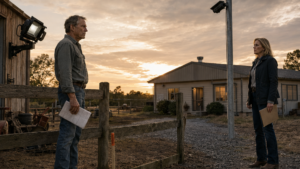
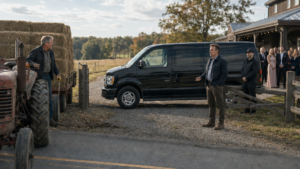
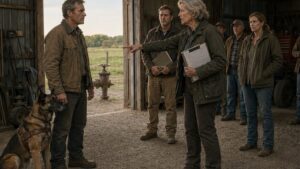
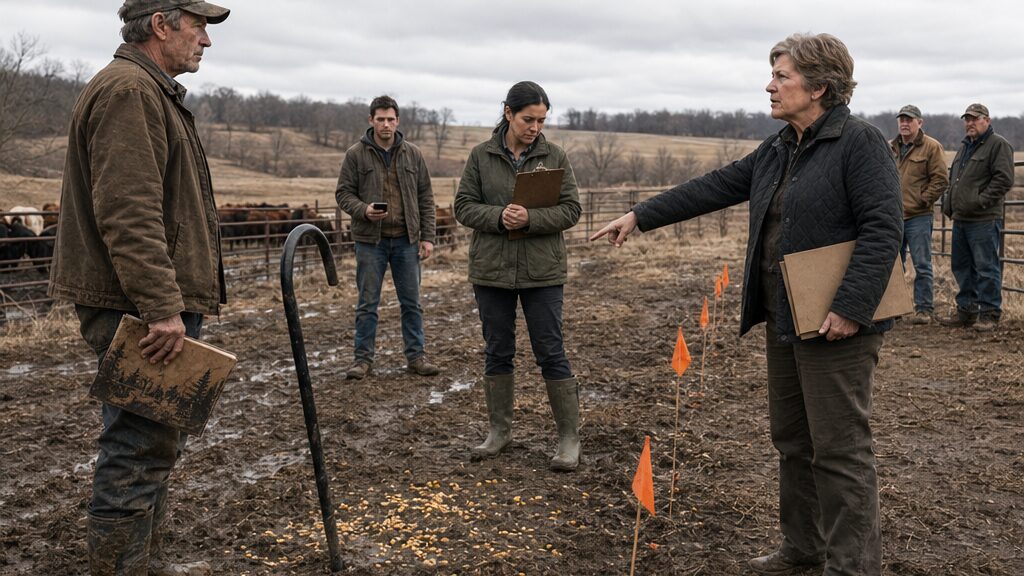
She stood beside the empty feeder hook in a dark green coat, one hand gripping the sleeve and the other pointing toward Samuel’s cattle lot. Fresh orange boundary flags bent in the wind between them.
“He put grain here to draw deer across my hay ground,” she said as soon as the inspector approached. “Then he acted as if I objected to birds.”
Samuel stood ten feet away with his wildlife log tucked beneath his arm.
David lifted his phone.
“Put that away,” Samuel said.
“I’m documenting.”
“You’re making it worse.”
Two neighboring farmers had stopped their trucks along the road. Neither crossed the ditch, but both watched through open windows.
The county inspector introduced himself, then glanced toward David’s phone. “No issue with recording, but I’d prefer nobody narrate while I work.”
Barbara handed over the complaint.
“I included photographs,” she said. “You can see the deer trails coming from his feeder onto my parcel.”
“They were coming from your timber before the feeder was there,” Samuel said.
Barbara turned toward him. “And now you feed them.”
“To keep them from the cattle lot.”
“You keep saying that like it gives you the right.”
The inspector raised a hand. “We’ll start with placement and purpose. Then we’ll deal with ownership and removal.”
“Removal?” Barbara said.
“The feeder is missing.”
“I’m aware.”
Samuel watched her face. No surprise. No curiosity. Only control.
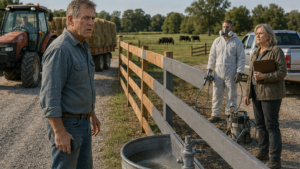
Emma Rivera arrived carrying a measuring wheel and a folder of printed photographs. She greeted both of them without warmth or distance, then joined the inspector beside the empty stand.
Samuel opened his log.
“I started feeding here November eighteenth. Before that, deer crossed the north lot four times in six weeks. Two fence breaks, one loose heifer, one cut on a yearling.”
Barbara said, “That doesn’t prove where the deer went afterward.”
Samuel looked at the ground.
“It does if you follow them.”
He walked east from the feeder site. The mud held three distinct patterns: older hoof marks pressed deep near the tree line, newer tracks circling the feeder, and a narrow trail continuing toward the drainage hollow.
He stopped where the tracks divided.
“Before the feeder, they came straight through here.” He pointed toward the cattle lot. “After I put grain at the edge, they turned down the hollow.”
The inspector crouched.
Samuel continued another twenty yards. “You can see the fence approach dried up. Fresh tracks stay below the rise.”
Emma handed the inspector photographs taken the day before. “The north lot damage is consistent with repeated wildlife pressure. The diversion appears to have reduced crossings.”
Barbara’s grip tightened on the plastic sleeve. “Reduced them for him.”
Emma said, “Yes.”
“And shifted them to me.”
“Possibly.”
Barbara gave a short, bitter laugh. “That’s the whole complaint.”
Samuel turned toward her. “Your hay damage was above the feeder, not below it.”
“You don’t know when it happened.”
“I saw the tracks.”
“You see what helps you.”
David’s phone remained raised.
Samuel wanted to tell him again to stop. Instead, he walked to the first orange flag.
“The deer weren’t crossing the planted section,” he said. “They were using the drainage edge.”
Barbara stepped closer. “Which is shared ground.”
The inspector looked between them. “Do we have a verified boundary?”
Barbara produced the old plat.
Samuel could have said the feeder stood east of the line. The tax map supported him if read one way. Thirty years of use supported him if use counted more than paper. His father had maintained the lane. Samuel had driven equipment through it every season since he was nineteen.
He could have answered quickly enough to make doubt sound like certainty.
Instead he looked at the bent flags.
“The exact site may not be solely mine,” he said.
David lowered the phone.
Barbara’s expression changed, not to triumph but to surprise.
The inspector said, “You knew that before installing the feeder?”
“I knew there was an old shared strip. I believed the stand was outside it.”
“Based on what?”
“Use. Old markers. Where my father said the line ran.”
“Not a current survey?”
“No.”
The wind pressed Barbara’s coat against her legs.
One of the farmers at the road pulled his truck forward and left.
Samuel felt the loss before the engine noise faded. In Miller County, a man’s admission traveled faster than his explanation.
Barbara held out the plat. “There. He admits it.”
“I admit the line needs verification.”
“You used ground you couldn’t prove was yours.”
“And you accused me of illegal baiting without mentioning the access dispute.”
“Because the feeder was the problem.”
“The strip is the problem,” Emma said.
Barbara looked at her. “The feeder brought it to a head.”
The inspector examined the hook. “Was this chain cut?”
Samuel showed him the severed links.
“Could an animal have done that?” the inspector asked.
Emma knelt beside the scattered corn and pressed a gloved finger into one of the broad prints.
“A black bear could have pulled the feeder hard enough to damage the chain,” she said. “The final break may have twisted or snapped. I wouldn’t call it cut without examining the feeder itself.”
“Which is gone,” David said.
Barbara looked at him. “Maybe your bear took it.”
A few days earlier, the line might have sounded ridiculous. Standing over the tracks, it sounded possible enough to make everyone hesitate.
The inspector asked Barbara, “Did you see the feeder after yesterday evening?”
“No.”
“Did you move it?”
“No.”
Samuel watched her answer. Her eyes stayed on the inspector.
The inspector wrote something down. “Until ownership and wildlife-use questions are resolved, no replacement feeder goes up at this location. Mr. Miller, provide your logs and fence-repair records. Ms. Wright, provide any evidence of crop damage and your basis for claiming exclusive control of the strip.”
“I never said exclusive,” Barbara replied.
“You said he had no right to use it.”
“That isn’t the same thing.”
Samuel almost smiled at the familiar shape of the defense.
Emma paced the lower trail with the measuring wheel. She stopped at the drainage channel and studied the ground. Then she followed a faint line back toward the feeder stand.
“What is it?” the inspector asked.
She pointed.
Two parallel scrapes ran through the mud, shallow at first, then deeper where the ground softened. They did not continue toward the tree line with the bear tracks.
They turned south.
Toward Barbara’s equipment lane.
Barbara stepped closer. “Those could be from anything.”
Emma followed the marks another six feet and lifted a flattened stalk of dead grass. Beneath it lay a small crescent of black paint.
Samuel recognized the coating from the feeder’s metal base.
David raised his phone again.
Samuel put a hand over the lens.
“Not yet,” he said.
David looked at him. “How much more do you need?”
“Enough to know what happened.”
The inspector placed the paint chip in a paper evidence envelope, though he made clear it was only for documentation, not a criminal investigation.
Barbara folded the old plat more carefully than necessary.
“These tracks prove nothing,” she said.
“No,” Samuel replied. “But they don’t go toward the woods.”
The inspector scheduled a survey review and instructed both parties not to disturb the shared strip.
As the county vehicles pulled away, Barbara walked back toward her field without speaking.
Samuel remained beside the bent hook.
The feeder might have fallen because of the bear. The chain might have broken without human hands. But after it struck the ground, something had dragged it south.
The scrape marks crossed the last orange flag and disappeared beneath the gravel of Barbara Wright’s equipment lane.
Chapter 4: The Camera That Cleared No One
David came through the kitchen door holding his phone as though it had burned him.
“You were wrong.”
Samuel looked up from the county maps spread across the table. Mud clung to David’s boots and melted onto the linoleum.
“About what?”
“The feeder.”
David placed the phone beside Samuel’s coffee. A black-and-white image filled the screen: the field edge under infrared light, the empty hook still occupied, the feeder hanging crooked beneath it.
A dark shape stood on its hind legs.
Samuel enlarged the image. The animal’s shoulders rose nearly to the crossbar. One front paw hooked around the feeder while the other pulled at the chain.
The timestamp read 2:13 a.m.
David swiped to the next frame. The bear dropped onto all fours, dragging the feeder sideways. In the third image, the chain snapped and the feeder struck the ground.
“There,” David said. “Barbara didn’t cut it.”
Samuel watched the sequence again.
“Where did this come from?”
“A trail camera on the tree line. The neighbor who checks traps down there sent it to the feed-store owner.”
“And the feed-store owner sent it to you.”
“He sent it to everybody.”
David took back the phone. The images had already appeared in the county farm group beneath his deleted accusation. Someone had written that Samuel owed Barbara an apology. Another person had posted a bear icon and asked whether wildlife could be charged with trespassing.
The jokes were mild. The judgment beneath them was not.
Samuel closed the map nearest him.
“You should answer.”
David’s head came up. “Me?”
“You accused her.”
“She still filed a false complaint.”
“That doesn’t make your accusation true.”
David paced to the sink and back. “She stood there yesterday acting like she knew nothing.”
“She may have known nothing.”
“You believe that?”
Samuel did not answer.
The footage explained the broken chain and the broad tracks beneath the hook. It explained why the feeder had fallen. It did not explain why a steel feeder weighing almost forty pounds had vanished from open ground.
But if Samuel said that now, it would sound like a man moving the line after losing an argument.
David typed with both thumbs.
“What are you writing?”
“That the bear knocked it down.”
“And?”
“And I was wrong to say Barbara took it.”
Samuel nodded once.
David looked at him. “You could try that sometime.”
Samuel’s hand tightened around his coffee cup. “Try what?”
“Saying the part where you were wrong.”
“I didn’t accuse her publicly.”
“You told me not to because you weren’t certain. You didn’t tell me there was an easement because you were.”
The screen chimed before Samuel could answer.
Another image had arrived.
David stared at it.
“What?”
“The timestamp.”
He turned the phone.
The first three frames showed the bear between 2:13 and 2:16. The new image was taken at 3:47. The feeder lay on its side, partly outside the camera’s view. Two pale beams cut across the lower field.
Headlights.
Samuel leaned closer.
The next frame was blurred by motion. A small utility vehicle stood near the drainage strip. A figure bent beside the damaged feeder, face hidden by the angle and winter coat.
The final frame showed the vehicle departing south with a black metal shape extending beyond its cargo bed.
David’s apology remained unsent.
“The bear knocked it down,” Samuel said. “Somebody else took it.”
They drove to the tree line before dark.
The camera was strapped to an oak thirty yards from the feeder site. Its view covered the lower field but not the equipment lane. Samuel compared the images with the ground, moving between the feeder stand and the point where the utility vehicle had stopped.
The tire tracks were faint. Frost and inspection traffic had disturbed them. Still, one rear tire had left a narrow zigzag pattern in the mud.
David crouched beside it. “Barbara’s utility cart has those tires.”
“So do half the carts in the county.”
“The headlights are square.”
“So are half the headlights.”
David stood. “You keep finding ways not to know.”
Samuel walked along the scrape marks Emma had found. They crossed the orange flags and continued to the gravel. Beyond that, the lane curved behind Barbara’s equipment sheds.
A vehicle moved near the farmhouse.
For a moment, Samuel expected Barbara to appear. Instead the sound faded behind the barn.
David lifted his phone to photograph the tire mark.
“Don’t post it.”
“I’m not an idiot.”
“You already posted once.”
David straightened slowly. “I corrected it.”
“After people saw it.”
“I know.”
Samuel heard the shame beneath the anger and regretted the words, but not enough to take them back.
They returned to the farmhouse after sunset. David sent his correction, including only the bear footage. He did not mention the later frames.
By morning, the correction had spread farther than the original accusation. The feed-store owner called Samuel before seven.
“Looks like the animal solved your mystery.”
“Part of it.”
“There’s more?”
Samuel looked across the kitchen at David.
“Nothing ready to repeat.”
The man hesitated. “Barbara came in yesterday. She didn’t look like somebody who’d just been cleared.”
“What did she want?”
“Asked whether anybody had seen footage from after the bear left.”
Samuel ended the call and turned toward David.
“She knew there could be another image.”
David reached for his coat. “Then we take it to the sheriff.”
Samuel blocked the doorway.
“No.”
“We have somebody loading your feeder.”
“We have a blurred figure and a utility cart.”
“We have tracks to her lane.”
“We take it to the inspector first.”
David’s jaw worked. “You’re protecting her.”
“I’m protecting us from making another claim we can’t pull back.”
“She didn’t protect you.”
“No.”
Samuel’s answer stopped him.
The knock at the door came hard enough to rattle the glass.
A woman stood on the porch with a gray travel coat buttoned to her throat and a leather folder pressed beneath one arm. Samuel recognized Linda Wright before she removed her sunglasses, though he had not seen her in nearly twelve years.
Barbara’s younger sister looked past him toward David.
“I need to speak to Samuel alone.”
David said, “About the feeder?”
Linda’s face tightened.
Samuel stepped onto the porch and closed the door behind him.
Linda looked toward Barbara’s farm, then back at Samuel.
“If you have that second camera image,” she said, “please don’t call the sheriff yet.”
Chapter 5: The Debt Behind the Locked Equipment Shed
Metal struck concrete inside Barbara’s equipment shed.
Samuel heard it from the lane before Linda reached the padlock.
The sound came again—a hollow scrape followed by the rattle of something heavy being shifted out of sight.
Linda stopped with the key halfway to the lock.
“She’s in there,” Samuel said.
“I know.”
“You said Barbara was at the bank.”
“She was supposed to be.”
Linda slid the key back into her coat pocket. The shed doors were weathered gray, their lower edges stained with mud. Behind them, something dragged once more across the floor.
Samuel looked at the fresh tire marks ending at the threshold. One track carried the same narrow zigzag pattern they had found by the feeder site.
“Open it.”
Linda did not move. “Let me explain first.”
“Explain why my feeder is in your shed?”
Her eyes shifted toward the farmhouse. “Explain why she thought taking it would fix anything.”
Samuel stepped away from the door, but only far enough to show he was listening.
Linda’s husband had died eight months earlier. Barbara’s husband had been gone three years, leaving behind a farm equipment business burdened by unpaid inventory loans and personal guarantees neither sister had understood until notices began arriving. Barbara had sold two machines, then a timber parcel. It had not been enough.
“The south acreage is the only thing we can sell without cutting the home place in half,” Linda said. “But the buyer wants clear access from the county road.”
“The access lane crosses the easement.”
“Yes.”
“And the feeder made him notice it.”
“The survey company noticed it. The feeder made Barbara believe you were establishing control before the sale.”
Samuel looked at the shed doors. “So she filed a wildlife complaint.”
“She couldn’t bring herself to say we needed the sale.”
“That isn’t my fault.”
“No.”
Linda’s answer came without defense.
“She asked me about the drainage strip twice this fall,” Samuel said. “Once at the feed store and once by the mailbox. Both times she started with complaints about ruts.”
“She was trying to ask what you remembered.”
“She could have asked.”
Linda gave him a tired look. “You could have answered.”
The lock turned from inside.
One door opened a foot, then stopped against something heavy. Barbara appeared in the gap wearing work gloves and an old canvas coat.
She looked at Samuel, then at Linda.
“You brought him here.”
“He already knew where the tracks went.”
Barbara pushed against the door until the obstruction scraped aside. Samuel glimpsed black metal on the floor.
His feeder lay on its side behind a stack of worn tires. One panel was crushed inward. The lid hung from a single hinge, and dried mud covered the base.
“You took it,” Samuel said.
Barbara stepped outside and pulled the door nearly shut behind her.
“I retrieved it.”
“From my field.”
“From the shared strip after an animal tore it down.”
“You hid it.”
“I put disputed property somewhere it couldn’t attract anything else.”
Samuel stared at her. “You told the inspector you hadn’t seen it.”
“I said I didn’t see it after the evening before.”
“You knew exactly what he was asking.”
Barbara removed one glove finger by finger. “And you knew exactly where you put it.”
Linda said her name quietly.
Barbara turned on her. “You think because you came back with a folder and a bank appointment, you understand what’s been happening here?”
“I understand enough.”
“No, you understand what the statements say. You weren’t here when deer tore up the lower hay. You weren’t here when the drainage backed into the lane. You weren’t here when every buyer asked why the access wasn’t clear.”
Samuel said, “None of that made the feeder yours.”
“It wasn’t yours where it was sitting.”
“The stand may have been disputed. The feeder wasn’t.”
Barbara looked toward the equipment lane. “It was lying broken on ground I help own.”
“And that gave you the right to conceal it?”
“It gave me the right to remove a hazard.”
“You could have called.”
“So could you, years ago, when the drainage stopped being maintained.”
The words landed harder than the accusation.
Samuel glanced at Linda.
She opened the leather folder and removed a letter from the prospective buyer. Access to the south acreage had to be uncontested before closing. Any open county complaint, uncertain easement, or unresolved drainage duty would delay the sale.
The closing deadline was six weeks away.
“If the sale fails,” Linda said, “the lender can move against the home parcel.”
Barbara’s face hardened. “He doesn’t need to know all of that.”
“He does if you’re using a nuisance complaint to force him off the strip.”
“I filed because the feeder brought deer onto our ground.”
“And because you wanted the county to say he had no right to be there,” Samuel said.
Barbara met his eyes. “Yes.”
The admission was quiet.
It did not excuse the missing feeder, but it stripped the conflict of its easiest shape. She had not taken it because birds irritated her. She had taken it because a broken object lying on uncertain land had become, in her mind, proof that Samuel might cost her the last sale available.
Samuel looked through the gap in the doors at the bent feeder.
“I want it back.”
“When the county determines ownership.”
“The county isn’t determining who owns my equipment.”
“They’re determining whether you abandoned it on our access.”
Linda stepped between them. “Barbara, return it.”
“No.”
“Then he calls the sheriff, and the buyer learns there’s a property complaint and a theft allegation.”
Barbara’s mouth tightened. “It wasn’t theft.”
Samuel could have used the fear he saw there. One call, one report, one more rumor at the feed store, and the buyer might walk before the county meeting.
He imagined David’s satisfaction.
He imagined the home parcel listed under a bank notice.
“I won’t call today,” Samuel said.
Barbara looked at him sharply.
“That isn’t forgiveness,” he continued. “You return the feeder before the review. You correct the part of your complaint that says I concealed the wildlife use from you. You knew why it was there.”
“I knew what you claimed.”
“You watched the deer turn away from my cattle lot.”
She did not answer.
“And I’ll bring every document I have on the strip.”
Barbara folded her arms. “You have documents?”
“Maps.”
“That isn’t what I asked.”
Samuel felt the old reflex close around his throat. Say less. Offer nothing that could weaken the farm. Let them prove what they believed.
Linda opened the folder again.
“There’s one more thing.”
She handed Samuel a photocopy of a handwritten ledger page. The script belonged to his father. He recognized the slanted sevens and the way every capital M leaned backward.
Drainage work delayed. Wright side paid gravel. Miller side to clear channel after harvest.
Below it, in different ink:
Samuel to finish when north lot repaired.
The date was twenty-two years earlier.
Samuel read it twice.
“I never saw this.”
“It was in Barbara’s husband’s records,” Linda said. “There are references to an agreement, but not the agreement itself.”
Barbara looked toward the lower field. “Your father promised to clear the channel. Then he got sick. After he died, you used the lane as if the promise died with him.”
Samuel held the page by its edges.
He remembered the flooded autumn after his father’s surgery. He remembered being told to keep the cattle operation alive, keep the ground together, keep people from taking advantage. He remembered a ditch he had intended to clear when there was time.
There had never been time because he had never made it time.
Linda returned the page to the folder.
“The feeder is only what finally made us stop pretending the strip settled itself,” she said.
Chapter 6: The Promise Samuel Refused to Name
The unsigned agreement was beneath twenty years of tax receipts.
Samuel found it at two in the morning in a cardboard box marked EQUIPMENT DEPRECIATION. The paper had been folded into quarters and tucked inside his father’s maintenance ledger as though hiding it among numbers might make it less unfinished.
Miller farm to clear and maintain northern half of drainage channel.
Wright farm to provide gravel and maintain southern access surface.
Both parties retain agricultural passage.
At the bottom were two signature lines.
Barbara’s husband had signed.
Samuel’s father had not.
Samuel sat at the office desk with the agreement under the yellow lamp. Beside it lay the feeder log, its recent entries neat and certain. Grain amounts. Deer tracks. Fence damage. Practical facts.
The old ledger held a different kind of record.
Gravel delivered by Wright.
Channel clearing postponed.
Culvert estimate requested.
Samuel to complete after calving.
The entries continued for four years, each postponement shorter than the last. Then the references stopped.
Samuel had inherited the ledger with the farm. He had read the cattle accounts, loan balances, equipment repairs, and seed costs. He had never read the drainage pages closely because the channel still moved water most seasons and the lane remained passable.
He had known there was an arrangement.
He had chosen not to learn how incomplete it was.
David appeared in the doorway wearing sweatpants and a work jacket.
“You still up?”
Samuel slid the agreement toward him.
David read it without sitting.
“He didn’t sign.”
“No.”
“But their side did the gravel.”
“Yes.”
“And you kept using the lane.”
Samuel looked at the ledger. “Yes.”
David placed both hands on the desk. “How long have you known?”
“I knew there had been talk about maintenance.”
“That isn’t what I asked.”
Samuel heard his own words returned to him.
“I knew enough to look,” he said. “I didn’t.”
David walked to the window. The cattle lot lights made pale rectangles across the yard.
“You going to give this to the county?”
Samuel did not answer.
“If you don’t,” David said, “I’m done after winter.”
Samuel looked up. “Done with what?”
“This farm.”
“You said you might take the equipment job in spring.”
“I said I might because every year you tell me the farm will make sense once we get through the next thing. But the next thing is always something nobody wrote down. A loan, a boundary, a promise somebody made before I was born.”
“You think an equipment shop won’t have problems?”
“I think their problems won’t become mine because an older man decided silence was the same as handling them.”
Samuel stood.
“Watch yourself.”
David turned from the window. “That’s what everybody does around you. Barbara watches what she says. Linda waits twelve years to come home. I delete a post because you tell me not to make trouble. And you keep the one piece of paper that explains why there’s trouble in a tax box.”
“I found it tonight.”
“You could have looked years ago.”
The anger in David’s face was not about Barbara or the feeder. Samuel saw that now. It was fear—the fear of being handed a farm whose obligations existed only in other people’s memories.
“I promised your grandfather I’d keep the ground together,” Samuel said.
David’s shoulders lowered slightly. “Maybe he meant take care of it.”
“I did.”
“You kept it. That isn’t always the same thing.”
David left before Samuel found an answer.
At dawn, Samuel carried the ledger to the feed shed. The empty place on the wall where his feeder log usually hung looked like another missing object. He set both books side by side on the workbench.
One showed what he had done carefully.
The other showed what he had avoided.
By nine, he had called Emma.
She arrived before the county review with a survey overlay and a list of possible remedies. Samuel placed the unsigned agreement in front of her.
She read it, then looked at him.
“This weakens your claim to exclusive use.”
“I know.”
“It may also establish that the strip was intended for shared agricultural access.”
“I know.”
“If the county accepts the maintenance history, they could assign you drainage costs going back several years.”
“I know.”
Emma closed the folder. “Why show me now?”
“Because it’s true.”
“That answer would have saved everyone time if you’d used it sooner.”
Samuel accepted the rebuke.
At the courthouse annex, Barbara and Linda waited outside the review room. Barbara held no complaint sleeve this time. Her hands were bare and clenched together.
Samuel approached with the ledger under one arm.
Barbara’s eyes dropped to it.
“What did you find?”
He handed her the unsigned agreement.
She read her husband’s signature first. Her thumb rested over it for several seconds.
Then she saw the blank line beneath his father’s name.
“You knew,” she said.
“Not what was written.”
“You knew there should have been something.”
“Yes.”
Linda stepped closer, but Barbara lifted one hand to stop her.
“All these years you let people say your family maintained that lane.”
“We used it.”
“You let us pay for gravel.”
“My father intended to clear the channel.”
“He intended.” Barbara’s voice tightened. “Do you know how many times I heard that?”
Samuel could have said his father had been ill. He could have listed the calving seasons, the machinery failures, the years when the farm barely covered taxes. Every reason was real.
None completed the ditch.
“I should have finished it,” he said.
Barbara looked at him as though the admission had arrived in a language she no longer trusted.
“And the feeder?” she asked.
“You should return it.”
“I will.”
“You should also correct the complaint.”
“I will correct what was misleading. I won’t withdraw the land-use challenge.”
“I’m not asking you to.”
That surprised her more than anything else.
The review-room door opened. A clerk called both families inside.
David stood at the far end of the hall. Samuel had not seen him arrive. He wore his work coat and carried no phone.
Samuel walked to him.
“I’m submitting everything.”
David looked at the ledger, then at the agreement in Barbara’s hands.
“What happens to the lane?”
“I may lose exclusive access.”
“That hurts.”
“Yes.”
“The farm can manage?”
Samuel considered the longer route to the north lot, the fuel, the winter mud, and the cost of drainage repairs.
“It’ll have to.”
David nodded, but did not promise to stay.
Inside the room, the board members arranged maps across a long table. Emma took a seat near the survey crew chief. Linda placed the buyer’s access letter beside the old plat. Barbara sat opposite Samuel.
Before the chair called the meeting to order, Samuel set his feeder log on the table.
Then he placed his father’s maintenance ledger beside it.
The two books looked nearly identical from a distance.
Samuel pushed the older one across the table to Barbara.
“This is the part I should have shown you years ago,” he said.
Chapter 7: Where the Feeder Stood After the Agreement
“The board rejects both original claims.”
The chair’s words settled over the review room before anyone moved.
Samuel sat with his hands folded beside the two ledgers. Across the table, Barbara held the unsigned agreement flat beneath her palm. Linda’s buyer letter rested beside it. Emma had pinned the survey overlay to a corkboard, where red, blue, and black lines crossed the shared strip without granting either family the clean victory they had requested.
The chair adjusted his glasses.
“Mr. Miller has not established exclusive control of the easement. Ms. Wright has not established authority to exclude agricultural passage that has been used for decades. The feeder was personal property, regardless of where it fell. The wildlife complaint contains valid concerns but overstates the evidence of deliberate nuisance.”
Barbara looked down.
Samuel did not.
The chair continued. “The county can clarify permitted use. It cannot repair the relationship that allowed the problem to grow.”
A review-board member slid a proposed order across the table. It required a current survey, removal of the feeder from the disputed site, restoration of the drainage channel, and a temporary suspension of vehicle use through the strip until maintenance responsibilities were settled.
Samuel read the last condition twice.
Without the lane, he would have to reach the north lot by the upper road. That meant an extra mile each trip, a steep grade in winter, and no practical route for the hay wagon when the ground softened.
Barbara read the same page and said, “The sale dies if access is suspended.”
Linda pressed her lips together.
The chair said, “The county cannot approve a private sale by pretending the access question does not exist.”
Emma stood and moved to the survey overlay.
“There may be another option.”
She traced the lower drainage line with one finger. The proposed buyer did not need the entire historic lane. A narrowed right-of-way could connect the south acreage to the county road if the families shifted the wildlife-diversion site east, cleared the channel, and placed the wettest section under a conservation lease.
“The lease would keep the drainage strip undeveloped,” Emma said. “The buyer receives defined access. The Wright parcel remains marketable. The Miller farm keeps agricultural passage, but not exclusive control.”
Samuel studied the line.
The revised lane cut farther south than the route he had used all his life. It would force him to move a gate, replace two fence corners, and surrender the straight approach to the north lot.
Barbara saw it too. “That takes usable ground from us.”
“It limits both sides,” Emma said. “It also removes the uncertainty.”
“And the feeder?” a board member asked.
“Relocate it beyond the clarified boundary and farther from the hay field. Use measured grain only during the diversion period. Samuel’s log can become part of the management plan.”
The chair turned to Samuel. “Would you accept that?”
Samuel looked at the old ledger.
His father’s unfinished promise had shaped the room long after the man himself was gone. Samuel could preserve the familiar lane by fighting the order. He could argue historic use, appeal the survey, and spend another season proving that keeping ground together mattered more than making it workable.
David sat against the rear wall. He gave no signal.
Samuel said, “I’ll clear the drainage channel.”
Barbara looked up.
“I’ll provide the labor and equipment,” he continued. “I’ll move the north gate and repair the fence where the new lane cuts through.”
The chair leaned back. “That is more than the proposed order requires.”
“It is less than leaving it unfinished another twenty years.”
Barbara’s expression tightened, but not with anger.
Samuel turned toward her. “The Wright side paid for gravel. My side did not complete the channel. The records are clear.”
Barbara glanced at her husband’s signature on the agreement.
“If the sale closes,” she said, “we can pay half the culvert replacement.”
Linda touched her sleeve. “We can pay it from the deposit.”
Barbara nodded once. “Then half.”
The chair looked between them. “And the feeder?”
Barbara stood.
Without speaking, she left the room.
The door closed behind her.
One board member exhaled and reached for the proposed order. Linda remained seated, her face unreadable.
Samuel felt David watching him.
After several minutes, the door opened again.
Barbara returned carrying the damaged feeder.
She must have loaded it into Linda’s vehicle before the meeting. Mud still marked its base. The crushed panel had been pushed outward, though the crease remained. A new hinge held the lid.
Barbara set it on the table beside Samuel’s log.
“I had the feed-store owner straighten what he could,” she said. “I should have returned it before today.”
Samuel touched the repaired hinge.
“You should have.”
“I also filed a correction this morning. The feeder was not concealed from me, and I had seen the deer turning below the cattle lot.”
The apology stopped there. No request for forgiveness followed it.
Samuel found that he preferred it that way.
The board recessed while the clerk revised the agreement. In the hallway, David stood beside the vending machines with his hands in his coat pockets.
“You gave up the lane,” he said.
“Part of it.”
“The easy part.”
“Yes.”
David looked through the glass doors toward the parking lot. “You could have fought.”
“I did fight. Just not for the same thing.”
David rubbed his thumb across a scrape on the vending-machine frame.
“The equipment shop called again,” he said.
Samuel waited.
“I told them I’d stay through spring.”
“That isn’t forever.”
“No.”
Samuel nodded. “Spring is work enough.”
Three weeks later, new white boundary posts stood along the lower field.
The orange flags were gone.
Samuel had spent six days clearing the drainage channel with the old excavator. Barbara and Linda paid for gravel and half the culvert. The buyer signed a revised access agreement, and the conservation lease preserved the wet strip that neither farm could afford to keep arguing over.
The new lane was less convenient. Samuel felt that every time he drove the long turn toward the north lot.
It was also unmistakable.
David repaired the feeder stand in the machine shed. He replaced the chain with a swivel and set the post east of the clarified boundary, where the deer trail bent away from both the hay field and the cattle fence.
On the morning they raised it, Barbara arrived carrying a galvanized scoop.
Samuel tightened the last bolt while David hung the feeder from the new hook. The repaired panel showed a shallow crease in the winter light.
Barbara looked toward her hay ground.
“Emma said eight pounds to start.”
Samuel pointed to the mark inside the scoop. “That line.”
Barbara measured the grain without speaking. She poured it beneath the feeder in a narrow strip rather than a mound.
David stepped back to examine the post.
“Straight enough?” he asked.
Samuel looked at the feeder, the new boundary posts, and the cleared channel carrying a thin line of water toward the culvert.
“It’ll hold.”
Barbara set the scoop beside the post.
For a moment, all three stood on ground whose use had finally been written down.
Then a doe appeared at the edge of the timber.
She watched them, ears forward, waiting for the field to empty.
Barbara walked toward her side of the boundary. David headed for the cattle lot. Samuel remained long enough to enter the date, grain amount, and new location in his feeder log.
Below the entry, he added one more line.
Drainage agreement completed.
He closed the notebook and hung it from the repaired stand.
The story has ended.