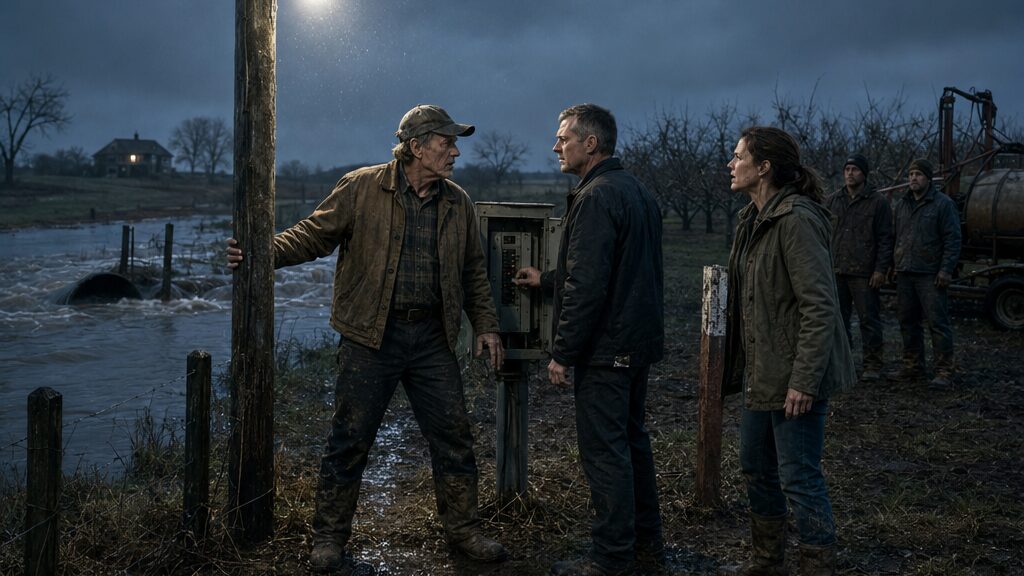
The Farmer Who Refused to Turn Off the Light Beyond the Flooded Field
Chapter 1: The Light That Crossed the Property Line
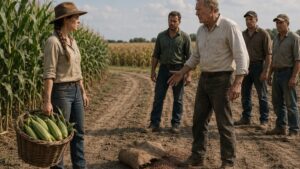
Melissa Brown came through the lower gate carrying wire cutters.
Thomas Carter saw their red handles flash beneath the field lamp before he recognized her face. The light mounted on the weathered pole threw a hard white circle over the pasture, the drainage ditch, and the first two rows of Melissa’s orchard. Beyond that circle, the land disappeared into blackness.
Thomas left the feed bucket beside the trough and walked toward her.
“Put those away.”
Melissa stopped at the pole. Her rubber boots were dark with mud, and the shoulders of her canvas coat shone with mist. She tilted her head toward her house on the rise beyond the orchard.
“That light has been in my bedroom every night for three weeks.”
“It’s been there longer than three weeks.”
“That doesn’t make it legal.”
She opened the cutters.
Thomas stepped between her and the cable running down the pole. The wire was enclosed in gray conduit, but the lower coupling had rusted enough to show its age.
“You cut that line,” he said, “you could hurt yourself.”
“So shut it off.”
“No.”
The answer came too quickly. Melissa’s mouth tightened.
For most of the past year, since she had taken over the orchard after her father’s illness, Thomas had tried to be patient with her questions. He had shown her where runoff usually gathered, which fence posts had been set before either of them was born, and how far the cattle might reach if the western wire sagged. She had heard advice where he had intended courtesy and control where he had intended warning.
Tonight, with the cutters in her hand, patience left him.
Melissa looked up at the lamp. Moths struck the metal shade and spun away. “It lights half my property.”
“It lights the lower field.”
“My lower rows are inside that field of light.”
Thomas glanced toward the orchard house. One upstairs window had been covered with a dark blanket from inside.
“I’ll angle the shade farther down.”
“You said that last week.”
“I did angle it.”
“Then your solution didn’t work.”
She moved around him. Thomas caught the pole with one hand, not touching her, but making it clear she would have to push past him.
Melissa stared at his hand. “You still think this is your land.”
“This post was here before you took over.”
“That isn’t an answer.”
Thomas looked at the ground near the pole. The grass had thinned into mud around the concrete footing. Ten feet east stood an old boundary stake, its orange cap nearly hidden under dead weeds. A newer survey ribbon fluttered farther west, tied to an orchard fence post.
Neither marker agreed with the other.
Melissa followed his gaze.
“That’s what I thought,” she said. “You don’t even know which side it’s on.”
“I know where the fence has always been.”
“The county map doesn’t care what everyone remembers.”
The words struck harder than her tone. Thomas had grown up among boundaries marked by stone piles, sycamores, and the agreements of men who shook hands over truck hoods. Melissa had inherited acreage measured by a surveyor after two bank loans and a family dispute. To her, an unwritten line was not tradition. It was a threat.
She closed the cutters but did not lower them.
“My son hasn’t slept properly in days,” she said. “The electric bill for the pump house is up, and I’ve got workers asking whether you’re watching them at night.”
“The lamp is on my meter.”
“That isn’t the only cost.”
Thomas could have told her then.
He could have pointed beyond the drainage ditch, beyond the wet strip of pasture and the lower gate, toward Virginia King’s farmhouse at the far edge of the valley. From where they stood, only one of Virginia’s windows was visible, a weak amber square between two leafless maples.
Instead he said, “The light can’t go dark.”
Melissa waited.
When he offered nothing more, she gave a short, disbelieving laugh. “Why?”
Thomas heard water moving under the gravel crossing. The sound was low tonight, no more than a steady pull through the culvert. He kept his eyes on the dark line of the ditch.
“There’s a reason.”
“That’s what you keep saying.”
“It’s enough.”
“No, Thomas. It’s enough for you because nobody around here ever made you explain yourself.”
Her voice had risen. Across the orchard, a porch door opened. A shadow stood briefly in the yellow rectangle before the door closed again.
Thomas lowered his voice. “Go home, Melissa.”
Her face changed. The anger remained, but something colder settled behind it.
“You don’t get to send me home from my own ground.”
She slid the cutters into her coat pocket.
For one moment Thomas believed the confrontation was finished. Then Melissa took out her phone, photographed the pole, the cable, the old stake, and the survey ribbon. She stepped backward until the full glare of the lamp filled her screen.
“What are you doing?”
“Creating a record.”
“There’s no need for that.”
“There wasn’t a need when I asked you the first time.”
She walked back through the gate and closed it carefully behind her.
Thomas remained beside the pole. The lamp buzzed overhead. Its beam flattened every object it touched—the wet fence, the gate latch, the pale trunks of the orchard trees—until nothing in the light seemed capable of hiding.
Everything beyond it could.
He picked up the feed bucket and finished checking the cattle. At the far trough, he looked toward Virginia’s farmhouse. Her porch was dark, but the narrow kitchen window remained lit. The field lamp made a bright corridor across the lower land, broken only where the ditch cut through it.
Years earlier, Virginia had told him she could see the glow from her back steps. She had said it casually, one hand resting on the porch rail.
I know where I am when that light is on.
Thomas had carried the sentence as instruction.
Near midnight, he drove his pickup to the orchard house. He did not go to the door. He stopped along the county road and studied the upstairs window Melissa had covered. Even with the shade angled down, a white band of light lay across the blanket.
He could see why she was angry.
That knowledge irritated him more than if she had been entirely wrong.
At dawn, the lamp clicked off automatically. The valley emerged slowly: gray pasture, silver ditch water, rows of bare fruit trees. Thomas returned to the lower gate with a wrench and adjusted the shade until it aimed almost straight down.
A county truck was already parked beside the road.
Patrick Moore, the land-use and electrical compliance officer, stood at the pole wearing a brown jacket and holding a clipboard. Melissa was beside him. She had changed into work clothes, but there were dark circles beneath her eyes.
Patrick nodded to Thomas. “Morning.”
Thomas looked at the paper fastened to the pole with a plastic tie.
“You move quick.”
“Complaint came in with photographs and a parcel map.”
Melissa folded her arms. “I told you I was making a record.”
Patrick touched the conduit with the end of his pen. “I’m not making a determination today. I need access to the service connection, the installation history, and any easement covering this location.”
“There’s no easement.”
Melissa’s eyes shifted sharply toward Thomas.
Patrick wrote something down. “Then we’ll need to establish whose parcel the pole occupies.”
“It’s been here twenty-two years,” Thomas said.
“That tells me its age, not its legal position.”
Thomas read the top line of the notice. Inspection required. Possible unpermitted electrical installation. He stopped before the section listing penalties.
Patrick lowered the clipboard. “Until I inspect it, don’t alter the wiring.”
Melissa looked at the wrench in Thomas’s hand. “Does changing the shade count?”
“Leave everything as it is.”
Patrick returned to his truck.
Melissa stayed at the gate. The morning was bright enough now that the lamp looked harmless—a dented metal shade on a leaning pole, no more threatening than an old piece of machinery.
“You could have answered one question,” she said.
Thomas cut the plastic tie, removed the notice, and smoothed the crease made by the pole.
“You wouldn’t have understood.”
Melissa’s expression hardened again. “Then I suppose the county can explain it to me.”
She left him holding the notice beneath the dead lamp.
Chapter 2: The Widow Beyond the Lower Gate
Virginia King’s truck stopped in the lane when the field lamp flickered.
Thomas had been waiting near her barn with a replacement fuse in his pocket. The lamp was half a mile away, across the drainage cut and Melissa’s lower orchard, but its glow usually reached the lane as a faint white bar between the trees.
Tonight it blinked once, disappeared, then returned.
Virginia’s brake lights brightened.
She did not move until the beam steadied.
Thomas walked down the lane as she eased forward. Her truck was an older model with a cracked dashboard and a sack of chicken feed on the passenger seat. When she lowered the window, cold air carried the smell of coffee and damp wool.
“What did you do to it?” she asked.
“Nothing yet.”
“It blinked.”
“I saw.”
Virginia looked past him toward the distant pole. “Melissa?”
“Loose connection.”
“That wasn’t my question.”
Thomas opened the barn gate. “Patrick Moore is inspecting it tomorrow.”
Virginia’s hands stayed on the steering wheel.
“Why?”
“Boundary complaint. Light spill. Wiring.”
“You left out the part where you made somebody angry.”
“She came into the field with cutters.”
Virginia’s mouth twitched, though not quite into a smile. “That sounds like Melissa.”
“She had no business touching it.”
“And you told her why she shouldn’t?”
Thomas took the feed sack from the passenger seat before answering. “I told her it had to stay on.”
Virginia shut off the engine. “That is not what I asked.”
She climbed down without accepting his hand. At seventy-eight, she moved carefully but not weakly. She placed each boot as if the ground had entered into an agreement with her and might be held accountable for breaking it.
They carried the feed into the barn. Virginia switched on the interior bulbs, revealing six empty stalls, stacked hay, and a red tractor with one rear tire removed. Two barn cats slipped from beneath a cabinet.
“You shouldn’t be driving that lane after dark,” Thomas said.
“I had a meeting in town.”
“You could have called.”
“I have a telephone, Thomas. I don’t have a dispatcher.”
He set the sack beside the grain bin.
Virginia cut it open with a pocketknife. “How far has this gone?”
“County notice. Inspection in the morning.”
“And what are you asking from me?”
Thomas had rehearsed the request on the drive over. He had intended to keep it simple.
“Tell Patrick you use the light.”
Virginia folded the top of the sack down with precise movements. “Use it how?”
“You know how.”
“I want to hear how you plan to say it.”
Thomas looked toward the open barn doors. The distant lamp was visible through the bare trees, a fixed point beyond the black pasture.
“It helps you find the lower route.”
“It helps me see whether I’ve lined up with the gate.”
“And the crossing.”
Virginia’s knife stopped in her hand.
Thomas continued before she could interrupt. “The county may allow a safety exception if you confirm it’s necessary.”
“Necessary for whom?”
“For you.”
Her face went still.
He knew then that he had chosen the wrong words, but pride prevented him from taking them back quickly enough.
Virginia closed the knife. “I can drive my own road.”
“I didn’t say you couldn’t.”
“You want me to sit in a county office and tell them an old widow needs your light to get home.”
“That’s not what it is.”
“That is exactly how you said it.”
Thomas lowered his voice. “You stop every time it flickers.”
Virginia glanced toward the barn entrance.
The observation had landed because it was true.
She walked outside, and Thomas followed. From the upper part of her lane, the light did not illuminate the road itself. It gave shape to the land around it. With the lamp visible, Virginia could tell where the pasture ended, where the lower gate stood, and whether she was approaching the crossing from the safe angle. Without it, every dark opening between the trees resembled the lane.
She leaned against the fence rail.
“I don’t like the dark down there,” she said.
Thomas said nothing.
“I never did. Not after that night.” She looked at him. “There. You got your answer.”
“I’m trying to keep it from being shut off.”
“No. You’re trying to keep from saying why you put it there.”
“The reason is private.”
“Whose privacy?”
He had no answer that would not sound like an accusation against himself.
Virginia rubbed her thumb along the worn top rail. “Did Melissa ask me whether I use it?”
“No.”
“Did you tell her to?”
“No.”
“You decided she didn’t need to know, and you decided I needed you to fight her.”
“She was going to cut the line.”
“Because the light shines into her house.”
“I offered to adjust it.”
“You offered to make your decision less uncomfortable for her.”
Thomas stepped away from the fence. “You want it gone?”
Virginia did not reply at once. The lamp hummed faintly across the field. Its glow caught the wet gravel of the lower lane.
“No,” she said. “It steadies me.”
The admission loosened something in Thomas’s chest.
Then she added, “That doesn’t make it yours to defend however you please.”
He looked back toward her farmhouse. The porch light was off. One curtain moved in the kitchen window, disturbed by a draft.
“Patrick will ask what it’s for,” Thomas said.
“Then tell him.”
“I won’t drag all that through a county meeting.”
“All what?”
“You know.”
Virginia’s face sharpened. “Say his name.”
Thomas stared at the lane.
She waited.
He could hear the barn cats moving in the hay and water dripping from the eaves into a metal pan. At last he said, “I’m not doing this tonight.”
“That is what you’ve said for twenty-two years.”
“I kept my promise.”
“You kept the part that let you work with your hands. You avoided the part that required your mouth.”
Thomas turned toward his truck.
Virginia called after him. “If Patrick asks me whether the light helps, I’ll tell him it does.”
He stopped.
“But I will not sit there while you make me the reason for every choice you refused to discuss. If you want me to testify, you tell the whole truth first.”
Thomas faced her again. “There’s no need.”
“There is now.”
A gust crossed the field. The lamp flickered a second time, and Virginia’s eyes moved toward it automatically.
Thomas reached into his pocket and felt the replacement fuse.
“I’ll fix the connection.”
“That won’t fix this.”
He walked down the lane alone. Near the lower gate, the gravel had washed thin enough to expose the rounded tops of older stones beneath it. Water murmured under the crossing, hidden in the culvert.
Virginia remained by the fence.
“Thomas,” she said.
He paused with one hand on the gate.
“Did you ever tell Melissa what lies under that gravel?”
The fuse felt suddenly small and useless in his palm.
Chapter 3: He Would Not Let Them Cut the Power
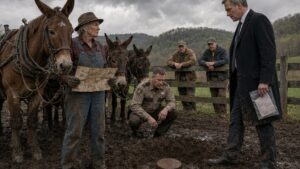
Patrick Moore had the power box open when Thomas put his hand over the switch.
Melissa saw the movement from the orchard side of the gate. It was not violent. Thomas did not shove Patrick or raise his voice. He simply reached past the officer’s arm, laid his broad hand across the disconnect lever, and held it there.
Above them, the field lamp still burned against the thinning darkness.
Patrick looked at Thomas’s hand. “Move it.”
“Not yet.”
“We agreed I would inspect the shutoff.”
“You can inspect it live.”
“No, I can’t.”
Two orchard workers had stopped beside a flatbed loaded with pruning bins. A feed truck slowed on the county road, its driver turning his head toward the pole. Melissa felt heat rise under her collar. She had wanted a county determination, not a spectacle.
Patrick closed the lid halfway, trapping Thomas’s fingers unless he withdrew them. Thomas did not.
“Seventy volts or seven thousand, I don’t work around a line somebody refuses to isolate,” Patrick said.
“The lamp stays on until daylight.”
“It is daylight.”
Thomas looked toward the eastern ridge. A pale strip had appeared above it, but the lower field remained dark beneath the trees.
Melissa stepped through the gate.
“This is what he does,” she said to Patrick. “He decides what counts as an answer.”
Thomas ignored her.
Patrick released the lid. “Mr. Carter, if you interfere with the inspection, I can order the installation de-energized at the service point.”
“You do that, it may not come back on tonight.”
“That depends on what I find.”
“It needs one more night.”
Melissa almost laughed. “Yesterday it could never go dark. Now it only needs one more night?”
Thomas’s hand tightened around the edge of the box.
The lamp cast deep shadows beneath his eyes. He looked older than he had two nights earlier, but not less stubborn.
Patrick lowered his voice. “Give me a reason I can put in the report.”
Thomas said nothing.
One of the orchard workers shifted beside the flatbed. Melissa could feel everyone waiting. This was the moment Thomas had created each time he withheld the next sentence—the moment when silence stopped looking dignified and began looking like contempt.
She pointed toward her house. “That beam hits my son’s room. It lights the rows when my crew is working late. The pole may be on my parcel, and the cable definitely runs toward the old pump-house line. Yet he acts as if asking a question is an attack.”
Thomas looked at her then. “You brought cutters onto wet ground.”
“Because you wouldn’t turn it off.”
“You could have killed yourself.”
“And you could have explained.”
Patrick raised one hand. “Enough.”
He looked at Thomas. “Take your hand away.”
Thomas did not move.
Patrick’s expression hardened. “I have respected the fact that you’ve farmed here longer than I’ve held this job. Do not make me confuse respect with permission.”
For the first time, Thomas seemed aware of the watching workers and the stopped truck. His gaze moved across them, then beyond them.
“Look past the light,” he said.
Melissa folded her arms. “We have all seen the light.”
“Not at it. Past it.”
He lifted his free hand and pointed across the lower pasture.
The beam reached over wet grass toward Virginia King’s property. Her farmhouse stood far beyond the ditch, mostly hidden by maples. In the brightening morning it looked small and ordinary.
“What am I supposed to see?” Melissa asked.
“The lane from Virginia’s barn.”
She followed the direction of his finger. A pale gravel track descended from Virginia’s property, crossed the low field, and seemed to vanish near the ditch before continuing toward the county road.
Patrick stepped away from the power box.
Thomas removed his hand from the switch but stayed between Patrick and the pole.
“Virginia watches for this lamp before she comes through the lower gate,” he said. “It tells her whether she’s lined up with the crossing.”
Melissa looked again. “That road is straight.”
“No.”
She almost argued, then noticed how the gravel curved near the drainage channel. The route did not cross at the narrowest point. It bent west, where higher ground concealed a culvert beneath a raised strip of stone.
Thomas pointed farther east. “Come in wrong and you hit the ditch.”
Patrick walked toward the crossing. Melissa followed, her boots sinking into the pasture. The orchard workers remained by the gate.
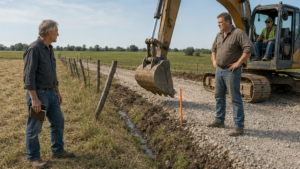
At first she saw only water-dark grass. Then Patrick crouched and pushed dead weeds aside. Brown water moved quickly below them, nearly level with the culvert mouth. The gravel over the pipe had washed away along one edge, leaving a broken shelf above the current.
Melissa stopped.
From her house, the drainage cut looked like a shallow swale. She had driven the upper farm road all year and never used this route. Her father had called it the King crossing and told her it was not worth maintaining. She had assumed it belonged entirely to Virginia.
“The lamp marks the west approach,” Thomas said behind her. “When the water comes up, the east side looks open. It isn’t.”
Patrick stood. “Why isn’t this hazard marked?”
“It is.”
He pointed toward the lamp.
Patrick looked back at the pole, then at the crossing. “A light half a field away is not a traffic marker.”
“It works.”
“For people who know what it means.”
Melissa felt the force of that answer. It was the shape of every arrangement Thomas trusted: useful to those who already understood, invisible to anyone who arrived later.
She looked at the broken gravel. “Virginia drives over this at night?”
“When she has to.”
“And you never told me?”
Thomas’s jaw shifted. “You didn’t use the lane.”
“My workers do.”
“Not after dark.”
“You don’t know that.”
Thomas looked toward the flatbed. Neither worker met his eyes.
Patrick took photographs of the culvert and the approach. “How long has the crossing been undermined?”
“It worsened after the spring flood,” Thomas said.
“Did you report it?”
“No.”
“Why not?”
“I added stone.”
Melissa stared at him. “On whose land?”
No one answered.
Patrick walked back toward the pole, checking the parcel map on his clipboard. Melissa stayed beside the ditch. Now that she knew where to look, the danger seemed obvious. The grass on the wrong approach was pressed flat by tires. A set of shallow tracks ended ten feet from the washed edge.
Her son had used the lower field twice to pull irrigation pipe. She had assumed he crossed wherever the ground was firm.
Thomas came to stand several feet away.
“You should have told me,” she said.
“Yes.”
The admission surprised her enough that she turned.
He was looking at the culvert, not at her.
“Then why didn’t you?”
His face closed again.
Melissa understood that there was more. Not merely an old habit or a neighborly favor. The way he watched the water carried the weight of memory.
Patrick called from the lamp. “I need both of you here.”
They returned to the pole. He had scraped mud from the concrete footing with a narrow probe. Beneath the soil, one side of the base extended west of the old fence line.
Patrick compared the location to the parcel map.
“The current survey places the boundary through this footing,” he said. “The pole is partly on the Brown parcel.”
Melissa looked at Thomas.
He did not deny it.
Patrick traced the conduit. “The underground feed runs from Carter’s pump house, crosses the boundary, and reaches a fixture that appears to have been installed without a permanent permit.”
“It was temporary,” Thomas said.
“How temporary?”
Thomas looked toward the crossing.
Patrick waited.
“Twenty-two years.”
One orchard worker let out a breath that sounded almost like a whistle.
Melissa felt her sympathy retreat beneath a fresh layer of anger. The crossing might be dangerous. Virginia might rely on the light. But Thomas had let an improvised arrangement occupy her family’s land for more than two decades and expected everyone to accept it because his reasons were private.
Patrick closed the power box.
“I am not disconnecting it this morning,” he said.
Thomas’s shoulders eased slightly.
“Don’t mistake that for approval. The wiring needs certification, the location requires written consent or relocation, and the crossing must be evaluated separately.”
“How long?” Melissa asked.
Patrick tore a sheet from his pad.
“Seventy-two hours. Until then, the lamp may operate under temporary restriction. No alterations. No expansion. If there’s rain heavy enough to raise the ditch, close the lower route.”
Thomas took the order.
Patrick looked directly at him. “And before I consider any safety exception, I want the full history of why that lamp was installed.”
Thomas read the page without speaking.
Melissa glanced across the field toward Virginia’s farmhouse. The lamp no longer looked merely intrusive. It drew a line through the gray pasture toward the dangerous crossing and the widow’s distant lane.
But its light also fell across the disputed footing, the illegal cable, and Thomas’s silence.
Patrick returned his pen to his pocket. “Seventy-two hours, Mr. Carter. After that, if you cannot make this lawful, the power goes off.”
Chapter 4: The Promise Made in Floodwater
Steven Lewis slid a brittle yellow tag across the workbench.
“You told Patrick there was no installation record.”
Thomas did not touch it.
The rural cooperative workshop smelled of hot dust, machine oil, and damp canvas. Coils of black cable hung from hooks behind Steven. Through the open bay door, a bucket truck idled beneath a gray sky.
The writing on the tag had faded, but Thomas recognized his own block letters beneath Steven’s initials.
TEMPORARY FLOOD SAFETY LIGHT.
Steven tapped the date.
“Twenty-two years is a long temporary.”
“You said the file was gone.”
“I said the cooperative didn’t have a permanent service application. I never said I forgot helping you put it up.”
Thomas looked toward the bay. “Can you certify it?”
“No.”
“The cable is sound.”
“The cable crosses a parcel line without an easement. The pole sits on two properties. The box isn’t weather-rated by current code, and the footing has shifted.”
“Can you make it sound?”
Steven leaned back against the bench. “Yes.”
Thomas finally looked at him.
“But not without Melissa’s written consent, a county permit, and a declared purpose.”
“Call it agricultural security.”
“I already lied for you once.”
“You didn’t lie.”
“I called an emergency installation temporary because that was what you promised it would be.”
Thomas picked up the tag. The paper crackled between his fingers.
Steven had been younger then, not long out of training, willing to pull cable from the Carter pump house after midnight because the lower field had been full of trucks, men with flashlights, and one ambulance that had arrived too late.
“You knew why it stayed,” Thomas said.
“I knew why it went up.”
Steven’s voice softened, which made the refusal harder.
“I also knew Virginia asked you about replacing it years ago. You told her you had it handled.”
“I did.”
“No. You kept it running. That isn’t the same thing.”
Thomas folded the tag once.
Steven took it back before he could put it in his pocket.
“That stays with the file.”
“There wasn’t a file five minutes ago.”
“There is now.”
Thomas’s jaw tightened.
Steven shut off the bucket truck from a wall switch. The sudden silence filled the workshop.
“Tell Patrick what happened,” he said. “Let Melissa decide whether she’ll grant the easement. Let Virginia decide whether she still wants the light. Then I’ll help design something legal.”
Thomas picked up his coat.
“You always did enjoy paperwork after somebody else finished the hard part.”
Steven did not answer the insult.
Thomas reached the bay door before Steven spoke again.
“You weren’t the only man in that field that night.”
Thomas stopped.
“No,” he said. “I was the one who should have reached him sooner.”
He drove to the old pump house instead of going home.
The building stood near the drainage channel, half hidden by cottonwoods. Its tin roof had rusted through along one edge, and the wooden door dragged across the floor when he opened it.
The field lamp’s underground cable entered through the rear wall. Above it hung an old switch, disconnected years ago when the automatic sensor had been installed.
Thomas brushed dust from the lever.
For a moment the pump house disappeared.
Rain hammered the roof. Water pressed through the grass in brown sheets. Virginia’s husband had driven down from the barn in a small tractor, trying to reach a stranded calf on the Carter side of the ditch. Thomas had seen the upper creek rise but had believed they still had time.
He had called Virginia’s house.
No answer.
He had driven toward the lower field, found the gate open, and seen one tractor light moving in the rain.
Then the light had vanished.
Thomas gripped the switch until the edge bit his palm.
He had warned him. That was the sentence he had repeated for twenty-two years.
He had warned him, only late.
By the time Thomas reached Virginia’s kitchen, the deadline had less than thirty-six hours remaining.
She let him in without greeting. A county parcel map lay open on the table beside three mugs. Melissa sat near the window.
Thomas stopped inside the door.
“What is she doing here?”
Virginia poured coffee into the third mug. “Asking questions.”
Melissa looked tired rather than angry. “I wanted to know whether you had permission to use her lane as part of your safety argument.”
“I don’t use her lane.”
“You maintain the crossing.”
“When it needs stone.”
“On land neither of you can clearly place.”
Virginia set the mug in front of Thomas. “Sit down.”
He remained standing.
Melissa pointed to the map. “Patrick says the county may allow the lamp temporarily if we agree to a shield and an access easement. I’m willing to discuss both.”
Thomas looked at her.
It was nearly what he had wanted. The lamp could remain. Steven could repair the box. The county could call the arrangement lawful without anyone reopening what had happened.
Virginia watched him understand the offer.
“No,” she said.
Melissa frowned. “No to what?”
“To the way he is about to accept this.”
Thomas pulled out a chair. “You said the light steadies you.”
“It does.”
“Then this solves the problem.”
“It solves your problem.”
Virginia sat opposite him.
“Tell Melissa why the light was installed.”
Thomas glanced toward the window. The field lamp was not visible in daylight, but he knew precisely where the pole stood.
“There was an accident.”
Melissa waited.
Virginia did not let him stop there. “Who?”
Thomas’s hand tightened around the mug.
“Her husband.”
“And?”
Thomas looked at Virginia. “Do you want this said?”
“I have wanted it said for years.”
The words removed the final place he had left to hide.
“He went through the lower gate during a flood,” Thomas said. “The culvert had started washing out.”
Melissa’s eyes moved to the map.
“I knew the upper creek was rising. I tried to call. Then I went after him.”
“You warned him?” Melissa asked.
“Too late.”
Virginia’s chair creaked as she shifted.
Thomas kept his eyes on the coffee. “By the time I reached the crossing, the tractor had gone into the drainage cut.”
The room stayed quiet.
Melissa asked, “Was he trying to reach your cattle?”
“A calf had broken through.”
“That’s enough,” Virginia said.
Thomas looked up.
She was not protecting him. Her face held anger.
“No,” he said. “She should know.”
“She should know what happened. She should not hear you turn it into a confession that makes you the only person in the story.”
Thomas stared at her.
Virginia folded her hands on the table.
“My husband saw the water. He knew the crossing. He chose to go because he thought he could still make it.”
“You weren’t there.”
“I knew him.”
“I should have closed the gate.”
“Yes.”
The agreement struck him harder than blame.
Virginia continued. “You should have marked the crossing. You should have filed the easement when I asked. You should have told Melissa when the property changed hands.”
Thomas said nothing.
“But you did not put that tractor in the ditch,” she said. “He made a choice. So did you. Stop stealing his choice because your guilt needs to be larger than everyone else’s.”
Melissa looked between them.
Thomas heard the automatic lamp click on across the field as the dark afternoon deepened. A faint white glow appeared through the kitchen window.
Virginia turned toward it.
Her expression softened for only a second.
Then she faced Thomas again.
“I like that light,” she said. “I have relied on it. I am also tired of being the widow you point toward whenever somebody challenges you.”
“That is not what I did.”
“You did it yesterday.”
Thomas remembered standing beneath the lamp, pointing past Melissa and Patrick toward Virginia’s house.
He had believed he was revealing the truth.
He had revealed only the part that defended him.
Virginia pushed the parcel map toward him.
“If you keep using my grief as permission to avoid the whole truth, I want the lamp removed.”
Melissa’s head lifted.
Thomas looked at the mapped boundary, the proposed easement, and the line of the lower crossing.
He could accept Melissa’s compromise and continue as before. He could call the lamp a safety fixture, shield the beam, and allow the old promise to survive under new paperwork.
But Virginia had withdrawn the one consent he had never thought to request.
Thomas stood.
Melissa asked, “What are you going to tell Patrick?”
He took his coat from the chair.
“That the lamp goes dark at the deadline.”
Chapter 5: The Night the Field Went Dark
The field disappeared the moment Melissa pulled the disconnect.
One second the lower orchard fence shone white beneath the lamp. The next, the rain swallowed the pole, the pasture, and the entrance to Virginia’s lane.
Melissa held the flashlight between her teeth and shut the power-box lid.
The deadline was still three hours away.
She knew that.
She also knew the weather service had issued a flood watch, Patrick had ordered the lower route closed if the ditch rose, and Thomas had done nothing except park a wooden barrier beside the gate without setting it in place.
The lamp was no longer lawful. Its cable crossed her land. Its glare had returned to her son’s window after Thomas’s last adjustment.
She told herself she was preventing a worse problem.
Thunder rolled beyond the ridge.
Melissa walked back toward the orchard house, one hand raised against the rain. Without the lamp, the rows looked unfamiliar. Tree trunks appeared and vanished at the edge of her flashlight. Water already ran between the lower rows, carrying leaves and strips of bark downhill.
At the house, her son’s boots were missing from the mudroom.
Melissa opened the back door.
“Where is he?”
An orchard worker looked up from a crate of tools. “Taking the small tractor to the pump shed.”
“Which way?”
The worker hesitated.
“The upper road?”
“He said the lower track was faster.”
Melissa was back outside before the sentence ended.
She called her son’s phone while running toward the gate. No answer. Rain struck the screen so hard she could barely see the number.
The lower field was entirely black.
For years she had cursed the field lamp for making darkness impossible. Now its absence felt like a hole cut into the land.
She reached the gate and pulled at the wooden barrier. It had been set beside the fence, not across the lane. Thomas had left it ready, perhaps waiting for the county’s exact deadline, perhaps waiting for permission that no longer mattered.
Melissa dragged one end toward the track.
An engine sounded across the field.
She froze.
Two pale tractor lights appeared beyond the orchard rows, moving toward the drainage channel from the east.
The wrong side.
Melissa dropped the barrier and ran into the pasture.
“Stop!”
The rain erased her voice.
She swung her flashlight in wide arcs. The tractor lights continued forward, bouncing over uneven ground. From that angle, the flattened grass led directly toward the washed edge Patrick had exposed.
Melissa’s boots sank to the ankles. She stumbled, caught herself on one hand, and raised the flashlight again.
The tractor horn sounded once.
Her son had seen something, but she could not tell whether he had seen her.
A pair of headlights flared from the Carter side of the field.
Thomas’s pickup came through his upper gate and stopped short of the disputed boundary. He turned broadside, aiming both headlights across the pasture.
The beams struck the rain and formed a bright wall.
Then he flashed them twice, paused, and flashed once more.
The tractor slowed.
Thomas repeated the pattern.
The machine stopped less than thirty yards from the drainage cut.
Melissa reached it breathless. Her son climbed down, his face pale beneath his hood.
“I thought the crossing was farther west,” he said.
“It is.”
“I couldn’t see the gate.”
Thomas remained beside his truck on his side of the boundary. He did not run across. He did not seize control or shout that he had warned them. He kept the headlights fixed while Melissa guided the tractor backward along its tracks.
When they reached firmer ground, Thomas moved his truck to illuminate the wooden barrier.
Melissa and her son dragged it across the lower lane.
Only then did Thomas approach the fence.
“You shut it off early,” he said.
Melissa wiped rain from her face. “Yes.”
His eyes moved to the tractor, then to her son.
He could have said anything.
He said, “Is he hurt?”
“No.”
Thomas nodded.
A deep cracking sound came from the ditch.
All three turned.
The west edge of the culvert sagged. Gravel slid into the brown water, followed by a section of the crossing wide enough to swallow a tire. The current pulled the stone away almost immediately.
Melissa gripped the fence.
Her son whispered, “I was headed there.”
Thomas took the flashlight from her and aimed it at the damaged crossing.
“Stay back.”
The order was calm, stripped of triumph.
They stood in the rain as the opening widened. The lamp pole remained dark behind them, its metal shade invisible except when lightning flashed.
Melissa had believed the fixture exaggerated a danger Thomas refused to explain. Now the darkness exposed the opposite: the hazard had been real, and the lamp had been too crude a solution for anyone who did not already know what it meant.
A new sound rose from the far side of the field.
Someone struck the lower gate with a metal object.
Thomas swung the flashlight toward Virginia’s lane.
“Virginia?”
A dim handheld light moved among the trees.
The culvert collapse had severed the normal crossing, and Virginia stood on the far side carrying a walking stick in one hand and a storm lantern in the other.
“What are you doing out here?” Thomas shouted.
“Checking whether fools can be counted in the rain.”
She stepped close enough for the lantern to show her face.
Thomas moved toward the broken crossing.
Virginia raised the stick. “Don’t.”
“The edge may go.”
“I can see that.”
“We’ll get the fire department around by the north road.”
“I am not injured.”
“You’re cut off.”
“For tonight.”
Melissa moved beside Thomas. “You can stay with us if we bring you around the county road.”
Virginia looked from Melissa to the dark pole.
“You shut it off.”
Melissa did not deny it.
“I thought I was ending the argument.”
“No,” Virginia said. “You thought ending the light would prove the argument belonged to you.”
Melissa lowered her eyes.
Virginia turned to Thomas. “And you left a barrier beside the gate instead of closing it.”
“The deadline hadn’t passed.”
“You knew the rain was coming.”
“Patrick said—”
“I know what Patrick said.”
Thomas stopped.
Virginia planted the end of her stick in the wet gravel.
“One of you hid the danger inside a private promise. One of you treated a boundary line as if water would obey it. I kept using the crossing because admitting I needed a safer route felt too much like surrender.”
The rain softened, but water continued rushing under the damaged culvert.
“All three of us built this,” she said.
Melissa looked at the gap where the crossing had been.
“I’ll call the volunteer department,” she said. “They can bring you around.”
Virginia nodded. “Do that.”
Thomas aimed his truck lights toward the safest part of her lane. Melissa called from beneath the raised hatch of her vehicle, giving directions to the dispatcher.
No one spoke about the lamp.
Its absence had already said enough.
Chapter 6: Three Owners, One Dangerous Crossing
Patrick placed three unsigned agreements on the county meeting table.
“If these are not executed today,” he said, “the lower route will be barricaded at both ends.”
Thomas sat between Melissa and Virginia, though the space separating them felt wider than the damaged field.
The agreement described the crossing as an agricultural access lane serving the King residence. It assigned repair costs by acreage, granted the county emergency entry, and required a permitted safety marker.
Thomas had read it twice before noticing the phrase dependent residential access.
Virginia noticed it immediately.
She pushed the papers away.
“I’m not signing that.”
Patrick folded his hands. “Which provision concerns you?”
“The one that makes me sound like cargo.”
“It is technical language.”
“It is inaccurate language.”
Patrick glanced toward the two county board members seated along the wall. “Mrs. King, the route primarily ensures access to your residence.”
“The route serves three properties. Their cattle trucks use it in dry months. Her workers use it. Emergency vehicles use it when the north road floods.”
Melissa leaned forward. “She’s right.”
Patrick looked at Thomas.
He had not expected Melissa to speak first.
One week had passed since the culvert collapse. The lower gate remained chained. Virginia had been using the north county road, adding nearly twelve miles to every trip. Melissa’s son had stopped taking equipment into the lower rows after dark.
The old lamp had been disconnected at the service point. In daylight it still stood over the field, but its shade had begun to turn in the wind.
Patrick tapped the agreement. “The county needs a defined purpose before approving shared maintenance.”
“Then define the real one,” Virginia said.
No one volunteered.
Thomas looked at the three blank signature lines.
His name was printed first.
For years, he had believed his silence spared Virginia from reliving her husband’s death. In truth, it had spared him from hearing the story told by anyone else.
He pulled the microphone closer.
“The crossing became dangerous twenty-two years ago during a flood,” he said.
One board member looked down at the file.
Thomas continued. “Virginia’s husband tried to cross with a tractor. A section failed. He died before we could get him out.”
Patrick’s expression remained neutral, but his pen stopped moving.
“I knew the creek was rising,” Thomas said. “I tried to warn him. I did not close the gate in time.”
Virginia watched him without rescuing him.
“Afterward, I installed the lamp with Steven Lewis. It was supposed to be temporary until we marked the route and filed an easement.”
Melissa asked quietly, “Why didn’t you?”
Thomas looked at the table.
“Because Virginia offered to formalize it.”
The room shifted.
Virginia opened her handbag and removed a folded carbon copy. The paper was thin and blue at the edges.
“I brought him an easement form three months after the accident,” she said. “He refused it.”
Patrick held out his hand, and she passed him the document.
Thomas could feel Melissa looking at him.
“I told her paperwork would bring inspectors onto the farms,” he said. “That repairs would cost more than any of us had.”
“That was partly true,” Virginia said.
Thomas nodded. “The rest was that the form required a description of the accident.”
The admission settled into the room without drama.
He had imagined confession as something that would break open all at once. Instead it felt like removing stones from a pocket, one by one, and placing them where others could see their weight.
“I kept the lamp burning,” he said. “I added gravel. I checked the ditch. Every time it worked, I told myself the arrangement was good enough.”
Melissa’s hands were clasped tightly on the table.
“And when I questioned it,” she said, “you heard me as someone trying to destroy the only thing protecting Virginia.”
“Yes.”
“You never considered that I might agree if you told me.”
“No.”
The word was difficult because it contained no defense.
Thomas looked toward Virginia.
“The promise became an excuse,” he said. “As long as I guarded the light, I did not have to admit I had failed to build anything safer.”
Virginia’s eyes lowered briefly.
Patrick broke the silence. “The county is not assigning fault for the original accident today. We are determining whether a lawful shared route can be established.”
Melissa reached for the agreement.
“My survey claim ignored the drainage pattern,” she said. “I was so focused on proving the boundary that I treated the crossing like his private problem.”
Thomas expected her to mention the early disconnection.
She did.
“I shut off the lamp before the deadline. My son nearly drove into the washout because I wanted the fixture gone more than I wanted to understand the route.”
One board member asked, “Are you willing to grant the land required for relocation?”
Melissa looked at the map. “A narrow strip on the west approach, yes. Not the old pole site. The new marker needs to stand fully inside my parcel or fully outside it, not on another argument.”
“That is reasonable,” Patrick said.
Thomas felt the first movement toward agreement.
Then Virginia tapped the phrase she had objected to.
“Not with this language.”
Patrick exhaled. “Mrs. King—”
“I will not accept a plan in which Thomas remains the protector, Melissa becomes the land donor, and I become the dependent old woman they serve.”
“What wording would you prefer?”
Virginia took Patrick’s pen.
She crossed out dependent residential access. Beneath it, she wrote slowly in firm capital letters.
SHARED EMERGENCY AND AGRICULTURAL ACCESS.
She turned the page toward the others.
“The crossing serves the farms and the residence. Maintenance decisions require all three owners. The light schedule requires all three owners. Closure requires notice to all three unless there is immediate danger.”
Patrick read the changes.
“The county can work with that.”
Thomas looked at Virginia. “You want control of the light schedule?”
“I want a vote.”
Melissa said, “So do I.”
Thomas almost answered that someone needed final authority. The habit rose in him before the words.
He let it pass.
Patrick drew a clean copy while they waited. Afterward, the group drove to the lower field to mark the new route.
Steven had already arrived with a crew to remove the old pole. A chain from the bucket truck circled its middle. When the winch tightened, the concrete footing broke free with a sound like stone splitting.
The pole lowered slowly into the mud.
Thomas watched the lamp shade touch the ground.
For twenty-two years it had stood upright as proof of a promise he believed only he could keep. Horizontal, disconnected, and streaked with soil, it looked like what it had always been: a temporary object asked to carry more meaning than its design could bear.
Steven approached with a clipboard.
“I can recommend a shielded solar beacon here,” he said, pointing to a higher section near Melissa’s boundary. “No underground cable. Focused beam. Manual emergency mode and timed night setting.”
“Who controls it?” Thomas asked.
Steven looked at the three of them.
“Whoever signs.”
Patrick returned with the revised agreement.
Melissa signed first. Virginia signed second.
Thomas held the pen over his line.
Across the damaged crossing, water moved below the temporary footbridge installed by the volunteer department. The route would require new stone, reflective markers, and a wider turn. It would not look like the old lane.
That was the point.
Thomas signed.
Virginia took the agreement before Patrick could collect it and added one final sentence beneath the purpose clause.
No owner shall alter, disable, or rely upon the system without informing the others.
She placed the paper back on the hood of Patrick’s truck.
“There,” she said. “Now it belongs to all of us.”
Chapter 7: A Beacon No One Had to Guard Alone
Thomas arrived at the lower field to find Melissa and Virginia installing the final marker without him.
Melissa stood on a step ladder, tightening the reflective plate to a cedar post. Virginia held the ladder steady with one hand and pointed with the other.
“Higher,” she said.
“It’s already above the fence.”
“Headlights come from lower than your eyes.”
Melissa shifted the plate another two inches.
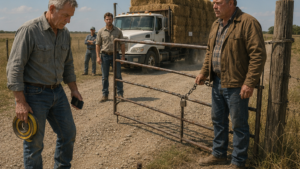
Thomas stopped beside the gate with a toolbox in one hand. The gate itself had been rehung on new hinges and widened enough for emergency vehicles. Fresh limestone formed a raised lane across the repaired culvert, bordered by reflective stakes that curved clearly away from the drainage cut.
The old lamp pole lay along the west side of the crossing. Steven’s crew had cut away the damaged footing and fitted the pole between two posts as a low guardrail. Its dented shade had been removed, leaving only the weathered metal length, streaked with rust and dried mud.
Virginia noticed Thomas first.
“You’re late.”
“I said eight.”
“It’s eight-ten.”
Melissa climbed down. “The county crew arrived early.”
Thomas set down the toolbox. “You could have waited.”
“We could,” Virginia said. “We chose not to.”
The answer was not unkind, but it held its boundary.
Thomas looked toward the new beacon.
It stood on Melissa’s side of the property line, fully inside the narrow strip she had granted for shared access. A square solar panel faced south above a compact fixture with a deep metal shield. Unlike the old lamp, it would cast no broad wash over the orchard or across the upstairs windows. Its beam was designed to fall only on the safe approach, the gate, and the first section of the raised crossing.
Steven knelt beside the control box, checking the battery leads.
“You bring the torque wrench?” he asked.
Thomas lifted the toolbox.
“Then you’re useful after all.”
The old ease in Steven’s voice had not returned completely, but enough of it was there for Thomas to recognize.
Patrick stood near the county truck with the signed agreement clipped to a board. Two small signs had been mounted at either end of the lane: SHARED ACCESS—CLOSE WHEN FLOODED. Beneath each sign, three phone numbers were listed without identifying one as primary.
Patrick called everyone together.
“The automatic setting runs from dusk until ten,” he said. “After ten, the motion sensor activates the lower beam for vehicles or pedestrians. The manual emergency mode keeps it on continuously for six hours.”
Virginia adjusted her coat collar. “Make that eight.”
Patrick looked at Steven.
“The battery will support eight unless there have been several cloudy days,” Steven said.
“Then six normally and eight during a declared storm watch,” Virginia said. “Put it in the protocol.”
Melissa nodded. “Agreed.”
They both looked at Thomas.
He had spent twenty-two years making such decisions before anyone else could consider them. His first instinct was to ask whether eight hours would reduce battery life, whether motion sensitivity would be affected by cattle, whether Virginia’s porch could see the focused beam clearly enough.
Instead he said, “Agreed.”
Patrick wrote the change.
Virginia glanced at him, measuring whether the answer had cost him anything.
It had.
Steven handed Thomas the torque wrench and directed him to the beacon base. Together they tightened the four anchor bolts. Melissa spread gravel around the footing while Virginia tested the width of the turn by walking the route with her stick.
The work was ordinary. No one watched from the county road. There were no orchard crews gathered at the gate, no official orders fastened to a pole, no argument sharp enough to travel across a field.
Thomas found the quiet more difficult than the confrontation.
At noon they tested the system by covering the solar sensor.
The beacon came on without a buzz.
A narrow amber-white beam settled over the lane. It illuminated the reflective stakes, the edge of the gate, and the pale crown of the rebuilt crossing. The orchard remained in shadow. Melissa’s house on the rise showed no trace of glare.
Virginia walked to the far side and turned.
“From here,” she called, “the left marker disappears behind the gate.”
Melissa moved it herself. She pulled the stake, carried it three feet uphill, and pressed it back into the ground.
Virginia raised one hand.
“That works.”
Thomas watched the exchange without interfering.
Patrick inspected the light spill with a handheld meter, then signed the permit.
“The route is approved for restricted shared access,” he said. “The county will inspect after the spring thaw. Until then, maintenance and closure follow the agreement.”
He gave one copy to each landowner.
Melissa folded hers into a plastic sleeve. Virginia placed hers in her handbag. Thomas read the first paragraph, then stopped at the revised purpose.
Shared emergency and agricultural access.
No one described Virginia as dependent. No one described Thomas as guardian. No one described Melissa as complainant.
Steven opened the control box and removed three small keys from a sealed envelope.
“One each,” he said.
He handed a key to Virginia, then Thomas, then Melissa.
Thomas turned his over in his palm. It was smaller than the key to the old pump house. The brass was bright and unmarked.
Melissa watched him.
“You kept the old switch key, didn’t you?”
“For the service box.”
“Where was it?”
“On my truck ring.”
“For twenty-two years?”
Thomas closed his hand around the new key. “Yes.”
Melissa looked toward the beacon. “I don’t want one person carrying this one.”
“There are three.”
“That isn’t what I mean.”
Near the gate stood a weatherproof lockbox mounted to a post. It held emergency instructions, a flashlight, and the closure chain. Melissa opened it.
“Patrick approved a shared key storage option,” she said. “Combination requires any two of us to change.”
She extended her hand.
Thomas looked at the key in his palm.
A week earlier, surrendering it would have felt irresponsible. Someone needed to know where the control was. Someone needed to be available. Someone needed to remain watchful when others went home.
He had built much of his life around being that someone.
Virginia came to stand beside Melissa.
“You may keep it,” she said. “But then it is your key, and we are back where we started.”
Thomas placed the key in the lockbox.
Melissa added hers. Virginia added the third.
Steven shut the lid.
That evening, Thomas returned to test the crossing with his truck.
The sun had dropped behind the ridge, leaving a cold blue band over the fields. The beacon activated as he approached the motion zone. Its light came on softly, reaching no farther than necessary.
He drove across at walking speed.
The tires remained centered between the markers. Water moved safely beneath the new culvert. At Virginia’s side, he stopped near the lower gate.
She stood beside her mailbox wearing a heavy coat.
“I saw you from the kitchen,” she said.
“Beam bright enough?”
“Yes.”
“Motion delay?”
“Fine.”
“I can set a nightly check until we know the battery holds.”
Virginia shook her head.
“It’s no trouble.”
“I know.”
“Then why not?”
She looked past him toward the focused light.
“Because I do not want you checking whether I need to be checked.”
Thomas rested one arm on the open truck window.
“What if there’s a storm?”
“We follow the protocol.”
“And if you’re late coming home?”
“I call.”
“If your phone is out?”
“I use the radio in the barn or take the north road.”
He almost listed the weaknesses in each option. Virginia saw the words gathering.
“Thomas.”
He stopped.
“I trust the light,” she said. “I am learning to trust the agreement. You need to let both of those exist when you are not standing beside them.”
He looked toward the old pole, now part of the guardrail. In the beacon’s narrow glow, its rusted surface was visible for only a few feet before disappearing into darkness.
“I thought keeping watch was the promise,” he said.
Virginia’s expression softened.
“It was the only promise you knew how to make then.”
She closed the mailbox.
“That does not mean it is the only one you are allowed to keep.”
Thomas nodded once.
As he drove back across the field, he saw Melissa near the orchard fence. She was adjusting a lower reflector while her son held a flashlight.
Thomas slowed.
Melissa approached the truck.
“No glare upstairs,” she said.
“Good.”
“My son says the west turn is clearer now.”
“It is.”
They stood with the engine idling between them.
Melissa put her hands into her coat pockets. “I still think you should have told me sooner.”
“You’re right.”
“And I should not have cut the power.”
“No.”
She waited, perhaps expecting him to soften the answer.
He did not.
Then she nodded. “All right.”
It was not forgiveness. It was enough truth to continue working beside.
Thomas drove through the lower gate and stopped long enough to close it behind him. The latch caught cleanly.
The new beacon remained steady over the shared lane. Its shield kept the orchard dark. Its reflected markers traced a safe bend toward Virginia’s property. No single house appeared to own the light, and no one standing at a distance would know which landowner had first wanted it, opposed it, or depended on it.
Thomas walked the final stretch home after parking his truck near the upper barn.
At the crest of the pasture, he could have turned and checked whether the beacon still burned. The habit pulled at him with the force of a hand on his shoulder.
He kept walking.
Behind him, the light stayed on without being watched.
The story has ended.