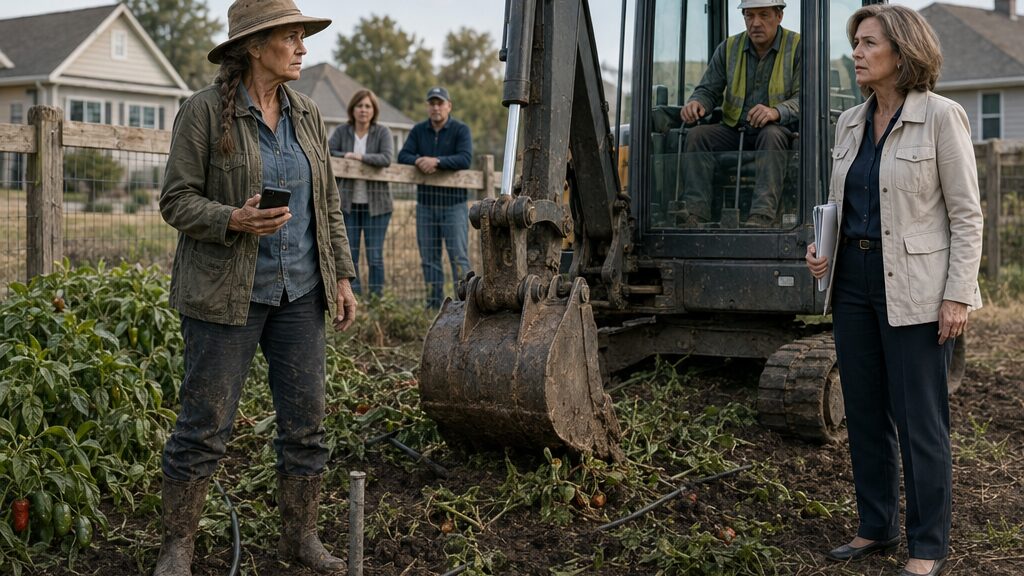
They Bulldozed Emily’s Garden for Breaking HOA Rules—Then She Found the Boundary They Never Checked
Chapter 1: The Excavator Crossed the Wrong Row
The excavator bucket dropped into Emily Harris’s pepper row before she understood why the machine was there.
Six plants disappeared beneath the steel teeth.
“Stop!”
Emily ran from the shed, one glove still tucked into the back pocket of her jeans. The machine’s engine swallowed her voice. The operator curled the bucket, dragging black soil, irrigation tubing, and green pepper branches into a broken mound.
Emily stepped directly into the next row and raised both arms.
The operator saw her.
The bucket stopped.
For three seconds, nothing moved except dust.
Then Donna Clark came through the farm gate carrying a folder.
“Emily, you cannot stand in front of equipment.”
Emily stared at the ruined plants.
“You brought it onto my land.”
Donna’s mouth tightened. “The association authorized removal of the noncompliant agricultural area.”
“My what?”
“The board has sent notices for months.”
Emily looked past her toward the subdivision. A few residents had gathered along the sidewalk behind the fence. The houses there were less than fifteen years old.
Emily had planted vegetables here with her father before the first foundation had been poured.
She pointed at the excavator.
“Tell him to leave.”
Donna opened the folder. “We have a work order.”
“That isn’t what I asked.”
The operator lowered his engine to idle.
Donna glanced toward him. “We need to continue.”
Emily moved closer to the machine.
“No.”
“Emily—”
“Show me the boundary.”
Donna stopped.
Emily could hear the excavator ticking beneath its idle now.
“You say your association has authority here,” Emily said. “Show me where its property ends and mine begins.”
Donna held up a sheet inside the folder.
“We have the management map.”
“I didn’t ask for a management map.”
Emily’s voice remained quiet.
“I asked for the recorded boundary.”
One of the neighbors shifted behind the fence.
Donna’s expression changed—not fear, exactly, but irritation at being forced into a conversation she had expected to be over.
“The board has already established that this strip falls within association jurisdiction.”
“Using what?”
“Our records.”
“Which record?”
Donna closed the folder.
“The proper time to dispute this was during the violation process.”
Emily looked at the torn earth.
“That bucket is sitting where my peppers were five minutes ago. I think now is proper enough.”
The operator climbed down.
“I’m not moving anything while she’s standing there,” he said.
Donna turned toward him. “The work order is valid.”
“Maybe. But I’m not running equipment around somebody who’s contesting the property line.”
Emily took out her phone.
Her hands were shaking.
She hated that Donna could probably see it.
Instead of putting the phone away, Emily photographed everything—the bucket, the torn irrigation tube, the tire marks, the gate, the work order in Donna’s hand.
Then she noticed something near her boot.
A dull metal cap barely protruded from the soil beside the irrigation line.
Emily crouched.
She brushed dirt away with two fingers.
The little iron survey pin had been there as long as she could remember. Her father used to tell her not to strike it with the tiller.
She had never thought much about why.
Now she photographed it.
Donna watched her.
“What is that supposed to prove?”
“Nothing yet.”
Emily stood.
“But before anybody digs another foot, I intend to find out.”
Donna exhaled through her nose.
“The board isn’t going to suspend necessary enforcement because you found an old piece of metal.”
“Then you should have no trouble proving where the line is.”
Donna turned to the operator.
“Move to the north end. Clear the section beside the fence.”
Emily’s head snapped up.
“That section is mine too.”
“The work order covers it.”
Emily walked toward Donna until the folder was the only thing between them.
“Then give me a copy.”
Donna hesitated.
That hesitation hurt Emily more than the dismissive tone had.
For months, she had treated every notice as an irritation that could eventually be corrected by explaining the obvious. She had answered politely. She had avoided meetings. She had refused to spend her mornings arguing with people who had never harvested anything more demanding than lawn clippings.
She had assumed being reasonable would protect her.
Now half a pepper row lay underneath an excavator bucket.
“Give me the work order, Donna.”
Donna removed the top sheet and held it out.
Emily took it.
The operator remained beside his machine.
“I can wait for somebody to sort this out,” he said.
Donna looked toward the residents at the fence. Her cheeks had reddened.
“We’ve already delayed this project twice.”
“That isn’t her problem,” the operator said.
Donna stared at him, then at Emily.
“No additional excavation until Monday,” she said. “But this doesn’t change the violations.”
Emily folded the paper once.
Donna left through the gate without saying goodbye.
The small audience dispersed more slowly.
Emily waited until the last neighbor had gone before walking back to the destroyed row.
She knelt beside the peppers.
Some plants had been uprooted cleanly. Others were crushed into the soil. A black irrigation hose had been sliced open and was leaking a thin stream of water into the tire rut.
Emily pinched the hose closed.
For years, that gate had rarely been locked.
Delivery drivers used it. Neighbors sometimes asked to buy tomatoes. Children had watched her bees from the fence.
She had never thought of openness as weakness.
She looked toward the metal survey pin.
Then she looked at the work order.
At the top was the management company’s name.
Below it was the association.
And beneath a description of the clearing work was a line Emily read three times.
PROPERTY LOCATION: ASSOCIATION COMMON AREA / HARRIS AGRICULTURAL PARCEL.
Emily slowly straightened.
Her land wasn’t merely listed as being subject to association rules.
The work order described it as association property.
Someone had decided where the boundary was.
And whoever had made that decision had been confident enough to send an excavator across it.
Chapter 2: Four Hundred Dollars Every Friday
Emily laid twelve envelopes across the kitchen table beside a basket of peppers she had salvaged from the damaged row.
Every envelope carried the same management-company logo.
The first had arrived twelve weeks earlier.
She remembered opening it with muddy hands and almost laughing.
UNAPPROVED AGRICULTURAL ACTIVITY.
The notice identified vegetable cultivation, visible farm equipment, beehives, and “commercial-type agricultural use” as violations.
Emily had read it twice, then looked through the kitchen window at the subdivision.
She had assumed somebody had made a clerical mistake.
Her house and half-acre plot had existed before the subdivision.
She wasn’t a member of its pool. She didn’t use its private streets. She had never paid its dues.
So she emailed the management company.
The response had been brief.
The property was shown within the association’s enforcement area.
Emily replied that it wasn’t.
Then she went outside and worked.
A week later, another notice arrived.
The third included a fine.
Four hundred dollars per week.
Emily had called the management office after that one.
The representative had told her to submit an architectural compliance request if she intended to maintain agricultural structures.
“My beehives were here before your clubhouse,” Emily had said.
The representative had paused.
“Then you can explain that in the application.”
Emily had hung up.
That had been her mistake.
Not because the representative was right.
Because Emily had decided the whole thing was too foolish to deserve more of her time.
She had put the notices in a drawer.
Inspectors—or people she assumed were inspectors—began photographing the fence.
Donna appeared once beside the gate and told Emily complaints had been received about bees.
“My bees don’t know what an HOA is,” Emily had said.
Donna hadn’t smiled.
“That’s exactly the attitude making this difficult.”
Later came complaints about produce crates visible from the street. Then a warning about a small roadside table Emily used twice each summer for excess tomatoes.
Each time, Emily answered just enough to object and not enough to force a formal decision.
Now she pulled her laptop toward her.
The excavator photographs were already uploaded.
She enlarged one.
The machine’s bucket hung over the ruined pepper row. Near the bottom corner of the image was the survey pin.
Emily opened her email archive.
She searched Donna’s name.
Thirty-seven results appeared.
Most were forwarded notices.
Then Emily found the message she remembered sending after the second fine.
She opened it.
Three sentences.
The last one made her sit back.
Your map is wrong. My parcel is not part of your subdivision, and I have never agreed to HOA restrictions.
Emily read it again.
She hadn’t forgotten objecting.
She had forgotten how clearly she had done it.
She searched for a response.
Nothing.
Then she opened the association’s online violation portal.
Her account existed despite her never creating one.
Twelve violations were listed.
The old email wasn’t attached to any of them.
Emily called the management office.
After several transfers, a representative found the correspondence.
“I see your email,” the representative said.
“Was it sent to the board?”
“I can’t confirm internal distribution.”
“Was it treated as an appeal?”
“No. Appeals require the form linked in the notice.”
“I said the property wasn’t in the HOA.”
“I understand.”
“No, I’m asking whether anyone answered that.”
Silence.
“I’m not seeing a response.”
Emily looked at the peppers on her table.
“So I challenged your authority, nobody answered, and three months later somebody sent an excavator.”
“I can’t address contractor decisions.”
“Who can?”
“The board.”
Emily ended the call before anger made her careless.
She printed the email.
Then she went outside.
The damaged row looked worse in afternoon light. Broken plants had begun wilting. The cut irrigation tube was temporarily patched.
Emily stood beside the old pin and opened the first violation notice.
A small map was printed on the second page.
She had barely noticed it before.
The subdivision was shaded gray.
Her half acre appeared inside the gray area.
She carried the page into the farmhouse and found an older county tax statement.
Its map was crude, but Emily could see a difference.
On the HOA map, the subdivision boundary ran behind her house.
On the tax map, a thin line wrapped around the house and field separately.
Two maps.
Two boundaries.
For the first time since the excavator arrived, Emily felt something other than anger.
She felt embarrassed.
Her father had kept deeds, receipts, surveys, and tax records in labeled boxes.
Emily had teased him about it.
“If the dirt moves,” he’d once told her, “then maybe you can throw away the paper.”
She hadn’t thrown it away.
She simply hadn’t looked.
Emily went to the hall closet and pulled out the old file box.
Inside were property-tax statements, seed invoices, a faded photograph of her father beside the first beehives, and folded county maps.
Near the bottom was a tax map nearly twenty years old.
She opened it across the kitchen table.
The subdivision wasn’t there yet. Only fields, two county roads, and a few rectangular parcels.
Emily found hers.
Half an acre.
Separate number.
Separate outline.
Years later, the subdivision had grown around three sides of it.
But on this map, at least, the line never disappeared.
Emily put the HOA map beside it.
The association’s gray shading crossed straight over the old boundary.
She took another photograph.
This time her hands weren’t shaking.
Tomorrow, she would go to the county records office.
And she would find out whether that thin line was merely an old mark on an old map—or whether twelve weeks of fines and an excavator had been sent across a boundary the HOA had never possessed.
Chapter 3: The Parcel the Subdivision Left Behind
The county clerk placed two recorded plats beneath the glass counter and looked at Emily.
“These don’t match the map you brought.”
Emily leaned closer.
“I know.”
“No,” the clerk said, tapping the HOA printout. “I mean this one isn’t a recorded plat.”
Emily stared at the paper she had spent three months being fined under.
“What is it?”
“I couldn’t tell you. Management map, maybe.”
The clerk slid the first official plat toward her.
“This is the subdivision as recorded.”
The lines were clean and black, crowded with lot numbers, easements, roads, and measurements.
Emily found her house.
Or rather, she found the empty shape where her house and field should have been.
The subdivision wrapped around it.
It did not include it.
Her pulse quickened.
“So that’s it?”
The clerk shook her head.
“That’s one document.”
The answer irritated Emily until she realized it was exactly what she needed.
Not reassurance.
Accuracy.
The clerk directed her to Thomas Wright in land records.
Thomas was a lean man with reading glasses and the careful manner of someone accustomed to people arriving at his desk hoping a piece of paper would settle an argument.
Emily showed him everything.
The fines.
The work order.
The tax map.
The photograph of the excavator.
Finally, the recorded subdivision plat.
Thomas studied the parcel numbers.
“Your tax parcel is this one?”
“Yes.”
“And you still own it under the same description?”
“Yes.”
He entered the number into his computer.
Emily waited.
Thomas rotated the monitor slightly.
“There.”
Her parcel appeared as its own shape.
The subdivision parcels surrounded it.
Emily felt a pressure loosen beneath her ribs.
“So they have no authority.”
Thomas looked at her over his glasses.
“I didn’t say that.”
She almost laughed from frustration.
“What did you say?”
“I said the county identifies this as a separate tax parcel and the recorded subdivision plat you’re showing me doesn’t include it.”
“Isn’t that the same thing?”
“Not necessarily.”
He pulled the keyboard closer.
“HOA authority can involve recorded covenants, later annexation documents, private agreements. County parcel records tell you one thing. They don’t automatically answer every private restriction question.”
Emily sat back.
For ten minutes she had been imagining carrying the plat into the next board meeting and watching Donna run out of words.
That imagined victory vanished.
Thomas must have seen it happen.
“This is useful,” he said. “It’s just not the end.”
Emily nodded.
“What do I need?”
“If you’re asking whether your parcel was ever made subject to private covenants, I’d start with your deed history and recorded instruments associated with the parcel. I can show you where to search. I can’t give you a legal opinion.”
“I don’t need an opinion.”
Thomas gave her a small look.
“Most people standing at this desk do.”
Emily almost smiled.
“Show me where to search.”
For the next hour, she worked through records she would once have considered unbearable.
Transfers.
Deed references.
Subdivision filings.
Easements.
She wrote dates in a notebook instead of trusting herself to remember.
The original subdivision plat had been recorded fourteen years earlier.
Emily’s parcel existed before it.
A later phase expanded the subdivision farther east.
Still her half acre remained outside the outlined lots.
Thomas helped her identify the recording references but refused to interpret them.
When she found no annexation instrument, she felt hope rise again.
Then Thomas pointed to another problem.
“Your deed may reference older restrictions separately.”
Emily looked at him.
“So I keep going.”
“That’s what I’d do.”
She left with copies in a brown county envelope.
At home, she spread them across the same kitchen table where the twelve violation notices had been.
This time she arranged everything by date.
Her father’s records filled gaps the county printouts didn’t.
He had kept the purchase papers from before Emily was born. He had kept irrigation receipts. A soil-conservation letter. Tax assessments.
And an envelope marked LAND.
Inside was a copy of the deed from the year her parents took full ownership.
Emily read slowly.
Most of the language meant little to her.
She recognized acreage.
Road references.
An easement.
Then she found an attachment.
The paper was yellowed at the edges.
It described permitted agricultural use of the parcel and referenced produce cultivation, accessory structures, and direct agricultural activity under the rules in effect at the time.
Emily read the date.
It predated the subdivision by decades.
She placed it beside the recorded plat.
For a moment, the case looked almost simple.
Her parcel had been separate.
Its agricultural use was old.
The subdivision had grown around it.
But Thomas’s warning remained.
Private agreements.
Later covenants.
Annexation.
Something recorded after this attachment could still change the picture.
Emily opened the file box again.
Near the bottom she found several envelopes from the years when the subdivision developer had been buying neighboring acreage.
Her father had kept those too.
One contained a purchase offer.
Another discussed access.
A third referred to a proposed boundary adjustment that apparently never occurred.
Emily’s stomach tightened.
She read every page.
Nothing showed a completed transfer.
Nothing showed HOA membership.
But one letter mentioned a future agreement that would be prepared “if the Harris parcel elects inclusion.”
Emily stopped.
If.
She circled the word.
Her father had never talked much about those negotiations. He had simply said they weren’t selling.
Emily looked through the remaining papers.
No signed inclusion agreement.
No later deed attachment.
No document surrendering the parcel.
Still, absence in her father’s box was not proof that nothing existed elsewhere.
She photographed the agricultural-use attachment and added it to her growing folder.
Then she looked at the HOA work order again.
ASSOCIATION COMMON AREA / HARRIS AGRICULTURAL PARCEL.
Two days earlier, those words had made her feel as if somebody had erased her ownership with a line of typing.
Now she understood something different.
There were lines that mattered because someone shaded them on a management map.
And there were lines that mattered because they had been measured, recorded, transferred, and agreed to.
Emily closed the folder.
She wasn’t ready to declare victory.
She had done too much assuming already.
But she was ready to ask Donna Clark a question in front of the entire board.
If Emily’s parcel had ever entered the HOA, there had to be a record of how it happened.
And this time, Emily wasn’t going to leave the room until somebody showed it to her.
Chapter 4: The Meeting Where Nobody Had the Plat
Donna Clark opened the HOA meeting by asking Emily when she planned to remove the remaining beehives.
Emily had not even taken off her coat.
For a moment, she simply stood beside the folding table with the brown county envelope tucked under one arm.
“I’m not removing them,” she said.
Donna looked down at the agenda.
“Then the violation remains active.”
Emily pulled out the recorded subdivision plat.
“That depends on whether you have authority to issue it.”
The room changed.
Not dramatically. Nobody gasped. Nobody raised a voice.
But several board members stopped arranging papers.
Michael Anderson looked from Donna to the large sheet Emily was unfolding.
Donna set down her pen.
“We’ve already discussed jurisdiction.”
“No,” Emily said. “You told me your map showed my property inside the association. I’m asking you to show me the recorded document that put it there.”
She spread the county plat across the table.
The subdivision lots formed an uneven block of numbered parcels.
Emily’s half acre appeared as an empty notch between them.
She placed one finger on it.
“This is my parcel.”
Donna did not lean closer.
“Our management records show the enforcement area extending to the county road.”
“Those aren’t the same thing.”
“The association has operated under that boundary for years.”
Emily looked around the table.
“Then someone here should be able to point to the document that created it.”
Silence.
A board member pulled the plat closer.
Michael stood and bent over the map.
“Where’s your house?”
Emily showed him.
“And the garden?”
“Here.”
Michael traced the subdivision line with his finger.
His expression tightened.
Donna said, “Recorded plats don’t necessarily reflect covenant jurisdiction.”
Emily nodded.
“I know.”
That answer seemed to surprise her.
“I’ve been to the county.”
Emily took out the parcel record and the older deed attachment.
“I know this doesn’t settle every private agreement. That’s why I’m here asking for yours.”
Donna pushed her chair back slightly.
“The association attorney is reviewing the issue.”
“Then what did the board rely on before sending the excavator?”
“We relied on the management company’s records and years of established enforcement.”
“Established against whom?”
Donna’s jaw tightened.
“Emily, this is becoming unnecessarily adversarial.”
Emily almost laughed.
Instead, she looked at the photographs in her folder—the destroyed pepper plants, the torn irrigation line, the excavator tracks.
She set them on the table.
“The machine was already adversarial.”
Michael picked up the management map from the board packet.
It showed the subdivision shaded in pale gray.
Emily’s parcel sat inside the shading.
He placed it beside the recorded plat.
The difference was obvious.
“Where did this map come from?” he asked.
Donna answered too quickly.
“The management database.”
“Based on what?”
“That is what we’re trying to verify.”
Emily looked at him.
“So you don’t know.”
Michael did not answer.
Donna did.
“We know the board has treated the Harris property as subject to community standards.”
“Treating it that way doesn’t make it so.”
Donna opened another folder.
“Actually, your own history suggests otherwise.”
She removed copies of Emily’s old violation notices.
Emily recognized the envelopes immediately.
Donna laid out several responses Emily had sent over the previous months.
“You responded to enforcement correspondence repeatedly.”
“Yes.”
“You discussed the alleged violations.”
“Yes.”
“You requested clarification.”
“Yes.”
“And you did not file a formal jurisdictional challenge.”
Emily felt something cold move through her.
She knew where Donna was going.
Donna continued.
“For months, you participated in the association’s compliance process without filing an appeal.”
“I told your management company my parcel wasn’t in the HOA.”
“But you did not use the appeal procedure.”
“Because I don’t believe I belong to your association.”
Donna folded her hands.
“That is precisely what legal counsel will have to evaluate.”
Emily stared at her own emails on the table.
The words looked smaller printed out.
She had believed refusing to engage fully protected her from recognizing the board’s authority.
Now her avoidance could be made to look like participation.
Michael picked up one email.
“What’s this one?”
Donna glanced at it.
“Routine correspondence.”
Michael read silently.
Then he looked at Emily.
“This says, ‘Your map is wrong. My parcel is not part of your subdivision.’”
Emily nodded.
“That was my second response.”
Michael turned to Donna.
“Did we receive this?”
“The management company did.”
“Was it sent to the board?”
Donna hesitated.
“I don’t remember the exact routing.”
Emily felt the room sharpen.
Michael placed the page down.
“Then before we talk about whether she filed the correct form, I think we need to know whether we ignored the substance because it arrived the wrong way.”
Donna’s face colored.
“We followed our established procedure.”
“And then hired equipment.”
“We hired a contractor after multiple unresolved violations.”
Emily asked, “Unresolved because I refused to comply, or unresolved because nobody answered whether you had jurisdiction?”
Donna looked directly at her.
“You still have not demonstrated that no covenant applies.”
Emily gathered the papers slowly.
“You’re right.”
Donna seemed taken aback.
Emily continued.
“I haven’t proven every possible thing that doesn’t exist. But your board sent a machine onto my property. So now I’m asking what you had before you did that.”
No one answered.
The meeting moved to other business, but not cleanly.
The board agreed to suspend additional physical enforcement until legal review was complete. Donna refused to withdraw the fines. Michael insisted the management company provide the source file for its boundary map.
Emily got no apology.
No declaration of victory.
No check for the destroyed plants.
Still, when she walked out of the clubhouse, she carried one thing she had not had when she entered.
The board itself had admitted its map was not the recorded plat.
She had almost reached her truck when Michael called after her.
“Emily.”
She turned.
He glanced back toward the clubhouse before approaching.
“I need to tell you something.”
She waited.
Michael kept his voice low.
“The morning of the excavation, Donna forwarded an email to the board.”
“What email?”
“Yours.”
Emily did not move.
“The one where you said the boundary was wrong?”
He nodded.
“She sent it to us at seven-thirteen that morning.”
Emily looked toward the clubhouse windows.
“And the excavator arrived around nine.”
“Yes.”
“Did anyone tell her to stop it?”
Michael rubbed a hand over his face.
“I asked whether we should verify the line first.”
“And?”
“She said the management map had already been relied on for years and delaying again would make the board look like it wasn’t enforcing anything.”
Emily stared at him.
Michael looked ashamed, but he did not look away.
“I didn’t stop her.”
The words mattered.
Not because they excused him.
Because they didn’t.
Emily tightened her grip on the county envelope.
Donna had not simply acted without knowing there was a boundary question.
She had acted after the question was placed directly in front of her.
Chapter 5: What Donna Was Trying to Protect
The email Michael described was in the board records exactly where he said it would be.
Emily found it three days later during the document review.
Seven-thirteen in the morning.
Donna had forwarded Emily’s message to the board with one sentence above it:
We have already delayed enforcement twice; management confirms the map, so the contractor will proceed as scheduled.
Emily read the line again.
Then she asked the management-company representative, “Was the map confirmed against a recorded plat?”
The representative shifted in the conference-room chair.
“I can’t speak to what verification was done at the board level.”
“I’m asking what your company did.”
“We maintained the property boundary shown in our system.”
“Where did it come from?”
“We’re still researching the original data source.”
Emily closed the file.
For days she had imagined Donna as someone who had simply wanted control.
The records showed something less satisfying.
There were complaints.
Many of them.
One homeowner had complained about bees near a backyard fence.
Another had photographed cars pulling onto the shoulder when Emily sold excess tomatoes the previous summer.
Two residents had written that visible crates, irrigation equipment, and farm activity made the subdivision look “unfinished.”
A real-estate agent had apparently told one homeowner that buyers asked whether additional commercial activity might develop along the edge.
Donna had answered all of them.
Often within hours.
Emily hated how much that complicated her anger.
Donna had not invented every concern.
The bees were real.
The roadside table had occasionally drawn cars.
Emily herself had watched two vehicles block part of a driveway one Saturday and had been annoyed enough to move the table farther inside the gate.
But none of those facts moved the boundary.
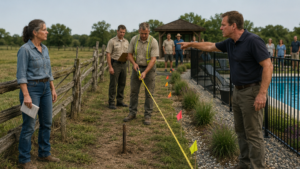
That afternoon, Emily found Michael standing beside the subdivision sidewalk while a survey technician placed bright flags along the farm edge.
“You knew about the complaints?” Emily asked.
Michael nodded.
“Most of the board did.”
“And that’s why you voted for enforcement.”
“Partly.”
He watched the technician push a stake into the soil.
“Last spring three houses along this side were listed. We started getting emails saying the farm looked like it was expanding into the neighborhood.”
“It wasn’t.”
“I know that now.”
“You could have known it then.”
Michael accepted the hit.
“Yes.”
The technician moved farther down the row.
Michael said, “Donna had people calling her at home. Not just about you. Parking, lawns, rental houses, fences. Everybody wanted the board to fix something.”
“So she used an excavator.”
“No. I’m not defending that.”
“It sounds like you are.”
“I’m telling you why I voted with her.”
Emily folded her arms.
Michael looked toward the houses.
“I wanted the complaints to stop. Donna said management had the boundary in its system and enforcement would settle it. That sounded easier than reopening old subdivision documents.”
Emily stared at him.
“And easier for who?”
He gave a tired nod.
“Exactly.”
That answer stayed with her.
Not because Michael had suddenly become brave.
He hadn’t.
He had been willing to let a system act against Emily because examining it closely would have created work and conflict for him.
That was almost worse than open hostility.
But it was also ordinary.
Fear of complaints.
Fear of falling property values.
Fear of appearing weak.
Nothing dramatic.
Just enough pressure for people to stop asking who actually had the right to do what.
The survey technician called Emily over.
A temporary flag stood several feet inside the farm side of the fence.
“This is preliminary until I finish the field work,” the technician said. “But your old pin is consistent with the recorded description.”
Emily looked toward the excavated row.
“How far from the boundary was the machine?”
The technician measured from the marked line.
“Entire disturbed section appears to be inside your parcel.”
Emily said nothing.
The answer was what she wanted.
It did not feel the way she had expected.
That evening, an email arrived from the HOA’s insurer.
Emily had submitted photographs, plant-loss estimates, and the irrigation repair invoice.
The response did not deny damage.
It did not accept it either.
Coverage could not be determined, the adjuster wrote, until the association’s authority and responsibility for contractor access were clarified.
Another delay.
Emily printed the email and added it to the folder.
Her kitchen table had become an archive of everything she once avoided.
Maps.
Notices.
Photographs.
Emails.
Receipts.
She ran her finger along the edge of the newest survey sketch.
The line looked almost absurdly simple on paper.
A few measurements.
A few points.
In real life, people had been arguing across it for months.
The next morning, Donna appeared outside the farm gate.
Emily saw her before Donna called out.
She almost stayed in the field.
Instead, she walked over.
Donna looked at the orange survey flags.
“I heard you commissioned a survey.”
“Yes.”
“Probably wise.”
Emily studied her.
Donna seemed tired.
There were shadows under her eyes that had not been there at the first meeting.
“Why didn’t you stop the contractor?” Emily asked.
Donna did not pretend not to understand.
“We had complaints going unanswered for months.”
“My boundary email wasn’t a complaint.”
“I believed management’s map was reliable.”
“You knew I challenged it.”
“I knew you challenged everything.”
The words came out sharper than Donna seemed to intend.
She paused.
Then said, “Every enforcement action became an argument. The hives. The produce table. The equipment. Residents were asking why the board had rules if one property could ignore them.”
“One property that may never have been under those rules.”
“I understand that now.”
“No. You understand that somebody is finally making you prove it.”
Donna looked toward the houses.
“Do you know what people say when the board doesn’t act? They say we’re incompetent. They say we’re playing favorites. They threaten to replace us.”
Emily almost felt sympathy.
Almost.
“You were more afraid of looking weak than of being wrong.”
Donna’s face hardened again.
“I made a decision based on the information I had.”
“You had my email.”
“And a management map.”
“You chose the one that let you keep moving.”
Donna did not answer.
The survey technician returned later that afternoon with permanent coordinates and a marked copy of the field survey.
Emily followed him along the edge.
One stake went near the old iron pin.
Another beyond the hives.
Another near the road.
When he finished, he handed her the preliminary certification.
Emily looked at the measurements.
Then at the excavator tracks, still faintly visible where she had not replanted.
Every damaged pepper plant.
Every crushed section of irrigation line.
Every tire mark.
All of it lay inside Emily’s parcel.
Not partly.
Not approximately.
Entirely.
She took a photograph of the stakes before touching anything.
Then she sent the survey to Donna, Michael, the management company, and the insurer.
The reply from Donna came twenty minutes later.
The board would discuss resolution.
Emily stared at those words.
Resolution could mean compensation.
Or it could mean another attempt to make the problem disappear without admitting what had happened.
Chapter 6: The Offer That Asked Her to Stay Quiet
The settlement check arrived before the settlement agreement.
Emily almost deposited it.
The amount was printed clearly enough to make her stop at the kitchen counter: compensation for the damaged pepper plants, irrigation repair, and a portion of her documented labor.
Not everything she had claimed.
But enough to make the last two months feel as though they might finally be ending.
Then she unfolded the attached letter.
Acceptance of payment, it said, would constitute agreement to the enclosed resolution terms.
Emily put the check down.
The resolution terms were six pages long.
By page two, she understood why Donna had been willing to send money.
The association would withdraw existing fines.
It would acknowledge that Emily’s parcel was not presently included in the recorded subdivision plat.
In return, Emily would release the association, management company, board members, and contractor from further claims connected to the excavation.
That part did not surprise her.
The next section did.
Emily would also agree voluntarily to limit agricultural activity visible from the subdivision.
No expansion of produce sales.
No additional hives.
No weekend vendor activity.
No roadside customer parking.
No new agricultural structures without written consultation with the association.
Emily read the word voluntarily twice.
She laughed once, without humor.
Then she sat down.
The check remained beside her hand.
For one dangerous minute, she imagined signing.
The pepper row was already replanted.
The survey was done.
The fines would vanish.
Donna would stop sending notices.
Emily could close the folder, put it in the hall closet, and go back to being left alone.
She picked up a pen.
Her name would end it.
That was exactly why she stopped.
Emily looked toward the window.
Beyond the glass, the farm gate stood open.
She remembered how many times she had avoided this conflict because she wanted peace more than clarity.
The unanswered first notice.
The phone call she ended instead of following with certified mail.
The meeting she skipped because she couldn’t bear the thought of sitting beneath fluorescent lights arguing about bees with strangers.
Every small withdrawal had felt reasonable at the time.
Together, they had created room for someone else to define her silence.
Emily put the pen down.
The mediation meeting was two days later.
Donna sat on one side of the table with the management-company representative.
Michael sat farther down, arms folded.
Emily placed the unsigned agreement between them.
“I’ll accept documented compensation,” she said. “I won’t accept these restrictions.”
Donna glanced at the marked pages.
“They’re intended to prevent the same conflict from happening again.”
“No. They’re intended to give you the control your own survey says you don’t have.”
“The board still has legitimate concerns about nuisance impacts.”
“Then address an actual nuisance if one happens.”
Donna’s expression cooled.
“We’re trying to resolve this without additional legal expense.”
“So am I.”
Emily pushed the agreement back.
“That’s why I won’t sign something that creates another argument before the first one is finished.”
The management representative cleared his throat.
“The restrictions are voluntary.”
“Then I’m declining them.”
Michael looked down, hiding what might have been a smile.
Donna noticed.
“This is not amusing.”
“No,” Michael said. “It isn’t.”
Donna turned back to Emily.
“If you intend to increase commercial activity, the board may have other remedies.”
Emily’s shoulders stiffened.
“What remedies?”
“Nuisance claims. Traffic impacts. Safety issues. Those don’t necessarily depend on HOA membership.”
There it was.
Not an excavator this time.
Something more careful.
Something that might even be legitimate under the right facts.
Emily hated that Donna had learned too.
She asked, “Are you threatening me for refusing your settlement?”
“I’m telling you the parcel doesn’t exist in isolation.”
Emily looked at Michael.
He did not disagree.
And that mattered.
The boundary survey had answered one question.
It had not given Emily permission to ignore everybody else.
She gathered the agreement.
“I’ll respond in writing.”
Outside, she sat in her truck without starting the engine.
The check was still in her bag.
For the first time, Emily understood why simple revenge stories always ended too soon.
Winning the boundary did not erase traffic.
It did not make bees incapable of crossing fences.
It did not mean she could do anything she wanted simply because Donna had done something she couldn’t.
Ownership came with its own obligations.
But obligation was different from submission.
That evening, Emily walked through the farm.
The damaged row was recovering.
The new pepper plants were smaller than the others, but healthy.
At the gate she stopped beside the permanent survey marker.
The metal cap was clean and bright now.
Her father had protected the old pin because he understood that the line mattered whether anyone was arguing about it or not.
Emily had spent years thinking the highest form of independence was needing nobody.
Maybe that had been wrong.
Maybe independence meant knowing when the rules applied, when they didn’t, and being willing to do the work to tell the difference.
She went inside and opened the county website.
Instead of searching HOA documents, she searched agricultural permits.
Direct farm sales.
Temporary vendor activity.
Roadside access.
Parking requirements.
The pages were dense.
She read them anyway.
The next morning, she called Thomas Wright.
He answered after two rings.
“County land records.”
“Thomas, this is Emily Harris.”
There was a pause.
“I remember.”
“I have a different question.”
“All right.”
Emily looked through the kitchen window at the gate.
“What permits would I actually need if I wanted to sell produce from my own farm?”
Thomas was quiet for a moment.
Then she heard a keyboard.
“How much activity are we talking about?”
“I don’t know yet.”
“Permanent stand?”
“Maybe not.”
“Outside vendors?”
Emily looked at the unsigned settlement agreement.
“Possibly.”
“Parking on-site?”
“If that’s what the rules require.”
Another pause.
Then Thomas said, “All right. Let’s start with what the county actually regulates.”
Emily picked up her pen.
This time, she was not asking someone else’s permission to exist on her land.
She was learning exactly what she could choose to do with it.
Chapter 7: The Gate Opened on Her Terms
The first vendor truck arrived before Emily had opened the gate.
It waited on the shoulder with its hazard lights blinking while Emily stood inside the entrance holding the new county permit in one hand and the gate chain in the other.
For a second, she did nothing.
Six weeks earlier, other people had walked through this opening with a work order and an excavator.
Now the choice to open it belonged to her.
Emily unhooked the chain.
The gate swung inward.
“Come on through,” she called.
The driver eased the truck between the permanent survey markers.
Emily watched the tires carefully.
They stayed on her side.
That mattered more than she expected.
By seven-thirty, folding tables stood beneath three white canopies. One vendor arranged peaches in shallow wooden crates. Another brought cut flowers and jars of honey. Emily set her own peppers, tomatoes, squash, and herbs beneath the old maple near the house.
She had imagined something bigger when she first asked Thomas about farm-direct sales.
Not revenge exactly.
But something close enough that she had caught herself thinking about Donna’s windows across the subdivision.
Thomas had corrected that impulse without knowing it.
The county allowed limited farm sales, but the conditions were clear: customer parking had to remain on the parcel, roadside visibility could not be obstructed, temporary tents needed safe placement, and vendor numbers mattered.
Emily had spent weeks measuring spaces instead of imagining crowds.
The work had steadied her.
At eight, the first customers arrived.
A pickup parked beside the barn.
Then a sedan.
Then two more cars.
Emily stood near the gate directing them into marked grass spaces.
For the first hour, everything worked.
People bought tomatoes.
A child watched the bees from well behind the fence.
One neighbor from the subdivision came over carrying cash and left with peaches and a bunch of flowers.
Emily did not know whether to laugh.
Then, shortly before ten, six vehicles arrived within minutes of one another.
The marked spaces filled.
A seventh car stopped near the shoulder.
Emily saw the driver hesitate.
Behind it, another vehicle slowed.
The exact scene Donna had warned about began forming in front of her.
Emily moved quickly.
She walked to the road and waved the next car onward.
“Sorry. We’re full for the moment.”
The driver lowered the window.
“We’ll only be five minutes.”
“I know. But you can’t wait here.”
A horn sounded behind him.
Emily felt heat rise into her face.
Across the road, a subdivision resident stood at the end of a driveway watching.
Emily could already hear the argument before anyone made it.
See? This is what we told you would happen.
The driver moved on.
Emily went back through the gate.
One of the vendors approached.
“We could squeeze two more cars along the fence.”
Emily looked at the space.
They probably could.
But the turnaround would be tighter. A vehicle leaving might have to back near the gate.
“No.”
The vendor shrugged.
“Your call.”
It was.
That was the uncomfortable part.
Emily had spent months demanding that other people respect where their authority ended.
Now she had to decide where her own should end.
At noon, she gathered the vendors.
“Next Saturday, we’re cutting one table.”
Nobody spoke at first.
The flower vendor frowned.
“Business is good.”
“I know.”
“We could mark more parking.”
“We could,” Emily said. “But we’d be using almost every open strip beside the road.”
The peach vendor nodded slowly.
Emily continued.
“I don’t want customers waiting on the shoulder. I don’t want driveways blocked. If we grow, we do it because the site can handle it.”
One vendor asked, “So who loses the spot?”
“I’ll rotate it. Including mine if I need to.”
That quieted the complaints.
By afternoon, the flow settled.
The market was modest.
Not spectacular.
Emily liked it better that way.
Customers walked between the tables without crowding. People carried paper bags of produce back to their cars. The bees worked the flowers beyond the fence, indifferent to everything.
Donna did not appear.
Emily saw her once through an upstairs window, then not again.
At closing, Emily dragged the last empty crate into the shed.
She was tired enough that her legs ached.
But the exhaustion felt clean.
She had opened the gate.
Nothing terrible had happened.
Nothing miraculous had happened either.
She preferred that.
The next Friday, an envelope arrived by certified mail.
Emily recognized the law office name before opening it.
Donna had made good on her warning.
The letter did not claim Emily belonged to the HOA.
Instead, it cited traffic safety, nuisance concerns, customer congestion, and potential interference with neighboring residential use.
It demanded that Emily cease expansion of “commercial-style market activity” pending resolution.
Emily read it twice.
Then she set it on the kitchen table beside the county permit.
A year earlier, a letter like that might have stayed unopened for three days.
Three months earlier, she might have called Donna and argued.
Now Emily picked up the phone and called the county office.
She confirmed her permit conditions.
Then she reviewed her parking plan.
Then she reduced the next market to two outside vendors.
On Saturday morning, Donna came to the gate.
Emily was arranging a sign that read PARKING FULL — PLEASE RETURN LATER.
Donna glanced at it.
“So you received the letter.”
“Yes.”
“And you’re still operating.”
“Yes.”
“You understand we’re not withdrawing the nuisance concerns.”
Emily straightened.
“You don’t have to.”
Donna seemed caught off guard.
Emily gestured toward the field.
“I reduced vendors. I moved customer parking farther inside. Nobody waits on the shoulder. The county knows what I’m doing.”
“That doesn’t mean the board has no interest.”
“I didn’t say that.”
Donna looked at her more carefully.
Emily continued.
“If there’s an actual problem, document it. I’ll address it. But I’m not shutting down a lawful use because you think there might be one.”
Donna’s face tightened.
“You make everything sound simple.”
“No.”
Emily looked toward the new boundary marker beside the gate.
“I just don’t want us pretending one problem gives you authority over five other things.”
A car turned into the entrance.
Emily stepped aside and waved it toward an open space.
Donna remained outside the gate.
For once, she did not cross.
Later that afternoon, Michael arrived without his family.
He bought tomatoes he clearly did not need.
Emily handed him the bag.
“You came for vegetables?”
“No.”
“I figured.”
He looked toward the subdivision.
“The board met last night.”
Emily waited.
“Donna wants to authorize litigation over the market.”
Emily felt her stomach tighten, but she kept her hands still.
“And?”
Michael looked down at the bag.
“We’re not funding it.”
Emily stared at him.
“We?”
“Four of us voted no.”
“Why?”
“Because the attorney couldn’t tell us we had a strong case based on what you’re doing now. And because some of us are tired of turning every concern into a test of authority.”
Emily said nothing.
Michael added, “That doesn’t mean everybody likes the market.”
“They don’t have to.”
“I know.”
He glanced at the gate.
“I didn’t before.”
A customer approached Emily with a question about the honey.
Michael stepped away.
Before leaving, he stopped beside the permanent boundary marker.
“Donna won’t let this go easily.”
Emily nodded.
“I don’t need her to.”
Michael looked at her.
“What do you need?”
Emily looked across the tables, the parked cars, the open gate, and the subdivision beyond it.
“A line everybody can live with.”
Michael gave a small nod.
Then he walked back toward the houses.
For the first time since the excavator crossed her peppers, Emily could see the outline of a settlement that was not surrender and not revenge.
But someone still had to draw it.
Chapter 8: The Line Everyone Could Finally See
Donna placed the corrected association map on the meeting table herself.
No one spoke while she unfolded it.
Emily stood across from her with both hands resting lightly on the back of an empty chair.
The old gray shading was gone.
In its place, a clean black line curved around the Harris parcel.
Not through it.
Around it.
Donna tapped the legend.
“The management company has updated its system.”
Emily looked at the map.
Months ago, she had wanted this moment to feel larger.
She had imagined Donna forced to admit everything in front of the board.
She had imagined satisfaction sharp enough to erase the pepper plants under the excavator bucket.
Instead, Emily felt tired.
And relieved.
Mostly relieved.
The board’s proposed agreement lay beside the corrected map.
It withdrew every outstanding HOA fine.
It acknowledged that Emily’s parcel was excluded from the recorded subdivision and that the association had no covenant-enforcement authority over it.
The insurer had agreed to pay the documented crop loss, irrigation damage, survey costs, and a portion of related expenses.
In return, Emily would release the excavation claim once payment cleared.
No agricultural restrictions.
No control over her hives.
No requirement that she consult the association before using her own land.
The market provisions appeared separately.
Not as HOA rules.
As practical commitments Emily herself had proposed.
No customer parking on subdivision streets.
No vehicles waiting on the county-road shoulder.
A limited number of outside vendors.
Clear gate access for emergency vehicles.
If conditions changed, the parties would discuss the actual problem rather than assume broader authority.
Michael read the final paragraph and looked at Emily.
“This matches what you sent?”
“Yes.”
Donna folded her arms.
“I still think the market creates pressure on neighboring properties.”
Emily nodded.
“It can.”
Donna looked surprised again.
“That is why I’m limiting it.”
A homeowner seated behind the board raised a hand.
“If the association damaged her property after she warned us, there should be a public apology.”
Donna’s face went still.
The room shifted toward Emily.
Months earlier, she might have wanted exactly that.
She pictured Donna standing in the clubhouse while neighbors watched.
She pictured the words.
We were wrong.
Emily waited for the satisfaction to arrive.
It didn’t.
She looked at the corrected map.
“The agreement is enough.”
The homeowner frowned.
“After what happened?”
“Yes.”
Donna looked at Emily.
Emily met her eyes.
“I wanted the boundary corrected. I wanted the damage paid for. I wanted the fines gone. That’s what this does.”
Donna said quietly, “You don’t want an apology?”
Emily thought about the excavator.
“I wanted one when the peppers were still lying in the dirt.”
Donna lowered her gaze.
“What changed?”
“I stopped wanting you to feel exactly what I felt.”
No one moved.
Emily continued before the silence could turn the sentence into something grander than she meant it.
“That doesn’t excuse what happened.”
“I know.”
Donna’s reply was barely above a normal speaking voice.
Emily believed her.
That surprised her more than anything else that evening.
The board voted.
The agreement passed.
Not unanimously.
It didn’t need to.
Donna signed first.
Emily signed after her.
The pen scratched across the page and stopped.
That was all.
No applause.
No dramatic declaration.
Just ink.
When Emily walked outside, Michael followed.
“You could have made that harder on her.”
“Yes.”
“Why didn’t you?”
Emily looked toward the dark outline of the farm.
“Because then I’d still be arranging my life around Donna.”
Michael gave a short laugh.
“That may be the first thing you’ve said about this that I completely understand.”
The first payment arrived the following week.
Emily deposited it.
She repaired the last damaged irrigation line and replaced the torn section of fencing near the old excavation track.
The fines disappeared from the association portal.
A few days later, the management company mailed her confirmation that the property had been removed from its enforcement database.
Emily put the letter in the LAND file.
Not the drawer.
The file.
Her father would have approved.
By early autumn, the market had found its natural size.
Three outside vendors on most Saturdays.
Sometimes four if one brought little more than flowers and a folding table.
Emily’s own produce filled the longest stand.
The roadside sign was smaller than the one she had first imagined.
FARM SALES — SATURDAY.
No slogans.
No reference to the HOA.
Customers parked in the grass rows she had measured herself.
When spaces filled, Emily closed the gate temporarily and put out the full sign.
Some people complained.
She let them.
Ownership did not require giving everybody what they wanted.
That lesson had turned out to work in both directions.
One Saturday morning, Donna appeared at the gate carrying nothing.
Emily was opening the chain.
For a moment, neither woman spoke.
Donna looked at the permanent survey marker.
“They’re not very impressive, are they?”
Emily glanced down.
The marker was a plain metal cap set into the ground.
“No.”
“All that trouble over something you can barely see.”
Emily lifted the chain off the post.
“It was always there.”
Donna nodded.
Across the field, a vendor truck waited to enter.
Donna stepped aside.
Then she said, “The parking is better.”
Emily looked at her.
“Thank you.”
Donna seemed almost annoyed by the simplicity of the exchange.
“I mean it.”
“I know.”
A pause.
Donna glanced toward the hives.
“One of the homeowners asked me if you sell honey.”
“Sometimes.”
“Do you have any today?”
Emily pointed toward the second table.
Donna stood still for half a second.
Then she walked through the gate.
Not as HOA president.
Not carrying a folder.
Just as a customer.
Emily watched her go.
She felt no triumph.
Only the strange lightness of discovering that some conflicts ended not when one person defeated another, but when both finally stopped pretending the line was somewhere else.
The vendor truck rolled forward.
Emily raised one hand, guiding the driver between the markers.
“Straight ahead,” she called.
The tires passed cleanly through the gate.
By nine, customers were moving between tables with paper bags and coffee cups. Children stopped to look at the flowers. Someone asked Emily how hot the red peppers were.
The morning became ordinary.
That was the part Emily valued most.
No machinery.
No notices.
No arguments about maps.
Just work.
At midday, she walked to the edge of the property where the old survey pin remained beside the irrigation line.
The new permanent marker stood several yards away, bright enough to find without brushing dirt from it.
Emily rested one hand on the fence post.
Her father’s voice came back to her.
If the dirt moves, then maybe you can throw away the paper.
She smiled.
The dirt had moved.
The paper had mattered.
So had the line.
But the line meant something different now.
At first it had been a place someone crossed.
Then it became proof.
Then a weapon.
Then a defense.
Now it was simply a boundary—clear enough that nobody had to fight over where one person’s authority ended and another person’s responsibility began.
A car approached the entrance.
Emily walked back.
The parking attendant sign showed two spaces remaining.
She opened the gate wider.
The car entered without touching the shoulder, without blocking the road, without crossing any disputed ground.
Behind it came another.
Emily stood between the permanent markers and waved them through.
For the first time in months, every person entering her farm knew exactly whose choice had opened the gate.
The story has ended.