They Chained Maria’s Farm Gate Over a $90 Notice—Then She Found Years of Backdated Land Fines
Chapter 1: The Chain Across Maria Rivera’s Farm Gate
The chain was new.
Maria Rivera knew that before she even stopped her pickup.
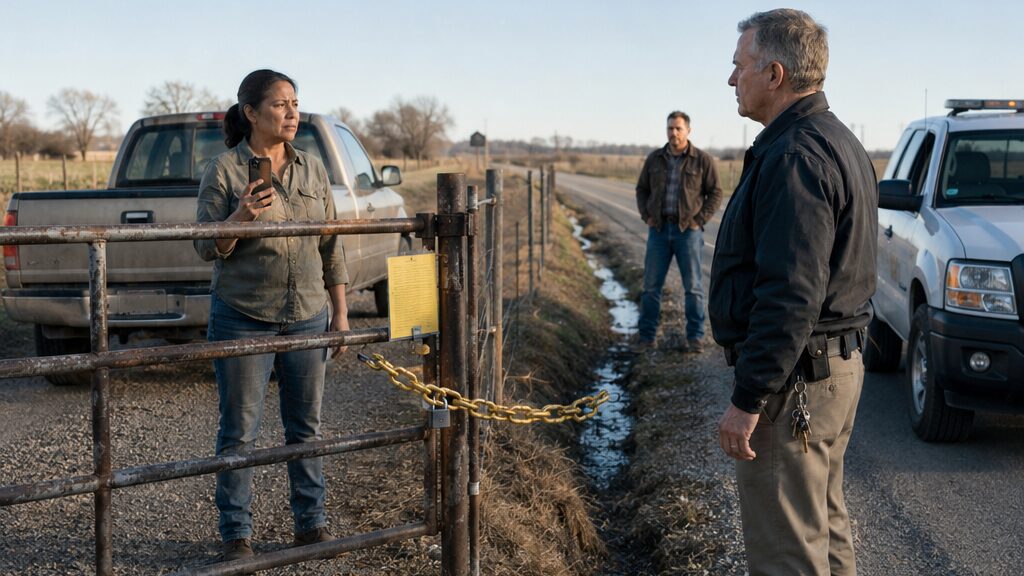
It flashed yellow against the weathered gray bars of her farm gate, looped twice through the latch and secured with a county-issued lock large enough to see from fifty yards away. On the gate hung a plastic-sleeved notice that had not been there when she checked the lower field before dark Sunday evening.
Maria braked hard enough to send a crate of empty produce boxes sliding against the back of the cab.
Beyond the gate, the gravel lane curved toward two acres of vegetables ready for the Monday pickup. The refrigerated truck from the regional market was due before nine.
A white county vehicle sat on the shoulder.
Raymond King stood beside it with a clipboard tucked under one arm.
Maria killed the engine but stayed behind the wheel for a moment.
She had worked with Raymond once. Not closely, but enough to know the way he planted his feet when he expected an argument.
She stepped out.
“What happened?”
Raymond glanced toward the gate rather than at her. “Rural access enforcement.”
“That tells me the department.”
“You’ve got an unpermitted expansion at the turnaround and drainage crossing.”
Maria stared through the bars.
The turnaround was a widened patch of gravel where delivery trucks reversed before entering the packing shed. It had existed, in one form or another, since her father was alive.
“You chained the entrance?”
“The access is under correction order.”
“My produce truck comes in two hours.”
Raymond removed the clipboard from beneath his arm.
“Then you need to make alternate arrangements.”
Two neighboring landowners had slowed their pickups on the county road. Neither stopped, but both watched.
Maria felt heat move up her neck.
Years earlier, she had been the person behind a county counter explaining correction periods to angry property owners. She knew what Raymond expected now: outrage, an appeal to old relationships, perhaps the words You know me.
She gave him none of them.
Instead she walked to the gate.
The notice showed a ninety-dollar access citation near the top. Below it was a warning that unresolved land-use violations could accrue additional penalties and lead to towing of vehicles obstructing enforcement access.
Maria took out her phone.
Raymond exhaled through his nose. “Photographing it doesn’t stay the order.”
“I know.”
She photographed the whole page.
Then the lock.
Then the chain passing through her gate.
Then the drainage ditch beside the lane.
“What time was this issued?”
Raymond looked at the notice. “You had your correction period.”
“That wasn’t my question.”
His expression tightened.
“Friday.”
“What time Friday?”
“It was entered Friday afternoon.”
Maria enlarged the photograph on her phone.
At the bottom of the notice, in small print, was an electronic issuance stamp.
Monday, 6:41 a.m.
She looked at him.
“This says it was issued thirteen minutes ago.”
Raymond shifted the clipboard.
“The case was opened Friday.”
“Opening a case isn’t service.”
“You know how the system works.”
“I used to.”
That landed harder than she intended.
For a second neither spoke.
Maria zoomed in again.
The notice referenced a correction deadline that had already expired at midnight Sunday.
She looked from the date to the chain.
“You’re saying my correction period ended before this notice was issued.”
“The violation existed before the notice.”
“That isn’t the same thing.”
Raymond’s jaw worked once.
“We inspected the site last week. Gravel was added beyond the mapped agricultural access. The drainage crossing was widened. We have no active approval for either.”
Maria glanced toward the shallow ditch.
After spring rains had washed out the edge of the lane, she had added gravel. She had also replaced two crushed sections of pipe beneath the crossing.
She had considered it maintenance.
Apparently Raymond had not.
“If there’s a permit problem,” she said, “I’ll deal with the permit problem. But you don’t get to invent a deadline.”
“No one invented anything.”
“Then unlock the gate while I appeal.”
“I can’t.”
“You can.”
“I’m not going to.”
The first market truck appeared far down the road.
Maria recognized the white cab immediately.
Raymond saw it too.
She could feel the humiliation becoming visible.
The driver slowed, turned on his hazard lights, and stopped short of the gate.
Maria walked over and spoke through his open window.
“They’ve closed the access.”
“For how long?”
“I don’t know.”
He looked past her toward Raymond.
“I’ve got three other stops.”
“I know. Take them first.”
The driver hesitated.
Maria hated that hesitation more than the chain. It was the look people gave when they wanted to help but had schedules, fuel costs and somebody else’s produce warming behind them.
“I’ll call you,” she said.
He nodded and pulled away.
Raymond watched without comment.
Maria went back to the notice.
“Where are the added penalties listed?”
“You’ll see them in your parcel account.”
“How much?”
“They accrue daily until correction.”
“How much, Raymond?”
“Three hundred.”
She thought she had misheard him.
“Three hundred total?”
“Per day.”
Maria lowered her phone.
The ninety-dollar citation suddenly looked almost decorative.
“When did that start?”
“The violation date.”
“What violation date?”
“You can check the case.”
“You’re standing here with the case.”
“I’m standing here to secure the access.”
Maria looked at the county lock.
There were cutters in her barn. Larger ones in the machine shed.
She could have removed the chain in less than a minute.
Raymond seemed to read the thought.
“Break that lock and it becomes a separate violation.”
She gave him a flat look.
“I know.”
That was the trouble. She knew enough to understand exactly how much worse one angry decision could make things.
So she did something that surprised Raymond.
She stopped arguing.
She photographed his clipboard from where she stood, catching the case number without touching the papers.
Then she walked back to her pickup.
“Maria.”
She opened the door.
“You need to submit the correction plan before this gets more expensive.”
She looked over the roof at him.
“How much more expensive?”
He did not answer.
Maria drove the pickup around to the side entrance used for tractors, parked near the farmhouse and went straight into the small office beside her kitchen.
Her old county login no longer worked, of course. She used the public parcel portal instead.
The page loaded slowly.
Farm address.
Parcel number.
Current status: enforcement hold.
She clicked the financial tab.
The first line showed the ninety-dollar citation.
The second showed an administrative assessment.
The third showed a daily land-use penalty.
Maria leaned closer.
The start date was not Friday.
It was not last week.
It was months earlier.
Her fingers went still on the mouse.
At the bottom of the page, the running balance appeared in bold.
$18,390.
Maria read it twice.
Outside her office window, the yellow county chain cut across the gate.
Chapter 2: The Daily Fine That Started Months Too Early
Maria printed the account page before she trusted herself to call anyone.
The printer rattled beside her desk while the same number remained on the computer screen.
$18,390.
She picked up the page and ran her finger down the entries.
Daily land-use penalty: $300.
Assessment start date: February 12.
That was impossible.
The county inspection had taken place the previous Thursday.
Maria opened the case details.
The system listed the violation as “unpermitted agricultural access expansion/drainage alteration.”
It also listed a field verification date from the prior week.
She compared the two.
The penalties had begun nearly six months before anybody had supposedly verified the condition.
Maria called the planning office.
A receptionist transferred her twice before Laura Nelson answered.
“Records.”
“Laura, it’s Maria Rivera.”
There was a pause.
“Maria?”
“I need a parcel history.”
Another pause, shorter this time.
“For your farm?”
“You heard already.”
“I saw the enforcement status.”
Maria looked through the window.
The gate remained chained.
“I need the source date for the daily assessment.”
Laura lowered her voice. “That’s enforcement, not records.”
“The case is using a February start date against an August inspection.”
“I can look at the record. I can’t interpret it for you.”
“I’m not asking you to.”
That was not entirely true.
Maria heard herself and disliked it.
She had called Laura because Laura knew where old things went when the county pretended they had vanished.
“Give me the parcel number.”
Maria did.
Keys clicked.
“Current file shows no active agricultural access permit.”
“There was one.”
“The system says none.”
“My father had approval for that crossing.”
“When?”
“Late nineties. Maybe early two-thousands.”
“That may not be in the current database.”
“Exactly.”
Laura was silent.
Maria waited.
Finally Laura said, “There’s a legacy reference field.”
“And?”
“There’s a number in it.”
Maria grabbed a pen.
“Read it.”
“RA-2147-B.”
Maria wrote it on the printed penalty page.
“That number isn’t linked to the digital file,” Laura said.
“What is it?”
“I don’t know yet.”
“You just found it.”
“I found a reference. That is not the same thing as finding a permit.”
Maria closed her eyes.
There had been a time when she would have said exactly that to somebody across the county counter.
“Can I come in?”
“You can request the parcel history like anyone else.”
“I’ll be there in forty minutes.”
“Maria.”
“What?”
“If you come in angry, Raymond will make this about access to records instead of the records themselves.”
Maria almost laughed.
“You think I don’t know that?”
“I think you know it so well you might forget other people can see you’re angry.”
That silenced her.
“I’ll be there.”
Before leaving, Maria called the produce buyer and arranged for the driver to meet her at the side tractor entrance. The truck could not safely make the turn, so Maria spent thirty minutes moving crates in her pickup, four at a time.
By the last load, sweat had soaked the back of her work shirt.
She told nobody why the main gate was closed.
Not the driver.
Not the farm-supply clerk who called about an order.
Not the neighbor who sent a short message asking whether everything was all right.
She could fix it.
That belief had hardened into something close to defiance.
The county planning office occupied a low brick building beside the courthouse annex. Inside, fluorescent lights hummed over counters Maria remembered too well.
Laura looked older than when Maria had left eleven years earlier, but not dramatically. Her hair was shorter. Her reading glasses hung from a dark cord.
She slid a public records request form across the counter.
“Fill out the parcel and case number.”
Maria did.
Laura pulled up the current digital case on a monitor angled away from the public side.
“Here’s what enforcement sees.”
Maria leaned forward.
The screen showed a parcel diagram with the access lane marked in red.
A note read: UNPERMITTED EXPANSION.
Below it:
Daily assessment: $300.
Maria pointed to the start date.
“Where did February come from?”
Laura opened the event log.
One entry had been generated automatically.
“System-derived date,” she said.
“Derived from what?”
Laura clicked again.
The field referenced an “expiration.”
“What expired?”
“I don’t know.”
“Open it.”
“I am.”
The next window contained almost nothing.
Permit status: expired.
Legacy source: RA-2147-B.
No scanned document attached.
Maria straightened.
“There.”
Laura nodded slowly.
“Something used that legacy file number to generate the expiration date.”
“So the county has enough information to backdate a fine from an old permit but not enough information to show me the old permit.”
Laura gave her a warning look.
“That is an interpretation.”
“It’s also what’s on the screen.”
Raymond appeared from the hallway carrying a folder.
“I heard you were here.”
Maria did not turn around immediately.
When she did, she held up her printed account page.
“Why do my penalties start in February?”
“The system calculates from the violation date.”
“No. It calculates from an expiration attached to a file your system can’t display.”
Raymond looked at Laura.
Laura stepped back from the monitor.
“I’m processing a public records request.”
Raymond faced Maria again.
“The current parcel record shows no valid approval for the expansion.”
“Then show me what expired.”
“If it isn’t scanned, you’ll have to request archives.”
“I just did.”
Raymond’s mouth tightened.
“Until something changes the current record, the enforcement status stands.”
Maria felt a small pulse of satisfaction despite herself.
He had not said the record was correct.
He had said it stood.
Those were different things.
Laura disappeared into a back office.
When she returned, she carried a thin transfer ledger.
She ran one finger down a handwritten list.
“RA-2147-B was boxed during the records conversion.”
“Where?”
“Off-site archive first. Then transferred back when that contract ended.”
“So you have it.”
Laura shook her head.
“I have a transfer notation.”
She turned the ledger toward Maria.
Beside the old file number was a date and a storage code.
The final column contained two words.
SCAN PENDING.
Maria looked up.
“When was this written?”
“Eight years ago.”
“Eight years?”
Laura nodded.
Maria looked again at the computer screen, where the county had confidently calculated eighteen thousand dollars from a record it had never finished scanning.
“Can you pull the box?”
“Not today. Archive retrievals are Tuesdays and Thursdays.”
“Tomorrow is Tuesday.”
“I know.”
Raymond stepped closer.
“Even if you find an old approval, it won’t necessarily cover what exists now.”
Maria folded the penalty sheet.
“That’s fine.”
He looked surprised.
“I’m not asking it to cover what exists now. I’m asking what the county knew before it started charging me three hundred dollars a day.”
Raymond said nothing.
Maria slipped the archive number into her pocket.
For the first time that morning, she believed the chain might come off.
Then Laura tapped the transfer ledger.
“There’s one more problem.”
Maria looked down.
The box had been returned to county custody eight years earlier.
But no destination shelf had ever been entered.
Chapter 3: The Permit Folder Nobody Put Online
At 8:07 Tuesday morning, Maria found her father’s parcel number written in pencil on the side of a cardboard archive box.
She almost missed it.
The county archive room was in the basement beneath the planning office, where rows of metal shelving held banker boxes with fading labels and years crossed out in black marker. The records archive clerk had already told Maria twice that nothing inside was arranged by current parcel number.
Laura stood three shelves away comparing the transfer ledger with a handwritten inventory.
“RA-2147-B,” Maria called.
Laura came over.
The box label showed only an old district code and a range of road names.
Maria pointed to the pencil notation.
Her father’s original parcel number.
“That’s ours.”
The archive clerk lifted the box onto a rolling table.
“You can review it here. Nothing leaves the room.”
Maria pulled on the thin cotton gloves they required for older material.
For twenty minutes she found nothing but culvert requests, driveway sketches and correspondence from people whose names she barely remembered.
Then she saw the corner of a photograph.
A weathered metal gate.
Her gate.
Not exactly as it looked now. The hinges were cleaner, the cedar posts newer, and behind it stood her father in a faded work jacket with one hand resting on the latch.
Maria stopped breathing for a second.
The photograph was clipped to a folded site plan.
Laura leaned closer but did not touch it.
“What does the stamp say?”
Maria unfolded the paper carefully.
Agricultural access approval.
Drainage crossing.
Twelve-foot gravel lane.
Twenty-four-foot turnaround.
Her father’s signature appeared at the bottom.
Below it was a county approval mark.
Maria sat back.
“He had it.”
Laura kept her expression neutral.
“He had approval for something.”
Maria looked at her.
“You sound like me fifteen years ago.”
“That’s why I’m saying it.”
Maria almost smiled.
She read every line.
The drainage pipe beneath the lane had been authorized. The turnaround had been authorized. Even the gravel shoulder Raymond had described as an informal encroachment appeared in the sketch.
The county’s current statement—that no lawful agricultural access had ever existed—was wrong.
For one clean minute Maria let herself enjoy that.
Then Laura placed the current aerial parcel map beside the old site plan.
“The dimensions don’t match.”
Maria looked.
The original turnaround ended six feet short of the modern gravel edge.
She knew exactly why.
Three years earlier, after a delivery truck sank into the shoulder during a wet harvest, Maria had added stone along the outer curve. She had considered it repair work.
The drainage line had also changed.
Her father’s plan showed one culvert.
Maria had replaced it with two smaller pipes after the original collapsed.
“Maintenance,” she said.
Laura gave her a look.
“You want the records answer or the friend answer?”
“Records.”
“Changing the number of pipes can affect drainage review.”
Maria tapped the old plan.
“But the crossing itself is approved.”
“Yes.”
“And the turnaround.”
“The original footprint.”
Maria leaned against the table.
The victory she had imagined the night before narrowed.
Raymond had been wrong when he said the entire access was unauthorized.
But he might not be wrong about the later work.
Laura seemed to read the calculation on her face.
“This helps you.”
“It doesn’t erase everything.”
“No.”
Maria hated how much she respected that answer.
She photographed each page according to archive rules, then found another document behind the site plan.
It was a permit renewal notation.
No expiration date.
That mattered.
The digital system had treated the old approval as if it expired in February. The paper file contained no such expiration.
Maria pointed to it.
“Where did the date come from?”
Laura compared the pages.
“I don’t see it.”
“Could the conversion software have assigned one?”
“It shouldn’t.”
“That isn’t an answer.”
“It’s the only one I have.”
Maria copied the file references.
By late morning she had assembled enough to establish three facts.
Her father’s access had been formally approved.
The digital database omitted that approval.
And the date used to trigger Maria’s backdated fines did not appear anywhere in the paper permit folder.
She carried copies upstairs.
Raymond was in a conference room.
When Maria placed the original permit copy on the table, he studied it longer than she expected.
“You said there was no approved agricultural access,” she said.
“I said there was no active approval in the system.”
“Yesterday you said no valid approval.”
Raymond looked at the site plan.
“This changes the baseline.”
Maria waited.
“But not the expansion.”
There it was.
Not surrender.
Not denial either.
Maria sat across from him.
“Then we separate them.”
He frowned.
“The original access was lawful. You review the later gravel and drainage work from the date you actually inspected it. You remove everything that was backdated from an expiration that doesn’t exist.”
Raymond closed the folder.
“That decision is above my level once assessments are posted.”
“You’re the one who put the chain on.”
“I enforce the status.”
“You also have discretion to suspend access restrictions during review.”
“Not where drainage is involved.”
“Why?”
“Because if that crossing changes runoff onto the county ditch, it affects the road.”
Maria leaned forward.
“Has anyone measured runoff?”
“Not yet.”
“So you chained a working farm gate before measuring the thing you say makes it unsafe.”
Raymond’s eyes hardened.
“You keep treating this like a records problem because that’s the part you understand.”
“And you keep treating the record like it’s reliable because that’s the part that makes enforcement easy.”
For a moment the old workplace history between them seemed to fill the room.
Raymond slid the permit back.
“File the appeal.”
“I will.”
“Then let the process decide.”
Maria stood.
As she gathered the copies, Raymond added, “You should also look carefully at the dimensions before you make this a bigger issue than it is.”
She paused.
“What does that mean?”
“It means an old approval doesn’t make every later change legal.”
“I know.”
“I’m not sure you do.”
Maria left before her temper answered for her.
Back downstairs, Laura was still working in the archive.
Maria expected to spend another hour copying her father’s file.
Instead she found Laura at the rolling table with three folders laid side by side.
“What are those?”
Laura looked toward the archive clerk before answering.
“I was checking the transfer ledger.”
“For what?”
“Other files boxed under the same conversion batch.”
Maria looked down.
Different parcel numbers.
Different roads.
All rural.
Laura opened the first folder.
The paper file contained an old agricultural access approval.
The digital printout clipped beside it showed no active permit.
Second folder: same pattern.
Third: same.
Maria felt the satisfaction from finding her father’s permit disappear.
“How many?”
“I don’t know.”
“Laura.”
“I don’t.”
Laura turned the ledger around.
Several entries carried the same notation Maria had seen beside her own file.
SCAN PENDING.
Maria looked at the rows.
One parcel number was familiar.
Nicholas Brown’s cattle property two miles east.
She stared at it.
Laura lowered her voice.
“If you’re thinking what I think you’re thinking, don’t assume yet.”
Maria touched Nicholas’s parcel number.
“I’m not assuming.”
But she already knew what she was going to do next.
She was going to ask whether his gate had a county chain on it too.
Chapter 4: The Neighbor Who Received the Same Impossible Notice
Nicholas Brown did not invite Maria into the house.
He met her at the cattle gate with a folded county notice in one hand and a pair of fencing pliers in the other.
A new chain ran through his gate latch.
Not yellow like Maria’s. Plain galvanized steel, county tag hanging from the lock.
“You too?” Maria asked.
Nicholas gave her a long look.
“I was about to ask you the same thing.”
His cattle stood beyond the gate near a trough, their heads turning toward the sound of Maria’s pickup. The access lane behind them led to a loading pen and an equipment shed.
Maria nodded toward the notice.
“When did you get it?”
“Yesterday afternoon.”
“Can I see?”
Nicholas hesitated.
“You working for them again?”
“No.”
“You’ve been at the county office two days straight.”
“I’m trying to find out why my gate is locked.”
He studied her face.
Then he handed over the paper.
The wording was familiar enough to make Maria’s stomach tighten.
Unpermitted agricultural access modification.
Correction period.
Daily assessment upon expiration.
She went directly to the timestamp.
Tuesday, 3:18 p.m.
“When did they say the penalty started?”
Nicholas wiped one hand on his jeans.
“April.”
Maria looked up.
“April?”
“Says I widened the lane without approval.”
“Did you?”
“I put crushed stone along the edge after the feed truck buried itself.”
“How much?”
“What?”
“The assessment.”
“Three hundred a day.”
Maria folded the notice carefully along its existing crease.
“Have you checked the balance?”
“No.”
“Why not?”
His expression hardened.
“Because I figured if I logged into that county site, I’d throw the computer through a wall.”
“This isn’t funny.”
“I’m not laughing.”
Maria handed the notice back.
“Do you have old paperwork for this entrance?”
“My dad built it.”
“That isn’t what I asked.”
Nicholas stared across the pasture.
“Somewhere.”
“Permit?”
“Maybe.”
“Drainage approval?”
“I don’t know.”
He looked at her again.
“What did you find?”
Maria should have told him everything.
The missing digital approval. The paper file. The false expiration. The eighteen-thousand-dollar balance.
Instead she said, “My old permit wasn’t scanned.”
Nicholas waited.
“That all?”
“For now.”
She heard the lie the moment it left her mouth.
Not a complete lie.
Worse.
A partial truth designed to keep control.
Nicholas gave her the same skeptical look he had used when they were younger and she tried to tell him county procedures were simpler than people made them.
“You always did that.”
“Did what?”
“Talk like the answer’s in a drawer somewhere if people would just stop yelling long enough to let you open it.”
“Sometimes it is.”
“And sometimes the drawer belongs to the people causing the problem.”
Maria looked at the chain.
“Do you want help or not?”
He exhaled.
“Come inside the machine shed.”
They found the old farm records in a dented filing cabinet behind a shelf of hydraulic fluid.
Nicholas pulled envelopes, tax receipts and equipment invoices while Maria sorted by year.
After twenty minutes she found a faded county receipt.
Agricultural access review fee.
A file number had been typed along the bottom.
Maria copied it.
“This number looks like the same generation as mine.”
“What does that mean?”
“Legacy filing system.”
“English, Maria.”
“It may never have been moved into the digital database.”
Nicholas leaned against the workbench.
“So they lose the record and charge me because they lost it?”
“We don’t know that yet.”
He laughed once without humor.
“You sound like them when you say that.”
Maria looked down at the receipt.
He was right.
By noon they were at Maria’s kitchen table with Nicholas’s public parcel account open on her laptop.
His balance was lower than hers but already over ten thousand dollars.
Maria compared the event log against the notice in his hand.
“Here.”
Nicholas leaned closer.
The daily assessment had begun April 3.
The first verified notice delivery appeared Tuesday.
“This date,” Maria said, tapping the screen, “comes before service.”
“How much before?”
“Months.”
“So yours wasn’t a fluke.”
“No.”
The words changed the room.
Until then Maria could still imagine one corrupted record, one bad conversion, one enforcement case nobody had reviewed properly.
Nicholas’s file made that harder.
She opened the page showing his permit history.
No active approval.
Legacy reference field populated.
No attached scan.
Maria sat back.
Nicholas watched her.
“How many farms?”
“I saw three folders yesterday with the same pattern.”
“And you didn’t say anything?”
“I didn’t know what they meant.”
“You knew enough to come here.”
“That’s why I came.”
“No. You came to check mine.”
Maria shut the laptop.
“What’s the difference?”
“The difference is whether you’re trying to fix this or just make sure you’re not the only one.”
The sentence stung because it found something she had been avoiding.
She had spent two days thinking about her gate.
Her produce.
Her father’s permit.
Her fines.
Not Nicholas’s cattle lane. Not the other parcel numbers Laura had found.
Maria stood and carried the coffee mugs to the sink although neither had finished drinking.
“I have an appeal coming.”
Nicholas looked at her back.
“So?”
“So I’m not walking into it with guesses.”
“You’ve got two cases.”
“Two aren’t a policy.”
“They’re two farms paying money on dates nobody can explain.”
Maria turned.
“What do you want me to do? Walk into the county board meeting and accuse everyone before I know what happened?”
“No.”
Nicholas folded his notice.
“I want you to stop acting like this is only dangerous if you say it out loud.”
An hour later Maria returned to the planning office alone.
She asked Laura for the public index covering the three other legacy parcels.
Laura did not bring it.
Raymond did.
He placed himself between Maria and the records counter.
“You requested information on another property this morning.”
“It’s public.”
“That doesn’t mean you should be using county records to build private cases for neighbors.”
“I’m not building anybody’s case.”
“You’re a former employee. You know how this looks.”
Maria felt the old instinct to become precise enough to win.
“What, exactly, are you accusing me of?”
“I’m telling you to stay inside your appeal.”
“My appeal now includes a database pattern.”
Raymond lowered his voice.
“You don’t know that.”
“I have two cases with penalty dates before verified notice and legacy permits that were never scanned.”
“You have two incomplete files.”
“That’s the pattern.”
“That is not proof of improper enforcement.”
Maria stepped closer to the counter.
“Then let me see the transfer index.”
“No.”
Laura looked up.
Maria did too.
Raymond corrected himself.
“Not without a formal records request.”
Maria held his gaze.
“Fine.”
She filled one out at the counter.
Raymond waited until Laura carried it away.
Then he spoke quietly enough that only Maria could hear.
“You think this conversion was clean?”
Maria said nothing.
His eyes went to the hallway.
“It wasn’t.”
Her pulse changed.
“How unclean?”
Raymond’s face closed again.
“I didn’t say that.”
“Yes, you did.”
He picked up the request form copy.
“The migration was never clean, Maria.”
Then he walked away before she could ask the only question that mattered.
How long had he known?
Chapter 5: Raymond King Knew the Records Were Incomplete
“Yes,” Raymond said the next morning. “We knew older approvals were missing.”
He said it before Maria had even sat down.
The conference room door clicked shut behind her.
On the table between them lay Maria’s permit file, Nicholas’s public parcel summary, and a county key with a square brass tag stamped with the number assigned to Maria’s gate lock.
She looked at the key.
Then at Raymond.
“How long?”
“Long enough.”
“That isn’t an answer.”
“It’s the answer you’re getting until the planning director is in the room.”
“You were willing to tell me yesterday.”
“I said the migration wasn’t clean. I didn’t say every enforcement action was wrong.”
Maria took the chair across from him.
“Then explain how incomplete records became automatic fines.”
Raymond rubbed a thumb along the edge of the brass key tag.
“The county converted nearly thirty years of rural files. Some scanned. Some didn’t. Some were indexed under addresses that changed after road renumbering. Some had handwritten parcel numbers. You know what those files looked like.”
“I also know missing paperwork isn’t proof that approval never existed.”
“I know.”
The admission stopped her.
Raymond leaned back.
“You think I enjoy putting chains on farm gates?”
“I don’t know what you enjoy.”
“Then don’t pretend you know why we’re doing it.”
He opened a folder Maria had not seen before.
Inside were photographs.
A washed-out shoulder along a county road.
Brown water pooled against a house.
A drainage ditch filled with stone and gravel.
Another photograph showed a farm entrance where a wide culvert redirected runoff across the road surface.
“These are from last spring,” Raymond said.
Maria studied them.
“What am I looking at?”
“Three unauthorized drainage modifications within twelve miles.”
“One of them mine?”
“No.”
“Then why are they here?”
“Because two years ago we had complaints, warnings, meetings, voluntary correction letters. Nobody wanted to be the bad guy. Then that storm hit.”
He tapped the photograph of the flooded house.
“The water crossed a property line, filled a crawlspace and damaged the county road. Everyone suddenly wanted to know why enforcement had been so soft.”
Maria looked closer.
The ditch had been filled almost level with the road.
“That isn’t maintenance.”
“No.”
“And it isn’t what I did.”
“No.”
“Then stop treating them as the same.”
Raymond’s expression tightened.
“The problem is everybody says theirs is different.”
“Sometimes it is.”
“Which is easy to say after the damage.”
Maria pushed the photographs back.
“So the county decided to standardize.”
“We were ordered to review rural access and drainage records.”
“And when the digital system showed no permit, you treated that as no permit.”
“In most cases.”
“Knowing the conversion was incomplete.”
Raymond looked toward the closed door.
“Yes.”
There it was.
Not corruption.
Not a secret scheme.
Something almost more ordinary: an administrative decision made under pressure because opening every box was slow and enforcing from a computer screen was fast.
Maria stared at the key.
“How many parcels?”
“Thousands were reviewed.”
“How many were penalized?”
“I don’t have that number.”
“How many had legacy references?”
“I don’t know.”
“You expect me to believe that?”
“I expect you to understand the difference between knowing there were migration problems and knowing which individual records were missing.”
Maria sat back.
That difference mattered.
She hated that it mattered.
“You could have suspended enforcement on legacy files.”
“And let genuinely unpermitted work continue while we searched boxes for months?”
“You could have reviewed them before imposing daily penalties.”
“With what staff?”
“That’s not the property owner’s problem.”
“No. Flooded roads became the property owner’s problem.”
The room went quiet.
Raymond was not trying to win now.
That unsettled Maria more than his earlier defensiveness.
He opened another folder.
“This is your current aerial.”
A red outline traced Maria’s turnaround.
He placed her father’s approved site plan beside it.
The differences were obvious.
The current gravel extended beyond the approved edge.
Maria pointed to the red outline.
“I added stone after the delivery truck sank.”
“I know.”
“I didn’t build a second driveway.”
“No.”
“I replaced a collapsed pipe.”
“With two pipes.”
“Yes.”
“That changes flow.”
“Maybe.”
“That’s why it requires review.”
Maria crossed her arms.
“You’re trying to turn a database failure into an argument about six feet of gravel.”
“No. I’m telling you your case has two separate questions.”
He tapped the old plan.
“Was the original access approved? Yes.”
Then the aerial.
“Were later modifications reviewed? No evidence they were.”
Finally the penalty summary.
“Should the county have backdated charges based on an expiration we can’t support? That’s now in question.”
Maria looked at him.
“You could have said that Monday.”
“Yes.”
“Instead you chained the gate.”
“Yes.”
“Why?”
Raymond’s hand tightened around the edge of the table.
“Because if I make exceptions at the gate, every person I’ve cited says enforcement depends on who you know.”
“I wasn’t asking for an exception.”
“You worked here.”
“So?”
“So half the county still thinks people who worked behind that counter get different rules.”
Maria remembered the neighbors slowing their trucks Monday morning.
She had assumed they saw her humiliation.
Maybe Raymond had seen something else: a former employee expecting a favor.
“You thought if you unlocked it for me, it would look corrupt.”
“I thought the order had to stand until the record changed.”
“And now?”
“Now the record changed.”
He nudged the brass key with one finger.
Maria watched it slide half an inch.
“Then remove the chain.”
“I can suspend the access restriction if the planning director signs off.”
“Will you recommend it?”
Raymond did not answer immediately.
Before he could, someone knocked.
The planning director entered, carrying another folder.
The conversation became more formal after that.
Maria laid out the false expiration date.
Raymond acknowledged the old approval.
The planning director agreed that the backdated assessment required review but refused to cancel anything before the administrative appeal.
“Fine,” Maria said. “Then put that in writing.”
The director nodded.
Raymond stayed quiet.
Maria thought she had finally separated the valid question from the invalid punishment.
Then Raymond opened the last folder.
“I need you to see something else.”
He took out a photocopied internal memo.
The paper was old enough that the toner had softened at the edges.
The heading referred to legacy rural permit retention during a budget reduction years earlier.
Maria scanned the first paragraph.
Her breathing slowed.
The memo recommended that older agricultural permits remain in physical files rather than being individually digitized unless a parcel became active.
“That was temporary,” she said.
Raymond said nothing.
Maria read farther.
Physical record retained as authoritative source.
Digital index entry sufficient for inactive parcels.
The language was familiar.
Not merely familiar.
She remembered arguing for it.
The county had been months behind. Scanning contractors were expensive. Staff had spent entire days feeding brittle pages into machines while customers waited at the counter.
Keep the originals. Index the file numbers. Scan them when the parcels come back into active review.
It had seemed practical.
Raymond pointed to the bottom.
Maria did not need him to.
Her initials were beside the recommendation.
M.R.
For a moment the conference room disappeared.
She could see herself years earlier at a county desk, younger, impatient, certain that a competent clerk would always know to retrieve the paper file before making a final decision.
She had never imagined a future system treating the absence of a scan as the absence of permission.
Raymond’s voice was quieter now.
“You asked who created the gap.”
Maria kept looking at her initials.
He did not have to finish the sentence.
Chapter 6: The Filing Shortcut Maria Once Defended
Maria recognized the second set of initials too.
They were hers.
Friday morning, the old memo lay on her kitchen table beside the current enforcement notice, the two documents separated by nearly fifteen years and less than twelve inches of scratched oak.
M.R.
On the old page, the letters looked confident.
She remembered writing them.
The county had been cutting costs. A digitization project was running over budget. Boxes filled a conference room because nobody had enough hours to scan decades of farm permits, culvert approvals, access sketches and handwritten amendments.
Maria had argued that the paper files were safe.
Indexed.
Retrievable.
Authoritative.
There was no reason, she had said, to waste months scanning inactive parcels when a clerk could pull the original if an issue ever arose.
The logic had been sound only as long as somebody remembered the second half.
Pull the original.
The county had preserved the shortcut.
Then forgotten the safeguard.
Maria poured coffee and left it untouched.
She wanted to blame Raymond.
There was plenty to blame him for.
He knew the digital conversion was incomplete. He enforced anyway. He had let an automated expiration create months of penalties without verifying the paper file.
But Maria could no longer tell herself she had entered this story from the clean side.
Her phone rang.
Laura.
“The hearing moved.”
Maria straightened.
“What?”
“Planning director wants it this afternoon.”
“It was supposed to be next week.”
“I know.”
“Why?”
“Because the assessment issue is now flagged, and there are questions about the other legacy parcels.”
Maria looked at the memo.
“What time?”
“Two.”
“That gives me five hours.”
“I know.”
Maria almost snapped at her.
Instead she said, “Thank you.”
Laura hesitated.
“Maria?”
“What?”
“Don’t come in trying to prove you were right about everything.”
Maria looked through the kitchen window.
The chain was still across the farm gate.
“What makes you think I would?”
Laura did not answer.
She did not need to.
After the call, Maria gathered her documents into three stacks.
Her father’s original approval.
The current aerial showing her later expansion.
The penalty and notice records showing the unsupported backdating.
For the first time, she did not put the papers that helped her on top.
She put Raymond’s memo there.
Her memo.
At ten, she drove to the county archive.
Laura had reserved a small worktable.
“You found anything else?” Maria asked.
“A pattern. Not a conclusion.”
She placed several public index sheets on the table.
Legacy file references.
No scans attached.
Recent enforcement activity.
Maria recognized Nicholas’s parcel and two others.
“How many?”
“In this batch? More than these.”
“Daily assessments?”
“Some.”
“Backdated?”
Laura pushed her glasses up.
“That’s where I stop.”
“Why?”
“Because you’re asking me to become part of the argument.”
“You are part of the records office.”
“Exactly.”
Maria’s irritation rose.
Laura did not retreat.
“I will certify what the system contains. I will certify what the archive contains. I will not tell the hearing officer what those facts mean.”
Maria stared at her.
Years ago, Maria would have respected that distinction immediately.
Now it felt like resistance because she needed someone else to say what she already believed.
She sat down.
“Fine.”
Laura’s shoulders loosened.
Maria copied the relevant indexes.
After several minutes she said, “I signed that memo.”
Laura did not pretend ignorance.
“I know.”
“You saw it?”
“Yesterday.”
“And you didn’t tell me.”
“I thought Raymond would.”
Maria laughed quietly.
“That was generous.”
“No. It was his argument.”
Maria looked at the rows of file numbers.
“I thought we were saving time.”
Laura leaned against the table.
“You probably were.”
“That isn’t helping.”
“It isn’t supposed to.”
Maria looked up.
Laura continued.
“You left instructions saying the paper file remained authoritative. The problem isn’t that you kept paper. The problem is people started treating the digital field as the whole record.”
“I helped create the arrangement.”
“Yes.”
Maria waited for absolution.
Laura did not give it.
That, unexpectedly, helped more.
By noon Maria had what she needed for her own appeal.
She could show that her father’s original access was legal.
She could show the expiration date behind the backdated penalties had no support in the paper record.
She could concede that her later widening and replacement drainage pipes still required current review.
She could probably win suspension of the fines.
Maybe removal of the chain.
She put the folders into her bag.
Then she saw Nicholas’s parcel number on the index sheet again.
If she walked into the hearing and argued only that Maria Rivera’s file had been mishandled, the county could correct Maria Rivera’s file.
One property.
One gate.
One exception.
Nicholas would still have his chain.
The other farmers could still be charged from incomplete records.
Maria sat back down.
“What would it take to request a review of all enforcement files with legacy references and no attached scans?”
Laura blinked.
“That’s not your appeal.”
“I know.”
“It could make your hearing harder.”
“I know.”
“You would be asking them to examine the procedure, not just the assessment.”
“Yes.”
Laura glanced at the memo.
“And this becomes relevant.”
Maria followed her eyes.
Her initials.
“Yes.”
“You’ll have to explain it.”
“I know.”
This time the words felt different.
Not defensive.
Heavy, but useful.
Maria copied the request language onto a fresh page.
At twelve forty-five, Raymond called.
“The hearing officer will want the issue narrow.”
“Of course.”
“Your parcel. Your assessment. Your access.”
“My parcel is tied to a records process.”
“Maria.”
“What?”
“If you turn this into an attack on the department, you’re going to lose people who might otherwise agree with you.”
She looked at the old memo.
“I’m not attacking the department.”
“That’s what Nicholas Brown thinks.”
Maria froze.
“You talked to Nicholas?”
“He called enforcement this morning asking about his file.”
Of course he had.
Maria had left him with half an answer and expected him to wait.
“What did you tell him?”
“That his case has its own review process.”
“And does his penalty date come before his notice?”
Silence.
“Raymond?”
“I’m not discussing another parcel with you.”
Maria closed her eyes.
The old instinct returned: handle your own problem first. Win cleanly. Then help somebody else.
But that instinct had already cost her two days.
“Fine,” she said.
“Fine what?”
“I’ll see you at two.”
She ended the call.
Then she called Nicholas.
He answered on the fourth ring.
“If you’re calling to tell me not to make trouble—”
“I’m not.”
Silence.
Maria looked at the chain through the window.
“I should have told you the whole amount Monday.”
“What amount?”
“My penalties.”
“How much?”
“Over eighteen thousand.”
Nicholas said nothing.
“I thought I could fix mine before I got anybody else involved.”
“Sounds like you.”
“I know.”
That admission quieted him more effectively than an argument would have.
“My hearing is at two,” Maria said.
“So?”
“I’m bringing the old permit, the false penalty date and the records-conversion memo.”
“What memo?”
“One I signed years ago.”
Nicholas was silent again.
Maria continued.
“I helped set up the paper-retention shortcut. It wasn’t meant to erase approvals, but it helped create the gap they’re enforcing through now.”
“You’re going to tell them that?”
“Yes.”
“Why?”
Maria looked at the stacks on her table.
Because it was true was the simplest answer.
It was also not enough.
“Because if I ask them to trust the old paper when it helps me, I have to tell them why the paper ended up separated from the system in the first place.”
Nicholas exhaled.
“What do you need from me?”
There it was.
Not rescue.
Not proof handed to her.
A choice to stop doing this alone.
“Bring your notice,” Maria said. “Bring the account printout if you can. Don’t argue anybody else’s case. Just bring yours.”
“To your hearing?”
“Yes.”
“They may not let me speak.”
“That’s fine.”
“Then why come?”
“So they can’t pretend I’m asking for a private exception.”
Nicholas was quiet for several seconds.
“I’ll be there.”
Maria hung up.
She placed the old memo on top of her file.
Beside it she set her current fine notice.
One page showed the shortcut she had once defended.
The other showed what happened when a shortcut outlived the people who remembered its limits.
At one fifteen she picked up both.
Then she drove toward the county building to argue a case that was no longer only about her farm.
Chapter 7: The Hearing Was No Longer Just About Her Farm
Maria began by admitting the county was right about one thing.
The hearing officer looked up from the file.
Raymond did too.
Maria placed the current aerial photograph on the table.
“The turnaround is wider now than the footprint approved in my father’s original permit,” she said. “And I replaced one failed culvert with two smaller pipes without filing an amendment.”
Nicholas shifted in the row of chairs behind her.
The planning director stopped writing.
Maria continued before anyone could mistake the admission for surrender.
“So if the county wants a current drainage review of those changes, I’m not contesting that.”
Raymond’s expression changed slightly.
For four days he had expected Maria to argue that every piece of enforcement against her was invalid. She could see that argument prepared in the folders in front of him.
She had just removed it.
The hearing officer folded her hands.
“Then what are you contesting?”
Maria placed the penalty statement beside the aerial.
“Everything the county charged before it had a supportable violation date.”
The room went quiet.
She showed the Monday notice.
Then the event log.
Then the account page with the February assessment start.
“The county says I received a correction period. This notice was electronically issued Monday morning after that correction period had already expired.”
Raymond leaned toward his microphone.
“The case existed before formal service.”
Maria turned to him.
“A case can exist. A daily penalty can’t become fair merely because somebody typed an earlier date into a system.”
The hearing officer raised a hand.
“Address me, please.”
Maria nodded.
She had promised herself she would not turn this into the kind of confrontation people remembered instead of the facts.
She slid the old permit copy forward.
“This is the original agricultural access approval from the county’s paper archive.”
The hearing officer examined it.
The planning director had already seen it, but Nicholas had not. Maria heard the faint movement behind her as he leaned forward.
“The county’s digital record said there was no approval,” Maria said. “The paper file says there was.”
Raymond spoke.
“We have acknowledged the original access.”
“Yes.”
Maria pulled out the digital expiration screen.
“But the daily assessment did not begin from my later gravel work. It began from an expiration date attached to this legacy permit.”
The hearing officer compared the documents.
“Where is the expiration stated in the original approval?”
“It isn’t.”
Raymond looked toward the planning director.
The director answered.
“We have not located a paper source for that expiration field.”
“So,” the hearing officer said, “the automated penalty date may have been generated from information that cannot currently be verified.”
“Yes.”
Maria felt the first shift in the room.
Not victory.
Space.
She had learned long ago that bureaucratic decisions rarely turned on dramatic discoveries. They turned when one sentence no longer supported the next.
She opened another folder.
“I also want the record to show that my case may not be isolated.”
Raymond’s shoulders tightened.
The hearing officer looked at him, then back to Maria.
“This hearing concerns your parcel.”
“I understand.”
“Then stay with your parcel unless the other information directly affects the reliability of the process used against you.”
Maria had expected that.
She lifted the old conversion memo.
“This does.”
Raymond stared at the page.
Maria placed it on the table.
“Years ago, when I worked here, the county had more legacy paper files than it had money to scan.”
She heard Nicholas move again.
Maria kept her eyes on the hearing officer.
“I recommended that inactive rural permits remain in paper files as long as the digital index preserved the file number and staff retrieved the originals when a parcel became active.”
She pointed to the initials at the bottom.
“Those are mine.”
The planning director stopped writing entirely.
Raymond said nothing.
Maria had imagined this moment repeatedly since morning.
In some versions she explained herself.
In others she blamed budget cuts.
Now she did neither.
“It was a shortcut,” she said. “I believed it was safe because the paper file remained the authoritative record.”
The hearing officer looked at the memo.
“And what changed?”
“The county eventually began treating the absence of a scanned document as evidence that an approval did not exist.”
Raymond leaned forward.
“That is too broad.”
Maria turned toward the hearing officer, not him.
“Then narrow it. In my case, the system ignored an indexed paper file until I asked for it. In Nicholas Brown’s case, his public parcel record shows the same basic pattern.”
The hearing officer looked toward Nicholas.
He had brought a plain folder.
No speech.
No signs.
No angry neighbors packed into the room.
Just paperwork.
“Mr. Brown is not a party to this appeal,” the hearing officer said.
“I know,” Maria replied. “I’m not asking you to decide his case.”
“Then why is he here?”
“Because if the county corrects my file only because I happened to know where old records were stored, that doesn’t correct the process.”
Raymond finally spoke.
“You’re implying we intentionally ignored records.”
Maria looked at him.
“No.”
That surprised him.
“I’m saying you knew the migration was incomplete.”
His face went still.
The hearing officer noticed.
“Mr. King?”
Raymond glanced at the planning director.
Then he looked at Maria.
“Yes.”
The word was barely louder than the ventilation system.
The hearing officer leaned forward.
“You knew historical approvals might exist outside the digital database?”
“Yes.”
“And enforcement continued on parcels where the digital system showed no active approval?”
“In some cases.”
“Why?”
Raymond took a breath.
“Because we were ordered to standardize rural access enforcement after repeated drainage failures. We had limited staff, a large backlog and active complaints.”
Maria listened.
This was the part she could not dismiss.
Raymond described washed-out county shoulders. Flooded roadside property. Culverts installed without review. Gravel pushed into drainage channels.
He did not exaggerate.
He did not ask for sympathy.
He simply explained the pressure that had turned incomplete records into enforceable assumptions.
The hearing officer looked at Maria.
“Do you dispute that your current drainage configuration should be reviewed?”
“No.”
Raymond looked at her.
Maria continued.
“That’s exactly why the backdated penalties should be removed.”
The hearing officer waited.
“If the county has a legitimate present concern,” Maria said, “then inspect the present condition, give me a valid correction period and require whatever amendment the current rules require.”
She touched the eighteen-thousand-dollar statement.
“But don’t use a missing scan and an unsupported expiration to pretend I’ve been ignoring an order for six months.”
That was the moment the hearing changed.
The planning director requested a short recess.
When they returned, the brass-tagged gate key sat on the table beside Maria’s file.
Maria noticed it immediately.
Raymond must have placed it there.
The hearing officer read from a written determination.
The unsupported backdated daily assessments would be suspended pending administrative correction.
The original agricultural access approval would be restored to the parcel’s active record.
The county would issue a new review specific to the later widening and drainage alteration.
Maria listened without moving.
Then came the part she had not expected that day.
The planning department would also identify active rural enforcement cases containing legacy permit references without scanned source documents and refer them for records verification before additional historical penalties accrued.
Nicholas breathed out behind her.
Not loudly.
Just enough for Maria to hear.
The hearing officer looked at Maria.
“This does not eliminate your obligation to bring the current drainage work into compliance if review determines an amendment is required.”
“I understand.”
“And it does not decide Mr. Brown’s case.”
“I understand.”
The hearing officer closed the file.
Raymond remained seated.
Maria gathered her papers.
For the first time since Monday, she did not feel the need to organize them into what proved she was right and what proved someone else was wrong.
They were simply the record.
At the door, Raymond called her name.
She turned.
He held the release order.
“The chain can come off.”
Maria looked at the key.
“Today?”
“Once this is entered.”
“And the drainage review?”
“Still required.”
She nodded.
“That’s fair.”
Raymond’s mouth tightened at the word.
Maybe because he agreed.
Maybe because neither of them had reached the hearing expecting fairness to look like both sides losing part of their argument.
He signed the release order.
Then he slid it across the table.
Chapter 8: When the Gate Opened, the Work Wasn’t Finished
Two weeks later, Raymond returned to Maria’s farm carrying the key instead of a notice.
Maria saw him through the kitchen window.
His county vehicle stopped beside the gate, but there was no clipboard tucked under his arm.
The chain still ran through the bars.
After the hearing, Maria could have had it removed immediately. The release order authorized it.
She had chosen not to cut it.
The county lock was still county property, and Raymond had said he would return after the administrative entry cleared.
It had taken longer than either of them expected.
Maria walked down the gravel lane.
Raymond held up the key.
“Records finally caught up.”
“That would be a first.”
He almost smiled.
Almost.
Nicholas had told her the county suspended his historical daily assessments three days earlier while his paper file was being retrieved. Two other neighboring landowners had received similar notices of review.
None of their cases were finished.
That mattered.
Maria had spent years working around people who believed the arrival of a letter meant a problem was solved.
Often it meant the real work had only become official.
Raymond inserted the key.
The lock opened with a stiff metallic snap.
For a second neither of them touched the chain.
Then Maria pulled it free.
It was heavier than she remembered.
She coiled it once and hung it over the gatepost rather than dropping it in the dirt.
Unlocked.
Raymond watched her.
“You can keep the chain there?”
“It belongs to the county.”
“It does.”
“Then take it if you want it.”
He shook his head.
“Leave it until I finish the property log.”
Maria looked at the bright links against the weathered post.
Two weeks earlier they had looked like the whole problem.
Now they looked smaller.
Raymond walked toward the drainage crossing.
“The review engineer marked the current turnaround.”
Maria had already seen the preliminary measurements.
“I know.”
“You’re about six feet outside the old approved footprint on the east curve.”
“I know.”
“And the two pipes need flow calculations.”
“I know that too.”
Raymond glanced at her.
“You always say that.”
“Sometimes I actually do.”
That earned a real smile, brief and tired.
Maria had already bought survey stakes at the farm-supply store.
She retrieved them from the bed of her pickup and carried them toward the turnaround.
Raymond followed.
She drove the first stake where the old approved gravel ended.
The second marked the widened edge.
The difference was not dramatic.
Six feet of crushed limestone.
Three years earlier, Maria would have called it too small to matter.
Monday morning, she had called it maintenance.
Now she looked toward the ditch.
Water did not care what she called it.
“I’ll submit the amendment,” she said.
Raymond nodded.
“If the calculations work, it may just be an as-built approval with drainage conditions.”
“And if they don’t?”
“You may have to change the pipes.”
Maria pressed another stake into the soil.
“That’ll cost money.”
“Yes.”
She wiped her hands on her jeans.
“Still cheaper than eighteen thousand dollars for an expiration nobody can find.”
Raymond looked toward the road.
“The audit has thirty-seven cases so far.”
Maria stopped.
“Thirty-seven?”
“Legacy reference. Missing scanned source. Active enforcement.”
“How many have paper approvals?”
“Too early to say.”
“And the old assessments?”
“Frozen where they depend on unsupported historical dates.”
Maria let that settle.
Thirty-seven was not thousands.
It was not proof that every person cited had been treated unfairly.
Some of those files would probably show no approval at all.
Some would contain work far beyond anything ever permitted.
Some owners would still owe money.
That was the point.
The audit was not supposed to guarantee innocence.
It was supposed to make the county look before deciding.
“What happens to you?” Maria asked.
Raymond glanced at her.
“What do you mean?”
“You knowingly enforced from incomplete records.”
He looked at the drainage stakes.
“There’s an internal review.”
Maria waited.
“I’ll answer for my decisions.”
No complaint.
No self-defense.
That made it harder to stay angry with him, though not impossible.
“You should have checked my paper file before you chained the gate.”
“Yes.”
“You knew better.”
“Yes.”
Maria nodded.
There was nothing useful left to add.
Raymond looked at her.
“You should have filed the drainage amendment when you changed the pipes.”
She let out a breath.
“Yes.”
“You knew better.”
Maria gave him a sideways look.
“Yes.”
Neither apologized.
It was not that kind of reconciliation.
Raymond returned to his vehicle.
Before leaving, he glanced at the chain hanging from the post.
“You want me to take that now?”
Maria looked at it.
“No.”
He raised an eyebrow.
“I’ll bring it in when the property log closes.”
“That could be another week.”
“I’ve had it this long.”
He nodded once and drove away.
Later that afternoon, Maria finished marking the turnaround.
The produce driver arrived shortly after four.
For two weeks he had been using the tractor entrance, backing twice to make the tight angle.
This time he slowed when he saw the main gate standing open.
Maria stepped aside.
He rolled down the window.
“We good now?”
Maria looked toward the survey stakes beside the gravel.
“Good enough to use the gate.”
He laughed.
“I’ll take it.”
The truck passed through.
Maria watched the rear wheels clear the old drainage crossing without slipping into the shoulder.
Behind the truck, the gate remained open.
On the post, the county chain hung loose.
Nicholas called while Maria was loading the last crates.
“They found my file.”
“And?”
“Original entrance approved. Later gravel still under review.”
Maria smiled despite herself.
“Sounds familiar.”
“Penalty date was wrong.”
“Good.”
“They’re removing the old charges.”
“Good.”
Nicholas paused.
“You going to say you told me so?”
“No.”
“That’s new.”
“Don’t get used to it.”
He laughed.
Then his voice became quieter.
“Thanks for telling them it wasn’t just yours.”
Maria looked across the vegetable rows.
“I should have done it sooner.”
“Probably.”
She appreciated that he did not rescue her from the truth either.
After the truck left, Maria climbed into her pickup.
She could have driven around the farm the way she had all week.
Instead she pointed the hood toward the main entrance.
The tires rolled across the widened gravel.
Past the fresh survey stakes.
Over the drainage pipes still waiting for formal review.
Through the gate her father had once opened with one hand in an old photograph.
Maria slowed beside the post.
The chain moved slightly in the breeze but stopped against the wood.
Unlocked.
Not erased.
Not forgotten.
Just no longer mistaken for authority by itself.
Maria drove through the open gate toward the fields.
The story has ended.