They Fined Her Farm Two Hundred Dollars—Then She Found Who Spent $14,000 Watching Her Land
Chapter 1: The Camera Beyond the Kitchen Window
The camera lens appeared beyond Samantha Harris’s kitchen window before she saw the woman holding it.
It floated above the hydrangeas like a dark glass eye, aimed past the sink and into the room.
Samantha froze with one hand around her coffee mug.
Then Betty Wright straightened from the side yard.
She wore a tan field jacket buttoned neatly to the throat despite the warm morning, and a professional-looking camera hung from a strap against her chest. She did not look embarrassed to have been caught. She lifted two fingers in a little greeting, almost cheerful.
Samantha set down the mug.
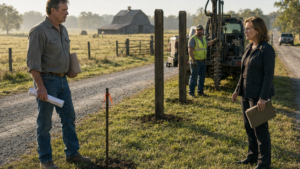
The farm had been awake for an hour. A delivery truck had already brought seed trays, and beyond the house the small vegetable field shone with irrigation water. The gravel lane that served Samantha’s property continued past her lower pasture before joining two neighboring farms. Everybody used it. Feed trucks used it. Hay wagons used it. Repair crews used it.
Betty had used it for thirty years.
Samantha stepped onto the porch.
“What are you doing?”
Betty lowered the camera.
“Documenting traffic.”
“At my kitchen window?”
“I was documenting the lane.”
“The lane is thirty feet that way.”
Betty looked toward the gravel without moving.
Then she reached into a canvas folder.
“I was coming to give you this anyway.”
The single-page notice had the cooperative name across the top and a box marked PENALTY near the bottom.
Two hundred dollars.
Unauthorized commercial activity and excessive vehicle use.
Samantha read it twice.
“What unauthorized activity?”
“The deliveries.”
“I run a farm.”
“You run more than what was represented when you joined the road cooperative.”
“I bought seed trays.”
“And last Thursday?”
“Compost.”
“Tuesday before that?”
“A refrigeration repair.”
Betty answered too quickly.
Samantha looked up.
The older woman’s expression changed by barely anything, but the mistake had already been made.
“How do you know what came Tuesday?”
Betty shifted the camera strap higher on her shoulder.
“We have records.”
Samantha looked at the notice again.
Under the violation summary were four dates.
Tuesday, 7:12 a.m.
Thursday, 9:46 a.m.
Friday, 4:18 p.m.
Monday, 6:51 a.m.
She knew all four arrivals. The Tuesday repair van had stayed less than twenty minutes. Friday had been a neighbor borrowing her utility trailer.
“You’ve been recording when people come here?”
“The cooperative has a responsibility to protect the road.”
“Who authorized that?”
“The cooperative did.”
“That isn’t an answer.”
Betty’s mouth tightened.
“You can bring it up Saturday.”
“Bring what up?”
“The fine. Your concerns. All of it.”
Betty turned toward the lane.
Samantha held the paper at her side.
“Betty.”
The woman stopped.
“If somebody is standing beside my house with a camera again, they need to tell me why before they do it.”
Betty looked back.
For the first time, the confidence in her face became something harder.
“You’re assuming this is personal.”
“You were pointing a camera through my kitchen window.”
“I was documenting use of cooperative property.”
“That window is not cooperative property.”
Betty walked away.
Her boots made a dry grinding sound over the gravel.
Samantha watched until the tan jacket passed the bend near the mailbox shelter.
Only then did she look at the four times again.
She had not given those times to anyone.
By nine o’clock, anger had turned into method.
She opened a notebook in her farm office and listed every delivery she could remember from the past month. Seed. Feed. Refrigeration. Tractor parts. Produce pickup.
She compared them with invoices and calendar entries.
There were no unusual loads. No heavy equipment beyond what neighboring farms routinely brought through.
At noon, she drove the lane slowly.
Ruts showed near the low spot before George King’s field, but they were old. A county road inspector had mentioned the culvert there the previous spring. Everyone knew it needed attention.
Nothing explained a camera at her house.
At the shared mailbox shelter, Samantha noticed a clipboard hanging from a nail inside.
She reached for it, then stopped.
The top page was a handwritten maintenance sheet.
Ditch clearing.
Gravel delivery.
Gate repair.
Nothing unusual.
But on the corner of the sheet, in blue ink, someone had written:
Harris — 6:51.
Samantha stared at it.
A pickup rolled around the bend.
She let the clipboard fall back against the wall.
George King lifted a hand from behind the wheel as he passed.
Usually he stopped if she was near the boxes.
Today he kept going.
Samantha stood there until the dust settled.
That evening she worked until dark tying tomatoes and moving irrigation hose. She told herself several times that she was not going to build a conspiracy out of a note and an awkward neighbor.
At ten thirty she carried her laptop to the kitchen.
Her door camera stored clips whenever movement crossed the porch or side walk.
She searched Monday.
Nothing unusual after breakfast.
Sunday.
A raccoon. Wind moving a feed sack.
Saturday.
She almost missed the clip because the camera had marked it at 11:43 p.m.
Samantha clicked.
The side yard appeared in washed-out gray.
For several seconds nothing moved.
Then Betty Wright stepped into frame.
She was crouched below Samantha’s bedroom window.
The camera was in her hands.
And the lens was pointed up.
Chapter 2: Three Handwritings in One Farm Log
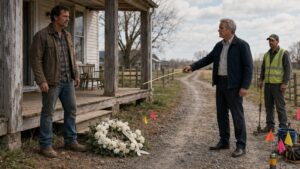
Samantha found her truck plate number before she found her name.
It was Wednesday morning, written halfway down a page tucked behind the ordinary maintenance clipboard at the mailbox shelter.
7K—
The last digits matched.
Beside them someone had written:
5:58 out.
8:21 return.
She had left before sunrise that day for the wholesale produce market.
Nobody from the cooperative had been waiting at her gate.
Someone had watched.
Samantha closed the shelter door halfway and listened.
A tractor worked in a distant hayfield. Birds moved in the cedar windbreak. Nothing else.
She took out her phone and photographed the page.
Then another.
The sheets were not maintenance records at all.
They were a log.
Monday listed a plumbing van.
Tuesday recorded Samantha’s pickup leaving, returning, then leaving again.
Wednesday included a produce truck and the words two visitors.
One entry simply said lights on late.
Samantha’s throat tightened.
She flipped backward.
Three weeks.
Then five.
Then nearly two months.
There were observations about vehicles, hours, visitors, and which direction Samantha drove when she left.
Some entries concerned other farms, but Samantha’s name appeared far more often.
She read until she saw an entry that made her stop.
King waved to Harris at 4:03.
George.
Not just traffic.
Interactions.
She photographed every page.
By the time she returned to her office, her hands were shaking—not from fear exactly, but from the effort of staying precise.
She transferred the photos to her computer and began sorting them by date.
That was when she noticed the handwriting.
The first hand was narrow and upright, with clipped numbers.
The second leaned heavily right.
The third printed in block capitals.
Three people.
Maybe more.
The thought she had resisted since Monday settled into place.
Betty was not doing this alone.
Samantha printed enlarged copies and spread them across the desk.
She had spent nine years doing work like this in rooms without windows: grant ledgers, nonprofit minutes, procurement files, expense reports. She had left because eventually every innocent mistake had begun to look like concealed intent, and every concealed intent had started following her home.
She had promised herself farming would be different.
So she forced herself to write two columns.
KNOWN.
ASSUMED.
Under KNOWN:
Betty photographed the property.
The log existed.
Three handwriting styles.
Arrival and departure times recorded.
The $200 notice used matching dates.
Under ASSUMED:
Betty created the log.
George participated.
The board authorized it.
The cooperative paid for it.
She stared at the last line.
That one bothered her.
Betty had said, We have records.
Not I have records.
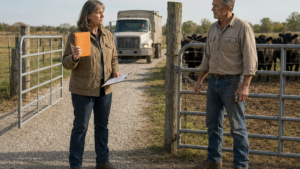
At lunchtime Samantha found George repairing fence beside his lower pasture.
She stopped her truck on the lane.
He saw her and kept tightening wire.
“George.”
“Morning.”
“It’s afternoon.”
He looked at the sky as though checking.
Samantha got out.
“You know about a traffic log?”
His pliers stopped.
That pause was enough to sharpen everything in her.
“What traffic log?”
“The one in the mailbox shelter.”
“Lots of papers in there.”
“The one with my license plate. My deliveries. When I leave my house.”
George bent the wire harder than necessary.
“You need to talk to Betty.”
“I’m talking to you.”
“I don’t run the cooperative.”
“Your name is in it.”
That made him look at her.
“My name?”
“It says you waved to me.”
His expression shifted—not surprise, exactly. Embarrassment.
Samantha mistook it for guilt.
“How many of you are doing this?”
George threw the pliers into the grass.
“Don’t do that.”
“Do what?”
“Decide the answer before somebody gives you one.”
“You knew.”
“I said talk to Betty.”
“That means you knew.”
“It means I’m not standing in a ditch arguing about board business.”
He picked up the pliers and walked toward the fence line.
“Saturday,” he said. “Say whatever you want Saturday.”
Samantha stood beside the truck.
His refusal felt worse than a confession.
That evening she returned to the shelter after most of the farms had gone quiet.
The log was still there.
This time she removed it carefully, carried it to the bench outside, and photographed the inside covers.
The back contained several abbreviations she had overlooked.
Road.
Water.
Ins.
Risk.
Beside her name, written in the narrow upright hand, was a line with a date six weeks earlier.
Harris — add to paid risk file.
Paid.
Samantha read it again.
The word changed the shape of the problem.
She had assumed neighbors were being nosy.
Now she wondered whether somebody had turned watching her into an expense.
She replaced the book exactly where she had found it.
At home she created a new folder on her computer.
She called it ROAD COOP.
Inside she saved the photographs, the $200 penalty, camera stills of Betty near the bedroom window, and copies of Samantha’s delivery invoices.
Then she opened the cooperative bylaws she had received when she purchased the farm.
The document was seventeen pages long.
Road maintenance.
Drainage responsibilities.
Voting rights.
Assessments.
Emergency expenditures.
Nothing on surveillance.
Nothing on monitoring private residences.
Nothing on paid risk files.
Near midnight, Samantha reached the section governing expenses outside the annual budget.
Member approval required above a stated threshold.
She leaned back.
For the first time since Betty appeared outside her kitchen, Samantha felt something colder than anger.
If somebody had been paid, there should be a vote.
If there was a vote, there should be a record.
And if there was no record, then the question was no longer simply who had been watching her.
It was who had spent the cooperative’s money to do it.
Chapter 3: Forty Pages on the Machinery-Shed Table
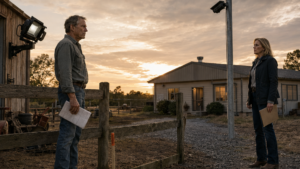
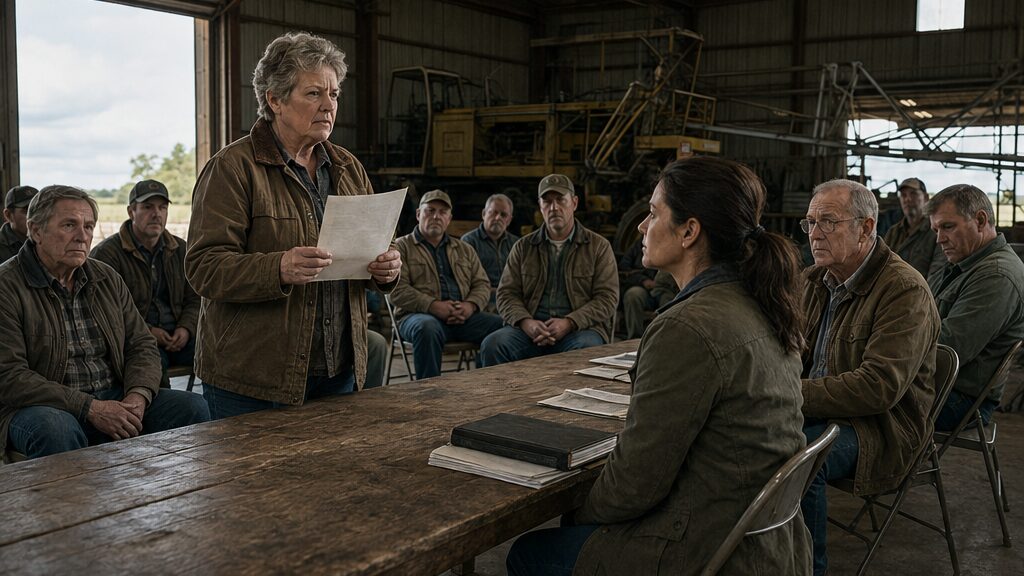
Betty Wright began Saturday’s cooperative meeting by reading Samantha’s penalty aloud.
She did it before approving the previous meeting’s minutes, before Jerry Miller gave the treasurer’s report, before anyone discussed the washed-out shoulder near the culvert.
“Two hundred dollars for repeated unauthorized commercial traffic beyond normal agricultural use.”
Samantha sat in the second row with a thick folder across her knees.
Around her, muddy work boots shifted on the concrete floor of the machinery shed.
Betty looked over the page.
“Before anyone reacts, this isn’t personal.”
Samantha almost laughed.
She did not.
Betty continued.
“We have increased heavy use on the shared lane. We have drainage problems. We have insurance concerns. We cannot maintain infrastructure if individual owners simply decide the rules don’t apply to them.”
A board member nodded.
Someone in the back said, “That’s fair.”
Samantha felt heat rise behind her ears.
She had expected resistance.
She had not expected Betty to frame her as the reason the road was failing.
Betty set the notice down.
“Samantha, you asked to address this.”
Samantha stood.
“Yes.”
She carried the folder to the scarred wooden table at the front.
Betty folded her arms.
Samantha placed the $200 notice down first.
Then a still image of Betty beside the farmhouse.
Then another.
Then the copied surveillance pages.
Then a tabbed stack of delivery invoices, cooperative bylaws, and dated notes.
The pile landed with a flat, heavy sound.
Conversation stopped.
“Forty pages,” Samantha said. “All dated.”
Betty’s face remained composed.
“What exactly are we looking at?”
“You tell me.”
“I’m asking you.”
Samantha slid one photograph across the table.
“That is you beside my bedroom window at eleven forty-three at night.”
The machinery shed became still enough for Samantha to hear the tick of cooling metal from a tractor parked behind the chairs.
Betty looked at the photograph.
“I was documenting activity near the lane.”
“My bedroom is not near the lane.”
“You’ve cropped the image.”
“The camera did.”
Betty pushed it back.
“This is getting dramatic.”
A nervous laugh came from somewhere behind Samantha.
The sound hit harder than she expected.
For a moment she was no longer in a machinery shed. She was back in conference rooms years earlier, listening to board members joke about missing receipts because they believed the woman asking questions was being difficult.
She nearly answered in the same sharp voice she had once used in those rooms.
Instead, she opened the copied log.
“These entries track when I leave my house, when I return, who visits, when lights are on, and which neighbors speak to me.”
A farmer leaned forward.
“What log?”
“The one kept in the mailbox shelter.”
Several people turned toward Betty.
She said, “It’s a road-use record.”
“It says George waved at me.”
George was standing near the open shed door.
Samantha looked directly at him.
“And there are three different handwriting styles. So I’d also like to know who besides Betty and George has been recording me.”
George straightened.
“Hold on.”
“You knew about the log.”
“I knew there was a traffic record.”
“You refused to answer me.”
“That doesn’t mean I wrote in it.”
“You expect me to believe your name is in a surveillance record and you had nothing to do with it?”
George’s face hardened.
“Careful, Samantha.”
Betty cut in.
“This is exactly why we shouldn’t turn routine risk documentation into accusations.”
Samantha faced her again.
“Fine.”
She pulled out the bylaws.
“Then let’s not talk about motives. Let’s talk about authority.”
Betty’s expression changed slightly.
Samantha placed the bylaws beside the logbook.
“You said the cooperative authorized the monitoring.”
“It did.”
“Show me the vote.”
Betty blinked.
“The board has authority to protect cooperative assets.”
“That isn’t what I asked.”
Jerry Miller looked down at his papers.
Samantha noticed.
“When was the vote?”
Betty said, “We discussed the road situation repeatedly.”
“When did members authorize paid monitoring of private farm activity?”
Nobody moved.
Betty reached for the bylaws.
“You’ve lived here less than four years. There are practices that predate you.”
“Practices aren’t votes.”
“We don’t hold a membership referendum every time we take steps to reduce liability.”
“How much did the steps cost?”
Betty paused.
That pause traveled through the shed.
Jerry cleared his throat.
Samantha turned toward him.
“You’re treasurer.”
Jerry removed his glasses and rubbed one lens with his shirt.
“There are expenses associated with risk documentation.”
“How much?”
“That isn’t something I’m going to reconstruct from memory in a meeting.”
“Was there a contractor?”
Jerry looked at Betty.
Betty did not help him.
“Yes,” he said finally.
Samantha felt the room change.
Not dramatically. Nobody gasped. Nobody apologized.
But boots stopped shifting.
One of the board members picked up Samantha’s copied log.
“A contractor wrote this?”
Jerry said, “I didn’t say that.”
“Then what did they do?” Samantha asked.
Betty’s voice sharpened.
“This meeting is not an audit.”
“No,” Samantha said. “Not yet.”
The words came out more pointedly than she intended.
Betty stared at her.
Samantha regretted the tone immediately, but not the question.
She pointed to the handwritten notation beside her name.
“Paid risk file. Who paid for it?”
Jerry closed the folder in front of him.
“There is an invoice.”
“For what?”
“I said there is an invoice.”
“Can we see it?”
“Not today.”
“Why?”
“Because I don’t carry every financial record to a monthly meeting, and I’m not going to start reading vendor documents aloud without making sure I know exactly what I’m looking at.”
It was the first answer Samantha had heard all morning that sounded careful instead of defensive.
She nodded once.
“Then bring the records.”
Betty leaned forward.
“You’re turning a road-maintenance problem into a courtroom.”
Samantha looked at the old gravel map pinned behind her.
“No. I’m asking who watched my house and who paid them.”
A board member asked, “Was there actually a vote?”
Betty did not answer.
George spoke from the doorway.
“And for the record, I didn’t write in that book.”
Samantha turned.
“You knew it existed.”
“Yes.”
“You knew they were tracking me.”
“I knew Betty wanted traffic documented.”
“And you said nothing.”
George’s jaw tightened.
“That is not the same thing as spying on you.”
“It felt the same from my side.”
He stared at her for a long moment.
Then he picked up his cap from a folding chair.
“You don’t get to make me guilty because I didn’t handle this the way you wanted.”
He walked out of the shed.
The accusation remained behind him like something Samantha had dropped and could no longer pick up.
Betty began gathering papers.
“We’re moving on.”
Samantha put one hand on the stack.
“No.”
Betty looked up.
“I want the minutes showing the authorization. I want the expenditure. I want the contractor invoice. And I want whatever policy allowed people to photograph my home.”
“You can submit a records request.”
“I will.”
Jerry spoke quietly.
“You should.”
Betty looked at him.
Jerry did not look away.
“There’s an invoice,” he said again, this time to Samantha. “If you want to understand this, start there.”
“What was purchased?”
Jerry’s fingers rested on his closed ledger.
He hesitated.
Then he said, “That depends on what the contractor considered part of the service.”
Samantha felt the anger in her settle into something more exact.
A contractor.
A paid risk file.
A monitoring log nobody remembered approving.
She gathered her forty pages.
For the first time, Betty no longer looked irritated.
She looked worried.
Chapter 4: The Vote That Never Reached the Minutes
Samantha found the missing vote because there was nothing where it should have been.
Tuesday morning, she sat at the narrow desk in her farm office with the cooperative’s meeting minutes spread across three months. The pages were ordinary enough—ditch clearing, gravel invoices, gate repair, annual dues, complaints about standing water near the lower bend.
Then came the month the monitoring had begun.
There was no vote.
No motion.
No recorded authorization for a contractor.
No mention of surveillance, traffic observation, risk files, or photography.
Samantha checked again.
Then a third time.
She lined the copied logbook beside the minutes and matched dates.
The first cluster of detailed entries began six days after a meeting in which Betty had raised “increased liability exposure” and “abnormal commercial use.” The minutes recorded discussion.
Only discussion.
Samantha circled the paragraph.
For nine years, before she left audit work behind, she had learned to distrust gaps more than bad numbers. Numbers could be corrected. Missing authorization usually meant someone had decided procedure was inconvenient.
She opened the cooperative bylaws.
Expenses over the stated threshold required board action and notation in the minutes. Larger non-emergency expenses required member approval.
She did not yet know what had been spent.
But Jerry had said contractor invoice.
That meant money.
By noon Samantha was at the county records desk, not because she expected county files to contain the cooperative’s private bookkeeping, but because she wanted the road easement and maintenance agreement that governed the shared lane.
The records clerk slid an old file across the counter.
“Copies are twenty-five cents a page.”
Samantha nodded.
The agreement confirmed what she already knew: maintenance responsibility was collective. No individual owner had unilateral control over access, and the cooperative existed to manage common costs.
Nothing in it gave Betty authority over private observation.
Back at the farm, Samantha made another column.
CLAIM.
RECORD.
Betty’s claim: cooperative authorized monitoring.
Record: no vote found.
Betty’s claim: road protection.
Record: traffic log included visitors, lights, interactions, and times unrelated to road damage.
Betty’s claim: routine risk documentation.
Record: paid file referenced.
She stopped.
There was a rhythm here.
A familiar one.
At the nonprofit where Samantha had finally burned out, the problem had not been that every person was corrupt. Most were not. The problem had been that everyone knew one person was making decisions outside the rules, and each person had convinced themselves that fixing it would create more trouble than ignoring it.
She had spent years walking into rooms where everyone wanted the numbers clean but nobody wanted to know how they had gotten dirty.
She closed her eyes.
She had left that life.
She had bought land partly because dirt was supposed to be simpler.
A truck door slammed outside.
Samantha looked through the office window.
George King stood beside her pickup.
She went out.
He did not greet her.
“You told the room I was spying on you.”
Samantha folded her arms.
“I said your name was in the log and you knew about it.”
“You asked how many of us were doing it.”
“You wouldn’t answer me.”
“That isn’t proof.”
“No.”
The word came out harder than she intended.
George waited.
Samantha looked toward the lane.
“You knew the log existed.”
“I knew Betty was keeping traffic records.”
“You saw what was in it?”
“Some of it.”
“And you didn’t say anything.”
“No.”
“Why?”
He picked at a splinter on the truck bed.
“Because every time that cooperative gets into a fight, somebody wants everybody else to pick a side. I’m tired of it.”
“That’s convenient.”
“Probably.”
He looked at her.
“But convenient isn’t the same as guilty.”
Samantha felt the answer land where she least wanted it.
George continued.
“Betty asked me to take shifts watching the lane.”
Samantha’s attention snapped back.
“And?”
“I told her no.”
“When?”
“About six weeks ago.”
“Why didn’t you tell me?”
“Because I figured she’d drop it.”
“She didn’t.”
“I know.”
“You knew she was still watching.”
“I knew she was watching traffic. I did not know she was outside your house at night.”
Samantha studied him.
“Did you write in the log?”
“No.”
“You expect me to take that on trust?”
“No.”
His answer was quiet.
“I expect you to prove it if you’re going to say it in front of people.”
Samantha did not respond.
George nodded once.
“That’s all I came to say.”
He got back in the pickup.
Samantha stood there after he drove away, feeling something she disliked more than anger.
Shame.
Not because George had stayed silent. He had.
Not because his silence had been harmless. It had not.
Because she had filled the missing space herself.
That afternoon she returned to the documents with less certainty and more discipline.
She built a timeline from the logbook, minutes, penalty notice, and known deliveries.
The accounting category appeared only indirectly in Jerry’s treasurer reports.
Road maintenance.
The monthly total had jumped sharply during the same period.
Not enough to prove anything.
Enough to ask.
She found two smaller charges labeled professional services.
Then a larger transfer folded into a maintenance total with no vendor listed in the minutes.
Samantha leaned closer to the screen.
There it was.
The bookkeeping did not tell her what the cooperative had bought.
But it told her where someone had hidden the answer.
Road maintenance.
That evening she drafted a formal written request.
She kept the tone flat.
Copies of relevant meeting minutes.
Invoices.
Contracts.
Vendor scope.
Board approvals.
Member votes.
Reserve-fund transfers.
Any document connected to paid risk documentation, traffic monitoring, or photographic observation.
She read it once.
Then removed three sentences that sounded angry.
Added a ten-day deadline.
Printed two copies.
The next morning, she drove to the cooperative office.
Betty was there.
She looked at the envelope in Samantha’s hand before looking at Samantha.
“What now?”
“A records request.”
Betty did not take it immediately.
“You’re making this bigger than it is.”
“I don’t know how big it is.”
“You could have called.”
“I asked at the meeting.”
Betty’s jaw tightened.
Samantha extended the envelope.
“Ten days.”
Betty took it.
Behind her, Jerry was sitting at the office desk with a calculator and ledger.
He looked up.
Samantha saw recognition in his face.
Not surprise.
Recognition.
She left before she could ask him what he knew.
Ten days from now, the cooperative would either produce the records or refuse.
Either answer would tell her something.
Chapter 5: Fourteen Thousand Dollars Under Road Maintenance
The number was fourteen thousand dollars.
Samantha saw it before she saw the vendor name.
Ten days after delivering her request, a thick envelope arrived by certified mail. She carried it to the dining table, pushed aside a basket of green beans, and opened the packet under the hanging light.
Invoices.
Ledger pages.
Board correspondence.
Insurance letters.
Copies of minutes she already had.
She began with the general ledger.
Road maintenance.
Gravel.
Culvert inspection.
Brush clearing.
Drainage.
Then a single entry nearly four times larger than the surrounding expenses.
$14,000.00.
Samantha sat back.
For several seconds she did nothing.
Then she pulled the copied logbook from her folder and placed it beside the ledger.
The payment date fell in the same week detailed observation began.
Her pulse quickened.
She turned to the invoice.
The vendor name was unfamiliar.
The description was not.
Risk documentation services.
Traffic-use assessment.
Photographic documentation.
Property-access observation.
Periodic field reports.
Samantha read the page twice.
The first thought came fast and ugly.
Betty had spent fourteen thousand dollars to watch her.
The second thought was worse.
Maybe Betty had paid herself through somebody else.
Samantha began tracing.
Vendor address.
Payment account.
Approval initials.
Insurance references.
She found no payment to Betty.
No family connection.
No reimbursement back to any board member.
The vendor appeared to be an outside contractor.
That should have made the answer cleaner.
It did not.
The invoice schedule matched dates in the handwritten log.
One field visit corresponded with the night Betty appeared near Samantha’s bedroom window.
Another matched the morning the seed delivery arrived.
A third billed “supplemental community observation support.”
Samantha frowned.
Community support.
That likely explained the handwriting.
The contractor may have been encouraging residents or cooperative members to add entries between formal visits.
She kept reading.
Near the back of the packet was a letter from the cooperative’s agricultural insurance carrier.
The tone was blunt.
Repeated road deterioration.
Unresolved culvert concerns.
Water-management exposure.
Increasing commercial traffic.
Potential review of coverage terms.
Samantha slowed.
The letter predated the monitoring program.
It warned that if the cooperative could not document road use, maintenance activity, and risk mitigation, future coverage could be affected.
Not canceled immediately.
But threatened.
That mattered.
She read a second letter.
Then an estimate for culvert replacement.
The number was high enough to make her stomach tighten.
The cooperative had a real problem.
The road was aging.
The drainage system was worse.
Reserve funds were thin.
Betty had not invented the risk.
Samantha pushed the chair back and walked to the sink.
Through the window she could see the gravel lane running pale between the fields.
The same lane she had been furious to see documented.
The same lane everyone depended on.
She returned to the table.
The evidence did not excuse the surveillance.
But it changed the motive.
She pulled out a yellow pad.
QUESTION ONE: Was $14,000 stolen?
Answer: no evidence.
QUESTION TWO: Was $14,000 spent without proper authorization?
Likely.
QUESTION THREE: Did the contractor exceed legitimate road observation?
Clearly.
QUESTION FOUR: Did Betty know?
Unknown.
By late afternoon Samantha had created a cross-reference sheet.
Every contractor billing date.
Every matching log entry.
Every camera still.
Every board minute.
Every insurance warning.
The picture grew more precise and less satisfying.
Betty had not built a scheme to enrich herself.
She had built a system to manage fear.
The distinction did not make Samantha less angry.
It made the anger harder to use.
At four fifteen she drove to the cooperative office.
Jerry was alone.
He looked at the binder in her hands and sighed.
“You found it.”
“Fourteen thousand.”
“Yes.”
“Why is it under road maintenance?”
“Because that’s what Betty said it was.”
“You’re treasurer.”
“I know.”
“You processed it.”
“I did.”
“Without a vote?”
Jerry removed his glasses.
“There was board discussion.”
“There is no recorded motion.”
“No.”
“No authorization?”
He hesitated.
“Betty believed the risk provision gave her discretion.”
“That isn’t what the bylaws say.”
“I know what they say.”
“Then why did you pay it?”
Jerry’s mouth flattened.
“Because the insurer was breathing down our necks, the culvert estimate was more than we had in reserve, and every meeting turned into twenty people arguing about whose trucks did what.”
“So you let Betty decide.”
“I let a chairperson act during what I believed was a risk problem.”
“Fourteen thousand dollars.”
“Yes.”
“To photograph people’s homes?”
“That is not what I thought I was paying for.”
Samantha stopped.
Jerry looked tired.
“I thought it was traffic counts, road-use documentation, maybe photos of heavy vehicles and washouts.”
“You never saw the scope?”
“I saw the summary.”
“Not the contract?”
“Not until later.”
“And when you saw it?”
He looked toward the window.
“I told Betty it had gone too far.”
“When?”
“After the first month.”
“Did you stop payment?”
“No.”
“Did you tell members?”
“No.”
Samantha closed the binder.
“Why?”
Jerry gave a humorless laugh.
“Same reason people do stupid things in committees. I thought we could fix it quietly.”
The words bothered her because they were ordinary.
No villainy.
No grand plan.
Just avoidance.
Samantha drove from the office to Betty’s farm.
Betty was outside a barn stacking irrigation fittings.
She watched Samantha approach.
“You got the records.”
“Yes.”
“And?”
“Fourteen thousand dollars.”
Betty set down the fitting.
“For professional risk documentation.”
“For surveillance.”
“For documentation.”
“Of my bedroom window?”
Betty looked away.
Samantha held up the invoice.
“You authorized this without a vote.”
Betty did not answer.
“You told the meeting the cooperative approved it.”
“The board knew we had a risk program.”
“That is not the same thing.”
“We had an insurance warning.”
“I read it.”
“We had a failing culvert.”
“I saw the estimate.”
“We had more traffic than we could account for.”
“So you hired people to watch us.”
“To document use.”
“You put my name in a paid risk file.”
Betty’s face tightened.
“You were running more deliveries than most.”
“I run a farm.”
“So does everyone else, and not everyone has refrigerated pickups, repair vans, produce buyers, and customers coming down that lane.”
“That still requires a vote.”
Betty looked at her for a long time.
Then she said it.
“I authorized it.”
Samantha said nothing.
Betty wiped dirt from her hands with a rag.
“There was no formal vote.”
The admission should have felt like victory.
Instead, Samantha heard only the next question.
“Why hide it?”
Betty looked toward the road.
“Because if I’d asked first, nothing would have happened.”
Chapter 6: Why Betty Chose Control Over Consent
Betty did not defend herself in the barn.
She picked up her truck keys.
“Come on.”
Samantha stayed where she was.
“Where?”
“You want to know why? Come look.”
Ten minutes later they stood beside the low culvert where the shared lane crossed the drainage channel.
The problem was worse up close.
One side of the gravel shoulder had slumped toward the ditch. Water had eaten beneath the pipe. Rust showed along the lower seam, and the soil above it had cracked into a narrow line.
Betty kicked loose gravel from the edge.
“County inspector said we’ve got maybe one hard season before this needs replacement.”
“I saw the estimate.”
“You saw the cheap estimate.”
Samantha looked at her.
“There’s another?”
“With reinforcement and water diversion.”
“How much?”
“Enough that the current reserve doesn’t cover half.”
Betty walked down the slope carefully.
“Two years ago, that lane handled farm pickups, feed trucks, hay equipment. Now we’ve got heavier refrigerated units, delivery vans, contractors, customers, everybody expanding.”
“You mean me.”
“I mean everybody.”
“But you documented me.”
“You were the fastest change.”
Samantha folded her arms.
“So that made my house fair game?”
“No.”
The answer came quickly.
Betty looked up at her.
“No. The house part went too far.”
It was the first thing she had said that sounded like an admission rather than a defense.
Samantha waited.
Betty climbed back toward the lane.
“At first I kept a notebook.”
From the truck cab she pulled a small, battered book with a cracked black cover.
She opened it.
The pages were nothing like the surveillance log.
Washout after storm.
Standing water near King pasture.
Loose gravel at bend.
Delivery truck stuck, Tuesday.
Pipe exposed two inches.
Simple maintenance notes.
Dates.
Conditions.
Repairs.
“This was the first log?” Samantha asked.
“Yes.”
“Why wasn’t this enough?”
“Insurance wanted documentation.”
“So you hired a contractor.”
“They said they could build a risk record.”
“And you let them turn people into subjects.”
Betty’s mouth tightened.
“I let them do more than I should have.”
“Why?”
“Because I was scared.”
The words surprised Samantha more than anger would have.
Betty looked down at the damaged culvert.
“If coverage changed, some of these farms couldn’t afford the assessments. If the culvert failed and somebody got hurt, we’d all pay. If the irrigation crossing washed out, people would lose crops while we argued.”
“So you decided nobody else got to decide.”
“I decided somebody had to.”
“That’s not leadership.”
“I know what you think it is.”
Samantha stepped closer.
“No. That’s the problem. You don’t.”
Betty looked at her sharply.
Samantha kept her voice level.
“You had a real problem. You had an insurance warning. You had bad infrastructure. You might even have been right that people would argue for six months.”
Betty said nothing.
“But you used that fear to make rules nobody approved. Then you hid the expense and told everyone the cooperative had authorized it.”
“I was trying to keep the place solvent.”
“You were trying to keep control.”
The distinction sat between them.
Betty’s face changed.
Not defeat.
Recognition.
Then resistance returned.
“Control gets things done.”
“It also got a camera outside my bedroom.”
Betty looked away.
A truck approached along the lane.
George slowed as he came near them.
He stopped.
For a second no one spoke.
George looked at Betty’s old notebook in Samantha’s hand.
“You showed her that?”
Betty nodded.
George climbed out.
Samantha felt tension gather in her shoulders.
George looked at her.
“I told Betty no.”
Samantha said, “She told me.”
Betty glanced between them.
“I asked several people to keep basic traffic notes before we hired the contractor.”
George said, “I said I wasn’t doing it.”
“Why?”
“Because I knew where it would go.”
Betty frowned.
“You didn’t know.”
“I knew people.”
He turned to Samantha.
“I should’ve told you.”
She did not rescue him from the admission.
“Yes.”
He nodded.
“I figured if I stayed out, it wasn’t my mess.”
“That didn’t work.”
“No.”
Samantha looked down at the old notebook.
The handwriting was Betty’s.
The same narrow, upright numbers she had seen in the surveillance log.
But here the entries were about water and gravel, not who waved at whom.
Something meant to keep a road safe had become a record of people.
Not in one dramatic step.
In increments.
One exception.
One shortcut.
One decision nobody challenged.
Samantha handed the notebook back.
“I was wrong about you writing in the other log,” she said to George.
He looked at her.
She continued.
“I said it publicly before I proved it.”
“That you did.”
“I’ll correct it publicly.”
Betty looked surprised.
George did too.
Samantha hated that.
Not because they doubted she would do the right thing.
Because part of her had been tempted not to.
She had wanted the clean version.
Betty wrong.
George complicit.
Samantha proven right.
The records had refused to give her that story.
George rubbed the back of his neck.
“I still knew enough that I should’ve spoken.”
“That part is yours.”
“Fair.”
Betty gave a short, tired breath.
“Is this what Saturday is going to be? Everybody confessing?”
Samantha looked at her.
“No.”
“What then?”
“A vote.”
Betty’s expression closed.
“On what?”
“Ending the monitoring. Voiding the fine. Spending controls. A financial review.”
“And the culvert?”
“We deal with that too.”
“With what money?”
“That’s the part everybody gets to decide.”
Betty looked down the lane.
“You think they’ll vote themselves higher dues?”
“I think they should have the chance to say no.”
“And if they say no and something fails?”
“Then the consequences belong to all of us.”
Betty shook her head.
“That sounds good until somebody has to live with it.”
Samantha looked at the cracked gravel beside the culvert.
“No. It sounds harder.”
That evening she sat at her dining table with the old surveillance copies on one side and her notes for the upcoming meeting on the other.
At the top of the page she wrote Betty’s unauthorized authorization.
Then George’s silence.
Then Jerry’s payment.
She stared at the list.
Finally she added one more line.
My accusation against George.
She almost crossed it out.
Instead, she underlined it.
If she was going to stand in front of the cooperative and demand that everyone account for what they had done, she would have to begin with the thing she had done herself.
Chapter 7: The New Logbook Stays Where Everyone Can See It
Samantha began the meeting by admitting she had been wrong.
That was not how Betty expected it to start.
It was not how George expected it either.
The machinery shed held nearly every cooperative member this time. Folding chairs filled both sides of the long worktable. The old surveillance log sat closed in front of Samantha beside the contractor invoice, the $200 penalty, and a clean yellow legal pad.
Betty sat at the far end.
Jerry had the cooperative ledger open.
Samantha stood.
“Before we discuss Betty, the contractor, the money, or the fine, I need to correct something I said at the last meeting.”
George looked up.
Samantha faced him.
“I implied George participated in recording my movements. I did not have evidence of that. He knew a traffic-monitoring effort existed and chose not to tell me, and I still think that was wrong. But he did not write in the surveillance log, and I should not have said otherwise.”
Nobody spoke.
George shifted in his chair.
Samantha continued before anyone could turn the correction into a ceremony.
“I’m putting that in the record because the rest of what I’m asking for today depends on the same standard.”
She placed her palm on the stack of documents.
“If we expect people to prove what they say, that includes me.”
George gave a small nod.
Betty watched Samantha with an unreadable expression.
One board member cleared his throat.
“So now can we deal with the actual problem?”
“Yes,” Samantha said.
She lifted the contractor invoice.
“Fourteen thousand dollars.”
The room changed.
Several people already knew the number from conversations over the previous two weeks. Hearing it in the shed was different.
Samantha set the invoice beside the closed surveillance log.
“This was paid from cooperative funds under road maintenance. The service included traffic-use assessment, photographic documentation, property-access observation, and risk files.”
Someone near the back said, “Fourteen thousand?”
Jerry answered before Samantha could.
“Yes.”
“Who voted for that?”
Nobody did.
The silence lasted long enough to answer.
Betty leaned forward.
“We have already established there was no formal membership vote.”
A farmer across the table said, “Then how did fourteen thousand dollars leave the account?”
Betty’s shoulders stiffened.
“I authorized the contract under the risk provisions.”
Samantha said, “And Jerry processed it.”
Jerry nodded.
“I did.”
He looked around the room.
“I believed the chair had emergency discretion because we were dealing with insurance exposure. I should have insisted on a recorded board action. I didn’t.”
It was less defensive than the first time Samantha had heard him explain it.
A woman near the shed door asked, “Did you know they were taking pictures of houses?”
“No.”
Jerry looked at the logbook.
“Not at first.”
Betty added, “Neither did I, at first.”
Samantha turned to her.
“But you knew later.”
Betty met her eyes.
“Yes.”
“Did you stop it?”
“No.”
There was no excuse attached.
That mattered.
The meeting did not erupt. Nobody shouted. Nobody clapped.
Instead, people began asking practical questions.
Who had access to the photographs?
Were copies still held by the contractor?
What information had been collected?
Why had visitor names been recorded?
Why were residents’ interactions with one another relevant to road maintenance?
Betty answered what she could.
Jerry answered what he could.
For the first time, neither controlled the room.
Samantha did not either.
That was the point.
After nearly half an hour, Jerry slid a new sheet toward the center of the table.
“We have three decisions in front of us.”
He pointed to the first.
“Terminate the monitoring agreement and require destruction or return of private-property observation records.”
The second:
“Void enforcement actions based primarily on unauthorized monitoring.”
The third:
“Require recorded board votes for extraordinary expenditures above the bylaw threshold, including emergency ratification at the next meeting.”
Samantha looked at Betty.
“My fine?”
Betty glanced at the $200 notice.
“It should be voided.”
A board member asked, “Because the deliveries were allowed?”
Betty answered carefully.
“Because the evidence used for that penalty was gathered through a process we did not properly authorize.”
Samantha appreciated the precision.
It did not pretend the road issue had vanished.
The vote to terminate the surveillance program passed easily.
So did the motion voiding Samantha’s fine.
The spending-control measure took longer.
One member worried it would paralyze emergency repairs.
Another proposed that genuine emergencies could still be handled immediately, but any extraordinary expense would require written notice and ratification within a fixed period.
Samantha listened.
She had arrived expecting to fight Betty.
Instead, she found herself arguing about thresholds, timelines, and what qualified as an emergency.
It felt strangely familiar.
Not because she was back in auditing.
Because this time the people whose money was involved were in the room.
Then Betty placed the culvert estimate on the table.
The mood tightened again.
“This is what none of these votes solve.”
She pushed the paper toward the center.
“We still have a failing crossing.”
Jerry added another sheet.
“And we do not have enough reserve funds to repair it properly.”
Someone asked the obvious question.
“How much are we short?”
Jerry gave the number.
Several people groaned.
A farmer in the back said, “So after fourteen thousand dollars went to watching trucks, now you want more dues?”
Betty did not flinch.
“Yes.”
That answer created more anger than any defense of the monitoring program had.
Samantha understood why.
Higher dues were tangible.
Privacy violations were frightening, but a larger assessment had to be paid.
A board member looked at Samantha.
“You wanted everybody to decide. Here it is.”
The words were not hostile.
That made them harder.
Samantha looked through the open shed door toward the shared lane.
The gravel ran past every property represented in the room.
Her farm could not function without it.
Neither could George’s.
Neither could Betty’s.
Transparency had not made the culvert cheaper.
It had only made the cost impossible to hide.
“We should see the repair bids,” Samantha said.
Betty slid them forward.
“We should see the reserve balance.”
Jerry turned the ledger around.
“And we should vote on the assessment after everyone has both.”
A few people muttered.
Samantha continued.
“If we vote no, that should be recorded too. Then if the culvert gets worse, nobody gets to pretend we weren’t told.”
George spoke from the side wall.
“That seems fair.”
Betty looked at Samantha for a long moment.
Then she nodded.
The assessment did not pass unanimously.
It passed narrowly.
People would pay more.
The culvert would be repaired.
Nobody looked happy about it.
Samantha found that more convincing than applause would have been.
After the votes, Jerry closed the financial ledger.
One of the board members picked up the surveillance log.
“What happens to this?”
Samantha looked at it.
For weeks, that little book had represented every suspicion she had carried about the place: people watching, people talking, people deciding privately who belonged and who did not.
Betty reached under the table and produced another notebook.
New.
Plain black cover.
She placed it beside the old one.
“I bought this yesterday.”
Samantha raised an eyebrow.
Betty opened the first page.
Across the top she had written:
ROAD AND WATER ACCESS — MAINTENANCE RECORD.
Below that were columns for date, location, observed condition, action needed, and completion.
No names.
No private visitors.
No departure times.
No lights in windows.
Betty pushed it toward Samantha.
“You said the original idea wasn’t the problem.”
“The original notebook tracked the road.”
“This one will too.”
George leaned over it.
“Where are you keeping it?”
“The mailbox shelter.”
Samantha looked at Betty.
“Locked?”
Betty hesitated.
Then shook her head.
“No.”
A small smile almost reached Samantha’s mouth.
Almost.
Jerry said, “Anyone can enter a road or water issue. Anyone can inspect the entries.”
“And corrections?” Samantha asked.
“Dated. Initialed. Nothing erased.”
Samantha nodded.
“That works.”
Betty closed the old surveillance log and slid it toward Jerry for retention with the official records until the contractor’s materials were confirmed destroyed.
The new book remained on the table.
The distinction was almost embarrassingly simple.
A book could watch people.
Or a book could help people watch something they shared.
The paper had never been the problem.
The secrecy was.
When the meeting ended, chairs scraped across concrete and people drifted toward trucks and tractors.
George stopped beside Samantha.
“You didn’t have to do that first.”
“Yes, I did.”
He looked at her for a second.
“You still mad I kept quiet?”
“Yes.”
“Fair.”
“You still mad I accused you?”
“Yes.”
Samantha nodded.
“Also fair.”
That was as close to reconciliation as either of them seemed prepared to manage.
George put on his cap.
“See you around.”
“You usually do.”
He laughed once.
The joke surprised them both.
Near the worktable, Betty was gathering folders.
Samantha approached.
For a moment they stood with the evidence between them.
The camera photographs.
The invoice.
The canceled penalty.
Betty said, “You were right about the vote.”
Samantha waited.
“And wrong about thinking I was trying to hurt your farm.”
“I know.”
Betty looked at her.
“That doesn’t make what I did right.”
“No.”
Samantha expected herself to enjoy saying it.
She did not.
Betty picked up the culvert bid.
“I still think half this group would rather argue until the road falls into the ditch.”
“They might.”
“You trust that?”
“No.”
Betty seemed surprised.
Samantha looked toward the open shed.
“I trust making them own the decision.”
Betty considered that.
Then she tucked the papers under her arm.
“That’s slower.”
“Usually.”
“I hate slow.”
“I noticed.”
Betty gave her a dry look and walked away.
Two days later, Samantha stopped at the mailbox shelter on her way to the lower field.
The new logbook lay on the bench.
Unlocked.
Three entries had already been made.
Loose gravel near the bend.
Standing water by the irrigation gate.
Culvert survey scheduled Friday.
Samantha turned to the next blank line.
For a moment she remembered the other book.
Her license plate.
Her visitors.
The time she had left home before sunrise.
She could still feel the old instinct asking who had written what, who had known, who had kept quiet.
That instinct was not gone.
Maybe it never would be.
She took the pen attached to the notebook.
At the bottom of the page, she wrote:
Harris farm entrance — shallow rut forming after produce pickup. Check after next rain.
She added the date.
Nothing about the driver.
Nothing about the truck plate.
Nothing about who had watched it happen.
Just the road.
Samantha closed the book but did not latch the shelter.
As she drove away, she could see it through the open side: a plain black notebook resting where any member could reach it.
The lane ahead was still worn.
The culvert still needed work.
Betty was still Betty.
George had not become a friend overnight.
Fourteen thousand dollars could not be unspent.
But the next decision would not be made in the dark.
For now, that was enough.
The story has ended.