He Let the Marina Rise Beside His Broken Dock—Then Chose What Justice Would Cost
Chapter 1: The Morning They Tore Out Robert’s Dock
The excavator bucket hooked beneath the first section of Robert Walker’s dock at 7:18 on Monday morning and lifted fifty years of weathered timber out of the lake as if it were rotten fencing.
Robert stood on his porch with a coffee mug in one hand and watched water stream from the boards.
The machine operator swung the section toward shore. One of the old posts snapped against a rock with a sound Robert felt more than heard.
He set the mug on the porch rail.
“Stop.”
The operator looked toward a man standing near the shoreline.
Jason Green wore clean khaki pants, a white shirt with the sleeves rolled once, and a dark vest that looked too expensive for mud. Rolled plans were tucked beneath one arm.
Jason raised a hand, but not to stop the excavator.
The bucket moved again.
Robert walked down the slope.
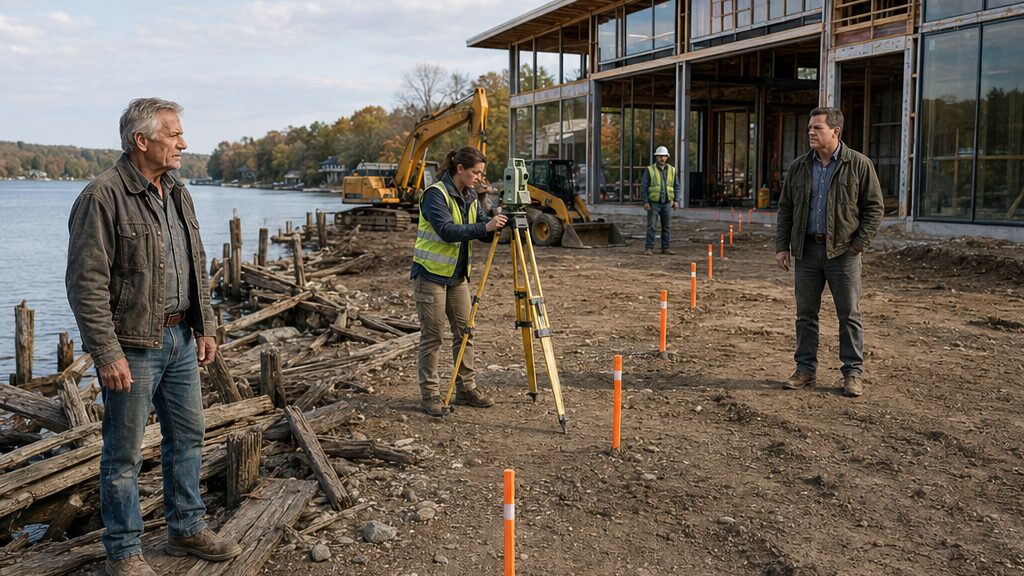
His rubber boots sank into ground churned by equipment. Pieces of his dock lay scattered among pale stones, reeds and muddy cable.
“You’re on my property,” Robert said.
Jason removed his sunglasses.
“We went through this Friday.”
“No. You told me you were starting shoreline preparation.”
“And I told you the survey put the line here.”
Jason pointed toward a fresh orange stake twenty feet from where Robert remembered any boundary ever running.
Robert looked at it.
Then at the dock.
“I’ve tied a boat there since before you were old enough to drive.”
“I understand you’ve used it a long time.”
Used it.
Robert let the word sit between them.
Jason unfolded one sheet from the roll. The paper was crowded with lines Robert could not read from where he stood.
“The survey puts your frontage east of this point. The old dock extends into our parcel and interferes with the marina approach.”
Robert stared at him.
“Your parcel.”
“That’s what the survey says.”
Behind Jason, the excavator dropped another timber onto the growing pile.
Robert heard nails grind against stone.
A worker disconnected the rope holding Robert’s aluminum fishing boat to the remaining outer post.
Jason gestured toward it.
“You’ll need to move your little boat too. We’ve got crews coming in behind this machine.”
For the first time that morning, Robert felt something hot rise through his chest.
He had spent most of his working life repairing engines for men who believed shouting made a wrench turn faster. It never had.
He looked at Jason’s plans instead.
“Where did your surveyor start?”
Jason hesitated.
“Start?”
“What monuments?”
“I hired licensed people, Robert.”
“That wasn’t my question.”
Jason’s jaw tightened.
“Our survey is current.”
A current survey.
As though age itself made a boundary unreliable.
Robert turned toward the lake.
The old dock had been built before the marina property next door had a marina, before the paved county road reached this side of the water, before anyone talked about glass clubhouses and seasonal memberships. Robert had replaced deck boards, driven new posts, repaired storm damage and once rebuilt the outer eight feet after spring ice tore it sideways.
He knew where the shoreline changed.
He knew where his father had shown him the iron marker above the high-water rocks.
He had not thought about that marker in years.
A worker called from the excavator.
Jason answered, “Keep going.”
Robert turned back.
“You’re certain enough to tear it out before we settle this?”
Jason lowered his voice.
“We have permits. We have financing. I have a construction schedule that’s already tight. I can’t stop a commercial project every time somebody disagrees with a survey.”
There it was.
Not malice exactly.
Momentum.
Robert understood momentum. A seized bearing could destroy an entire gearbox because somebody decided shutting down for an hour cost too much.
“You have my number,” Jason added. “If your attorney wants to send something over, send it.”
Robert almost said he did not need an attorney to remember his own land.
Instead he looked down at the nearest broken dock board.
A faded notch remained on one edge where, decades earlier, he had fitted a ladder that was long gone.
The board was older than Jason’s project.
Older than most of the equipment now tearing it apart.
But old wood was not evidence.
Robert picked up his coffee mug from where he had carried it halfway down the slope, although he did not remember setting it there.
“Move the boat carefully,” he said.
Jason seemed surprised.
“That’s it?”
“For now.”
Robert walked to the water, stepped into the aluminum boat and untied the remaining line himself.
The construction superintendent stood nearby with a clipboard against his thigh. He watched Robert with the uncomfortable expression of a man who had expected an argument and preferred machinery to people.
“Where do you want it?” he asked.
Robert pointed east.
“There’s a gravel pocket by the reeds. Pull it there.”
Two workers helped him drag the boat away.
When Robert turned back, Jason was already speaking into his phone.
The excavator removed the last outer section of the dock.
By nine, nothing extended from Robert’s shore except two broken posts and a muddy gap between rocks.
Jason’s crew began grading.
Robert returned to the house.
From the kitchen window he could see an orange survey stake standing beyond the old dock line. He washed mud from his hands and made another cup of coffee he did not drink.
His anger had changed.
That bothered him.
At first he had wanted Jason to stop.
Now he wanted to know how wrong Jason was.
Robert went into the small room he still called the office, though the desk mostly held tax notices, equipment receipts and envelopes he kept because throwing away records made him uneasy.
The bottom drawer stuck halfway.
He lifted it, pulled again and heard the familiar scrape of wood.
Inside were property papers in a brown folder.
Robert took them to the desk.
The original purchase documents were there. So were later tax maps, insurance records and a survey copy from years ago.
He unfolded the largest sheet carefully.
The paper had yellowed along its creases.
Near the lower corner was a recording stamp.
Robert leaned closer.
He traced the western property line with one finger, then followed its bearing toward the lake.
His finger stopped.
He looked through the office window toward Jason’s orange stake.
Then back at the plat.
The two lines could not possibly be the same.
Chapter 2: The Line Recorded Before the Marina Existed
Robert laid Jason’s claimed boundary and his old recorded plat beside each other on the kitchen table and understood immediately that one of them had moved more than a few inches.
He did not have Jason’s full survey, only the page the developer had allowed him to photograph on Friday. Robert printed the image at the county library and enlarged it until the parcel lines were readable.
The difference at the shoreline looked closer to thirty feet.
Perhaps more.
He placed a coffee cup on the corner of the old plat to keep it flat.
For ten minutes he did nothing except compare bearings, dimensions and landmarks.
The old document referenced two monument points. One was near the county road. The other had once been described in family conversations as an iron pin above the shoreline.
Robert remembered his father standing near a cedar post and telling him never to let anybody pull the marker because “roads change and fences lie.”
Robert had been twenty-something and more interested in getting a boat motor running.
Now the sentence returned with irritating clarity.
By noon he was at the county records office.
The land-use clerk behind the counter listened without interrupting while Robert explained that his dock had been removed based on an adjoining owner’s new survey.
“I’m not asking you to tell me who owns what,” Robert said. “I want to know what’s recorded.”
“That I can help with.”
She pulled the parcel history.
Robert waited while the printer produced copies one sheet at a time.
The marina parcel had changed ownership twice in twenty years. Robert’s parcel had not.
The clerk placed an older subdivision plat beside a more recent parcel map.
Robert pointed at the western line.
“Was this ever amended?”
“Not in what I’m seeing.”
“Vacated?”
“No.”
“Boundary agreement?”
She searched again.
“No recorded agreement.”
Robert felt the first clean satisfaction he had experienced since the excavator started.
“So that settles it.”
The clerk shook her head before he finished.
“It settles that I don’t see a recorded document changing this plat.”
“That’s the same thing.”
“It isn’t.”
Robert frowned.
She turned the old plat toward him.
“Recorded lines matter. So do monuments. So do later conveyances, easements, shoreline rights, survey interpretation. I can tell you what’s in our records. I cannot tell you where a boundary physically lands.”
Robert leaned back.
“You’re saying this paper can be right and I can still be wrong.”
“I’m saying you need a surveyor if location is disputed.”
That irritated him more than he expected.
For most of his life, a measurement meant something. A shaft was either within tolerance or it was not.
Land seemed to attract people who could look at one line and produce six meanings.
The clerk photocopied the original plat and circled the recording reference.
“If this is what your deed references, give the complete chain to whoever surveys it. Don’t just hand them the sheet you like.”
Robert understood the rebuke.
He thanked her.
At home that evening, machinery continued working beside the lake.
Jason’s crew had cleared the dock debris and widened the construction lane.
Robert carried the county copies into his office.
While searching for another folder, he found an old photograph beneath a stack of insurance statements.
He sat down.
The picture showed the dock whole.
Robert stood on it much younger, one foot on the gunwale of a fishing boat. Beside him was his father, narrow-shouldered and sunburned, holding a stringer of fish.
The shoreline behind them was rougher then.
No marina.
No retaining wall.
No glass.
Robert studied the angle of the dock against the rocky point.
He had not remembered that photograph existed.
For several seconds the dispute stopped being about acreage.
Jason had called the dock an obstruction.
That was what stayed with Robert.
Not dangerous. Not disputed.
An obstruction.
Something that belonged in the way of progress until a machine removed it.
Robert put the photograph beside the plat.
The next morning he called three surveying companies.
The first could not come for two weeks.
The second said waterfront title work required more research than Robert seemed to want.
The third call reached Rachel Lewis.
She asked him to explain the problem once.
Then she asked, “Do you have the adjoining survey?”
“Part of it.”
“Recorded plat?”
“Yes.”
“Deed references?”
“Yes.”
“Any known physical monuments?”
“Possibly.”
“Don’t dig for them.”
Robert almost laughed.
“I know better than to move a survey marker.”
“You’d be surprised.”
She asked for scans.
An hour later she called back.
“There’s enough here for me to look at it.”
“When?”
“Thursday morning.”
Robert glanced through the window.
A truck loaded with steel pilings had turned into Jason’s construction entrance.
“Tomorrow?”
“I have field work tomorrow.”
“Thursday, then.”
There was a pause.
“Mr. Walker, I want to make something clear. I’m not coming out there to prove your old plat right.”
“I didn’t ask you to.”
“You sound like you already know the answer.”
Robert looked at the photograph of his father.
“I know somebody tore out my dock.”
“That isn’t the same question.”
“No,” Robert admitted. “It isn’t.”
Rachel’s tone softened slightly.
“I’ll check the recorded control and whatever monuments can still be verified. Then we’ll know more than we do now.”
After the call, Robert drove to the marina entrance.
He did not go onto Jason’s parcel.
From the public road he watched a crane unload pilings.
Jason noticed him and walked over.
“You get an attorney?”
“A surveyor.”
Jason exhaled through his nose.
“Robert, you can spend money however you want.”
“I intend to.”
“I’m trying to save you some of it. We already surveyed this.”
Robert nodded toward the construction.
“Then another measurement shouldn’t scare you.”
Jason’s expression changed.
Only slightly.
But Robert saw it.
Not fear.
Annoyance at delay.
“Your surveyor can stay off the active site unless they coordinate with my superintendent.”
“If the boundary is where you say it is, she won’t need much of your site.”
Jason looked toward the lake.
“We start clubhouse foundation work tomorrow.”
Robert had not known that.
It gave him a small, ugly pulse of satisfaction.
He disliked himself for enjoying it.
“Thursday,” Robert said.
Jason put his sunglasses back on.
“Fine.”
Robert drove home.
That evening he unfolded the recorded plat again, but he no longer let himself call it proof.
On Wednesday afternoon, Rachel emailed him a short list of records she had reviewed. Among them were the original subdivision plat, later deeds, county reference notes and an easement document Robert barely remembered.
He called immediately.
“What easement?”
“Shoreline access language. I haven’t mapped it yet.”
“On my property?”
“Possibly across part of it.”
Robert went quiet.
Rachel continued, “This is why we measure before deciding what the documents mean.”
At six the next morning, Robert saw her truck turn into his driveway.
A tripod and survey equipment were secured in the bed.
Rachel stepped out, pulled on a reflective vest and looked past him toward the lake.
“Show me where everybody thinks the line is.”
Robert pointed first toward Jason’s bright orange stake.
Then toward the place above the rocks where his father had once shown him an iron pin.
Rachel studied the distance between them.
“That’s not a small disagreement.”
“No.”
She lifted the equipment case.
“Then we start with the monuments.”
Chapter 3: The Survey Stakes Cut Through the Clubhouse
Rachel drove the first temporary stake into bare soil less than four feet from a trench where Jason’s crew planned to pour concrete that afternoon.
The construction superintendent noticed immediately.
“You can’t put that there.”
Rachel kept one hand on the stake.
“It’s temporary.”
“That’s an active work area.”
“It may also be Mr. Walker’s property.”
The superintendent looked at Robert.
Robert said nothing.
A concrete truck idled beyond the excavation. Workers had stopped pretending not to listen.
Rachel picked up her prism pole and moved toward the next measurement point.
Robert followed.
They had spent nearly two hours locating control.
The old roadside monument had taken twenty minutes to expose beneath gravel and weeds. The shoreline reference was harder. Rachel rejected one rusted piece of metal Robert had hoped was the old pin because its position did not fit the recorded call.
The actual marker was farther inland, buried beneath roots near the remains of an old cedar fence post.
When Rachel found it, she did not smile.
She measured.
Then measured again.
Only after establishing both points did she begin setting a working line toward the water.
Jason arrived as the second stake went in.
He stepped from his SUV carrying the same rolled plans Robert had come to recognize.
“What’s this?”
“Field verification,” Rachel said.
Jason walked toward the stake.
“My survey puts the boundary east of here.”
“I know.”
“You’ve seen it?”
“I reviewed the page Mr. Walker had.”
“Then you know this is wrong.”
Rachel adjusted her equipment.
“I know it’s different.”
Jason looked at Robert.
“You hired her to create a dispute.”
Robert felt the old anger return.
This time he kept his voice level.
“I hired her to measure.”
“We already measured.”
Rachel looked up.
“Who established your control?”
Jason stared at her.
“My survey firm.”
“From which monuments?”
“I’d have to ask them.”
Rachel nodded.
“You should.”
A worker near the trench restarted a saw.
The sharp mechanical whine broke the silence.
Jason gestured toward the equipment.
“We have work scheduled. I’m not stopping construction because somebody found an old pin in the dirt.”
Rachel did not react.
“I’m not asking you to stop.”
Robert looked at her.
She glanced toward the unfinished clubhouse.
Its foundation and lower framing extended along the water, with steel columns rising around what would eventually become the glass west wall.
Rachel moved the prism pole again.
The third temporary stake landed beside a stack of construction lumber.
The fourth fell inside the rough outline of the clubhouse terrace.
Jason’s expression tightened.
“That can’t be right.”
Rachel checked her screen.
“I haven’t given anybody an opinion yet.”
“But you’re putting a property line through my building.”
“I’m marking a measured line from the control I located.”
“That’s semantics.”
“No,” Rachel said. “It’s surveying.”
Robert nearly smiled.
He stopped himself.
Rachel walked another twenty yards.
The line continued toward the lake.
Each new stake made the shape of the problem easier to see.
Orange marker.
Orange marker.
Orange marker.
Then glass framing.
Robert stood where his dock had once met the shore.
Broken sections of two posts remained in the water, cut close to the surface.
From there, the temporary stakes appeared to run almost straight through the west side of Jason’s clubhouse.
The visual simplicity of it unsettled him.
For two days, the dispute had existed as paper.
Now anyone could understand it from fifty yards away.
Jason could too.
He came down the slope quickly.
“How much?”
Rachel looked at him.
“How much what?”
“How far are you claiming I’m over?”
“I’m not claiming anything.”
“You know what I mean.”
Rachel opened her field notebook.
“At this location, the line I’m recovering from the recorded control is significantly west of the line shown on your construction survey.”
“How significantly?”
She gave him a preliminary distance.
Jason removed his sunglasses.
The construction superintendent muttered something under his breath.
Robert looked at the building.
The number was larger than he had expected.
Not merely the terrace.
Not merely landscaping.
A substantial portion of the west footprint crossed the measured line.
Jason turned toward Robert.
“You think this means you own my clubhouse?”
Robert could have answered quickly.
He wanted to.
Instead he looked at Rachel.
“Check it again.”
Jason blinked.
Rachel studied Robert for a moment.
Then nodded.
“I was going to.”
She reset from the opposite direction.
For forty minutes she repeated measurements, checked elevations and compared record calls.
Robert stood beside the ruined dock while Jason paced between the superintendent and his phone.
A crane waited offshore.
Nobody seemed willing to decide whether it should move.
Finally Rachel folded the legs of her tripod.
“The monument-based boundary is holding within acceptable tolerance.”
Jason said, “According to an old plat.”
“According to physical monuments tied to the recorded plat.”
“My surveyor used current shoreline mapping.”
“That may be part of the difference. I haven’t reviewed their complete field file.”
Robert felt the answer settle inside him.
Jason had torn down his dock using a line that, at minimum, now looked badly questionable.
“So we stop them,” Robert said.
Rachel looked toward the clubhouse.
“You can call your attorney. You can notify the county. You can challenge the construction footprint.”
Robert heard the qualification.
“But?”
“There’s an easement.”
Jason seized on it.
“What easement?”
Rachel opened her folder.
“A recorded shoreline access easement affecting part of this area.”
Robert frowned.
“For the marina?”
“For the adjoining parcel. The language is old and not especially clean.”
Jason’s confidence returned by a degree.
“There. You see?”
Rachel turned toward him.
“No. An easement is not ownership.”
“But it gives access.”
“Potentially. Depending on scope. It does not automatically authorize a clubhouse.”
Jason’s mouth flattened.
Robert looked back at the stakes.
His satisfaction had lasted perhaps thirty seconds.
Now the problem had acquired another layer.
Rachel continued.
“There are also shoreline-use questions separate from the upland boundary. You need title review. The county needs to know which permit drawings relied on which line. Your lawyer should look at the easement language.”
Robert picked up one of the broken dock fragments and turned it over in his hands.
“So we know more.”
“Yes.”
“But not everything.”
“That’s usually how this works.”
Jason laughed once without humor.
“What you know is that I have an access easement and an approved project.”
Rachel answered before Robert could.
“What I know is that your construction survey and the recovered monument line materially disagree.”
Jason looked toward the waiting crane.
The superintendent approached him.
“We need a call on concrete.”
Jason rubbed one hand over his mouth.
Robert expected him to stop.
Even temporarily.
A day, perhaps.
Long enough to put both surveyors together and determine how a project this large had reached foundation work with two incompatible lines.
Jason looked at Robert.
“You filed anything?”
“Not yet.”
“County complaint?”
“Not yet.”
“Court order?”
“No.”
Jason turned to the superintendent.
“Keep the crew moving.”
The superintendent hesitated.
“You sure?”
“We’re not abandoning a schedule over a preliminary field disagreement.”
Rachel said quietly, “I would get your surveyor here.”
“I will.”
“Before more permanent work goes in.”
Jason looked at the concrete truck.
Then at the unfinished clubhouse.
His face had the strained stillness Robert recognized from mechanics who had already invested too much time in the wrong diagnosis.
“We pour today.”
The superintendent nodded reluctantly and walked away.
Robert watched workers return to the trench.
Rachel began collecting her temporary equipment, leaving only the stakes she needed documented.
“You should put him on formal notice,” she told Robert.
“I will.”
“When?”
Robert looked at the foundation.
Wet concrete would be in the trench by afternoon.
Steel after that.
Glass eventually.
Every step would make the mistake harder to undo.
He should have felt urgency.
Instead he remembered Jason standing beside the excavator telling him to move his little boat.
Robert slipped his hands into his jacket pockets.
“Let me get everything together first.”
Rachel stopped packing.
“Everything?”
“Your final survey. County records. Easement. Permit drawings.”
“That’s reasonable,” she said, but her expression suggested there was a limit to how long it would remain reasonable.
Jason was already on his phone again.
Behind him, the concrete truck began backing toward the trench, its warning alarm repeating across the shoreline.
Robert looked from the ruined ends of his dock to the orange stakes running through the future glass wall.
He knew now that Jason had a serious problem.
And Jason knew enough to stop.
Yet as the first concrete chute swung into position, Jason raised one hand and waved the crew forward.
“Work through the weekend,” he called to the superintendent. “We make up the lost time.”
Chapter 4: Every New Pilings Made Silence More Expensive
Robert woke before six to the sound of steel being driven into the lake.
He pulled on his boots and stepped onto the porch.
A new row of pilings stood beyond the ruined dock, dark vertical marks where open water had been the evening before.
A crane barge was already working on the next one.
For several seconds Robert simply watched.
Jason had not slowed down.
He had accelerated.
By seven, trucks were backing along the construction road. Men carried forms toward the clubhouse. A delivery flatbed arrived with framing material. The orange stakes Rachel had set still cut across the site, but the workers treated them like obstacles to step around.
Robert called Rachel.
“They worked all night?”
“Not all night,” she said. “Probably started before daylight.”
“They’re setting pilings past the line.”
“Past the monument-based line, yes.”
“You sent your preliminary measurements?”
“To you and Jason’s survey firm yesterday evening.”
Robert looked at the growing marina.
“So now he can’t say he didn’t know.”
“He can say the surveys conflict.”
“That’s not the same thing.”
“No.”
Rachel paused.
“Have you contacted your attorney?”
“I’m getting the package together.”
“That isn’t what I asked.”
Robert said nothing.
Rachel understood the silence.
“Robert, being careful is one thing. Letting permanent work continue after you’ve got a credible boundary conflict is another.”
“I know.”
“Do you?”
He ended the call shortly after that.
The words irritated him because they sounded too much like something he had already told himself.
By midmorning his kitchen table had disappeared beneath documents.
Rachel’s preliminary survey.
The recorded plat.
Deed references.
The shoreline easement.
Photographs of the destroyed dock.
Copies of Jason’s permit drawings from the county file.
Robert used a yellow legal pad to list dates in order.
Dock removed.
Survey disputed.
Monuments checked.
Jason notified.
Construction continued.
The chronology was clean.
Too clean.
Each line made Robert feel less like a man gathering information and more like a man building a case.
His attorney called shortly before noon.
“I reviewed what you sent.”
“And?”
“You have a serious claim.”
Robert waited.
“But?”
“There’s always a but with land.”
The attorney explained that the easement had to be interpreted separately from ownership. The marina might possess limited rights of access along a defined shoreline corridor, but that did not automatically permit a commercial structure over Robert’s upland parcel.
The clubhouse mattered.
So did the permitting.
“Were the county plans based on Jason’s survey?”
“They appear to be.”
“Then they approved the wrong footprint.”
“Possibly. Don’t turn ‘possibly’ into ‘certainly’ before the county does.”
Robert rubbed his thumb along the edge of the legal pad.
“What can I file?”
“A formal boundary and encroachment complaint. Potentially seek emergency relief if construction continues.”
“Today?”
“If you want.”
Robert looked through the window.
A boom lift was moving along the clubhouse frame.
Glass panels were stacked nearby.
“Let me finish organizing everything.”
There was a pause.
“For what?”
“To make sure there’s no hole.”
“You don’t need a perfect case to put someone on notice.”
“He’s already on notice.”
“That’s not the same thing as asking a court or county to act.”
Robert knew that too.
He ended the call with a promise to call back.
Around three, he walked toward the edge of the marina work zone.
The construction superintendent intercepted him near the access lane.
“You can’t come through here without a hard hat.”
“I’m not coming through.”
The superintendent looked tired. Mud dried in gray streaks on his work boots.
Robert nodded toward the piling crew.
“How late are you running?”
“As late as we need.”
“Jason pushing?”
“He’s got an opening date.”
Robert studied him.
“What happens if the line is wrong?”
The superintendent’s mouth tightened.
“That’s above me.”
“But you’ve seen Rachel’s stakes.”
“I’ve seen stakes.”
“You know what they mean.”
“I know what surveyors say they mean.”
The answer had an edge.
Robert heard something under it.
Fear.
“How many people are working this job?” Robert asked.
“Depends on the day.”
“Twenty?”
“More.”
“And if it stops?”
The superintendent stared at the crane.
“Some get shifted. Some don’t.”
Robert had wanted the man to admit Jason was reckless.
Instead he had given Robert a different problem.
Men with mortgages.
Subcontractors waiting on invoices.
People who had never touched Robert’s dock.
The superintendent said, “We were supposed to be enclosed before the next weather system. If we miss that, it costs everybody.”
“Even if you’re building in the wrong place?”
“I’m not the one deciding where the place is.”
Robert looked toward Jason’s office trailer.
The developer was inside with two men in business clothes.
Investors, maybe.
Or lenders.
Jason emerged ten minutes later and saw Robert.
He walked over.
“You here to shut us down?”
“Not yet.”
Something flickered in Jason’s face.
Relief.
Then he covered it.
“I told you, my surveyor is reviewing the discrepancy.”
“While you keep building.”
“I have a valid permit.”
“Based on a line that may be wrong.”
“May be.”
Jason stepped closer.
“Do you understand what stopping this job costs per day?”
Robert looked at him.
“Do you understand what building on somebody else’s land costs?”
Jason’s jaw worked.
“This can be resolved.”
“Then resolve it.”
“I am.”
Robert glanced toward the crane.
“No. You’re spending money.”
Jason’s expression hardened.
“Because construction schedules don’t stop for every disputed interpretation.”
Robert almost answered.
Then he noticed the two men near the office trailer watching them.
Jason noticed too.
His voice dropped.
“Send your lawyer’s letter. Send your survey. We’ll deal with it.”
“You already have the survey.”
“Then let the professionals deal with it.”
Robert turned away.
He had what he needed.
Rachel completed her signed survey package the next morning.
The attorney assembled the deed chain and easement analysis.
Robert obtained the county permit set showing the clubhouse footprint exactly where Rachel’s line crossed it.
He printed photographs of every construction stage.
By Friday afternoon, his folder was thick enough that the metal clip would barely close.
He carried it to the county land-use office.
The clerk from earlier recognized him.
“You came back.”
“I brought more paper.”
“That’s usually how these things go.”
She directed him to a building inspector who reviewed the first pages without expression.
Then the inspector spread Rachel’s survey beside the permitted site plan.
His finger stopped over the clubhouse west wing.
“Has this been provided to the permit holder?”
“Yes.”
“When?”
“Thursday.”
“And construction continued?”
Robert looked through the office window, though the lake was miles away.
“Yes.”
The inspector turned another page.
“Do you want to make a formal boundary and encroachment complaint?”
The question was simple.
Robert had expected satisfaction when somebody finally asked it.
Instead he saw the superintendent’s tired face.
The workers stepping around orange stakes.
Jason telling the crew to make up lost time.
And the broken dock board with the old ladder notch.
The inspector slid a form across the desk.
“If you want the county to act, I need your signature.”
Robert looked at the blank line at the bottom.
For the first time since Monday morning, there was nothing left to verify.
Only a choice.
Chapter 5: The New Glass Doors Were Chained Shut
The first worker arrived at the clubhouse Thursday morning and found a county seal across the main entrance.
By seven-thirty, a chain had been looped through the glass door handles.
The building looked finished enough to host a party.
That made the lock seem harsher.
Robert stood on his own shoreline and watched men gather around the entrance, reading the posted notice in silence.
Two days earlier, he had signed the complaint.
The county moved faster than he expected.
Rachel’s survey, the recorded plat, the permit drawings and the continuing construction were enough to trigger a stop-work review over the disputed footprint.
The inspector had been careful with his language.
“This is not a final ownership determination.”
“I understand.”
“We’re stopping activity affecting the contested area until the location and permit basis are clarified.”
Robert understood that too.
Still, when the chain went on the doors, it felt final.
Jason arrived just after eight.
He did not park in his usual place.
He stopped crooked beside the construction trailer, left the driver’s door open and walked directly toward the clubhouse.
The superintendent met him halfway.
Robert could not hear the first words.
He heard Jason’s voice after that.
“Who authorized this?”
“The county.”
“Based on what?”
The superintendent looked toward Robert’s property.
Jason followed his gaze.
He crossed the muddy ground quickly.
Robert waited.
“You filed it.”
“Yes.”
“You told me you were still reviewing.”
“I finished.”
Jason looked back at the locked clubhouse.
“You understand what you’ve just done?”
Robert folded his arms.
“I filed a boundary complaint.”
“You froze a four-million-dollar project.”
“The county froze work on a disputed footprint.”
“Don’t do that.”
“Do what?”
“Hide behind wording.”
Robert’s face tightened.
“I spent a week asking you to look at wording.”
Jason laughed once, sharp and exhausted.
“My survey says one thing. Yours says another. That happens. It gets resolved.”
“Then why did you keep pouring?”
“Because I have contractual deadlines.”
“That doesn’t move a monument.”
Jason stared at him.
For several seconds neither man spoke.
Behind them, workers stood in small groups.
No machinery was running.
The absence of noise made everything more exposed.
Jason lowered his voice.
“I have investors flying in tomorrow.”
“That’s not my problem.”
“They were promised a functioning marina.”
Robert looked toward the ruined end of his shoreline.
“I was promised my land.”
Jason’s face changed.
The anger remained, but something behind it gave way.
Not remorse.
Pressure.
“You think I ordered that dock out because I wanted to insult you?”
“You told me to move my little boat.”
Jason shut his eyes briefly.
“That was a bad line.”
“It was.”
“I had a survey. A permit. A schedule.”
“And a warning.”
“I had a conflicting opinion.”
“You had Rachel’s measurements.”
“For one day.”
“And you poured anyway.”
Jason looked away.
A county vehicle pulled into the site.
The building inspector stepped out carrying a folder.
The superintendent walked toward him.
Jason watched the inspector approach the clubhouse.
“What happens now?” Robert asked.
Jason gave him a bitter look.
“You tell me. You seem to be running the project.”
“No. That was your mistake.”
The inspector joined them.
He explained that county review had found enough discrepancy between the permitted plans and monument-based boundary evidence to suspend work on the affected portion of the site.
Jason interrupted.
“Affected portion. Not the whole marina.”
“Correct.”
“So unlock the east side.”
“Some work may continue after we define an uncontested work zone.”
“When?”
“When the revised limits are documented.”
Jason clenched his jaw.
“What about penalties?”
“If work occurs inside the stop-work area, enforcement escalates.”
Robert said nothing.
He had imagined this moment differently.
In the version that had lived in his head after the dock was destroyed, Jason would finally look small.
Instead he looked tired.
Cornered.
Still responsible, but no longer invincible.
The inspector handed Jason a copy of the order.
Jason skimmed it.
Then he looked at Robert.
“You got what you wanted.”
Robert’s answer came slower than he expected.
“No.”
Jason almost smiled.
“What, this isn’t enough?”
“My dock is still gone.”
That silenced him.
The inspector moved on to speak with the superintendent.
Jason folded the notice once.
“Your attorney contacted mine.”
“I know.”
“They’re asking for title review.”
“Good.”
“You know what that does to financing?”
Robert did not.
Not fully.
Jason answered anyway.
“My next construction draw is tied to clear title and permit compliance.”
“That sounds like something you should have settled before building.”
Jason’s eyes hardened again.
“There it is.”
“What?”
“The part where you enjoy this.”
Robert felt the accusation land because it was not entirely false.
“I’m protecting my property.”
“You could’ve filed the day Rachel put those stakes in.”
Robert said nothing.
Jason took one step closer.
“You waited.”
“I was getting the records together.”
“You waited while we kept working.”
“I told you the line was wrong.”
“And you knew I didn’t believe you.”
“That was your choice.”
Jason nodded slowly.
“Yes.”
Then he looked at the clubhouse.
“And waiting was yours.”
Robert watched him walk away.
The sentence followed him home.
That afternoon, his attorney called.
“The lender froze the next draw.”
Robert sat at the kitchen table.
“For the whole project?”
“Pending title clarification, apparently.”
Robert looked at the old photograph of the intact dock.
“Jason know?”
“I assume he knows before I do.”
The attorney continued.
“There’s something else. The title company produced its preliminary file.”
Robert straightened.
“What’s in it?”
“A note from before foundation work.”
“What kind of note?”
“Boundary discrepancy. Monument verification recommended before permanent construction in the western footprint.”
Robert stared at the table.
“Recommended to who?”
“The developer and the survey firm were both copied.”
The room felt suddenly smaller.
“Before the clubhouse foundation?”
“Yes.”
“How long before?”
“Several days.”
Robert looked through the window toward the locked glass building.
Jason had not simply learned about the problem when Rachel arrived.
He had been warned earlier that the monument line needed to be reconciled.
“Send me the page.”
“It’s already in your email.”
Robert opened his laptop.
The document was dry, technical and brief.
No accusation.
No drama.
Just a note advising that recorded monument control should be confirmed before final western-footprint construction.
Jason Green’s project email appeared in the distribution line.
Robert read it twice.
Then a third time.
The question had changed.
It was no longer whether Jason knew there might be a problem.
It was what he had decided to risk after he knew.
Chapter 6: Jason Had Been Warned, But Robert Had Waited
“I saw the note.”
Jason said it before Robert’s attorney finished asking the first question.
The county conference room went still.
Robert sat at one end of the table with his attorney and Rachel. Jason sat opposite them with his own attorney, the title-company representative and two investors who had arrived looking angrier than Robert had ever seen Jason.
The stop-work order had been in place three days.
Nobody bothered pretending this was still a neighbor dispute.
Jason rubbed both hands over his face.
“I saw it.”
One of the investors leaned forward.
“And you kept building.”
“It wasn’t a stop notice.”
“It said verify monument control.”
“It said recommended.”
Rachel spoke for the first time.
“Because surveyors don’t issue court orders.”
Jason looked at her.
“My firm believed the current shoreline work supported their line.”
“Did they tell you the monument discrepancy was resolved?”
Jason did not answer.
His attorney shifted in his chair.
“Jason.”
“No.”
The investor sat back.
Robert watched Jason closely.
He had expected the admission to feel like a door opening.
Instead it exposed a room he had not imagined.
Jason continued.
“We had concrete booked. Steel booked. Crews scheduled. If I paused foundation work, I lost the opening window.”
The second investor said, “So you gambled.”
Jason looked at him.
“I made a judgment.”
“With our money.”
“With the project.”
“Same thing.”
Jason’s face hardened.
Then softened again under the weight of exhaustion.
“Our lender had already warned us about missing the seasonal opening. We miss that, the revenue assumptions collapse.”
Robert listened.
For the first time, Jason was not talking about being right.
He was explaining why he had refused to be wrong.
Jason turned toward him.
“I thought if there was an overlap, we’d negotiate it.”
“After you built on it.”
“If necessary.”
Robert almost laughed.
“You planned to make the building the argument.”
Jason held his gaze.
“Yes.”
The honesty was uglier than denial.
But it was also clearer.
One of the investors muttered something under his breath.
Jason ignored him.
“I thought once the structure was there, nobody was going to order millions of dollars torn apart over thirty feet.”
Rachel said, “That assumption is exactly why you verify the line first.”
“I know that now.”
Robert looked at him.
“No. You knew it then.”
Jason’s mouth closed.
No one rescued him from the distinction.
The title-company representative spread several documents across the table.
The practical problem was now larger than the original encroachment.
The lender had suspended further draws.
The county would not release the affected permits until the boundary and easement questions were corrected.
Investors had been promised a marina footprint that included waterfront access now partly under dispute.
The clubhouse could not legally open in its present configuration.
Robert should have felt triumphant.
Instead he noticed the construction superintendent through the conference-room window talking on the phone in the parking lot.
His shoulders were rounded.
The attorney beside Robert slid him a note.
Maximum leverage now.
Robert folded it without reading it twice.
Jason’s attorney proposed purchasing the disputed strip.
The number was high.
Higher than Robert expected.
One investor immediately supported it.
“Pay him. Clear title. Finish the project.”
Jason looked at Robert.
“We can close fast.”
Robert asked, “And my shoreline?”
“You’d be compensated.”
“That wasn’t the question.”
Jason exhaled.
“We redesign your access.”
“My dock?”
“We build you a new one.”
“Where?”
Jason glanced at the site plan.
“East.”
Robert shook his head.
“That moves me because you built wrong.”
“It gives you better access.”
“It gives you what’s convenient for the marina.”
One investor leaned forward.
“Mr. Walker, nobody is trying to insult you.”
Robert looked at him.
“You weren’t there Monday morning.”
The man stopped talking.
Robert’s attorney quietly said, “You have alternatives.”
He knew what that meant.
Injunction.
Removal.
Damages.
Potential pressure large enough to threaten the entire project.
Jason knew too.
“How much do you want?” Jason asked.
Robert stared at him.
“You still think this is a number.”
“Everything in this room is a number.”
“That’s why you’re in this room.”
Jason flinched.
Robert felt a flash of satisfaction.
Then immediately disliked it.
The meeting broke for lunch.
Robert did not leave with the others.
He drove home alone.
The marina was silent when he arrived.
No cranes.
No saws.
No reversing alarms.
He walked down to the water.
Most of the old dock debris had been hauled away.
One weathered board remained wedged between rocks beneath the edge of the construction lane.
Robert pulled it free.
It was heavier than he expected, soaked through on one end.
The notch from the old ladder was still there.
He sat on a rock with the board across his knees.
Jason had made the wrong choice.
That remained true.
But Robert had made one too.
Rachel had told him to put Jason on formal notice.
His attorney had offered emergency action.
The county had been ready to receive a complaint.
Robert had waited.
He had called it caution.
Part of it had been.
Part of it had also been the image of Jason’s expensive clubhouse getting deeper into the wrong side of an orange line.
Robert had wanted the lesson to hurt.
Now it did.
Not only Jason.
The superintendent.
Workers.
Investors who should have asked harder questions but had not ordered Robert’s dock removed.
Even the county was spending time untangling a mistake that could have been smaller.
Robert carried the board back to the porch.
When he returned to the conference room that afternoon, Jason was standing by the window.
“We have forty-eight hours before the lender decides whether to treat the freeze as a default event,” Jason said.
Robert set his folder on the table.
His attorney looked at him.
Jason added, “If you demand full removal immediately, we may not survive long enough to redesign.”
Robert studied him.
A week earlier, that sentence would have sounded like victory.
Now it sounded like another machine already moving too fast.
Jason sat down.
“I was wrong to keep building.”
Nobody spoke.
He continued.
“I thought momentum would force a compromise. I thought you’d take money.”
“You thought I’d have no practical choice.”
Jason nodded once.
“Yes.”
Robert opened his folder.
“I did have a choice.”
Jason looked at the documents.
Robert continued.
“I could have filed sooner.”
His own attorney glanced toward him.
Jason’s expression shifted.
“That doesn’t make this your fault.”
“No.”
Robert let the word settle.
“But it means I’m not going to pretend I was only waiting for paperwork.”
One of the investors looked between them.
Robert slid Jason’s purchase offer back across the table.
“I’m not selling the strip.”
Jason’s face fell.
Robert held up a hand.
“I’m also not asking you to tear out everything.”
Silence returned.
Robert pulled out a new sheet prepared with his attorney that morning.
Jason looked at it but did not reach for it.
“What is that?”
“My terms.”
Robert placed one finger on the first line.
“You give up any claim to the disputed upland strip.”
Second.
“You remove the part of the clubhouse and terrace that crosses the verified boundary.”
Third.
“You redesign the west marina section around the easement instead of pretending the easement is ownership.”
Fourth.
“You restore my shoreline and build my dock back where it belongs.”
Jason’s eyes moved down the page.
Robert added, “You pay the survey, legal and restoration costs caused by the encroachment. You correct whatever your investors and lender were told about the waterfront footprint.”
Jason looked up.
“And the rest of the marina?”
“If the county approves a corrected plan, that’s between you, them and your lender.”
“You’d let it continue?”
Robert leaned back.
“It isn’t my marina to destroy.”
Jason stared at him.
Robert tapped the paper once.
“But it isn’t your shoreline to take.”
Jason finally picked up the terms.
For the first time since the excavator tore out the dock, Robert was no longer waiting to see how expensive Jason’s mistake could become.
He had decided what he actually wanted back.
Chapter 7: Robert Asked for His Shoreline Back, Not Jason’s Ruin
The excavator returned to Robert’s shoreline three weeks later.
This time, its bucket was not tearing out his dock.
It was removing the concrete terrace Jason had built across the corrected boundary.
Robert stood near the porch with his coffee while the machine lifted a broken section of slab and swung it toward a waiting truck.
The sound was familiar enough to make his shoulders tighten.
Then he noticed the difference.
Before touching anything, the construction superintendent walked the new boundary with Rachel Lewis. Bright temporary stakes marked the verified line. Every machine operator had a copy of the revised work limits.
Nobody crossed them.
Rachel stopped beside Robert.
“You wanted accuracy.”
“I did.”
“You have it now.”
He looked toward the shortened west side of the clubhouse.
The original design had been cleaner.
More impressive.
That was obvious even to Robert.
The new plan pulled the terrace back, removed part of the west wing, shifted marina circulation east, and preserved the limited shoreline access easement without treating it as ownership.
The remaining project could survive.
Barely.
Jason had accepted the terms four days after Robert placed them on the conference table.
Not immediately.
There had been arguments over demolition costs, lender conditions, shoreline restoration, insurance and how much of Robert’s legal expense was reasonably tied to the encroachment.
Robert had refused to argue about the value of his land.
That part was no longer negotiable.
The corrected survey controlled the redesign.
The disputed strip stayed his.
Jason approached from the marina side carrying a rolled set of revised plans.
He stopped at the boundary stake rather than stepping past it.
Robert noticed.
“The west framing comes out today,” Jason said.
“I can see that.”
“New wall starts next week.”
Robert nodded.
For several seconds the two men watched the excavator work.
Jason looked older than he had a month earlier.
Not dramatically.
Just enough that the strain no longer disappeared when he put on sunglasses.
“The bank approved the revised draw,” he said.
Robert glanced at him.
“I heard.”
“One of the investors stayed in.”
“One left?”
Jason nodded.
“Couldn’t live with the revised return.”
Robert did not say he was sorry.
Jason did not seem to expect him to.
“The project survives,” Robert said.
“If we hit the new opening date.”
“There’s always another opening date.”
Jason gave him a tired half smile.
“I wish my lender believed that.”
The superintendent called from below.
Jason turned.
Then stopped.
“There’s something else.”
Robert waited.
“The disclosure package went out yesterday. Corrected footprint. Easement language. Boundary history. All of it.”
“That was part of the agreement.”
“I know.”
Jason looked toward the lake.
“I’m telling you it’s done.”
Robert nodded once.
“Good.”
There was no apology in the moment.
No handshake.
Robert preferred it that way.
The work mattered more.
By the end of the week, the encroaching section of terrace was gone.
The clubhouse wall had been cut back.
A new foundation line sat entirely on Jason’s side of the boundary.
Along Robert’s shoreline, crews removed construction gravel and regraded the disturbed bank.
Then the superintendent came to the porch carrying a simple dock plan.
Robert looked at it.
“No decorative railing.”
“Wasn’t planning any.”
“No lights along the sides.”
“Fine.”
“No composite decking.”
The superintendent raised an eyebrow.
“You want wood?”
“I had wood.”
“It rots.”
“So do most things eventually.”
The superintendent looked at the drawing again.
“Pressure-treated?”
“Yes.”
“Same approximate footprint as the old one?”
“Within the corrected line.”
He nodded.
“We can do that.”
Robert went inside.
The surviving board leaned against the wall of his office.
He had cleaned the mud from it but left the dark water staining and the old ladder notch.
He carried it outside.
The superintendent ran his thumb over the edge.
“This isn’t structural anymore.”
“I know.”
“You want it somewhere visible?”
Robert looked toward the water.
“Put it across the inside end. Where I’ll step over it.”
The superintendent understood.
“Threshold board.”
“That’ll work.”
Construction on the replacement dock began the following Monday.
Robert watched more closely than he meant to.
Not because he distrusted the crew.
Because each post restored something that paperwork alone had not.
The first day produced only pilings.
The second brought framing.
By Thursday afternoon, deck boards reached almost to the old outer point.
Jason came down while the crew was finishing.
He remained on his side until Robert waved him over.
That surprised both of them.
Jason stepped carefully across the new dock.
“It’s smaller than I expected.”
“It’s about the size of the one you tore out.”
“I know.”
Robert looked at him.
Jason corrected himself.
“I mean, the new marina makes it look smaller.”
“That’s different.”
They stood at the end.
To the east, the marina spread across the water with rows of slips, service docks and the shortened glass clubhouse.
It was still a large project.
Just no longer pretending Robert’s shoreline belonged to it.
Jason leaned against a post.
“If you’d taken the purchase offer, you could’ve built something twice this size.”
“I didn’t want something twice this size.”
Jason nodded.
“I know that now.”
Robert looked at the new decking.
“Do you?”
Jason considered the question.
“I think so.”
For a moment, Robert remembered the morning Jason had told him to move his little boat.
The memory no longer carried the same heat.
Not because Jason had been forgiven.
Because Robert no longer needed the sentence to keep hurting.
Jason said, “I still think you should’ve filed sooner.”
Robert looked at him.
“So do I.”
Jason seemed surprised.
Robert continued.
“You were wrong to keep building.”
“I know.”
“I was wrong to let part of me enjoy watching you do it.”
Jason looked toward the marina.
“That cost me a lot of money.”
“Yes.”
“And you.”
“Yes.”
Neither man tried to balance the numbers.
Some things did not become equal because both sides admitted fault.
Jason had ordered the dock removed.
Jason had ignored the warning.
Jason had built across the boundary knowing the problem might be real.
Robert’s delay did not erase that.
But admitting his own part kept him from turning justice into a story where only one man had ever made a choice.
The superintendent walked out carrying the weathered board.
“Need you to approve this before we screw it down.”
He positioned it across the inner edge of the dock.
The old ladder notch faced the lake.
Robert stepped onto it once.
The board creaked.
For an instant he could see the old photograph again—his father beside him, fish hanging from a stringer, before the marina existed.
“Right there,” Robert said.
The superintendent fastened it down.
Two weeks later, the county released the corrected permit package.
The marina reopened construction under the revised footprint.
Some portions of the original plan disappeared completely.
Others survived.
The west wing became narrower.
The terrace ended before Robert’s line.
A small landscaped strip replaced what had once been proposed as commercial access across his upland ground.
The easement remained what it had always been: limited access, not ownership.
Robert received reimbursement for the dock, shoreline restoration, surveying and agreed legal costs.
Nothing about the settlement made him wealthy.
That pleased him more than he expected.
Money would have made the ending easier to misunderstand.
By late summer, the marina finally opened.
There was no ceremony involving Robert.
No public acknowledgment.
No crowd gathered to watch Jason admit he had been wrong.
Customers arrived with coolers, bags and polished boats. Employees carried fuel hoses and checked slips. The glass clubhouse reflected the lake in broad pale panels.
Robert’s little aluminum fishing boat sat tied to his rebuilt dock.
Exactly where he wanted it.
One evening near sunset, Jason walked down the marina path and stopped at the corrected boundary.
He did not cross.
Robert was sitting at the end of his dock.
Jason raised a hand.
Robert returned the gesture.
That was all.
The relationship would never become friendship.
It did not need to.
Robert looked down at the old board beneath his boots.
For weeks, he had thought the board represented what Jason had taken.
Now it marked the point where the rebuilt dock began.
That was different.
He carried his coffee mug toward shore, then changed his mind and set it on the weathered board.
The marina operated beyond the corrected line.
Engines started.
Lines were cast off.
People moved through the clubhouse that had once seemed certain to consume everything around it.
It had survived.
So had Robert’s shoreline.
Neither fact diminished the other.
Robert stood there until the coffee cooled.
For the first time since the excavator had torn his old dock apart, he no longer cared whether Jason understood how expensive arrogance could become.
Robert understood something more useful.
Being right had given him leverage.
Choosing what to do with it had given him his land back.
The story has ended.