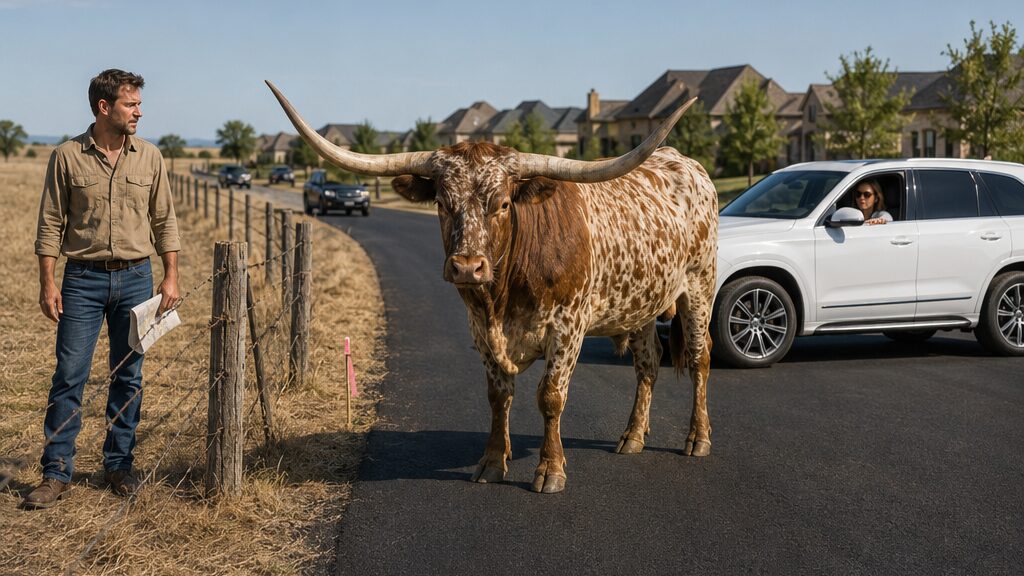
They Paved a Shortcut Across His Pasture, but the Old Fence Line Told a Different Story
Chapter 1: The Blacktop That Wasn’t There Monday
Daniel Miller hit the brakes so hard that the thermos on the passenger seat rolled into the floorboard.
Where cattle had been standing Monday afternoon, there was now a strip of black asphalt.
It cut through the west side of his pasture in a smooth dark curve, too fresh even to have gathered dust. A paving roller sat near the far end. Two workers in reflective vests were pulling cones from the edge while another man leaned against a pickup with a clipboard.
Daniel stayed in his truck for several seconds.
He had left before sunrise to pick up feed. When he returned, part of the fence was gone.
Not damaged. Gone.
He stepped out and walked toward the opening.
The fence had never been pretty. The cedar posts leaned in different directions, and some were darker near the ground from decades of weather. His grandfather had set the first run of them when this side of the ranch was still miles from the nearest subdivision.
Now several posts lay in a pile of scraped dirt.
Daniel stopped beside one.
The lower half was polished smooth from cattle rubbing against it over the years. He recognized a split in the wood near the top where his father had once wrapped wire around it after a storm.
A machine had torn it out in seconds.
“Can I help you?” the man with the clipboard called.
Daniel looked from the post to him.
“What happened to my fence?”
The man frowned as if the question surprised him.
“We opened the easement.”
Daniel turned slowly toward the asphalt.
“That isn’t the easement.”
The man glanced at the clipboard.
“This is the alignment we were given.”
“By who?”
“Meadowbrook association.”
Daniel looked beyond the pasture.
On the other side of the property line, Meadowbrook rose in clean rows of pale stucco, stone entry walls and trimmed lawns. From Daniel’s side, the development always looked almost artificial, as though somebody had dropped a catalog photograph against eighty acres of grass.
He pointed toward the old gate farther north.
“The access runs there.”
The contractor gave a small shrug.
“I’m not the surveyor. We’re just building what was approved.”
“Approved by who?”
“The HOA.”
“That isn’t what I asked.”
The man’s expression tightened.
Daniel took out his phone.
He photographed the road, the machinery, the torn ground, the fence opening and the pile of posts.
The contractor watched him.
“You need to talk to the association.”
“I intend to.”
“We were told the owner was aware.”
Daniel lowered the phone.
“Which owner?”
The contractor hesitated.
Then a white crossover appeared at the Meadowbrook end of the pavement.
It slowed at the cones but did not stop. One worker waved it forward.
The vehicle crossed onto Daniel’s pasture.
Daniel stepped out of its path.
The driver lifted two fingers from the steering wheel in casual thanks and continued across the fresh blacktop toward the county road.
Daniel watched until the vehicle disappeared.
The road was not just construction anymore.
It was already being used.
He called the ranch hand and told him to keep the cattle in the south field until further notice.
“Fence trouble?” the man asked.
“Something like that.”
Daniel ended the call.
The contractor had returned to his pickup.
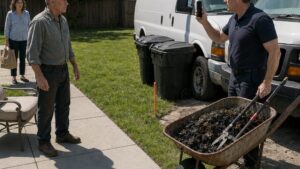
Daniel walked toward the spoil pile and began pulling fence material free.
One post had snapped near the base. Two more were buried beneath chunks of sod.
Then he found the one he had noticed first.
He tugged until the dirt released it.
For a moment he stood with the old cedar post in both hands.
There was nothing valuable about it.
It wasn’t carved. It didn’t carry a name. It had never appeared in a family photograph.
But Daniel knew where it had stood.
That seemed to matter more than he wanted it to.
His phone rang.
The screen showed Michelle Williams.
Daniel answered.
“Michelle.”
“Daniel, I was told there was some confusion with the access project.”
He looked at the asphalt.
“That’s one word for it.”
“We’ve been trying to improve circulation for months. The board finally got the work scheduled.”
“On my pasture.”
“On the access corridor.”
Daniel rubbed dirt from the old post with his thumb.
“Your contractor removed my fence.”
“The fence crossed an easement.”
“Did you survey it?”
A pause.
“We reviewed the property information.”
“That wasn’t my question either.”
Michelle sighed.
Her voice remained controlled, the way it always did at neighborhood meetings when she wanted to make disagreement sound unreasonable.
“Daniel, Meadowbrook has legal access along that side. You know that.”
“I know there is an easement.”
“Then I’m not sure why this needs to become adversarial.”
Daniel looked toward the road.
Another vehicle had appeared.
This one was a dark sedan. It rolled smoothly through the gap where his fence had stood.
He watched it pass.
“Because an easement isn’t permission to pave wherever you feel like paving.”
“We didn’t pave wherever we felt like.”
“You tore out fence posts without calling me.”
“The contractor believed notice had been handled.”
“By who?”
Another pause.
“Daniel, I’m not going to argue construction logistics over the phone.”
“Good.”
“I’ll have the property manager send you the documents.”
“Send everything.”
“We’ve already checked the access.”
The certainty in her voice stopped him.
Daniel looked down at the post in his hands.
“What does that mean?”
“It means the association did not spend money on a road we had no right to build.”
Daniel said nothing.
Michelle continued.
“The easement has existed for years. Residents and service vehicles have used that side before. This isn’t something we invented yesterday.”
Daniel looked toward the old northern gate.
Service trucks had passed there.
Utility crews too.
Occasionally somebody had cut wider around mud.
He had complained once or twice.
Mostly he had opened the gate and let them through.
That was different from blacktop.
At least he thought it was.
“Send me the records,” he said.
“I will.”
“And tell your people not to touch another fence post.”
Michelle’s tone cooled.
“The work is essentially finished.”
“That doesn’t answer me.”
“No additional fence work is planned.”
She ended the call first.
Daniel stood beside the pavement for several minutes after that.
A third vehicle came through.
Then a fourth.
By late afternoon the fresh road had tire marks.
Daniel loaded the salvageable posts into the back of his pickup.
He did not block the road.
He did not move cattle into the field.
He did not drive over to Meadowbrook and demand a meeting.
Instead, he walked the entire length of the new pavement taking photographs.
At the northern end, he found an old corner post still standing.
The wire had been cut cleanly beside it.
Daniel photographed that too.
Then he went home, carried the cedar post into the barn and leaned it against the wall.
He had always believed there were certain things a man should not have to explain repeatedly.
Where his land ended was one of them.
That evening, an email from the Meadowbrook property manager arrived with three attachments.
Daniel opened the first.
It was an old recorded easement.
He enlarged the scanned page.
There it was.
A legal right of access across part of his property.
Michelle had not invented that.
Daniel stared at the document longer than he expected to.
Then he opened the map attached to it.
The line on the page did not look like the road he had walked that afternoon.
But he was no surveyor.
Michelle’s last sentence returned to him.
We’ve already checked the access.
Daniel printed the documents.
At seven the next morning, he drove to the county records office to find out whether she was right.
Chapter 2: The Easement Was Real, but the Road Wasn’t
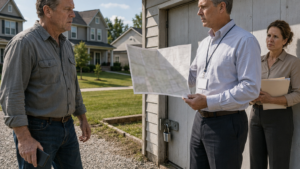
The county records clerk slid the plat across the counter and tapped one narrow shaded strip with her finger.
“There.”
Daniel looked at it.
He had spent most of the drive into town expecting to discover some error in Meadowbrook’s paperwork.
Instead, the first thing the county showed him was that the easement was real.
It crossed the eastern edge of his property exactly where Michelle had said some form of legal access existed.
Daniel leaned closer.
“How wide?”
The clerk read the notation.
“Twenty feet.”
“And that’s the whole thing?”
“That’s what was recorded with this instrument.”
Daniel pulled out the photocopy Meadowbrook had sent him.
The legal description matched.
He felt a brief, unwelcome drop in his stomach.
The clerk noticed.
“Problem?”
“Maybe.”
She turned the plat toward herself.
Daniel pointed to the curve of the shaded corridor.
“Can you make me a copy at full size?”
“Sure.”
When she returned, Daniel spread it across an empty table.
The easement ran beside the historic fence line for part of the distance, then angled northeast toward the county road.
The new shortcut did something else.
Daniel took out his phone and opened the photographs from Tuesday.
In one image, the asphalt curved west around a low drainage swale before turning back toward Meadowbrook.
On the plat, the easement did not.
He held the image beside the map.
Once he saw the difference, he could not unsee it.
The blacktop was wider.
And the curve appeared farther into his pasture.
The clerk passed by carrying a file box.
Daniel stopped her.
“Can I ask you something?”
“You can ask.”
“If somebody has an easement here, can they move it over?”
She shook her head before he finished.
“I can’t give legal advice.”
“I’m not asking you to.”
She smiled.
“That’s exactly what you’re asking.”
Daniel nodded once.
“Fair.”
“You need an attorney and probably a surveyor.”
Daniel folded the map carefully.
He called Jonathan Scott before leaving the parking lot.
Jonathan had handled leases, water questions and one ugly boundary disagreement Daniel’s father had gotten into years earlier.
He answered on the fourth ring.
“What’s broken?”
“My fence.”
“That sounds physical, not legal.”
“HOA next door paved through it.”
There was silence.
Then Jonathan said, “Start over.”
Daniel explained.
Jonathan interrupted only twice.
Once to ask whether Daniel had received formal notice.
Once to ask whether Daniel had personally authorized anyone to widen or relocate the easement.
“No.”
“Ever?”
“No.”
Another pause.
“What about informal use?”
Daniel looked through the windshield at the courthouse square.
“What do you mean?”
“Utility trucks. Maintenance. Construction. Residents. Anybody crossing outside the written corridor with your knowledge.”
Daniel thought about muddy winters.
A cable crew had gone around the gate once because their trailer could not make the angle.
Landscapers had crossed after a storm.
A Meadowbrook maintenance truck had used the opening beside the fence often enough that Daniel recognized the driver.
“I didn’t keep a log.”
“That wasn’t my question.”
Daniel almost laughed.
Jonathan had used the same line Daniel had used on the contractor.
“Yes,” he said. “There have been vehicles.”
“Did you object?”
“Sometimes.”
“Every time?”
“No.”
Jonathan exhaled.
“All right. Don’t do anything dramatic.”
“I wasn’t planning to.”
“Don’t block the road.”
“I haven’t.”
“Don’t threaten anybody.”
“I haven’t.”
“And don’t put livestock anywhere unusual until we know where the actual line is.”
Daniel looked toward the south on instinct, though the ranch was miles away.
“They’re my pastures.”
“I know. Humor me.”
Jonathan asked him to photograph every remaining post, the full road alignment and any old gate locations. He also told Daniel to schedule a boundary survey.
“You may be right,” Jonathan said, “but right now we have a map, photographs and your memory. That’s not the same thing as knowing where asphalt sits on the ground.”
Daniel drove home with less satisfaction than he had expected.
At the ranch kitchen table, he spread the county plat beside printed photographs.
The old fence appeared in nearly every image.
Not straight.
Not pretty.
But consistent.
Daniel found an aerial photograph from several years earlier in a property tax file. The pale fence line was visible against the pasture.
He laid a ruler over it.
The alignment seemed to follow the same course as the plat.
The new asphalt did not.
Daniel called a county surveyor.
The earliest available field visit was Thursday afternoon.
“Tomorrow?”
“Preliminary only. If the corners are recoverable.”
“Take it.”
By noon, Meadowbrook traffic had increased.
Daniel stood near the north gate watching vehicles emerge from the development and use the shortcut.
One driver slowed and rolled down his window.
“Everything okay?”
Daniel recognized him vaguely from a fence complaint the previous summer.
“Working on it.”
The man glanced at the asphalt.
“It’s nice, isn’t it?”
Daniel did not answer.
“Cuts several minutes off.”
“So I’ve noticed.”
The man gave a friendly wave and drove on.
That bothered Daniel more than anger would have.
The residents did not look like people deliberately trespassing.
They looked like people using a road they had been told belonged there.
Back at the house, Jonathan called.
“I reviewed what you sent.”
“And?”
“The road appears suspicious.”
“That’s lawyer language.”
“It’s lawyer language because I don’t want you repeating that I said it’s illegal until somebody establishes the line.”
Daniel leaned against the counter.
“What happens if it’s outside?”
“We send notice. Demand use stop. Document damages. Maybe seek an injunction if they refuse.”
“And if they say I’ve been letting people use it?”
“They probably will.”
Daniel looked through the kitchen window toward the distant roofs of Meadowbrook.
“That shouldn’t let them pave it.”
“No. But history matters.”
Daniel did not like the sentence.
Jonathan continued.
“If you’ve allowed vehicles to cross an area for years, they’ll argue reliance. Maybe permission. Maybe an expanded practical route. Whether that gets them anywhere is another question. But don’t assume the map ends this.”
Daniel picked up the old plat.
“So what does?”
“Facts. Survey. Records. And what you’ve actually done over the years.”
After they hung up, Daniel walked the fence line again.
At one spot the pavement came within a few feet of an old post the contractor had left standing.
He pulled up the plat on his phone.
If his reading was correct, that post should have been near the western edge of the lawful corridor.
But the asphalt continued well beyond it.
For the first time, Daniel felt something close to relief.
Not because the fight was over.
Because at least the ground itself seemed to remember the same boundary he did.
His phone buzzed.
A message from an unfamiliar number appeared.
Hi Daniel. This is one of the Meadowbrook residents. Just wanted to say thanks for letting us use your road all these years. The paving makes the morning drive so much easier.
Daniel read it twice.
Your road.
All these years.
He stared across the pasture toward the gap where his gate had once been left open for utility crews and maintenance trucks.
He had thought he was being neighborly.
Apparently somebody else had been keeping a different version of the story.
Chapter 3: The Bull in Front of the White SUV
The longhorn stood sideways across the new asphalt, chewing as if the white SUV twenty yards away did not exist.
Daniel saw the problem before Michelle Williams opened her driver’s door.
“Stay in the vehicle,” he called.
She froze with one foot on the pavement.
The bull lifted its head.
Its horns stretched wide enough to make the SUV look smaller than it was.
Michelle got back inside.
Daniel was already moving toward the fence line, not toward the animal.
The ranch hand stood near the open gate.
“I told you they’d get into this section.”
“They’re supposed to be in this section.”
“Yeah.”
That was the problem.
The cattle had always grazed here.
Daniel had kept them south for two days because of the construction and survey work. That morning, with the temporary interior gate repaired, he had returned part of the herd to their normal rotation.
He had not driven them onto the asphalt.
He had not tied feed near the road.
The bull had simply found the warm black surface and stopped.
Michelle lowered her window.
“Move him.”
Daniel stopped behind the remaining fence.
“Back up.”
“Daniel.”
“There’s plenty of room behind you.”
“I am not reversing all the way back through that entrance.”
The bull flicked one ear.
Daniel lowered his voice.
“Then sit there until he moves.”
Another vehicle appeared behind Michelle.
Then another.
The second driver honked.
Daniel turned sharply.
“Don’t do that.”
The horn sounded again.
The bull raised its head higher.
Michelle leaned from the window.
“Tell them to stop.”
Daniel almost smiled at the reversal but didn’t.
He waved both vehicles backward.
The first driver responded.
The second did not.
The ranch hand walked farther down the fence and shouted that the road was blocked.
Daniel returned his attention to Michelle.
“You need to reverse.”
“This is a resident access road.”
“It’s also inside a cattle pasture.”
“That you intentionally put cattle into after threatening the association.”
“I didn’t threaten the association.”
“You told the contractor not to touch your fence.”
“That isn’t a threat.”
“You knew what this would do.”
Daniel looked at the bull.
The animal had gone back to chewing.
“What exactly is it doing?”
Michelle stared at him.
“Blocking the road.”
“Yes.”
“You think this is funny.”
“No.”
“You’re using livestock to intimidate people.”
Daniel felt his jaw tighten.
Behind Michelle, someone had gotten out of a vehicle and raised a phone.
He saw the camera pointed toward the bull.
Then toward him.
Daniel stepped backward from the fence.
“Get back in your car,” he told the resident.
“I’m not near him.”
“You’re in a pasture with cattle.”
The resident hesitated, then returned to the vehicle.
Michelle said, “This is exactly what I’ve been telling the board.”
Daniel looked at her.
“What have you been telling them?”
“That you’re trying to make the access unusable.”
“The access was usable before you paved anything.”
“You left the gate open.”
“For service trucks.”
“And residents used it.”
“Sometimes.”
“And you didn’t stop them.”
There it was.
Not a deed.
Not a survey.
Something messier.
Habit.
Daniel glanced toward the old fence posts running behind the asphalt.
“You think because I didn’t chase every car off, you can move the road wherever you want?”
Michelle’s face hardened.
“We didn’t move anything. We improved an established access.”
Daniel reached into his shirt pocket and unfolded a copy of the county plat.
“I pulled the record yesterday.”
She looked at the paper but did not take it.
“So?”
“So your road doesn’t appear to follow this.”
“Appear?”
“Surveyor comes this afternoon.”
Michelle crossed her arms.
“You don’t even know.”
“I know enough not to pretend twenty feet means whatever width is convenient.”
Her eyes shifted to the people waiting behind her.
Daniel understood what she was thinking.
A private disagreement was becoming a public inconvenience.
And now everyone could see it.
The bull stepped forward.
Michelle immediately faced the windshield.
Daniel raised one hand.
“Stay still.”
The animal walked three slow steps along the asphalt, then stopped again.
Daniel moved toward the gate.
He opened a smaller section of fence farther east.
“Back out and use the north entrance.”
Michelle lowered her window again.
“You want me to back up past three cars?”
“Yes.”
“This is ridiculous.”
“It is.”
“You’re admitting that?”
“I’m saying there’s a safe way out.”
Michelle stared at him for several seconds.
Then she shifted into reverse.
The vehicles behind her began backing one at a time.
Daniel stood where everyone could see him and kept the interior gate open.
The bull never approached the SUV.
It never charged.
It barely seemed interested.
That did not matter.
By the time Michelle cleared the pasture, two more residents had arrived, and at least three phones were recording.
One man called through his window, “Are we supposed to avoid this road now?”
Daniel answered carefully.
“Until the survey is finished, I’d use the legal entrance.”
Michelle stopped her SUV beside him.
The window lowered.
“You don’t get to decide what’s legal.”
“No.”
Daniel held up the folded plat.
“But neither do you.”
Her expression changed slightly.
Not fear.
Something closer to calculation.
“You should think very carefully about what you’re doing.”
“I have been.”
“If somebody gets hurt because you decided to turn cattle loose on an association road—”
Daniel cut her off.
“They’re in my grazing pasture.”
“That’s your claim.”
“That’s why the surveyor is coming.”
Michelle looked toward the longhorn.
Then toward the phones.
“You know what those pictures are going to look like.”
Daniel followed her gaze.
A white SUV.
A massive bull.
Fresh black asphalt.
An angry HOA president.
A rancher standing behind an old fence.
She was right.
The photographs would tell whichever story people wanted them to tell.
Michelle drove away.
By midmorning, Daniel’s phone began vibrating almost continuously.
Jonathan called first.
“Tell me you didn’t put a bull on the road.”
“I didn’t put a bull anywhere.”
“That’s not comforting.”
“He walked there.”
“You understand those are different sentences legally and identical sentences on social media?”
Daniel looked across the pasture.
“Probably.”
“Someone sent me a screenshot. The neighborhood group is calling it deliberate harassment.”
“Of course they are.”
“Do not respond.”
Daniel said nothing.
Jonathan sighed.
“That silence thing you do isn’t always helping.”
“I thought lawyers liked silence.”
“We like clients who know when to use it.”
Daniel ended the call more irritated than he wanted to admit.
At two-thirty, the county surveyor arrived.
He carried a field controller and measuring equipment, then spent nearly an hour locating corners and comparing recorded points.
Daniel followed at a distance.
Michelle did not return.
The surveyor placed one temporary flag.
Then another.
The line began to take shape.
Daniel watched the third flag go into the ground beside an old fence post.
The fourth landed near the shoulder of the new road.
The fifth landed in the asphalt itself.
Daniel walked closer.
“How preliminary is preliminary?”
“Enough that I’m not giving you a signed opinion today.”
Daniel pointed at the flag.
“But?”
The surveyor looked down the line of weathered posts, then back toward the road.
“But if the monument calls check out the way they appear to, your old fence was following the record pretty closely.”
Daniel looked along the flags.
They cut across the new pavement.
Not along its edge.
Across it.
“How far outside?”
“Let me finish before you start measuring victory.”
Daniel almost objected to the word.
Then he looked toward Meadowbrook.
A cluster of residents had gathered near the development entrance, watching.
One of them was Michelle.
She could see the flags too.
The surveyor walked another twenty yards and pushed the next marker into Daniel’s pasture.
This one stood several yards inside the blacktop.
Daniel had his first real proof that the road had crossed a line.
But as he looked at Michelle across the distance, he remembered her accusation.
You left the gate open.
The survey might prove where the legal boundary was.
It would not answer what Daniel’s years of silence had allowed everyone else to believe.
Chapter 4: The Permission Daniel Never Put in Writing
Jonathan Scott placed a printed email on Daniel’s desk and tapped one sentence with the capped end of a pen.
“Read that.”
Daniel did.
Existing owner-approved access will remain available during construction.
He read it again.
“Whose email is this?”
“Association property manager to the paving contractor. Sent three weeks ago.”
Daniel leaned back in his chair.
“They’re calling it owner-approved.”
“Yes.”
“I never approved paving.”
“I know what you told me.”
“That isn’t what happened.”
Jonathan removed his glasses.
“Then we need to understand what did happen before their lawyer tells a judge for us.”
Daniel looked toward the ranch office window.
Beyond the glass, the temporary survey flags stood in the pasture like small interruptions of color. The preliminary line crossed the new asphalt exactly where Daniel had suspected.
That should have made things simpler.
Instead, Jonathan had arrived Friday morning carrying a folder thick enough to suggest the opposite.
“There’s more,” Jonathan said.
Daniel gave him a flat look.
“There usually is when you say that.”
Jonathan turned another page.
The HOA had provided photographs from prior years.
A utility truck near the north gate.
A landscaping trailer cutting around a muddy section.
A Meadowbrook maintenance pickup entering through the opening.
In one photograph, Daniel could see his own truck parked near the barn in the background.
The ranch gate stood open.
Jonathan pointed.
“Do you remember this?”
“Probably.”
“That’s not useful.”
Daniel stared at the photograph.
Then he did remember.
A hard rain had turned the usual utility lane into mud. A maintenance driver had stopped at the fence and asked whether he could swing wider.
Daniel had been replacing a trough valve.
The man had looked worried about getting the truck stuck.
Daniel heard his own voice from years earlier.
Just use the opening.
He looked away from the photograph.
Jonathan saw the change in his face.
“What?”
“I told one of their maintenance drivers he could cross there.”
“Once?”
“More than once, probably.”
“Residents too?”
Daniel rubbed his thumb over the edge of the desk.
“I didn’t stand out there keeping count.”
Jonathan waited.
Daniel hated that silence.
“Some residents crossed when the main entrance was backed up. I told a couple of them not to tear up the grass.”
“But you didn’t close the gate.”
“No.”
“Send written notice?”
“No.”
“Post anything?”
“No.”
Jonathan put his glasses back on.
“All right.”
Daniel frowned.
“Don’t say it like that.”
“Like what?”
“Like I gave them the road.”
“You didn’t give them a road.”
“Then say that.”
Jonathan’s expression did not change.
“You didn’t give them a road. You may have given them years of ambiguity.”
That landed harder.
Daniel stood and walked toward the window.
The old gate had always been practical to him.
Open meant someone could pass.
Closed meant cattle were in the wrong place for traffic.
He had never thought an open gate was an agreement.
He had assumed everybody understood the difference between courtesy and ownership.
Apparently that assumption had been doing more work than he had.
“The survey still matters,” Daniel said.
“Absolutely.”
“And the pavement is outside the recorded corridor.”
“Preliminarily.”
Daniel turned.
“So why does any of this matter?”
“Because they’re not arguing that you signed over land. They’re arguing that the association relied on a long-standing access pattern you allowed.”
“To pave it?”
Jonathan shook his head.
“That’s where their argument gets weak.”
Daniel waited.
“But weak doesn’t mean nonexistent.”
Jonathan opened another document.
“HOA counsel sent this last night.”
The letter was formal, restrained and unmistakably hostile.
It accused Daniel of interfering with established access and creating a safety hazard by allowing livestock near a route the association claimed had been openly used for years.
At the bottom was the part Jonathan had wanted him to see.
If Daniel obstructed continued use before the survey and legal issues were resolved, the association reserved the right to seek emergency injunctive relief.
Daniel set the letter down.
“They’re threatening to take me to court so they can keep driving over my pasture.”
“They’re threatening to ask a judge to preserve the status quo.”
“The status quo was grass.”
Jonathan almost smiled.
“That’s a good sentence. Save it for later.”
Daniel walked outside after Jonathan left.
He followed the old fence line slowly.
The surveyor had returned that morning to confirm two corner monuments. Orange flagging now ran close to the weathered posts for most of the distance.
At the north gate, Daniel stopped.
The latch hung loose.
He remembered how often he had left it that way.
Not because anyone had rights beyond the easement.
Because it was easier.
A delivery driver late for a job.
A utility crew.
A resident trying to avoid a backup.
He had treated each event as temporary.
He had never considered that temporary things, repeated often enough, could become somebody else’s history.
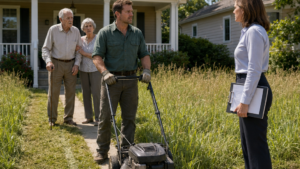
Saturday afternoon, the HOA held an emergency meeting.
Daniel went because Jonathan advised him to listen rather than argue.
The clubhouse conference room overlooked a pool bright enough to hurt his eyes.
Michelle Williams sat at the center of the table with two board members and Jessica Hall.
Residents filled the chairs along the wall.
Michelle began with a prepared statement.
“The association’s position is that the access route was not newly created in substance. The project improved a route that had been openly and continuously used.”
Daniel said nothing.
A resident raised a hand.
“So can we use it or not?”
Michelle answered before anyone else.
“At present, residents should use the primary entrance while counsel reviews the matter.”
A murmur went through the room.
Another resident asked who was paying for the new pavement if it had to be removed.
Michelle’s expression tightened.
“We are not assuming removal.”
Daniel watched Jessica.
She had been quiet through most of the meeting, reading the packet in front of her.
Then she asked, “Was Daniel notified before the work?”
Michelle turned.
“The property manager handled contractor coordination.”
“That wasn’t my question.”
Daniel looked down.
Apparently that sentence belonged to everybody now.
Michelle folded her hands.
“The project was treated as maintenance of existing access.”
Jessica glanced toward Daniel.
“Did he approve that?”
Michelle’s eyes followed.
Daniel answered.
“No.”
The room changed.
Not loudly.
Just enough.
A few residents stopped whispering.
One board member shifted in his chair.
Michelle said, “Daniel had permitted access for years.”
“That is not the same question,” Jessica said.
Michelle’s jaw tightened.
“We’re not litigating this in an open meeting.”
Jessica closed the packet.
“No. But we voted on it.”
The meeting ended forty minutes later without resolution.
Residents left in small clusters.
Daniel waited near the hallway until most of them were gone.
He was halfway to the door when Jessica caught up.
“Daniel.”
He stopped.
She lowered her voice.
“I voted for the paving.”
He looked at her.
“I figured.”
“I thought you agreed.”
“I didn’t.”
“I know that now.”
There was no defensiveness in her voice, which made him listen.
Jessica looked back toward the conference room.
“Michelle told us it was routine easement maintenance.”
Daniel said nothing.
“She said the property owner had signed off on keeping the existing access in place.”
“Signed off how?”
Jessica shook her head.
“I don’t know.”
Daniel felt the old certainty return, but differently this time.
Not clean anger.
Something sharper.
“Was there a document?”
“I never saw one.”
“Then why did you vote?”
Jessica looked embarrassed.
“Because I assumed she had.”
That answer was too familiar.
Daniel had made assumptions too.
About gates.
About neighbors.
About what nobody needed explained.
Jessica glanced toward the closed conference-room door.
“There’s something else.”
Daniel waited.
“Why did Michelle tell us you had approved the paving if you never did?”
Chapter 5: The Board Vote Had One Missing Fact
Jessica Hall placed the meeting minutes on the hood of Daniel’s pickup Monday morning and pointed to a single line.
Final survey confirmation pending.
Daniel read it once.
Then again.
The words were buried halfway down the second page beneath budget approvals and contractor scheduling.
“What date?”
“Three days before the paving contract was signed.”
Daniel looked at her.
“You had this?”
“The board had it.”
“And still voted?”
Jessica looked toward the pasture.
The permanent survey stakes had been set that morning.
They tracked almost exactly beside the oldest fence posts.
At two points, the asphalt crossed several yards west of them.
“I didn’t understand what it meant,” Jessica said. “Michelle said it was a technical update. She said the access itself wasn’t in question.”
Daniel folded the minutes.
“So the boundary was.”
“Yes.”
The word sat between them.
A truck from the survey company pulled away from the road.
Daniel watched it go.
He had imagined this moment for nearly a week.
Final markers.
Confirmed measurements.
Proof.
He thought it would feel like winning.
Instead, he was standing beside a woman who had helped approve the road because someone she trusted had told her the important questions were already settled.
Daniel handed the minutes back.
“Is Michelle coming?”
“She said she’d meet us at the clubhouse.”
Daniel looked at the asphalt.
“Tell her I’d rather meet here.”
Jessica hesitated.
“Why?”
“So nobody has to imagine what we’re talking about.”
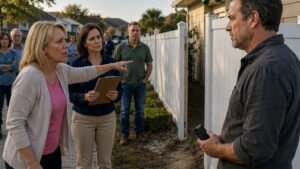
Twenty minutes later Michelle’s SUV stopped near the pasture gate.
She got out with the HOA property manager and one other board member.
Her white blouse and dark slacks looked too formal for the dusty shoulder, but her shoes were sensible enough that Daniel suspected she had chosen them deliberately.
Jonathan arrived a few minutes after that.
He carried a folder.
No one smiled.
Daniel walked them to the first survey stake.
Jonathan pointed toward the recorded easement corridor.
“The final survey is consistent with the historical fence alignment.”
Michelle looked down the line.
“And?”
“And approximately part of the paved section extends beyond the recorded easement.”
“How much?”
Jonathan gave the measurement.
It was not the hundred feet residents had started repeating online.
At the widest point, the encroachment was substantially less than that.
Still enough.
Enough pavement to require removal.
Enough disturbed ground to require restoration.
Enough to make the board’s decision expensive.
Michelle crossed her arms.
“Our counsel is reviewing whether historic use affects that conclusion.”
“The survey conclusion?” Jonathan asked.
“The access rights.”
Daniel spoke.
“Historic use doesn’t move the stakes.”
Michelle looked at him.
“No, but it may affect what access was reasonably understood.”
“Reasonably understood by who?”
“Everyone who has been using it.”
Daniel almost answered immediately.
Then he remembered Jonathan’s warning.
He let the silence sit.
Jessica broke it.
“What did you mean when you told us survey confirmation was pending?”
Michelle turned toward her.
“We knew the field work wasn’t complete.”
“Then why did we authorize permanent paving?”
The property manager looked down.
Michelle’s shoulders stiffened.
“Because the access itself had existed for years.”
Jessica held up the minutes.
“That’s not what this says.”
Michelle’s expression changed.
For the first time Daniel saw something beyond irritation.
Fatigue.
She looked toward the Meadowbrook rooftops.
“When the developer turned the association over, the second access was presented as part of the neighborhood circulation plan.”
Daniel said, “Presented by who?”
“The developer.”
“Was it recorded?”
“We believed the easement covered it.”
“You believed.”
Michelle looked at him sharply.
“Yes.”
Jessica said, “And when the survey wasn’t finished?”
Michelle did not answer.
The board member beside her shifted.
Daniel watched her face.
“You knew.”
Michelle exhaled.
“I knew there was a question about exact alignment.”
“And you paved anyway.”
“We had residents demanding the second exit.”
“That isn’t an answer.”
“It is part of the answer.”
Her voice sharpened.
“Do you think nobody has pressure on their side of this fence, Daniel?”
He said nothing.
Michelle gestured toward the development.
“People bought homes being told there were two practical ways in and out. The main entrance backs up every morning. We had complaints about emergency access, school traffic, delivery congestion. The developer told everyone this route was established.”
Jonathan said, “That still doesn’t authorize construction outside the easement.”
“I know that now.”
The sentence quieted the group.
Michelle looked at the pavement.
“We had already spent money on engineering. Residents were asking why the board couldn’t complete something they believed they’d paid for when they bought their homes.”
Jessica said, “So you pushed it through.”
Michelle turned.
“I made a decision.”
“You told us Daniel approved.”
“I said he had historically allowed the access.”
“That isn’t the same thing.”
Michelle looked toward Daniel again.
“No. It isn’t.”
There was no apology.
Not yet.
But there was something Daniel had not expected.
Admission.
Not of everything.
Enough to change the shape of the conflict.
He looked down the survey line.
The old posts and new stakes ran almost together.
Behind them, cattle grazed near the dry grass.
A week earlier, the bull standing on the asphalt had looked like chaos.
Now the markers made the scene embarrassingly simple.
The animal had been standing on the wrong road, not in the wrong pasture.
Jonathan opened his folder.
“We have preliminary restoration numbers.”
Michelle’s face hardened again.
“How much?”
“Removal, soil remediation, drainage repair, reseeding, fence replacement and livestock handling put it in the mid-forties.”
The board member beside her stared.
“Forty-five thousand?”
“Possibly more.”
Michelle looked at Daniel.
“That’s absurd.”
“The asphalt didn’t appear by itself.”
“We can compensate him without ripping out an entire section.”
Daniel listened.
There it was.
The first offer.
Not spoken like an offer.
Spoken like common sense.
Michelle continued.
“We could purchase the strip or negotiate permanent access.”
Jonathan glanced at Daniel.
Daniel already knew what Jonathan wanted.
Don’t answer quickly.
He didn’t.
They moved to the clubhouse to continue discussions.
Inside, numbers replaced anger.
Cost of removal.
Cost of reconstruction.
Potential legal fees.
Assessment impact.
Insurance questions.
Daniel listened until the words became detached from the ground they were discussing.
At one point Michelle slid a sheet toward him.
It was not a formal agreement.
Just a proposal.
Cash compensation.
A maintenance commitment.
Permanent use of the paved alignment.
Daniel read it.
The amount was enough to replace fencing well beyond the damaged section.
Enough to cover months of operating expenses.
Enough that saying no felt less principled and more expensive.
Michelle watched him.
“This resolves it.”
Daniel looked up.
“It leaves the road.”
“Yes.”
“Outside the easement.”
“With your consent.”
He thought about the old cedar post leaning against his barn wall.
For years, he had treated the boundary as something obvious.
Then other people had treated his silence as permission.
Now Michelle was offering money to convert that confusion into permanence.
Daniel pushed the paper back.
“No.”
Michelle’s expression tightened.
“You haven’t even countered.”
“I don’t want to sell you the mistake.”
“That’s not what this is.”
“It is to me.”
Jonathan remained silent.
Jessica watched from the far side of the table.
Michelle leaned forward.
“Then what do you want?”
Daniel considered the question.
A week earlier, he might have said punishment.
Remove everything.
Pay every dollar.
Make sure everybody knew who was wrong.
Now he looked at Michelle and saw someone who had made a bad decision because admitting uncertainty had felt more dangerous than proceeding.
He understood that more than he wanted to.
Daniel stood.
“I want the pasture restored.”
Michelle said nothing.
“The road comes out where it’s outside the easement. Drainage gets repaired. Fence gets rebuilt on the surveyed line.”
“And access?”
“The legal access stays legal.”
She stared at him.
“That will cost the association more than paying you.”
“I know.”
“You’re making a point.”
“No.”
Daniel looked at the proposal between them.
“I’m trying to stop us from having this argument again ten years from now.”
He left the paper on the table.
By evening, Jonathan had three missed calls from HOA counsel.
Daniel had one email from Michelle.
The subject was Settlement Alternative.
He opened it at the kitchen table.
The association was willing to increase the cash amount.
The road would remain.
Daniel closed the message without answering.
Forty-seven thousand dollars might repair damage.
But money alone would not put the boundary back where everyone could see it.
Chapter 6: Forty-Seven Thousand Dollars Wouldn’t Fix the Boundary
The revised settlement would have paid Daniel more than the estimated restoration cost if he agreed to one sentence buried on page four.
The paved access may remain in its present alignment as a permanent association right of passage.
Daniel read the sentence at his kitchen table Wednesday morning.
Then he pushed the agreement away.
Jonathan sat across from him drinking coffee.
“Financially,” Jonathan said, “it’s not a bad offer.”
Daniel gave him a look.
“I know what that tone means.”
“What tone?”
“The one where you want me to be practical.”
“I always want you to be practical.”
Daniel looked back at the agreement.
The association had offered enough to cover damaged pasture, fencing, soil work and several months of ranch expenses.
Money had been tight the previous winter.
Feed costs had climbed.
A tractor repair had arrived at the worst possible time.
Daniel could think of ten useful places for the difference.
That was what bothered him.
“They’re not paying to fix it,” he said.
“No.”
“They’re paying me to agree it isn’t wrong anymore.”
Jonathan folded his hands.
“Yes.”
Daniel stared through the kitchen window.
The survey stakes were visible in the distance.
Beside them, the old fence wandered in the same general line it had followed for decades.
For most of his life, Daniel had taken that fence for granted.
His grandfather had put it there.
His father had repaired it.
Daniel had replaced wire when it sagged.
Nobody had ever sat him down and told him that boundaries needed more than posts.
They needed words.
Written ones, apparently.
Jonathan pulled a legal pad toward him.
“If you don’t want the money-for-access deal, define what you do want.”
Daniel took the pad.
He drew a line.
Not carefully.
Just enough.
“This is the surveyed boundary.”
Jonathan nodded.
Daniel drew another line farther east.
“This is the recorded easement.”
“Okay.”
“The pavement outside this comes out.”
Jonathan wrote.
“Fence?”
“Rebuilt along the surveyed line.”
“Gate?”
Daniel stopped.
The old instinct was to say no gate.
Close everything.
Make everybody use the main entrance.
Then he looked at the two lines.
The easement existed whether he liked it or not.
And service vehicles still needed a practical way through it.
“A service gate on the legal corridor.”
Jonathan looked up.
“That’s new.”
“I’m learning.”
A hint of amusement crossed Jonathan’s face.
“Dangerous habit.”
Daniel ignored him.
“Written access rules. Who can use it. What for. No widening, grading or construction without written permission.”
“Residents?”
“Not outside whatever the recorded easement actually gives them.”
Jonathan nodded.
“Maintenance responsibility?”
“Association handles damage caused by its authorized users.”
“Livestock?”
Daniel thought about the white SUV and the bull standing in the road.
“Access doesn’t turn grazing land into a cattle-free zone.”
Jonathan wrote that down more carefully.
“Safety procedures can be addressed.”
Daniel nodded.
“And restoration.”
They worked through estimates.
Asphalt removal.
Topsoil.
Compaction repair.
Drainage.
Reseeding.
Temporary livestock relocation while equipment operated.
Fence materials.
The total came to just under forty-seven thousand dollars.
Daniel stared at the number.
It had the satisfying shape of punishment if he let it.
But item by item, it was mostly dirt, wire, labor and time.
That helped.
By noon, Jonathan had converted Daniel’s notes into a formal counterproposal.
The HOA would pay documented restoration costs.
The association would not acquire permanent rights outside the recorded easement.
The surveyed boundary would govern future improvements.
The lawful corridor would remain available under written conditions.
Daniel read it twice.
“Send it.”
Jonathan did.
The response came before sunset.
Not from Michelle.
From HOA counsel.
The board was divided.
Some members wanted to accept.
Others argued that removing the pavement was wasteful and would trigger a special assessment.
Daniel stood at the pasture gate reading the email on his phone.
Across the fence, a Meadowbrook resident slowed on the legal entrance and raised a hand.
Daniel returned the gesture.
That simple exchange felt more complicated than it should have.
His phone rang.
Jessica.
“There’s a board meeting tonight.”
“I assumed.”
“Michelle is getting hammered.”
Daniel looked toward the development.
“By who?”
“Everybody, for opposite reasons.”
He could almost hear the exhaustion in her voice.
“Half the residents think she surrendered too quickly. The other half want to know why the board paved before the survey.”
Daniel leaned on the gate.
“What do you think?”
Jessica was quiet.
“I think I voted for something I didn’t understand.”
“That makes two of us.”
“What did you vote for?”
“Nothing.”
“Exactly.”
Daniel smiled despite himself.
Jessica continued.
“I think the restoration proposal is fair.”
“Even the removal?”
“Yes.”
“That’ll cost you.”
“I know.”
“And assessments?”
“I know.”
Daniel heard movement on her end.
Then a door closing.
“She may call you.”
“Michelle?”
“Yes.”
“Why?”
“Because counsel isn’t getting anywhere.”
At seven-thirty, Daniel was eating dinner when the call came.
Michelle’s voice was tired.
Not defeated.
Just stripped of the board-meeting polish.
“Your proposal is expensive.”
“So was the road.”
“I expected that answer.”
Daniel set down his fork.
“What do you want?”
“To know whether there is any version where you take compensation and leave the pavement.”
“No.”
“Any?”
“No.”
Michelle exhaled.
“You understand residents will say you’re forcing them to pay twice.”
Daniel leaned back.
“They paid once for a road nobody confirmed they could build.”
“That distinction isn’t going to make the assessment easier.”
“I know.”
Silence.
Daniel waited.
Michelle said, “You really don’t want the money?”
“I want the damage paid for.”
“You know what I mean.”
“Yes.”
Another pause.
“Why?”
Daniel looked toward the dark kitchen window.
His reflection stared back.
He thought about giving the answer he had carried all week.
Because it’s mine.
It was true.
But incomplete.
“Because if I take the money and leave the road,” he said, “then the next person who owns this place gets the same confusion, except permanent.”
Michelle did not respond immediately.
Daniel continued.
“I should’ve put rules in writing years ago. I didn’t. That’s on me.”
He heard her shift.
“I didn’t expect you to say that.”
“I didn’t expect to mean it.”
A faint breath that might have been a laugh.
Then her voice hardened again.
“I still made decisions based on the access you allowed.”
“You made one decision before you knew where the line was.”
“I know.”
It was the first time she had said it to him without qualification.
Daniel looked at the legal pad on the counter.
The sketch of the fence.
The gate.
The easement.
“Meet me tomorrow.”
“Where?”
“The pasture.”
“With attorneys?”
“No.”
A pause.
“Daniel—”
“They can write whatever we agree to later.”
“What exactly are we agreeing to?”
“I don’t know yet.”
“That isn’t reassuring.”
“It wasn’t meant to be.”
He could almost picture her expression.
Finally she said, “What time?”
“Eight.”
“Fine.”
The next morning, Daniel reached the disputed section early.
He brought the survey map, restoration estimate and a length of new fence wire.
Not because he planned to use it.
Because he wanted to see how it looked against the old posts.
At eight-two, Michelle’s SUV stopped beside the gate.
She stepped out alone.
No board members.
No property manager.
No counsel.
Daniel noticed that first.
Michelle noticed the wire in his hand.
“Are you rebuilding already?”
“Not yet.”
She walked toward him.
The new asphalt lay between them and the line of survey stakes.
For the first time since the conflict began, neither of them had anyone else to perform for.
Daniel pointed toward the lawful corridor.
“That stays.”
Michelle looked.
Then toward the asphalt outside it.
“And that goes.”
“Yes.”
She folded her arms.
“What else?”
Daniel held out the sketch.
“A service gate here. Written rules. No guessing. No informal expansion.”
Michelle studied it.
“You’d actually give us a gate?”
“I’m not giving you anything you don’t already legally have.”
Her eyes remained on the page.
“But you’d make the access usable.”
“Properly.”
She handed the sketch back.
The silence stretched.
Then Michelle said, “If the board accepts removal, I have to amend the meeting record.”
Daniel looked at her.
“To say what?”
“That I authorized paving while survey confirmation was pending.”
There it was.
The cost she had been avoiding.
Not just money.
Responsibility.
Daniel rolled the fence wire once around his hand.
“And will you?”
Michelle looked down the asphalt toward Meadowbrook.
“Yes.”
Not proudly.
Not gracefully.
But clearly.
Daniel nodded.
“Then I’ll tell Jonathan we’re close.”
Michelle started back toward her SUV, then stopped.
“Daniel.”
He looked up.
“I still think you should have told us years ago that the informal crossings had limits.”
He considered that.
“So do I.”
She nodded once.
Then left.
Daniel remained beside the old fence line.
For the first time, the next step did not depend on proving who had been more entitled.
It depended on whether both sides were willing to put the boundary into terms neither could pretend not to understand.
Chapter 7: The New Fence Followed the Old Line
The excavator bucket bit under the first section of blacktop at eight-thirteen on a Tuesday morning.
Daniel stood beyond the temporary barrier and watched the pavement crack.
The sound was sharper than he expected.
For weeks, the road had looked permanent. Smooth edges. Painted markings. Tires passing over it as though it had always belonged there.
Now one curl of hydraulic steel lifted a broken slab from the pasture and exposed compacted soil underneath.
The restoration contractor signaled to his crew.
A dump truck backed closer.
Michelle Williams stood twenty yards away beside the Meadowbrook property manager.
She had arrived without the white SUV this time. Her vehicle was parked outside the work area, near the legal entrance.
Daniel noticed that.
Jonathan Scott had told him not to assign meaning to small things.
Daniel did anyway.
The final agreement had been signed six days earlier.
The HOA would pay the documented restoration expenses.
The pavement outside the recorded easement would be removed.
Compacted soil would be loosened and graded.
Drainage would be repaired.
The pasture would be reseeded.
The damaged fence would be replaced along the surveyed boundary.
The legal easement would remain exactly what it had been before all of this started.
No wider.
No farther west.
No mystery.
Daniel had read the agreement three times before signing.
He had expected satisfaction.
What he felt instead was mostly fatigue.
Another section of asphalt broke loose.
Michelle walked toward him.
“The contractor says they may need two extra days.”
Daniel nodded.
“As long as they keep equipment off the reseeded section.”
“I already told them.”
He looked at her.
She caught the look.
“What?”
“Nothing.”
“You don’t believe I can give instructions without creating another problem?”
“I didn’t say that.”
“You thought it.”
Daniel almost denied it.
Then stopped.
“Probably.”
Michelle gave a brief smile without humor.
“At least you’re improving.”
“How?”
“You said it.”
The excavator swung another slab into the truck.
For several minutes they watched without speaking.
The survey stakes remained visible beside the old posts. They had become familiar over the past weeks, bright markers beside weathered cedar.
Michelle nodded toward them.
“The board approved the amended minutes last night.”
Daniel turned.
“You made the correction?”
“Yes.”
He waited.
She seemed to know what he was waiting for.
“The record now states that I authorized permanent paving before final survey confirmation.”
“That couldn’t have been pleasant.”
“No.”
She looked toward Meadowbrook.
“Several residents asked me to resign.”
Daniel said nothing.
“I’m not telling you because I want sympathy.”
“I didn’t think you were.”
“I stayed.”
That surprised him.
“Why?”
Michelle considered the question.
“Because leaving immediately would have been easier.”
Daniel looked at her.
For the first time since they had met over the disputed road, he understood exactly what she meant.
A crew member called Daniel over to inspect the exposed soil.
He followed.
Where the pavement had curved outside the easement, the earth underneath was pale and hard-packed.
The contractor drove a metal probe into it.
It stopped after only a few inches.
“We’ll rip this section deeper before adding topsoil.”
Daniel crouched.
He picked up a handful of dry dirt from the edge and rubbed it between his fingers.
Grass had grown here before.
Cattle had crossed it.
Rain had settled into it instead of running along a paved edge.
None of those things were dramatic.
That was why they mattered.
“Do it right,” Daniel said.
The contractor nodded.
By the end of the first week, most of the asphalt outside the legal corridor was gone.
The shape of the pasture returned slowly.
Not perfectly.
There were raw stretches of worked soil and machinery tracks, and the newly seeded section looked more like a construction site than grazing land.
But the black curve no longer dictated where the eye went.
The fence crew arrived the following Monday.
Daniel had expected them to rebuild exactly what had been there.
Instead, he stopped them after the first posts were unloaded.
“Wait.”
The foreman looked over.
Daniel walked to the surveyed easement.
He had spent the weekend thinking about the gate.
Not the old one.
The new one.
The settlement required the HOA to restore the boundary and preserve legal access.
It did not require Daniel to make that access easy.
That part was his choice.
He pointed to the lawful corridor.
“I want a service gate here.”
The foreman checked the plans.
“That’s not on this drawing.”
“I know.”
Michelle, who had come to inspect the restoration, heard him.
“A gate?”
Daniel looked at her.
“For authorized service use.”
She narrowed her eyes.
“You’re changing the plan?”
“Adding to it.”
Jonathan, standing nearby, folded his arms.
“I assume you’re planning to document the conditions.”
Daniel looked at him.
“I’ve learned one thing.”
“Only one?”
Daniel ignored him.
The gate would remain locked except for scheduled utility, maintenance or emergency access consistent with the easement.
The HOA would have a controlled access procedure.
No resident shortcut.
No widening.
No construction without written agreement.
No one would have to guess whether an open gate meant permission.
Michelle studied the location.
“This would’ve prevented most of this.”
Daniel looked toward the old posts.
“Probably.”
She did not say anything else.
The new fence began taking shape.
Straight posts.
Fresh wire.
A clean gate.
Daniel had expected to dislike it.
It looked too new against the pasture.
Too deliberate.
Then the crew reached the section where one weathered cedar post still stood beside the survey line.
The foreman pointed.
“You want us to pull that?”
Daniel looked at it.
The wood was gray and cracked.
His grandfather had set it decades earlier.
It had survived storms, cattle, drought and finally a road project that had removed nearly everything around it.
Daniel walked over and put one hand on the post.
For years, he had believed its meaning was obvious.
It marked the edge.
That was all.
But an edge no one explained could become a suggestion in somebody else’s mind.
“Leave it,” he said.
The foreman nodded.
Daniel looked toward the stack of salvaged material beside his barn.
“I’ve got another one I want to use.”
That afternoon he brought back the cedar post he had recovered from the spoil pile on the first day.
He cleaned the loose dirt from it and carried it to the new service gate.
Michelle watched from the other side of the fence.
“What are you doing with that?”
“Keeping it.”
He fastened the old post upright beside the new gate, not as structural support but as a marker.
The fresh steel hardware looked almost too neat beside the worn cedar.
Daniel stepped back.
The new fence followed the surveyed boundary.
The old post showed that the line had not appeared because of a lawsuit or a board meeting.
It had simply been there.
The restoration contractor finished reseeding later that week.
By the time the equipment left, the pasture was quiet again.
The lawful access remained visible near the gate, narrower than the paved shortcut had been and clearly separated from grazing ground.
A service vehicle arrived the following Monday.
The driver stopped outside the gate.
He called first.
Daniel almost laughed when he saw the phone light up.
He walked over, unlocked the gate and stood aside.
The driver passed through slowly.
“Appreciate it.”
Daniel nodded.
“Close it behind you.”
“I will.”
The gate latched.
Nothing about the exchange was difficult.
That bothered Daniel a little.
Not because he wanted difficulty.
Because it showed how much of the conflict had grown from things nobody had bothered to state.
Michelle came by that evening.
She stood at the new fence without crossing.
The cattle grazed farther back in the pasture.
No vehicles waited.
No residents filmed.
No board members argued.
She looked at the old cedar post beside the new gate.
“You kept it.”
Daniel nodded.
“Thought about throwing it away.”
“Why didn’t you?”
He rested one hand on the top rail.
“Because it did its job.”
Michelle looked at the weathered wood.
“Didn’t seem like it did.”
Daniel considered that.
“The post did.”
She looked at him.
“I didn’t.”
Neither did I, he thought.
This time he said it.
“Neither did I.”
Michelle nodded.
There was no apology left to exchange.
No friendship waiting to begin.
Only a boundary both of them could finally describe in the same words.
She started toward her car.
Daniel called after her.
“Michelle.”
She turned.
“If the board needs service access, call first.”
A small smile appeared.
“We have it in writing.”
“Even better.”
She left.
Daniel remained by the gate until the dust from her vehicle settled.
The new fence was straighter than the old one.
The legal easement was open.
The pasture belonged to the cattle again.
Beside the new gate, the salvaged cedar post leaned slightly despite Daniel’s effort to set it true.
He decided not to correct it.
For decades, his family had known where the ranch ended because somebody had shown them.
Now the people next door would know too.
Not because the boundary was obvious.
Because this time, Daniel had made sure it was understood.
The story has ended.