They Tried to Fine Her for Farming Her Own Land—Then the Old Boundary Records Changed Everything
Chapter 1: The Certified Notice Beside the Tomato Rows
The rural mail carrier did not leave the envelope in Linda Adams’s box.
He drove the quarter mile up her gravel lane, stopped beside the tomato beds, and waited with one elbow resting on the open window of his truck.
“Need your signature on this one.”
Linda wiped her hands on the knees of her jeans. She had been tying a tomato vine to a cedar stake, and the smell of crushed leaves still clung to her fingers when she took the electronic pad.
The envelope he handed her was heavier than ordinary mail. Cream-colored. Certified. Her name and farm address were typed cleanly across the front.
In the upper corner was the name of the private association that maintained the shared road running along the eastern edge of her property.
Linda almost laughed.
“They sending me another reminder about gravel?”
The carrier gave the envelope a glance.
“Wouldn’t know.”
He drove away before she opened it.
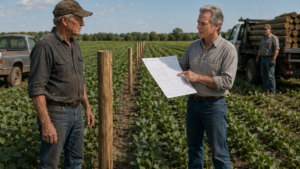
Linda stood between three raised beds her husband had built years earlier from rough-sawn boards. Tomatoes leaned against their cages. Beans climbed twine. Rosemary had grown woody enough that she cut it with pruning shears now.
The first page inside the envelope carried a dark embossed emblem and a block of formal language.
NOTICE OF FINAL LAND-USE ENFORCEMENT.
Linda’s smile disappeared.
She read the first paragraph twice.
The road and landowners association claimed she was maintaining unauthorized agricultural improvements inside a restricted common-access corridor. She was ordered to remove the three raised produce beds, clear a narrow strip beside the gravel road, and pay accumulated enforcement costs totaling $4,800.
Payment was due within seven business days.
Failure to comply, the notice said, could result in additional collection action and enforcement against the affected property interest.
Linda lowered the paper.
For several seconds she could hear nothing except a mockingbird in the fence row and the faint ticking of the mail truck cooling somewhere down the county road.
“Affected property interest,” she said aloud.
Her house was paid off.
So was the farm.
She had spent thirty-seven years watching mortgage payments leave the checking account every month. After her husband died, one of the few things that had let her sleep was knowing nobody held a note on the land.
She read the page again.
The language did not actually say foreclosure. It did not have to. Collection. Enforcement. Property interest.
The words had been chosen by somebody who understood what frightened landowners.
Linda carried the envelope into the farmhouse and laid everything on the kitchen table.
There had been two earlier letters.
She found them in the drawer where she kept appliance manuals, seed invoices, and things she intended to deal with later. Both were from Robert Clark, chairman of the association.
The first said portions of her garden appeared to extend into an area reserved for shared access.
The second warned that continued agricultural use could result in fees.
She had read each one and put it away.
The beds had been there longer than Robert had lived on the road. Linda remembered her husband measuring the first one with an old steel tape, complaining that she had chosen the only patch of ground with enough rocks to build another house.
They had planted tomatoes there the following spring.
No one had called them an agricultural encroachment then.
Linda looked through the kitchen window.
From inside, the beds seemed even smaller.
Three rectangles of dark soil.
A row of tomatoes.
Beans.
Rosemary.
Beyond them, grass sloped toward the shared gravel road.
At the edge of that grass, half-hidden by clover, something rust-colored protruded from the earth.
The old iron pin.
Her husband had pointed it out dozens of times over the years.
“That little ugly thing matters more than the fence,” he used to say.
Linda had stopped listening whenever he began talking about survey lines. He could turn a five-minute question about a gate into forty minutes of old plats and measurements.
After he died, she had let grass grow around the pin.
Now the association claimed part of that same strip was common land.
Linda went back to the notice.
There was a payment address and a detachable section at the bottom. The formal design irritated her, but irritation was easier to manage than the tightness gathering under her ribs.
She took out her checkbook.
Four thousand eight hundred dollars would hurt.
It would not ruin her.
That thought frightened her more than the amount itself.
She could make it disappear.
Write the check. Move the beds farther uphill. Let Robert have his strip. Avoid meetings, lawyers, arguments, surveyors, and the kind of bitterness her husband had carried home whenever someone moved a fence without asking.
Before he died, she had made him a promise after one particularly ugly dispute with a neighboring owner.
“We are not spending the rest of our lives fighting lines on maps.”
He had looked tired enough to agree.
Linda wrote the date on the check.
Then she stopped.
The detachable payment slip listed her parcel.
She knew the number because it appeared on every tax bill.
Linda stood, went to the old desk in the front room, and pulled the latest property-tax statement from a folder.
She laid it beside the cream notice.
The numbers were almost the same.
Almost.
Her tax parcel ended in 417.
The association notice ended in 471.
Linda checked again.
She carried both papers to the kitchen, adjusted her glasses, and compared them digit by digit.
The notice demanding $4,800 did not identify her parcel correctly.
Her unfinished check remained on the table.
For the first time that morning, Linda was no longer wondering how quickly she could make the problem go away.
She was wondering exactly what Robert Clark believed he had the right to do.
Chapter 2: The Rule That Sounded More Official Than It Was
“The association is legitimate.”
The county recorder said it before Linda had finished explaining why she was there.
Linda sat straighter in the molded plastic chair across the counter.
For one sinking moment, the cream notice inside her folder seemed to grow heavier.
The recorder turned her monitor slightly away from the glare.
“Registered years ago. Road maintenance, shared drainage, a few access provisions. It’s still active.”
“So they can fine me?”
“I didn’t say that.”
Linda looked up.
The recorder tapped the edge of Linda’s folder.
“You asked whether the association exists. It does. What it can enforce is a different question.”
That distinction had not occurred to Linda the night before.
She had slept poorly anyway.
Every time she closed her eyes, the words property enforcement returned in the neat black type of Robert’s notice.
The recorder pulled several recorded instruments connected to Linda’s tract and the shared road. There were old covenants, amendments, maintenance agreements, and plats copied from documents older than Linda’s marriage.
None made quick reading.
Linda found references to grading, drainage, snow removal, shared repair costs, and access for maintaining the road.
She did not find language saying the association owned the strip where her produce beds stood.
“What does ‘maintenance easement’ mean here?” she asked.
“It means exactly what the recorded document says it means.”
Linda gave her a look.
The recorder almost smiled.
“Sorry. I mean you shouldn’t assume it means ownership. An easement and ownership aren’t the same thing.”
Linda traced a faint line on one photocopied plat.
A tiny circle marked one corner near the road.
IRON PIN FOUND.
She leaned closer.
It appeared to correspond roughly with the rusted marker in her grass.
By noon she had more paper than certainty.
That was when she called Jonathan White.
He had known her husband through county work years earlier. Jonathan had since left government practice, but his name still surfaced whenever people along the road argued about easements or old plats.
He came to Linda’s kitchen that evening wearing work boots and carrying no briefcase.
“You still make coffee too strong?” he asked.
“Only for people giving free advice.”
“I didn’t say free.”
That was close enough to a joke that Linda relaxed.
She slid the certified notice toward him.
Jonathan read the first page.
Then the second.
Then he returned to the first and read it again.
Linda watched his expression change almost imperceptibly.
“What?”
“Who drafted this?”
“Robert sent it.”
“That wasn’t my question.”
“I don’t know.”
Jonathan placed the notice beside the county copies.
The cream paper, embossed emblem, and heavy formatting looked strangely theatrical next to the crooked photocopies of actual recorded instruments.
He pointed to a paragraph.
“This says the association has determined a continuing violation affecting a controlled access corridor.”
“Yes.”
“Then here it says they may initiate property enforcement remedies.”
“That’s the part I didn’t care for.”
“I can see why.”
“So it’s illegal?”
Jonathan leaned back.
“I didn’t say that either.”
Linda felt irritation rise.
“The county tells me they’re real. You tell me the paper looks wrong. Somebody needs to tell me whether I owe them forty-eight hundred dollars.”
Jonathan stayed quiet long enough that she regretted snapping.
Finally he said, “A private association can be legitimate and still overstate what it can do. It can have rules without owning your land. It can have an easement without having the right to use it for anything it wants.”
He pulled the old covenant closer.
“This language is about maintaining the road. Grading. Drainage. Access necessary for maintenance.”
“And vegetable beds?”
“I haven’t found vegetable beds.”
“Robert called them agricultural improvements.”
Jonathan looked through the window toward the darkening garden.
“You’ve got tomatoes, Linda. You didn’t open a feedlot.”
She nearly smiled.
Then he pointed to the parcel number.
“You caught this?”
“Yes.”
“It might be a clerical mistake.”
“Or?”
“Or they’re using a form built from another parcel description. Either way, don’t turn a mistake into a conspiracy before you know what it is.”
That was exactly the kind of answer her husband had hated from attorneys.
Precise enough to be useful. Careful enough to be irritating.
Jonathan gathered the county copies into order.
“If you want certainty, we need the full chain. Original easement, amendments, plats, whatever authority the association believes gives it control over that strip.”
“You can get that?”
“You can.”
Linda frowned.
“I thought that was why I called you.”
“It’s why you called me. It’s not why you have to stay dependent on me.”
The sentence landed harder than he probably intended.
Her husband had handled records.
Her husband had handled surveyors.
Her husband had gone to meetings and come home angry while Linda said she wanted no part of it.
She looked toward the old desk.
“I don’t like this stuff.”
“I know.”
“Neither did he, no matter what he pretended.”
Jonathan nodded.
“But he knew where things were.”
Linda disliked the accuracy of that.
The phone rang before she could answer.
Robert Clark’s name appeared on the kitchen display.
Jonathan looked at her but did not reach for the phone.
Linda almost let it ring out.
That would have been easier.
Instead, she answered.
“Linda,” Robert said. His voice was calm, businesslike. “I wanted to make sure you received the final notice.”
“I received it.”
“We haven’t received payment or a remediation confirmation.”
“It hasn’t been seven business days.”
A pause.
“No, but we have contractors scheduled in the area Friday. Since the access corridor has to be marked anyway, I thought we could take care of yours at the same time.”
Linda looked at Jonathan.
He said nothing.
“What exactly are they taking care of?”
“Marking the controlled strip. Once it’s marked, you’ll have a clear line for removing the beds and anything else inside it.”
“You’re sending people onto my farm?”
“They’ll be working within the association corridor.”
“Show me where the association owns it.”
Robert’s tone changed—not much, but enough.
“We’ve been through the rules twice.”
“You sent me warnings twice. That isn’t the same thing.”
Another pause.
“We’ll have the documents with us Friday morning.”
“What time?”
“Eight.”
Linda looked at the parcel map lying beside the certified notice.
A faint circle marked the old iron pin.
“All right,” she said. “Bring the documents.”
She hung up.
Jonathan raised an eyebrow.
Linda closed the folder herself.
For the first time since the envelope arrived, she did not ask him what she should do next.
Chapter 3: The Survey Flag Planted Beside the Old Iron Pin
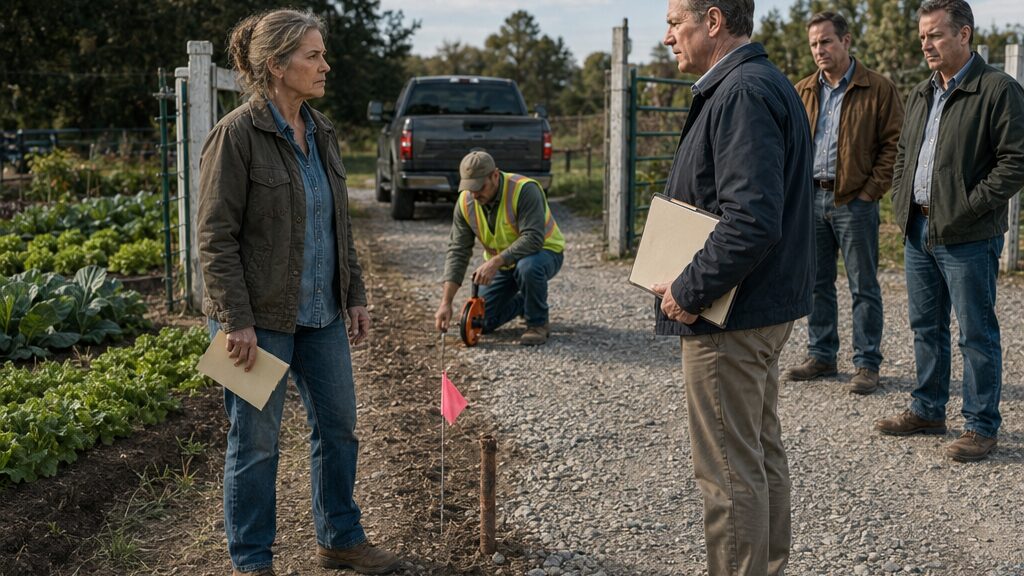
The contractor’s truck turned into Linda’s lane at 7:43 Friday morning.
She had not finished breakfast.
Gravel cracked beneath heavy tires as the truck came past the mailbox, followed by Robert Clark’s pickup and a smaller SUV carrying two association board members.
Linda set down her coffee.
She had expected eight.
Apparently Robert had decided seventeen minutes early belonged to him too.
By the time she stepped outside, the contractor had already lowered the tailgate. Wooden stakes, fluorescent flags, marking paint, and a long measuring wheel were stacked in the bed.
Robert approached carrying a folder.
“Morning, Linda.”
“You said eight.”
“We’re close.”
Linda looked at the contractor, then at the equipment.
“No one marks anything until we talk.”
Robert’s expression tightened.
“We are talking.”
One of the board members stayed by the vehicles. The other unfolded a printed diagram against the hood of Robert’s pickup.
Linda had tucked the certified notice into its original envelope. She held it now at her side.
Robert pointed toward the grass running between the produce beds and the gravel road.
“The controlled corridor follows this side. We’ll establish the edge, then you’ll know what has to move.”
“According to what recorded document?”
“The association covenants.”
“Which page?”
Robert opened his folder.
He had expected resistance, Linda realized.
What he had not expected was the question to be that specific.
He produced a copy of the same covenant she had obtained at the courthouse.
“This authorizes access for road purposes.”
“It authorizes maintenance.”
“That includes maintaining adequate access.”
“To the existing road.”
Robert exhaled.
“Linda, we’re not here to debate terminology in the driveway.”
“That’s exactly what you’re here to do if your terminology lets you take part of my driveway.”
The contractor looked away.
Robert lowered his voice.
“No one is taking your farm.”
“Then nobody should have trouble showing me where your strip begins.”
He gestured to the contractor.
“Go ahead and mark the preliminary line.”
The man hesitated only a second.
That was enough.
Linda stepped off the gravel and onto the grass between him and the first tomato bed.
She did not raise her voice.
“You can stand there. You can measure from the road. You are not putting a stake in my ground until he shows me recorded authority.”
The contractor stopped.
Robert’s face reddened slightly.
“Linda, your compliance period has expired.”
“No, it hasn’t.”
“The board authorized field preparation.”
“The notice says seven business days. This is day four.”
Robert glanced at the paper in her hand.
For the first time, Linda saw uncertainty rather than irritation.
One of the board members spoke quietly to him. Linda could not hear the words.
Robert answered without turning.
“This isn’t enforcement work. It’s marking.”
“Then it can wait.”
The contractor shifted his measuring wheel.
Robert looked toward the garden.
“Other owners have cooperated without turning routine road management into a legal fight.”
The phrase struck Linda strangely.
Other owners.
“How many?”
“That isn’t relevant.”
“It became relevant when you brought them up.”
Robert closed his folder.
“We have people who need to work.”
“So do I.”
Linda pointed toward the raised beds.
“These beds were here before you bought your place. Before you chaired anything. You’re telling me they suddenly sit inside land your association controls. Show me where that land was granted.”
Robert’s answer came faster this time.
“The corridor predates both of us.”
“Good. Then there should be a record.”
The contractor had begun measuring from the edge of the gravel anyway, without entering the grass. He rolled the wheel twenty feet, glanced at Robert’s diagram, then walked toward the ditch shoulder.
Linda watched him take a fluorescent flag from his pocket.
He bent and pushed it into the soil.
The bright plastic snapped upright.
Six inches away, something rusty protruded from the grass.
Linda stared.
The old iron pin.
It had been there the entire time, nearly swallowed by clover and roadside weeds.
Her husband’s voice came back with uncomfortable clarity.
That little ugly thing matters more than the fence.
“Stop.”
This time everyone heard her.
Linda crossed the grass, crouched, and pulled weeds away from the rusted metal. A square iron head emerged from the soil.
The contractor leaned closer.
“That a monument?”
“I believe so.”
Robert looked down at it.
“That doesn’t establish anything by itself.”
“No,” Linda said. “But neither does your flag.”
She set the unopened payment envelope on the hood of Robert’s truck, directly beside his diagram.
“Your office sent me that demanding forty-eight hundred dollars and telling me to clear this strip. The parcel number is wrong. The recorded language I found talks about road maintenance, not ownership. And now your contractor has planted your proposed line six inches from an old iron boundary marker.”
Robert stared at the envelope.
Linda continued.
“I am not saying the pin proves I’m right. I’m saying you have not proved you are.”
The board members had gone quiet.
Robert looked past Linda toward the gravel road.
Finally he said, “Do you think I invented this because I enjoy driving around arguing about gardens?”
“I don’t know why you’re doing it.”
“We have road work coming. We have drainage work. We need consistent access.”
“Then ask for consistent access.”
“We have.”
“No. You sent a bill.”
That landed.
Robert’s jaw tightened.
For a moment Linda thought he might order the contractor forward anyway.
Instead, he lifted the diagram off the truck.
“We’ll suspend field work on your section pending document review.”
It was bureaucratic language for leaving.
Linda accepted it.
“When will I get the documents?”
“I’ll send what we have.”
“What gives you the right to collect the $4,800?”
“The board’s enforcement schedule.”
“That tells me how much you charge. Not what gives you control of the land.”
Robert gave her a long look.
“You weren’t at the meetings when this was explained.”
There it was.
Linda felt the shame before the anger.
He was right about that part.
She had ignored the notices announcing meetings. She had told herself shared-road arguments belonged to people who enjoyed conflict.
Robert continued more quietly.
“Some of us have spent two years trying to prevent this road from becoming unusable. Farm trucks are wider. Delivery traffic is heavier. Emergency access is poor. Every owner wants the benefits, but nobody wants six feet taken from their side.”
For the first time that morning, he did not sound like a chairman.
He sounded tired.
Then he ruined it.
“Other owners understood that cooperation was necessary.”
Linda looked at him sharply.
“Understood, or paid?”
Robert did not answer.
The contractor collected the unused stakes.
Within ten minutes, the vehicles were backing down Linda’s lane.
The fluorescent flag remained beside the iron pin.
Linda considered pulling it out.
She left it.
The bright new marker and the old rusted one stood so close together they seemed to accuse each other.
Linda was carrying her coffee back toward the house when another pickup slowed at the entrance.
Nicole Thomas stepped out before Linda recognized her.
Nicole owned cattle pasture farther along the shared road. They had known each other for years without ever becoming friends.
She walked directly to the flagged spot.
“So he got to you too.”
Linda stopped.
“What do you mean?”
Nicole reached into her truck and took out a cream-colored envelope.
Same weight.
Same embossed emblem.
Same formal blocks of print.
She held it out.
Her mouth was set hard.
“You’re not the first one they sent that paper to.”
Chapter 4: The Neighbors Who Had Already Signed Away Something
Nicole held the cream-colored envelope between two fingers as if it were dirty.
Linda did not take it at first.
“How much?”
“Thirty-two hundred.”
“For what?”
Nicole gave a short laugh that carried no amusement. “For being in the way.”
She opened the envelope herself and spread the papers across the hood of her pickup. The layout was nearly identical to Linda’s: embossed emblem, formal headings, deadlines, references to enforcement. Nicole’s land was different, though. Her cattle pasture sat farther down the shared road where the ditch narrowed between two old fence lines.
The association claimed part of her gate apron and pasture entrance interfered with a controlled access strip.
Linda read the demand once.
Then again.
“Did you pay this?”
Nicole looked toward the road.
“Some.”
Linda looked up.
“What does that mean?”
“It means I sent them eighteen hundred before I got mad enough to stop.”
The answer landed harder than Linda expected.
Nicole folded her arms.
“My hay truck was due. Robert told me if I didn’t resolve the access issue, road work could limit heavy vehicles through my section. Maybe he meant it. Maybe he didn’t. I wasn’t interested in finding out during cutting week.”
Linda handed the notice back.
“Did he say they could close the road?”
“He said the board had authority to control access during maintenance.”
“That’s not the same thing.”
“No.” Nicole’s voice sharpened. “I know that now.”
Linda felt the accusation before Nicole said anything else.
“You got the meeting notices too.”
“Yes.”
“You never came.”
Linda looked at the fluorescent flag beside the rusted pin.
“No.”
“People asked questions.”
“I didn’t know that.”
“You would’ve if you’d been there.”
Nicole’s words were not loud, but Linda wished they had been. Anger would have been easier to resist than the plain fact of them.
“I thought it was the usual road argument.”
“It stopped being usual months ago.”
Linda stiffened.
“How many others got these?”
Nicole shrugged. “I know of four for sure. Maybe more.”
By late afternoon, Linda knew of seven.
Nicole drove her to two neighboring farms and called three other owners from the cab of her truck. One had paid an enforcement fee in full. Another had signed a temporary access agreement allowing the association to use an additional strip along his frontage for one year. Two had received notices but were still deciding what to do.
The adjacent cattle farmer met them beside a machine shed with a folded agreement in his shirt pocket.
“I signed,” he said before Linda asked.
Nicole frowned. “Why?”
“Because I needed my feed truck through here.”
He pointed down the narrow road.
“Robert said the drainage contractor might have to close sections unless they got enough room to stage equipment. I had calves on supplement and no place to turn a loaded truck around if they blocked the south end.”
“Did he threaten you?” Linda asked.
The farmer rubbed his jaw.
“He explained consequences.”
Nicole made a sound under her breath.
The farmer looked at her.
“You can call it whatever you want. I had feed coming.”
That was the first moment Linda understood how the notices worked.
Not everyone had believed Robert possessed unlimited authority.
Some had simply calculated that resisting him might cost more than cooperating.
By Saturday morning, the problem had changed shape.
It was no longer Linda against Robert.
It was a road full of landowners who had each been made to believe they were dealing with a private problem.
Linda drove to the association’s meeting room with Nicole beside her. The room occupied one end of a converted equipment building near the center of the road. Folding tables had been arranged in a rectangle. Coffee sat in a metal dispenser near the wall.
Only eight owners came.
Robert sat at the front with two board members.
He looked at Linda when she entered but did not greet her.
The meeting began with drainage repairs, gravel costs, and complaints about washboarding near the north curve. For twenty minutes, everything sounded ordinary enough that Linda almost felt foolish.
Then Robert moved to “access consistency.”
He used that phrase three times.
Linda watched the people around the table.
Nobody interrupted him.
Finally she raised her hand.
Robert paused.
“Yes?”
“What recorded authority gives the association control of land beyond the existing maintenance easement?”
The room changed.
Not dramatically.
No one gasped.
But several people stopped looking at Robert and began looking at Linda.
Robert folded his hands.
“We addressed that in prior sessions.”
“I wasn’t at those.”
“I know.”
The small rebuke was deserved.
Linda accepted it.
“I’m asking now.”
Robert glanced toward one board member.
“The association has longstanding authority to maintain adequate access for the road.”
“That doesn’t answer the question.”
A man near the end of the table shifted in his chair.
Robert said, “We are trying to prevent every property owner from applying a different interpretation.”
Nicole spoke.
“That’s not what she asked.”
Robert looked at her.
Nicole did not lower her eyes.
The meeting moved badly after that.
One owner wanted the road widened immediately because two trucks had nearly clipped mirrors near his property. Another said the association had no business collecting penalties before obtaining surveys. Someone else complained that outsiders buying newer homes near the road wanted suburban access on farm geometry.
Linda listened more than she spoke.
The divisions were not simple.
Some people supported Robert because they believed the road genuinely needed improvement.
Some distrusted him.
Some had paid because they were tired.
Some had signed because the alternative seemed risky.
The farmer who had shown Linda his temporary agreement finally said, “I didn’t sign because I thought Robert owned my frontage. I signed because I needed a truck through.”
Silence followed.
Robert’s face hardened.
“That road does not function by individual convenience.”
“No,” the farmer said. “But neither should your paperwork.”
That was the closest anyone came to open confrontation.
After the meeting, Linda remained behind while people folded chairs and carried coffee cups to the trash.
Nicole was helping gather papers when she found several sets of old minutes in a side rack.
“Linda.”
She held one page under the fluorescent light.
The minutes were from a meeting Linda had skipped nearly a year earlier.
Most of the page concerned culverts and gravel bids.
Then a paragraph near the bottom mentioned a proposed road improvement plan.
Linda read the sentence twice.
The association intended to pursue a “continuous access corridor” sufficient for future road widening, drainage work, and related development requirements.
“Development?” Nicole said.
Linda looked toward the front of the room.
Robert had already left.
A second line referred to preliminary coordination with county planning staff.
Linda folded the page carefully.
The notices were not merely about keeping the existing road usable.
Someone needed a corridor wide enough for something that had not been built yet.
Chapter 5: The Road Project Hidden Behind the Enforcement Campaign
The county planning map showed a pale shaded strip running directly through Linda’s disputed ground.
She stood over the counter with one hand pressed against the paper.
The strip followed the shared road, widened near the north curve, and cut across frontage belonging to several owners she had spoken with over the weekend.
At her farm, it passed through the grass beside the tomato beds.
“That’s not a maintenance map,” Linda said.
The planning clerk shook his head.
“No. Preliminary transportation access.”
“For what?”
He turned to a larger sheet.
A proposed residential development lay beyond the far end of the road, where pasture had been changing hands in pieces for several years. The plan was not enormous, but it was large enough to increase traffic substantially.
New homes.
Service vehicles.
School buses.
Emergency access.
The shared farm road, narrow and uneven in places, was the most practical route.
“The county hasn’t approved this,” the clerk said. “They’re still working through access conditions.”
“Who’s they?”
“The developer, association representatives, engineers.”
Linda looked again at the shaded strip.
“And the association needs this width?”
“They need sufficient legal access. What that means parcel by parcel is their problem.”
That sentence stayed with her.
Their problem.
Robert had turned it into hers with a certified demand for $4,800.
On the drive home, Linda slowed near Nicole’s pasture. A delivery truck waited while Nicole moved cattle away from the gate. Farther down, two vehicles met on the narrowest section and one had to reverse nearly fifty yards.
Robert had not invented the road problem.
That irritated Linda almost as much as the notice.
By afternoon, she was standing in the association office with the planning map rolled under her arm.
Robert looked at it before she said anything.
“So you found the project.”
“You could have told me.”
“We discussed it at meetings.”
“I wasn’t asking about meetings.”
Robert leaned back.
“What are you asking?”
“Why a road project became a land-use violation.”
His expression remained controlled.
“Because people ignored voluntary access requests.”
“I never received one.”
“You received meeting notices.”
“That is not the same thing as asking for an easement.”
Robert looked tired.
The office was small, crowded with road invoices, culvert estimates, and photographs of washed-out shoulders. Nothing about it looked glamorous or powerful.
He opened a drawer and removed a binder.
“You know what happened two winters ago?”
“I know the ambulance had trouble at the north turn.”
“It lost six minutes.”
Linda remembered the flashing lights through bare trees.
Robert tapped the binder.
“We have delivery trucks tearing shoulders up. Farm equipment that can barely pass. Drainage that fails every heavy rain. And now a development proposal that could bring county money into widening the road properly.”
“There it is.”
“What?”
“The development.”
“Yes, Linda. The development matters.”
His voice rose slightly, then settled.
“If the project moves forward, the developer helps fund road improvements. If it doesn’t, the owners here keep paying for patches.”
“So you decided everyone should give you whatever strip you needed.”
“I decided we needed consistent access.”
“You sent people bills.”
“We sent enforcement notices where use conflicted with the corridor.”
“The corridor you hope to create.”
Robert went still.
Linda saw that she had finally named the weak point.
He stood and walked to a wall map.
“The county wants certainty. The developer wants certainty. Engineers cannot design a road around twelve different opinions.”
“Then negotiate twelve agreements.”
“We tried.”
“Did you?”
Robert turned.
“Do you know how many people said they supported road improvement until the line touched their side?”
Linda said nothing.
“All of them,” he continued. “Everyone wants a better road. Everyone wants fire trucks to get through. Everyone wants deliveries in February. Then you show them six feet of grass and suddenly the common good is somebody else’s responsibility.”
The words were not unreasonable.
That was what made them dangerous.
Linda rolled the planning map tighter.
“You’re still not allowed to pretend disputed authority is settled authority.”
Robert looked toward the window.
For several seconds neither spoke.
Then he said, “If we lose continuous access, the development agreement probably collapses.”
Linda studied him.
There was no triumph in his voice.
Only pressure.
“How long have you known?”
“Months.”
“And the board?”
“They know we need the corridor.”
“That wasn’t my question.”
Robert’s jaw tightened.
“They know the project depends on access.”
“Do they know your notices threaten property enforcement for strips the association may not own?”
“They approved the enforcement schedule.”
Again, not an answer.
Linda understood something then.
Robert had not begun with a scheme to frighten old farmers.
He had begun with a road he believed needed fixing.
Somewhere between that problem and the deadline attached to the development, he had decided the distinction between persuasion and authority was inconvenient.
“Why $4,800?” she asked.
“Accumulated compliance charges.”
“For tomatoes.”
“For continued obstruction after notice.”
“They are tomatoes.”
“They are inside the proposed corridor.”
“Proposed.”
Robert rubbed both hands over his face.
“I am trying to get this road fixed before somebody gets hurt.”
“And I am trying to understand why you think that lets you charge me for refusing land you never asked me to give.”
He lowered his hands.
The anger left his face.
“So what do you want?”
“The record.”
“You have the covenants.”
“I want everything connected to my frontage. Every map. Every proposed easement. Every communication where somebody decided your maintenance authority covered that strip.”
Robert looked at her for a long moment.
Then he opened the binder.
“There’s something you should know before you decide everyone here is trying to steal from you.”
Linda waited.
“Your husband discussed additional access years ago.”
Her grip tightened around the map.
“With who?”
“With the previous board.”
“Discussed what?”
“A limited easement along your road edge.”
Linda stared at him.
“No.”
Robert reached for another folder.
“He never signed the version they prepared.”
The relief came too quickly.
Then Robert added, “But he didn’t reject the idea either.”
Linda felt the room narrow around her.
“What exactly did he agree to?”
“I don’t know exactly.”
“You just told me—”
“I told you he discussed it. I have references to it in old correspondence.”
“Show me.”
Robert hesitated.
That hesitation was enough to make Linda step closer to the desk.
“Show me.”
He found a photocopy of an old meeting note. Her husband’s name appeared beside a short line about seasonal access for road equipment.
No signature.
No legal description.
No final agreement.
But it existed.
Linda read it twice.
All weekend she had been building a simple story in her head.
Robert pushed.
She resisted.
The records would prove which of them was right.
Now her husband stood inside the problem too.
Robert watched her carefully.
“He understood the road needed room.”
Linda folded the copy.
“Or he understood there was something worth discussing.”
“That’s fair.”
She looked at him.
It was the first fair thing he had said all afternoon.
Linda left with the photocopy in her folder.
As she drove home, the old iron pin waited beside the fluorescent flag at the edge of her lane.
For the first time, she wondered whether her husband had once intended the line to move willingly.
Chapter 6: What Her Husband Had Asked Her to Learn
The folder was behind a box of worn tractor manuals.
Linda found it because Robert’s photocopy had used the old road name.
She had seen the same name written in pencil on a narrow manila tab years ago and ignored it.
Now she stood in the farm office with dust on her fingers and pulled the folder free.
Inside were plats, meeting notes, two unsigned easement drafts, and pages covered in her husband’s handwriting.
Linda sat at the desk.
The first draft granted temporary access along the eastern edge of the farm during drainage work.
The second was broader.
Her husband had crossed out several lines.
Beside one clause he had written:
Too wide. Seasonal only.
Beside another:
No permanent widening without survey.
Linda let out a breath she had not realized she was holding.
He had not agreed to give the land away.
But he had considered giving some access.
That distinction should have relieved her.
Instead it made her chest ache.
She turned another page.
There were rough measurements from the old iron pin to the gravel edge. Notes about culverts. A sketch of the produce beds before they had been built.
Then, halfway down a yellow legal sheet, one sentence stopped her.
You need to know where the line is without me.
Linda stared at the handwriting.
It was not addressed to anyone.
Maybe it had been a reminder to himself.
Maybe not.
She knew the shape of his letters, the way he leaned hard on capital letters when irritated. The sentence looked deliberate.
A memory surfaced.
He was standing at the kitchen sink years earlier with a folded plat under one arm.
“Come look at this with me.”
“I’m cooking.”
“It’ll take five minutes.”
“It never takes five minutes.”
He had laughed.
Then later, after a dispute with a neighbor over a fence, he had tried again.
“You ought to know where all this is.”
“I know where the farm is.”
“That isn’t what I mean.”
She had refused because the entire subject exhausted her.
Maps became arguments.
Pins became suspicions.
Measurements became accusations.
Her husband could lose half a day proving that a post had been moved two inches.
Linda had believed her refusal kept peace inside the house.
Sitting at his desk now, she understood what it had also done.
It had left knowledge entirely in his hands.
After he died, she had inherited the land but not the habit of defending it.
Jonathan arrived that afternoon.
Linda did not offer him coffee.
She handed him the folder.
He read quietly for twenty minutes.
Finally he tapped the unsigned drafts.
“These matter.”
“They prove Robert is right?”
“No.”
“They prove I’m right?”
“No.”
Linda almost laughed.
Jonathan continued.
“They prove your husband considered granting limited access. They also prove he was distinguishing temporary use from permanent widening.”
He pointed to the handwritten notes.
“And he wanted a survey before anything permanent.”
Linda looked at the sentence about knowing the line.
“I spent years thinking he liked this.”
“Liked what?”
“Arguing.”
Jonathan smiled faintly.
“He liked being right.”
“That too.”
“But that doesn’t mean he wanted the fights.”
Linda leaned back.
“I told him I wasn’t spending my life fighting lines on maps.”
“I remember.”
“He told you?”
“He complained you wouldn’t come to a meeting once.”
Linda closed her eyes briefly.
“Of course he did.”
Jonathan returned the papers to order.
“The important thing is he never executed the easement.”
“So Robert has nothing.”
“Robert may have maintenance rights under the existing recorded easement. He may also have a legitimate reason to seek wider access. What he doesn’t appear to have is a completed grant for the wider corridor.”
Linda looked toward the window.
The road was visible through the trees.
“What happens if I say no to everything?”
“The development may have to redesign access. The road project may lose funding. Or they may find another arrangement.”
“And if I say yes?”
“You negotiate terms.”
The answer surprised her.
She had been expecting a choice between surrender and victory.
Jonathan seemed to notice.
“You can be right about what they did and still decide some access makes sense.”
Linda folded her arms.
“That sounds inconvenient.”
“Most property law is.”
She looked again at her husband’s notes.
Seasonal only.
No permanent widening without survey.
The words did not read like fear.
They read like limits.
Her phone buzzed.
Nicole had sent a message asking whether Linda had found anything.
Linda typed a reply, then erased it.
She did not want to send conclusions she had not earned yet.
Instead she called the county survey office and asked for the names of licensed surveyors familiar with the older plats along their road.
By evening she had scheduled a formal boundary survey.
The earliest available date was two weeks away.
It felt too long.
Then Linda did something that surprised her more.
She called Robert.
“I’m ordering a survey.”
A pause.
“Fine.”
“I also want a meeting when it’s done.”
“With the board?”
“With the owners affected by these notices.”
Robert’s voice cooled.
“That could turn into a circus.”
“Then don’t make it one.”
“What exactly are you planning?”
“I don’t know yet.”
That was true.
She looked at the unsigned easement draft on the desk.
“I know what I’m not doing.”
“And that is?”
“I’m not paying the $4,800.”
Robert said nothing.
“And nobody marks another inch of my farm until the survey is finished.”
Another pause.
“All right.”
Linda almost thanked him.
She stopped herself.
Then she added, “Bring the road plans.”
“Why?”
“Because if you want something from me, I want to see what it actually is.”
After the call, she went outside.
The fluorescent flag still stood beside the rusted iron pin.
Linda knelt and cleared the last clump of grass from around the metal.
For years she had thought peace meant not looking too closely at lines.
Now she left both markers exactly where they were.
In two weeks, everyone would have to look.
Chapter 7: The Line Everyone Could Finally See
The surveyor began at the iron pin Robert’s contractor had nearly ignored.
He knelt in the grass beside Linda’s lane, scraped away loose soil with a narrow hand tool, and exposed several more inches of rusted metal. Then he set his equipment over it and looked toward a second monument farther down the property.
Robert stood ten yards away with his arms crossed.
Nicole was beside the cattle farmer near the road. Two association board members had come as well, along with several owners whose land appeared on the proposed access map.
Nobody talked much.
The surveyor checked the instrument, made a measurement, then checked it again.
Linda watched the fluorescent flag still standing beside the old pin.
Two weeks earlier, Robert’s contractor had treated that bright piece of plastic as though putting it in the ground could create a boundary.
Now the temporary flag leaned slightly after several rains.
The iron pin had not moved.
The surveyor walked downhill and placed a new stake.
It was nowhere near the association’s proposed line.
Robert noticed immediately.
“That can’t be right.”
The surveyor did not look up.
“It’s preliminary.”
Robert walked closer.
“The corridor is farther west.”
“The proposed corridor may be.”
“I’m talking about the established access.”
“So am I.”
The surveyor continued toward the next point.
Linda said nothing.
She had learned enough over the past two weeks to know that victory declared too early usually became embarrassment.
They spent most of the morning following old measurements, recorded monuments, and physical evidence through grass, ditch edges, and fence corners.
The result did not give Linda everything.
That mattered.
There was an existing maintenance easement.
It followed the road closely and gave the association access necessary to grade, repair drainage, and maintain the traveled surface.
But it was narrower than the strip Robert’s board had marked.
At Linda’s produce beds, the difference was substantial.
The three beds sat entirely on Linda’s property and outside the recorded maintenance easement.
The proposed widening corridor cut into land the association did not presently control.
The surveyor spread a field copy of the plat across the hood of his truck.
“This line is ownership,” he said, pointing.
Then another.
“This is the recorded maintenance easement.”
He moved his finger several feet farther.
“And this is what was shown to me as the proposed future corridor.”
Nicole leaned closer.
“So they’re three different things.”
“Yes.”
Robert stared at the map.
One of the board members said quietly, “How far off were our markings?”
“It varies.”
“At Linda’s?”
The surveyor measured on the page.
“Enough that I would not describe the proposed line as the existing easement.”
No one spoke for several seconds.
Linda looked from the map to the garden.
The tomatoes had grown taller since the certified notice arrived. One plant had bent under its own weight and needed tying.
The beds had never been the problem.
They had simply made the disputed strip visible.
Robert finally said, “The road still needs widening.”
The surveyor folded his equipment case.
“That’s not a survey question.”
Robert looked at Linda.
She expected an argument.
Instead he said, “No. It isn’t.”
The owners moved to the association meeting room after lunch.
Linda brought the cream-colored notice, the county copies, her husband’s unsigned drafts, and the surveyor’s preliminary boundary sketch.
Robert brought engineering plans for the road.
For once, everyone was looking at the same documents.
The proposed widening would soften the worst curve, improve drainage, and create enough width for larger emergency vehicles to pass without forcing oncoming traffic onto private yards.
The plan also required additional land.
Not everywhere.
But on Linda’s frontage and several others.
Robert stood at the end of the table.
“This is what I’ve been trying to accomplish.”
Nicole answered first.
“You could have shown us this before sending bills.”
“We discussed the project.”
“You discussed road improvements. You did not tell me an enforcement charge was being used to push me into an access agreement.”
Robert looked toward one board member.
The board member avoided his eyes.
Linda noticed.
“How did those notices get approved?” she asked.
Robert’s expression hardened.
“The board approved enforcement.”
“That still isn’t what I’m asking.”
He knew it.
Everyone did.
Linda placed her certified notice on the table.
“This paper says I violated a controlled corridor. Today we established that the wider corridor does not exist as a recorded right across my land.”
Robert said, “The language was intended to reflect the access required under the road plan.”
“Required by the plan,” Linda said. “Not already granted by me.”
Nobody raised a voice.
That made every sentence clearer.
The cattle farmer unfolded the agreement he had signed.
“So what exactly did I give you?”
Jonathan White, sitting against the wall at Linda’s request, did not answer for anyone.
He had told her before the meeting that this part needed to belong to the owners themselves.
Robert looked at the farmer’s document.
“A temporary right of access.”
“Because I was told my frontage was already interfering with the corridor.”
Robert rubbed his thumb against the edge of the table.
Linda could see him calculating.
Not whether he was wrong.
How much wrong he was willing to admit.
Finally he said, “The notices should have distinguished the recorded maintenance easement from the proposed widening corridor.”
Nicole gave a humorless laugh.
“That is a polite way to say it.”
Robert looked at her.
“I’m not trying to be polite.”
“Then try accurate.”
Linda expected the exchange to sharpen.
Instead Robert sat down.
For the first time since the dispute began, he looked less like a chairman than a man who had run out of procedural language.
“The road project cannot move ahead in its current form without additional access.”
No one disputed that.
He continued.
“If we lose the development contribution, the association cannot afford the full work.”
“That doesn’t make the notices valid,” Linda said.
“No.”
The single word altered the room.
Linda looked at the old cream paper in front of her.
For weeks she had imagined hearing Robert concede.
She had expected satisfaction.
What she felt instead was responsibility.
The road did need work.
The ambulance delay had happened.
Farm trucks did struggle through the curve.
Winning the boundary argument did not fill potholes.
Linda unrolled the survey sketch.
“My husband considered a seasonal easement here.”
She pointed to the eastern edge of her property.
Robert looked at the line.
“I know.”
“He refused the wider version.”
“Yes.”
“So do I.”
Robert leaned back.
Linda continued.
“But there’s room for something narrower than your proposal.”
Nicole turned toward her.
Linda traced a strip that avoided the produce beds and followed the existing drainage edge.
“I’ll consider granting access here for road widening and drainage.”
Robert stared at her.
“What width?”
“We negotiate that after your engineer works from the actual boundary instead of the line your contractor tried to mark.”
One board member began to speak, but Linda raised her hand.
“I’m not finished.”
The room settled.
“There are conditions.”
Robert’s expression closed again.
“What conditions?”
“All enforcement notices based on the proposed corridor are withdrawn.”
Nicole sat straighter.
“All payments made under those notices are reviewed.”
Robert started to object.
Linda continued over him.
“Every temporary agreement obtained under that same claim is reviewed so people understand what they signed and can get independent advice.”
“That could take months.”
“Then it takes months.”
“The developer has deadlines.”
“That is not our emergency.”
Robert looked down at the engineering plan.
Linda placed her unfinished payment check beside the cream notice.
She had kept it for reasons she had not understood until now.
“I was going to send you this.”
Robert looked at the check.
“Forty-eight hundred dollars because I was afraid of the paper you mailed me. Not because I understood your authority. Not because we negotiated anything.”
She folded the check once.
“I’m willing to give something the road actually needs.”
Then she tore it in half.
“I’m not giving it because you frightened me.”
No one applauded.
Linda was grateful.
Robert stared at the torn check, then at the survey map.
“What happens if the board refuses?”
Linda met his eyes.
“Then you have the maintenance easement you already had.”
Outside, the old iron pin sat beside the new survey stake.
The line was finally visible.
Now Robert had to decide whether the association could live within it.
Chapter 8: Keeping the Farm Without Becoming What She Feared
Robert returned to Linda’s farm three weeks later without a folder.
No board stationery.
No contractor.
No fluorescent flags.
He parked near the mailbox and walked up the gravel lane carrying a single rolled engineering drawing.
Linda was tying tomatoes again.
For a moment, the scene felt so much like the morning of the certified letter that she almost expected the rural mail carrier to appear behind him.
Robert stopped beside the beds.
“The board voted last night.”
Linda tightened the garden twine around a cedar stake.
“And?”
“We’re accepting the narrower alignment.”
She looked at him.
“Subject to final drafting?”
“Yes.”
“Review of the notices?”
“Yes.”
“Payments?”
He hesitated.
“Reviewed individually.”
“That sounds less certain.”
“It is less certain.”
At least he was no longer disguising uncertainty as authority.
Robert unrolled the revised engineering drawing across the top board of an empty bed.
The new road line stayed closer to the existing gravel and shifted the drainage work away from Linda’s vegetables. A narrow voluntary easement would still be needed along part of her frontage.
The old iron pin was marked on the plan.
Not ignored.
Not buried beneath a proposed corridor.
Marked.
“The developer’s engineer says this works,” Robert said. “Costs more.”
“How much?”
“Enough that they complained.”
Linda nodded.
“That sounds healthy.”
Robert almost smiled.
Almost.
“The board is also having outside counsel rewrite the enforcement procedures.”
Linda studied him.
“You should have done that before.”
“Yes.”
No defense followed.
That mattered more than an apology would have.
Robert rolled the drawing halfway closed, then stopped.
“I still think people underestimated how serious the road problem was.”
“I probably did.”
He looked surprised.
Linda continued tying the vine.
“I skipped meetings because I didn’t want another argument about land. That made it easy for me to tell myself none of it belonged to me until your notice showed up.”
Robert glanced toward the road.
“That doesn’t excuse the notice.”
“No.”
They stood with both facts between them.
It was less satisfying than choosing one villain and one victim.
It was also truer.
A pickup stopped near the farm entrance.
Nicole got out with another envelope in her hand.
Linda recognized the association stationery from a distance, but this envelope was ordinary white.
Nicole walked up without greeting Robert.
“They sent confirmation.”
Robert nodded.
“I know.”
“My payment is under review.”
“Yes.”
“Under review is not refunded.”
“No.”
Nicole looked at Linda.
“They say they’re comparing each payment to the authority that existed when the demand was issued.”
“That’s what we asked for.”
Nicole’s mouth tightened.
“I know what we asked for.”
Linda waited.
Nicole looked toward the produce beds.
“You know what still bothers me?”
“Yes.”
“You didn’t say anything until they came for you.”
Robert shifted as if preparing to leave.
Linda stopped him with a glance.
He had been part of the harm, but this part was hers.
Nicole continued.
“I paid eighteen hundred dollars. The cattle farmer signed because he thought his feed deliveries were at risk. Others sat in those meetings asking questions. You stayed home.”
Linda felt the old reflex rise.
She could explain her husband.
His death.
The promise.
The fights she had watched consume him.
Every explanation was true.
None changed Nicole’s point.
“I did.”
Nicole seemed almost disappointed by the lack of defense.
Linda put down the garden twine.
“I told myself staying out of it meant I wasn’t adding to the conflict.”
“And?”
“It meant other people had to carry it.”
Nicole looked at her for a long moment.
“That’s closer.”
It was not forgiveness.
Linda did not ask for more.
Robert rolled the engineering plan completely.
“I’ll leave this with you.”
“No,” Linda said. “Bring the final version when the easement language is ready.”
He paused.
“Why?”
“Because I’m reading it this time.”
Robert gave one short nod.
“Fair enough.”
He walked back toward his truck.
At the edge of the grass, he stopped beside the rusted iron pin and the newer survey marker.
The fluorescent flag from his contractor was gone.
Linda had finally pulled it after the formal survey was filed.
Robert looked down at the two legitimate markers.
“I should’ve ordered the survey first.”
Linda wiped dirt from her hands.
“Yes.”
Then he left.
The final agreement took another two weeks.
Linda read every page.
So did Jonathan.
Then Linda read it again without him.
The association received a defined strip for widening and drainage, narrower than the original proposed corridor and tied specifically to the road project. It did not acquire ownership of Linda’s ground. The easement could not simply expand because a future board decided expansion would be convenient.
The certified enforcement demand against Linda was formally withdrawn.
The association began reviewing similar notices parcel by parcel. Some payments were clearly tied to valid maintenance violations. Others, including Nicole’s, required correction or refund.
There was no single dramatic meeting where everything became right.
One owner remained angry about the lost development time.
Another thought Linda should have refused any new easement at all.
The cattle farmer was mostly interested in when construction would begin.
Nicole received part of her money back first. The rest remained disputed because one charge related to an actual drainage obstruction on her frontage.
When she told Linda, she shook her head.
“Of course they found one thing I really did.”
Linda smiled.
“Would’ve been cleaner if they hadn’t.”
“Life has poor editing.”
It was the first joke Nicole had made with her since the dispute began.
The road work started late that season.
Crews widened the worst turn, rebuilt a culvert, and reinforced the shoulder near Nicole’s pasture gate. The work was noisy and inconvenient. For three days Linda had to coordinate deliveries around equipment parked near her lane.
Nobody pretended improvement came without cost.
But this time the access was written down.
Measured.
Agreed to.
One afternoon, after the crews left, Linda walked to the edge of her garden carrying a small trowel and a rosemary plant she had started from a cutting.
The rusted boundary pin stood several feet from the new legal easement marker.
She could have covered the old pin again.
The grass would have done it by summer.
Instead she cleared a small circle around it.
Then she planted the rosemary just uphill, safely inside her property.
Her husband had once told her the ugly little piece of iron mattered more than a fence.
For years she had thought he meant the metal.
Now she understood.
The pin mattered because somebody had taken the trouble to decide where one right stopped and another began.
A boundary was not necessarily a declaration of hostility.
Sometimes it was what made cooperation possible.
Linda pressed soil around the rosemary roots.
Beyond the ditch, the improved road curved toward the neighboring farms.
A truck passed without dropping a wheel into the shoulder.
Linda watched it go, then returned to the tomato rows.
She had kept the farm.
More importantly, she no longer needed to pretend that keeping peace meant never asking where the line was.
The story has ended.