They Closed His Farm Road for Breaking Their Rules, Then He Found Who Actually Owned the Crossing
Chapter 1: The Morning They Blocked His Cattle Trailer
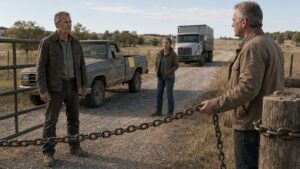
Benjamin Carter saw the orange marker before he saw Kathleen Hall’s truck.
It stood in the gravel like a warning, a waist-high fiberglass stake planted where the turnout widened beside his cattle gate. Ten yards beyond it, Kathleen’s pickup sat sideways across the broadest part of the entrance.
Benjamin eased off the accelerator.
Behind him, twelve steers shifted inside the livestock trailer. Their weight rolled against the suspension, metal rattling sharply in the quiet morning. He had been hauling cattle through that entrance for more than twenty years.
Kathleen stepped from beside her truck holding a clipboard.
Benjamin lowered his window.
“You’ll have to turn around,” she said.
He looked past her toward the gravel lane.
“Road washed out?”
“No.”
“Tree down?”
“No.”
She walked closer and held up a sheet inside a clear plastic sleeve.
“The association adopted the heavy-vehicle rule Friday. No livestock trailers, feed trucks, or equipment over the new weight limit through the common turnout without prior approval.”
Benjamin looked at the cattle behind him, then back at her.
“I’m taking them to the south pasture.”
“You can use your other entrance.”
“My other entrance won’t take this trailer.”
Kathleen’s expression barely changed. “Then you’ll need to make other arrangements.”
A truck passed on the county road behind him and slowed as the driver noticed the blocked trailer. Benjamin felt the attention more than he saw it.
He had known Kathleen since before she became president of the road association. She was not foolish. She kept records, remembered deadlines, and could tell you exactly which culvert had been replaced in which year.
That was partly why he did not understand what she was doing.
“You’re telling me I can’t cross my own farm entrance?”
“I’m telling you the turnout is maintained by the association and subject to association rules.”
Benjamin looked down at the gravel.
Recent crushed stone covered most of the surface. The widened fan of the turnout had grown gradually over the years as longer trailers and larger delivery trucks became common. It looked almost like part of the private road now.
Almost.
Kathleen handed him the notice.
He read enough to understand the immediate problem. Heavy traffic had been blamed for rutting, shoulder damage, and rising maintenance costs. Until permits were issued, oversized agricultural vehicles were to use designated alternate access points.
His farm was listed.
“You know that north gate drops straight into the ditch,” he said.
“It’s still an entrance.”
“Not for thirty feet of trailer.”
“The board considered that.”
Benjamin folded the notice once.
“You drove out there?”
Kathleen hesitated.
“We reviewed the access map.”
That answer irritated him more than if she had simply said no.
Emily came walking from the barn, gloves tucked into the back pocket of her jeans. She took in Kathleen’s truck, the cattle trailer and her father still sitting behind the wheel.
“What happened?”
Kathleen answered before Benjamin could.
“Your father needs to use the north entrance.”
Emily looked at her.
“With that trailer?”
“It’s the approved route.”
Emily gave a short laugh without amusement. “Then whoever approved it has never turned a trailer.”
“Emily,” Benjamin said.
She looked at him, recognizing the warning in his tone.
Kathleen tapped the clipboard against her leg.
“The rule applies to everyone.”
Benjamin opened his door and stepped down.
The steers shifted again. He could smell dust, cattle and the faint heat already rising off the trailer deck.
“Show me the map.”
Kathleen turned the clipboard around.
The association map was simple: county road, private lane, property lines, access points. The widened turnout was shaded as part of the road corridor.
Benjamin stared at the curved boundary line.
Something was wrong.
He could not immediately say what.
But he remembered standing beside his father forty years earlier while an old grader cut the original lane. Back then the road had entered almost straight between two fence posts. The broad swing of gravel where Kathleen’s truck now stood had not existed.
On her map, the road corridor swallowed that whole area.
“When was this redrawn?”
“It’s the map we use.”
“That wasn’t what I asked.”
Kathleen’s mouth tightened. “Benjamin, I’m not arguing property history beside a cattle trailer. The rule is in effect.”
He handed the clipboard back.
“Are you sure that whole turnout belongs to the association?”
For the first time, she looked genuinely annoyed.
“It’s been maintained by the association for years.”
“That isn’t the same question.”
“It’s the association turnout.”
Benjamin glanced toward the orange marker. Someone had planted it several feet inside the gravel fan.
He had a sudden memory of an old cedar fence line running near that spot.
Kathleen opened her truck door.
“If you block traffic any longer, I’ll have to document that too.”
Emily stepped forward, but Benjamin lifted one hand.
He climbed back into the pickup.
Reversing a loaded livestock trailer onto a county road was exactly the kind of thing the new rules supposedly wanted to prevent. Emily stopped traffic while he backed slowly toward the farmyard, then guided the trailer through a wide circle near the barn.
Once the cattle were unloaded temporarily, Emily slammed the trailer gate harder than necessary.
“You’re going to let her do that?”
“I turned around. That isn’t the same as letting her do anything.”
“She embarrassed you in front of half the road.”
Benjamin unhooked the safety chain.
“That’s not what matters.”
“It should matter a little.”
He looked toward the entrance. Kathleen’s pickup was gone, but the orange stake remained.
Years earlier, association letters had arrived about gravel assessments, drainage repairs, vegetation trimming and revised traffic rules. Benjamin had skimmed most of them. If a bill seemed reasonable, he paid it. If a map came attached, he put it in a drawer.
His father had always said neighbors survived by not turning every disagreement into a boundary fight.
Benjamin had lived by that longer than he cared to admit.
Inside the farmhouse, he went to the small desk near the kitchen window and opened the bottom drawer.
Receipts. Tax statements. Seed invoices.
Underneath them sat an old manila envelope.
Benjamin pulled it free.
Inside was a folded road plat, yellowed at the creases and marked in his father’s pencil.
He spread it across the desk.
The original lane was narrow.
And the boundary line ran straight through the middle of what Kathleen Hall now called the association turnout.
Chapter 2: The Old Plat Shows a Narrower Road
Benjamin laid Kathleen’s map beside his father’s plat and knew within thirty seconds that both could not be right.
The newer map showed a broad road corridor sweeping into the Carter entrance like the mouth of a funnel.
The older plat showed twelve feet of access.
Nothing more.
Emily stood across the kitchen table with her coffee untouched.
“How old is that?”
Benjamin read the survey date.
“Older than you.”
“That helpful, huh?”
He traced the faded line with one finger.
The document showed the county road, the Carter parcel, the neighboring parcels and a private access easement crossing the edge of the farm. The dimensions were difficult to read where the paper had worn thin, but the geometry was unmistakable.
The historical lane did not include the modern turnout.
Emily leaned closer.
“So Kathleen’s map is wrong.”
“Maybe.”
“It either matches or it doesn’t.”
“Maps get amended. Easements get changed.”
“Did you sign anything?”
“No.”
“Granddad?”
Benjamin looked at the pencil notes along one corner.
“That’s what I need to find out.”
By early afternoon he was standing at the county records counter beneath fluorescent lights, waiting while the recorder searched an index on an aging computer.
Benjamin had brought the old plat, Kathleen’s notice and the parcel number from his tax statement.
The recorder rotated the screen slightly.
“Here’s the original access easement.”
Benjamin leaned toward it.
The legal description matched the narrow corridor on his father’s plat.
“Twelve feet?”
“Looks like it.”
“And amendments?”
The recorder searched.
One instrument corrected a spelling error. Another transferred an adjoining parcel. A later filing addressed drainage maintenance.
Nothing obviously widened the easement.
Benjamin felt the first clean satisfaction he had experienced since Kathleen blocked the trailer.
“So there’s no expanded right-of-way.”
The recorder looked at him over her glasses.
“I said I’m not seeing one in this index.”
The distinction landed.
“You’re saying there could be something elsewhere.”
“There can always be something elsewhere. Old records get referenced under grantors, parcels, road names. If you’re planning to make a legal decision, don’t build it on five minutes at this counter.”
Benjamin nodded.
That was the kind of answer he trusted.
She retrieved the physical file for the old easement.
Inside were copies of the original instrument, a hand-drawn sketch and correspondence regarding drainage. The easement granted access over a narrow strip along the Carter property. Maintenance responsibilities were shared among several landowners.
There was no language Benjamin could find giving the association ownership.
But farther back in the file, a reference caught his attention.
Road stabilization—emergency widening.
The document itself was not there. Only an index notation from years later.
Benjamin copied the reference number.
“Can we pull this?”
The recorder tried.
“That one’s in an older maintenance archive.”
“How long?”
“Depends whether the box was transferred correctly.”
Benjamin sat at a wooden table while she disappeared through a secured door.
He thought about Kathleen standing beside his cattle trailer.
It would have been easy, satisfying even, to call her immediately and tell her that the records showed she had been enforcing rules over ground that might not belong to the association.
He took out his phone.
Then put it away.
He had spent most of his life believing that restraint prevented trouble.
That habit had advantages. He had avoided feuds that lasted generations over fences, irrigation ditches and cattle that wandered through a broken gate.
But there was another side to it.
People filled silence with assumptions.
Sometimes they built rules on top of those assumptions.
The recorder returned carrying a thin folder.
“This may be what you’re after.”
Inside was a maintenance summary written after severe flooding had damaged part of the private road decades earlier. Trucks had needed room to turn while culverts were replaced. Gravel had been placed beyond the original lane.
Benjamin read the paragraph twice.
Temporary widening authorized by adjoining landowner.
His satisfaction faded.
“Does it say temporary use or temporary construction?”
The recorder leaned over.
“Just what you see.”
There was no attached agreement.
No dimensions.
No duration.
No deed reference.
Only a note that the adjoining landowner had authorized widening during emergency repairs.
Benjamin knew exactly who that landowner had been.
His father.
Emily was waiting when he returned home.
“Well?”
“The easement is narrow.”
She smiled immediately. “I knew it.”
“But there was widening after the flood.”
Her smile disappeared.
“Legal widening?”
“I don’t know.”
“Did Granddad sign something?”
“I don’t know that either.”
Benjamin set copies of the records on the table.
Emily read the maintenance notation.
“That doesn’t give them the land.”
“No.”
“So tell Kathleen.”
“Not yet.”
She pushed the paper away.
“This is what you always do.”
Benjamin looked up.
“What?”
“You wait until everybody else decides what you meant.”
“That’s not what I’m doing.”
“You ignored those association maps for years.”
“They were maintenance notices.”
“They had maps attached.”
Benjamin did not answer.
Emily folded her arms.
“You didn’t want to argue, so you let somebody else draw the line.”
The words were sharper than he wanted, mostly because they were not entirely wrong.
That evening Benjamin called a licensed surveyor and gave him both descriptions: the original recorded easement and the modern gravel turnout.
The surveyor asked for copies before committing to anything.
Benjamin emailed them.
Twenty minutes later, the phone rang.
“I can be there Wednesday morning,” the surveyor said. “But understand something. I can show you boundaries and recorded easement geometry. I can’t tell you what some old permission means legally.”
“That’s fine.”
“You sure?”
Benjamin looked through the kitchen window toward the widened crossing.
“No,” he said. “That’s why I want the line marked first.”
Chapter 3: Orange Flags Across the Turnout
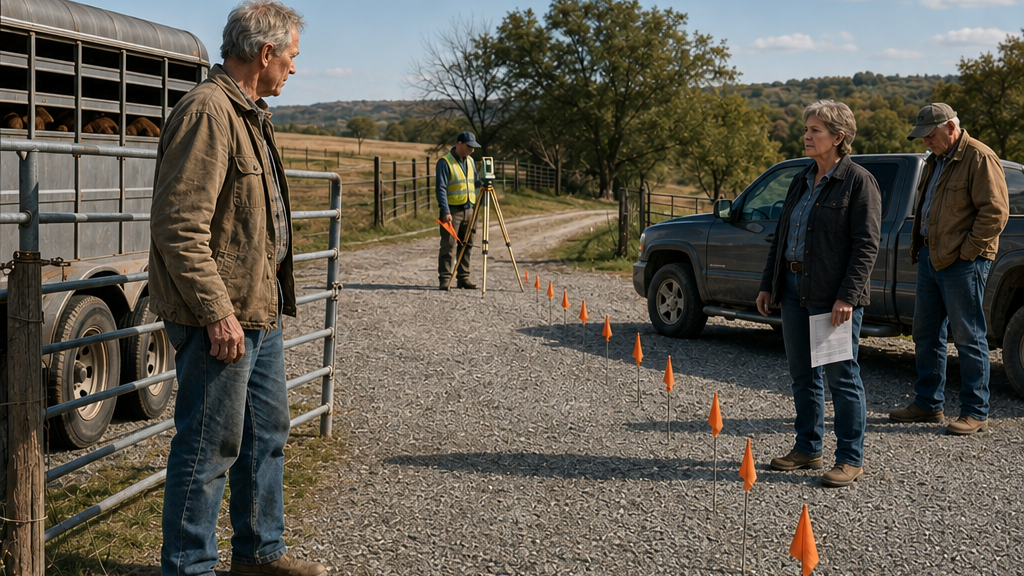
The surveyor’s first orange flag went into the gravel four feet beyond Kathleen Hall’s front tire.
She stared at it.
“That can’t be right.”
The surveyor checked the instrument mounted on his tripod and did not answer immediately.
Benjamin stood near the cattle gate with his hands in his jacket pockets.
Kathleen had arrived ten minutes after the survey crew, her association pickup carrying the same clipboard she had used Monday. Ronald Baker came behind her in his farm truck.
Kathleen pointed toward the flag.
“You’re inside the association turnout.”
The surveyor finally looked up.
“I’m marking the deed boundary and the recorded easement based on the instruments I was provided.”
“This road has been here for decades.”
“I’m not determining how long the gravel has been here.”
He moved farther down the turnout.
The next orange flag went into the shoulder.
The third landed almost in the middle of the broad turning sweep.
By the fifth, a bright diagonal line crossed the gravel from Benjamin’s fence side toward the private lane.
Ronald took off his cap.
“Well.”
Kathleen turned on him. “Don’t start.”
“I didn’t say anything.”
“You were about to.”
Benjamin walked toward the surveyor.
“Where does the recorded easement end?”
The surveyor pointed with the tip of his marking pole.
“Based on the description, about here. The original corridor stays much narrower than the present gravel.”
Kathleen looked from the flags to Benjamin.
“You arranged this without notifying the association.”
“It’s my parcel being surveyed.”
“You’re surveying an association road.”
Benjamin glanced at the orange line.
“That seems to be the question.”
Her cheeks colored.
“We’ve maintained this turnout since before I was president.”
“I’m not arguing that.”
“We paid for gravel.”
“I know.”
“We repaired the drainage.”
“I know that too.”
“Then what exactly are you trying to prove?”
Benjamin could feel Emily watching from near the barn.
He chose his words carefully.
“I’m trying to find out whether you had the right to block me from ground you may not control.”
Kathleen tightened her grip on the clipboard.
“You’re turning a traffic rule into a property dispute.”
“No. The traffic rule did that Monday.”
The surveyor continued working.
A pickup slowed on the county road. Then another.
Benjamin disliked the spectacle. He had not asked anyone to watch, yet the line of orange flags made the dispute impossible to hide.
For years the turnout had looked like one continuous piece of road.
Now the flags sliced it into two different things.
Ronald walked the line slowly.
“If this is accurate,” he said, “a feed truck couldn’t make that swing without crossing Carter ground.”
Kathleen answered quickly.
“Long use matters.”
“Maybe,” Ronald said.
“You were on the board when we approved the gravel.”
“I remember.”
“So you know.”
Ronald rubbed the back of his neck.
“I know we treated it like ours.”
Kathleen looked at Benjamin.
“There. That’s what everyone has always understood.”
Benjamin did not respond.
The distinction between ownership and understanding had already caused enough trouble.
The surveyor placed another flag near the ditch.
Then he called Benjamin over.
“This corner is useful.”
He showed Benjamin the old monument point referenced in the deed. Most of it was buried, but the surveyor had located the position from the recorded calls.
The line from that point matched Benjamin’s father’s old plat almost exactly.
Benjamin felt a hard little click of vindication.
The old map had not been sentimental memory.
The land really did run where his father had drawn it.
Kathleen saw something in his expression.
“What?”
Benjamin pointed.
“The plat matches.”
She stared at the line.
For the first time since Monday, she had no immediate answer.
Emily came closer.
“So the association blocked Dad from using his own land.”
Kathleen turned toward her.
“That has not been established.”
“The surveyor just—”
“Emily,” Benjamin said.
She stopped.
He looked at Kathleen.
“The survey establishes where the recorded line is. That’s enough for today.”
Kathleen laughed once, sharply.
“You think you can close this?”
“I haven’t said that.”
“You’re thinking it.”
Benjamin was.
For three days, he had imagined removing the association marker, parking his own equipment across the disputed gravel and telling Kathleen to use somebody else’s entrance.
The image had felt increasingly reasonable.
Now that the flags were actually in the ground, it felt different.
Because Ronald was staring at them too.
So was the feed-truck driver who had slowed on the county road.
The widened strip might belong to Benjamin. But other people had built their routines around it.
Ronald suddenly walked back toward his truck.
“I’ve got something.”
Kathleen frowned. “What?”
“Old road file.”
He opened the rear door and pulled out a battered accordion folder.
“I brought it because I remembered the flood work.”
Benjamin’s satisfaction cooled.
Ronald placed the folder on the hood.
Inside were old invoices, culvert receipts, handwritten board notes and faded photographs of a washed-out lane.
He found a single sheet tucked behind a gravel invoice.
“That’s it.”
Benjamin took it.
The top described emergency access repairs after flooding. The lower half contained a short handwritten note giving permission to widen the turn temporarily so dump trucks and equipment could get through.
Emily leaned over his shoulder.
“Temporarily.”
Kathleen pointed at the note.
“Permission.”
Benjamin barely heard either of them.
He knew the handwriting.
His father’s capital C always leaned backward. The lowercase r hooked beneath the line.
Benjamin read the final sentence.
Use what ground you need for repairs. We can fix papers later.
For several seconds nobody spoke.
Ronald shifted his weight.
“I remembered him telling us not to hold up the repair crew.”
Kathleen’s confidence returned by degrees.
“So this wasn’t some secret taking of land.”
“I never said it was.”
“You were letting everyone believe we had no permission.”
Benjamin looked at her.
“I found this thirty seconds ago.”
She looked away.
The surveyor continued collecting measurements behind them, his equipment giving a faint electronic chirp.
Emily tapped the page.
“It still says later.”
Benjamin nodded.
There was no later agreement attached.
No revised easement.
No deed.
But the moral ground under his feet had changed.
His father had allowed the widening.
Neighbors had relied on it.
Benjamin himself had used it for decades without asking how temporary permission had become permanent practice.
He folded the paper along an old crease.
Kathleen watched him.
“So what now?”
Benjamin looked across the orange flags.
On Monday they had felt like something imposed on him.
This morning, for a few satisfying minutes, they had felt like proof that Kathleen was wrong.
Now they looked neutral.
A line did not decide what a man ought to do with it.
“I’m going to read this properly,” Benjamin said.
Kathleen started to answer, but he had already noticed a second pencil mark near the bottom of the page.
Three words, written smaller than the rest.
His father’s handwriting again.
Fix papers later.
Chapter 4: The Permission His Father Never Finished
“Fix papers later.”
Benjamin read the three words again under the yellow light above the equipment-shed bench.
The old repair note lay beside his father’s plat, held flat by a pair of steel wrenches. In daylight the pencil marks had looked faint. Under the lamp, they seemed darker, almost recent.
Emily stood on the other side of the bench.
“So he knew paperwork was missing.”
“He knew something needed finishing.”
“That’s what I said.”
Benjamin folded his arms.
“No. You said it proves the association has no rights. It doesn’t prove that.”
“It proves Granddad didn’t give them permanent use.”
“It proves he wrote three words.”
Emily stared at him.
“You’re doing it again.”
Benjamin knew exactly what she meant, which made him dislike the accusation more.
Outside, cattle bumped against a feeder. The sound carried through the metal wall.
“What would you like me to do?” he asked.
“Tell Kathleen the restriction is invalid. Tell the board the turnout is on our land. Tell them they don’t get to make rules for us until they prove they have the authority.”
“And if Dad told Ronald and the others they could keep using it?”
“Then they can show us.”
Benjamin looked down at the note.
His father had been a practical man. When the flood tore out the culvert, he would have cared first about getting trucks moving again. A formal easement could wait. Neighbors were neighbors.
Benjamin had inherited the same instinct.
That was the part troubling him.
By Thursday morning he had spread every road notice he could find across the farmhouse table.
Emily brought in another stack from the filing cabinet.
“Here.”
Benjamin recognized association envelopes he had opened and barely read.
One contained a revised road-maintenance diagram from six years earlier.
The modern turnout was shaded as association-maintained road.
Another from four years earlier showed the same.
A third announced heavier gravel placement and asked members to report access concerns.
Emily tapped it.
“You got this.”
“I see that.”
“And did nothing.”
“I paid the assessment.”
“That’s not what I mean.”
Benjamin rubbed a thumb across the paper edge.
He remembered thinking the map was approximate. He remembered deciding that correcting it would start an argument over a road everyone used anyway.
“I should’ve questioned it,” he said.
Emily stopped sorting.
It was not the answer she had expected.
Benjamin gathered the maps into one stack.
“I saw the drawings. I knew they were loose. I decided it wasn’t worth fighting over.”
“And now Kathleen thinks it belongs to them.”
“Maybe because nobody told her otherwise.”
“That doesn’t make what she did right.”
“No.”
He looked toward the lane.
“But it means this didn’t start Monday.”
That afternoon Benjamin drove to the association office with copies of the plat, survey preliminary, and repair note.
Kathleen was not there.
A board member accepted the envelope and said she would see that it reached her.
Benjamin wrote his phone number on the outside.
“Tell her I want the heavy-vehicle restriction paused until we sort the boundary.”
The board member nodded carefully.
Benjamin left without argument.
At four-thirty, Emily came into the barn carrying an envelope.
“This was taped to the gate.”
Benjamin opened it.
The new notice was broader than the first.
Pending review, agricultural vehicles exceeding the stated weight could not use any association-maintained portion of the road system adjacent to the Carter property without authorization.
Emily read over his shoulder.
“She didn’t even wait to look at what you brought.”
Benjamin checked his phone.
No missed call.
“She widened the restriction.”
“Exactly.”
Emily took the paper from him.
“She’s daring you.”
Benjamin walked toward the farm entrance.
The survey flags were still in place. Their orange tops moved slightly in the breeze, cutting across gravel everyone had treated as one road for years.
He imagined chaining off the disputed strip.
He could do it before dark.
Kathleen would discover in the morning that the association’s neat map meant very little if its vehicles could not physically make the turn.
The thought gave him a brief, sharp satisfaction.
Then he pictured Ronald’s hay trailer.
The feed truck.
An ambulance trying to swing wide on a wet night.
His father’s note had not said, Never let them use it.
It had said, Fix papers later.
Benjamin had inherited the unfinished part.
Emily came up beside him.
“If you don’t push back now, she’ll keep doing this.”
“I’m pushing back.”
“How?”
He looked at the flags.
“Properly.”
“That sounds like another way to wait.”
Benjamin turned to her.
“For years, maybe it was.”
Emily went still.
He continued before he could lose the nerve.
“I should’ve corrected those maps when they first came. I didn’t. I thought staying out of arguments was the same as keeping peace.”
She said nothing.
“It wasn’t.”
The admission felt heavier than he expected.
Benjamin took the new restriction notice from her.
“But I’m not fixing one bad assumption by making another one. I need to know what I can close, what I shouldn’t close, and what everybody actually owes.”
Emily looked toward the turnout.
“So what happens tomorrow?”
Benjamin folded Kathleen’s notice and put it in his shirt pocket.
“Tomorrow I ask where the money went.”
Chapter 5: The Road Fee Nobody Could Explain
The invoice said Benjamin Carter owed money for maintaining the turnout that the survey now placed mostly on Benjamin Carter’s land.
He read the line twice.
Then he slid the paper across the association meeting table.
“What exactly was I paying for?”
No one answered immediately.
Kathleen sat at the far end with Ronald and two other board members. The association attorney had joined by speakerphone.
Beyond the room’s narrow windows, several orange survey flags were visible at the edge of the gravel.
Kathleen picked up the invoice.
“Road maintenance.”
“That’s not what I asked.”
“The association grades the lane, replaces gravel and maintains drainage.”
Benjamin nodded.
“I know what work gets done. I’m asking what right the association believed it was maintaining.”
Kathleen set the invoice down.
“The road has been treated as common access for decades.”
“Treated by who?”
“All of us.”
Benjamin looked around the table.
“That’s practice. I’m asking for the document.”
Ronald shifted in his chair.
Kathleen’s voice hardened.
“You’ve benefited from every load of gravel placed there.”
“I have.”
“You’ve used that turnout more heavily than most of the members.”
“Probably.”
“So acting like the association simply took something from you is misleading.”
“I’m not acting like that.”
Benjamin tapped the invoice.
“I’m asking why I was assessed to maintain land that your own rules now say I can’t use.”
The room went quiet.
That was the contradiction no one could smooth over.
The attorney’s voice came through the speaker.
“I want to separate two issues. Maintenance participation does not automatically establish ownership. It may be relevant to access rights or reliance, but those are different questions.”
Kathleen glanced at the phone.
“We have decades of continuous use.”
“Understood.”
“And permission.”
“Apparently some permission during emergency repairs.”
Kathleen’s jaw tightened.
“From his father.”
“Yes. But the documents I’ve reviewed do not show a recorded expansion of the original easement.”
Benjamin watched the change around the table.
No one celebrated.
No one looked defeated.
They looked worried.
That felt more serious.
One board member asked, “What does that mean for the restriction?”
The attorney paused.
“It means I would advise against enforcing a categorical exclusion over the disputed portion until the boundary and access rights are resolved.”
Kathleen leaned forward.
“Then how are we supposed to control damage? We spent nearly twice the normal amount on gravel last year.”
Ronald looked down.
Benjamin noticed.
“What?”
Ronald rubbed his palms together.
“Nothing.”
“You’ve been wanting to say something since Wednesday.”
Kathleen gave him a warning look.
Ronald saw it and sighed.
“We pushed her.”
Kathleen’s head turned.
“Ronald.”
“No point pretending now.”
Benjamin waited.
Ronald looked at him.
“Last spring, after the repair bill came in, the board got complaints. Folks wanted to know why dues kept climbing. Heavy trucks were blamed. Feed trucks, stock trailers, equipment.”
“That still doesn’t explain Monday.”
“We told Kathleen she needed to enforce the rules harder.”
Kathleen sat rigidly.
Ronald continued.
“Some of us made it sound like she’d been too soft. Said if she couldn’t control traffic, somebody else should handle the chair.”
The admission changed the room more than any deed had.
Benjamin looked at Kathleen.
She did not look embarrassed.
She looked tired.
“I still made the decision,” she said.
Ronald nodded. “You did.”
Kathleen turned to Benjamin.
“The road was deteriorating. Members were angry. Your farm runs some of the heaviest equipment through that entrance.”
“My farm also pays assessments.”
“Yes.”
“And instead of checking the boundary, you blocked me.”
“I relied on the association map.”
“After I specifically asked whether the turnout was yours.”
Kathleen’s face tightened.
That was where explanation stopped helping her.
The attorney spoke again.
“Whatever the pressure was, continuing the restriction now that ownership is disputed creates unnecessary risk.”
A board member asked, “What about back maintenance?”
“What about it?” Benjamin said.
The member gestured toward the paperwork.
“If part of the turnout is his, but association money improved it, that matters too.”
Benjamin nodded.
“It does.”
Kathleen looked surprised.
“You agree?”
“Of course I agree.”
Emily, sitting against the wall, shifted slightly but remained silent.
Benjamin continued.
“If you put gravel on my ground and I used it, I’m not pretending I got no benefit. But benefit doesn’t make your map accurate, and paying your invoice doesn’t give you the right to lock me out.”
The attorney asked for the association’s maintenance records to be audited against the surveyed area.
Benjamin felt his anger settle into something more useful.
Kathleen had been wrong.
But the board had built the pressure behind her, the association had spent real money, and Benjamin had watched inaccurate maps arrive for years without saying a word.
No single person owned the whole mistake.
That did not mean no one was responsible.
After the meeting, Ronald followed Benjamin into the parking area.
“You going to close it?”
Benjamin looked toward the road.
“Part of it.”
Ronald stopped.
“You know what that does to the turn.”
“I do.”
“A long trailer won’t make it.”
“That’s the point.”
Ronald shook his head.
“You just said you didn’t want to hurt everybody.”
“I don’t.”
“Sounds like it.”
Benjamin opened his truck door, then stopped.
“I’m not closing the recorded easement. I’m closing the disputed widened strip temporarily. Association can use what it can prove it has.”
“And the rest of us?”
Benjamin looked at him.
“That’s why I’m giving notice before I do it.”
Ronald stared at him for a moment.
“You’ve changed.”
“No.”
Benjamin glanced back at the building where Kathleen remained inside.
“I waited too long to say what I meant.”
By sunset, he had placed temporary barriers along the surveyed edge of the widened strip, leaving the narrow recorded corridor open.
The orange flags remained exactly where the surveyor had planted them.
Tomorrow, everyone would learn whether the old road was still enough.
Chapter 6: When the Feed Truck Could Not Turn
The feed truck made it halfway into the old easement before its rear wheels reached the ditch.
The driver stopped.
Benjamin stood beside the temporary barrier and watched the truck idle at an angle across the entrance.
The recorded lane was open.
Technically.
Practically, it was almost useless to a vehicle that size.
The driver leaned out the window.
“I can back out if you stop traffic.”
Benjamin looked at the long body of the truck, then at the orange flags marking the disputed gravel only a few feet away.
“How much room do you need?”
“About ten feet more than you’ve given me.”
Emily stood by the gate with her arms crossed.
“That’s their problem.”
Benjamin looked at her.
“It’s our feed.”
“Today. Next week it’ll be somebody else’s truck.”
The driver waited.
Across the county road, Ronald had pulled over in his pickup.
Benjamin could feel the entire argument changing shape.
On Friday, the barriers had felt precise.
He had closed only what the survey said was disputed. He had left the documented corridor untouched.
Now a working truck sat crooked between his legal correctness and a drainage ditch.
Ronald crossed the road.
“Told you.”
Benjamin ignored the satisfaction in his voice.
“How many places rely on this turn?”
Ronald shrugged.
“Mine. Yours. The place farther east when they bring hay in. Equipment haulers sometimes.”
“That many?”
“Road got wider, trucks got longer. Nobody thought much about it.”
That was the problem in one sentence.
Nobody thought much about it.
Benjamin walked to the barrier.
Emily stepped in front of him.
“Dad.”
“I’m moving it.”
“Then this was pointless.”
“No.”
“Yes, it was. You finally had leverage for one day.”
Benjamin looked at her.
“I still have the survey.”
“They’ll drag negotiations out forever if you keep making it easy.”
“Maybe.”
“And Kathleen gets exactly what she wants.”
Benjamin shook his head.
“No. Kathleen wanted authority without having to ask.”
He lifted one end of the barrier.
“What I’m giving the driver is permission.”
The distinction sounded small until he said it aloud.
Emily watched him drag the barrier back far enough for the truck to swing across the disputed gravel.
He did not pull a single orange flag.
The feed truck eased forward.
Its rear wheels cleared the ditch by less than two feet.
The driver raised one hand in thanks and continued toward the farm.
Ronald studied Benjamin.
“So everybody gets through again?”
“Not automatically.”
Ronald frowned.
“Then what are you doing?”
“Temporary access. Necessary farm deliveries. One at a time if I have to.”
“You planning to stand here all weekend?”
“If that’s what it takes.”
Emily stared at him.
“You’re making this harder on yourself.”
“I know.”
“Why?”
Benjamin looked down the lane where the feed truck disappeared behind the hay field.
“Because being right about the line doesn’t make every consequence right.”
For the rest of the morning he moved the barrier three times.
A hay trailer came through.
Then a utility vehicle.
Then Ronald himself, pulling a loaded trailer that needed nearly the full widened arc.
Each time Benjamin opened the disputed strip deliberately and closed it again afterward.
By noon his back ached.
The flags that had looked like victory on Wednesday now seemed to measure something less comfortable: how many people had quietly built their lives around a promise never properly finished.
Emily brought him water.
“You could leave it open.”
“I could.”
“Then why don’t you?”
“Because open without terms is how we got here.”
She handed him the bottle.
“That sounds like something Granddad would hate.”
Benjamin smiled faintly.
“Probably.”
“He’d say shake hands and get back to work.”
“He did.”
“And?”
Benjamin twisted the cap loose.
“And then he wrote ‘fix papers later.’”
Emily looked toward the flags.
For once, she had no quick answer.
Benjamin drank.
“I spent years thinking Dad kept peace because he never pushed things. Maybe sometimes he just postponed them.”
Emily sat on the lowered tailgate of the pickup.
“And you did the same.”
“Yes.”
The word came easier now.
He capped the bottle.
“I’m not doing it again.”
A pickup appeared on the county road.
Benjamin recognized Kathleen’s before it turned in.
He expected the clipboard.
There was none.
She parked before the barrier and got out carrying only her keys.
Emily stood.
Ronald, who had been checking a trailer light nearby, stopped what he was doing.
Kathleen looked at the orange flags first.
Then at the barrier.
Then at Benjamin.
“I heard you were letting trucks through.”
“Necessary ones.”
“On your permission.”
“For now.”
She nodded slowly.
No argument.
No citation.
No rule book.
Benjamin waited.
Kathleen glanced toward Emily and Ronald.
“Could I talk to you somewhere private?”
Emily’s eyebrows rose.
Benjamin studied Kathleen’s face.
The hard certainty from Monday was gone, but he could not tell what had replaced it.
Regret, maybe.
Or another strategy.
He opened the equipment-shed door.
“Inside.”
Kathleen followed him toward it without reaching for a clipboard that was no longer there.
Chapter 7: The Agreement That Should Have Existed Years Ago
Kathleen placed the original restriction notice on Benjamin’s equipment-shed table and pushed it toward him.
The paper had been folded twice. One corner was bent where Benjamin had carried it in his shirt pocket on Monday.
“I’m withdrawing it,” she said.
Benjamin did not touch the notice.
Across the table sat Ronald, the association attorney, and one other board member. Emily stood near the open shed door. Beyond her shoulder, the orange survey flags still divided the gravel turnout.
Kathleen followed Benjamin’s eyes.
“I’m withdrawing the broader restriction too.”
“That settles the citations,” Benjamin said. “Not the road.”
“I know.”
Her answer came without the defensive edge he expected.
The attorney opened a folder.
“We have a proposed agreement.”
Benjamin sat down.
The document allowed continued use of the widened portion of the Carter parcel for farm and residential access, defined maximum widths for routine traffic, assigned responsibility for grading and drainage, and required notice before major construction equipment used the turn.
It also included an annual payment from the association to Benjamin for the expanded access.
Benjamin read slowly.
Emily moved behind him.
“What about the past years?” she asked.
The attorney looked at Benjamin rather than her.
“We can discuss reimbursement separately.”
“And the assessments Dad paid?”
“Those will be audited.”
Benjamin turned a page.
The language was careful.
Too careful in one place.
The association would pay him a lump sum in exchange for acknowledgment of its continued historical right to use the widened turnout.
Benjamin tapped the paragraph.
“Take this out.”
Kathleen leaned closer.
“What part?”
“Historical right.”
The attorney said, “That language helps settle any uncertainty about prior use.”
“It creates new uncertainty.”
“It resolves it.”
“No. It pays me to pretend the question was already settled.”
The room went still.
Kathleen looked at him.
“The money is not insignificant.”
“I didn’t ask how much.”
Emily glanced at him, surprised.
The attorney folded his hands.
“What would you prefer?”
“A recorded easement that starts when we sign it.”
“That leaves prior use unresolved.”
“Yes.”
Kathleen exhaled through her nose.
“So after all this, you want to preserve the argument?”
“No. I want to stop pretending old habits were legal documents.”
He pushed the proposal back.
“If you want access from now on, we write exactly what you have from now on.”
The attorney studied him for a moment.
“That is workable.”
Kathleen looked less certain.
“What about what we spent maintaining it?”
“We audit that too.”
“And what you benefited from?”
“We count that.”
Emily shifted.
Benjamin could feel her objection before she said anything.
“So we might owe them?”
Benjamin looked at her.
“We might owe our share of work that helped our farm.”
Kathleen said quietly, “That’s more than I expected you to say.”
Benjamin leaned back.
“Doesn’t make the restriction right.”
“No.”
Something in the way she said it changed the room.
Not surrender.
Acceptance.
Ronald rubbed his palms on his jeans.
“Well. That’s more progress than we made all week.”
The attorney began marking revisions.
For nearly an hour they worked through practical details.
The easement would follow the surveyed geometry instead of the association’s old map. Routine maintenance would be shared according to use. Heavy construction traffic would require advance coordination, not permission from one person. Emergency vehicles would have unrestricted access. Neither side could block the widened area without defined safety or repair reasons.
Benjamin insisted that no single association officer could suspend a member’s access without board review except for an immediate hazard.
Kathleen objected.
“What if someone tears up the road?”
“Then document it.”
“That can take time.”
“So can replacing cattle that miss a scheduled haul.”
She looked at him.
“That’s what this has been about for you?”
“It started there.”
Kathleen sat back.
For the first time, Benjamin wondered what Monday had looked like from her side.
Not the blocking itself. That remained wrong.
But everything before it.
The repair bills.
Complaints.
Board members telling her she was too weak.
Members demanding lower dues while wanting a perfectly maintained road.
“I should have checked your deed,” she said.
No one interrupted.
Kathleen looked toward the open door.
“When you asked whether the turnout belonged to us, I already had people telling me every rule I made was being challenged.”
Benjamin waited.
“I thought if I stopped and said I wasn’t sure, the whole board would decide I couldn’t handle the job.”
Ronald looked down.
Kathleen continued.
“So I answered like I was sure.”
“That was the problem,” Benjamin said.
“I know.”
Her voice tightened slightly.
“I’m not asking you to tell me it wasn’t.”
Benjamin nodded once.
That was enough.
By late afternoon the attorney had a revised framework.
Before anyone signed, he pointed to one final section.
“Maintenance participation.”
Benjamin read it.
Because the Carter farm benefited substantially from the widened turn, Benjamin would remain responsible for a defined share of ordinary gravel and drainage costs.
Emily frowned.
“They restricted us and we still pay?”
Benjamin looked through the door at the gravel.
His livestock trailers used the widest arc.
His feed deliveries did too.
“Fair is fair.”
Emily crossed her arms.
“You always say that when fair costs us money.”
“That’s when it counts.”
Kathleen almost smiled.
Almost.
The agreement was not signed that afternoon. The attorney still needed the survey description formatted for recording, and the association needed a formal vote.
But the argument over whether an agreement was needed had ended.
As everyone gathered their papers, Kathleen picked up the old restriction notice.
Then she stopped.
“This belongs to you.”
She laid it on the table again.
Benjamin folded it and placed it beside his father’s old plat.
A week earlier, one sheet had represented somebody else’s authority.
Now it looked small.
The attorney closed his folder.
“There is one matter we haven’t resolved.”
Benjamin knew which one.
“Past use.”
“Yes. If you wish to pursue compensation for the years the widened portion was used without a recorded grant, we need to address that before final settlement.”
Emily looked at her father.
Kathleen did too.
Benjamin stared through the open shed door at the orange flags moving along the edge of the road.
He had spent the week deciding where the line was.
Now he had to decide what it was worth.
Chapter 8: He Pulled the Last Orange Flag Himself
The first livestock trailer under the new agreement slowed at the Carter turnout, and Kathleen Hall stepped backward instead of raising a hand.
Benjamin noticed.
The driver swung wide across the gravel, crossed the newly recorded easement, and continued toward the eastern farms without stopping.
No one asked permission.
No one blocked the road.
The permanent boundary markers were small metal caps set flush near the edges, almost invisible unless someone knew where to look.
Only one orange survey flag remained.
Benjamin had left it there deliberately.
Three weeks had passed since the meeting in the equipment shed.
The final agreement had been recorded at the county office two days earlier.
The association received defined access over the widened strip. Benjamin retained ownership. Maintenance costs were divided by an agreed formula. Emergency access was protected. Heavy traffic rules now required documented reasons and board review instead of one person’s judgment.
The old association map had been withdrawn.
So had every restriction against the Carter farm.
The accounting review had taken longer.
Some gravel invoices clearly benefited Benjamin’s entrance.
Some drainage work benefited the entire private road.
Some charges could not be divided honestly after so many years.
The attorney had eventually presented Benjamin with two choices.
One was aggressive: calculate a market rate for years of unrecorded use, offset maintenance contributions, and negotiate from the largest defensible number.
The other was simple: reimburse Benjamin’s survey costs, direct legal expenses, and the portion of assessments that had clearly been charged to him for association control rather than shared maintenance.
Emily had wanted the first.
At least initially.
“They used our land,” she had said.
“They did.”
“They charged us while using it.”
“Some years.”
“And Kathleen blocked you from it.”
“Yes.”
“So why make it cheap?”
Benjamin had looked at the invoice totals spread across the kitchen table.
“Because I’m not selling anger by the year.”
Emily had gone quiet.
He did not forgive the restriction by refusing punitive back charges.
He did not erase Kathleen’s decision.
He simply could not make himself treat every year of ordinary neighbor use as theft when his father had invited that use and Benjamin himself had watched it continue without objection.
So he accepted reimbursement for the survey, legal work and clearly improper charges.
Nothing more.
Ronald called it generous.
Benjamin corrected him.
“Practical.”
Now, standing beside the turnout, he watched Kathleen speak with a board member near her truck.
She no longer carried the clipboard everywhere.
She was still association president.
That surprised some people.
Benjamin had not asked her to resign.
Ronald had not either.
The board had revised its procedures instead.
Kathleen had lost something harder to measure than a title: the assumption that certainty and authority were the same thing.
Benjamin understood that loss better than he expected.
Emily walked up beside him.
“You going to leave that flag forever?”
Benjamin looked at the last strip of orange plastic trembling above the gravel.
“Thinking about it.”
“That sounds sentimental.”
“You accusing me?”
“Yes.”
He smiled.
She nodded toward Kathleen.
“You two friends now?”
“No.”
“Enemies?”
“No.”
“That’s inconvenient.”
“Most neighbors are.”
Emily laughed.
The sound carried across the turnout.
Kathleen glanced their way but did not come over.
A feed truck approached from the county road.
It slowed, made the wide turn easily, and rolled past without anyone moving a barrier.
Benjamin watched its rear wheels cross the place where, weeks earlier, the old twelve-foot easement had forced the truck toward the ditch.
The road looked ordinary again.
That was what struck him.
After all the papers, meetings, arguments and measurements, nothing dramatic remained.
Gravel.
Fence.
Gate.
Truck tracks.
The important part was invisible now because it had finally been written down properly.
Emily crouched beside the remaining flag.
“What did Granddad actually mean, you think?”
Benjamin knew which words she meant.
Fix papers later.
“He probably meant exactly that.”
“And then didn’t.”
“No.”
“Why?”
Benjamin considered the question.
His father had trusted his neighbors.
That was true.
But Benjamin had begun to understand that trust had also given his father an excuse to postpone uncomfortable conversations.
“He figured decent people would work it out.”
Emily stood.
“Were they decent?”
Benjamin looked toward Kathleen.
She was listening while Ronald pointed toward a drainage culvert. No shouting. No clipboard. Just two people discussing who needed to call the grader.
“Mostly.”
Emily smiled faintly.
“That’s not much of an ending.”
“It’s usually the truth.”
Benjamin bent and pulled the orange flag from the gravel.
The metal stem came free with hardly any resistance.
For a moment he held it in his hand.
The flags had meant different things every time he looked at them.
First intrusion.
Then proof.
Then leverage.
Then inconvenience.
Finally, only a temporary way of showing people where something invisible had always been.
He carried the flag back toward the farmhouse.
Inside, the old road plat still lay on the desk.
Benjamin unfolded it one final time.
His father’s pencil marks crossed the yellowed paper. Near the bottom were the three words that had survived longer than the handshake behind them.
Fix papers later.
Benjamin placed the newly recorded survey beside it.
Clean lines. Dates. Bearings. Signatures.
Two versions of the same road.
One built on memory and trust.
One built because memory and trust had finally proven insufficient.
He did not throw the old plat away.
Instead, he folded it carefully along its worn creases and placed it in the drawer beneath the new survey.
Emily appeared at the kitchen doorway.
“Keeping both?”
Benjamin closed the drawer.
“Yes.”
“Why?”
He looked through the window toward the turnout.
A livestock trailer was disappearing down the lane. Kathleen’s truck followed farther behind, leaving enough room between them.
“Because one tells us where we came from.”
He rested his hand on the drawer.
“And the other keeps us from having to argue about it again.”
Outside, there were no orange flags left to tell anyone where the boundary stood.
They did not need them anymore.
The story has ended.