The Farmer Who Measured One Flooded Fence Line and Uncovered Why His Neighbor Needed the Land
Chapter 1: The Excavator Stopped Over an Old Iron Pin
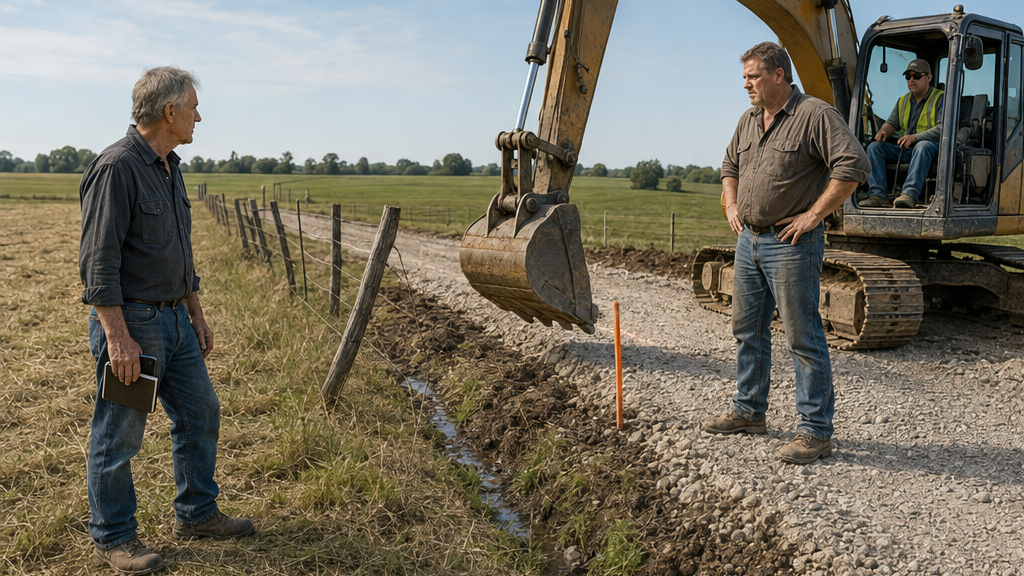
The excavator bucket was hanging six inches above Jonathan Carter’s orange stake when he walked into the lane.
The operator saw him first. His gloved hand froze on the control lever, and the bucket stopped with three steel teeth pointed toward the gravel.
Jonathan kept walking.
Fresh crushed rock covered what had been a grass shoulder two days earlier. Gregory Walker’s crew had widened the lane enough for a feed truck to pass beside the new cattle fence, and the excavator had peeled a shallow swale along the hayfield side. Pale subsoil lay exposed beneath the darker topsoil.
Gregory stood beside the machine with his hands on his hips.
“You put that stake there this morning?”
“Yesterday.”
“It’s in my lane.”
Jonathan looked at the stake, then at the nearest old fence post. “That’s the question.”
Gregory gave a short laugh. “The fence is the line.”
“The fence has leaned east for thirty years.”
“My father treated it as the line.”
“So did mine when neither one of them needed twelve-foot equipment through here.”
The operator looked from one man to the other.
Gregory stepped closer. He was eighteen years younger than Jonathan and broader through the shoulders, wearing clean work jeans and boots dusted gray by new gravel.
“I already had this shot,” Gregory said. “The lane stays where it is.”
Jonathan glanced past him.
The new grade ran straight toward the lower end of his hayfield. Several orange stakes marked Gregory’s proposed edge, but one of Jonathan’s stood almost in the center of the fresh gravel.
Jonathan had spent thirty-seven years designing farm drainage systems before cutting his consulting work down to a few jobs a year. He knew what people expected from a sixty-six-year-old farmer standing beside an excavator.
They expected an argument about memories.
He took a small field notebook from his shirt pocket.
Gregory’s expression changed slightly. “What’s that supposed to do?”
“Nothing by itself.”
Jonathan walked to the oldest corner post, crouched, and hooked the end of a measuring tape around its base.
Gregory followed.
“You want to measure all morning, measure. Kevin’s got another site after lunch.”
The operator was not Kevin. Jonathan knew that much. Kevin Adams owned the excavation company and had left one of his men running the machine while he picked up stone.
Jonathan pulled the tape taut.
The distance bothered him.
He measured again.
Then he stepped away from the fence and scraped the toe of his boot through the loose gravel.
A darker patch appeared beneath it.
Jonathan bent and pushed gravel aside with both hands.
Gregory sighed. “What are you looking for?”
“Something your blade went over.”
He found the top of it under three inches of crushed rock.
At first it looked like a rusted bolt. Jonathan cleared more stone until a narrow iron pin appeared, driven vertically into the ground.
Gregory stopped talking.
Jonathan brushed dirt from the metal.
He remembered seeing that pin when he was nineteen, long before anyone had widened the lane, when his father had made him hold the end of a chain while two men measured the parcel.
He had not trusted the memory enough to mention it.
Now he photographed the pin.
Gregory folded his arms. “That could be anything.”
“It could.”
Jonathan extended the tape from the pin to the corner post.
Then to a concrete culvert headwall farther north, a feature old enough to appear on the surveys he remembered.
He wrote both figures in his notebook.
He measured a second time.
The difference between the old fence and the iron pin was not inches.
It was several feet.
The new gravel ran even farther into Jonathan’s side.
Gregory looked at the numbers but pretended not to.
“You don’t know that pin controls anything.”
“No.”
“So we agree.”
“We agree I need the recorded plat.”
Gregory pointed toward the excavator. “Then get it. I’m not losing a workday over something buried in the dirt.”
Jonathan looked at the operator instead.
“You’ll want those measurements before you dig another foot.”
The operator shifted in his seat.
Gregory’s voice hardened. “He works for me.”
Jonathan capped his pen.
“I know.”
That calm answer seemed to irritate Gregory more than an argument would have.
“You’ve been farming behind that fence for years,” Gregory said. “Now suddenly I improve the lane and you discover five feet you can’t live without.”
“It isn’t five feet I’m worried about.”
“What, then?”
Jonathan looked down the new swale.
The machine had created a clean fall from Gregory’s pasture entrance toward the lower hayfield. The old ground had spread rainfall gradually along the grass shoulder. The new cut was narrower, deeper, and smooth enough to carry water.
He had noticed it immediately.
But he had been so focused on the boundary that he had not yet worked out what the grade would do in a hard storm.
“Your drainage cut,” he said.
Gregory glanced toward it. “That keeps water off the lane.”
“Where does it put it?”
“In the ditch.”
“There isn’t a ditch at the bottom.”
“There is now.”
Jonathan stared at him.
Gregory seemed to hear his own answer a second too late, but instead of backing away from it, he waved toward the machine.
“This place needs to work. I’m running cattle, not preserving an old fence as a museum exhibit.”
“And I’m cutting hay, not storing your runoff.”
Gregory’s jaw tightened.
For the first time that morning, Jonathan felt the old temptation to settle the issue with authority in his voice. He knew the grade. He knew soils. He knew what machinery could change in a few hours.
He could have listed Gregory’s mistakes one by one.
Instead, he folded the tape.
“Give me until I check the records.”
“No.”
The word landed flat between them.
Gregory turned toward the operator.
“Finish the shoulder.”
The operator hesitated.
“Gregory—”
“You heard me.”
The diesel engine rose.
Jonathan stepped back onto the hayfield.
The bucket lowered beside the exposed iron pin.
It did not strike it. The operator left a narrow island of gravel around it and shaved another strip of soil from the shoulder instead.
Jonathan photographed that too.
By noon, he had seventeen pictures, four sets of measurements, and a line of fresh excavation running toward the lowest part of his field.
He went home without confronting Gregory again.
At the kitchen table, he transferred the measurements into an old field notebook he had used for drainage jobs. He marked the pin, the culvert, the corner post, and the approximate edge of Gregory’s new gravel.
The geometry was crude, but the conclusion was not.
If the recorded plat matched the old reference points, Gregory had crossed the line.
Jonathan reached for his phone to call the county records office.
He stopped before dialing.
Patricia should know.
Half the lower parcel was tied to both of them through the family ownership arrangement, though Jonathan handled nearly all the field decisions. He told himself he would call her after he had proof. There was no reason to worry her with a dispute that might disappear once Gregory saw the plat.
That was how Jonathan usually handled problems.
Facts first. People later.
He called the county instead.
That evening, the weather alert sounded on his phone while he was closing the machine shed.
A heavy band of rain was expected overnight.
Jonathan stood in the doorway and looked toward the lower field.
Beyond the fence, the raw drainage cut showed as a pale line through the darkening grass.
For the first time all day, the iron boundary pin was no longer what concerned him most.
The new swale was pointed directly at the lowest hay he owned.
Chapter 2: Rain Found the Shortcut Gregory Had Cut
Jonathan’s boots went into water before he reached the first windrow.
He stopped.
The lower hayfield had been dry enough for a truck the previous afternoon. Now several acres held a shallow brown sheet that reflected the gray morning sky.
Water moved through it slowly, carrying bits of straw and pale gravel.
Jonathan followed the current uphill.
He already knew where it would lead.
At the disputed corner, muddy runoff streamed through Gregory’s new swale, crossed beside the rusted iron pin, and spilled through the grass where the shoulder had been cut away.
The old fence had never stopped water.
It had never needed to.
The natural ground had spread runoff across a broad, shallow slope. Gregory’s excavation had collected it and given it direction.
Jonathan crouched near the pin.
Water curled around the exposed iron and carried a ribbon of fine soil into his field.
He took a photograph.
Then another from farther back.
The satisfaction he had felt yesterday when the measurements supported him was gone.
Being right about the boundary would not dry hay.
A pickup appeared at the far end of the lane.
Kevin Adams climbed out wearing a rain jacket, stared at the flooded field, and said nothing for several seconds.
“You shoot this grade?” Jonathan asked.
Kevin shook his head.
“Your operator?”
“No.”
“Who did?”
Kevin wiped rain from his face. “Gregory showed us where he wanted the lane. Said he’d handled the drainage.”
Jonathan looked toward Gregory’s pasture.
“You didn’t have elevations?”
“For a farm lane?” Kevin said. “We had a centerline and stone depth. That’s it.”
Jonathan pointed toward the brown water. “That isn’t lane runoff anymore.”
“I can see that.”
“Did you cut the outlet where it is?”
“My guy did what Gregory marked.”
Kevin’s answer was careful. Not defensive, but careful.
He had a business to protect and a customer whose bill had not yet been paid.
Jonathan understood that.
“You knew there was a property question.”
“I knew you two disagreed about an old fence.”
“I told your operator there was an iron pin.”
“That was yesterday.”
“The water is today.”
Kevin looked at the field again.
“Want me to plug the cut?”
Jonathan almost said yes.
It would take the excavator less than an hour to push soil back into the swale. The immediate problem might be reduced before another rain.
But the work was on disputed ground, and Gregory had ordered it.
Jonathan heard his own professional instinct answering before his pride could.
“Not until we know where the water is supposed to go.”
Kevin looked surprised.
“You’re asking me not to fix it?”
“I’m asking you not to make a second guess on top of the first.”
A vehicle slowed on the county road.
Jonathan recognized Patricia’s car before it turned into the farm entrance.
His stomach tightened.
He had not called her.
She parked beside his pickup and stepped out carrying an umbrella she did not open.
“What happened?”
Jonathan looked at Kevin.
Kevin understood immediately.
“I’ll be at the yard.”
He left them beside the flooded field.
Patricia watched his truck disappear.
Then she turned to Jonathan.
“How long has this been going on?”
“Since yesterday.”
“That’s not what I asked.”
Jonathan wiped mud from the side of his boot.
“Gregory started widening the lane last week.”
“And you didn’t call me.”
“I didn’t know there was a real boundary problem until yesterday.”
“You knew someone was moving a fence.”
“Not the whole fence.”
“Jonathan.”
He hated the way she said his name when she believed he was editing the truth.
She walked to the exposed pin.
“What is that?”
“Old boundary monument. Probably.”
“Probably?”
“I need the plat.”
Patricia looked across the water.
“And this?”
“The grade is wrong.”
“His grade?”
“Yes.”
“On our land?”
“That’s what I’m checking.”
She stared at him.
“Our land.”
Jonathan said nothing.
Patricia had never worked the fields as many hours as he had, but the lower parcel was not his alone. Their father’s estate planning had left ownership divided in a way Jonathan considered inconvenient and Patricia considered protection against exactly this kind of unilateral decision.
He had managed the acreage for years because it was simpler.
Simple had become a habit.
Patricia stepped into the shallow water and looked toward Gregory’s lane.
“How much hay?”
“Too early to know.”
“And another storm?”
“Possible this weekend.”
She turned back.
“What are you planning to do?”
“County records first. Then drainage office. If the pin checks out, Gregory has to restore the line.”
“And the water?”
“We document it.”
“That’s not an answer.”
“It’s the first step.”
Patricia gave a humorless laugh. “You always have a first step that somehow doesn’t involve anyone else.”
Jonathan felt the remark land harder than it should have.
“I was going to call you.”
“When?”
“When I knew what I was talking about.”
“You mean when you’d already decided what should happen.”
“That’s not fair.”
She looked at the flooded hay.
“Neither is finding out from a neighbor who called me at seven this morning because there was water standing on property with my name on it.”
Jonathan stopped.
“Who called you?”
“One of the farmers south of us. He saw Gregory’s machine yesterday.”
Jonathan looked toward the road.
He disliked the idea of other people discussing the dispute before he understood it himself.
Patricia saw his expression.
“Don’t worry. Your reputation survived.”
“That’s not what I’m worried about.”
“I know exactly what you’re worried about.”
She pointed toward the iron pin.
“You want that thing to tell you who’s right.”
“It may.”
“But even if it does, this isn’t only yours to settle.”
Jonathan straightened.
“The lane crosses the parcel I manage.”
“The parcel we own.”
“I’m trying to protect it.”
“Then include me.”
The words were quiet.
That made them harder to dismiss.
They walked the field together.
Jonathan showed her where the water entered, how the new cut concentrated flow, and where sediment had already begun accumulating against a windrow. He used the handle of his shovel to estimate depth at three points.
Two inches.
Nearly four in the lowest pocket.
The numbers steadied him.
Patricia watched him write them down.
“You still keep that notebook?”
“For useful things.”
She looked at the mud around them. “Maybe write my phone number in it.”
He almost smiled.
Almost.
By midmorning the rain stopped, but the water remained.
Jonathan marked the wet edge with small flags so he could compare it later. At the iron pin, he found fresh gravel washed several inches into the field.
The evidence was no longer just about ownership.
The ground itself was showing what the machine had changed.
As they walked back to the pickups, Patricia stopped.
“I’ll go to the records office with you.”
“You don’t need to.”
“That wasn’t a question.”
Jonathan put the shovel in his truck.
“I can get copies.”
“I said I’m going.”
He shut the tailgate harder than necessary.
Patricia waited.
Then she said, “There’s something else you need to remember before you start filing complaints.”
Jonathan looked at her.
“Half of that lower parcel is legally mine.”
“I know that.”
“No. You know it on paper.”
She glanced toward the floodwater.
“If you need my signature to start something official, you’re not getting it until I know everything you know.”
Chapter 3: The County Plat Proved Less Than Jonathan Expected
The fence was wrong.
Jonathan knew it before the county drainage clerk finished flattening the old plat beneath two clear weights.
A heavy black boundary line ran north from the road, passing through a survey monument marked near the same position as the iron pin Jonathan had uncovered.
The fence wandered east of it.
The new gravel wandered farther.
Patricia leaned over the counter beside him.
“So he crossed it.”
The clerk adjusted her glasses.
“I can tell you what the recorded plat shows. I can’t adjudicate a boundary dispute.”
Jonathan pointed to the monument notation.
“This reference is tied to the culvert headwall?”
“It appears so.”
“And this dimension?”
“Recorded at the time of subdivision.”
Jonathan compared it with the figures in his notebook.
Within the limitations of his field measurements, they matched.
A quiet pressure released inside his chest.
He had been right.
Gregory’s lane was over the recorded line.
Patricia noticed.
“You look pleased.”
“I look correct.”
“That’s worse.”
The clerk hid a smile.
Jonathan requested certified copies of the plat and the later parcel descriptions.
While she prepared them, Patricia walked to a display rack near the wall. Jonathan remained at the counter reviewing the dimensions.
He had expected the records to simplify the problem.
Instead, the clerk returned with another folder.
“You asked about drainage?”
“Yes.”
“There are historic maintenance notes on that low area.”
Jonathan looked up.
“What kind?”
“Not a county tile system. More like cooperative work between adjoining owners. Old surface-flow agreement, maintenance entries, culvert changes.”
She opened the file.
The paper was newer than the plat but old enough to carry faded typewritten entries.
Jonathan scanned the first page.
The low field had always received water from more than one direction. Not much under ordinary conditions, but enough that past owners had maintained a broad grassed flow path along the property edge.
He read the sentence twice.
Do not obstruct or substantially concentrate established surface drainage without downstream accommodation.
Patricia leaned over his shoulder.
“That sounds relevant.”
“It is.”
“To Gregory?”
“To everybody.”
The satisfaction Jonathan had felt five minutes earlier faded.
The line proved Gregory’s encroachment.
It did not mean Jonathan could simply demand the swale be filled and return every inch of ground to its previous shape. Water from Gregory’s pasture still had to go somewhere, and the old records recognized that responsibility across ownership lines.
The clerk pointed toward a handwritten maintenance map.
“This outlet used to spread here.”
Jonathan studied it.
The old flow path crossed near the disputed pin, widened along the grass shoulder, then eased toward a shallow depression beyond the hayfield edge.
Gregory’s new cut had narrowed that broad path into a chute.
“There,” Jonathan said.
Patricia followed his finger.
“That’s why it flooded?”
“It’s part of why.”
“So the line is yours, but the water isn’t.”
Jonathan looked at her.
“Water doesn’t care whose line it crosses.”
The clerk gave him a brief look, as though she had heard the sentence from many farmers over many years.
They left with copies of the plat, parcel descriptions, drainage notes, and a list of offices Jonathan might need if the dispute became formal.
In the parking lot Patricia held out her hand.
“Let me see the drainage pages.”
Jonathan passed them over.
“You were right about the property line,” she said.
“Yes.”
“You sound disappointed.”
“I thought that was the difficult part.”
Patricia folded the copies carefully.
“You thought proving Gregory wrong would fix it.”
Jonathan did not answer.
At the farmhouse that afternoon, he spread everything across the kitchen table.
He drew the recorded boundary in pencil on a fresh sheet, then the existing fence, then Gregory’s widened lane.
Three separate lines.
The iron pin sat at the center of the problem like the period at the end of a sentence no one had wanted to read.
Patricia made coffee while Jonathan compared the historical drainage map with his own field sketch.
“Gregory has to move the lane,” he said.
“Probably.”
“He crossed the boundary.”
“Yes.”
“And the swale has to be regraded.”
“Yes.”
Jonathan looked up.
“What does ‘probably’ mean?”
“It means I’m waiting for the part you’re not saying.”
“There isn’t a part.”
Patricia set his coffee beside him.
“Jonathan, you found a buried survey pin from decades ago almost from memory. You knew enough about the old drainage to recognize something was wrong as soon as Gregory cut it. Yet when I asked why this matters so much to you, you talked about five feet of hay ground.”
“It matters because it’s ours.”
“That isn’t all of it.”
He picked up his pencil.
Patricia did not move.
“You said I needed to know everything before I signed anything,” she continued. “Fine. I’ve read the plat. I’ve read the drainage notes. Now tell me why you acted like you’d seen a ghost when the clerk pulled the old maintenance file.”
Jonathan’s hand stopped.
He had hoped she had missed that.
“It reminded me of something.”
“What?”
“Old work.”
“Whose?”
Jonathan looked down at the historic map.
There had been a summer, years earlier, when spring water had repeatedly collected near the home place. Their father had been ill. Patricia had been managing another part of the acreage. Jonathan had been busy with engineering jobs and convinced he could solve the problem quickly.
He had solved it.
For one field.
The consequences had lasted much longer elsewhere.
“That isn’t relevant to Gregory moving the line,” he said.
Patricia’s expression hardened.
“That answer means it’s relevant.”
“It’s a separate issue.”
“To you, maybe.”
She walked out of the kitchen.
Jonathan expected the back door to close.
Instead he heard the wooden steps to the basement.
A few minutes later Patricia returned carrying a dusty expanding file.
She placed it on the table beside the county plat.
Jonathan recognized his mother’s handwriting on the tab.
Farm drainage and repairs.
Patricia opened the folder and pulled out an invoice.
The paper had yellowed at the edges.
Jonathan did not need to read the contractor’s description.
He recognized the job from the amount.
Patricia turned the sheet toward him.
Near the bottom, beneath the authorization line, was his own signature.
She put one finger on it.
“You want Gregory held responsible for changing where water goes without asking.”
Jonathan stared at the name he had written more than twenty years earlier.
Patricia’s voice stayed level.
“Before I sign anything, you’re going to tell me exactly what you changed when you signed this.”
Chapter 4: The Old Drainage Bill Changed Patricia’s Side
Patricia kept one finger on Jonathan’s signature.
“You want Gregory held responsible for changing where water goes without asking,” she said. “So tell me what you changed when you signed this.”
Jonathan stared at the invoice.
The paper carried a contractor’s faded stamp, a machine-hours charge, crushed rock, tile, and excavation. Twenty-three years had softened the ink but not the memory.
“I lowered the outlet behind the home place.”
“How much?”
“About eighteen inches.”
Patricia’s eyes stayed on him.
“And?”
“I tied the upper swale into the west run.”
“The west run that crossed the ground I was managing.”
“Yes.”
“You told me Dad approved it.”
“He did.”
“He was recovering from surgery and signing whatever you put in front of him.”
Jonathan pushed back from the table.
“That’s not fair.”
“Was I asked?”
“No.”
The word silenced the kitchen.
Patricia removed her finger from the invoice.
Outside, a tractor crossed the distant road, its engine fading beyond the windbreak. Jonathan could hear the refrigerator motor and the small tick of the wall clock.
He had spent years remembering that drainage job as a practical decision made during a difficult season.
The basement had taken water twice. Their father’s health was failing. Jonathan had been commuting for engineering work and trying to keep the home acreage functioning on weekends. A contractor had been available for three days. The grade was obvious. The solution was affordable.
He had acted.
That was how he had explained it to himself.
Patricia folded her arms.
“What happened the next spring?”
“You had more standing water.”
“More?”
Jonathan looked toward the window.
“Enough that you had to change where you planted.”
“For four years.”
“I helped maintain the outlet.”
“You fixed the problem you created.”
“I didn’t create all of it.”
“No. You just decided your wet yard mattered more than my field.”
Jonathan’s jaw tightened.
“The house foundation mattered.”
“I know.”
Her voice softened, which made the argument harder.
“That’s the part you never understood. I know why you did it.”
Jonathan looked at her.
Patricia tapped the old invoice.
“You had a reason. A good one, even. And you still should have asked.”
Jonathan turned toward the county plat spread across the table.
Gregory’s gravel lane crossed the recorded line. That fact had not changed.
But Patricia had changed the shape of the dispute.
Jonathan had spent two days thinking of Gregory as a man who believed necessity gave him permission.
Now he had an older piece of paper proving Jonathan had once believed something similar.
Patricia pulled out a chair and sat.
“I’m not saying Gregory gets the land.”
“He doesn’t.”
“I know.”
“And his swale is wrong.”
“I know that too.”
Jonathan looked at her.
“Then what are you saying?”
“I’m saying I won’t help you turn this into a crusade because you’re angry somebody did to you what you once did to me.”
“That’s not the same.”
“No. He crossed a property boundary. You didn’t. But the part where you decide you know what has to happen and everyone else can catch up later? That part feels familiar.”
Jonathan reached for his coffee. It had gone cold.
He did not drink it.
The next morning they met at the old machine shed.
Jonathan had brought the county plat, the historical drainage map, and his field notebook. Patricia carried the invoice in a clear plastic sleeve.
They walked to the disputed edge without speaking much.
The floodwater had receded, leaving flattened hay and a brown sediment line through the grass.
Jonathan stopped at the iron pin.
He placed the old drainage sketch beside his new measurements on the hood of his pickup.
The two problems were separated by more than two decades, yet the lines on paper seemed to answer each other.
His old work had pushed water west.
Gregory’s new cut pushed it south.
Both choices had been made to protect something immediately useful.
Neither had respected the person downstream enough.
Patricia leaned over the sketch.
“You see it now.”
Jonathan nodded.
“I see it.”
“You going to say it?”
He glanced at her.
“I should have asked you.”
Patricia waited.
Jonathan almost added an explanation.
The sick father. The wet foundation. The available contractor. The forecast.
He stopped himself.
“I should have asked you before I changed it.”
Patricia looked back at the field.
“All right.”
That was all she gave him.
It was more than he expected.
A pickup came down Gregory’s lane before noon.
Gregory stopped beside them and climbed out.
His face looked tired rather than angry.
“I need that lane finished by next Thursday.”
Jonathan closed his notebook. “Then you should’ve kept it on your property.”
Gregory looked at Patricia, apparently surprised to see her there.
“This between you two now?”
“It always was,” Patricia said.
Gregory’s mouth tightened.
“I’ve got a lender coming next week. The new cattle setup has to be usable.”
Jonathan studied him.
“Then we need to fix the grade before you make it worse.”
“I’m not tearing out a lane based on an old pin.”
“We have the recorded plat.”
Gregory looked at the papers on the hood but did not approach.
Jonathan continued.
“The gravel is across the line. The new swale is concentrating runoff into our lower field.”
Gregory rubbed a hand over the back of his neck.
“I can add a culvert.”
“Not where the grade is now.”
“You always have another condition.”
Jonathan felt the old anger return.
He had measurements. County records. Flooded hay.
He could have listed all of it.
Patricia spoke first.
“Gregory, do you dispute the recorded line?”
Gregory looked at her.
“I dispute losing equipment access because somebody found a rusty rod under gravel.”
“That wasn’t the question.”
He turned away.
For a moment Jonathan saw not arrogance but calculation.
Gregory was counting something.
Days, perhaps.
Money.
“What happens next Thursday?” Jonathan asked.
Gregory looked back sharply.
“Nothing you need to worry about.”
“You brought it up.”
“I said I have a lender inspection.”
“For what?”
“My operation.”
“That doesn’t answer much.”
“It answers enough.”
Gregory walked to his truck, then stopped with one hand on the door.
“I’ll make you an offer.”
Jonathan said nothing.
Gregory faced him again.
“Sell me the strip.”
Patricia straightened.
“What strip?”
“From the road to the upper pasture corner. Enough to put the lane cleanly inside one parcel.”
Jonathan almost laughed.
“You dug first and now you want to buy what you dug into.”
“I’m trying to solve it.”
“You’re trying to keep it.”
Gregory’s face hardened.
“I’ll pay fair value.”
“The land isn’t for sale.”
“You don’t even know my number.”
“I don’t need to.”
Gregory looked at Patricia.
“You feel the same?”
Patricia did not answer immediately.
Jonathan turned toward her.
That small delay bothered him.
Finally she said, “We’ll hear what you’re offering.”
Jonathan stared at her.
Gregory named a figure.
It was far more than the narrow strip was worth as hay ground.
For several seconds nobody spoke.
Jonathan looked from Gregory to the iron pin protruding beside the fresh gravel.
A man did not offer that much money for five feet of inconvenient dirt unless the dirt was attached to something much larger.
Chapter 5: Gregory’s Offer Was Really About the Bank
Gregory’s offer was almost four times what Jonathan would have expected for the acreage involved.
Jonathan repeated the number.
Gregory nodded.
“Cash at closing.”
Patricia looked at Jonathan but said nothing.
Jonathan stepped over the iron pin and stood on the edge of Gregory’s new gravel.
“What exactly are you buying?”
“The strip.”
“That isn’t what I asked.”
Gregory exhaled.
“I need the lane.”
“You already have a lane.”
“I need this width.”
“For what?”
Gregory glanced toward the cattle lots beyond the rise.
“For trucks. Feed. Livestock trailers.”
“Those came through before.”
“Not the way the operation is changing.”
There it was again.
Not an answer, but pressure around one.
Jonathan looked at the new fencing on Gregory’s side. More gates. Fresh posts. A wider turning area near the barn. Work that had cost real money before the lane dispute ever began.
“You expanded the herd?”
Gregory’s expression closed.
“That’s my business.”
“Then keep your business on your ground.”
Gregory looked toward Patricia.
“The offer stands until Monday.”
He got into his truck.
Jonathan watched him drive away.
Patricia folded her arms.
“You still want to say we don’t need to know his number?”
“I want to know why he needs the strip badly enough to overpay.”
“That’s different.”
Jonathan glanced at her.
She almost smiled.
“Progress,” she said.
He did not answer.
Later that afternoon Jonathan stopped at the local feed store for mineral blocks.
Gregory’s truck was already in the parking lot.
Jonathan would have walked past if he had not seen the man standing beside the bed of the pickup with an agricultural lender.
The lender held a folder. Gregory was talking quietly, one hand resting on the tailgate.
Jonathan could not hear everything.
He did not try.
Then the lender said, clearly enough to carry across two parking spaces, “If the access isn’t documented, I can’t treat that expansion as fully operational.”
Gregory saw Jonathan.
The conversation stopped.
Jonathan loaded his mineral blocks.
The lender closed the folder and walked toward another vehicle.
Gregory remained beside his truck.
“You following me now?”
“No.”
“Sure looks like it.”
Jonathan shut his tailgate.
“You made the bank part of the boundary when you told me you had a deadline.”
Gregory stared at him.
Then some of the fight left his face.
“Come look at something.”
Jonathan hesitated.
Gregory pointed toward his cattle lots.
“Five minutes.”
They drove separately.
At Gregory’s upper lot, new fencing divided the pasture into tighter handling areas. A feed lane had been widened near the barn, but the only clean route for a long trailer came through the disputed lower access.
Jonathan saw the problem immediately.
A loaded livestock trailer could use the old lane.
Barely.
With the new layout, turning from the old width into the handling area would require backing twice, possibly more in mud.
Gregory leaned against a gate.
“I took a loan against the expansion.”
“How many head?”
“Enough.”
Jonathan waited.
Gregory looked across the cattle.
“Too many for the old setup.”
“That was your choice.”
“Yes.”
The admission surprised Jonathan.
Gregory kicked at a clod of dirt.
“Feed prices went against me last year. I needed more capacity to make the numbers work this year.”
“So you borrowed to expand.”
“I borrowed because standing still was losing money.”
Jonathan understood the arithmetic even if he disliked the decision.
Farm debt did not arrive dramatically.
It accumulated through machines, feed, fencing, interest, fuel, repairs, and the belief that next season would make the previous one look reasonable.
“The lender wants functional access before renewal?” Jonathan asked.
Gregory nodded.
“If they mark the expansion incomplete, I lose part of the operating line.”
“How much?”
“That’s not your concern.”
“It becomes my concern when you cut a ditch through my hayfield to protect it.”
Gregory’s mouth tightened.
“I told Kevin to widen the lane because I thought the fence was the boundary.”
“After I showed you the pin?”
“You showed me a piece of iron.”
“And measurements.”
“I had crews scheduled. Gravel delivered. The inspection date already set.”
Jonathan looked at him.
“You thought I might be right.”
Gregory did not answer.
That silence told Jonathan more than denial would have.
The anger returned, but it was different now.
Less clean.
“You could have stopped for one day.”
“One day becomes three. Three becomes ten.”
“You flooded my field.”
“I didn’t know it would do that.”
“You didn’t know because you didn’t check.”
Gregory’s face hardened again.
“And what do you want? Me to say I panicked?”
Jonathan said nothing.
Gregory looked toward the new cattle setup.
“My father left me a farm that worked for the way he farmed it. I’m trying to make it work now.”
Jonathan thought of the old invoice on his kitchen table.
A wet foundation.
A sick father.
A contractor available for three days.
Reasons had a way of becoming permission if nobody interrupted them.
“You still don’t get the strip,” Jonathan said.
“I figured.”
“But I understand why you offered.”
Gregory looked at him carefully.
“That help?”
“No.”
It was the honest answer.
That evening another weather alert arrived.
A slow-moving storm system was expected over the weekend, with heavier totals possible Sunday night.
Jonathan drove to the lane before dark.
The swale remained open.
The lower field had mostly drained, but the flattened hay showed where the water had reached.
Kevin Adams arrived ten minutes later.
He walked the cut with Jonathan, measuring its depth with the handle of a shovel.
“I can close this tomorrow morning,” Kevin said.
“Gregory authorize it?”
“No.”
Jonathan looked at him.
Kevin rubbed his jaw.
“I talked to him.”
“And?”
“He wants the lane done.”
“What do you want?”
“To get paid and never hear the words boundary pin again.”
Jonathan gave a short laugh.
Kevin did not.
“I’m serious. I should’ve stopped when your numbers didn’t match the fence.”
“You didn’t have the plat.”
“I had enough uncertainty to ask.”
Jonathan recognized the sentence.
Kevin continued.
“I’m not touching this site again unless both property owners give me written direction.”
“Both meaning Gregory and me?”
“Gregory, and whoever legally owns your side.”
“Patricia.”
Kevin nodded.
“If the township tells me something different, fine. But I’m done guessing.”
He climbed into his truck.
Jonathan stood beside the open swale after Kevin left.
The next storm was coming.
Gregory would not surrender the lane.
Kevin would not alter it without agreement.
Patricia would not sign something Jonathan dictated alone.
For the first time since the excavator arrived, Jonathan could no longer solve the problem simply by proving where the line belonged.
He went home, opened his field notebook to a blank page, and drew the iron pin in the center.
Chapter 6: One New Line Could Save Both Fields
By midnight Jonathan had drawn the same lane six different ways.
The seventh was narrower.
He sat at the kitchen table with the county plat on his left, the old drainage sketch on his right, and his field notebook between them.
The iron pin was marked with a small black square.
Everything else bent around it.
Jonathan shifted Gregory’s lane three feet east at the narrowest point, widened the turning radius farther north, and moved the culvert outlet so runoff entered the old broad flow path instead of the new cut.
He calculated the grade twice.
Then a third time.
The lane would remain wide enough for Gregory’s livestock trailer.
The Carter boundary would remain intact.
The water would have somewhere to go.
Patricia walked into the kitchen just after seven the next morning and saw the papers.
“You sleep?”
“Enough.”
“That means no.”
Jonathan slid the newest sketch toward her.
She studied it.
“You moved his culvert.”
“Yes.”
“And narrowed the lane here.”
“Only where the boundary pin controls the width.”
Patricia traced the pencil line with one finger.
“Can a trailer make that turn?”
“If he flares the entrance farther north.”
“That costs him more gravel.”
“Yes.”
“And this?”
She tapped a dashed line west of the pin.
Jonathan hesitated.
“That restores the broader drainage spread.”
Patricia compared it with the old maintenance map.
Then she looked at him.
“It also changes what you did twenty-three years ago.”
Jonathan leaned back.
The new grade did more than correct Gregory’s swale.
It eased part of Jonathan’s old westward diversion and returned some flow to the historical path.
He had noticed around two in the morning.
He had almost erased it.
“I thought we were fixing Gregory’s work,” Patricia said.
“We are.”
“And yours.”
“Yes.”
The word came easier this time.
Patricia sat opposite him.
“You could’ve left that part out.”
“I know.”
“Why didn’t you?”
Jonathan looked down at the sketch.
“Because then I’d be asking him to fix only the water that inconveniences me.”
Patricia studied him for a moment.
“That almost sounded reasonable.”
“Don’t spread it around.”
She smiled.
It was the first uncomplicated smile between them since the flooding began.
They drove to the field after breakfast.
Jonathan carried a laser level he had not used professionally in years. Patricia held the grade rod while he checked elevations from the road culvert to the lower outlet.
The work felt familiar in his hands.
Not because he was proving anyone wrong.
Because the ground had a problem and measurements could help describe an answer.
At the iron pin, Patricia stopped.
“Your drawing works?”
“On paper.”
“That’s not what I asked.”
Jonathan looked through the level again.
“Yes. If Kevin can keep the outlet shallow here and Gregory gives up part of the shoulder.”
“And if Gregory agrees.”
Jonathan lowered the instrument.
“That’s the problem.”
Gregory arrived just before noon.
Jonathan spread the sketch across the hood of his pickup.
“No sale,” he said.
Gregory’s expression flattened.
Jonathan tapped the drawing.
“But there’s another way.”
Gregory leaned closer despite himself.
Jonathan explained the narrower lane, the northern flare, the relocated culvert, and the restored surface-flow path.
Gregory listened until Jonathan reached the cost.
Then he stepped back.
“No.”
“You haven’t priced it.”
“I know what moving that much gravel costs.”
“Less than buying the strip.”
“The land purchase goes on the balance sheet. Reworking a lane is money gone.”
Patricia looked at him.
“So this was never about what the land was worth.”
Gregory rubbed his forehead.
“I have financing numbers I have to meet.”
Jonathan pointed at the existing swale.
“And another storm coming.”
“I can armor the outlet.”
“That will send the water faster.”
“Then put in a bigger pipe.”
“To where?”
Gregory did not answer.
Jonathan felt the conversation slipping toward the same argument they had already had.
He stopped.
“Gregory, look at the drawing.”
“I did.”
“No. Look at what it fixes.”
Gregory stared at him.
Jonathan pointed first to Gregory’s side.
“You keep equipment access.”
Then to the Carter parcel.
“We keep the line.”
Then to the dashed drainage path.
“And the water stops being concentrated into one low field.”
Gregory’s eyes moved across the paper.
“It still costs me money I don’t have.”
“That doesn’t make the current grade acceptable.”
“You think I don’t know that now?”
The admission came sharper than Jonathan expected.
Gregory looked toward the flooded hay.
“I saw what happened.”
For several seconds none of them spoke.
Jonathan thought Gregory might agree.
Instead Gregory folded the edge of the drawing back with one finger.
“I can’t do this before the lender inspection.”
“Then delay the inspection.”
“You think I haven’t asked?”
That stopped Jonathan.
Gregory looked exhausted.
“They gave me Thursday. That’s already after one extension.”
Patricia spoke quietly.
“If the township sees this before then?”
Gregory glanced toward her.
“They’ll probably make it worse.”
Jonathan understood what he meant.
An official restoration order might require the lane to be pulled back entirely until a compliant plan was approved. Gregory could lose access at exactly the moment he needed to demonstrate it.
That possibility would have satisfied Jonathan two days earlier.
Now it felt less like justice than waste.
But giving Gregory the strip would reward the encroachment.
Leaving the swale open risked another flood.
Jonathan folded the drawing.
“I’ll send you a copy.”
Gregory looked surprised.
“You still filing?”
“I haven’t decided what I’m asking for.”
Gregory gave a tired laugh. “That’s comforting.”
He drove away.
That afternoon Jonathan called the township road supervisor, then the county drainage office. He described the encroachment, the runoff, the historical flow notes, and the proposed correction.
He did not ask them to punish Gregory.
He asked them to look at the site.
By late afternoon the township had coordinated a Monday morning inspection with the conservation district technician.
Jonathan wrote the time in his notebook.
Patricia read it over his shoulder.
“Monday gives Gregory three days.”
“To think.”
“To panic.”
“Probably both.”
The storm clouds had begun building in the west when they returned to the boundary.
Jonathan placed the new drawing on the hood again.
For years, maps and measurements had been his way of ending arguments.
This one did not end anything.
It gave everyone a choice.
Patricia tapped the iron pin marked at the center.
“What are you going to tell them Monday?”
Jonathan looked toward Gregory’s cattle lots, then down the swale that crossed into their hay.
A week earlier he would have had an easy answer.
Restore everything.
Move every stone.
Put the land back exactly as it had been.
Now he folded the drawing and slipped it into his notebook.
“I’m going to tell them where the line is,” he said.
Patricia waited.
“And then?”
Jonathan looked at the darkening sky.
“Then I have to decide what I actually want them to enforce.”
Chapter 7: At the Boundary, Jonathan Chose What to Save
The excavator was parked in almost the same place it had been the morning Jonathan found the iron pin.
Its bucket rested on the gravel now, engine silent.
Jonathan stood beside Patricia while the township road supervisor paced the lane with a measuring wheel. The conservation district technician carried Jonathan’s copied plat and stopped every few yards to compare elevations with the drainage map.
Gregory waited near his truck.
Kevin Adams stood apart from everyone, hands in his jacket pockets, as if determined not to touch a machine until somebody handed him written instructions.
The iron pin remained exposed near the lane edge.
Jonathan had tied a short piece of orange flagging around it so nobody would bury it again.
The township supervisor stopped beside the pin.
“This is the monument shown on the recorded plat?”
“That’s the location,” Jonathan said.
“And your measurements tie it back to the culvert?”
“Within what I could establish in the field.”
The supervisor nodded toward the technician.
She checked the dimensions again, then looked at Gregory.
“The existing fence isn’t the controlling feature here.”
Gregory’s face did not change.
The technician pointed toward the gravel.
“This lane edge is across the recorded line.”
“How far?”
She gave him the figures.
Gregory stared at the ground.
Jonathan had imagined that moment more than once.
He had expected satisfaction.
Instead he watched Gregory look from the pin to the cattle lots beyond the rise, and all Jonathan could think about was Thursday.
The lender.
The operating line.
The cattle that still needed feed whether Gregory had made a bad decision or not.
The technician walked downhill toward the swale.
Everyone followed.
She stopped where erosion had carved a narrow groove through the shoulder.
“This is the bigger issue.”
Gregory looked up.
“The water?”
“The concentration of it.”
Jonathan unfolded his field sketch.
The technician compared it with the historical notes.
“You designed this alternative?”
“I sketched it.”
She studied the proposed culvert shift and widened grassed outlet.
“This is closer to what the old drainage records describe.”
Patricia stood beside Jonathan without speaking.
The township supervisor looked toward Gregory.
“You have two problems. Encroachment and drainage alteration.”
Gregory rubbed both hands over his face.
“What happens if we do nothing?”
The supervisor answered plainly.
“Then the lane work stops. The disputed section gets restored, and the drainage has to be corrected before additional work.”
“All of it?”
“If there’s no agreement on a compliant alternative, yes.”
Gregory looked at Jonathan.
Jonathan saw anger first.
Then fear.
It vanished almost immediately.
Gregory walked several yards away and stood beside the excavator.
Jonathan followed.
“You wanted this,” Gregory said without turning.
“I wanted the line respected.”
“You knew what a full restoration would do to me.”
“I learned.”
Gregory faced him.
“That supposed to make me grateful?”
“No.”
“Because I’m not.”
Jonathan looked toward the iron pin.
“I wouldn’t be either.”
That answer seemed to unsettle Gregory.
He lowered his voice.
“I knew your measurements might be right.”
Jonathan said nothing.
Gregory stared past him toward the road.
“Not the first day. But after you found the pin, I called somebody who knew the old parcels.”
Jonathan’s chest tightened.
“And you kept digging.”
“I had gravel coming. Kevin scheduled. Lender inspection already moved once.”
“You knew.”
“I knew there was a chance.”
Jonathan felt the cleanest version of his anger return.
“You flooded our field over a chance.”
Gregory snapped back, “I was trying not to lose my farm.”
“And that gave you the right?”
“No.”
The word stopped Jonathan.
Gregory looked down.
“No,” he repeated. “It didn’t.”
The excavator’s metal cooled with small ticking sounds beside them.
Jonathan thought of Patricia’s invoice.
He knew what it was to build a good reason around a bad method.
Gregory continued.
“I kept telling myself if the lane was done, I could sort the paperwork after.”
Jonathan almost laughed, but there was nothing funny in it.
“That logic gets expensive.”
“I noticed.”
They returned to the group.
The technician had Jonathan’s sketch spread across the hood of Kevin’s pickup.
“This alternative can work,” she said. “But only if both sides agree to the revised access and drainage treatment.”
Gregory looked at the page.
“What if I don’t?”
“Then restoration to the verified property line is the straightforward option.”
Kevin spoke for the first time.
“And I’m not moving dirt either way without signatures.”
The township supervisor nodded.
“That’s sensible.”
Patricia picked up the sketch.
She read it once more, though she already knew every line.
Then she held it out to Jonathan.
“You decide.”
He looked at her.
“It’s your land too.”
“Yes.”
“That’s why you decide.”
Jonathan frowned.
Patricia’s expression did not soften.
“Not because I’m giving you control. Because I want to know what you choose now that you finally understand you don’t own every consequence by yourself.”
Jonathan looked at the iron pin.
A week earlier, he had wanted Gregory’s work removed completely.
Every stone pulled back.
Every cut filled.
Every visible sign of the trespass erased.
He could still ask for that.
Nobody standing there would call it unreasonable.
He looked at Gregory.
Then at the flooded edge of his hayfield.
Then at the pencil line on the sketch that also corrected part of his own old drainage mistake.
Jonathan took the paper from Patricia.
“I want the legal boundary restored.”
Gregory’s shoulders fell slightly.
Jonathan continued.
“But I support the narrower access plan if the drainage work follows this grade and the ownership line stays unchanged.”
Gregory looked up.
“You’re agreeing to access?”
“Use. Not ownership.”
“And the strip?”
“Still ours.”
Gregory looked at Patricia.
She nodded once.
The technician tapped the drawing.
“This needs exact field staking, but conceptually it works.”
Kevin stepped closer.
“If I get written elevations and both signatures, I can move the culvert and rebuild the shoulder.”
Gregory looked at the cost notes Jonathan had written in the margin.
“I can’t pay all of that at once.”
Jonathan’s first instinct was to say that was not his problem.
He let the sentence pass.
Kevin said, “That’s between you and me.”
Gregory glanced at him.
“You’d carry part of it?”
“I said we’d talk.”
It was not generosity.
It was business.
That made it believable.
The township supervisor reset the orange flag beside the iron pin and drove a temporary stake just beyond it to mark the verified working line.
The excavator sat silent a few feet away.
The opening scene had returned, but the power in it had changed.
No one was shouting.
No one was celebrating.
There was simply a piece of iron in the ground and several people finally agreeing to act as if it mattered.
By early afternoon the corrective plan was rewritten in plain terms.
Gregory signed first.
Patricia signed beside Jonathan.
Kevin signed beneath the work instructions.
Gregory handed the pen back, then studied the drainage sketch.
He pointed toward the lower outlet.
“If Kevin flattens this another half percent, does that spread the flow better?”
Jonathan looked at the line.
A week earlier, the question would have sounded like surrender.
Now it sounded like work.
“Not there,” Jonathan said. “Move the break about twenty feet uphill.”
Gregory nodded slowly.
“Show me.”
Chapter 8: The Pin Stayed Where the Water Could Pass
Rainwater reached the disputed corner three weeks later.
Jonathan stood at the edge of the lower hayfield with Patricia while a steady stream came down Gregory’s side of the lane.
Neither of them spoke.
The water reached the rebuilt culvert.
For half a second, Jonathan felt his shoulders tighten.
Then the flow spread.
It left the pipe in a shallow fan, crossed the restored grassed swale, and slowed before reaching the iron pin.
No brown channel formed.
No gravel moved.
The water stayed where the new grade was meant to carry it.
Patricia stepped closer to the field edge.
“Well?”
Jonathan watched the flow another ten seconds.
“Better.”
She laughed.
“That’s all?”
“It’s raining. I reserve the right to remain cautious.”
The repaired lane was narrower at the disputed section, then widened gradually toward Gregory’s upper pasture. Fresh gravel showed where Kevin had pulled the shoulder back. The old fence had been reset closer to the verified line, but not exactly on it.
The boundary pin remained visible.
Kevin had placed a small protective ring around it so equipment would not bury it again.
Jonathan had expected the pin to feel like a trophy once the work was finished.
It did not.
It looked small.
Almost ordinary.
Across the lane, Gregory’s truck approached slowly.
He stopped near the culvert and got out.
Jonathan waited.
Gregory walked to the outlet and watched the water.
“Looks like it’s holding.”
“So far.”
Gregory nodded.
He did not apologize again.
Jonathan was glad.
A dramatic apology would have been easier than living beside each other afterward.
Gregory pointed up the lane.
“Trailer made the turn yesterday.”
“Without backing?”
“Once.”
Jonathan considered that.
“You widened too late.”
“I know.”
Another pause.
Then Gregory looked toward Patricia.
“Thanks for signing.”
She gave him a measured look.
“Don’t make us regret it.”
“Wasn’t planning to.”
Patricia shrugged. “Plans seem to be the trouble around here.”
Gregory almost smiled.
He returned to his truck.
Before leaving, he lowered the window.
“Jonathan.”
Jonathan looked over.
“That break in the grade you moved uphill?”
“Yes.”
“You were right about that.”
Jonathan nodded.
Gregory drove away.
Patricia watched the truck disappear beyond the rise.
“That sounded painful for him.”
“He’ll recover.”
They walked along the edge of the hayfield.
The flattened patches from the first flood were still visible, but new growth had started underneath. Some loss could not be repaired in a week or even a season.
The same was true of other things.
At the old outlet Jonathan stopped.
The revised drainage path diverted less water toward Patricia’s acreage than his twenty-three-year-old design had.
He had expected her to mention it.
She had not.
He pointed with his boot.
“This section should need less maintenance now.”
“I know.”
“You checked it?”
“I’ve been checking your work for years.”
Jonathan looked at her.
She smiled.
There was no accusation in it this time.
Rain tapped against the brim of his cap.
Jonathan opened his field notebook.
The pages held the original measurements, sketches, rainfall depths, county dimensions, Gregory’s offer, and the final corrected grade.
He turned to the last page.
Patricia took the notebook from his hands.
Jonathan raised an eyebrow.
“What?”
She closed it.
“The next time water needs somewhere to go, we decide together before you start drawing lines.”
Jonathan looked at the pin behind them, then at the water moving quietly through the grass.
“All right.”
Patricia handed the notebook back.
He did not open it.
They stood beside the field until the rain strengthened, watching the water cross one property and enter another without caring who owned either one.
The iron pin stayed exactly where it belonged.
The water was allowed to pass.
The story has ended.