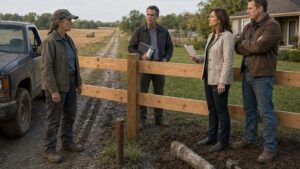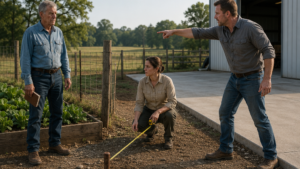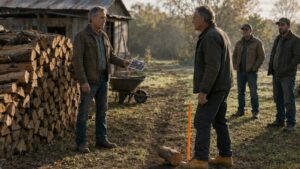
They Called Him Just a Tenant Farmer Until the Old Survey Map Reached the County Records Office
Chapter 1: The Night They Told the Tenant Farmer to Leave
“Pick those papers up, Gregory, and take them with you.”
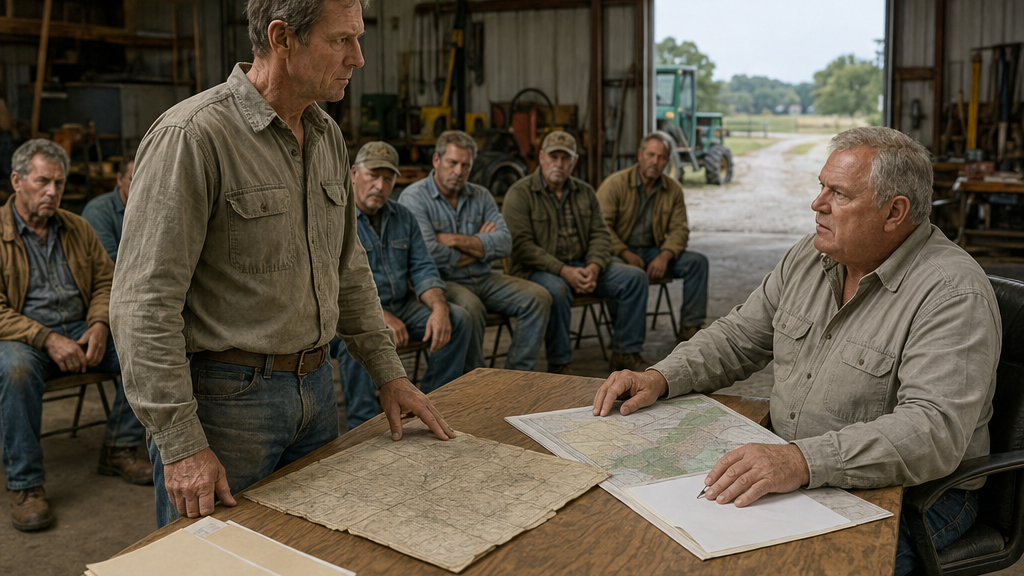
Frank Wilson’s voice carried easily through the metal equipment shed.
A dozen folding chairs faced the plywood table at the front. Boots scraped against concrete. Somebody shifted a coffee cup. Nobody said anything about the three sheets that had slid from Gregory Adams’s folder and landed near Frank’s chair.
Gregory looked down at them.
Then he looked at Frank.
“I asked who approved the assessment.”
“And I answered you.”
“No. You told me I wasn’t entitled to ask.”
Frank leaned back, his broad hands resting on the association’s new road map.
“You lease Katherine Moore’s farm. Katherine has a vote. You don’t.”
A few faces turned toward Gregory and then away again.
He had expected resistance. He had not expected to feel sixty years old and sixteen at the same time.
Gregory bent, gathered the papers, and placed them back on the table.
The first was the maintenance assessment: twelve hundred dollars assigned to the Moore farm’s use of the private gravel lane.
The second was a six-hundred-dollar heavy-vehicle penalty.
The third warned that continued violations could result in restricted access for nonmember commercial traffic.
Commercial traffic meant the feed truck.
It meant the cattle trailer.
It meant the hay hauler that needed the wide entrance when the lower field was ready.
Gregory straightened.
“The feed truck has used that lane for nine years.”
Frank’s expression tightened. “And the lane has cost more every year for nine years.”
“That doesn’t answer who authorized the new restriction.”
“The board did.”
“Under what section?”
Frank gave a short laugh.
It was not loud, but the shed was quiet enough that it reached every chair.
“Gregory, you’re trying to make this complicated.”
“I’m trying to make it clear.”
“You aren’t an owner.”
Gregory felt the heat climb into his face.
Frank continued before he could answer.
“We spent thirty-eight thousand dollars last year keeping that road passable. Culvert work. Gravel. Grading. Drainage. Half the people in this room complained that we let users run heavy trucks over it without paying their share.”
One of the neighboring farmers nodded.
Gregory saw it.
That hurt more than the laugh.
He understood the road cost money. He had never argued otherwise. He had helped pull Frank’s grain truck out of the ditch two winters earlier, after a thaw turned the north bend into soup. He had spread gravel from his own loader along the Moore entrance without sending anyone a bill.
But somewhere between maintaining a road and controlling it, Frank had stopped hearing the difference.
Gregory opened his folder again.
“I requested the meeting minutes approving the assessment.”
“You received the fee schedule.”
“I requested the vote.”
“You received what tenants are entitled to receive.”
That word again.
Tenants.
Not farmers. Not neighbors. Not people whose work had put ruts in the road because the road existed to carry farm work.
Gregory’s fingers stopped on a folded sheet at the bottom of his folder.
He had brought it almost by accident.
The paper was soft at the creases and yellowed along one edge. A survey plat. Old enough that the title block had been drawn before half the houses along the southern ridge existed.
He unfolded it once.
Frank glanced at it and frowned.
“What’s that supposed to be?”
“Old survey.”
“Of what?”
Gregory did not answer immediately.
The association’s current maintenance map lay beneath Frank’s hands. Thick black lines marked the private road and the equipment entrance. A shaded strip indicated the area the board claimed to control.
Gregory looked from that line to the faded survey plat.
His breathing slowed.
Something was wrong.
Not dramatically wrong. No missing acreage. No road drawn in the wrong county.
Just a bend.
The new map carried the association boundary past the drainage dip and almost to Katherine’s cattle gate.
The old plat stopped several yards short.
Gregory leaned closer.
Frank tapped the table.
“You finished?”
Gregory ignored him.
There was an iron-pin notation on the old plat. A bearing. A distance. He remembered driving a rod into hard August ground while a younger man held the prism pole near the ditch.
The memory came too quickly.
He folded the plat halfway again.
Frank mistook the movement for surrender.
“Here’s the simple version,” he said. “The association controls the road. Members set the rules. Katherine Moore owns the farm. You rent it. You don’t have an ownership interest in this association property, and you don’t get to walk in here every month challenging what the members decide.”
Gregory raised his eyes.
“Say that again.”
Frank blinked. “What?”
“The part about me having no interest.”
“I just did.”
“No. Put it in writing.”
For the first time that evening, the room changed.
The treasurer stopped rearranging papers.
Frank stared at him.
“You want me to write that you don’t own Katherine’s farm?”
“That isn’t what you said.”
A farmer in the second row shifted forward.
Gregory kept his voice level.
“You said I have no enforceable interest in the road or the association parcel, and therefore no standing to challenge what you do there.”
Frank’s face sharpened. “That is exactly right.”
“Then write it.”
“Why?”
“Because I asked.”
Frank looked around the room as though Gregory had offered him an opportunity to end the argument permanently.
Maybe that was what he believed.
He pulled a blank sheet from the treasurer’s stack.
“What wording?”
Gregory gave it to him carefully.
“That the board’s position is that Gregory Adams, as tenant of the Moore farm, has no ownership, access, security, easement, contractual, or other enforceable interest in the association-controlled lane parcel.”
Frank paused at “security.”
Gregory noticed.
So did nobody else.
Then Frank wrote.
His pen moved firmly across the paper.
When he finished, he added the date and his name beneath the statement.
“There.” He pushed it toward Gregory. “Now are we done?”
Gregory read every line.
“Sign it.”
Frank’s mouth tightened.
Then he signed.
Gregory slipped the page into his folder.
The satisfaction he expected did not come.
Instead he felt the old uneasiness from the survey plat pressing against his fingertips.
Frank stacked the meeting papers.
“You still owe the assessment and penalty. And if the heavy-truck rule is violated again, access restrictions begin.”
Gregory nodded once.
“Understood.”
That answer seemed to irritate Frank more than an argument would have.
Gregory gathered his folder and walked toward the shed door.
Behind him, chairs began scraping again. The meeting moved on to ditch mowing and gravel bids as though the last ten minutes had settled something.
Outside, the gravel lane disappeared past the equipment shed toward Katherine’s farm.
Gregory stood beside his pickup and opened the folder under the dome light.
He took out Frank’s signed statement.
Then the survey plat.
He unfolded the old paper enough to see the boundary bend again.
There, beside the faded bearing, was a project number he had not thought about in years.
Gregory stared at it until the dome light dimmed.
Then he folded Frank Wilson’s signed statement inside the old survey plat and put both back into the folder.
Chapter 2: Every Question Added Another Charge to the Farm
The feed driver called Gregory at 6:17 Wednesday morning.
“I can see your gate,” the man said. “Can’t get to it.”
Gregory was already pulling on his boots.
“What’s blocking you?”
“Chain across the wide entrance.”
Gregory stopped.
The association kept a chain at the equipment entrance for emergencies, but for years it had hung loose from a cedar post. The opening was wide enough for feed trucks and livestock trailers that could not safely make the sharper turn at Katherine’s house.
“Stay there,” Gregory said.
Five minutes later, his pickup rattled down the lane.
The feed truck waited on the far side of the drainage dip, engine idling. Gregory could hear the soft grind of the auger equipment vibrating behind the cab.
A galvanized chain stretched between two posts.
A laminated association notice hung from the middle.
Gregory got out.
The feed driver lowered his window. “Want me to back out?”
“Not yet.”
Gregory read the notice.
Heavy commercial vehicles were prohibited through the equipment entrance pending payment of outstanding assessments and compliance review.
The date at the bottom was Tuesday.
One day after the meeting.
Gregory took out his phone and photographed the chain, the notice, both posts, and the truck waiting beyond them.
Then he called Frank.
Frank answered on the fourth ring.
“You put the chain up?”
“The board authorized restricted access.”
“The warning said continued violations.”
“You already had a violation.”
“For a delivery made before the rule changed.”
There was a pause.
“The lane is association property, Gregory.”
Gregory looked at the drainage dip.
The old survey line came back to him.
“How far does that property run?”
Frank exhaled.
“We settled this Monday.”
“No. You signed your position Monday.”
“Same thing.”
Gregory hung up before anger made him say something useless.
He opened the narrow gate by Katherine’s house instead. It took the driver nearly fifteen minutes to line up, and one rear wheel dropped into the soft shoulder. Gregory guided him through inch by inch until the truck reached the feed bins.
By eight-thirty, Gregory had already lost half the morning.
The mail arrived before noon.
Another association envelope.
He opened it at the kitchen table.
Records reproduction and administrative review fee: four hundred dollars.
Gregory laughed once, without humor.
His original question had cost nothing.
The answer had cost twelve hundred.
Challenging it had added six hundred.
Asking to see how they reached the decision had added four hundred more.
The folded survey plat sat at the far end of the table.
He had not opened it since Monday night.
At one, Katherine Moore drove in.
She carried the latest association notice in one hand.
“You called Frank again.”
“He chained the equipment entrance.”
“I know.”
“Then you know why.”
Katherine put the notice down. She was in her early sixties, practical in the way people became when a farm had taught them that every broken thing eventually became an invoice.
“Gregory, I’m not saying they’re right.”
“That usually means you’re about to tell me to pay them.”
“I’m telling you I need the road open.”
“So do I.”
“Then pay it under protest.”
Gregory looked at her.
“Two thousand two hundred dollars?”
“Until we figure out what they’re doing.”
“If I pay every time they invent a fee, we already figured out what they’re doing.”
Katherine pressed her lips together.
“I own the farm. If this turns into a fight between the association and my property, I’m the one named on the deed.”
There it was.
Not cruelly said.
That made it worse.
Gregory’s eyes moved toward the folded plat.
Katherine noticed.
“What is that?”
“Nothing yet.”
Her expression changed.
“You said the same thing when you found the boundary pin by the ditch last spring.”
Gregory stood and reached for his cap.
“I’m going to the association office.”
“Gregory.”
He stopped at the door.
Katherine lowered her voice.
“If you know something that affects my land, I need you to tell me.”
He wanted to.
Instead he said, “I need to know whether I remember it right.”
The association office occupied a small room at the back of the equipment shed.
The treasurer was there alone.
Gregory paid the copying charge by check because refusing it would only give Frank another procedural excuse.
“I want the minutes approving the heavy-vehicle rule, the maintenance allocation, and the current boundary map used for the assessment.”
The treasurer studied him.
“You really want all of it?”
“Yes.”
“You know Frank thinks you’re trying to make him look foolish.”
“I’m trying to see the records.”
The treasurer disappeared into a filing room.
He returned with thirty-two pages.
Gregory sat at a folding table and began reading.
The maintenance assessment had been approved six weeks earlier.
The heavy-vehicle rule had been adopted nineteen days later.
The first penalty issued to Gregory was dated two days after that.
He read the rule twice.
It was broader than what Frank had described at the meeting.
It gave the board discretion to restrict vehicles over a defined weight from any “association-maintained access area.”
Gregory turned to the map.
The black boundary line crossed the drainage swale, continued past the equipment entrance, and ran nearly to Katherine’s cattle gate.
His stomach tightened.
He remembered that corner.
Not as an idea.
As a place.
A hot day. Red flagging. A rusted iron pin under weeds. His old survey chief telling him to check the backsight because the developer’s sketch was wrong.
Gregory asked for a copy of the map.
The treasurer hesitated.
“You already paid.”
“That was the idea.”
Back at the farmhouse, Gregory put the new map on the table.
Only then did he unfold the old plat.
He weighted the corners with a salt shaker, a coffee mug, a socket wrench, and the association envelope.
The two drawings were different scales, but the shapes matched well enough.
Until the equipment lane.
Gregory used a ruler.
The association line extended beyond the old boundary by approximately twenty-three feet at one point, narrowing farther north.
He traced the old line with his finger.
Near the drainage swale, beneath a faded callout, were two small letters.
GA.
Gregory sat very still.
Not initials added by some county clerk.
His initials.
His handwriting.
And beside them, almost hidden by the crease, was the same project number he had seen Monday night.
He had not merely worked somewhere nearby.
He had surveyed this exact strip before Katherine Moore ever leased him a single acre.
Chapter 3: The Survey Job Gregory Had Tried to Forget
The project number on the plat matched the label on a cardboard archive box Gregory had not opened in fourteen years.
He found it Saturday morning beneath old tax folders and a broken transit case in the farm office closet.
Project 14-77.
He carried the box to his desk and left it there for nearly an hour.
Outside, cattle moved along the fence toward the water tank. The hydraulic pump on the loader needed a seal. Hay forecasts were beginning to matter.
All of those things gave Gregory respectable reasons not to open a cardboard box.
Finally, he cut the old tape.
Dust rose from the lid.
The first folders were ordinary survey work: control points, elevation notes, boundary sketches, invoices.
The development had been called Cedar Ridge Farms, though there had never been much cedar and never became much of a development.
A company had bought several tracts along the ridge with plans to divide them into large rural lots. Gregory had been part of the survey crew contracted to mark roads, drainage easements, and access corridors.
He remembered the job differently now.
Not as land.
As unpaid invoices.
The developer had run out of money slowly, then all at once. Equipment disappeared. Contractors stopped answering calls. Gregory’s crew had spent months chasing payment for completed work.
He had eventually signed an agreement securing part of the outstanding amount against a small access parcel associated with the proposed road.
At least he thought that was what happened.
He had been younger, angrier, and tired of paperwork handled by people who always promised the check was coming next Friday.
Gregory pulled out a bound field book.
The handwriting was his.
Station numbers. Bearings. Distances.
At the equipment-lane bend, he had written: Existing iron pin controls. Developer sketch conflicts.
He looked at the association map on the other side of his desk.
The same conflict had survived all these years.
That did not mean Frank had fabricated anything.
Maps accumulated mistakes. One engineer copied another. A preliminary line became a final line because nobody checked the first assumption.
Gregory knew enough about surveying to distrust the version of events that made him instantly right.
He continued through the box.
An old invoice showed the developer owed his survey company more than thirty thousand dollars.
Another folder held correspondence between the developer, Gregory’s employer, and a local escrow office.
The arrangement gradually became clearer.
Part of the unpaid survey balance had been secured through an agreement connected to the future access parcel. Once a specified payment was made and the permanent road easement was finalized, Gregory’s interest would be released.
He frowned.
Why Gregory personally rather than the survey company?
Then he found the assignment.
When the company downsized, part of the receivable had been transferred to him in lieu of wages and expenses the company could no longer cover.
He remembered signing it.
He had tried hard not to.
Those months had cost him savings, sleep, and the last of his patience for development work. Soon afterward he left surveying full-time and returned to agricultural work.
For years, he told himself that decision had nothing to do with Cedar Ridge.
The box disagreed.
Near noon he found a folder marked RELEASE.
His pulse quickened.
Inside was a prepared document.
It identified the parcel.
It referenced the recorded security and access agreement.
It stated that Gregory Adams, upon receipt of the required settlement amount, released his interest in the described property.
His name was typed at the bottom.
There was a signature line.
Blank.
Gregory sat back.
That proved less than excitement wanted it to prove.
A draft was a draft.
Maybe another copy had been signed.
Maybe the final document had been executed at the closing office.
Maybe the county had recorded it and this folder simply lacked the duplicate.
He forced himself to keep searching.
There were letters discussing the payment milestone. One said the release would be held until funds cleared.
Another, written two weeks later, warned that the developer’s account was deficient.
Then the correspondence stopped.
Gregory found no settlement check.
No closing confirmation.
No executed release.
At two in the afternoon, Katherine knocked on the office door.
Gregory covered the release with another folder before realizing what he had done.
She saw the movement.
“That’s encouraging.”
“I’m checking something.”
“You’ve been checking something for three days.”
Gregory pushed his chair back.
Katherine looked at the open box.
“Cedar Ridge.”
He studied her face.
“You remember it?”
“Everybody around here remembers it. Half-built entrances, survey stakes everywhere, strangers talking about horse properties like they invented pasture.”
Despite himself, Gregory smiled.
It disappeared quickly.
“I surveyed it.”
“I know.”
That stopped him.
Katherine folded her arms.
“You knew?”
“I knew you did survey work around here. I didn’t know you were involved in whatever this is.”
Gregory looked toward the hidden release.
He could tell her.
Instead he heard himself say, “I’m not sure it’s anything.”
Katherine’s face hardened—not with anger, exactly, but disappointment.
“You keep saying that.”
“Because I don’t know yet.”
“But you know more than you’re telling me.”
Gregory did not answer.
She glanced through the window toward the gravel lane.
“I got another call from Frank. He says if the account stays unpaid, he’ll ask the board to restrict access completely.”
“He can ask.”
“That is my farm tied up in this.”
“And my cattle.”
“I know that.”
“Do you?”
The question came out sharper than he intended.
Katherine went still.
Gregory regretted it immediately, but pride arrived before apology.
She nodded once.
“When you decide I’m entitled to know what affects my property, call me.”
The door closed behind her.
Gregory stared at the empty chair across from him.
Frank had reduced him to a tenant.
Now Gregory had done almost the same thing in reverse: used Katherine’s ownership as a reason to keep her outside his uncertainty until he could present something finished.
He pulled the release back into view.
The document did not look powerful anymore.
It looked unfinished.
That afternoon, he arranged every Cedar Ridge record in date order.
Survey contract.
Assignment.
Recorded access-and-security agreement.
Escrow correspondence.
Draft release.
Failed payment notices.
Then he searched the document index included in the original closing packet.
Each instrument had a handwritten recording reference beside it.
Plat.
Agreement.
Easement.
Assignment.
At the bottom was the release.
Gregory ran his finger across the row.
The space for the county recording number was blank.
He checked the back of the page.
Nothing.
He checked the second copy.
Blank again.
Gregory reached for his phone, then stopped.
A missing number in his box was not proof of a missing record at the courthouse.
But it was enough to make Monday necessary.
He closed the archive box, left the release on top, and placed the folded survey plat beside it.
For fourteen years, he had treated Cedar Ridge as a bad job he had survived.
Now one empty line in an old index suggested the job might not have ended when he thought it had.
Chapter 4: The County Record Did Not Say What He Expected
Donna Clark looked at the document on her screen, then at Gregory.
“Why is an agreement this old still attached to an active parcel?”
Gregory had been waiting for some version of yes or no.
He had not expected a question.
The county recorder’s office opened at eight. Gregory had arrived fifteen minutes early with the Cedar Ridge box strapped behind the passenger seat of his pickup and the folded survey plat inside his coat, though the morning was already warm enough that he did not need the coat.
Now he sat across a counter from Donna while fluorescent lights hummed overhead and a printer worked somewhere behind the records shelves.
“I was hoping you could tell me,” he said.
Donna glanced back at the screen.
“I can tell you what’s recorded. That’s different.”
Gregory nodded.
He respected the distinction, even if he disliked it.
On the counter between them lay copies of the old access-and-security agreement, the assignment, the draft release, and the document index with its empty recording line.
Donna had already checked the obvious searches.
Gregory Adams.
Cedar Ridge.
The original parcel number.
The newer association parcel number.
She had found the agreement.
She had found the assignment.
She had found several later easements.
She had not found the release.
“Could it have been recorded under a different number?” Gregory asked.
“Anything is possible until we finish checking.”
A county survey technician came over after Donna called him.
He carried a current parcel image printed on oversized paper.
Gregory unfolded his old plat.
For the first time since finding it, he spread the whole thing flat in public.
The technician placed the modern parcel image beside it.
Donna pointed to the narrow strip near the former Cedar Ridge entrance.
“This is what concerns me.”
Gregory leaned over the counter.
The old agreement described a defined access parcel using bearings and distances. The current association map, by contrast, treated the road and equipment entrance as one continuous managed area.
“Can you overlay them?” Gregory asked.
The technician nodded.
“Roughly.”
He disappeared with copies.
Donna returned to the computer.
Gregory watched her search the grantor and grantee indexes again.
His heart had begun beating harder.
He hated that.
He had told himself all weekend that the county might produce the release in under five minutes. If it did, he would go home, show Katherine exactly what he found, and deal with Frank’s charges some other way.
But every unsuccessful search made another possibility harder to ignore.
Donna finally turned the monitor slightly toward him.
“Here’s the recorded agreement.”
Gregory recognized the instrument number.
“And here is the assignment putting part of that interest in your name.”
“So it’s still there?”
“The record is still there.”
“That’s what I asked.”
“No.” Donna’s expression remained patient. “You asked if the interest is still enforceable.”
Gregory sat back.
“And that isn’t the same thing.”
“No.”
The small rise of certainty he had felt collapsed enough to embarrass him.
Donna continued.
“I’m not your lawyer. I can tell you that I do not see a recorded release. That means I would not treat the agreement as obviously extinguished from the chain of title.”
Gregory looked at the old paper.
“But?”
“But that does not make you owner of the road.”
He said nothing.
Donna watched him long enough to see that this was exactly where his mind had gone.
“You don’t own the association parcel because a release is missing,” she said. “The agreement might preserve certain access, security, consent, or payment rights. The exact effect depends on the language and whatever happened afterward.”
Gregory rubbed one hand over his jaw.
“So Frank was wrong.”
“About what?”
“He signed a statement saying I have no enforceable interest of any kind.”
Donna looked down at the copy.
“He may have been too broad.”
That was not the dramatic answer Gregory had imagined receiving on the drive over.
It was better.
Because it was precise.
The survey technician returned carrying a transparent overlay and the current parcel print.
He placed the old plat beneath it.
The two boundary systems lined up closely at the southern entrance.
Then separated.
At the drainage swale, the association’s current control area pushed beyond the old access parcel. Farther north, a gravel turnaround and a drainage improvement appeared to cross the older described strip.
Gregory pointed.
“That culvert wasn’t there when we surveyed.”
“No,” the technician said. “That came later.”
Donna searched another index.
“When?”
The technician checked the notation.
“Four years ago.”
Gregory looked up.
Four years.
The association had reconstructed the drainage there four years earlier. He remembered because Katherine’s pasture had flooded during the work.
Donna found another filing.
Then another.
A road-maintenance declaration.
A drainage modification.
An amendment to the private-road operating rules.
None of those documents, on their face, mentioned Gregory’s old agreement.
“What would they have needed from me?” Gregory asked.
Donna shook her head.
“That is where you need legal advice. Some agreements require consent to specific physical alterations. Some only protect access. Some security interests are satisfied even if the release never gets recorded. I cannot tell you which applies.”
Gregory picked up the agreement.
He found the section he had read repeatedly over the weekend.
No permanent alteration to the described access area was to be made without written consent of the secured party until release or satisfaction.
He pushed it toward Donna.
“This.”
She read it.
Then reread it more slowly.
“Yes,” she said. “That language is why I would not ignore the agreement.”
Something in Gregory wanted to smile.
He stopped himself.
“What about the payment condition?”
“That’s the bigger question.”
“I never received the settlement.”
“You remember that.”
“I would remember thirty thousand dollars.”
Donna gave him a level look.
“You would be surprised what people remember differently after fourteen years.”
The remark could have offended him.
Instead it steadied him.
Records first.
Memory second.
That was how surveying had worked too.
By late morning, Donna had produced certified copies of the relevant recorded instruments. The technician printed the parcel overlay for Gregory.
Before he left, Donna pulled one more index onto her screen.
Her brow tightened.
“What?”
She pointed.
“These later filings use the association’s newer boundary description.”
“All of them?”
“Not all. But several.”
“How far back?”
She scrolled.
“Four years, at least.”
The number settled heavily between them.
Gregory had walked into the courthouse wondering whether one old release had been forgotten.
He walked out understanding the problem was larger and less convenient.
He did not own the road.
He did not have a secret deed.
He could not wave one document and erase fourteen years.
But the association had been acting as though an old recorded obligation did not exist, and several physical and administrative decisions appeared to have relied on a boundary that did not match the earlier instruments.
Gregory stood on the courthouse steps and called an attorney whose office had handled farm leases for Katherine once before.
He explained only enough to ask what documents to bring.
“Bring everything,” the attorney said.
“I was afraid you’d say that.”
“Especially the things you think don’t matter.”
Gregory looked at the folded plat under his arm.
He had spent fourteen years deciding it did not matter.
Now Donna’s certified copies showed four years of association filings that might depend on whether he had been wrong.
Chapter 5: The Old Boundary Created a New Problem for Everyone
Katherine Moore did not ask whether Gregory had won.
She asked, “Are you planning to take the road away from everybody?”
They were standing in her kitchen, and Gregory had not yet taken the certified county copies out of his folder.
“That’s not what this is.”
“Frank says your lawyer contacted the association about an old property claim.”
“My lawyer contacted them about a recorded agreement.”
“He called it a lien.”
“It isn’t that simple.”
Katherine folded her arms.
“You’ve spent a week telling me nothing is simple.”
Gregory set the folder on the table.
The reaction he had expected from the county discovery had changed since Monday.
At first, walking back to his pickup with certified records under his arm, he had felt a grim satisfaction. Frank had laughed at him in front of everybody. Frank had signed a statement that Gregory had no interest at all.
Now there was proof that something survived.
By Tuesday afternoon, after the attorney read the agreement, satisfaction had narrowed.
The attorney had been plain.
The missing release mattered.
The access-and-security agreement might still create enforceable rights.
But proving what remained unsatisfied after fourteen years could require tracing payments, assignments, and later property transactions. The agreement did not make Gregory owner of the road. It did not permit him to close it. It did not automatically void every association decision.
It did, however, give him enough standing to challenge actions affecting the described strip.
That was more than Frank had allowed him.
Less than revenge would require.
Katherine pulled out a chair.
“Show me.”
Gregory unfolded the plat.
He laid the county overlay on top and marked the narrow affected strip with a pencil.
“Here.”
Katherine studied it.
“That’s all?”
“That’s enough.”
“The road association map shows more.”
“That’s part of the problem.”
He explained the old agreement.
The failed development.
The unpaid survey work.
The assignment.
The conditional release.
Katherine listened without interrupting until he reached the missing recording.
Then she looked up.
“I thought you gave that up.”
Gregory’s hand stopped.
“What?”
“The Cedar Ridge claim.”
“You knew about it?”
“Not the details.”
She leaned back.
“Years ago, after the development collapsed, my father said there were contractors and survey people still tied to pieces of the project. Your name came up.”
Gregory tried to remember that conversation.
Nothing.
Katherine continued.
“Later, when you started leasing this place, I assumed whatever you had was settled. You never mentioned it.”
“I wanted nothing to do with Cedar Ridge.”
“That isn’t the same as settling it.”
“No.”
Her eyes stayed on him.
“And you knew it might still be open?”
The question landed harder than Frank’s accusations had.
Gregory could have protected himself with technical language.
He could have said he did not know whether the document remained enforceable.
He could have said he had no proof until Monday.
Both were true.
Neither answered Katherine.
“I knew there had been paperwork left hanging,” he said.
“How long?”
“For years.”
“And you never checked?”
“No.”
“Why?”
Gregory looked toward her kitchen window.
Beyond it, the gravel lane cut across the lower field.
Because checking would have meant reopening a period of his life when he had done everything right and still gone unpaid.
Because he had left surveying partly so nobody could ever again turn his work into a stack of promises.
Because after leasing Katherine’s farm, he had wanted to be judged by cattle weights, hay yields, fences, and whether he paid rent on time.
Not by an old claim.
“I didn’t want to be the man still chasing Cedar Ridge,” he said.
Katherine’s expression softened, but only slightly.
“So you let everybody assume it was gone.”
“I let myself assume it was gone.”
“That has consequences too.”
He nodded.
There it was.
The part no certified copy could correct for him.
Katherine stood and walked to the window.
“If you push this as far as it can go, what happens?”
“My attorney says we can challenge the assessment, the access restriction, and some alterations made inside the described area.”
“To everybody?”
“Potentially.”
“Even people who had nothing to do with Frank embarrassing you?”
Gregory looked down at the map.
The easiest version of justice had been more appealing before he knew its shape.
If the association’s authority over the strip was formally questioned, lenders might delay transactions. Maintenance projects might stop. Neighboring farmers who depended on the same lane could be forced into expensive review over actions they had approved in good faith.
Gregory picked up his pencil.
Instead of circling the association parcel, he marked only the narrow strip described in the old agreement.
“This,” he said.
Katherine turned.
“This is what I’m challenging. My charges. My access. Physical alterations in this strip that should have been checked against the recorded agreement.”
“You’re not trying to blow up the association?”
“I’m trying to make them stop pretending the whole lane belongs to whatever decision Frank makes.”
Katherine sat down again.
For the first time since the dispute began, Gregory felt they were on the same side of the table.
Not in complete agreement.
But looking at the same thing.
The next afternoon, that feeling lasted until Gregory found an association envelope clipped to Katherine’s gate.
He opened it there.
NOTICE OF SUSPENSION.
Effective Friday at 6:00 a.m., nonmember commercial access associated with the Moore tenancy would be suspended until outstanding balances were satisfied.
Gregory read the page twice.
Katherine came down the lane in her pickup and stopped beside him.
“He did it?”
Gregory handed her the notice.
Her jaw tightened.
“I told Frank yesterday we were reviewing this.”
“Apparently that helped.”
“He’s trying to force payment before the records question gets any bigger.”
Gregory looked toward the wide equipment entrance.
The chain hung loose for now.
Friday was three days away.
He called his attorney from the gate.
“What do we send?”
“Not a threat,” the attorney said. “A notice. Precise. Attach the recorded agreement, identify the disputed strip, state the access right you are asserting, and demand that they postpone suspension pending review.”
“And if they don’t?”
“Then they’re making a choice with notice.”
Gregory understood that language immediately.
The same reason he had asked Frank to sign the statement.
Make the choice visible.
That evening, Gregory prepared the certified letter at the farmhouse table.
Katherine read it before he sealed the envelope.
She pointed to one paragraph.
“This says you reserve all remedies.”
“That’s standard.”
“It sounds like war.”
Gregory considered it.
Then crossed out the sentence and replaced it with narrower language requesting withdrawal of the charges, suspension of the access restriction, and formal review of the boundary and agreement.
Katherine handed the page back.
“That sounds like what you told me you wanted.”
Gregory signed it.
The next morning he stood at the post-office counter while the clerk stamped the certified receipt.
He watched the envelope disappear into the outgoing bin.
Until then, Frank had been acting on the assumption Gregory would either pay or get tired.
Now the association would have the county records in hand before Friday.
The next move would no longer be a misunderstanding.
Chapter 6: Frank Wanted the Correction Kept Between Two Men
Frank Wilson called Gregory at 9:42 Thursday night.
Gregory knew the number.
Frank had never used it to call him after dark.
He let the phone ring twice before answering.
“Yes?”
For a moment there was only breathing.
Then Frank said, “You awake?”
“I answered.”
“Can we talk?”
Gregory was sitting at the farmhouse kitchen table.
The old plat was spread in front of him. Frank’s signed meeting statement rested across the lower corner, exactly where the newer association map had once covered the original boundary.
“What about?”
“You know what.”
Gregory leaned back.
“Go ahead.”
Frank’s voice sounded smaller over the phone than it did inside the equipment shed.
“I got your certified letter.”
“That was the purpose.”
“I also got a call from counsel.”
Gregory waited.
Frank continued.
“There may have been some confusion in the records.”
“Confusion.”
“Old Cedar Ridge documents. Things nobody has looked at in years.”
“I looked at them.”
“I’m aware.”
Frank went quiet.
Gregory could picture him at his own kitchen table, perhaps with the same association files opened in front of him.
“What do you want, Frank?”
“I want to fix this without turning it into something it doesn’t need to be.”
Gregory almost laughed.
A week earlier, Frank had ordered him to pick his papers off the floor.
Now Frank wanted scale and restraint.
“How?”
“We cancel the penalty.”
“Which one?”
“All of it. The maintenance assessment charged to you, the heavy-truck penalty, records fee. We lift the access suspension.”
Gregory looked at the signed statement.
“And?”
“And we move on.”
There it was.
The offer.
Not an apology.
Not correction.
Erasure.
Gregory ran one finger along the crease of the old plat.
“What happens to your statement from the meeting?”
“What about it?”
“You said I had no enforceable interest in the lane.”
“That was based on what the association understood at the time.”
“You signed it.”
“I know I signed it.”
“In front of everybody.”
Frank exhaled sharply.
“Gregory, I am offering to wipe out more than two thousand dollars.”
“You’re offering to stop charging me money you may not have had authority to charge.”
“That isn’t established.”
“Then why are you calling me at ten o’clock at night?”
Silence.
A tractor-trailer passed on the distant county road, its sound rising and fading.
When Frank spoke again, the edge was gone.
“The association’s lender asked questions today.”
Gregory sat forward.
“What questions?”
“The same ones your letter raised.”
Frank sounded tired now.
“The road association has a credit line for maintenance. We used it for the drainage work four years ago and the resurfacing after that. Counsel forwarded your documents. The lender wants confirmation that the association had authority over the entire improved area.”
Gregory looked at the county overlay.
“So they’re checking.”
“Yes.”
“That’s what I asked you to do.”
“I know.”
The admission was quiet.
Gregory said nothing.
Frank filled the silence.
“You think I enjoy collecting assessments? Half the members won’t pay until the road has holes deep enough to swallow a tire. Then everybody wants it fixed yesterday.”
Gregory remembered the north bend two winters ago.
Frank’s grain truck in the ditch.
Three men with chains and a loader trying to get it out before dark.
“I know the road costs money.”
“Then you know why I tightened the rules.”
“That doesn’t explain the boundary.”
“No.”
“Or why you charged me for records.”
“That fee was in the schedule.”
“You approved the schedule.”
“Because people request boxes of documents every time they lose an argument.”
Gregory heard the defensiveness returning.
Then Frank stopped himself.
When he spoke again, he sounded less like a chairman and more like a man who had been awake too long.
“We had a title review when the association reorganized.”
“When?”
“Four years ago.”
“The same year as the drainage work.”
“Yes.”
“And?”
“It wasn’t complete.”
Gregory’s hand tightened around the phone.
Frank continued before he could speak.
“There were old exceptions. Cedar Ridge instruments. The attorney handling it said most appeared stale or satisfied by later transactions.”
“Appeared.”
“That was the advice.”
“Did you check mine?”
“No.”
The word sat between them.
“Why?”
“Because nobody had asserted it in fourteen years. Because the road had been used openly. Because the members were furious about costs. Pick one.”
Gregory closed his eyes.
There was the explanation he had wanted.
Not corruption.
Not a secret plan.
Something more ordinary and therefore harder to dismiss.
Frank had seen uncertainty and chosen convenience.
Then, when Gregory asked a question, he chose humiliation instead of checking.
“You could have told me that Monday,” Gregory said.
“I didn’t know your name was in those records Monday.”
“You didn’t ask.”
“No.”
“And after I asked?”
Frank did not answer.
Gregory looked at the signed statement again.
“You called me a tenant like that ended the conversation.”
“You are a tenant.”
Gregory’s jaw tightened.
Frank heard it.
“That came out wrong.”
“No. It came out exactly how you meant it.”
Another silence.
Then Frank said, “What do you want?”
Gregory had imagined hearing those words.
In the imagined version, they felt satisfying.
In reality, they sounded heavy.
“Withdraw the charges in writing.”
“Done.”
“Suspend the access restriction.”
“Done.”
“Review the boundary and the recorded agreement before you make any more changes there.”
“We can do that.”
“And correct the record at the next meeting.”
Frank’s breathing changed.
“What do you mean?”
“The same room. Same people. You tell them your statement about me having no enforceable interest was wrong.”
“That’s unnecessary.”
“It was necessary when you said the opposite.”
“I’m trying to keep this between two men.”
“You didn’t keep the first part between two men.”
Frank’s voice hardened.
“If I stand up in that room and say the board exceeded its authority, I lose half the members.”
“That’s not my decision.”
“You don’t understand what it’s been like keeping that association together.”
Gregory glanced at the folded map.
“No. But I understand what it’s like being told I don’t count because my name isn’t on Katherine’s deed.”
“I never said you don’t count.”
“You said I had no standing. You laughed when I asked who approved the assessment. Then you charged me for the records.”
Frank said nothing.
Gregory let the silence remain.
When Frank finally spoke, there was no argument left in his voice.
“I’ll cancel the charges tomorrow.”
“And the meeting?”
“I need to think.”
“The suspension begins at six.”
“It won’t.”
“I want that in writing too.”
Frank gave a tired sound that might once have been a laugh.
“You really do want everything written.”
“Lately.”
Frank promised an email before morning.
Neither man said good night.
Gregory ended the call.
For several minutes he sat without moving.
The temptation was there.
He could send the county records to every association member before breakfast. He could attach Frank’s signed statement. He could make sure nobody ever again confused certainty with authority.
Instead, Gregory folded the statement once.
Not to hide it.
To preserve it.
He placed it inside the survey plat and closed the folder.
Then he wrote a single sentence on the front page of his notes for the next association meeting.
I am asking for correction, not control.
At 10:18, Frank’s email arrived confirming the charges and suspension would be placed on hold pending review.
Gregory printed it.
Then he added it to the same folder Frank had ordered him to take out of the equipment shed.
Before turning off the kitchen light, Gregory sent one reply.
I will be at the next meeting with the same papers.
Chapter 7: He Returned With the Same Folded Map
The equipment shed went quiet when Gregory Adams placed Frank Wilson’s signed statement beside the unfolded survey plat.
Not completely quiet. The fluorescent fixtures still buzzed. A folding chair squeaked near the back wall. Outside, tires rolled over the gravel lane and faded toward the county road.
But nobody at the table spoke.
Gregory stood in nearly the same place where Frank had ordered him to gather his papers a month earlier.
This time, the papers stayed exactly where Gregory put them.
Frank sat behind the association table with the treasurer beside him. He looked older than he had at the previous meeting. Not defeated. Not frightened.
Careful.
Katherine Moore sat in the second row.
Gregory had asked her that afternoon whether she wanted to sit beside him.
She had shaken her head.
“It’s your question,” she said. “You answer it.”
Now Frank cleared his throat.
“We have one additional matter before the regular agenda.”
A farmer near the back said, “We all know what matter.”
Nobody laughed.
Frank looked down at a typed page.
“The board received a preliminary review of the Cedar Ridge documents, the current road instruments, and the historical access agreement asserted by Gregory Adams.”
Asserted.
Gregory noticed the word but let it go.
Frank continued.
“The review concludes that the association’s records did not adequately account for an older recorded agreement affecting a portion of the equipment-lane area.”
The treasurer stared at his hands.
Someone asked, “What does that mean for the road?”
Frank glanced toward Gregory.
“It means the boundary and authority over certain actions require clarification.”
“That’s not what you told us last month,” another member said.
Frank’s jaw moved.
“No.”
Gregory could feel the room turning toward him.
A month ago, he had wanted that.
Standing there now, he discovered he did not.
He put one finger on Frank’s signed statement.
“This is what I asked to have corrected.”
Frank looked at the page.
Then at Gregory.
“The board’s position at the last meeting was too broad.”
The words came slowly.
Gregory waited.
Frank seemed to understand that too broad was not quite enough.
He looked toward the chairs.
“I stated that Gregory had no enforceable interest of any kind in the lane parcel because he was a tenant of the Moore property.”
Nobody moved.
“That statement was wrong.”
Gregory had imagined this moment while driving a tractor, loading hay, fixing fence, lying awake after Frank’s late-night call.
In those versions, the sentence had felt like a door opening.
In reality, it was simply a sentence.
Necessary.
Late.
Useful.
No music. No applause.
Just a man saying in public that something he had said in public was untrue.
Frank continued.
“The association has withdrawn the maintenance assessment charged directly to Gregory, the heavy-vehicle penalty, and the administrative records fee. The access suspension has also been withdrawn.”
Gregory glanced at Katherine.
She gave him a small nod.
One of the neighboring farmers raised his hand.
“So all the assessments are invalid?”
“No,” Frank said.
Another member leaned forward. “Why not? If the association didn’t control that land, how can anything we did be valid?”
Before Frank answered, Gregory spoke.
“That isn’t what the records say.”
Several heads turned toward him.
The farmer frowned.
“I thought this whole thing was because they don’t own the road.”
“It isn’t.”
Gregory placed the transparent county overlay on top of the old plat.
“The association has authority over the road. The issue is this strip.”
He traced the narrow area beside the drainage swale.
“My old agreement affects access and certain alterations here. It doesn’t make me owner of everybody’s road.”
A man near the rear said, “But if the board messed it up, why not challenge all of it?”
Gregory looked at him.
“Because all of it isn’t wrong.”
The answer seemed to disappoint some people.
That surprised Gregory.
Outrage was easy when it belonged to somebody else.
The farmer persisted. “What about four years of dues?”
“What about them?”
“If the filings were wrong, shouldn’t we get the money back?”
Gregory folded his arms.
“You paid for gravel. You got gravel. You paid for grading. The road got graded.”
“That’s not the point.”
“It is to me.”
Frank looked at Gregory then.
Not gratefully.
Something closer to recognition.
Gregory went on.
“I challenged charges made against me and an access restriction tied to a boundary the board had not properly checked. I’m asking them to review physical work and rules affecting the recorded strip. I’m not asking to pretend the road never needed maintenance.”
Katherine’s voice came quietly from behind him.
“Then what changes?”
The question was for the room as much as Gregory.
Frank answered this time.
“The association has agreed to commission a current boundary survey and title review. Until that is completed, no permanent alterations will be made within the disputed strip without written review of the older agreement.”
The treasurer added, “And future penalties tied to access restrictions will require the board to identify the instrument giving us authority before the penalty is issued.”
A farmer muttered, “Should’ve been doing that already.”
Frank heard him.
“Yes,” he said.
The single word carried more weight than any defense would have.
Gregory looked at the old plat.
Its creases were nearly white now. His initials still sat beside the faded bearing.
For years, he had treated that map as proof of a bad period in his life.
Then, for several weeks, he had treated it as leverage.
Standing in the shed, he saw something else.
A survey did not decide who deserved land.
It recorded relationships between fixed points.
This line connected to that pin.
This easement crossed that parcel.
This obligation remained until something valid changed it.
Maps were less about possession than people liked to pretend.
They were about where one person’s certainty had to stop.
Frank tapped the page in front of him.
“There is one more issue.”
Gregory looked up.
“The drainage improvement from four years ago crosses part of the area described in the agreement. The review recommends that we obtain retroactive consent where possible and confirm the work does not interfere with protected access.”
A member near the aisle looked at Gregory.
“So now you get to approve the culvert?”
“Maybe,” Gregory said. “Maybe the documents say something narrower once the attorney finishes. I’m not signing anything tonight just because I’m finally being asked.”
That earned the first genuine reaction in the room: not laughter, but several people shifting as though they had not expected him to refuse immediate power.
Frank nodded once.
“Fair.”
The meeting moved to ordinary business after that.
Gravel bids.
Mowing.
A washed shoulder near the north bend.
Gregory remained for all of it.
Nobody asked why a tenant was still sitting there.
That mattered more than he wanted it to.
When the chairs began folding at the end, Frank stayed behind the table.
Gregory gathered his certified copies.
He left Frank’s signed statement where it was.
Frank touched the edge of it.
“You taking this?”
“No.”
Frank looked surprised.
Gregory folded the old survey plat along its familiar creases.
Then stopped.
The association’s new survey file sat open beside the treasurer’s papers.
Gregory looked at the map in his hands.
For fourteen years, he had carried it from one box to another because throwing it away felt wrong and looking at it felt worse.
He unfolded it again.
Carefully.
Then he placed it inside the new file.
Frank watched him.
“You don’t want the original?”
“I’ve got copies.”
“That one has your field notes.”
“I know.”
Gregory closed the file.
“Seems like the people making decisions about the road ought to know where the old lines came from.”
Frank rested a hand on the file but did not open it.
After a moment he said, “I shouldn’t have talked to you the way I did.”
Gregory looked at him.
It was not the correction he had demanded. That had already happened.
This was something smaller.
Maybe harder.
“No,” Gregory said. “You shouldn’t have.”
Frank nodded.
Neither man tried to improve the sentence.
Outside, Katherine was waiting beside Gregory’s pickup.
“You left the map?”
“Yes.”
“I thought you kept everything.”
“I used to.”
She smiled slightly.
The chain at the equipment entrance hung from the cedar post, loose and ordinary again.
Beyond it, the lane ran toward the farm, gray gravel flattened by feed trucks, cattle trailers, pickups, rain, and years of people who had all needed some part of the same road.
Gregory opened his truck door.
Katherine paused before getting into hers.
“You know,” she said, “you could have told me about Cedar Ridge years ago.”
Gregory looked over the roof of his pickup.
“I know.”
“You probably should have.”
“I know that too.”
She waited.
This time he did not hide behind silence.
“I thought if I brought it up, people would see me as a man hanging onto some old claim because he didn’t own enough of anything new.”
Katherine studied him.
“And now?”
Gregory looked back toward the shed.
The plat was no longer in his folder.
Frank’s statement was no longer something he needed to carry.
“Now I figure a man can lease a farm and still know where he stands.”
Katherine nodded once.
Then they drove separately down the same gravel lane toward home.
The story has ended.