The HOA Towed His Work Trailer From His Own Land—Then the Old Easement Changed Everything
Chapter 1: They Hooked the Trailer Before Scott Could Stop Them
The tow cable snapped tight just as Scott Carter turned through the gate.
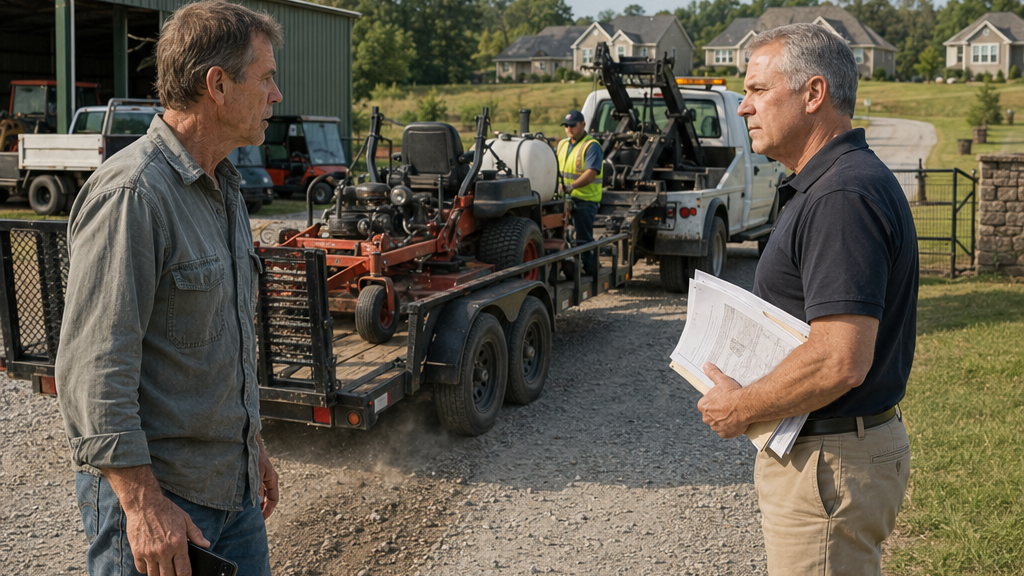
For half a second, he could not make sense of what he was seeing. His flatbed trailer sat crooked behind a yellow tow truck, its tongue already lifted, its rear ramps trembling against the gravel. A compact loader was strapped to the deck beside two hydraulic attachments and a rack of hand tools. The whole trailer gave a hard metallic jerk as the winch pulled it another foot.
Scott braked so sharply that a box of irrigation fittings slid off the passenger seat.
He was out of the truck before the engine stopped.
“Hold up.”
The tow driver glanced toward him but kept one hand on the control lever.
A second man stood near the edge of the lot in a dark polo shirt, a folder tucked beneath his arm. Scott recognized him from two brief encounters at the subdivision entrance.
Frank Nelson.
The new HOA president.
Scott crossed the gravel without running. He had learned a long time ago that running toward machinery made everybody stupid at once.
“That trailer belongs to me,” he said.
Frank stepped forward. “We know.”
Scott looked at him, then at the tow driver.
“And you’re taking it anyway?”
Frank opened the folder. “You were notified.”
The trailer moved again. One rear tire bumped through a shallow rut.
Scott raised his phone and began taking pictures.
Frank’s mouth tightened. “You can document it if you want.”
“I plan to.”
The lot was four acres of gravel, grass, and working equipment that had belonged to Scott’s uncle before it belonged to him. Three trucks sat along the old pole shed. Two enclosed trailers were backed near the fence. The open flatbed had been in nearly the same place for years, moved when jobs required it and returned when they did not.
Beyond the tree line, roofs from the newer subdivision rose in clean rows.
Frank pointed toward them with the folder.
“The commercial-vehicle rules apply to this parcel.”
Scott lowered his phone.
“Which parcel?”
Frank blinked. “This property.”
“I asked which parcel.”
“The one we’re standing on.”
Scott looked down at the gravel.
“I know where I’m standing.”
The tow driver shifted his weight.
Frank pulled several papers from the folder. “Mr. Carter, your land is shown inside the association boundary.”
“Show me the parcel number.”
Frank flipped one page, then another.
Scott watched him carefully.
He had expected an argument about whether a flatbed counted as commercial equipment. He had expected Frank to point at some sentence in a rulebook. What he had not expected was hesitation over the most basic question.
Frank found a map.
“Here.”
Scott stepped closer. The paper showed roads, lots, and a heavy boundary line. His four acres appeared to sit inside it.
“That’s a map,” Scott said.
“Yes.”
“What recorded document gives you authority over my land?”
Frank’s expression changed.
Not much. Just enough.
“You received the violation notice.”
“That wasn’t my question.”
“You’ve ignored repeated association communication.”
“I asked what recorded document gives you authority to remove my trailer.”
Frank closed the folder.
“The board has already acted.”
Behind them, the winch whined again.
Scott turned immediately.
“Stop moving it.”
The driver released the lever.
Scott crouched beside the trailer. One of the steel attachment brackets had shifted against the loader frame. A ratchet strap was pulled at an angle he had not left it in.
“You load this?”
“No,” the driver said. “It was strapped when I got here.”
“You check the straps?”
The driver looked toward Frank.
Scott saw that too.
He photographed the bracket, the straps, the hitch, the tow truck plate, the trailer tires, and the position of every piece of equipment he could see.
Frank said, “This doesn’t need to turn into something bigger than it is.”
Scott stood.
“You’re taking maybe forty thousand dollars’ worth of equipment off my property.”
“We’re enforcing a rule.”
“Then tell me exactly what authority you’re enforcing it under.”
Frank’s jaw set.
Scott had dealt with men like him on commercial jobs—men who became firmer when they were no longer certain, because backing down in front of other people felt worse than being wrong.
Frank tapped the folder.
“You should have responded when the notice came.”
That landed harder than Scott wanted it to.
He had seen envelopes from the association before.
Most went into a pile.
Years earlier, when the subdivision had first pushed closer to his fence line, letters had started arriving with logos and meeting dates and language about common areas. Scott’s uncle had called them “somebody else’s paperwork.” Scott had inherited the same habit.
If it did not involve his taxes, insurance, customers, or county permits, he usually gave it little attention.
Frank mistook his silence for surrender.
Scott had mistaken it for insulation.
Neither of them said that.
Scott lifted the phone again.
“I’m asking one more time. Which parcel are you enforcing?”
Frank stared at him.
Then he said, “The one identified in the association map.”
“Put that in writing.”
“It already is.”
“Good.”
Scott stepped away from the trailer.
The tow driver looked at him. “You stopping me?”
Scott wanted to.
Every instinct in him wanted to stand behind the truck and make the man call somebody with a badge before moving another inch.
But the machinery was already hooked. The driver was working under an order. Scott could turn the gravel lot into a physical confrontation, or he could make sure nobody later got to pretend the morning had happened differently.
He moved aside.
“No,” he said. “I’m documenting you.”
The driver nodded once.
The tow truck pulled forward.
The flatbed crossed the gravel slowly, its tires crunching over the same ground where Scott had parked it the previous afternoon.
Frank remained near the gate.
Scott filmed the trailer all the way out.
When the last tire passed the property sign, he stopped recording.
Frank said, “Call management Monday. They can explain the process.”
Scott looked at him.
“You might want them to explain it to you first.”
Frank’s face hardened, but he did not answer.
The tow truck disappeared toward the paved subdivision road.
The space it left behind looked strangely larger than it should have.
Scott walked to where the trailer had been. A fresh scrape cut through the gravel. Near it lay a small black cap from one of the hydraulic couplers.
He picked it up.
By late morning, Scott had photographed everything twice.
Then he went into the small office attached to the pole shed and started looking for the paperwork Frank kept mentioning.
Invoices sat in one pile. Fuel receipts in another. A parts catalog lay open beside a coffee mug.
Underneath two supplier statements was a white envelope.
It carried the association logo.
Scott stared at the postmark.
Thursday.
He turned it over.
Still sealed.
Chapter 2: The Notice He Should Have Opened
The notice had his parcel description printed correctly.
Scott read that line three times.
The road reference was right. The acreage was right. Even the old abbreviated description he had seen on tax records matched closely enough that he could not dismiss the letter as something mailed to the wrong property.
Below it was the alleged violation: commercial equipment stored in view of association residences.
The open flatbed was specifically identified.
Scott sat back in his chair.
Until then, his anger had been simple.
Frank had crossed a boundary.
Now a less comfortable question entered the room.
What if Scott had ignored the thing that was supposed to tell him where the boundary actually was?
He read the notice from the beginning.
It cited the association’s vehicle and storage restrictions, referred to prior communication, and warned that enforcement action could follow if the violation remained.
Scott checked the date.
Thursday.
The trailer had been removed Saturday morning.
He looked at the unopened envelope lying beside his hand and felt his certainty lose some of its clean edge.
He still did not believe the HOA had any business on his four acres.
But belief was not the same as a record.
By noon, he had called the towing company.
The person who answered confirmed the trailer was in their storage yard and gave him the release amount.
Scott asked who had authorized the tow.
“The association.”
“Which person?”
“I have an authorization form.”
“Whose name?”
There was a pause.
“Frank Nelson.”
Scott wrote it down.
“Did he give you proof the HOA controlled the property?”
“We got a tow request.”
“That wasn’t my question.”
The person on the line became more guarded.
“You can discuss that with the association.”
Scott almost laughed.
Instead he asked about pickup hours.
The tow yard sat forty minutes away. By the time he reached it, irritation had hardened into concentration.
The flatbed was parked behind a chain-link fence among disabled cars, work vans, and two campers.
Scott paid the release fee.
He hated doing it.
Not because of the amount alone, but because handing over his card felt like participating in his own loss.
Once the trailer was brought out, he walked around it before hitching up.
The front edge of the compact loader bore a fresh silver scrape.
One hydraulic attachment had shifted several inches.
A hose coupling near the deck had been crushed against a steel bracket.
Scott crouched and ran a finger along the damaged fitting.
The tow driver from that morning was not there.
A yard employee watched him inspect the equipment.
“That like that before?”
“No.”
“You got pictures?”
Scott looked up.
“Yes.”
For the first time that day, the answer gave him some satisfaction.
He photographed the damage again before moving anything.
Back at his lot, he parked the flatbed farther from the road than usual, close to the pole shed.
That annoyed him too.
He told himself it was temporary.
Still, he noticed what he had done.
Frank had moved the trailer once, and now Scott was moving it himself.
The empty patch of gravel where it normally sat remained visible from the office window.
On Monday morning, Scott called the association management office.
A representative answered after transferring him twice.
Scott gave his name and parcel description.
“I need the document that puts my property under your association.”
Keyboard sounds clicked through the phone.
“Your parcel is listed in the association boundary records.”
“I know what your map says. I want to know why.”
More typing.
“It appears the parcel was added to the association records in 2018.”
Scott stopped writing.
“Added how?”
“I’m looking at a property file.”
“Was there an annexation?”
“That appears to be what this references.”
“Who signed it?”
“I don’t have the full recorded instrument in front of me.”
Scott looked toward the filing cabinet against the wall.
His uncle had still been alive in 2018.
Not healthy, but alive.
He had been the kind of man who kept receipts for mower blades from twenty years earlier. If he had signed away control over the land, Scott could not imagine him failing to mention it.
“Send me what you have.”
“There may be a records request process.”
“Then send me that.”
The representative hesitated.
“Mr. Carter, I also see several previous notices.”
Scott rubbed a thumb against the edge of his desk.
“How many?”
“Three in the last two years, not including the current violation.”
He closed his eyes briefly.
“What were they for?”
“One appears to concern commercial equipment visibility. Another references landscaping materials near the access boundary. The third is general compliance correspondence.”
Scott remembered envelopes.
He did not remember opening them.
The representative continued, “There’s also a note that prior mail received no response.”
Scott looked at the Thursday notice.
Frank had not invented that part.
“Does ignoring your letters make my land part of the HOA?”
“I can’t answer legal questions.”
“Neither could Frank.”
The representative said nothing.
Scott regretted the remark as soon as he made it. It felt good for half a second and accomplished nothing.
He lowered his voice.
“Send me the record-request instructions.”
That afternoon, he pulled his uncle’s property papers from a metal cabinet.
The folders smelled faintly of dust and machine oil.
Tax statements.
Insurance renewals.
Survey copies.
Old utility easements.
A handwritten list of fence repairs.
Scott searched for 2018.
He found medical bills, county tax receipts, a tractor invoice, and a note about replacing culvert pipe near the east line.
Nothing about an HOA.
Nothing about an annexation.
Nothing with an association logo.
He sat on the floor beside the open cabinet, papers spread around him.
For years, Scott had treated those records as proof that the land existed outside everybody else’s permission.
His uncle had owned it.
Then Scott had inherited it.
That was the whole story in his mind.
But the association had a map.
It had his correct parcel description.
It had records saying something happened in 2018.
And Scott had years of unopened mail that made him look less like a man defending a boundary and more like a man who simply did not want to hear an answer.
He found the deed transferring the property to him after his uncle’s death.
He read every line.
No HOA appeared by name.
That helped.
But it did not answer what had happened before the transfer.
Scott laid the deed beside the violation notice.
One document said he owned the land.
The other behaved as if ownership came with rules he had never accepted.
He picked up his phone and called Cynthia Green.
He had used her once years earlier when a contractor wanted temporary access across the back of the property.
She listened without interrupting.
When he finished, she asked one question.
“Do you have the 2018 annexation document?”
“No.”
“Then you don’t know yet whether they’re wrong.”
Scott looked at the empty gravel patch outside.
“I know my uncle never told me he joined an HOA.”
“That’s not the same thing.”
He did not like the answer.
That was why he hired her.
Chapter 3: The Map Said One Thing, the Deed Another
Cynthia Green placed the HOA map on her conference table and said, “This is not worthless just because you don’t like what it shows.”
Scott leaned back in the chair.
“I didn’t say worthless.”
“You called it a coloring-book boundary ten minutes ago.”
“It looks like one.”
Cynthia slid the paper toward him.
“And if somebody relied on it for years, that matters.”
Scott folded his arms.
Monday afternoon had already been spent at the county records office, where a clerk helped them pull deeds, plats, recorded restrictions, and an index of instruments tied to Scott’s parcel.
The stack on Cynthia’s table was thicker than Scott expected.
He had come wanting one page.
Something clean.
Something that said the HOA had no authority and should never have touched the trailer.
Instead he had received a paper history of people making decisions long before Frank showed up with a tow truck.
Cynthia tapped the 2018 entry.
“There was an annexation action.”
Scott leaned forward.
“Signed by who?”
“That’s what we’re trying to determine.”
The packet included a board resolution, a revised association map, meeting references, and a legal description that appeared to include Scott’s parcel.
Scott felt his stomach tighten when he saw the description.
“So they did annex it.”
Cynthia shook her head.
“Don’t skip steps.”
“It’s sitting right there.”
“It shows the association intended to treat the parcel as included.”
“That sounds like annexation.”
“It may be. It may also be incomplete.”
She pulled out another page.
“Where’s the owner acknowledgment?”
Scott looked at it.
There was no signature from his uncle.
“Where’s the recorded consent?” Cynthia continued. “Where’s proof of the notice required by whatever mechanism they were using? Where’s the document connecting the board’s vote to your uncle’s actual property interest?”
Scott’s irritation began to shift.
“You’re saying they don’t have it.”
“I’m saying I haven’t found it.”
“That’s the same thing if it isn’t there.”
“No. It isn’t.”
Scott looked away.
Cynthia had a way of making caution sound like resistance.
He knew that was unfair.
He also knew he had spent the weekend imagining the moment when somebody competent would finally say Frank had been completely wrong.
Cynthia refused to give him that satisfaction before the record earned it.
She turned another page.
“The meeting minutes say the boundary adjustment was approved.”
“Was my uncle at the meeting?”
“No attendance list attached.”
“Was he notified?”
“No proof attached.”
“Did he sign?”
“Nothing we’ve found.”
Scott tapped the table.
“Then what exactly am I missing?”
“Possibly nothing. Possibly another filing. Possibly a procedure that did not require the kind of consent you’re assuming. I need the governing documents from that period.”
Scott exhaled through his nose.
Outside Cynthia’s office window, traffic moved along the commercial strip toward town. Inside, his whole property seemed reduced to page numbers.
He pulled the flatbed title from his folder and set it beside the HOA map.
“There. My trailer. My land. Their line.”
Cynthia looked at the title.
“The trailer title proves you own the trailer.”
“And the deed proves I own the property.”
“Yes.”
“So what more do they need to be wrong?”
“Ownership doesn’t answer whether restrictions run with land.”
Scott went quiet.
That sentence bothered him because he knew it was probably true.
He had spent years saying, My land, as though those two words settled every possible question.
Cynthia softened slightly.
“Scott, I’m not defending the tow.”
“Feels like it.”
“I’m trying to make sure you don’t walk into a board meeting claiming something broader than you can prove.”
He looked at the photograph on his phone of the flatbed behind the tow truck.
Frank standing near the gate.
Folder under his arm.
Certain.
“What can I prove?”
Cynthia separated three pages.
“First, the association treated your parcel as included by 2018.”
Scott frowned.
“That helps them.”
“For now.”
She pointed to the next sheet.
“Second, the records we have do not show clear owner acknowledgment or notice.”
“That helps me.”
“Yes.”
Then the third.
“Third, Frank authorized enforcement before anyone appears to have resolved that gap.”
Scott looked at her.
“That’s enough for the towing complaint.”
“Possibly. Especially if the tow authorization depends on lawful control of the property.”
The first clean piece of ground appeared beneath him.
Not victory.
Ground.
Cynthia told him to file the complaint with photographs, the release receipt, and the written violation notice. She would keep working on the title history.
Scott started gathering the loose papers.
A folded sheet slipped from beneath the 2018 packet and landed near the edge of the table.
Cynthia picked it up.
It was older than the others, copied from a recorded instrument with faint survey markings along one side.
She stopped.
“What?”
Cynthia did not answer immediately.
She unfolded it completely.
A narrow strip ran from the subdivision road across the edge of Scott’s parcel toward the gravel access.
Scott recognized the route.
“That’s the old access line.”
Cynthia looked at the recording date.
Then at the date of the association’s original restrictions.
Her expression changed.
“How long has this been here?”
“As long as I can remember.”
“No. I mean this recorded easement.”
Scott leaned closer.
The date was six years earlier than the association restrictions they had been reviewing.
He felt the old urge to seize the answer before it was fully formed.
“There it is.”
Cynthia looked at him.
“There what is?”
“The proof.”
“Proof of what?”
“That they never had authority.”
She held his gaze.
“No.”
The word landed flat.
Scott stared at her.
“You just said it predates their restrictions.”
“It does.”
“So?”
“So now we find out what the easement actually does.”
She traced the thin recorded line with one finger.
“And more importantly, how everyone treated it after the subdivision was created.”
Scott looked down at the faded map.
For the first time since the tow truck had crossed his gravel lot, the question was no longer only whether Frank had made a mistake.
It was how long other people had known there was a boundary problem before Frank ever arrived.
Chapter 4: The Easement Everyone Had Learned to Ignore
The easement line did not stop at Scott’s fence.
It ran from the subdivision road, crossed a narrow strip near the edge of his four acres, and followed almost exactly the gravel access his uncle had used long before the first subdivision house went up.
Scott stood beside Cynthia Green on Tuesday morning with a copy of the recorded map folded against the hood of his truck.
“That’s it,” he said. “That’s the road.”
Cynthia looked from the map to the gravel.
“Part of it.”
“What do you mean, part?”
“The recorded easement is narrower than the road in a few places. And the language matters more than the drawing.”
Scott stared toward the subdivision entrance.
He had expected the old record to feel like a weapon. Instead Cynthia kept turning it into another question.
They walked the easement line slowly.
At one point, the gravel narrowed beside a drainage ditch. Farther up, it widened where delivery trucks had been turning for years. Beyond the trees stood a row of backyard fences from the subdivision.
One homeowner watched them from a deck.
Scott pretended not to notice.
Cynthia stopped near an old survey marker half-hidden by grass.
“This predates the association restrictions by six years.”
“You already said that.”
“I’m saying it again because it matters.”
“Then why won’t you say it settles this?”
“Because it doesn’t say, ‘The HOA can never regulate Scott Carter’s parcel.’”
Scott looked at her.
“It says what can use this strip and for what purpose. It may limit later restrictions that interfere with those rights. It may also show the property was treated differently from ordinary subdivision lots. But we still need history.”
“What kind?”
“How the association behaved.”
Scott almost smiled.
“So now their mistakes help me.”
“Sometimes patterns matter.”
Back in Cynthia’s office, she called the HOA management company and requested archived correspondence tied to Scott’s parcel.
The representative initially said older files might be incomplete.
Cynthia asked for anything referencing the parcel number, easement, boundary, commercial storage, or annexation.
They waited.
Scott spent part of the afternoon replacing the crushed hydraulic coupling on the attachment that had shifted during the tow. The damage was not catastrophic, which almost irritated him more. It was just enough to cost money and time. Just enough to remind him every time he touched the machine that someone had moved it without permission.
The flatbed remained parked close to the shed.
He had not moved it back.
That bothered him.
Near four o’clock, Cynthia called.
“Come back in.”
He arrived to find several scanned documents spread across her desk.
Most were boring.
Insurance correspondence. Landscaping complaints. A drainage question. Old board emails.
Then Cynthia handed him a printed management note dated several years earlier.
Scott read it once.
Then again.
The line near the middle was short.
Jurisdiction pending clarification.
He looked up.
“They knew.”
“Somebody knew there was a question.”
“That says jurisdiction.”
“It does.”
“And they did nothing.”
Cynthia leaned back.
“Apparently, they did what organizations often do with unclear problems that aren’t currently expensive.”
Scott waited.
“They postponed them.”
She showed him an older email chain.
A resident had complained about trailers visible beyond the subdivision’s rear boundary. A management employee had asked whether Scott’s parcel was enforceable under association restrictions.
The response from a prior board member was cautious: the parcel appeared on a later boundary map, but the easement and older deed history needed review before enforcement.
No review followed.
Another year passed.
Then another complaint.
Again, no final decision.
Scott felt the satisfaction he had wanted the day before.
It lasted less than a minute.
“Frank didn’t create this.”
“No.”
“He inherited it.”
“Yes.”
Scott sat back.
He had imagined Frank finding a line on a map and deciding to expand his little kingdom.
That version was easy.
The records showed something messier.
The HOA had carried an unresolved question for years. Frank had stepped into a position where complaints already existed and a map already showed Scott’s land within the association boundary.
Frank had been wrong to act before confirming authority.
But he had not invented the uncertainty.
Scott rubbed a hand over his face.
Cynthia watched him.
“What?”
“He probably thinks everybody before him was too scared to enforce.”
“That would be my guess.”
Scott looked at the old management note again.
“And I made it easy.”
Cynthia did not answer.
He knew what she was thinking.
The old correspondence included references to notices sent to him.
He had ignored most of them.
The prior boards had avoided the issue. Scott had done the same thing from the opposite side.
Silence had suited everybody until someone finally acted.
His phone vibrated on the desk.
An email.
The sender was Linda Moore.
Scott knew the name from the HOA paperwork. Treasurer.
The message was brief.
Mr. Carter, I understand you obtained the 2018 annexation materials and older easement record. Before the board meets, would you please send me copies of the full file you received?
Scott showed Cynthia.
She read it without changing expression.
“Interesting.”
“Why?”
“Because she didn’t ask whether you had them.”
Scott looked back at the screen.
She had asked him to send them.
Not prove they existed.
“Think she’s seen this stuff before?”
“Maybe.”
Scott picked up the page marked jurisdiction pending clarification.
For the first time, the question was not what Frank had failed to check.
It was what Linda already knew before the tow truck ever came through Scott’s gate.
Chapter 5: The Board Had Known the Boundary Was Unsettled
“Frank knew there was a question,” Linda Moore said. “He just thought the answer was obvious.”
Scott did not sit down.
The HOA clubhouse smelled faintly of burnt coffee and carpet cleaner. A folding table had been set up near the front room with three chairs, a yellow legal pad, and a stack of documents.
Linda sat on one side.
Scott remained standing on the other.
“You told him?”
“I told him the file wasn’t clean.”
“When?”
“The week before the tow.”
Scott stared at her.
Linda’s hands were folded over the legal pad.
“He asked why previous boards had never enforced the commercial-equipment rule against your property. I told him there had been a boundary issue.”
“And he ordered the tow anyway.”
“Yes.”
The answer was quiet.
That made it land harder.
Scott finally pulled out a chair.
“Why didn’t you stop him?”
“I’m treasurer.”
“You’re on the board.”
“I don’t have unilateral authority over the president.”
“You had a vote.”
“There wasn’t a vote on the tow.”
Scott leaned forward.
Linda’s expression tightened.
“That’s part of the problem.”
For several seconds, neither spoke.
Scott had come prepared to hear excuses. Instead Linda was giving him facts that made the board look worse.
She pushed a photocopy toward him.
It was an older management memo.
The phrase he had seen the previous day appeared again: pending clarification.
“This should have been resolved years ago,” Linda said.
“Why wasn’t it?”
“Because no one wanted to spend association money on a legal opinion over one edge parcel when there wasn’t an active dispute.”
Scott gave a short laugh.
“So everybody waited until somebody took my trailer.”
“That’s not how I would put it.”
“It’s how it happened.”
Linda did not argue.
She looked toward the window.
Several subdivision homes were visible across the parking area. Trim lawns. Mailboxes in matching styles. The kind of place where small inconsistencies were noticed because everything else had been made consistent.
“We had complaints,” she said.
“About me.”
“About equipment. Early trucks. Material piles. Noise.”
“I run a landscaping business.”
“I know.”
“Been doing it longer than half those houses have existed.”
“I know that too.”
Scott studied her.
Linda was not defending the tow. She was explaining the pressure behind it.
That was somehow more difficult to dismiss.
“Frank ran for president saying the board had stopped enforcing rules,” she said. “People liked that.”
“People like rules when they think they’re for somebody else.”
Linda almost smiled, but did not.
“He started going through old files. Your parcel came up.”
“And you told him it was disputed.”
“I told him it needed review.”
“What did he say?”
“That the map put you inside the boundary and years of nonresponse showed you knew the rules applied.”
Scott sat back.
There it was.
His own silence.
Not legal consent.
Not proof.
But something Frank had used to make his assumption feel reasonable.
Scott remembered the unopened Thursday letter beneath his invoices.
“How many letters did you send me over the years?”
Linda looked down.
“Enough that you should have answered one.”
Scott’s jaw tightened.
“You think that makes the tow my fault?”
“No.”
The answer came immediately.
“I think it made it easier for people here to believe they already knew your position.”
Scott looked away.
Beyond the clubhouse, he could see the road that curved toward his property.
He had spent years treating every HOA envelope like junk mail from a government he had never elected.
Maybe that had felt principled.
It had also meant nobody had ever been forced to answer him directly.
Linda slid another document across the table.
“This is a proposed reimbursement.”
Scott read the first paragraph.
Release fee.
Documented equipment repair.
Attorney costs incurred to date.
The amounts were not enormous, but together they covered most of what he had spent.
“What’s the catch?”
Linda tapped the second page.
The language required both sides to release claims related to the towing incident.
Scott read farther.
Nothing in the document determined future HOA jurisdiction.
He looked up.
“You want me to take the money and leave the boundary alone.”
“We want to resolve the damages.”
“That’s not what I asked.”
“Scott, the board can reimburse you without deciding a property question tonight.”
“Then you can tow me again next month.”
“No one is talking about another tow.”
“You don’t need to. This paper says nothing about whether you think you control my land.”
Linda exhaled.
“This is the part where you make things harder than they have to be.”
He stared at her.
Then, unexpectedly, he nodded.
“You’re right.”
Linda seemed surprised.
Scott looked down at the agreement.
“I do.”
He thought of Cynthia telling him the easement did not magically settle everything. He thought of the years of unopened mail. He thought of how badly he wanted one sentence declaring the HOA had never possessed a single inch of authority.
Maybe that sentence would never be legally honest.
But this settlement did something worse.
It paid for the mistake while preserving the right to repeat it.
Scott pushed the papers back.
“I’m not signing.”
Linda’s shoulders dropped.
“I expected that.”
“I’ll settle the money.”
She looked at him.
“If?”
“The board puts jurisdiction on the emergency-meeting agenda.”
“That could turn into a legal fight.”
“It already did.”
“Cynthia told you the easement isn’t conclusive.”
“She did.”
“So you understand the board may not give you the declaration you want.”
Scott nodded.
“I understand.”
“Then what exactly are you asking for?”
“A decision that you can’t enforce against this parcel unless you first establish that you have the right to.”
Linda was silent.
Scott continued.
“You don’t have to say I won every argument since 2018. You don’t have to say Frank invented the map. But I’m not taking four hundred dollars, or four thousand, or whatever number you put there, and going back to wondering if another truck shows up because somebody complains about my equipment.”
Linda looked at the proposed settlement.
Then at the easement map Scott had brought with him.
The two documents lay side by side.
One offered money.
The other showed a line nobody had wanted to define.
“I’ll put it on the agenda,” she said.
Scott stood.
At the door, Linda stopped him.
“One more thing.”
He turned.
“I did tell Frank to wait.”
Scott said nothing.
“He said waiting was why people had lost confidence in the board.”
“And what did you say?”
“That acting without an answer wasn’t the same as leadership.”
Scott studied her.
“Why didn’t you tell me that before today?”
Linda looked tired.
“Because until the tow, I thought this was still a paperwork problem.”
Scott glanced toward the road.
His flatbed sat miles away on his property now, parked farther inside the lot than it had been before.
“It stopped being paperwork when the cable tightened.”
He left the clubhouse without taking the reimbursement agreement.
The emergency meeting was scheduled for Thursday.
For the first time, the board would have to decide whether protecting its authority meant admitting where that authority ended.
Chapter 6: Frank Could Defend the Rule but Not the Tow
“The commercial-vehicle rule is valid.”
Frank Nelson said it before Scott had finished sitting down.
The emergency meeting had barely started.
Five people occupied the long table at the front of the clubhouse. Linda sat near the middle with a binder open in front of her. Two other board members sat beside her. Frank was at the end.
Scott sat opposite them.
Cynthia had helped him organize the documents, but she was not there to speak for him.
That had been Scott’s choice.
If he wanted the board to understand the timeline, he would give it to them himself.
Frank continued.
“The rule has been enforced throughout this community. Residents have been cited for work vans, trailers, RV storage, and equipment visible from neighboring lots.”
Scott nodded.
“I believe you.”
Frank stopped.
One of the board members looked up.
Scott placed the violation notice on the table.
“I’m not arguing whether you have a commercial-vehicle rule.”
He placed the HOA map beside it.
“I’m asking whether you had authority to use it on this parcel.”
Frank leaned back.
“The parcel is on the association map.”
“Yes.”
“It has been for years.”
“Yes.”
“And Mr. Carter received repeated notices without objecting.”
Scott felt Linda watching him.
He could have fought that point.
Instead he said, “That’s true.”
Frank’s expression shifted.
Scott continued.
“I ignored them.”
The room became still.
“I thought your letters were somebody else’s problem. That was a mistake.”
Frank spread his hands slightly, as if Scott had finally conceded the case.
Then Scott placed the 2018 annexation packet on the table.
“But ignoring a letter isn’t the same as granting authority.”
Frank’s hands stopped moving.
Scott slid the packet toward the middle.
“This file shows the board treated my land as annexed in 2018. Cynthia and I found the resolution. We found the revised map. We found the meeting reference.”
One board member asked, “And your objection?”
“We didn’t find proof the owner acknowledged it. We didn’t find clear proof he got whatever notice was required. We didn’t find the piece that turns the board’s intention into an unquestionable right to enforce against the parcel.”
Frank said, “Your attorney also told you that doesn’t automatically invalidate the annexation.”
Scott looked at him.
“She did.”
The answer produced another pause.
Frank had expected resistance, not agreement.
Scott understood then what Cynthia had been trying to teach him.
He did not need to win every sentence.
He needed to make the board answer the right question.
He pulled out the older easement map.
“This was recorded before the association restrictions.”
Linda turned the copy so the other members could see it.
Frank said, “An access easement doesn’t exempt an entire parcel from rules.”
“I didn’t say it did.”
“You’ve been saying the HOA has no authority.”
“I said that Saturday because I believed it.”
Scott glanced at Linda, then back at Frank.
“Now I’m saying you didn’t know whether you had authority when you had my trailer removed.”
Frank’s jaw tightened.
“That’s different.”
“Yes.”
Scott reached for his phone.
He had printed one photograph larger than the others.
The image showed the flatbed behind the tow truck, its tongue raised, gravel scraped beneath its tires. Frank stood several feet away with the folder under his arm.
Scott placed the photo beside the easement map.
“Saturday morning I asked you which parcel you were enforcing.”
Frank said nothing.
“You showed me this map.”
Scott tapped the HOA boundary map.
“I asked what recorded document gave you authority. You didn’t have one with you.”
“I had the association records.”
“You had a map.”
“A map maintained by management.”
“And you knew there was a question about the parcel.”
Frank looked toward Linda.
She did not look away.
“I knew there had been a question,” he said.
“Did you ask management to resolve it before the tow?”
“I asked management whether the parcel was shown inside the association.”
“That’s not what I asked.”
Frank’s voice sharpened.
“You had ignored violations for years.”
Scott leaned back.
For a moment, he recognized the temptation to answer anger with anger.
Instead he waited.
One of the board members asked Frank, “Did you get counsel’s confirmation?”
Frank did not answer immediately.
Linda turned a page in her binder.
“Frank?”
“No.”
“Did management confirm enforceability beyond the map?”
“They confirmed the parcel was listed.”
“That’s not the same thing,” Linda said.
Frank looked at her.
“You told me previous boards kept ducking this.”
“I told you it needed review.”
“And residents were tired of review.”
Scott heard something in Frank’s voice that had not been present Saturday.
Not arrogance exactly.
Frustration.
Frank looked down the table.
“For three years people complained about inconsistent enforcement. We had trailers sitting out, work vehicles, landscaping debris. Every time somebody got a notice, they pointed at Carter’s lot and asked why he was allowed to do whatever he wanted.”
Scott said nothing.
Frank turned toward him.
“You think this was personal?”
“I think you towed my trailer.”
“I thought I was enforcing the same rule on you that everybody else had to follow.”
There it was.
Not innocence.
But reason.
Frank had not needed to hate Scott.
He had needed Scott to fit the category he had already decided existed.
The stubborn holdout.
The man previous boards were too weak to challenge.
Scott understood that better than he wanted to.
Because Scott had categorized Frank too.
Another HOA president.
Another man with a binder pretending paperwork could move a fence.
Linda spoke.
“You still authorized the tow after I told you the boundary file was unresolved.”
Frank looked at her.
“Yes.”
No one moved.
Scott had expected denial.
The admission took some of the air out of the room.
Frank rubbed his thumb along the edge of the table.
“I thought the map and the history of notices were enough.”
One board member asked, “Were they?”
Frank’s mouth tightened.
“Apparently not.”
Scott looked at the photograph.
Saturday morning had felt like the whole story.
Trailer gone. Authority abused. Somebody right and somebody wrong.
Now the photograph looked different.
It still showed the harm.
But it also showed what happened when several people let uncertainty sit long enough for confidence to replace proof.
Scott cleared his throat.
“I filed a towing complaint.”
Frank looked up.
“I know.”
“I’m pursuing reimbursement for the release fee and the damaged coupling.”
Linda nodded.
“That can be handled.”
“But that isn’t why I asked for this meeting.”
Scott pushed the photograph and map toward the center.
“I want a written resolution that this association does not enforce against my parcel unless it first establishes lawful jurisdiction through a proper process.”
Frank gave a humorless laugh.
“So you want us to admit we have no authority.”
“No.”
The answer surprised Frank.
Scott continued.
“I want you to admit you haven’t established it.”
One of the board members leaned forward.
“That’s a narrower statement.”
“It’s the true one.”
Frank looked at Scott for a long moment.
Then he said, “And what happens when you start parking more trailers where every house on that side can see them?”
Scott felt heat rise behind his neck.
The old response was ready.
My land.
My business.
My choice.
He swallowed it.
“I’ll follow whatever rules actually apply to my property.”
Frank shook his head.
“That sounds convenient.”
“It’s also how rules are supposed to work.”
Linda closed her binder.
The board moved into discussion.
They did not vote immediately.
They argued about insurance exposure, the towing complaint, attorney review, prior notices, and whether suspending enforcement against Scott’s parcel would undermine other residents’ confidence.
Scott listened.
At one point, Frank argued that Scott’s years of silence had given the association reasonable grounds to rely on its records.
Scott answered before anyone else could.
“He’s right about the silence.”
Frank looked at him.
“I should have responded. I should have demanded an answer years ago.”
Scott touched the old easement map.
“But my failure to ask the question doesn’t turn your assumption into an answer.”
The room went quiet again.
That was the moment the meeting changed.
Not because anyone applauded.
Not because Frank collapsed.
Because two board members began asking how to correct the process rather than how to defend the tow.
Linda proposed temporary suspension of enforcement against Scott’s parcel while counsel prepared permanent language.
Another member wanted reimbursement authorized immediately.
Frank sat with his arms folded.
After nearly two hours, Linda asked whether he wanted to add anything before the board moved forward.
Frank looked at the papers in front of him.
Then at Scott.
“I still think the appearance complaint was legitimate.”
Scott nodded.
“You’re allowed to.”
Frank’s eyes narrowed slightly.
“I also think previous boards left a mess.”
“They did.”
“And you helped by ignoring every letter.”
Scott nodded again.
“I did.”
For the first time since Saturday, Frank seemed to have nothing prepared for the answer.
He looked toward the other board members.
Then he removed a key ring from his pocket and set it on the table.
A small clubhouse key hung from it beside a plastic association tag.
“I’m resigning as president.”
Linda straightened.
“Frank—”
“I’ll remain a member until you decide otherwise. But I’m not going to preside over the review of a decision I made.”
No one tried to stop him.
Frank stood.
At the end of the table, he paused.
“I was wrong to order the tow before the jurisdiction issue was resolved.”
Scott waited.
Frank looked at him.
“I’m not saying the complaints about your lot were unreasonable.”
Scott thought about how badly he had once wanted a total surrender.
Instead he said, “I didn’t ask you to.”
Frank left the room.
The door closed quietly behind him.
Linda looked down at the easement map, then at Scott.
“We still have to decide what we’re willing to put in writing.”
Scott gathered the photograph of the trailer but left the map on the table.
“That,” he said, “is the part I came for.”
Chapter 7: The Settlement Was Worth Less Than the Boundary
Cynthia Green crossed out the sentence Scott cared about most.
The red line went straight through four words.
Never had legal authority.
Scott stared at the page.
“No.”
Cynthia capped her pen.
“No what?”
“Put it back.”
“I’m not putting it back.”
Scott sat across from her desk with the revised settlement between them. A week had passed since Frank resigned, and the HOA’s attorney had finally sent proposed language addressing both the towing incident and Scott’s parcel.
Scott had read it twice before bringing it to Cynthia.
He had already disliked how careful it sounded.
Now she was making it even more careful.
“They towed the trailer,” he said. “They admitted they shouldn’t have.”
“They admitted the tow should not have occurred before jurisdiction was established.”
“That’s lawyer language for the same thing.”
“No. It’s lawyer language because it is not the same thing.”
Scott leaned back.
The old easement map lay beside the settlement. He had seen it so many times now that he could picture the faded line without looking.
Cynthia tapped the sentence she had deleted.
“If you insist they sign a declaration that they never had authority, they may refuse because the underlying annexation question has not been judicially resolved.”
“I’m not going to court just to prove something they already know.”
“Good.”
“Then why make me sign something weaker?”
“Because weaker isn’t the right word.”
She pulled the agreement closer.
The proposed language stated that the HOA would suspend all enforcement against Scott’s parcel unless and until association jurisdiction was established through a documented legal process, with notice to the parcel owner and an opportunity to contest the determination.
Cynthia underlined the paragraph.
“This does more for you tomorrow than your sentence about yesterday.”
Scott looked at it.
“They can’t tow anything.”
“Not under HOA authority without first resolving jurisdiction.”
“They can’t cite me.”
“Same answer.”
“They can’t decide next month that their map is good enough.”
“Not under this agreement.”
Scott looked toward the window.
That should have satisfied him.
Instead he felt as if he were being asked to trade certainty for precision.
He wanted a sentence that proved Frank wrong.
Cynthia was offering him a sentence designed to prevent another Frank.
She seemed to read the difference on his face.
“You wanted vindication.”
“I wanted them off my land.”
“Then take the language that keeps them off your land.”
Scott looked down again.
For most of his life, protecting property had meant gates, locks, surveys, and knowing where the corners were.
Now it meant commas.
That afternoon, he met Linda Moore at the HOA office.
The reimbursement paperwork was waiting.
The association agreed to repay the trailer-release charge, the documented hydraulic repair, and the attorney expenses tied directly to the towing dispute.
Linda slid a check request form toward him.
“You’ll receive payment after the agreement is executed.”
Scott barely looked at it.
“What about this paragraph?”
Linda read where he pointed.
“That was added after counsel reviewed the board vote.”
“So the board agrees not to enforce against the parcel.”
“Unless jurisdiction is properly established.”
Scott looked at her.
“You really like that phrase.”
“I like phrases our attorney says we can keep.”
He almost smiled.
Then Linda pushed a second page toward him.
“We also added something for you.”
Scott read it.
He frowned.
The agreement required him to acknowledge receipt of future correspondence concerning boundary or jurisdiction issues and to respond within a reasonable period rather than simply ignore it.
“You’re putting homework in a settlement.”
“I’m putting communication in it.”
“That sounds nicer.”
“It’s also accurate.”
Scott looked at her.
Linda did not look embarrassed.
“You ignored us for years.”
“I know.”
“If we’re agreeing not to rely on assumptions, neither side gets to go back to creating them.”
Scott read the paragraph again.
A month earlier, he would have crossed it out on principle.
Now he thought about the unopened Thursday notice.
He thought about the old management files marked pending clarification.
He thought about how easily silence had hardened into somebody else’s certainty.
“Fine,” he said.
Linda blinked. “Fine?”
“I’ll respond.”
“That may be the easiest thing you’ve agreed to all week.”
“Don’t get used to it.”
Before signing, Scott turned to the last page.
Something was missing.
He checked the packet again.
“Where’s the parcel description?”
Linda looked down.
“The agreement references it.”
“I want it attached.”
“The parcel number is in the first paragraph.”
“I want the full legal description attached as an exhibit.”
Linda studied him.
Scott placed one finger on the agreement.
“We got here because everybody kept talking about ‘that parcel’ and pointing at maps. If this is going to control what happens later, I want the land identified.”
Linda picked up the phone.
The revised copy arrived the next morning.
Exhibit A contained the full legal description.
Scott read it slowly.
He checked the acreage.
The road reference.
The old boundary calls.
Then he signed.
Linda signed for the association.
Cynthia retained a copy.
The settlement did not say Scott had been right about everything.
It did not say the HOA had been wrong about everything.
It said something more useful.
Until jurisdiction was properly established, the association would not enforce its covenants against Scott’s parcel.
The reimbursement followed two days later.
Scott deposited it without ceremony.
Then he drove back to the lot.
The flatbed was still parked close to the pole shed where he had moved it after the tow.
He backed his truck to it, hitched up, and pulled it across the gravel.
For the first time since Saturday morning, he returned it to the place where it had always sat.
Not near the road to prove anything.
Not farther inside to avoid anybody.
Just its normal place.
Scott unhitched it.
The coupler dropped onto the block with a familiar steel knock.
He stood there a moment.
Then he went into the office carrying the signed agreement.
This time, before putting it away, he made sure the parcel description was still attached.
Chapter 8: This Time the Boundary Was in Writing
The new HOA envelope sat on Scott’s desk for less than thirty seconds before he opened it.
He noticed that fact immediately.
The association logo was the same.
The white envelope was the same.
Even the weight of folded paper inside felt familiar.
But instead of sliding it beneath invoices, Scott cut it open with the edge of a utility knife.
The first line did not say violation.
It said boundary review.
Scott read on.
The board had adopted a procedure for parcels along the outer edge of the subdivision where recorded boundaries, easements, or historical management records created uncertainty about association jurisdiction.
No enforcement action would begin against those parcels until the relevant ownership and governing documents were reviewed.
Owners would receive written notice.
They would have a defined period to respond.
Disputed cases would go to counsel before physical enforcement measures could be authorized.
Scott sat back.
He read it again.
Then he laughed once under his breath.
Not because it was funny.
Because the whole thing sounded so obvious now.
Check first.
Act second.
It had taken a tow truck, damaged equipment, attorney fees, an emergency meeting, and a resignation to turn those two steps into policy.
Scott folded the letter and placed it beside the signed agreement.
Outside, the flatbed sat where it used to sit.
That had become important to him for a while.
For the first few days after the settlement, he caught himself looking toward it every time a vehicle slowed near the gate.
Then the habit faded.
The trailer returned to being what it had been before Frank made it into a symbol.
A tool.
One morning, Scott loaded sod cutters onto it.
Another day, irrigation pipe.
Later that week, an employee left two muddy wheelbarrows strapped near the rear ramp, and Scott realized he had gone most of the afternoon without thinking about whether someone in the subdivision could see them.
That felt more like winning than the reimbursement check had.
The property itself had not changed.
The subdivision still pressed against one side of it.
Backyard fences still lined the tree break.
People still walked dogs along the association road.
Scott still started some trucks before sunrise during the busy season.
And some residents probably still thought his work yard was ugly.
The difference was that complaints could no longer become authority simply because nobody challenged the path between them.
A few weeks later, Scott was near the gate replacing a worn latch when Frank Nelson drove past.
Frank slowed.
For a moment, Scott thought he might keep going.
Instead Frank stopped near the shoulder and lowered the window.
Scott rested one hand on the gate.
Neither man spoke first.
Finally Frank nodded toward the flatbed.
“Looks like you put it back.”
“Never planned not to.”
Frank looked past him toward the equipment yard.
“I heard the board adopted the new review process.”
“They sent me a copy.”
Frank gave a small nod.
“That’s probably good.”
Scott could have said more.
He could have reminded Frank what the old process had cost.
He could have asked whether he still thought the trailer was an eyesore.
Instead he tightened the latch bolt with his wrench.
Frank watched for a second.
“I still think some of those complaints were reasonable.”
Scott looked up.
“I know.”
“You still think none of their rules apply to you?”
Scott considered the question.
Months earlier, he would have answered before Frank finished asking.
Now he wiped his hand on his jeans.
“I think you establish the boundary first.”
Frank looked at him.
Then he nodded.
“That’s fair.”
It was not an apology.
Scott did not need another one.
Frank drove on.
The encounter left no triumph behind, only a strange quietness.
Frank was still a neighbor.
Scott was still the man with trucks and trailers near the subdivision.
Neither of those facts had been erased by a board vote.
That mattered.
Scott had once imagined resolution as a clean line: one side right, one side wrong, one side defeated.
The easement map had taught him otherwise.
Some lines existed because people had agreed exactly where they were.
Others existed because generations had used the same strip of land until everyone assumed they understood it.
Those were the dangerous ones.
Later that afternoon, Linda stopped by the lot.
She stayed near the gate rather than driving in.
Scott walked over.
“I’m not here about a violation,” she said.
“Good opening.”
She handed him a thin folder.
Inside was the final board policy and the recorded minutes adopting it.
Scott scanned the first page.
“You brought me this in person?”
“I was nearby.”
He gave her a look.
Linda shrugged.
“And I thought you’d appreciate having a clean copy.”
Scott closed the folder.
“How many other parcels?”
“Three we know of.”
“With problems?”
“With questions.”
Scott nodded.
That word sounded better now.
Questions could be answered.
Assumptions were harder.
Linda glanced toward the lot.
“The board’s also reviewing old management files.”
“That sounds miserable.”
“It is.”
“You volunteered?”
“I was already the person who knew where everything was buried.”
Scott studied her.
“You knew my file was a problem.”
“Yes.”
“And you let it sit.”
“Yes.”
There was no defensiveness in the answer.
Scott appreciated that more than he expected.
“I let your letters sit too,” he said.
Linda gave him a brief smile.
“Look at us. Two models of responsible administration.”
Scott laughed.
Then Linda grew serious.
“For what it’s worth, the towing complaint is still separate. The company has to answer that on its own.”
“I know.”
“You pursuing it?”
“Yes.”
She nodded.
No argument.
No warning.
The dispute had narrowed to where responsibility actually belonged.
Before leaving, Linda looked at the flatbed.
“I understand why residents complained about seeing commercial equipment.”
Scott glanced at her.
She held up a hand.
“I’m not saying we control it.”
“Good recovery.”
“I’m saying everybody lives next to something they didn’t choose.”
Scott looked past the fence at the subdivision roofs.
“That includes me.”
Linda smiled.
“Exactly.”
After she left, Scott returned to the office.
The bottom drawer of the metal filing cabinet held his uncle’s property papers.
Scott opened it and pulled out the old folder.
His uncle had written CARTER PROPERTY across the tab in block letters with a black marker.
Inside were tax receipts, faded surveys, utility records, and the handwritten fence-repair list Scott had found weeks earlier.
Scott slid the new agreement beneath them.
Then he stopped.
For years, he had treated the old papers almost like a family relic—proof that the land had survived without anybody else’s permission.
Now he understood them differently.
They survived because somebody kept them.
Somebody answered tax notices.
Somebody recorded easements.
Somebody marked boundaries.
Somebody saved the papers that explained what everyone else might later forget.
Scott placed the HOA boundary-review notice behind the signed agreement.
Then he added a copy of the old easement map.
The faded line crossed the page toward the gravel road.
Once, Scott had wanted that line to prove one simple thing.
That the HOA had no right to touch him.
It had done something harder.
It had forced everybody involved to admit what they knew, what they did not know, and what they had failed to resolve.
Scott closed the folder.
Outside, an employee started one of the work trucks.
The engine settled into a rough idle.
A few seconds later came the metallic clank of a ramp being lowered on the flatbed.
Ordinary sounds.
That was what Scott had wanted back.
He slid the folder into the cabinet, closed the drawer, and this time did not feel as though he were putting the problem away.
He was keeping the answer.
And now the boundary was in writing.
The story has ended.