The HOA Ordered Him to Move His Barn—Then the Survey Put Their Playground on His Land
Chapter 1: The Tape Measure Stopped Beside His Barn
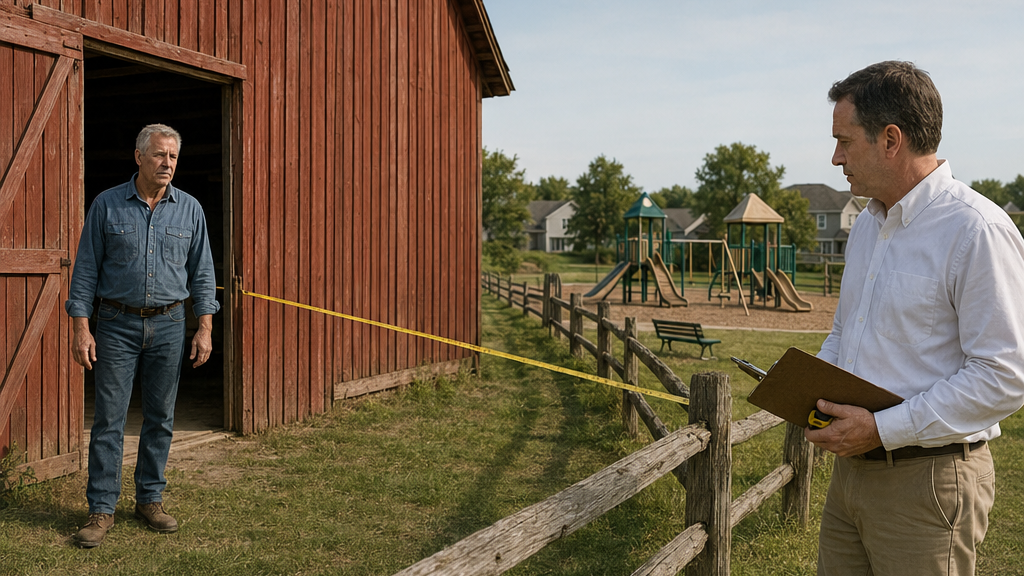
Donald Hill saw the yellow tape before he saw the notice.
It ran across the grass from the old split-rail fence toward the red barn, bright against the dull green like someone had drawn a line through his property without asking.
Jeffrey Martin stood beside the fence holding the tape housing in one hand and a clipboard in the other. He had already hooked the metal end around a fence post.
Donald came down from the barn doorway.
“What are you measuring?”
Jeffrey looked up. “Setback.”
“That fence?”
“The property line.”
Donald stopped several feet away.
Jeffrey pulled the tape tight, glanced at the number, then looked toward the barn wall. “Five feet, four inches.”
Donald stared at him.
The barn had stood there four years.
He had dug the post holes himself, framed the walls himself, spent half a summer climbing ladders after promising his knees he was done with that kind of work. He had gone to the county office before he poured a footing. He had filed what they asked for, waited for approval, and kept every piece of paper in a gray metal cabinet in his house.
Now a man with a tape measure was telling him the building had somehow moved.
“Five feet from what?” Donald asked.
Jeffrey tapped the fence post. “From the boundary.”
“No. I mean what survey point are you measuring from?”
Jeffrey’s expression tightened slightly. “The fence marks the boundary.”
“According to what?”
“The association site plan.”
Donald looked from Jeffrey to the fence.
The fence was older than the playground beyond it. Parts of it leaned. One post had been replaced with pressure-treated lumber that had not yet grayed like the rest.
“You have a registered corner?” Donald asked.
Jeffrey lowered the clipboard. “Donald, I’m not here to debate surveying standards.”
“Then don’t tell me where my property ends.”
Jeffrey let out a slow breath.
The adjoining neighbor had apparently filed a written complaint the week before. Donald had heard nothing about it until that morning. Jeffrey explained that the board had received renewed complaints about inconsistent enforcement—fences, sheds, parking pads, additions. If one owner got cited while another was ignored, the board heard about that too.
“We have to follow the covenants evenly,” Jeffrey said.
“Then follow them from the right line.”
“I’m following the records we have.”
Jeffrey unhooked the tape and let it recoil with a hard metallic snap.
Then he removed a white envelope from beneath the clipboard and handed it over.
Donald did not take it immediately.
“What’s that?”
“Formal notice.”
“For a measurement you just admitted isn’t from a survey point?”
“I said our site plan uses the fence as the boundary.”
“That isn’t the same thing.”
“It’s the record the association has.”
Donald finally took the envelope.
His name was printed across the front. The HOA logo sat in one corner.
Jeffrey’s voice remained even. “You have time to contest it.”
Donald tore the envelope open with his thumb.
The notice cited the setback provision and stated that an accessory structure appeared to violate the required distance from the property boundary. It gave him sixty days to correct the condition or provide documentation sufficient to overturn the finding. Continued noncompliance could result in fines.
Donald read the page twice.
“Correct the condition,” he said. “Meaning what?”
“If the barn is inside the setback, you’d need an approved remedy.”
“You mean move it.”
“I mean the board would need to review the options.”
Donald folded the paper once.
“You built a sentence so nobody has to say move the barn.”
Jeffrey’s jaw tightened.
“I didn’t write the covenant.”
“No. You just measured from a fence and decided it was law.”
For the first time, irritation showed clearly in Jeffrey’s face.
“You think I enjoy doing this? I’ve got residents telling us we ignore violations depending on who they belong to. We received a written complaint. I came out. I measured against the association map. I issued what the rules require.”
Donald glanced toward the barn.
The western wall caught the morning sun. The boards still showed faint saw marks from when he had cut them. Inside were his tools, a mower, lumber stacked for projects he had not gotten around to, and an old workbench he had rebuilt after retiring.
The idea of dismantling any part of it because someone had hooked a tape to a fence post felt ridiculous.
That feeling almost made him careless.
Almost.
He turned back.
“Show me the map.”
Jeffrey hesitated, then opened the clipboard and pulled out a reduced site sketch.
The lines were clean and simple. Lots, roads, common areas. A heavy line ran along Donald’s side yard.
“And where’s the survey reference?” Donald asked.
Jeffrey pointed. “That line is the parcel boundary.”
“That wasn’t my question.”
Jeffrey said nothing.
“No bearing? No monument number? No recorded coordinates?”
“This isn’t a boundary survey.”
There it was.
Not loud.
Not dramatic.
But Donald felt the entire argument shift half an inch under his feet.
“You issued a violation from a document that isn’t a boundary survey.”
“We issued it based on the association’s records and a field measurement.”
Donald looked at the yellow tape hanging from Jeffrey’s hand.
For a few seconds neither man spoke.
Then Jeffrey tucked the sketch back under the clip.
“If you have evidence that contradicts the map, submit it. I’ll review it.”
“And until then?”
“The notice stands.”
Donald gave a short, humorless laugh.
“You don’t know where the line is.”
“I know what our records show.”
“That’s not the same thing.”
Jeffrey did not argue.
He gathered the tape, checked that he had his clipboard, and walked toward the road.
At the edge of the driveway he stopped.
“For what it’s worth,” he said without turning fully around, “if the map is wrong, I want to know that too.”
Donald watched him leave.
He wanted to dismiss the entire thing as bureaucracy dressed up as certainty. He wanted to put the notice in a drawer and let Jeffrey discover how difficult it was to make a sixty-four-year-old man move a barn.
Instead, he went into the house.
The gray metal cabinet stood in the small room off the kitchen. Donald opened the bottom drawer and pulled out the folder marked with the property purchase documents.
Permit.
Building sketch.
Tax map.
Closing papers.
Then, beneath an old insurance declaration, he found the plat.
He spread it across the kitchen table and put Jeffrey’s notice beside it.
Donald traced the side dimension with one finger.
Then he got up, found a calculator, and checked it again.
The distance shown on the plat did not place the line where the fence stood.
Not even close.
Donald sat back down.
For the first time that morning, he stopped wondering whether Jeffrey’s measurement was wrong.
He began wondering which line everyone had been living with for years.
Chapter 2: The Notice Became More Expensive Than an Argument
By Wednesday morning, Donald’s sixty-day deadline had already become a number he could feel.
It sat on the kitchen table beside his coffee.
Fifty-eight days.
He had written the number in pencil at the top of the notice, then immediately regretted doing it. The page looked more official with his own countdown added.
The plat lay beside it.
According to Donald’s reading, the side boundary should have been farther toward the HOA common area than the fence. If he was right, the barn was fine.
He drove to the HOA office carrying copies of the plat and the original building permit.
Jeffrey met him in the small conference room.
Donald placed the documents down.
“There. County approved the barn.”
Jeffrey studied the permit.
“I never said they didn’t.”
“You said it violates the setback.”
“The building permit proves you were approved to build.”
“Exactly.”
Jeffrey shook his head.
“It doesn’t necessarily prove where the parcel boundary is.”
Donald felt irritation rise instantly. “You can’t have it both ways.”
“I’m not.”
Jeffrey turned the permit so Donald could see the stamped approval.
“This says the county approved the structure based on the submitted site information. It doesn’t say a licensed surveyor established the line.”
Donald pointed at the plat.
“That does.”
“That’s what we need to verify.”
“We?”
Jeffrey leaned back.
“If you want, the association can arrange a joint survey. We split the cost. If our map is wrong, we correct it.”
Donald stared at him.
“You send me a violation without knowing the boundary, then want me to pay half to prove you shouldn’t have sent it?”
“I’m offering a way to resolve it.”
“You’re offering to charge me for your mistake.”
“We don’t know yet that it’s our mistake.”
Donald gathered the papers.
“That sentence right there is why I’m not paying half.”
Jeffrey’s mouth tightened, but he did not stop him.
At the door, he said, “The deadline doesn’t pause unless the board has evidence.”
Donald turned.
“You have evidence. You have a plat.”
“We have two documents that don’t agree.”
Donald left before he said something that would make him feel good for ten seconds and cost him later.
He went directly to the county permitting office.
The clerk behind the counter pulled up the permit record and compared it with Donald’s copy.
“Yes, this was approved,” the clerk said.
“So the barn passed setback review.”
“It passed the permit review based on what was submitted.”
Donald heard Jeffrey’s wording in hers and disliked it immediately.
“But if the setback was approved—”
“The county doesn’t perform a boundary survey for every residential accessory structure.”
Donald frowned.
The clerk turned the screen slightly.
“The permit establishes that you had approval to build. It doesn’t independently establish your property corners.”
“So what does?”
“A boundary survey.”
Donald stood still.
He had expected the county file to end the argument. Instead, it had removed one of his strongest pieces of certainty.
He unfolded the plat.
“What about this?”
The clerk examined it.
“This may be perfectly valid. But if the question is where this line physically sits on the ground today, you’d want a licensed surveyor to retrace it.”
Donald thanked her and left with exactly the same papers he had arrived with.
Only now they seemed lighter.
That evening, he walked the length of the fence.
For years he had treated it the way everyone else did. Fence meant edge. His grass stopped there. HOA maintenance began on the other side. Children cut through toward the playground. Landscapers ran their machines along the common strip.
He had never challenged any of it because there had never been a reason.
That bothered him more than Jeffrey’s tape measure.
Maybe Jeffrey had assumed.
But so had Donald.
At the barn corner, he measured by eye toward the fence.
Then he looked past it.
Beyond the rails, the ground widened toward the playground. A mulch bed curved around the nearest bench. Farther back stood a swing structure and a climbing platform.
Donald remembered something.
Not clearly at first.
A flash of rust.
Years earlier, not long after he bought the property, he had been clearing weeds near the back edge. His shovel had struck metal. He had uncovered the top of a round iron pin set low in the soil.
At the time, he had assumed it was an old marker.
He had even mentioned it to the man who owned the property before him.
The man had said something like, “That’ll be one of the old corners.”
Donald had never checked.
Later, when the HOA replaced landscaping near the playground, mulch and soil had been spread over that area.
He stood beside the fence, trying to remember exactly where the pin had been.
Not along the fence.
Past it.
Several feet past it.
He went inside and pulled the plat out again.
This time he ignored the barn.
He traced the property line toward the rear corner.
Then his finger stopped near the part of the drawing that bordered the common parcel.
Donald looked through the kitchen window toward the playground.
The old iron marker, if it was still there, was somewhere on the other side of the fence.
Chapter 3: The Old Marker Pointed Past the Fence
Donald’s shovel struck metal at 8:17 Saturday morning.
The sound was small—one hard click beneath six inches of packed soil—but it stopped him immediately.
He knelt near the edge of the HOA mulch bed, pushed loose dirt aside with his gloved hand, and saw a circle of rust no wider than a quarter.
He sat back on his heels.
The fence was behind him.
Not inches behind him.
Several feet.
Donald took out his phone and photographed the spot before touching anything else.
Then he cleared only enough dirt to expose the top.
The iron pin was dark, scarred, and set firmly into the ground.
He stood and looked toward the barn.
From here, the visible fence line suddenly seemed less permanent than it had all week. It was just wood. Posts placed by somebody at some point for some reason.
The pin was something else.
Or at least he hoped it was.
Donald stretched a piece of mason’s string between two temporary stakes, using the general direction shown on his plat.
He did not pretend it was surveying.
He was trying to see.
The line ran away from the iron pin toward the front side of his property.
It did not follow the fence.
It angled inside the area everyone had been treating as HOA common ground.
And behind Donald, in the opposite direction, that same projected line seemed to point toward the outer edge of the playground.
A child shouted from the climbing structure.
Donald turned.
Parents sat on benches beyond the mulch bed. A little boy pumped his legs on a swing. Nobody paid attention to the older man kneeling beside a rusty piece of metal.
Donald suddenly felt foolish.
A week earlier he would have taken the marker as proof. He would have called Jeffrey and told him exactly where to put his violation notice.
Now the county clerk’s words stayed with him.
Physical line.
Licensed surveyor.
Retrace it.
Donald pulled the string down.
He called Jeffrey anyway.
Jeffrey arrived forty minutes later wearing jeans and a polo instead of the white shirt he usually wore for association business.
Donald pointed to the exposed pin.
“Remember asking for evidence?”
Jeffrey crouched without touching it.
“What is it?”
“You tell me.”
“I can tell you it’s an iron rod.”
“It’s where my old plat suggests the corner should be.”
Jeffrey looked toward the fence.
Then toward the playground.
His expression changed, but only slightly.
“How long have you known this was here?”
Donald did not like the question.
“I remembered it this week.”
“That isn’t what I asked.”
“I found it years ago. I didn’t need it then.”
Jeffrey stood.
“So you knew there might be a marker outside the fence when we talked Monday?”
“I knew I had seen an old pin somewhere back here. I didn’t know exactly where.”
Jeffrey brushed dirt from his hands.
“And you didn’t mention it.”
Donald felt the accusation land because there was enough truth in it to sting.
“You showed up with a violation already written.”
“And you decided I didn’t deserve information because you were angry.”
“I decided you shouldn’t be issuing legal-sounding orders from a tape measure.”
“That part may turn out to be right.”
The answer surprised Donald.
Jeffrey looked at the iron pin again.
“But this could be an old utility marker. It could belong to an earlier parcel configuration. It could be disturbed. Neither of us knows.”
Donald almost argued.
Instead, he stopped himself.
“What happens if it is the corner?”
Jeffrey followed the implied line with his eyes.
The playground sat beyond them.
“I don’t know.”
That was the first answer Donald had heard from him all week that sounded completely honest.
Jeffrey took a photograph.
“I’m going to send this to the board.”
“And the violation?”
“Still open.”
Donald laughed once.
“Of course.”
Jeffrey ignored that.
“If this turns out to be a valid monument, we’ll have a bigger mapping problem.”
Donald looked toward the children.
The phrase bigger mapping problem stayed with him.
After Jeffrey left, Donald remained by the pin.
His first feeling had been satisfaction.
He had found something Jeffrey’s site sketch did not show.
But satisfaction faded when he studied the geometry.
If the legal line really passed where the old pin suggested, this was no longer only about keeping his barn where it stood.
The fence might be wrong.
The common landscaping might be wrong.
Possibly part of the playground.
And Donald had no intention of making that claim based on string and memory.
He went inside and searched for local surveyors.
The first office could not come for five weeks.
The second did mostly commercial work.
The third transferred him to Timothy Scott.
Timothy listened while Donald explained the dispute.
Then he interrupted.
“Before you tell me where you think the line is, do you have the deed and recorded plat?”
“Yes.”
“Any prior surveys?”
“Not that I know of.”
“Visible monuments?”
“One iron pin.”
“Do not move it.”
“I haven’t.”
“Good.”
Donald looked through the window toward the red barn.
“How soon?”
“Next Friday for fieldwork, assuming I can pull the records before then.”
Donald hesitated when Timothy quoted the cost.
It was more than half of what Jeffrey had proposed as Donald’s share of a joint survey.
That fact irritated him in a way he could not blame on anyone else.
He could have agreed earlier.
He had refused because paying half had felt like admitting responsibility.
Now he was paying all of it because he needed an answer he could trust.
“Schedule it,” Donald said.
Timothy paused.
“One other thing. I don’t work for the result you want.”
“I know.”
“If that barn is over, I’ll tell you it’s over.”
Donald looked at the notice still lying on the kitchen table.
“And if it isn’t?”
“I’ll tell you that too.”
Donald gave him the property information.
After the call, he went back outside and covered the exposed pin loosely with an overturned orange bucket so nobody would step on it.
The bucket stood several feet beyond the old fence.
Beyond that, the playground swings moved back and forth in the afternoon air.
For the first time, Donald understood that the survey might clear his barn and still leave him with a problem much larger than the one he had started with.
Chapter 4: The Survey Line Kept Going Toward the Playground
Timothy Scott drove the first wooden stake into the ground six feet beyond the fence.
Donald said nothing.
He had spent the entire week imagining that moment, and in every version he had felt vindicated.
Instead, he felt his stomach tighten.
Timothy crouched over the survey instrument, checked the reading again, then walked several paces toward the barn with the prism pole.
“Don’t celebrate yet,” he said.
“I didn’t say anything.”
“You didn’t have to.”
Donald folded his arms.
The old iron pin sat uncovered near the orange bucket. Timothy had spent the first hour locating recorded references, checking bearings from the plat, and comparing them against two other monuments farther along the parcel.
He had refused to answer Donald’s questions while he worked.
Is the pin good?
Maybe.
Does the fence look wrong?
Possibly.
Is the barn safe?
Not enough data yet.
Every answer had irritated Donald until he finally understood that Timothy’s caution was not reluctance. It was discipline.
Now the first bright survey flag fluttered on the HOA side of the fence.
Timothy moved again.
A second flag went in.
Then a third.
They formed a straight line that did not care where the old fence stood.
Donald walked toward the barn corner.
“So?”
Timothy checked his field notes.
“The setback is measured from the legal boundary, not the fence.”
“I know that.”
“I’m reminding you because what matters is the boundary, not whether you and Jeffrey were right about each other.”
Donald looked away.
Timothy set the pole beside the barn, took another reading, and wrote something.
“How much clearance?” Donald asked.
Timothy looked at him.
“More than required.”
Donald waited.
“That’s it?”
“That’s the answer.”
The breath Donald released came out harder than he expected.
For nearly two weeks he had been carrying the image of someone ordering him to cut apart the building he had spent months constructing. The notice on his kitchen table had made the threat feel larger every time he walked past it.
Now Timothy had reduced the question to a few measurements.
The barn was legal.
Donald wanted to call Jeffrey immediately.
He reached for his phone.
“Wait,” Timothy said.
Donald stopped.
Timothy was staring toward the rear of the property.
“What?”
“I want to close the line.”
“The barn is clear.”
“The barn was your question. The boundary is my job.”
He picked up his equipment.
Donald followed.
The professionally established line continued past the barn, through the strip of grass Donald had long treated as somebody else’s responsibility.
Timothy placed another stake.
Then another.
The stakes marched toward the common area.
Donald’s satisfaction began to change shape.
At the old fence corner, Timothy crossed into the landscaping beside the playground.
A woman sitting on a bench looked over as he set another flag near a row of low shrubs.
“Are you with the HOA?” she asked.
“Surveying,” Timothy said.
She nodded as if that explained enough and turned back toward the children.
Donald watched the flag.
It was inside the maintained common area.
Not near its edge.
Inside it.
Timothy moved forward.
The next flag landed beside the mulch.
Donald felt a pressure behind his ribs.
“How far are you taking this?”
“To the rear corner.”
“That goes through the playground.”
Timothy looked at the recorded bearing, then toward the climbing structure.
“Yes.”
Donald stood still.
The yellow tape Jeffrey had stretched beside the barn had been easy to understand. Fence to wall. Five feet. Violation.
This was different.
The line was invisible until Timothy made it visible.
And once it appeared, it kept going.
A flag went in near a bench.
Another went behind the swing set.
Donald looked at the old fence behind them.
For years, that fence had separated his land from the community space so neatly that nobody had questioned it.
Now it looked almost absurd.
A physical object pretending to settle something it had never proved.
Timothy walked toward one of the concrete footings beneath the swing structure.
He took another reading.
Donald moved closer.
“Tell me that’s not what it looks like.”
Timothy lowered the pole.
“I’m not telling you anything until I finish.”
“That footing is on my side.”
“Possibly.”
“You just marked the line.”
“I marked a field point. Let me finish.”
Donald swallowed his irritation.
Children were still using the equipment.
That made the discovery feel stranger.
A girl crossed the projected line while running toward a slide. A parent pushed a toddler on a swing. None of them knew that the ground beneath them had just become disputed.
Timothy spent another forty minutes checking measurements.
Donald paced between the barn and the playground.
He called Jeffrey but got voicemail.
“This is Donald. Survey is underway. You need to come see this.”
He ended the call.
Timothy finally returned to the old marker, compared notes, then walked toward Donald.
“The barn is outside the required setback.”
Donald nodded.
“And?”
“The fence does not follow the recorded boundary.”
“I can see that.”
Timothy glanced toward the playground.
“The legal line extends into what the association is maintaining as common property.”
“How far?”
“I need to calculate the exact encroachment.”
Donald pointed toward the nearest bench.
“That’s over.”
“Yes.”
“The swing footing?”
“Yes.”
Donald stared.
“And the climbing structure?”
“Part of it appears to be.”
Donald let out a quiet breath.
He had imagined the survey ending the dispute.
Instead, it had moved the dispute twenty yards.
Jeffrey arrived near noon.
He walked from the parking area toward the flags, slowing after the third one.
“What am I looking at?”
Timothy introduced himself and explained only the technical facts.
He did not accuse.
He did not speculate.
He showed Jeffrey the recovered monuments, the recorded bearings, and the field points.
Jeffrey walked the line twice.
At the playground edge, he stopped.
“You’re saying this is Hill’s parcel?”
“I’m saying the record boundary is here.”
Jeffrey looked toward Donald.
Donald had expected excuses.
Instead, Jeffrey seemed pale.
“The compliance map shows the fence.”
“I know,” Donald said.
Jeffrey ignored the tone.
“Is there any chance the fence became the boundary later?”
Timothy shook his head. “Not from anything I’ve reviewed.”
Jeffrey rubbed a hand across his mouth.
“I need to call Sarah.”
Donald looked at him.
“You can withdraw the violation first.”
Jeffrey turned.
“The barn appears compliant. Yes.”
“Appears?”
Timothy spoke before Donald could.
“It is compliant.”
Jeffrey nodded once.
“Then I’ll withdraw it.”
The words should have felt like victory.
They did not.
Donald looked toward the playground.
“Before you call anybody,” he said, “how much of that is over?”
Timothy checked the distance between his last two readings.
“At the deepest point we’ve measured so far, roughly twenty-two feet.”
Jeffrey stared at him.
“Twenty-two?”
“Approximately. I’ll certify it after calculations.”
Donald followed the line with his eyes.
Twenty-two feet was not a technical mistake hidden in paperwork.
It was benches.
Mulch.
Concrete.
Permanent equipment.
A place the HOA had maintained for years as if ownership had never been in doubt.
Jeffrey took out his phone.
Donald looked back toward the barn, where the first bright survey flag stood beyond the fence that had caused everything.
His building was safe.
That question was over.
A larger one had taken its place.
How had an association strict enough to threaten a man over five feet built an entire playground twenty-two feet across a line it had never properly located?
Chapter 5: The Playground Plans Had Never Proved the Boundary
Sarah Ramirez had three folders open when Donald entered the HOA records room, and none of them contained the document he had asked to see.
She looked up.
“I found the playground construction file.”
“Survey?”
“No.”
“Recorded site plan?”
“A site plan.”
“That isn’t what I asked.”
“I know.”
Sarah pushed one sheet across the table.
Donald sat.
The drawing showed the playground, walking path, benches, landscaping, and fence. The property edge appeared as a clean straight line.
He leaned closer.
There were no bearings.
No monument references.
No surveyor’s seal.
Nothing tying the line to a point on the actual ground.
“This is a concept drawing.”
“That’s what it appears to be.”
“And they built from this?”
Sarah folded her hands.
“I’m still reconstructing that.”
Jeffrey stood near the file cabinet.
He had been quieter since the survey.
Donald looked at him.
“Your compliance map uses the same line.”
Jeffrey nodded.
“Yes.”
“From this drawing?”
“Not directly. My map is a later association map.”
“But it inherited the fence line.”
Jeffrey looked toward Sarah, then back at Donald.
“Yes.”
Donald leaned back.
For days he had imagined finding proof that somebody had known.
An email.
A warning.
A survey buried in a drawer.
Something that would turn the entire mess into a simple act of arrogance.
Instead, what sat in front of him was worse in a quieter way.
Nobody had checked.
Sarah opened another folder.
“The playground was installed more than twelve years ago. The board at the time hired a contractor. The contractor drawings reference the association site plan.”
“The one with no survey.”
“Yes.”
“Did anyone verify ownership?”
“I can’t find evidence that they did.”
Donald looked at the paper again.
A straight line on a page had become a fence.
The fence had become a boundary.
The boundary had become policy.
Then policy had become a violation notice against him.
At the board meeting that evening, the certified survey lay in the center of the table.
Timothy’s line was no longer a row of temporary flags.
It was a formal record.
Donald watched Jeffrey slide the original barn violation toward himself.
“I’m withdrawing this effective today.”
One of the unnamed board members glanced at him.
“Can we do that before legal reviews the survey?”
Jeffrey answered without hesitation.
“The setback finding was based on an incorrect boundary assumption. The barn complies. There’s nothing to enforce.”
Donald looked at him.
Jeffrey did not ask for credit.
That surprised him.
Two weeks earlier, Donald had thought Jeffrey would fight any fact that embarrassed the board.
Instead, Jeffrey had become the first person at the table willing to say the simplest part aloud.
They were wrong about the barn.
Sarah turned to the next issue.
“The playground is different.”
Donald felt his jaw tighten.
“Different how?”
“Not in terms of the survey. In terms of remedy.”
“Your structures are on my property.”
“We understand that.”
“Then move them.”
Sarah held his gaze.
“Immediately?”
“Yes.”
Jeffrey shifted in his chair.
Sarah opened a spreadsheet.
Donald almost laughed.
“What’s that supposed to do?”
“Show you what immediate relocation means.”
“I know what it means.”
“I don’t think you do.”
She turned the page toward him.
The HOA had money in reserve, but much of it was already allocated to drainage repairs, resurfacing, and replacement of aging common-area equipment.
Relocating the playground all at once would consume most of what remained uncommitted.
“Then raise dues,” Donald said.
“That may be what happens.”
“Not my problem.”
Sarah’s expression changed.
Not anger.
Something closer to fatigue.
“You’re right.”
The answer disarmed him.
She continued.
“It isn’t your responsibility to absorb our error. But I’m responsible for understanding what correcting it does to everyone else.”
Donald looked around the table.
Nobody was smirking.
Nobody was pretending the survey did not exist.
That made his anger harder to use.
One board member asked whether the equipment could be shifted within the common parcel instead of replaced.
Sarah said they needed contractor estimates.
Another asked about removing only the encroaching portions.
Jeffrey shook his head.
“You can’t treat the legal line as optional because the fix is expensive.”
Donald looked at him again.
There it was—the second surprise.
Jeffrey, the man who had started the entire thing with a yellow tape measure, was now arguing for the corrected boundary more firmly than Sarah.
Sarah closed the spreadsheet.
“I’m not saying we ignore it.”
“You’ve known your records were bad?” Donald asked.
The room went still.
Sarah did not answer immediately.
“I knew the old site files were incomplete.”
“How long?”
“Since last year.”
Donald stared at her.
“You knew.”
“I knew we were missing some original development documents. I did not know the playground crossed onto your parcel.”
“You didn’t think it was worth checking?”
Sarah’s mouth tightened.
“We have incomplete records all over this development. Old drainage notes. Landscaping agreements. Utility references. You don’t reopen every file because something might be wrong.”
“You do before you accuse somebody else.”
“That part I agree with.”
Donald sat back.
The anger came fast now because this piece was close enough to what he had imagined.
“You let Jeffrey issue that notice knowing your records weren’t complete.”
Sarah looked at Jeffrey.
“I didn’t know what he was measuring from until after the complaint was already in process.”
Jeffrey spoke quietly.
“That’s on me.”
Donald turned.
Jeffrey did not look away.
“I treated the compliance map as if the boundary had already been established. I shouldn’t have.”
The room was silent.
Donald had wanted that admission.
Now that he had it, it felt smaller than expected.
Sarah opened another file.
“The HOA attorney has reviewed the survey. We need to resolve the encroachment formally.”
“Good.”
“He’ll contact you.”
“For what?”
“To discuss options.”
“I’ve already told you my option.”
Sarah glanced toward the playground through the meeting-room window.
Children moved between the swings and slide under the parking-lot lights.
“Donald, I’m asking you not to decide the remedy tonight.”
“You decided mine before you had a survey.”
Jeffrey looked down.
Sarah absorbed the remark.
“Yes,” she said. “And that was wrong.”
Again, the lack of resistance left Donald with nowhere easy to push.
The meeting ended without a relocation vote.
The barn violation was gone.
That should have been enough for one night.
But the next afternoon, Donald received a call from the HOA attorney.
The attorney’s voice was measured.
“We accept the certified boundary for purposes of discussion.”
Donald stood at his kitchen window looking toward the playground.
“There isn’t much to discuss.”
“There may be.”
“How?”
“Would you consider granting the association an easement over the existing playground area?”
Donald looked at the line of bright survey stakes running across the grass.
For the first time since Timothy had planted them, he understood that proving where the boundary belonged had not decided what he was going to do with it.
Chapter 6: The Easement Offered Him Victory Without Repair
The easement agreement was twelve pages long.
Donald read the first two paragraphs and pushed it away.
The HOA attorney sat across from him at the kitchen table.
Beside the agreement lay Timothy’s certified survey.
On one document, the disputed strip was shaded.
On the other, it belonged to Donald.
The attorney folded his hands.
“You should have your own counsel review it.”
“I’m not signing it.”
“You haven’t read it.”
“I read enough.”
The proposal would grant the HOA permanent use of the encroaching playground area in exchange for compensation, maintenance obligations, and formal recognition that Donald retained underlying title.
Donald tapped the survey.
“You spent two weeks telling me the line didn’t matter. Now you want permanent rights across it.”
“The association is acknowledging the line.”
“And asking me to make the mistake permanent.”
“That’s one way to characterize it.”
“It’s the accurate way.”
The attorney did not argue.
Sarah sat at the far end of the table. She had asked to attend because the financial terms came from her reserve planning.
Donald looked at her.
“How much cheaper is this than moving it?”
“A lot.”
“That’s why you’re here.”
“It’s one reason.”
Donald turned back to the attorney.
“No.”
The attorney closed the agreement but did not put it away.
“If the playground must be removed immediately, it may remain closed for months.”
“That is not my doing.”
“No.”
Donald waited for the qualification.
None came.
Sarah spoke instead.
“The contractor says there isn’t enough usable common area to relocate everything without regrading and moving drainage.”
Donald looked through the kitchen window.
From here, the survey stakes were easy to see.
The fence had become visually irrelevant.
“I didn’t build your playground.”
“No,” Sarah said.
“I didn’t draw your map.”
“No.”
“I didn’t send myself a violation.”
Sarah’s jaw tightened.
“No.”
“Then stop explaining consequences to me like I created them.”
The attorney shifted in his chair.
Sarah looked down at the closed easement.
When she spoke again, her voice had changed.
“I knew we had bad records.”
Donald said nothing.
She continued.
“Not that the playground was over. I didn’t know that. But last year, when we were reviewing reserve assets, I couldn’t find original survey support for several common areas.”
Donald stared at her.
“Why didn’t you fix it?”
“Because every correction costs money.”
“That’s your answer?”
“It’s the ugly answer.”
She rubbed one thumb along the edge of the table.
“We had drainage work coming due. Pavement. Insurance increases. I told myself the old common-area layouts had been there for years and nobody had challenged them, so we could prioritize things we knew were failing.”
Donald looked at her for a long moment.
“You knew there might be gaps.”
“Yes.”
“And when I got cited?”
“I thought Jeffrey was dealing with a normal setback complaint. By the time I understood the boundary question, you had refused the joint survey and both sides were dug in.”
Donald felt irritation flicker.
“My refusal didn’t put your playground there.”
“No.”
“It didn’t make Jeffrey measure from the fence.”
“No.”
Sarah looked directly at him.
“But it did make the answer take longer.”
That landed because Donald had already thought the same thing.
He had refused half a survey because half a survey felt like half an admission.
Then he had paid the full cost himself.
The attorney said nothing.
Donald looked down at the agreement.
For days after Timothy’s survey, Donald had imagined the cleanest possible ending.
The HOA had told him to move something.
He would tell them to move something.
Simple.
Balanced.
Fair.
But simplicity had begun to feel suspicious.
The children using the playground had not drawn the bad map.
The current board had not installed the equipment.
Jeffrey had made a reckless assumption, but he had withdrawn the violation once facts replaced it.
Sarah had avoided a records problem because she feared the financial consequences of discovering exactly the kind of problem now sitting on Donald’s table.
Nobody was innocent.
But nobody was the single villain he had wanted.
The attorney slid the easement back toward him.
“You don’t need to decide today.”
“I already decided.”
Donald pushed it back.
“No permanent easement.”
Sarah exhaled.
The attorney nodded once.
“Then we’ll proceed with removal planning.”
Donald looked toward the playground again.
“How long?”
“Unknown.”
Sarah answered.
“If everything has to come out at once, likely several months between engineering, permits, site work, and funding approval.”
“And the whole playground closes?”
“Probably.”
Donald walked to the window.
A survey stake stood beside the nearest bench.
It marked his land.
That fact mattered.
He would not erase it because the HOA found its mistake expensive.
But another thought had been bothering him since the board meeting.
Ownership was not the same as punishment.
He turned around.
“I won’t give you an easement.”
“We understand,” the attorney said.
“But I’ll consider temporary access.”
Sarah looked up.
“For what?”
“For moving the equipment.”
The attorney leaned forward.
Donald raised a hand.
“Temporary. Written expiration. No ownership claim. No permanent structures left on my side when it ends.”
Sarah’s expression sharpened.
“You’d let us phase the relocation?”
“If the contractor can keep part of the playground open while the rest moves.”
The attorney opened his notebook.
Donald stopped him.
“I said I’ll consider it.”
“What else?”
Donald looked at Timothy’s survey.
“The corrected boundary gets recorded and reflected on every association map before I sign anything.”
Sarah nodded slowly.
“And the violation?”
“Already withdrawn,” Jeffrey’s absence seemed to say from the empty fourth chair.
Donald folded the easement proposal once and slid it back across the table.
“You wanted permanent permission to stay on my land.”
He tapped the certified line with one finger.
“I’m offering temporary permission to get off it.”
Chapter 7: They Could Move the Playground Without Moving the Truth
“I’m not selling the strip.”
Donald said it before the HOA attorney finished opening his folder.
The board meeting room went quiet.
Sarah Ramirez had spreadsheets arranged in front of her. Jeffrey Martin sat two seats away with the corrected survey map beside his notebook. The playground contractor had brought a rolled site drawing that extended halfway across the table.
Donald placed Timothy Scott’s certified survey in front of him.
“The boundary stays where the survey puts it,” he said. “No permanent easement. No sale.”
One of the board members shifted in his chair.
“Then what exactly are we voting on?”
“A way to move what doesn’t belong there without shutting everything down at once.”
Sarah looked at Donald carefully.
That was different from the man who had told her immediate removal was not his problem.
Donald knew she heard the difference.
He also knew he did not owe anyone an explanation for it.
The contractor unrolled the revised playground plan.
“We can rotate the swing structure and shift the benches inward,” he said. “The climbing unit is harder. Part of the fall zone crosses the boundary, so we’d have to move the entire unit.”
“How long?” Sarah asked.
“If we phase it? Six to eight weeks, depending on inspections.”
“And if we do everything at once?”
“Playground closes completely.”
“For how long?”
The contractor shrugged. “Could be months.”
Donald studied the drawing.
A heavy line now marked his legal boundary. Unlike the old association sketch, this one showed survey references and permanent monuments.
The line no longer depended on a fence.
Sarah pointed to a shaded area.
“To move the climbing structure, crews need temporary access from Donald’s side.”
Donald nodded.
“That’s what I’m offering.”
The attorney leaned forward.
“A temporary construction license.”
“With an expiration date.”
“Yes.”
“No automatic renewal.”
“We can write that.”
“No language that creates future access rights.”
“Agreed.”
Donald looked around the table.
“And when the work is finished, everything on my side comes out. Concrete, mulch edging, benches, all of it.”
Sarah tapped her pen.
“That adds cost.”
Donald looked at her.
“I’m not negotiating the boundary.”
“I know.”
Her answer came without the resistance he expected.
That made the room easier to breathe in.
Jeffrey turned the revised map toward himself.
“The compliance maps should be corrected before any work starts.”
Sarah looked at him.
“We can do both simultaneously.”
“No.”
Jeffrey’s voice was calm.
“The wrong map is how this started.”
Donald watched him.
Jeffrey continued.
“If we leave the old line in the system another month, someone could pull it up tomorrow and make another decision from it. Correct it first.”
One board member frowned.
“That delays construction.”
“By a few days.”
Sarah looked down at her numbers.
Donald realized Jeffrey was arguing Donald’s position more firmly than Donald needed him to.
“I agree with Jeffrey,” Donald said.
Jeffrey glanced over.
It was the first time Donald had said those words since the dispute began.
Nobody smiled.
That made the moment feel more genuine.
Sarah turned to the financial sheet.
“There’s something else residents need to understand.”
The reserve impact.
The revised phased plan cost less than full demolition and replacement, but not enough to make the expense painless. Some drainage work would be delayed. A modest assessment might still be needed.
“You’ll have people angry,” Donald said.
“I already do.”
“Some of them will blame me.”
Sarah did not deny it.
“Probably.”
Donald rubbed his thumb along the edge of the certified survey.
Several weeks earlier, that possibility would have hardened him.
Let them blame me.
It was my land.
Both things remained true.
But now he understood what Sarah had been trying to protect, even if she had protected it badly. Every correction landed somewhere. There was no version where the board admitted its mistake and money appeared from nowhere.
He looked toward the contractor.
“Can most of the equipment stay?”
“Yes. If the board approves this layout.”
“And the playground can remain partly open?”
“We’d close sections as we work.”
Donald nodded.
“That’s the condition.”
The attorney began writing.
Donald stopped him again.
“One more.”
The room waited.
“The new boundary pins stay visible until the permanent fence work is finished.”
Sarah frowned slightly.
“Why?”
“Because everyone has spent years looking at the wrong line.”
He pointed to the map.
“I want the right one visible while the correction happens.”
Jeffrey nodded.
“Reasonable.”
Donald almost laughed at the word.
Reasonable had been missing from the first morning beside the barn.
The attorney drafted the essential terms aloud: limited construction access, no permanent property interest, no prescriptive claim, defined start and end dates, restoration of Donald’s land, recorded corrected mapping.
When he finished, the board moved to the relocation vote.
Before anyone spoke, Jeffrey raised his hand.
“I want something in the minutes.”
Sarah looked at him.
“What?”
“That the original barn violation was issued using an association map that did not establish the legal property boundary. The violation was withdrawn because the survey confirmed the barn complied.”
Donald looked at him.
Jeffrey kept his eyes on the board.
“I made the enforcement decision,” he said. “That needs to be part of the record too.”
No excuse followed.
No explanation about resident pressure.
No reminder that Donald had refused the joint survey.
Just responsibility.
Donald felt something loosen that had nothing to do with property.
The vote passed.
Not unanimously.
One board member objected to the cost. Another wanted more time.
But the majority approved the phased relocation, corrected mapping, temporary construction license, and permanent boundary documentation.
Sarah sat back after recording the vote.
“That’s going to be an unpleasant letter to homeowners.”
Donald gathered his survey.
“You’ll survive it.”
She gave him a tired look.
“So will you.”
Outside, the playground was empty for the evening.
Donald and Jeffrey walked toward the property edge.
The bright temporary flags still traced Timothy’s line.
Near the old fence corner, a new capped survey pin had been set flush with the ground.
Jeffrey stopped beside it.
“I should have asked the question you asked me.”
Donald knew which one.
What point are you measuring from?
“Yes,” he said.
Jeffrey looked toward the barn.
“You also could’ve mentioned that old pin sooner.”
Donald felt the old instinct rise—to defend himself, explain the notice had already been written, remind Jeffrey who started it.
He let the instinct pass.
“Yes,” he said.
Jeffrey nodded once.
Nothing was repaired by pretending only one of them had been stubborn.
The next morning, the association filed the corrected site mapping.
Two days later, Donald signed the temporary construction license.
A week after that, the first crew arrived.
Before machinery touched the playground, the contractor ran a string between Timothy’s permanent survey points.
This time the line was not an accusation.
It was an instruction.
Everything on one side could stay.
Everything on Donald’s side had to move.
Chapter 8: The New Fence Followed a Line Everyone Could Finally See
The last concrete footing came out of Donald’s ground on a cold Tuesday morning.
The excavator lifted the broken cylinder from the soil and set it onto a trailer beside the relocated swing hardware.
Donald watched from the barn doorway.
The playground had reopened the week before. The climbing structure sat farther inward now, the benches faced a slightly smaller grass area, and the new fence followed Timothy’s recorded boundary instead of the old assumed one.
Jeffrey crossed the yard carrying a thin folder.
He handed it to Donald.
Inside was the original violation notice, a withdrawal letter, and the corrected association map.
“Thought you should have the complete file.”
Donald looked at the old notice.
Five feet, four inches.
Sixty days.
All that certainty from the wrong starting point.
He closed the folder.
“Thanks.”
Jeffrey nodded toward the new fence.
“Looks different.”
“It is different.”
“No argument there.”
Donald almost smiled.
Across the line, children were already running toward the reopened playground.
The HOA had paid for the correction. Homeowners had absorbed part of the cost. Some neighbors still avoided Donald. Others waved again. Sarah had delayed one drainage project but kept the reserve from collapsing.
Nobody had escaped the mistake untouched.
Donald walked to the new gate.
A permanent survey pin sat beside the post, visible and undisturbed.
Months earlier, he had wanted the line to prove that he was right.
Now it meant something quieter.
Everyone knew where it was.
He swung the gate shut until the latch settled against the post.
For the first time, the fence followed the truth instead of pretending to be it.
The story has ended.