He Cut Down One Farmer’s Gate, Then Learned Who Controlled the Valley’s Summer Water
Chapter 1: The Morning They Cut His Farm Gate
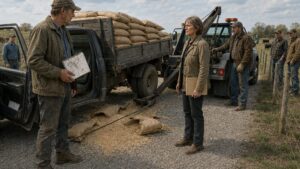
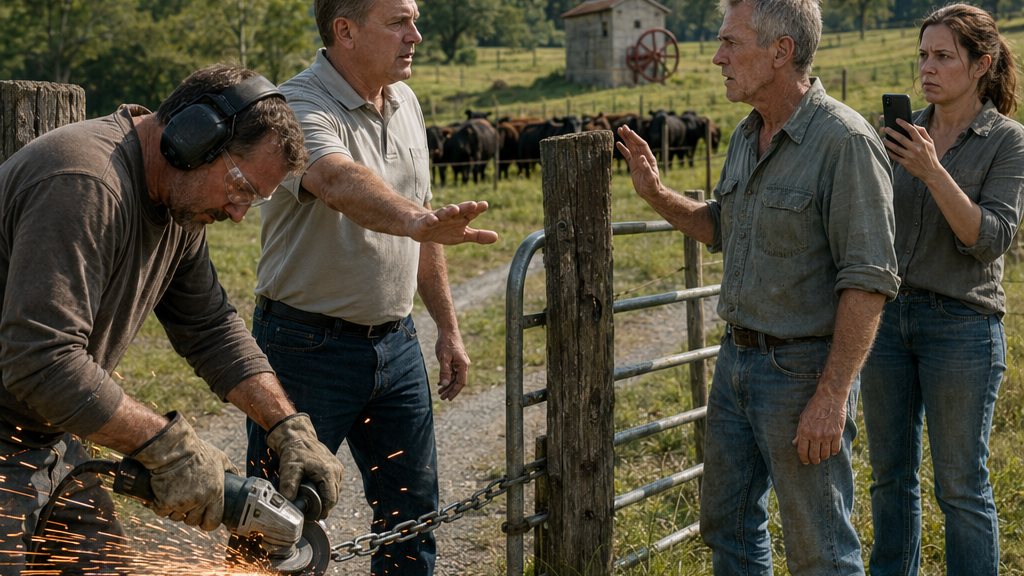
The grinder hit the galvanized chain at 8:17 Saturday morning.
Orange sparks scattered across Frank Carter’s gravel entrance and died in the weeds beneath the cedar post. His cattle lifted their heads from the lower pasture at the sudden metallic scream.
Frank crossed the yard before the contractor had made it halfway through.
“Stop.”
The man eased off the trigger.
Eric Moore stood beside the association pickup with a folded sheet of paper under one arm. He wore clean work boots that had not yet collected dust from the lane.
“Frank,” he said, “we sent you two notices.”
“That isn’t what I said.”
Frank pointed at the grinder.
“I said stop.”
The contractor looked between them.
Eric unfolded the paper. “The association voted to clear obstructions along the agricultural access lane. Your gate narrows the approach.”
“My gate doesn’t sit in your lane.”
“It affects access.”
“That wasn’t the question.”
Frank could feel his pulse in his jaw. The gate had hung there since his father replaced the original wooden one almost thirty years ago. Feed trucks had passed it. Hay wagons had passed it. A volunteer fire tanker had once backed through during a brush fire without touching either post.
Eric tapped the notice.
“You had time to respond.”
That landed harder than Frank wanted it to.
The first notice had sat unopened beside the coffee maker for four days. The second he had read, folded twice, and left beneath a cattle invoice.
He had meant to answer.
Then he had decided the whole thing was foolish enough not to deserve one.
Jessica came down from the equipment shed, wiping grease from her hands.
“What are they doing?”
“Apparently improving the neighborhood,” Frank said.
Eric’s face tightened. “This isn’t personal.”
Jessica stared at the grinder.
“You’re cutting our gate off.”
“The association has an access obligation.”
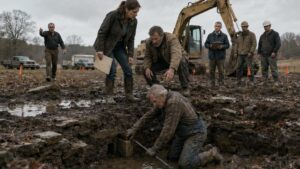
Frank walked to the edge of the gravel and pushed his boot through a strip of flattened grass. He scraped until rusty metal showed beneath the dirt.
A survey pin.
He crouched and brushed it clean.
“There.”
Eric did not move.
Frank pointed from the pin toward the lane.
“Your recorded easement runs that side.”
Then he pointed toward the cedar post.
“This is mine.”
The contractor lowered the grinder.
Eric glanced at the pin and then at the paper in his hand.
“It isn’t that simple.”
“It looks fairly simple from down here.”
Jessica pulled out her phone.
Eric noticed.
“Don’t turn this into a show.”
“She’s documenting what happens on our property.”
Frank stood slowly.
For a moment, nobody spoke. Somewhere beyond the pasture, a diesel engine labored up the county road.
Frank looked at the contractor.
“I’m not asking you to argue property law. I’m asking who told you to cut it.”
The man nodded toward Eric.
Frank turned.
“Eric, I want you to say it plain. Are you ordering him to remove my gate?”
Eric’s expression changed almost imperceptibly. There was still confidence in it, but now calculation too.
“The board authorized removal of obstructions.”
“Not what I asked.”
Jessica kept the phone steady.
Frank waited.
Eric exhaled.
“Yes. As chairman, I’m directing the contractor to remove it.”
Frank nodded once.
Then he stepped backward.
Jessica looked at him.
“Dad?”
“Let him finish.”
Her eyes widened. “You can’t be serious.”
“I’m serious.”
The grinder started again.
This time Frank did not speak.
The chain snapped with a hard metallic crack. One loose end slapped against the cedar post. The contractor removed the hinges next, then lifted the long galvanized gate with another worker and carried it toward the truck.
Frank watched the opening appear where the gate had been.
It felt larger than it was.
Not because cattle could get out—the interior fence still held—but because a line Frank had always considered obvious had just been treated as negotiable.
Eric folded his paper again.
“We can discuss reimbursement if the survey establishes—”
“It already did.”
“I mean a current survey.”
Frank looked at the exposed pin.
“You knew enough to bring a grinder.”
Eric’s mouth hardened.
“The insurance inspection was clear. We have to keep access open.”
That was the first thing Eric had said that sounded less like authority and more like worry.
Frank caught it, but his anger was too fresh to examine it.
A feed truck appeared at the bend and slowed where the gate had stood. It passed without difficulty, tires crunching over the gray gravel.
Eric watched it go.
Frank did too.
Neither man mentioned what they had just seen.
When the contractor’s truck finally pulled away, the severed chain remained in the grass. Frank picked it up. The cut end was still warm.
Jessica followed him toward the barn.
“We should call an attorney.”
“Maybe.”
“Maybe?”
“They came onto our land with a grinder.”
“I noticed.”
“You’re acting like you don’t care.”
Frank stopped.
“I care enough not to decide what comes next while I’m mad.”
Jessica folded her arms.
“That’s new.”
He gave her a look.
She did not apologize.
From the barnyard, Frank could see across the lower hayfield toward the small concrete pump house beside the tree line. A rust-red iron valve wheel protruded from the main pipe outside it, faded by decades of rain and sun.
His father had painted it twice when Frank was a boy. The color never lasted.
Frank stared at it longer than he meant to.
Jessica followed his gaze.
“What?”
He looked back at the severed chain in his hand.
“Go into the office.”
“For what?”
“The old pump-house files.”
She frowned. “Why?”
“Because I haven’t looked at them in years.”
Twenty minutes later, Frank sat at the scarred wooden desk behind the machinery shed while Jessica worked through the bottom drawer of an old steel filing cabinet.
Tax records. Pump invoices. Well tests. Easement maps.
Then she pulled out a thick tan folder held together by a black binder clip.
The handwriting on the front belonged to Frank’s father.
AGRICULTURAL WATER AGREEMENT.
Jessica set it on the desk.
Frank rested the cut chain beside it.
For the first time that morning, his anger became something colder and more precise.
He opened the folder.
Chapter 2: The Agreement Nobody Remembered to Renew
The signature page was there.
The renewal page was not.
Frank turned backward, then forward again, certain two sheets had stuck together.
Nothing.
Jessica leaned over his shoulder.
“What are you looking for?”
“The extension.”
“What extension?”
“The agreement renewed every five years.”
He flipped through the papers a second time.
There were handwritten notes from his father, old pump-maintenance receipts, maps of the trunk line and amendments covering electricity costs. The latest formal lease had begun five years earlier.
Frank found the expiration clause.
March 31.
Four months ago.
He read it twice.
Jessica read it once.
“You’re telling me they don’t have a current contract?”
“I’m telling you I can’t find one.”
“That sounds like the same thing.”
“No.”
Frank closed the folder.
“It sounds like we check.”
By early afternoon, they had opened every relevant drawer in the office. No renewal appeared. Frank searched his email, though the association had historically handled the agreement on paper. Jessica checked the farm accounting records.
There had been no new lease payment.
The annual amount had always been laughably low. Frank’s father had written the original terms when only a handful of neighboring farms drew water during dry months. Later owners were added, then more acreage.
Frank had never pressed the issue.
His father had called the arrangement neighbor water.
“You don’t get rich selling a man rain when the sky won’t give him any,” he used to say.
Frank had inherited that attitude along with the pump house.
He had also inherited one instruction.
Never strand somebody’s crop over a quarrel.
At three, Frank drove to the county records office.
The clerk brought up the recorded easement plat on a monitor and rotated it so Frank could see.
The shared agricultural lane followed the gravel bed from the county road, widened at the bend, then continued between two parcels.
Frank touched the screen near his entrance.
“And that line?”
“Property boundary.”
“The easement?”
She indicated a parallel marking several feet away.
Frank said nothing.
The gateposts stood outside it.
He asked for a certified copy.
On the drive home, satisfaction settled over him so quickly it bothered him.
Eric had been wrong.
Not arguably wrong. Not neighbor-dispute wrong.
The recorded line put the gate on Frank’s acreage.
Yet the deeper satisfaction came from the folder on the passenger seat.
That part bothered him more.
At the pump house, Frank unlocked the steel door.
The air inside smelled of mineral water, dust and warm electrical equipment. The pump controls hummed steadily.
Outside, the main line emerged from the wall and split toward the association system.
The old iron wheel sat above the shutoff.
Frank wrapped one hand around it.
It resisted when he tested it.
He pushed harder.
A faint metallic groan came from the stem.
Jessica, standing behind him, said, “You could turn it.”
Frank released the wheel.
“I know.”
“They cut your gate.”
“I know that too.”
“They’re using your water without a contract.”
“That’s what it looks like.”
Jessica stepped closer.
“So what exactly are we waiting for?”
Frank looked across the fields.
The trunk line disappeared beneath the grass beyond his boundary, carrying spring water toward farms scattered along the valley.
He could picture Eric’s face at the gate.
Yes. As chairman, I’m directing the contractor to remove it.
Frank put both hands in his pockets.
“We’re waiting until I know what shutting this does.”
“You already know.”
“No. I know what the valve does.”
That silenced her.
Back in the office, he spread the agreement beside the certified easement plat.
The old lease did not guarantee permanent service. It allowed use of Frank’s privately owned pumping system under defined terms, with renewal requiring written agreement from both sides.
There was no automatic extension clause.
No renewal.
No current payment.
Frank called the association office.
No answer.
He left no message.
That was an old habit, and he knew it even while doing it.
He told himself he was gathering facts first.
The truth was less comfortable.
Part of him wanted Eric to discover the problem the hard way.
Near dusk, Frank walked back to the gate entrance.
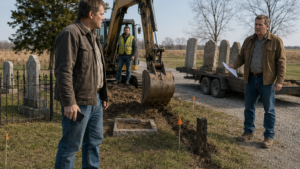
The opening looked wrong. The contractor had taken the gate but left shallow hinge scars in the cedar posts.
The severed chain lay on his desk now, beside the documents.
A clean physical fact.
Eric had ordered it.
Frank had the recording.
The county had the boundary.
And the association had apparently let its water agreement expire.
For a few minutes, Frank imagined the simplest response.
A termination notice.
Then the iron wheel.
One turn until the line went silent.
Eric could explain that to everybody else.
The thought felt good for perhaps five seconds.
Then Frank heard his father’s voice in memory.
Never strand somebody’s crop over a quarrel.
Frank disliked that the dead could still interrupt a satisfying idea.
Jessica appeared in the doorway carrying two glasses of iced tea.
“You find anything else?”
“Yes.”
She handed him one.
“What?”
“They’re more exposed than I thought.”
She looked almost pleased.
Frank wasn’t.
He opened a blank document on the computer.
At the top he typed the association’s name.
Below it:
NOTICE OF TERMINATION OF PERMISSIVE IRRIGATION SERVICE.
Jessica read over his shoulder.
“So you are doing it.”
Frank began typing.
“I’m giving notice.”
“What happens after that?”
He looked through the office window toward the pump house, where the rust-red valve wheel was barely visible in the fading light.
“That depends on how many people are standing behind that one valve.”
Chapter 3: Forty-One Farms Behind One Valve
Eric Moore called the notice a bluff before Frank had even finished his morning coffee.
“You’re not shutting irrigation off in July.”
Frank held the phone away from his ear for a moment.
“Good morning to you too.”
“This isn’t funny.”
“I didn’t send anything funny.”
“You’re using water to retaliate over a gate.”
“You’re using water under an expired agreement.”
A pause.
Then Eric said, “That agreement has rolled forward for years.”
“Show me where.”
“We’ve always renewed.”
“Show me this year.”
Another pause.
Shorter this time.
“We’ll have counsel look at it.”
“You should.”
Eric’s voice tightened. “If you interfere with member farms, you’re going to create damages that dwarf whatever you think happened Saturday.”
Frank looked through the kitchen window toward the empty gateway.
“I know exactly what happened Saturday.”
He ended the call before Eric could answer.
By noon, Frank learned that Eric had been right about one thing.
The scale was bigger than the gate.
Jessica obtained the association’s latest irrigation assessment sheet from Amanda Green, the treasurer. Frank expected perhaps fifteen active users.
There were forty-one parcels.
He read the number twice.
“Forty-one?”
Jessica nodded.
“Some small. Some seasonal.”
“When did that happen?”
“Apparently while you were accepting the same check every year and never asking.”
That irritated him because it was true.
The original system had served six farms.
Expansion had happened gradually: a branch extended here, another meter added there, acreage divided between family members, former pasture planted in produce.
Frank had maintained the pump and main trunk but had paid little attention beyond the meter leaving his land.
Silence again.
He had thought leaving people alone was the same thing as managing something fairly.
Amanda arrived that afternoon in a dust-covered pickup.
She did not come to defend Eric.
That almost made it worse.
“You really mean to close the main line?” she asked.
“I sent notice.”
“That isn’t what I asked.”
Frank recognized the phrasing and almost smiled.
He didn’t.
“I haven’t decided what happens after the notice period.”
Amanda nodded toward her truck.
“Come ride with me.”
They drove less than a mile.
Her orchard sat on a south-facing slope where rows of young apple trees followed the contour of the land. Their leaves were still green, but some had begun curling inward at the edges.
Amanda parked between two rows.
“These went in last spring.”
Frank stepped out.
The soil beneath his boot broke apart like dry cake.
“We’ve had worse Julys.”
“Not with trees this young.”
She pulled one branch gently toward her and showed him the leaves.
“I supported the access changes.”
Frank looked at her.
“I know.”
“I thought Eric was talking about keeping the lane clear. Feed trucks. Fire equipment. Big machinery.”
“He was.”
“I never voted to cut your gate.”
“You voted for the policy that gave him room to think he could.”
Amanda let go of the branch.
“That’s fair.”
The absence of argument unsettled Frank more than denial would have.
She looked down the rows.
“If you need to stop the water because there’s no legal agreement, then say that. But don’t pretend forty-one parcels are Eric Moore.”
“I’m not pretending anything.”
“Aren’t you?”
Frank did not answer.
A drip emitter clicked faintly near his boot.
Amanda continued.
“If this line stops completely for a week, I can truck enough water to keep some of these alive. Not all. The vegetable growers downstream have less room than I do.”
Frank stared toward the ridge.
He had pictured Eric opening a dry valve.
He had not pictured Amanda choosing which trees to save.
That evening he went back to the pump house with the association map spread across the workbench.
For years, the diagram had meant maintenance: line sizes, branch valves, pressure zones.
Now it looked like a list of consequences.
Jessica stood across from him.
“You’re changing your mind.”
“I’m learning what the decision is.”
“That sounds like changing your mind.”
“It might be.”
She traced one branch with her finger.
“This feeds the association barn and common wash rack.”
Frank nodded.
“And this?”
“Old equipment lot.”
“This one?”
“Three farms, I think.”
They worked through the system until after dark.
Several branches could be isolated independently. Others could not. The main line pressure could also be reduced without shutting the system completely, though nobody had used it that way in years.
Frank pulled the original operating notes from the folder.
His father had marked minimum pressure figures in pencil.
Jessica leaned against the workbench.
“You could keep crops alive and still make them negotiate.”
Frank looked at her.
“That isn’t why we do it.”
“Why then?”
“Because if I make Eric’s mistake to prove Eric made a mistake, I haven’t proved much.”
She was quiet.
Frank picked up his termination notice.
The sentence he had written the night before read:
Upon expiration of the notice period, all irrigation service through the Carter trunk line will cease until a new agreement is executed.
He read it once.
Then he crossed out all irrigation service.
Jessica watched.
“What are you putting?”
Frank typed slowly.
Non-emergency and nonessential allocations may be restricted or suspended pending execution of a lawful replacement agreement, while minimum agricultural protection flow will be maintained where technically feasible.
Jessica read it.
“That gives you less leverage.”
“No.”
Frank saved the document.
“It gives me the right leverage.”
The next morning he printed the revised notice, signed it, and put it into an envelope addressed to the association.
Before sealing it, he looked once more at the sentence he had changed.
The first version would have made Eric afraid.
The second would make Eric answer.
Frank sealed the envelope and carried it to the mailbox.
Chapter 4: The Rule Eric Was Afraid to Bend
Eric Moore laid the insurance report on the association table before Frank had taken his seat.
“There,” Eric said. “Read the highlighted part.”
Frank remained standing.
The meeting room was a converted office beside the equipment yard, plain enough that nobody could pretend it was anything grander than what it was. Folding tables had been pushed into a rectangle. Dusty binders filled a shelf along one wall. Through the window, Frank could see part of the gravel lane disappearing toward the farms.
Amanda sat two chairs down from Eric with a yellow legal pad in front of her. Three other board members had already arrived.
Frank placed the severed gate chain on the table.
The metal landed with enough weight to stop the quiet conversations around the room.
Eric looked at it, then back at Frank.
“You wanted the reason,” he said. “That report is the reason.”
Frank picked up the paper.
The insurance inspector had visited six weeks earlier. The report listed several access concerns: brush encroaching at one bend, an abandoned trailer too close to the lane, a drainage culvert that reduced the usable shoulder, and gates or fixed obstructions that could delay large vehicles during emergency response.
Frank read that last paragraph twice.
It was real.
Not some language Eric had invented after the fact.
The recommendation specifically told the association to identify and correct obstructions along shared access routes before renewal.
Frank set the report down.
“I never said you had no access problem.”
“You said I had no authority.”
“At my gate.”
Eric leaned forward.
“If the gate affects the turn, then the association has to deal with it.”
“The gate didn’t affect the feed truck Saturday.”
“One truck.”
“It was the truck you kept talking about.”
Eric’s jaw tightened.
A board member across the table shifted in his chair.
“The fire tanker is wider,” Eric said. “The equipment haulers are longer. We had an insurer telling us that if we ignored access problems and something happened, every member could pay for it.”
Frank understood that.
He did not like understanding it.
For three days, he had made Eric simple in his own mind. Eric wanted control. Eric saw an old farmer at the edge of the association lane and assumed he could issue an order.
That was still part of it.
But not all of it.
Amanda tapped her pencil against her pad.
“The report also says verify easement authority before corrective work.”
Eric looked at her.
“I know what it says.”
Frank looked from Amanda to Eric.
“What did you just say?”
Amanda stopped tapping the pencil.
Eric answered first.
“We did verify.”
“No,” Frank said. “You checked the association map.”
“It was the map we had.”
“The county map says something different.”
“The county plat has measurements from decades ago.”
Frank pulled a certified copy from his folder.
“And those decades-old measurements put my cedar post outside your easement.”
Eric did not reach for it.
One of the board members cleared his throat.
“Eric, there was also that email.”
The room changed.
Not dramatically.
Nobody gasped.
But Amanda stopped writing.
Eric turned his head.
“What email?”
The board member looked uncomfortable now that the words were out.
“The survey concern. Before Saturday.”
Frank kept his voice level.
“What survey concern?”
Eric said, “It wasn’t a survey.”
“I didn’t ask you.”
The board member looked at Frank.
“A member questioned whether your gate was actually inside the easement. Sent Eric an old parcel sketch Friday afternoon.”
Friday.
The contractor had arrived Saturday morning.
Frank felt something cold move through his chest.
Eric sat back.
“It was not a certified survey.”
“You saw it?”
“Yes.”
“It showed the boundary might be outside the gate?”
“It raised a question.”
“And you cut it anyway.”
Eric pushed the insurance report toward Frank.
“We had been putting this off for weeks. Everybody had an excuse. Move the trailer later. Trim the brush later. Check the gate later. Then the insurer puts our renewal in question and suddenly I’m supposed to wait another month because you never answered either notice.”
There it was.
Not innocence.
Not ignorance.
A decision.
Frank had ignored the notices. That had been pride.
Eric had seen the doubt and gone forward anyway. That had been something else.
“You could have called me,” Eric said.
Frank almost laughed.
“So could you.”
“I sent written notices.”
“About removing an obstruction. Not about questioning my property line.”
“And you threw them aside.”
Frank did not answer.
Jessica had said almost the same thing.
Eric saw the silence and pressed.
“You don’t get to ignore every communication and then act shocked when the association moves.”
“No,” Frank said. “I get to own my land whether I answer your envelope or not.”
Amanda raised a hand slightly.
“That’s the part we keep stepping around.”
Eric looked toward her.
She continued.
“Frank should have responded. That doesn’t make the boundary disappear.”
Nobody spoke for a moment.
Frank looked at the cut chain lying between them.
It had been easy to see it as proof that Eric had no reason.
Now it meant something more exact.
Eric had a real problem and chose an unauthorized solution.
That made the decision worse, not better.
Eric picked up Frank’s revised irrigation notice.
“And now this.”
“Yes.”
“You’re threatening forty-one members over a gate.”
“I’m notifying an association using my system without a current agreement.”
“If you reduce service and anybody loses a crop, this goes to court.”
“It may.”
“That doesn’t concern you?”
“It concerns me more than cutting my gate concerned you.”
Eric leaned back.
“There it is.”
“What?”
“This is retaliation.”
Frank looked at him.
Part of him wanted to say yes.
He wanted Eric to hear it.
He wanted Eric to know that Saturday morning had a cost.
Instead Frank said, “If retaliation was what I wanted, the valve would already be closed.”
Amanda’s eyes shifted toward him.
Eric’s did too.
Frank continued.
“The agreement expired in March. I didn’t discover that because I was looking for a weapon. I discovered it because you came onto my land and forced me to open files I hadn’t touched in years.”
“You expect us to believe that distinction matters?”
“It matters to me.”
Eric tapped the notice.
“You say minimum agricultural protection flow. That phrase isn’t in the old agreement.”
“No.”
“So you’re inventing terms.”
“I’m controlling my own system after your right to use it expired.”
The association attorney, seated near the end of the table, spoke for the first time.
“Mr. Carter, I need to caution everyone that the exact rights and obligations under the expired agreement may be disputed.”
Frank nodded.
“That’s why I gave notice.”
Eric looked toward the attorney.
“If he changes pressure, we seek an injunction.”
The attorney did not immediately agree.
“We evaluate first.”
Eric’s face hardened.
Frank noticed.
For all Eric’s talk about rules, what seemed to frighten him most was uncertainty.
A clear prohibition, he could enforce.
A clear authorization, he could use.
A disputed line left him exposed.
Frank gathered his papers.
“When does your notice period end?” Amanda asked.
“Tomorrow night.”
Eric looked sharply at him.
“And what happens the morning after?”
Frank lifted the severed chain from the table.
The cut links clicked softly against each other.
“At dawn,” he said, “the water changes.”
Eric stood.
“You shut that line down and I’ll have papers filed before breakfast.”
Frank met his eyes.
“I didn’t say I was shutting it down.”
For the first time since the gate had been cut, Eric had no immediate answer.
Frank left him with that.
Chapter 5: He Turned the Wheel Only Halfway
Eric was already waiting beside the pump house when Frank arrived before sunrise.
His pickup sat crooked in the grass. The headlights were still on.
“You came early,” Frank said.
Eric shut the driver’s door.
“I figured if you were going to make a mistake, somebody ought to witness it.”
Frank unlocked the pump-house door.
“Thought you had attorneys for that.”
“They’ll be involved soon enough.”
Jessica stood several yards away with a clipboard and pressure readings from the night before. Amanda had come too, though she stayed near the fence and said nothing.
Frank did not ask anyone to leave.
The association had spent years treating the water system as though it were theirs whenever it crossed the property line.
This morning he wanted everybody to see exactly where control began.
Inside the pump house, the motor hummed steadily.
Frank checked the gauges first.
Then he stepped outside to the iron wheel.
Eric folded his arms.
“You understand what happens if you close that?”
“Yes.”
“I mean financially.”
“I know what crops cost.”
“I’m not talking only crops.”
Frank placed one hand on the wheel.
“Then be specific.”
Eric did not answer.
The old iron was cool beneath Frank’s palm.
He remembered being twelve years old, standing where Jessica stood now while his father showed him how slowly pressure traveled down the valley.
Never crank a system just because you’re mad at the gauge, his father had told him.
Frank had forgotten the exact words until that moment.
Or maybe he had only pretended to.
He began turning the wheel.
Eric stepped forward.
“Frank.”
The valve groaned.
Jessica watched the pressure gauge through the open doorway.
“Dropping.”
Frank turned again.
The sound of moving water changed inside the pipe, lower and tighter.
Eric’s voice rose.
“You gave written notice of restriction. Not crop damage.”
Frank kept turning.
Amanda moved closer.
“Frank.”
He stopped.
The wheel had traveled only half its usable range.
Jessica looked at the gauge.
“Main pressure is holding above minimum.”
Eric stared at Frank’s hand.
“That’s it?”
“No.”
Frank released the wheel.
“That’s the trunk pressure.”
He walked to the branch manifold behind the pump house.
Years of paint and dirt marked the smaller valves. Frank had spent the previous day confirming each branch against old diagrams and the association’s newer usage sheets.
He closed the valve supplying the common equipment wash rack.
Then the one serving ornamental plantings around the association building.
Then an oversized branch feeding an equipment lot where members routinely washed trailers and machinery.
He left the agricultural branches open.
Not fully.
Enough.
Eric followed him.
“You can’t arbitrarily decide who gets water.”
“I’m not.”
“You just did.”
“I’m preserving minimum crop protection while suspending nonessential use until there’s an agreement.”
“That language is yours.”
“The pipe is mine too.”
Amanda stepped between them before Eric could answer.
“What pressure reaches the orchard?”
Frank looked at Jessica.
She checked the calculation.
“Should be enough for reduced-cycle drip irrigation if upstream use stays inside allocation.”
Amanda nodded.
“That’ll keep the young trees alive.”
Eric turned toward her.
“You’re accepting this?”
“I’m accepting water.”
“You’re treasurer.”
“I’m also growing trees.”
Frank walked back to the main gauge.
Pressure stabilized lower than normal but comfortably above the minimum his father had written in pencil decades earlier.
For a few seconds, nobody spoke.
The moment Frank had imagined for days had arrived and then passed without the satisfaction he expected.
Eric was angry.
The association was restricted.
Frank’s authority over the system was unmistakable.
Yet the fields beyond the property line were still receiving water.
That mattered more.
Jessica handed Frank another sheet.
“Something’s wrong.”
Eric looked over.
“What?”
“The draw.”
Frank studied the numbers.
Even after shutting nonessential branches and lowering trunk pressure, the system was pulling substantially more water than the association’s old allocation schedule predicted.
He checked the gauge again.
“Could be a leak.”
Jessica shook her head.
“Not this much.”
Amanda came closer.
“The western branch?”
“Higher than the old records.”
“How much higher?”
“Almost double.”
Eric said nothing.
Frank looked at him.
“What got added?”
Eric’s expression shifted.
“Several members expanded acreage.”
“I know that.”
“Some new connections were approved.”
“How many?”
“I don’t have that number standing here.”
“You’re the chairman.”
“Amanda keeps the accounts.”
Amanda frowned.
“I keep billed parcels. I don’t approve line work.”
Jessica traced the branch on the diagram.
“This original line served five parcels.”
Amanda said, “There are nine over there now.”
Frank looked at Eric.
“You added four connections?”
“Over years.”
“Under whose permission?”
“The association manages distribution after the trunk connection.”
“Under the agreement you let expire.”
Eric rubbed a hand over his face.
“It wasn’t some secret operation, Frank.”
“I’m looking at a system drawing from my pump at nearly twice its recorded amount.”
“Because farming changed.”
“So did the load. Nobody told me.”
Eric’s patience broke.
“You didn’t want to be told. Every time somebody brought up the water agreement you acted like the old arrangement was good enough.”
Frank almost denied it.
Then stopped.
There had been conversations.
Passing remarks at meetings he had skipped. A request to review meter updates he had set aside. An envelope Jessica once placed on his desk that he never opened because the annual check arrived on time.
His silence was woven through this too.
Not enough to give Eric ownership.
Enough to explain how disorder had grown.
Frank looked at the gauge.
The reduced pressure was exposing what full flow had hidden.
Too many users.
Too little documentation.
Too much assumption.
Eric said more quietly, “You think I’m the only one who let things slide?”
“No.”
That answer surprised all of them.
Frank folded the old diagram.
“But I’m not going to let it slide anymore.”
By midmorning, phone calls had started.
The wash rack had no water.
The association landscaping sprinklers would not run.
Several farms reported lower pressure, though agricultural flow remained available.
Amanda called Frank from her orchard to confirm her drip system was operating.
It was.
No crops were stranded.
No cattle troughs went dry.
Eric’s threatened catastrophe had not arrived.
Something else had.
For the first time, every gallon moving through the system had become visible.
At eleven, Jessica found a discrepancy in the usage records from three years earlier.
At one, Amanda located two branch extensions never added to the formal allocation list.
By late afternoon, the association attorney sent Frank an email.
Jessica read the subject line aloud.
“Request for emergency negotiated meeting.”
Frank looked up from the pump log.
“No injunction?”
“Not yet.”
She opened the message.
The association proposed meeting the following week to address service terms, property access, disputed expansions and interim operations.
Jessica smiled faintly.
“Seems Eric finally found something he wants to answer.”
Frank looked out toward the old iron wheel.
The rust-red spokes caught the late light.
For days, he had pictured that wheel as a way to make Eric powerless.
Instead, stopping halfway had uncovered a system neither of them had properly controlled.
Frank closed the pump log.
“Tell them I’ll meet.”
Chapter 6: What Eric Knew Before the Grinder Started
“I saw the parcel sketch Friday afternoon.”
Eric Moore said it before the mediator finished reviewing the first page.
The room went still.
Frank had expected denial, qualification, maybe another argument over whether the sketch counted as a real survey.
Instead Eric sat with both hands flat on the table and looked directly at him.
“I saw it,” he repeated. “It suggested your gate could be outside the easement.”
The severed chain lay between them beside the expired water agreement.
Frank looked at it.
“Then why did you send the contractor?”
Eric’s eyes dropped toward the table.
“Because I had told the board we were enforcing the access policy Saturday.”
“That isn’t an answer.”
“It is.”
Eric leaned back.
“We’d spent two months talking about access. Every owner with a problem had a reason theirs was different. The trailer needed another week. The brush belonged to somebody’s cousin. The culvert wasn’t really narrow. Your gate had been there forever.”
He looked at Frank again.
“If I stopped the work because of an emailed sketch the night before, I figured the whole enforcement effort was done.”
Amanda sat near the mediator, arms folded.
“So you knew there was a real question.”
“Yes.”
“And you went ahead because you didn’t want to look weak.”
Eric’s mouth tightened.
“I went ahead because I thought if I backed down once, nobody would take the policy seriously.”
Frank felt the anger return.
Not the hot anger from Saturday.
Something steadier.
“You were willing to be wrong on my land so you could look certain in front of everybody else.”
Eric did not defend himself.
“That’s about the size of it.”
The admission left Frank with nowhere easy to put his anger.
He had wanted Eric to fight.
Wanted him to say the gate was obviously inside the easement, that the county record was irrelevant, that Frank had somehow caused his own property to be cut apart.
Instead Eric had named the weakness himself.
The mediator turned toward Frank.
“Mr. Carter, the association has acknowledged the boundary concern. We also need to discuss communications before the removal.”
Frank knew what was coming.
Eric did too.
The mediator placed two copies of the original notices on the table.
“You received these?”
“Yes.”
“Did you respond?”
“No.”
“Why not?”
Frank stared at the severed chain.
Because he thought Eric was overreaching.
Because he hated being ordered around.
Because answering would have meant acknowledging that Eric’s paper deserved his time.
None of those sounded as strong spoken aloud.
“I thought the notices were foolish.”
The mediator waited.
Frank continued.
“So I ignored them.”
Eric gave a short breath through his nose.
Frank looked at him.
“That doesn’t put my gate inside your easement.”
“No.”
“It doesn’t authorize the contractor.”
“No.”
“But I should have answered.”
Jessica, sitting behind Frank, shifted slightly.
He did not turn around.
The words were for the room, but they were also for her.
“I should have written back the first day and attached the old boundary map. Instead I treated silence like an answer.”
The mediator nodded once.
Amanda looked down at her notes.
Eric said, “If you had answered—”
Frank raised a hand.
“Don’t.”
Eric stopped.
Frank leaned forward.
“I’m not giving you my mistake so you can use it to erase yours.”
Eric held his gaze.
Frank continued.
“My silence made this easier to escalate. Your decision made it happen.”
After a moment, Eric nodded.
“Fair.”
The water agreement took the rest of the morning.
The association attorney conceded that the written lease had expired without a signed renewal. Frank conceded that decades of continued performance complicated any claim that every post-expiration gallon had been unauthorized.
Nobody liked that middle ground.
Which was probably why it was true.
Then Amanda produced the updated usage sheets.
Forty-one parcels.
Unrecorded branch extensions.
Allocations that had drifted beyond the original system design.
The attorney looked at Eric.
“Who approved these?”
“Different boards over time.”
“Under amendments?”
“Some.”
“Some?”
Eric rubbed his forehead.
“We treated distribution downstream from Frank’s connection as association business.”
Frank said, “While I treated everything past my meter as somebody else’s problem.”
The mediator glanced between them.
“That seems to be the recurring pattern.”
Nobody argued.
By lunch, the question was no longer whether the old arrangement could simply resume.
It could not.
Amanda spoke first.
“I’m not voting for another five-year agreement that leaves usage this vague.”
One board member agreed.
Then another.
Eric looked around the table.
“You all understand that means audits, meter work and higher costs.”
“Yes,” Amanda said.
“It also means Frank gets more control.”
Frank shook his head.
“No.”
Everyone looked toward him.
“I don’t want more control over your farms.”
Eric frowned.
“You’re controlling pressure now.”
“Until there’s a contract.”
Frank slid a single sheet of paper from his folder.
“I want less ambiguity.”
The mediator took it.
Frank had written the terms himself, then asked Jessica to make the language less angry.
The first conditions were expected.
The association would pay to restore the gate.
It would sign a boundary acknowledgment confirming that the gate and cedar posts sat outside the shared-lane easement.
A new irrigation agreement would establish realistic maintenance charges, metering requirements, allocation limits and emergency minimum flow.
Then the mediator reached the last condition.
He looked at Frank.
“You want enforcement authority changed.”
Eric’s eyes narrowed.
Frank nodded.
“No chairman should be able to order physical removal from disputed private property alone.”
“That’s association governance,” Eric said.
“Yes.”
“You don’t get to dictate our bylaws because you own a pipe.”
“I’m not dictating them.”
“You’re conditioning water service on them.”
“I’m conditioning a new long-term agreement on whether I believe the people using my system have a process that can’t repeat what happened at my gate.”
Eric looked at the attorney.
The attorney did not rescue him.
Frank continued.
“If the association wants access enforcement, fine. If a boundary is disputed, work stops until it’s verified. Two board approvals for physical action on private property. Written notice that states the exact authority claimed. That’s my condition.”
Amanda read the sheet.
“That should have been our rule already.”
Eric gave her a hard look.
She met it.
Frank sat back.
“This isn’t about making you resign.”
Eric looked surprised.
“Isn’t it?”
“No.”
Frank glanced at the chain.
“For a while, maybe I wanted it to be.”
Jessica’s expression softened behind him.
Eric picked up the proposed terms.
“You’re still asking us to admit fault.”
“Yes.”
“And pay for the gate.”
“Yes.”
“And pay a real maintenance rate instead of the old amount.”
“Yes.”
Eric almost smiled, though there was no humor in it.
“You’ve gotten expensive.”
Frank said, “Water got expensive years ago. We just kept pretending otherwise.”
The mediator called for a short recess.
Outside, Frank stood beside the association building and looked across the equipment yard toward the lane.
Jessica joined him.
“You surprised me in there.”
“With what?”
“The governance condition.”
“You don’t like it?”
“I do.”
She leaned against the railing.
“I thought you were going to ask for Eric’s head.”
Frank looked through the window.
Eric was still seated at the table, reading the proposal alone.
“So did I.”
An hour later, the board returned.
Amanda spoke for them.
“We’ll accept the boundary verification process and shared authorization rule if the attorney can clean up the wording.”
Frank nodded.
“The meters?”
“Mandatory.”
“Unrecorded branches?”
“Documented or disconnected.”
“Gate?”
“Restored at association expense.”
Frank looked at Eric.
“And you?”
Eric tapped the final sheet once against the table.
“I don’t like being told the rule exists because I couldn’t be trusted with the old one.”
Frank waited.
Eric signed the preliminary terms.
“But I can’t say you’re wrong.”
Frank did not feel victorious.
He felt something harder to name.
Relief, perhaps, stripped of celebration.
The attorney gathered the papers.
“We still need final irrigation terms.”
Frank nodded.
“I know.”
Eric looked at him.
“So you’re renewing?”
Frank slid one last envelope across the table.
“Those are the conditions under which I will.”
Amanda opened it.
Her eyes moved down the page, then stopped.
She looked at Frank.
“You included guaranteed minimum emergency flow even during a dispute.”
“Yes.”
Eric stared at him.
“Why?”
Frank thought of his father.
Then of Amanda’s young trees curling their leaves against the dry air.
“Because next time we disagree,” he said, “nobody else’s field should become the weapon.”
Chapter 7: The Gate Went Back, but Not the Old Arrangement
The contractor came back carrying hinges instead of a grinder.
Frank saw the truck turn onto the gravel lane just after eight on a Tuesday morning and stopped beside the barn to watch it approach.
For half a second, the sight of the association logo on the door tightened something in his chest.
Then the passenger climbed out holding a new length of galvanized chain.
Jessica came around the corner of the equipment shed.
“That’s a better accessory than last time.”
Frank glanced at her.
“You practicing being pleasant?”
“Not especially.”
The contractor walked toward them, clearly remembering the previous visit.
“Morning.”
Frank nodded.
The man gestured toward the cedar posts.
“I’ve got the replacement gate and hardware. Association work order says restore everything to prior position unless you want the swing changed.”
“Prior position.”
“All right.”
He hesitated.
“For what it’s worth, I didn’t know there was a boundary dispute that Saturday.”
Frank studied him.
“I know.”
The contractor seemed relieved.
Frank had spent several weeks discovering the difference between knowing who had performed an act and knowing who had made the decision.
It mattered.
Not enough to erase anything.
Enough to stop anger from spreading farther than it belonged.
The new gate was almost identical to the old one. The association had offered something more elaborate, but Frank declined. He did not want an upgraded monument to the dispute.
He wanted his gate.
While the contractor set the hinges, Frank walked to the exposed survey pin and checked the placement himself.
Nobody objected.
The association had already signed the boundary acknowledgment.
The cedar posts, gate swing and several feet of grass between them and the recorded easement were now identified on both the county plat and the association’s revised access map.
There would be no more language about implied control.
No more assumption that shared use meant shared ownership.
At ten, Amanda arrived carrying the final irrigation agreement in a thick folder.
Eric followed in his own pickup several minutes later.
He parked properly this time.
Jessica noticed.
“Personal growth,” she murmured.
Frank nearly smiled.
They met at the folding table Frank had set under the equipment shed roof.
The final documents were less elegant than the old agreement his father had kept.
They were longer.
Meter schedules, maintenance formulas, branch maps, allocation limits, drought procedures, emergency flow provisions.
The price the association would pay was significantly higher than before, though Frank had rejected Amanda’s first proposal to calculate profit on every gallon.
He wanted the pump maintained.
He wanted electricity covered.
He wanted replacement reserves funded before equipment failed.
He did not want neighboring farms to wonder whether every dry summer was making him rich.
Amanda opened the folder.
“The attorney incorporated the last changes.”
Frank flipped through them.
“And the permanent-use language?”
“Gone.”
“Control of the trunk line?”
“Remains with the Carter property.”
“Expansion?”
“Written approval before any new connection.”
Frank nodded.
Eric stood on the opposite side of the table.
He had been quieter at meetings since the mediation.
Not defeated.
Just more careful.
Amanda turned to the governance resolution.
“Board adopted this last night.”
She slid it toward Frank.
Physical enforcement on disputed private property now required boundary verification and approval by more than one board officer. Notices had to identify the specific easement, covenant or agreement being relied upon.
Frank read the final line.
No contractor action could proceed while a documented jurisdictional objection remained unresolved except in an immediate safety emergency.
He placed the paper down.
Eric said, “That enough?”
Frank looked at him.
“It’s clear.”
“That wasn’t what I asked.”
Frank recognized the old pattern between them.
Questions answered sideways.
Silence treated as strength.
He decided not to repeat it.
“Yes,” he said. “It’s enough.”
Eric nodded.
Amanda turned the signature pages around.
She signed first as treasurer.
Another board officer had already signed.
Then she handed the pen to Eric.
For a moment, he held it without writing.
Weeks earlier, he had stood beside Frank’s gate with a paper under his arm and acted as though certainty itself created authority.
Now the document in front of him did the opposite.
It defined where authority stopped.
Eric signed.
He slid the agreement toward Frank.
Frank did not immediately pick up the pen.
His father’s old contract was in the office fifty yards away.
Six farms had become forty-one parcels while that thin agreement sat mostly unchanged.
Frank could blame the association for expanding beyond the original understanding.
He could also blame himself for accepting checks and assuming silence would keep everything simple.
It had not.
Jessica stood behind him.
She said nothing.
Frank signed.
Amanda let out a breath.
“So we have water.”
“You had water yesterday.”
“You know what I mean.”
“Yes.”
Eric glanced toward the pump house.
“When do you restore full pressure?”
“Not full.”
His head turned.
Frank continued before the old defensiveness could return.
“Allocated pressure. Under the new schedule.”
Amanda nodded.
“That’s what we agreed.”
Eric looked down at the contract.
“Right.”
The difference was small.
It was also the whole point.
The old arrangement had survived because everybody relied on habit.
The new one would survive only if people paid attention.
Around noon, the contractor finished hanging the gate.
He tested the swing twice.
The galvanized frame moved cleanly between the cedar posts and latched with a familiar metallic click.
Frank walked over.
He ran his hand along the new chain.
The old severed one was still in his office.
For a while, he had considered hanging it on the wall.
He decided against it.
Some reminders taught their lesson without needing to be displayed forever.
Eric came to stand several feet away.
“Fire tanker can make that turn?”
Frank looked at him.
“Always could.”
Eric gave a short nod.
“Insurance inspector wants measurements anyway.”
“That’s fine.”
Another pause.
Then Eric said, “I should have stopped the contractor.”
Frank did not rescue him from the sentence.
“Yes.”
“I kept thinking if I backed off after making a big issue of enforcement, everybody would decide the rules were optional.”
“And now?”
Eric looked at the gate.
“Now I think making a bad decision faster doesn’t make the rule stronger.”
Frank considered that.
“I should’ve answered the notices.”
Eric looked over.
“Yes.”
Frank almost laughed.
“You could pretend to be gracious.”
“I’ve had a difficult month.”
“That makes two of us.”
It was not forgiveness.
Neither man tried to make it into that.
Eric walked back to his truck.
Amanda stayed long enough to confirm the updated irrigation cycle.
Her orchard would receive its normal agricultural allocation that evening. The vegetable parcels downstream would receive theirs after midnight. The wash rack would operate only inside scheduled hours. Common landscaping would get what remained within the association’s purchased allocation.
Nobody liked every part of it.
Frank took that as a promising sign.
Near sunset, he walked alone to the pump house.
The repaired gate stood behind him at the end of the lane.
He had closed it after the contractor left, not because anyone needed to be kept out, but because it was his gate and closing it was an ordinary thing he had done for years.
That ordinariness felt better than triumph.
Inside the pump house, the gauges waited at their reduced settings.
Frank checked the evening schedule Jessica had clipped beside them.
Then he stepped outside.
The old iron valve wheel was the same rust-red it had always been.
For weeks it had looked different to him.
First as inheritance.
Then as leverage.
Then, for one ugly stretch of days, as a way to make somebody else feel powerless.
Frank placed both hands on it.
He opened the valve slowly.
The stem turned.
Pressure climbed.
Water moved through the trunk line beneath his field, crossed the boundary and divided toward farms whose owners would probably never know exactly where Frank had stopped the wheel that morning weeks ago.
They did not need to.
A machine did not become more responsibly owned because everybody saw the person operating it.
The gauge reached the agreed pressure.
Frank stopped.
Across the valley, irrigation lines began coming alive one after another.
Not all at once.
Not without limits.
Enough.
He locked the pump house and walked back toward the entrance.
At the gate, he paused.
The new chain hung loosely through the latch.
He thought of the Saturday morning when the grinder had bitten through the old one and how certain he had been that the deepest offense was the destruction itself.
It had taken him longer to understand what actually angered him.
Someone else had decided his boundary did not need his agreement.
For a few days afterward, Frank had nearly made the same mistake in reverse.
He had almost decided that because the water belonged to him, everyone beyond his property line could bear the consequences of his anger.
Ownership gave him the power to close the valve.
It did not tell him when he should.
Frank pulled the gate shut.
The latch settled against the post.
Then he threaded the chain through, leaving enough slack for the metal to move naturally with the weight of the gate.
Jessica was waiting by the barn.
“Everything running?”
“At the agreed pressure.”
She looked toward the pump house.
“And you’re comfortable with that?”
Frank considered giving his usual answer—a shrug, a short yes, something that ended the conversation before it became personal.
Instead he said, “I should’ve spoken sooner.”
Jessica studied him.
“About the notices?”
“About all of it. The water. The expansions. The boundaries.”
She nodded.
“That’s probably true.”
“You don’t have to sound so pleased.”
“I’ve waited a long time to hear you admit something before a piece of machinery forced it out of you.”
Frank shook his head.
They started toward the house.
Behind them, the restored gate remained closed across Frank’s entrance.
Beyond it, the shared gravel lane continued through the valley exactly as before.
But the arrangement underneath it had changed.
The water still crossed property lines.
Authority no longer did.
The story has ended.