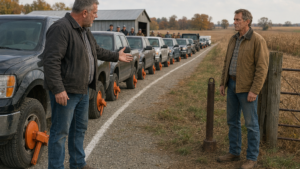
The HOA Ordered Him to Clear His Farmyard, Then Learned Their Water Line Crossed His Land
Chapter 1: The Yellow Notice on the Green Truck
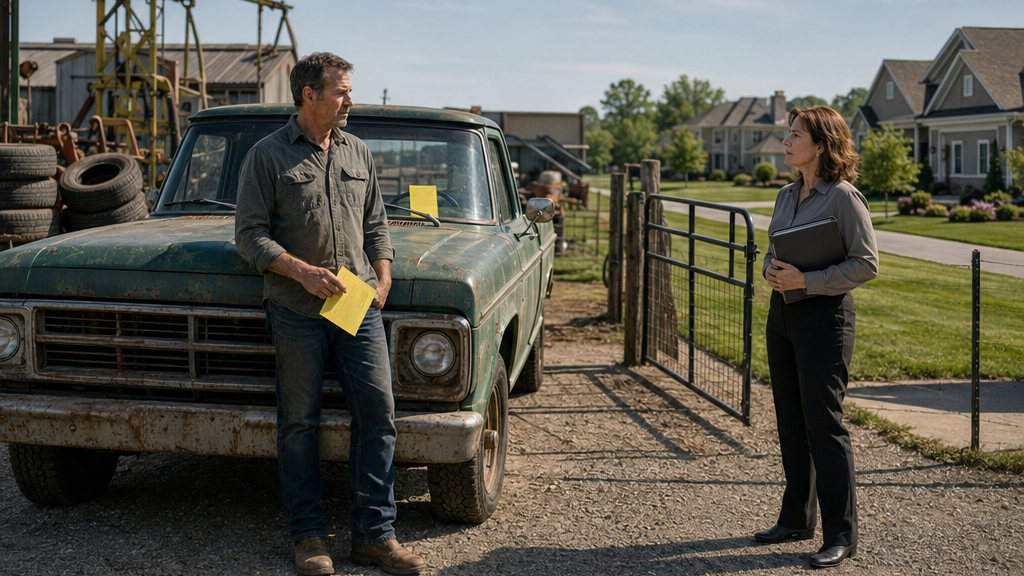
The yellow sheet was tucked beneath the windshield wiper of Daniel Baker’s green truck so neatly that, for half a second, he thought it was an advertisement.
Then he saw the words at the top.
VIOLATION NOTICE.
Daniel stopped in the gravel with a socket wrench still in his right hand.
The truck had not moved in nine days. Its hood was faded, its passenger-side fender carried a shallow dent from before Daniel had owned it, and the tires were older than several houses in Westridge Estates. He had been rebuilding the engine in stages whenever paying work allowed.
Someone had walked seventy yards onto his property to put the notice there.
He pulled the paper free.
The complaint listed visible automotive storage, stacked tires, unapproved equipment, gravel frontage conditions, and exterior maintenance inconsistent with Westridge community standards.
At the bottom, in heavier type, was a deadline.
Seventy-two hours.
After that, the notice warned, additional fines and legal remedies could follow.
Daniel read it twice.
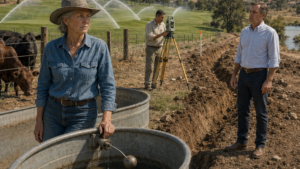
Across the fence, Westridge Estates looked exactly as it always did on a Monday morning: clipped lawns, pale houses, young ornamental trees held upright by identical support stakes. Beyond them, somebody’s sprinkler ticked in measured arcs.
His land looked different because it was different.
Twelve acres remained from the farm his father had once worked. The cattle were gone now, and most of the lower field had been leased for hay, but the workshop still stood behind the house. So did the machine shed, two tractors, a rusted disc harrow, three restoration projects, and the green truck.
Daniel folded the notice once.
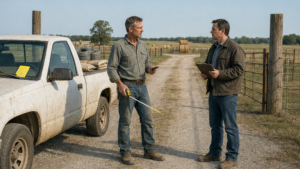
A white SUV turned from the subdivision road and stopped just outside his gate.
Barbara Roberts stepped out carrying a binder.
Daniel knew her by sight. HOA president. Mid-fifties. Efficient posture. Hair that never seemed troubled by wind.
She did not cross the gate this time.
“I was hoping you’d see it before you left for work,” she said.
Daniel looked at the notice. “You put this on my truck?”
“The association authorized delivery.”
“You walked onto my property.”
Barbara’s expression tightened slightly. “We’ve tried mail.”
Daniel remembered envelopes he had left unopened for days, then thrown into a drawer after confirming the sender.
“Mail works,” he said.
“Apparently not.”
He set the wrench on the truck’s hood.
Barbara opened the binder. “We’ve had repeated complaints from owners along the west boundary. The vehicles, the tires, machinery visible from the road. There were tracks through the grass last week.”
“My grass.”
“The appearance affects adjacent property.”
“That isn’t the same as jurisdiction.”
Barbara looked at him for a moment. “The board has reviewed the recorded development documents.”
Daniel almost laughed, but something in the way she said recorded stopped him.
“Which documents?”
“The ones governing Westridge and associated parcels.”
“Associated parcels.”
“Yes.”
Daniel unfolded the notice again.
He had spent twenty-three years solving mechanical failures for people who were often certain they already understood the problem. The quickest way to waste a day was to argue with someone’s confidence instead of checking the measurements.
So he checked.
The notice included a parcel number beneath his name.
Daniel read the digits slowly.
Then again.
His irritation changed shape.
“That’s not my parcel number.”
Barbara glanced down. “It identifies the property.”
“It identifies a property.”
“It came from the association file.”
“That doesn’t make it mine.”
Barbara closed the binder halfway. “Daniel, nobody is trying to make this more difficult than it needs to be.”
“Then what happens in seventy-two hours?”
“If the conditions remain, the board can escalate.”
“Fines?”
“Potentially.”
“Against land that isn’t in your association?”
She exhaled through her nose. “Your deed predates the subdivision. We understand that. But there are recorded agreements tied to the development, and the board’s counsel believes there is enough connection to require cooperation.”
That was more careful than the notice.
Daniel noticed that too.
“What connection?”
“I’m not going to conduct a title review at your gate.”
“You drove here.”
“I drove here because every attempt to discuss the boundary has been ignored.”
There it was.
Daniel leaned against the truck.
Over the past several years, he had received requests for meetings about landscaping, access, fencing, drainage, maintenance vehicles, and some proposal involving the strip along the eastern field. He had treated most of them the same way.
His land was his land.
The deeds existed.
The fence existed.
If Westridge wanted something, they could stay on their side.
He had considered that sufficient.
Barbara tapped the binder.
“Three homes on this side have sat longer than expected,” she said. “Owners are blaming what buyers see beyond the boundary. You may not care about that, but they do.”
“So this is about house prices.”
“It’s about protecting what residents bought into.”
“They didn’t buy my twelve acres.”
“No. But they bought next to them.”
Daniel looked toward the green truck.
The yellow paper seemed almost bright against the faded paint.
His father had bought the truck used and driven it until the transmission failed. Daniel had promised to restore it after the funeral, then spent four years finding reasons not to finish.
Barbara followed his gaze.
“That vehicle is one of the cited items.”
Daniel looked back at her.
“Did the board review the recorded subdivision plat before issuing this?”
“We reviewed the applicable records.”
“That wasn’t my question.”
For the first time, she hesitated.
Barely.
But Daniel saw it.
He lifted the notice.
“My deed was recorded before Westridge existed. This parcel was never conveyed to your developer. The number on this sheet isn’t mine. So before you send another one, I suggest you figure out what land you’re actually talking about.”
Barbara’s jaw set.
“You have seventy-two hours stated on the notice. If you dispute it, submit your objection in writing.”
“To an association I don’t belong to?”
“To the board that issued it.”
She returned to the SUV.
Daniel watched her leave through the gate and turn toward the rows of houses.
He should have felt satisfied.
Instead, one phrase remained.
Recorded agreements.
He went into the workshop, past the workbench and the compressor, to the steel cabinet against the back wall.
The bottom drawer stuck halfway.
He pulled harder.
Behind old tax folders and equipment manuals sat a brown deed box his father had labeled years ago in black marker.
Daniel carried it to the bench.
He opened the lid.
On top lay the original deed.
Beneath it was a bundle of folded maps he had not looked at since Westridge Estates was nothing but survey flags beyond the pasture.
Chapter 2: The Line Westridge Never Owned
The subdivision line ended at Daniel’s fence.
Not near it.
Not roughly along it.
At it.
Daniel stood beneath the fluorescent lights in the county records office Tuesday morning with the old plat spread beneath a clear protective sheet, following the heavy boundary line with one finger.
Westridge Estates occupied what had once been three adjoining tracts east of his family’s acreage. Roads curved through the development in tidy loops. Lots had been numbered. Utility corridors were marked. Common areas were shaded.
Daniel’s parcel remained outside the entire drawing.
Amanda Green stood on the opposite side of the counter.
“You’re sure this is the final recorded plat?” he asked.
She nodded. “Final plat for that phase. There were amendments later, but those dealt with internal lots and the southern entrance.”
“And nothing annexing this?”
“You’d have to ask a title attorney for a legal opinion. I can tell you what the records show.”
Daniel looked at her.
She gave him a small, practiced smile.
“I know. Annoying answer.”
“Accurate answer.”
“That’s why they pay me.”
He bent over the map again.
His father’s fence line appeared as an existing boundary. The developer had built Westridge right up against it without absorbing the Baker tract.
Relief came first.
Then annoyance.
Barbara’s notice had been more than aggressive. At least from this map, it looked baseless.
“Can I get a certified copy?”
“Yes.”
Amanda moved toward the printer station, then stopped.
“What exactly are they claiming?”
Daniel handed her a photocopy of the yellow notice.
She read the first page, not commenting until she reached the parcel number.
“This isn’t yours.”
“I noticed.”
She turned back toward the plat.
“That number may belong to one of the common tracts.”
“Can you check?”
She typed at a terminal.
A few seconds later she leaned closer to the screen.
“Stormwater parcel.”
Daniel stared at her.
“They cited me using their drainage parcel?”
“That’s what the number resolves to.”
A short laugh escaped him.
It was the first moment since Monday that the whole thing seemed simple.
Sloppy paperwork. Inflated authority. A board president relying on records she had not understood.
He could send a letter, attach the deed and plat, and tell them never to step onto his property again.
Then Amanda said, “There is another filing attached to your tract.”
Daniel stopped smiling.
“What kind?”
“Easement.”
She clicked twice.
The screen filled with an index entry recorded almost twenty years earlier.
Daniel recognized his father’s name.
His own appeared below it as successor owner.
Beneficiary: Westridge Development Company, assigns and successors.
“Can you pull that?”
Amanda looked at him. “That I can do.”
The document came from archives as a scanned image, gray at the edges, the handwriting on the notary section nearly faded.
Daniel read the first page.
Then the second.
It granted the developer a defined corridor along the eastern edge of the Baker farm for underground utilities and maintenance access.
Not ownership.
Not covenant authority.
An easement.
He traced the dimensions on the accompanying exhibit.
Thirty feet wide in places. Narrower near the road. It entered beside the subdivision’s northern common area, followed the old field edge, then turned near a low section of pasture where his father had once grown corn.
Daniel remembered construction crews there.
He had been in his twenties. He remembered pipes, excavators, piles of dirt, his father complaining that contractors never closed gates properly.
He had never asked what they were installing.
“Does this tell you what utility?” he asked.
“Not completely,” Amanda said. “The grant is broad. Water, related infrastructure, inspection and maintenance access. There may be a separate utility plan.”
“Where?”
“Different department.”
Daniel stared at the signature.
His father had agreed to it.
That bothered him more than Barbara’s notice.
Not because his father had done anything wrong, but because Daniel had always imagined the boundary as clean. Their side. Westridge’s side.
The paper showed something more complicated.
His father had permitted a piece of Westridge to pass beneath their land.
“When does this expire?”
Amanda leaned over.
Daniel had reached the renewal section.
The original easement ran for twenty years from the utility’s acceptance date, renewable by written agreement between the servient landowner and the beneficiary.
Not automatically renewable.
Written agreement.
He felt a quiet pressure behind his ribs.
“What was the acceptance date?”
Amanda found another filing.
“Here.”
Daniel counted.
He did it again because the first answer seemed absurd.
Eleven days.
The easement term ended in eleven days.
He sat back.
For years, Westridge had sent him letters asking to discuss access. He had assumed they wanted convenience—permission to trim brush, widen a service path, formalize contractor entry.
He had ignored them.
Now he understood at least part of Barbara’s confidence.
The HOA did possess a recorded right involving his property.
But it was not the right she had implied.
And it was about to expire.
By late afternoon, Daniel had spread the certified plat, the easement, his deed, and the yellow violation across his kitchen table.
The green truck was visible through the window, nose angled toward the workshop.
He wrote two headings on a legal pad.
WHAT THEY OWN.
WHAT THEY DON’T.
Under the second heading he wrote:
My parcel.
Appearance control.
Covenants.
Vehicle rules.
Then, under the first:
Easement until expiration.
The distinction looked almost childish once written.
Yet for years no one had forced him to make it.
Daniel turned to the easement exhibit.
A narrow shaded strip crossed the eastern edge of his land.
He remembered utility crews coming through twice after storms. He remembered once finding a Westridge contractor near his hayfield and sending him away because no one had called first.
Had that contractor possessed a legal right to enter?
Maybe.
Had Daniel ever bothered to read the agreement?
No.
His satisfaction cooled.
The next question mattered more than the invalid violation.
What exactly was under that strip of ground?
He called the county utility office before closing, gave them the recording reference, and asked for the infrastructure plan tied to it.
The employee on the phone said someone could pull the file the following morning.
Daniel thanked him and hung up.
Then he looked again at the renewal paragraph.
Written agreement.
Eleven days.
Barbara had issued a seventy-two-hour violation less than two weeks before the HOA needed Daniel’s signature on something buried in a file almost nobody in Westridge was likely to have read.
For the first time, he wondered whether the bad parcel number had been carelessness.
Or camouflage.
Chapter 3: Eleven Days Before the Easement Ends
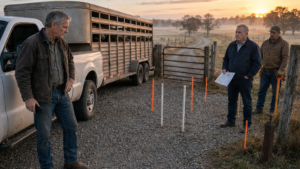
The orange survey stake appeared in the grass less than twenty feet from Daniel’s green truck.
He had driven the truck to the eastern field Thursday morning because the utility plan did not make sense from the kitchen table. Now, with a surveyor’s temporary marks crossing the hayfield edge, the old easement finally existed somewhere other than paper.
A painted line ran north toward Westridge.
Daniel unfolded the plat across the truck’s hood and weighted one corner with a wrench.
The surveyor pointed toward the subdivision fence.
“The recorded corridor follows this line, then bends around that low spot.”
“And the pipe?”
“Inside it. Based on the utility map, twelve-inch water line.”
Daniel looked at him. “Main supply?”
“Not exactly.”
The county utility inspector, standing several yards away, answered.
“Secondary loop.”
Daniel waited.
The inspector crouched near one of the flags and drew a rough shape in the dirt with a gloved finger.
“Westridge receives normal service from the south. This connection loops the system back from the north. It gives pressure balance and redundancy. If there’s a break or major work on the primary side, this helps keep service stable.”
“So if the easement expires, the water shuts off?”
“No.”
That answer should have been a relief.
Instead, Daniel felt disappointed.
He recognized the feeling immediately and disliked it.
The inspector continued.
“No one comes out with a wrench on expiration day. The physical line remains. But legal access becomes a problem. Maintenance becomes a problem. Long-term operation becomes a problem. If something fails, everybody starts calling attorneys before crews start digging.”
Daniel glanced toward Westridge.
Several rooftops rose beyond the fence.
“So they need the easement.”
“They need clear rights.”
The phrase landed differently than Daniel expected.
Clear rights.
That evening he sat across from a land-use attorney with the same documents spread between them.
The attorney read the violation notice first, then the plat.
“This association doesn’t appear to have covenant authority over your parcel based on what you’ve shown me.”
Daniel leaned back.
“So we send them that and we’re done.”
“With the violation, maybe.”
“And the easement?”
The attorney turned the pages.
“That’s separate.”
“Expires next week.”
“I see that.”
Daniel folded his arms.
“What if I don’t renew?”
The attorney studied him.
“You can ask me what your rights are, or you can ask me what I think you should do.”
“Start with rights.”
“Assuming there are no later amendments we haven’t found, you’re not obligated to grant them a permanent replacement just because they want one.”
Daniel nodded.
That was the answer he had come for.
The attorney continued before he could enjoy it.
“But refusing all renewal purely as retaliation would create a different problem.”
“They threatened fines on land they don’t control.”
“I’m not defending that.”
“They walked onto my property.”
“I’m not defending that either.”
“Then why should I make their problem easy?”
“Because the association president isn’t the same thing as every homeowner connected to that water loop.”
Daniel looked toward the window.
The attorney tapped the utility plan.
“Imagine a line break during summer demand. Or a fire response where redundancy matters. Maybe nothing happens. Maybe the county can route around it. But if you knowingly turn an infrastructure dispute into leverage against residents, you may be legally entitled to do more than is wise.”
Daniel’s jaw tightened.
His father would have hated the notice.
Daniel knew that.
His father also would have driven a wrench across the county at midnight if a neighbor’s well pump failed.
Those facts did not fit neatly together.
“What would you do?”
“Separate the issues. Challenge the violation. Then negotiate the easement as an easement.”
“That sounds reasonable.”
“You say that like it’s an insult.”
Daniel almost smiled.
The attorney slid the plat toward him.
“Ask yourself what you actually want.”
Daniel knew the first answer.
Leave me alone.
But that was the answer he had used for years.
Letters from Westridge arrived; he ignored them.
Contractors called; he told them to stay off the farm.
Meeting requests came; he declined.
He had assumed silence maintained the boundary.
Instead, both sides had filled the silence with assumptions.
After the meeting, Daniel drove home along County Road 12.
At the entrance to Westridge, a school bus stopped and released a group of children. Two ran toward a woman waiting beside a mailbox. Another dragged a backpack along the sidewalk.
Daniel slowed because traffic had stopped.
None of them had issued him a violation.
None had asked Barbara to use a drainage-parcel number on his land.
They simply lived there.
The clean satisfaction he had felt in the records office was gone.
At home, he parked the green truck directly over the approximate easement corridor and opened the plat across the hood again.
The yellow notice lay beside it.
One document claimed authority the HOA did not have.
The other documented a right it genuinely did.
That difference mattered.
His phone rang.
Barbara Roberts.
Daniel let it ring twice before answering.
“Baker.”
“I’m calling about the easement.”
Not the violation.
Daniel looked at the eleven-day deadline he had circled.
“So you know I found it.”
A pause.
“I assumed you would eventually review the records.”
“That’s an interesting way to put it.”
“We need to meet.”
“You already gave me seventy-two hours.”
“This is separate.”
“Is it?”
Another pause, longer this time.
Barbara’s voice lost some of its formal edge.
“There are issues the full board needs resolved before next week.”
“What issues?”
“I’d prefer to discuss them in person.”
Daniel looked across the field toward the subdivision roofs.
“Who’s coming?”
“Steven Clark and me. No counsel unless you bring yours.”
“What does Steven have to do with it?”
“He handles infrastructure matters for the board.”
That answered one question and opened another.
Daniel folded the yellow violation once more and placed it inside the plat.
“When?”
“Tomorrow evening. Clubhouse.”
“You came to my property with the notice.”
“Yes.”
“Now I’m supposed to come to yours.”
“You said you wanted clarity.”
Daniel looked down at the survey stakes tracing the buried water line through his field.
For years he had refused meetings because he believed there was nothing to discuss.
Now Barbara sounded like someone who had been waiting for him to discover exactly how much there was.
“I’ll be there,” he said.
Before she disconnected, Daniel asked one more question.
“Barbara—when you issued that violation Monday, did you already know this easement expired next week?”
The line went silent.
Then she said, “Tomorrow, Daniel.”
And hung up.
Chapter 4: The Agreement Barbara Needed Signed
Barbara slid a six-page agreement across the clubhouse table before Daniel had taken off his jacket.
“Read page three first,” she said.
Daniel remained standing.
The clubhouse meeting room smelled faintly of coffee and carpet cleaner. A row of stacked folding chairs lined one wall. On the other hung framed photographs of Westridge when the streets were new and the trees barely reached the rooflines.
Steven Clark sat at the far end of the table with a calculator, a yellow legal pad, and a folder marked with the subdivision’s utility records.
Daniel looked at Barbara.
“This is the emergency?”
“The easement is.”
He pulled out a chair.
Page three contained a legal description.
Thirty-foot utility corridor. Inspection rights. Excavation rights. Maintenance access.
Then he reached the paragraph that changed everything.
Permanent and perpetual.
Daniel read it again.
The existing easement expired. Barbara wanted the replacement never to.
He turned a page.
There was more.
The proposed agreement required Daniel to maintain the eastern frontage in a manner “compatible with adjoining residential character.” It restricted outdoor vehicle storage within view of the subdivision and limited equipment staging near the easement corridor.
Daniel looked up.
“So the violation disappears if I sign this.”
Barbara folded her hands. “The board is prepared to resolve both matters.”
“That wasn’t my question.”
Steven shifted slightly in his chair.
Barbara said, “The board needs certainty.”
“You want permanent utility rights and control over how my farm looks.”
“We want protections against incompatible uses beside residential property.”
“You don’t own residential property on my side of the fence.”
“No. But what happens on your side affects ours.”
Daniel took the yellow violation notice from his folder and placed it beside the agreement.
Then he unfolded the certified subdivision plat.
The heavy boundary line sat between them.
“This says your development stops here.”
Barbara looked at the plat without surprise.
That was the answer Daniel had been waiting for.
“You already knew,” he said.
“I knew your tract was outside the platted lots.”
“When?”
“Daniel—”
“When did you know?”
Barbara’s expression hardened. “Before Monday.”
Steven stopped writing.
Daniel leaned back.
“So you knew I wasn’t in Westridge when you sent the violation.”
“We were advised there were arguments for enforcement based on the recorded relationship between the properties.”
“What arguments?”
“The easement. Prior cooperation. The visual impact. There are provisions in the development records—”
“Do any of those make me an HOA member?”
Barbara said nothing.
Daniel tapped the notice.
“Do any let you fine me for the color of my truck?”
“No one cited the color.”
“You know what I mean.”
Her voice tightened.
“We have homeowners trying to sell houses along that boundary. One family dropped their asking price twice. Another buyer specifically mentioned the vehicle yard. Residents want to know why they follow standards while the property next door looks like a salvage operation.”
Daniel’s hands went still.
“It’s not a salvage operation.”
“I know that.”
“Do you?”
“Yes.”
For the first time, Barbara sounded tired instead of authoritative.
She removed her glasses.
“I know you restore equipment. I know some of those vehicles are valuable. Buyers driving through for ten minutes don’t know that.”
“So you decided to pretend your rules applied.”
“I decided the board could not keep telling residents we had no options.”
“That sounds like your problem.”
“It became everyone’s problem when the easement came due.”
There it was.
Daniel looked toward Steven.
“You knew too?”
Steven rubbed one thumb along the edge of his legal pad.
“I knew the renewal date.”
“And the notice?”
“I knew Barbara wanted stronger leverage.”
Barbara turned sharply. “Steven.”
He looked at her.
“He already found the documents.”
The room changed.
Not dramatically.
No one raised a voice.
But Daniel saw, for the first time, that the board was not standing on one solid position.
Steven faced him.
“The association should not have issued that citation as written.”
Barbara stared at him.
“You voted to authorize counsel review.”
“I voted for counsel review. I did not vote to use a common-property parcel number on Baker’s land.”
Daniel let the silence sit.
Then he asked, “Why are you telling me this now?”
“Because we have six days.”
“Five after tomorrow.”
Steven nodded.
“The secondary loop matters. The county strongly prefers it remain legally maintainable. If there’s a primary-line failure, that connection gives us redundancy.”
“I know.”
Steven looked surprised.
“I talked to the county.”
Barbara closed her eyes briefly.
Daniel saw fear there—not fear of him, exactly. Fear of control slipping away.
She put her glasses back on.
“Then you understand why we need this resolved.”
“I understand why you need an easement.”
“And the frontage?”
“No.”
Barbara’s mouth flattened.
“The board cannot sign away concerns residents have been raising for years.”
“The board doesn’t get to sign anything about my frontage.”
“You ignored three requests to discuss it.”
Daniel looked at her.
Steven spoke quietly.
“Actually, more than three.”
Daniel turned.
Steven opened another folder.
“Two maintenance-access letters. One boundary meeting request. One proposal to mark the utility corridor. One request for a contractor-contact procedure.”
“I wasn’t required to attend HOA meetings.”
“No,” Steven said. “You weren’t.”
“Then what’s your point?”
“My point is we kept trying to formalize the parts where our properties interact, and you kept treating every envelope like an attempt to annex your farm.”
Daniel felt heat rise under his collar.
“That’s because half the letters had language about standards and compatibility.”
“Some did. Not all.”
Barbara said nothing.
Steven continued.
“Two years ago, a repair crew came through after a pressure problem. You sent them away.”
“They showed up without calling.”
“They believed the easement allowed entry.”
“It required reasonable notice except emergencies.”
Steven paused.
“You read it then?”
Daniel did not answer.
Because he hadn’t.
He had read enough of the letter attached to it to decide Westridge was overstepping and had ordered the crew off his land.
The embarrassment was small but sharp.
Barbara saw it.
“This is what I mean,” she said. “You act as though we invented every point of contact.”
Daniel looked at her.
“You still issued a violation you knew was questionable.”
“Yes.”
The admission was so direct that he almost missed it.
Barbara glanced toward the framed photographs on the wall.
“I thought if we separated the issues, you would ignore the easement again. I thought if there was a deadline you couldn’t ignore, you would come to the table.”
“You used fake authority to get my attention.”
“I used authority our counsel said was arguable.”
“Was it?”
She did not answer.
Daniel gathered the permanent agreement.
For several minutes he read without speaking.
Permanent access.
Broad maintenance rights.
Frontage restrictions.
No meaningful restoration obligation if crews damaged crops beyond a general reasonableness clause.
No compensation beyond one nominal payment.
Everything tilted toward Westridge.
He pushed it back.
“No.”
Barbara stiffened.
Daniel added, “Not this.”
Steven leaned forward.
“What would you sign?”
Daniel folded the plat along its old crease.
“I don’t know yet.”
“The current agreement expires next week,” Barbara said.
“I’m aware.”
“If we cannot resolve it, the board will have to consider other remedies.”
Daniel stood.
“There’s the Barbara I recognize.”
“I’m stating reality.”
“So am I. My land is not Westridge. That notice needs to be withdrawn. Separately, if you want an easement, you can negotiate one.”
Barbara looked at the agreement between them.
“You intend to let it lapse?”
Daniel thought of the school bus.
The children crossing the sidewalk.
The county inspector drawing the water loop in dirt.
“No,” he said. “I intend to stop pretending the only choices are giving you everything or giving you nothing.”
Steven’s posture eased slightly.
Barbara’s did not.
Daniel put the yellow citation back into his folder but left a certified copy of the subdivision plat on the table.
At the door, he turned.
“I’ll send my terms.”
Barbara asked, “When?”
“Before you need them.”
Then Daniel walked out knowing exactly what he would not sign, and with no idea yet what he would build in its place.
Chapter 5: He Stopped Fighting Their Definition
Daniel drove a measuring stake into the gravel exactly where Barbara had wanted the vehicles removed.
He stretched a tape from the workshop corner to the eastern frontage.
Thirty-eight feet.
Then again.
Thirty-eight.
The green truck sat behind him with its hood raised, one front wheel missing.
For years Daniel had thought of the yard according to what it had always been: workshop space, farm access, storage, room to repair machinery without anyone asking whether it matched nearby siding colors.
Barbara had forced a different question.
If Westridge was determined to call his work an incompatible use, what exactly did the county call it?
By Friday afternoon, Daniel was standing at Amanda Green’s counter again.
“I’m not asking whether an HOA can tell me what to do.”
Amanda looked relieved.
“Good start.”
“I’m asking what the county permits me to do.”
“That is a much better question.”
Daniel placed photographs of the workshop, the green truck, two restored tractors, and a red pickup project on the counter.
“I restore agricultural machinery and older vehicles. Some belong to customers. Some are mine. I’ve had people ask to see them. School groups too, years ago.”
Amanda studied the photographs.
“What are you thinking?”
“Something small. Mechanical history. Farm equipment. Local vehicles. Maybe open certain weekends.”
“A commercial museum?”
“I don’t know.”
“Then we start with use categories, not names.”
That sentence saved him three days of guessing.
Amanda printed the county’s rural-use table and circled several sections.
Limited agritourism.
Educational display.
Accessory retail.
Rural heritage use.
Conditional public assembly.
Daniel read each one.
None gave him permission to do whatever he wanted.
Each came with setbacks, parking requirements, occupancy limits, sanitation rules, driveway standards, lighting restrictions, and review thresholds.
He frowned.
Amanda noticed.
“You expected the county version of ‘do whatever you want because you own it’?”
“I was hoping for something friendlier.”
“Ownership is why you get to apply.”
Daniel laughed once.
The distinction sounded irritatingly familiar.
Over the weekend, he cleared a space on the workshop wall and started drawing.
Not revenge.
That was the rule he gave himself.
If the only reason for the project was to anger Barbara, he would stop.
He drew a small exhibition building beside the existing workshop. Then crossed it out as too expensive.
He sketched a covered display shed.
Better.
He marked a concrete apron where visitors could walk around restored machinery without crossing the active repair area.
He placed parking away from the easement corridor.
He marked the green truck as Exhibit One.
The label made him stop.
He went outside.
The truck’s door creaked when he opened it.
Inside, the bench seat still carried a split his father had repaired with green tape that had gone almost black with age.
Daniel sat behind the wheel.
His father had used the truck for feed runs, fencing supplies, tractor parts, and once to haul Daniel home after he broke an ankle jumping from the hayloft.
Barbara saw an old truck.
Daniel had spent years seeing an unfinished obligation.
Maybe both had been looking at the wrong thing.
Monday morning he returned to county planning with a rough site plan.
Amanda looked at it for several seconds.
“This is more serious than Friday.”
“I had a weekend.”
“You have parking for twenty-four vehicles.”
“Twelve to start.”
“You drew twenty-four.”
“I plan ahead.”
She traced the driveway.
“Public use changes this entrance.”
“It’s already gravel.”
“That’s the problem. Sight distance, dust, emergency access.”
Daniel nodded.
“What else?”
“Lighting.”
“I barely need lighting.”
“If you have evening events, you do.”
“Then no evening events.”
“Noise.”
“I’m not running a concert venue.”
“Vehicle demonstrations?”
He hesitated.
“Possibly.”
“Then noise.”
The list grew.
ADA access.
Portable sanitation until permanent facilities.
Fire-code review.
Drainage from the proposed concrete apron.
Hours of operation.
Maximum event attendance.
Buffering near Westridge.
Daniel felt his enthusiasm shrink with every page.
“This is more restrictive than what I do now.”
Amanda handed the plan back.
“Public use means public responsibilities.”
He almost said forget it.
He had spent the week discovering that every institution wanted a line somewhere.
The HOA wanted one around his property.
The county wanted several through it.
Then Amanda tapped his drawing.
“But the use itself is possible.”
Daniel looked at her.
“If you satisfy the conditions and the hearing board approves it, yes.”
That was enough.
He returned to the farm and redesigned.
Parking moved west.
Lights became downward-facing fixtures mounted lower than he had planned.
The concrete pad shrank.
Public hours became Saturday and Sunday afternoons, with limited scheduled school visits.
No amplified outdoor sound.
Demonstration engines restricted to daytime.
He even drew a landscaped buffer along the Westridge side.
When he caught himself doing it, he stared at the pencil line.
Six months earlier he would have rejected the idea simply because the HOA would like it.
Now he left it.
Not for Barbara.
For the use to work.
The easement proposal took shape beside the site plan.
Limited term, renewable after ten years.
Defined corridor only.
Advance notice except emergencies.
Restoration of crops, fencing, gravel, and disturbed ground after maintenance.
Annual compensation tied to access burden.
No expansion without written consent.
No HOA covenant authority over the Baker tract.
No aesthetic restrictions hidden inside utility language.
Daniel sent the draft to his attorney.
Two hours later, Steven called.
“I heard you’re applying for something.”
Daniel looked through the workshop window toward the green truck.
“Rural mechanical heritage use.”
There was silence.
Then Steven said, “Barbara is going to think you’re doing it to provoke her.”
“I figured.”
“Are you?”
Daniel looked at the drawings covering the wall.
“Not anymore.”
That answer seemed to unsettle Steven more than anger would have.
“What does that mean?”
“It means if the county tells me I need traffic limits, I’ll accept traffic limits. If they tell me the lights can’t shine into Westridge, they won’t. But your board doesn’t get to invent authority over my property.”
Steven was quiet.
“That’s harder to argue with.”
“It should be.”
The following Wednesday, a county employee drove a wooden stake near Daniel’s entrance and fastened an orange public-hearing notice to it.
Daniel stood beside the green truck and read the date.
Two weeks.
Across the boundary, two homeowners had already stopped on the sidewalk to look.
By evening, three more had.
The dispute was no longer buried in board correspondence or an old easement file.
For the first time, everyone in Westridge would be able to ask what Daniel wanted to build—and whether their own association had any legal right to stop him.
Chapter 6: When the Board Finally Read the Plat
“Does Westridge Estates own any interest in Mr. Baker’s parcel?”
The county planner asked the question less than five minutes into the hearing.
Barbara Roberts had just finished describing Daniel’s proposed heritage center as a potentially incompatible commercial use beside a residential neighborhood.
Now she stood at the public microphone with one hand resting on a folder.
“No ownership interest,” she said.
The planner looked down at the application.
“Covenant authority?”
Barbara hesitated.
“No direct covenant authority.”
Daniel sat two rows back with the folded subdivision plat on his lap.
Several Westridge residents had come. Most did not look angry. They looked confused.
One leaned toward another and whispered something after Barbara’s answer.
The planner continued.
“Then the association’s standing here is as an adjacent property representative?”
“Yes.”
“Thank you. That is still relevant. Traffic, lighting, noise, drainage, and compatibility are all appropriate subjects.”
Daniel watched Barbara return to her seat.
She did not look at him.
That was the first important difference of the evening.
The county was willing to hear her concerns.
It simply refused to pretend they were something else.
Daniel was called next.
He carried the plat, site plan, and easement proposal to the front table.
The planner asked about hours.
“Saturday and Sunday, noon to five. Scheduled educational visits during weekdays.”
“Engine demonstrations?”
“Limited. Daytime only.”
“Outdoor lighting?”
“Downward-facing. No fixtures directed east.”
“Maximum attendance?”
“Whatever number fire and parking review supports. I’m not asking for unlimited events.”
An HOA homeowner raised a hand later and asked whether visitors would park on Westridge streets.
Daniel answered before Barbara could.
“No. If my lot fills, the event is full.”
Another asked about loud engines.
“Occasional demonstrations, within the county conditions. Not continuous repair work for visitors.”
The questions became less hostile because the answers were boring.
Daniel had learned that boring could be useful.
Then Barbara stood again.
“The concern remains cumulative impact. Once the use is approved, expansion can follow.”
The planner shook his head.
“Expansion beyond the approved site plan would require further review.”
Barbara nodded, but Daniel saw frustration.
She had come prepared to argue against a threat that depended on uncertainty.
The county kept turning uncertainty into conditions.
Steven Clark rose from his chair along the wall.
Barbara looked at him.
He went to the microphone.
“I’m speaking as Westridge treasurer and infrastructure liaison.”
Daniel straightened.
Steven glanced once at Barbara, then at the planner.
“I want the record clear on one point. Westridge does not own Mr. Baker’s tract, and the tract is not part of the association.”
The room shifted.
Someone behind Daniel whispered, “Then why did we send him a violation?”
Barbara’s shoulders stiffened.
Steven continued.
“The association does hold a utility easement across part of the tract. That easement is separate from covenant jurisdiction.”
Daniel did not smile.
He had imagined this moment earlier in the week, imagined enjoying it.
Instead, he watched Barbara stare at the table and felt only the weight of how avoidable the entire dispute had been.
The planner asked, “Is the easement affected by this project?”
Daniel answered.
“No. I moved visitor parking west of the corridor. The concrete apron stays outside it.”
“And renewal?”
“That’s a private matter between the landowner and easement beneficiary unless county utility requirements become involved.”
Daniel looked toward Steven.
“I intend to renew it.”
Barbara’s head lifted.
Several homeowners turned.
Daniel placed the draft on the table.
“Not permanently. Ten-year term. Defined maintenance rights. Emergency access. Restoration obligations after excavation. Compensation for recurring burden. Any expansion has to be negotiated separately.”
The planner nodded.
“And the HOA restrictions?”
“None over my parcel.”
Barbara stood.
“So you expect Westridge to accept continuing infrastructure dependence with less security than a permanent grant?”
Daniel faced her.
“I expect Westridge to accept the rights it actually needs.”
“And ten years from now?”
“We talk again.”
“You refused to talk for years.”
There it was.
Not accusation for effect.
Truth.
Daniel rested both hands on the table.
“Yes.”
The room became quiet.
He continued.
“You sent letters. I assumed every one was another attempt to tell me how to use the farm. Some were. Some weren’t. I should have read them more carefully.”
Barbara watched him.
Daniel pointed to the plat.
“But my mistake doesn’t turn your boundary into mine.”
“No,” she said.
“And your need for the easement doesn’t give you authority over my truck.”
“No.”
It was the first time she had said it plainly.
Daniel returned to his seat.
The hearing continued for another hour.
The county imposed more conditions than he liked.
Directional lighting.
Dust control.
A limit on outdoor demonstration hours.
A parking cap.
A requirement that larger events obtain temporary permits.
At one point Daniel’s attorney leaned over and whispered, “You can push back on the buffer width.”
Daniel looked at the site plan.
The buffer did not cost him anything important.
“Leave it.”
The attorney raised an eyebrow.
“It helps the use work.”
That sentence surprised Daniel as much as anyone.
By the end of the meeting, the county approved the project subject to final staff review and listed conditions.
Not a victory over Westridge.
Permission to proceed responsibly.
Outside, homeowners gathered in small clusters.
No applause.
No shouting.
One man asked Steven whether their water was about to be cut off.
Steven said, “No.”
Daniel appreciated him for saying it quickly.
Another homeowner approached Daniel.
“So what happens if the board doesn’t sign your easement?”
Daniel looked toward Barbara, who stood near the clubhouse entrance several yards away.
“That’s up to the board.”
“But the pipe stays?”
“The pipe stays.”
The homeowner nodded slowly and walked away.
Later that evening, Daniel attended the Westridge board meeting for the first time in his life.
His easement draft was on the agenda.
Barbara sat at the center of the table.
The yellow violation notice was there too.
Steven summarized the infrastructure risk, county guidance, and legal expenses likely if the association attempted to force a permanent easement through litigation.
Then Daniel’s attorney summarized Daniel’s offer.
When discussion opened, Barbara looked directly at Daniel.
“You’re asking the association to formally acknowledge that it has no regulatory authority over your tract.”
“Yes.”
“To withdraw the outstanding violation.”
“Yes.”
“To pay annual easement compensation.”
“Yes.”
“And to accept limits on maintenance access.”
“Defined limits. Not unreasonable ones.”
Barbara turned a page.
“In exchange, you guarantee renewal for ten years, emergency access, maintenance rights, and restoration coordination.”
“Yes.”
“And you will comply with county conditions on the heritage use.”
Daniel almost smiled.
“I have to. They actually have jurisdiction.”
Steven looked down to hide his reaction.
Barbara did not.
But after a moment, the corner of her mouth moved.
Not quite a smile.
Then it vanished.
She looked at the residents seated behind Daniel.
Three months earlier, perhaps even three weeks earlier, she might have framed the decision as standing firm against an uncooperative neighbor.
Now every person in the room knew the water loop crossed his land.
They also knew the violation had been issued against property outside the association.
The leverage Barbara had tried to keep private had become impossible to conceal.
She closed the folder.
“We’ll vote after executive consultation.”
Daniel stood.
“When?”
“Tomorrow night.”
“The current easement expires at midnight the following day.”
“I know.”
He gathered his plat.
Barbara looked tired again.
“Daniel.”
He paused.
“If the board accepts this, I need to know you won’t spend the next ten years treating every maintenance request as an invasion.”
Daniel looked at the folded map in his hands.
“That depends.”
Her expression sharpened.
“On what?”
“Whether you ask under the agreement instead of pretending you own the ground.”
For a second neither moved.
Then Barbara nodded once.
It was not agreement yet.
But it was the first honest boundary either of them had stated face-to-face.
Daniel left the clubhouse with the plat under his arm.
By the next night, Barbara would have to choose: accept the limits of the authority Westridge actually possessed, or explain to her own residents why an easement everyone depended on had been allowed to expire.
Chapter 7: The Sign Beside the Old Hayfield
The crane arrived before eight, carrying the one thing Daniel had once sworn he would never put near the road.
A sign.
Not a banner. Not a temporary board. A permanent steel sign mounted between two square posts beside the old hayfield, far enough back to meet the county setback and low enough that its lighting could not spill toward Westridge.
Daniel stood beside the green truck while the operator lifted it from the flatbed.
The lettering was simple.
BAKER FARM MECHANICAL HERITAGE CENTER.
Months earlier, a yellow sheet on that same truck had ordered him to make his property less visible.
Now the county had approved a public use whose entire purpose was to let people see what he had been doing there all along.
The irony was obvious.
Daniel had made a point of not decorating it.
“Two feet left,” he called.
The contractor adjusted the boom.
The sign swung slowly above the concrete footing.
Behind Daniel, the old workshop had changed without becoming unrecognizable. The gravel remained. The corrugated siding remained. So did the grease-darkened workbench inside.
What had changed was the arrangement.
The unfinished customer projects were screened from the visitor area. Restored tractors sat beneath the covered shed. A narrow concrete apron connected the parking area to the exhibits. Small downward-facing lights had been installed under the eaves.
The green truck occupied the first display space.
Daniel had finished it three weeks earlier.
He had refused to repaint the body.
The faded green stayed.
So did the dent in the passenger fender.
He rebuilt the engine, replaced the brakes, repaired the suspension, and cleaned the cab without erasing what time had done to it.
Even the strip of darkened tape remained across the split in the bench seat.
A contractor had asked why.
Daniel had told him it belonged there.
The sign settled onto its mounting bolts.
For a moment nobody spoke.
Then the crane operator lowered the cable.
Daniel looked across the fence.
Several Westridge residents had stopped along the sidewalk.
He recognized some of them from the county hearing.
No one complained.
One man lifted a hand.
Daniel returned the gesture.
That still felt strange.
The easement agreement had been signed four months earlier, eleven hours before the old one expired.
Barbara had negotiated until nearly the final page.
She had rejected the first compensation formula. Daniel had rejected language allowing “related infrastructure” without definition. Steven had insisted on an emergency-contact procedure detailed enough that no future crew could claim ignorance.
In the end, the agreement occupied thirteen pages.
Ten-year term.
Defined corridor.
Emergency entry.
Routine notice.
Restoration requirements.
Compensation.
No expansion without Daniel’s written approval.
No HOA regulatory authority over the remainder of his tract.
And, in a separate board action, formal rescission of the violation notice.
Daniel kept both documents.
He had not framed either one.
Opening day began at noon.
At eleven fifty-five, the parking lot was empty except for Daniel’s truck, a county-approved accessible space, and the food vendor’s small trailer.
Daniel checked the gate.
Then the visitor log.
Then the parking lines.
Then the restroom.
Then the light switches, despite the fact that it was midday.
His attorney had once told him he treated uncertainty like a machine making a bad noise: keep opening panels until the problem showed itself.
At twelve-oh-three, a pickup turned into the driveway.
A father climbed out with two children.
At twelve-oh-seven came an older couple.
Then a minivan.
Then another car.
By twelve-thirty, half the parking spaces were occupied.
Some visitors were neighboring farmers Daniel knew by sight. Others came from town. Several came directly from Westridge.
A boy stood in front of the green truck for so long that his mother finally apologized.
“He likes old trucks.”
“He has good judgment,” Daniel said.
The boy pointed through the open window.
“What’s that tape for?”
Daniel looked at the repaired seat.
“My father put it there.”
“Why didn’t you fix it?”
Daniel considered the question.
“I fixed what needed fixing.”
The boy accepted that immediately and moved on to a restored tractor.
Daniel watched him go.
For years, the truck had sat in the yard carrying a promise Daniel had postponed. Then it became evidence in someone else’s complaint.
Now it was neither.
It was simply part of the place.
By two, the lot was nearly full.
Daniel stood near the entrance reminding arrivals that they could not park along County Road 12 or in Westridge.
Nobody argued.
When the last marked space filled, he put out the FULL sign the county had required and stopped admitting vehicles until spaces opened.
Steven arrived on foot from the subdivision.
He examined the sign first.
“Smaller than I expected.”
Daniel glanced at him.
“Disappointed?”
“A little.”
Daniel laughed.
Steven walked toward the green truck.
“The board predicted floodlights and three hundred cars.”
“The board has an imagination problem.”
“Barbara predicted floodlights.”
“That sounds more accurate.”
Steven ran his eyes over the restored engine visible beneath the raised hood.
“You kept the body like this?”
“That was the point.”
Steven nodded.
A few minutes later, Daniel noticed a woman standing at the edge of the parking area.
Barbara.
She had come alone.
No binder.
No folder.
No board members.
She wore ordinary walking shoes and carried a bottle of water.
Daniel felt his shoulders tighten anyway.
She noticed.
“I’m not here officially.”
“That may be the first reassuring thing you’ve ever said at my gate.”
Barbara looked toward the visitor area.
Children were gathered around a cutaway tractor transmission Daniel had mounted on a waist-high stand. A neighboring farmer was explaining how gears transferred power to the rear axle.
“You got a decent turnout,” she said.
“We hit the parking limit once.”
“I noticed nobody parked in Westridge.”
“I said they wouldn’t.”
“Yes.”
She did not add anything.
Daniel waited.
Months earlier he would have filled her silence with suspicion.
Now he let it remain hers.
Barbara walked toward the green truck.
She stopped in front of it.
“So this is the vehicle.”
“This is the vehicle.”
“The one that started everything.”
Daniel looked at the faded paint.
“I think we started it.”
Barbara gave him a sideways glance.
“That sounds almost diplomatic.”
“Don’t spread it around.”
For a moment she smiled.
Then her expression settled.
“I should not have authorized that notice the way I did.”
Daniel said nothing.
It was not the sweeping apology some part of him had once imagined.
Barbara continued.
“I believed the board needed leverage before the easement deadline. I believed if we approached you only about renewal, you would ignore us again.”
“I probably would have.”
She looked at him.
That admission seemed to matter.
“But,” Daniel said, “you still knew the farm wasn’t yours to regulate.”
“Yes.”
“You could have asked.”
“I had asked before.”
“You could have asked without pretending.”
Barbara nodded.
“Yes.”
Nothing more came.
No dramatic confession.
No declaration that Daniel had been right about everything.
He discovered he did not need one.
A family from Westridge passed them on the way toward the tractors. One of the children waved at Barbara.
She waved back.
“They were worried about this place,” she said.
“So were you.”
“I was.”
“And now?”
Barbara looked across the parking area, then toward the buffer of shrubs Daniel had planted along the eastern line.
“I still wouldn’t want a racetrack.”
“You’re safe.”
“And I still think your old tire pile was ugly.”
Daniel glanced at her.
“It was.”
She seemed surprised.
“I moved it because the county required screening.”
“I know.”
“I should’ve moved it before that.”
Barbara studied him for a second.
“There may be hope for both of us.”
“Careful.”
She laughed quietly and walked toward the exhibits.
Daniel did not follow.
He stayed beside the truck.
Late in the afternoon, after the last visitors left and the food trailer pulled away, he checked the grounds for trash.
There was less than he expected.
A paper cup.
Two napkins.
A child’s dropped pencil.
Across the fence, Westridge returned to its usual quiet.
The heritage center did too.
That mattered to Daniel more than he had expected.
He had won the right to use his land without pretending his choices had no effect beyond the fence.
Barbara had lost the right to pretend those effects gave her ownership.
Both boundaries now existed on paper.
A week later, Daniel received the final recorded copy of the new easement.
He carried it into the workshop.
The steel cabinet against the wall still held the brown deed box he had opened the morning after finding the yellow notice.
He pulled it out and set it on the bench.
His father’s original deed lay on top.
Daniel placed the new agreement beside it.
For a moment, his old instinct returned.
Close the box.
Lock it away.
Assume the paper would speak for itself if anyone ever came asking.
Instead, he took out a clean folder.
He added the new easement, the certified plat, the county approval, emergency contact information, and the recorded boundary description.
He labeled the folder clearly.
Then he placed it beside his father’s deed.
Through the open workshop door, he could see the green truck beneath the new sign.
The farm had not become Westridge.
Westridge had not disappeared.
The water line still crossed his field.
Children still rode bicycles along the subdivision sidewalk. Maintenance crews would still need access someday. Daniel would still dislike some of their requests. Barbara would probably still dislike some of his decisions.
The difference was that no one had to guess where the rights began or ended.
Daniel closed the deed box.
This time, he did not lock it.
The story has ended.