The HOA Locked Him Out of the Pool for Breaking Their Rules—Then He Found the Parcel They Never Owned
Chapter 1: The Lock Hanging on Ronald’s Gate
Ronald Carter knew something was wrong before he reached the pool gate.
His key slid into the old latch the way it had for years, but the gate did not move.
He pulled once, then again.
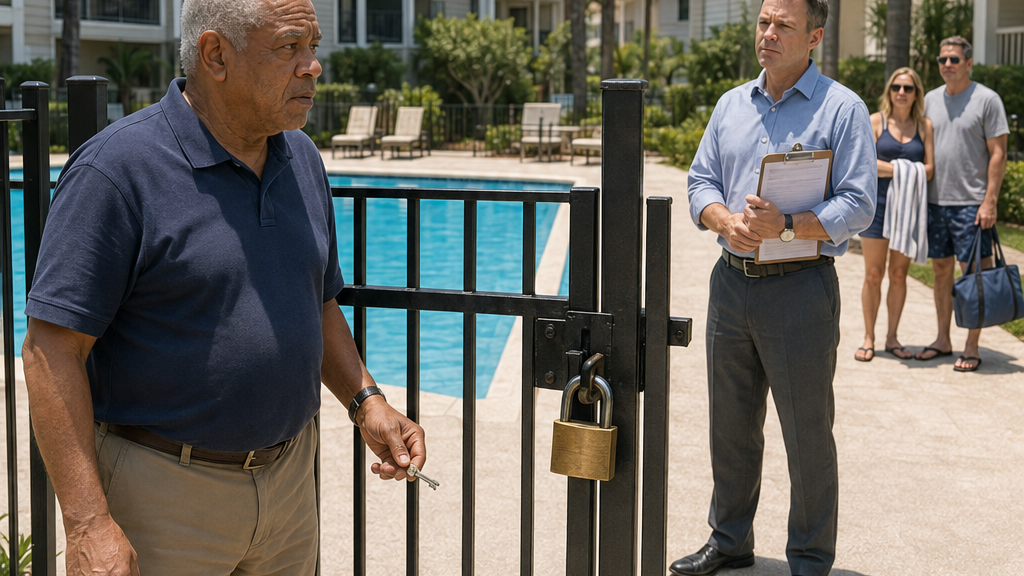
A new brass-colored padlock hung through the black metal bars, catching the morning light. A white sheet of paper had been tucked beneath a plastic cover beside it.
Ronald stood there with one hand still on the gate.
Behind the fence, the water was blue and still. Two lounge chairs sat crooked from the night before. A child’s foam noodle floated near the shallow end.
Everything looked normal except for the lock.
“Ronald.”
He turned.
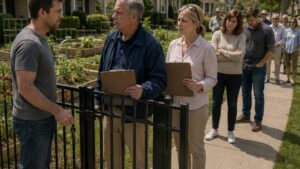
Gary Williams was crossing the courtyard with a clipboard tucked against his ribs. Two other residents were behind him, carrying towels and a canvas pool bag. They slowed when they saw Ronald at the gate.
Gary stopped several feet away.
“You got the notice?”
Ronald looked back at the paper.
“I just got the lock.”
Gary’s mouth tightened. “The notice was delivered yesterday.”
Ronald pulled the sheet free enough to read the first lines.
The association had suspended his pool access for violating the new guest policy. The violation concerned three visitors he had brought to the pool the previous weekend.
His sister. Her husband. Their grandson.
Ronald read the paragraph twice.
“Thirty days?”
Gary nodded.
Ronald glanced toward the residents standing nearby. Neither looked at him for long.
He folded the notice once.
“I’ve been using this pool since before half the roofs here were replaced the first time.”
“That isn’t the issue.”
“No?”
“The board adopted the guest policy in May. Every owner received it.”
“I received it.”
“And you exceeded the guest limit.”
Ronald looked at him.
Gary had been president less than a year. Before that, he had been the man who volunteered to organize parking stickers and replace burned-out courtyard lights. Ronald had liked him well enough.
Gary was organized. He answered emails. He remembered deadlines.
Lately, he also seemed to enjoy saying the words the board.
“Three family members,” Ronald said.
“The rule doesn’t distinguish between family and other guests.”
Ronald pressed his lips together.
He could feel the heat climbing behind his ears. It wasn’t the thirty days. He had gone whole summers without getting in the pool.
It was the lock.
Someone had come out here and decided a physical barrier was necessary for him.
The residents behind Gary moved through the gate using another latch point. The woman gave Ronald a small, uncomfortable smile.
He looked back at Gary.
“So everybody else goes in.”
“Approved residents with active access.”
“And mine is inactive.”
“For thirty days.”
Gary spoke patiently, which irritated Ronald more than anger would have.
Ronald tapped the notice.
“You could have called me.”
“We’ve already had complaints that enforcement is inconsistent.”
“From whom?”
“That’s not really relevant.”
“It feels relevant from this side of the gate.”
Gary exhaled through his nose. “Ronald, this isn’t personal.”
Ronald almost laughed.
A locked gate was a strange way to demonstrate that.
He stepped closer to the bars and looked at the padlock.
It was not part of the old hardware. Someone had threaded it through an added metal loop so the original key mechanism could not release the gate.
“When did you put this on?”
“The maintenance contractor did it early this morning.”
“You paid somebody to alter the gate?”
“To secure association access.”
Ronald turned slowly.
There it was.
Not pool access.
Association access.
He studied Gary for a moment.
Then he said, “Whose association access?”
Gary frowned.
“To the pool.”
“That isn’t what I asked.”
One of the residents inside the fence glanced over.
Ronald kept his voice level.
“Who owns the ground the pool sits on?”
Gary’s expression changed, but only slightly.
“The association maintains the pool.”
“I know who maintains it.”
“Ronald—”
“Who owns the parcel?”
Gary shifted the clipboard beneath his arm.
“It’s a common amenity.”
“That’s not an answer.”
“It has been treated as common property for decades.”
Ronald felt something old and half-forgotten move in his memory.
A closing table.
A developer in a brown suit.
Too many documents.
A narrow parcel beside his unit that nobody had known what to do with.
He had not thought about it seriously in years.
Gary mistook his silence for retreat.
“Your pool privileges are suspended,” he said. “That’s all this is.”
Ronald looked directly at him.
“Privileges.”
“Yes.”
Ronald nodded once.
He looked through the bars again.
Thirty-seven years.
His children had learned to swim there. His wife had once insisted the shallow end needed a second handrail. Ronald had replaced three cracked deck boards himself before the association finally started using contractors.
He had paid assessments like everyone else.
He had also paid something else.
A small tax line. Separate. Annoying.
He could suddenly see the envelopes.
Gary was still talking.
“If you want the board to review the suspension at the next meeting, submit something in writing.”
“I don’t want the suspension reviewed.”
Gary paused.
“I want the ownership reviewed.”
The patience disappeared from Gary’s face.
“We’re not turning this into something it isn’t.”
Ronald felt the anger rise again, but he held it.
That had been his habit for most of his life. On job sites, in sales meetings, at home. When somebody pushed too hard, Ronald did not usually push back immediately.
He stored things.
Sometimes too long.
He folded the notice a second time and put it in his pocket.
“Don’t install anything else on that gate until you check the records.”
Gary’s eyes narrowed.
“The board has already authorized the access upgrades.”
“Then check before you do it.”
“We’re not delaying safety improvements because you’re unhappy about a rules violation.”
Ronald looked at the padlock one last time.
“All right.”
Gary seemed almost disappointed by the answer.
Ronald walked away.
He crossed the courtyard without looking back, climbed the stairs to his unit, and went directly to the hall closet.
On the top shelf sat a gray document box he had not opened since refinancing the condo years earlier.
He carried it to the dining table.
Inside were old insurance policies, closing statements, tax notices, warranty papers, and a brittle envelope from the original developer.
Ronald sorted slowly.
He almost missed the deed because it had been folded behind a yellowed settlement statement.
He opened it carefully.
His own unit description appeared first.
Then another line.
A separate parcel designation.
Lot 4B.
Ronald sat back.
The pool was on Lot 4B.
And his name was on the page.
Chapter 2: The Parcel Number Nobody Remembered
The county website still recognized Lot 4B.
Ronald stared at the screen and wondered whether that made him relieved or afraid.
He had typed the parcel number exactly as it appeared on the old deed.
For several seconds, the website had shown nothing but a spinning circle.
Then a property record opened.
Lot 4B.
Crestwood Commons.
He leaned closer.
The owner field carried his name.
RONALD CARTER.
Ronald took his glasses off, wiped them against his shirt, and put them back on.
The name did not change.
He scrolled.
Parcel description.
Dimensions.
Tax district.
Recorded instrument reference.
There was no HOA listed as owner.
No Crestwood Association.
No management company.
Just him.
He sat very still.
From the dining room window, he could see a narrow slice of the pool fence through the trees. The new padlock was too far away to distinguish, but he knew exactly where it hung.
For the first time since Gary had put the suspension notice in his hand, Ronald felt something close to satisfaction.
Then he saw another line.
“Associated rights and encumbrances: see recorded instrument.”
He frowned.
He clicked the instrument number.
The scanned document was older and harder to read.
He enlarged it.
The original developer’s language ran across several pages in the dense legal style Ronald remembered from closing: easements, access, utility rights, common maintenance obligations.
He found his unit number.
Then Lot 4B.
Then a phrase about use by residential owners.
Ronald read it twice and understood it no better the second time.
His satisfaction faded.
He printed everything.
By noon, his dining table was covered.
The old deed sat beside the current county record. The suspension notice was under a coffee mug. A legal pad held dates Ronald had begun reconstructing from memory.
1987: bought the condo.
Pool already built.
Developer explained something about the pool parcel.
Ronald rubbed his forehead.
He could remember the room where he had signed the papers more clearly than the words.
His wife had been there.
They had been worried about the mortgage payment and whether the second bedroom would be large enough if they had another child.
The developer had treated the extra parcel like an administrative detail.
Ronald remembered joking about whether he was buying a swimming pool.
The developer had said something like, “Technically, the dirt under it.”
Or maybe Ronald had supplied that line himself over the years.
Memory was dangerous that way.
He got up and went back to the document box.
At the bottom were several old association newsletters. One contained a pool-cleaning schedule from the early nineties.
Another listed a special assessment for fence repairs.
Ronald had paid those too.
That gave him pause.
If the pool was his, why had everyone paid to maintain it?
Because everyone used it, he thought.
That had always been the arrangement.
But arrangement was not the same as ownership.
He called the county recorder’s public information line.
After a short menu, a clerk answered.
Ronald gave the parcel number.
“I’m trying to understand whether the current record is showing title ownership or just tax responsibility.”
The clerk asked for the instrument number.
Ronald read it.
There was typing.
“The current record owner is Ronald Carter.”
“That’s me.”
“All right.”
“Does the homeowners association appear anywhere?”
“Not as the owner.”
Ronald looked at the screen.
“What does that mean for the pool?”
“I can tell you what the public record says. I can’t interpret legal rights.”
“There’s language about residential use.”
“You’d need to review the recorded document or speak with an attorney.”
Ronald thanked her.
He did not call Gary.
That surprised him.
An hour earlier he had imagined walking straight to the pool gate with the printout folded in his hand.
Now the language about use bothered him.
He returned to the scanned instrument.
The original developer had created the condominium in stages. Some property was clearly common area. Some remained separately described. Lot 4B had been conveyed with Ronald’s purchase, but a paragraph farther down appeared to reserve something for the other units.
Access.
Enjoyment.
Maintenance.
The words were there, but the relationships between them were not obvious.
Ronald leaned back.
He had spent forty years selling building materials to contractors who occasionally believed the loudest interpretation of a specification was the correct one.
He had watched expensive mistakes happen that way.
Gary had made an assumption.
Ronald did not want to answer one assumption with another.
His phone buzzed.
An email from the HOA.
SUBJECT: Pool Access System Upgrade.
Ronald opened it.
The board had approved electronic access controls. Installation would begin the following week. Residents would receive activated fobs after confirming account status and compliance with association rules.
Ronald read the last phrase twice.
Compliance with association rules.
He felt his jaw tighten.
According to the county, the board did not own the parcel.
Yet it was about to install a system determining who could enter it.
He forwarded the email to himself, then printed it.
The printer whirred in the otherwise quiet room.
As he added the page to the growing stack, something fell from the document box onto the floor.
A tax envelope.
He bent and picked it up.
The paper was from years earlier.
His name.
His mailing address.
A parcel number.
Lot 4B.
Ronald opened it.
The amount was small enough that he understood why he had never paid much attention.
He went back to the box.
There were more.
Different years.
Same parcel.
Same separate charge.
He began arranging them by date.
He had paid taxes on the pool parcel separately from his condominium unit for decades.
Ronald sat down.
The problem was no longer whether he had imagined the ownership arrangement.
The problem was why nobody had ever bothered to clarify what that ownership meant.
And Ronald could no longer pretend he was innocent of that neglect.
Chapter 3: Thirty-Seven Years of Small Tax Bills
The clerk at the county counter slid the screen toward Ronald and pointed to a column of dates.
“It’s been billed to you the whole time.”
Ronald read down the list.
Year after year.
The tax account for Lot 4B had never been assigned to Crestwood Commons Association.
Never transferred to the management company.
Never merged with another parcel.
His name remained in the owner field.
“You’re sure there isn’t another record that supersedes this?”
The clerk shook her head.
“Not that I’m seeing.”
Ronald had brought copies of the deed, the current parcel printout, and six old tax envelopes in a folder.
He placed one envelope on the counter.
“I’ve been paying these without really thinking about them.”
“That happens more often than you’d think.”
He gave her a dry smile.
“I’d hoped you’d say less often.”
She smiled back, then turned serious when Ronald asked the question that mattered.
“So I own the pool.”
The clerk did not answer immediately.
“I’m saying the county property system identifies you as the record owner of this parcel.”
“That sounds like the same thing.”
“It isn’t always.”
Ronald felt his satisfaction drain again.
She tapped the recorded instrument number.
“There can be easements, covenants, access rights, maintenance obligations. Ownership of land doesn’t necessarily tell you everything someone else is allowed to do on it.”
He looked at the screen.
“Can the HOA lock me out?”
“That’s a legal question.”
“Of course it is.”
She gave him an apologetic look.
Ronald gathered his documents.
At the doorway, he stopped.
“If you were me, what would you do?”
The clerk glanced toward the waiting area, then lowered her voice slightly.
“I’d stop assuming anything and get the documents interpreted.”
That sentence followed him home.
Stop assuming anything.
By Monday afternoon, the dining table had become a crude archive.
He spread the tax envelopes in a line beside the HOA suspension letter.
Seeing them together changed their meaning.
For decades, each bill had been irritating but insignificant. Twenty-something dollars one year. A little more another. Ronald had paid them because the county said he owed them.
He had never asked why.
His wife once had.
He could remember her holding one envelope and asking, “Why do we have two property tax bills?”
Ronald had shrugged.
“Probably some parcel thing from the original closing.”
She had accepted that because he had accepted it.
Now he imagined explaining the same answer to Gary.
Probably some parcel thing.
His own carelessness annoyed him.
He had known enough to know something unusual existed.
He had simply never wanted the inconvenience of sorting it out.
The phone rang.
Donna Green.
Ronald had known Donna nearly twenty years. She was careful with money, careful with words, and nearly impossible to hurry.
“I heard you went to the county,” she said.
“Word travels.”
“Gary mentioned it.”
“Of course he did.”
Donna was quiet.
“Are you really listed as the owner?”
“Yes.”
Another pause.
“Of the pool?”
“The land under it.”
“That’s not exactly the same.”
Ronald almost smiled.
“You and the county clerk have been talking?”
“I’m the treasurer, Ronald. I’m paid in headaches.”
He leaned against the counter.
“Did you know?”
“Know what?”
“That the association doesn’t hold title.”
“I knew our file was strange.”
“That’s not an answer either.”
Donna sighed.
“We have maintenance records going back forever. Insurance records. Repair bills. Assessments. But the deed folder never made sense to me.”
“Did you ask?”
“Years ago.”
“And?”
“I was told the arrangement was old and everybody had always used the pool.”
Ronald closed his eyes.
There it was again.
Everybody always had.
A tradition dressed up as documentation.
“Did Gary know the file was strange?”
Donna hesitated.
“I don’t want to get in the middle of this.”
“You’re the treasurer. You’re already in the middle.”
“I told him before the new rules were adopted that the pool paperwork should probably be reviewed.”
Ronald straightened.
“What did he say?”
“That the management records treated it as an association amenity.”
“That wasn’t my question.”
“I know.”
Ronald looked through the window toward the courtyard.
“So he knew there was a title problem.”
“I said the file was incomplete. I didn’t say there was a title problem.”
“Donna.”
“I’m being precise because everybody should have been more precise years ago.”
That stopped him.
He could not argue with it.
After the call, Ronald drove to the management office.
Gary was not there. A manager behind the desk handed Ronald a printed notice when he asked about the pool access upgrade.
Installation date: Friday.
Four days away.
The notice described an electronic strike, fob reader, and updated gate hardware.
Ronald felt a new kind of urgency.
A padlock could be removed.
A full access system would turn the association’s assumption into infrastructure.
“Has the contractor already been paid?” he asked.
“A deposit.”
“Can it be paused?”
“Only by board direction.”
Ronald nodded.
On his way out, he passed Gary in the parking lot.
Gary slowed.
“I heard you’ve been making inquiries.”
“I’ve been reading records.”
“And?”
“The county lists me as the owner of Lot 4B.”
Gary’s face remained controlled.
“I’m aware of your claim.”
“It isn’t just a claim.”
“The association has decades of documented use.”
“That may matter.”
Gary seemed surprised by the answer.
Ronald continued.
“But so does title.”
“We’re proceeding with the installation.”
“Even with this unresolved?”
“The pool needs controlled access.”
“Controlled by whom?”
Gary’s expression hardened.
“The board has a responsibility to the community.”
Ronald held his gaze.
“So do I, apparently.”
Gary glanced toward the management office.
“If your attorney contacts us, we’ll respond.”
“I don’t have one yet.”
“Then maybe you should get one.”
Ronald watched him walk away.
It was not a threat exactly.
It was worse.
Gary sounded confident.
Ronald returned home and placed the Friday installation notice beside the old tax envelopes.
For the first time, the small bills did not look like forgotten paperwork.
They looked like thirty-seven years of someone quietly assigning responsibility to him.
And in four days, someone else planned to bolt a new control system onto the gate.
Chapter 4: The Lawyer Who Would Not Promise Victory
“Owning the parcel may be the beginning of the problem, not the end.”
Laura Adams said it before Ronald had finished taking the tax envelopes out of his folder.
He stopped with one hand over the stack.
“That’s not the sentence I was hoping to hear.”
“I assumed not.”
Laura’s office was small and orderly, with legal books along one wall and a narrow conference table between them. Ronald had expected reassurance once she saw the county record. Instead, she had spent fifteen minutes reading without offering him anything stronger than a raised eyebrow.
She placed the deed beside the current parcel printout.
“Your ownership position looks substantial.”
“Substantial?”
“I haven’t completed the title review.”
“The county says I own it.”
“The county database says you’re the record owner. Your deed appears consistent with that. Your tax history helps explain how the parcel has been treated.”
Ronald leaned forward.
“So take the lock off.”
Laura looked at him.
“That’s exactly why I’m being careful.”
She turned the old recorded instrument toward him and pointed to the paragraph he had struggled with all weekend.
“This language appears to grant residential owners use and access rights connected to the pool.”
Ronald read the sentence again.
“So they can use it.”
“Possibly more than simply use it. We need to determine whether this creates an easement, a covenant running with the units, or another enforceable right.”
“Does it let Gary lock me out?”
“No.”
The word came quickly enough that Ronald looked up.
Laura tapped the suspension notice.
“If you own the parcel and the association has no contractual authority to exclude you from it, physically preventing your access could be a serious problem for them.”
Ronald felt the first clean satisfaction he had experienced all week.
“Then we tell them to remove it.”
“We will.”
He reached for his folder.
Laura did not move.
“But?”
“But you’re thinking about this as if one side owns the truth and the other side owns the mistake.”
Ronald sat back.
“They put a lock on my gate.”
“They did.”
“They suspended me.”
“They did.”
“Knowing they might not even own the property.”
“I haven’t established what they knew yet.”
Ronald stared at the brass key he had placed on the table.
Laura picked it up and laid it directly beside the suspension letter.
“Your key worked for decades,” she said. “That matters. So does the fact that every other resident has apparently used the pool for decades.”
Ronald said nothing.
“You want control,” she continued.
“I want my property back.”
“Those may not be identical things.”
That irritated him because he could not immediately dismiss it.
He thought of summer evenings when every chair was occupied. Children jumping from the side. Residents grilling nearby. His wife handing out towels to people whose names Ronald could barely remember now.
Nobody had ever asked him for permission.
He had never expected them to.
Laura folded her hands.
“What outcome do you want?”
“The lock gone.”
“That’s the first outcome.”
“I want the board to stop pretending it owns something it doesn’t.”
“Second outcome.”
He frowned.
“And after that?”
Ronald opened his mouth.
Nothing came.
Laura waited.
Finally he said, “I don’t know.”
“That’s more useful than pretending you do.”
She drafted the notice while he sat across from her.
It did not accuse Gary of theft. It did not threaten to empty the pool or prohibit residents from entering. It stated that Ronald appeared to hold recorded title to Lot 4B, demanded that the association cease excluding him, requested suspension of further gate modifications, and required production of any document the HOA believed granted it authority to restrict his access.
Laura added one phrase Ronald read twice.
Potential unlawful interference with the rights of the record owner.
“Why not trespass?” he asked.
“Because I prefer being accurate before being dramatic.”
He almost smiled.
“Gary might not.”
“That is Gary’s problem.”
The letter went out that afternoon.
By five o’clock, the HOA had scheduled an emergency meeting for Thursday evening.
The electronic gate installation remained on Friday’s calendar.
Ronald returned home with less certainty than he had taken into Laura’s office, yet considerably more leverage.
His first impulse was to prepare every document he owned and lay them out at the meeting like evidence at trial.
Instead, he took Laura’s advice.
Three pages.
The deed.
The current county ownership record.
One representative tax bill.
Nothing more unless necessary.
He had spent decades in sales learning that too much evidence could make a person stop listening as effectively as too little.
Wednesday afternoon, Ronald found Donna Green checking the association mailbox cluster.
She saw him and looked as though she considered walking the other direction.
“Donna.”
She stopped.
“I’m not asking you to take sides.”
“That makes one of us.”
“What does that mean?”
She lowered the envelopes in her hand.
“Gary thinks I’m undermining the board because I told you the deed file was incomplete.”
“You told me the truth.”
“I told you what I knew.”
“Same thing.”
“No, Ronald. Not always.”
Her tone made him wait.
Donna glanced toward the courtyard.
“When we changed management companies six years ago, we inventoried association records. Pool invoices, insurance, maintenance contracts, inspections. Plenty of paper.”
“But no deed.”
“There was a photocopy of an old site plan and a note referring to Lot 4B. Nothing showing a transfer to the association.”
Ronald’s jaw tightened.
“You told Gary that?”
“I told the board.”
“When?”
“Before we adopted the new access system.”
The courtyard seemed to go quiet around them.
Ronald took a step closer.
“And they voted anyway?”
“The rules, yes.”
“The lock?”
“That was Gary’s enforcement decision after your violation.”
Ronald looked toward the pool.
The brass padlock was still there.
“So he knew.”
Donna shook her head.
“He knew the file was incomplete. That’s different from knowing you owned it.”
“He knew enough to check.”
“Yes.”
The answer was so quiet Ronald almost missed it.
Donna gathered the mail tighter against her chest.
“You should know something else.”
“What?”
“Gary wasn’t pushing the pool rules because he woke up wanting more control.”
Ronald waited.
Donna looked uncomfortable now for a different reason.
“There’s an insurance issue.”
“What insurance issue?”
“That’s what Thursday’s meeting is really about.”
Before Ronald could ask more, she walked toward her unit.
He remained beside the mailboxes with Laura’s warning in his head.
Owning the parcel may be the beginning of the problem.
Now he knew Gary had been warned the association’s records were incomplete before the suspension.
What he did not know was why Gary had been willing to take that risk anyway.
Chapter 5: The Insurance Letter Behind the New Rules
“We were told our pool coverage might not be renewed.”
Gary Williams said it before anyone had settled comfortably into the folding chairs.
The emergency meeting room was little more than a converted clubhouse office. Ronald sat at one end of the table with Laura beside him. Donna sat near the association files. Two board members occupied the opposite side.
Gary remained standing.
In front of him lay an insurance letter.
Ronald had expected Gary to begin with the deed dispute.
Instead, Gary pushed the insurer’s correspondence toward the center of the table.
“We had an inspection in April,” he said. “The carrier identified uncontrolled guest access, outdated gate hardware, inconsistent sign-in practices, and uncertainty about who was responsible for enforcement.”
Ronald glanced at Laura.
She was reading the letter.
Gary continued.
“Our premium already increased last year. The broker told us another problem at the pool could make replacement coverage extremely expensive.”
One board member shifted in his chair.
Ronald looked back at Gary.
“So that’s why the new rules.”
“Yes.”
“Why didn’t you say that Saturday?”
“Because your suspension was for violating the guest policy.”
“That isn’t an answer.”
Gary’s jaw moved.
“The policy applies regardless of why it was adopted.”
Ronald felt anger return, but it was different now.
Gary had not invented the problem.
That almost made the rest worse.
Laura slid the insurance letter back.
“This asks the association to improve access control and guest supervision.”
“Yes.”
“It doesn’t state that the association owns Lot 4B.”
“No.”
“It doesn’t instruct you to suspend the record owner from entering the parcel.”
Gary looked at Ronald.
“At the time, we had no reason to accept Ronald’s interpretation.”
Donna spoke before Ronald could.
“You had reason to question ours.”
Gary turned toward her.
“Donna.”
“You knew the deed file was incomplete.”
“I knew the historical paperwork was incomplete. That is common in older associations.”
“And I told you Lot 4B was strange.”
“You told us we lacked a clean deed packet.”
“The difference is getting smaller.”
Silence settled across the room.
Ronald watched Gary’s face.
For the first time, he saw something other than authority there.
Fear.
Not fear of Ronald.
Fear of losing control of the meeting.
Gary finally sat down.
“We had thirty days to respond to the insurer,” he said. “The pool was already open. People were bringing guests without signing them in. The old gate could be passed from person to person with one key. We needed a system.”
“That may all be true,” Ronald said.
Gary looked at him.
“But you still locked me out.”
“You knowingly violated a rule.”
“I brought my sister, her husband, and their grandson.”
“The rule was two guests.”
Ronald’s hands tightened beneath the table.
Laura touched one finger to the edge of his folder, a small reminder not to let the argument shrink back to three guests.
Ronald breathed out.
“Fine. Say I violated it. What gave you the authority to deny me entry to land titled to me?”
Gary looked at the deed copies.
“The association has operated the pool for decades.”
“That tells me what happened. Not why you had the right.”
“There are access rights attached to the units.”
Laura spoke.
“We agree there may be.”
Ronald turned toward her.
Gary noticed.
“There,” he said. “Even your attorney agrees.”
“She agrees the residents may have access rights,” Ronald said. “That does not make you the owner.”
“It may give the association authority to administer access.”
“It may,” Laura said. “That remains to be determined.”
Gary’s expression tightened.
Ronald understood then why the man had moved so quickly.
Every uncertain sentence sounded, to Gary, like a crack in the board’s credibility.
If Gary admitted he did not know, he believed the whole system might look illegitimate.
That explained him.
It did not excuse him.
Donna opened a binder.
“I found the email I sent before the May vote.”
Gary closed his eyes briefly.
Donna read only one line.
“‘Before purchasing new gate hardware, we should verify the association’s legal interest in Lot 4B because the ownership documentation in our files is incomplete.’”
Ronald looked at Gary.
“You read that?”
“Yes.”
“And ordered the lock anyway.”
“After you violated the rule.”
“Knowing you hadn’t verified the property.”
Gary leaned forward.
“I had fourteen households depending on us to keep the pool open. You think the carrier cares about a thirty-seven-year-old paperwork problem? They care whether a child gets hurt and whether we can show controlled access.”
Ronald’s anger faltered.
Not disappeared.
Faltered.
He thought of the child’s foam noodle floating behind the locked gate Saturday morning.
Gary was still wrong.
But he was not protecting nothing.
Laura broke the silence.
“The question is not whether the association needed reasonable safety rules. The question is whether those rules were enforced through authority the association actually possessed.”
Gary rubbed his forehead.
“What do you want?”
The room shifted toward Ronald.
For three days, he had wanted that question.
Now that it had arrived, he found it harder.
“My access restored.”
Gary nodded stiffly.
“Pending legal review, we can deactivate the suspension.”
“No,” Ronald said. “Not pending. Rescind it.”
Gary looked up.
“The guest violation occurred.”
“You can tell me I violated a guest rule. You cannot call my presence on my own parcel a privilege you can revoke.”
One of the board members quietly said, “He has a point.”
Gary glanced at him.
The balance in the room moved by an inch.
Not enough.
Gary folded his hands.
“I am not issuing a public apology tonight.”
Ronald felt his temper flare.
Laura spoke before he did.
“Then perhaps we focus on preventing additional interference.”
Gary’s eyes went to her.
“The electronic installation?”
“Yes.”
“We’re proceeding.”
Ronald stared at him.
Gary continued.
“If Ronald owns the parcel, that matters. If every unit possesses recorded pool access, that also matters. Until counsel determines the relationship, I’m not abandoning a safety upgrade required for insurance.”
The phrase every unit possesses recorded pool access hung in the room.
Ronald looked toward Laura.
She was no longer watching Gary.
She was looking at one of the old instruments.
Her finger stopped halfway down the page.
“What?” Ronald asked.
Laura did not answer immediately.
She drew the document closer.
Donna leaned forward.
Gary stopped talking.
Laura read silently, moved to the next page, then returned to the first.
Finally she looked at Ronald.
“I need to check the recording references.”
“What did you find?”
“Language granting the unit owners access to the pool parcel.”
“We already knew there was something.”
“This is stronger than I thought.”
Ronald felt the room tighten around him.
“How strong?”
Laura closed the folder.
“Strong enough that I don’t want to answer until I trace the original instrument.”
Gary leaned back, relief touching his face for the first time that evening.
Ronald saw it.
And understood the next problem before Laura said anything else.
He might own the pool.
The other residents might have a legally protected right to use it.
If both things were true, the question was no longer who had been wrong about ownership.
It was who had the right to control the gate.
Chapter 6: Owning the Pool Was Not the Same as Owning the Rules
“You own the land.”
Laura Adams let the sentence settle.
Then she added, “You cannot simply turn the pool into your private backyard.”
Ronald stared across her desk.
It was Friday morning.
In his coat pocket was a new brass padlock he had bought the night before.
He had not told Laura about it.
“Those two statements don’t fit together very well.”
“They fit together perfectly in property law.”
“I was afraid you’d say that.”
Laura rotated a copy of the original recorded declaration toward him.
She had highlighted two sections.
“The developer conveyed Lot 4B to you. That part is unusually clear.”
Ronald looked at the first paragraph.
“And this?”
“The units were granted continuing rights to access and use the pool, subject to reasonable rules concerning maintenance, safety, hours, and shared costs.”
“So Gary can make rules.”
“Reasonable ones, perhaps.”
“And suspend me.”
Laura shook her head.
“Not necessarily. Especially not from your own parcel in a manner that interferes with your ownership rights. The association also appears to have assumed administrative responsibilities over time without ever acquiring title.”
Ronald leaned back.
“So everybody was half right.”
“That is an unhelpful way of phrasing it, but close.”
He looked at the highlighted pages.
For days he had imagined the clean moment when someone finally said the pool was his.
He had expected that sentence to feel like a door opening.
Instead it revealed another hallway.
“What happens to the electronic system?”
“I told the HOA’s counsel that installation should pause until access control is addressed.”
“And?”
“They agreed to postpone the electronic reader.”
Ronald felt some tension leave his shoulders.
“What about the padlock?”
“The association agreed to remove the additional lock today and restore your normal access.”
There it was.
The victory he had wanted.
Yet Laura was still watching him.
“What?”
“What are you planning to do after they remove it?”
“Use the pool.”
“Ronald.”
He sighed.
He pulled the new brass padlock from his pocket and placed it on her desk.
Laura looked at it.
Then at him.
“I bought it yesterday.”
“I gathered that.”
“I was going to put my own lock on the gate.”
“And give keys to whom?”
“I hadn’t gotten that far.”
“Yes, you had.”
He disliked how easily she saw through him.
Ronald turned the lock in his palm.
“I wanted Gary to have to ask me.”
“For access.”
“Yes.”
“The way you had to ask him?”
Ronald’s fingers stopped.
Laura said nothing else.
By late morning, the maintenance contractor arrived at the pool gate.
Ronald stood on the courtyard side with Donna several feet away. Gary came from the management office holding a folder but said little.
The contractor crouched at the black metal gate.
His tool scraped against the added loop.
For five days, Ronald had seen that brass padlock every time he looked through his window.
Now the contractor cut the added hardware free and lifted the lock away.
A small metallic clink.
That was all.
No applause.
No residents gathering to watch.
Just a maintenance worker setting the association’s lock into a toolbox.
Gary handed Ronald his original key.
“Your suspension is rescinded pending revision of the enforcement procedure.”
Ronald looked at him.
“Pending?”
Gary’s mouth tightened.
“The access suspension is rescinded.”
“Thank you.”
Neither man liked how formal the exchange sounded.
Ronald inserted his key.
The gate opened.
For one second, the simplicity of it almost made him laugh.
Five days of records, taxes, attorneys, meetings—and the same old key worked.
He stepped inside.
Then he remembered the lock in his pocket.
Ronald removed it.
Gary noticed.
Donna noticed too.
Ronald walked back to the gate and held the padlock against the black bars.
It fit easily through the same loop the contractor had left usable.
He imagined snapping it shut.
Gary standing outside.
Gary calling.
Gary having to explain to fourteen households that the man he had suspended now controlled their access.
The image was satisfying.
Too satisfying.
Behind Ronald, the pool pump hummed.
He looked at the water.
He could see his wife years earlier at the shallow-end steps, one hand on the rail and the other waving at a neighbor’s child to stop running.
Everyone had used this place.
Everyone had maintained it.
Ronald had known that.
He had also known, somewhere in the back of his mind, that the tax bill came to him.
He had never corrected anyone.
Not because he had been deceived.
Because the arrangement was convenient.
Until it wasn’t.
Donna broke the silence.
“Are you locking it?”
Ronald looked at the padlock.
“I thought I was.”
Gary’s face gave away nothing.
Ronald turned the brass lock over once.
“My wife asked me years ago why we got two tax bills.”
Donna waited.
“I told her it was probably some old parcel thing.”
He gave a short, humorless laugh.
“I knew enough to ask. I just didn’t want the headache.”
Gary looked at him differently.
Ronald continued.
“That doesn’t make what you did right.”
“I didn’t say it did.”
“But I let everybody pretend the paperwork didn’t matter as long as the arrangement worked for me.”
Donna lowered her eyes.
“So did the board,” she said.
“Yes.”
Ronald put the padlock back in his pocket.
Gary glanced at the gate.
“What are you saying?”
“I’m saying nobody puts a unilateral lock on it until this is settled.”
Gary hesitated.
“And the residents?”
“The existing key access stays. Safety rules stay. We work out who has authority to administer them and who pays for what.”
Gary gave a tired nod.
It was not agreement yet.
But it was the first time Ronald had seen him listen without preparing his next defense.
That afternoon Ronald returned to Laura’s office.
She had already drafted a stronger demand letter.
One paragraph proposed that, absent agreement, Ronald reserve the right to assert exclusive control over portions of the parcel not burdened by recorded access rights and challenge unauthorized HOA installations.
A week earlier Ronald would have enjoyed every word.
Now he read it twice.
“Don’t send this version.”
Laura looked up.
“Why?”
“I don’t want exclusive control.”
“You may want leverage.”
“I have leverage.”
He placed the new brass padlock on her desk again.
“I almost used it.”
Laura waited.
Ronald pushed it toward her.
“I would’ve been doing exactly what Gary did. Taking the part of the law that helped me and pretending the rest didn’t exist.”
“What do you want instead?”
Ronald looked down at the marked declaration, the deed, the tax records, and his ordinary gate key.
“I want the parcel acknowledged as mine.”
Laura nodded.
“I want the residents’ access written clearly enough that nobody has to guess again.”
Another nod.
“I want maintenance, insurance, taxes, and liability divided in writing.”
“And the board’s suspension?”
“Rescinded in the record.”
“An apology?”
Ronald thought of Gary at the meeting, frightened less of Ronald than of appearing unable to control the problem.
“If he means one.”
Laura closed the aggressive draft.
“That sounds considerably harder than putting on your own lock.”
Ronald picked up the brass padlock.
“Yes.”
He slipped it into his pocket.
“Which is probably why nobody did it thirty-seven years ago.”
Chapter 7: The Gate They Finally Stopped Pretending About
Ronald Carter walked into the meeting carrying enough paperwork to make the pool unusable for months.
He left most of it in his folder.
The clubhouse room was fuller than it had been two weeks earlier. Several residents stood along the back wall because every chair had been taken. Gary Williams sat at the head of the table with Donna Green beside him and Laura Adams across from Ronald.
On the table between them lay the draft agreement.
No padlock.
No suspension notice.
No photographs of the gate.
Just twenty-three pages of language that finally said, in writing, what everyone had spent decades pretending did not need to be said.
Gary tapped the first page.
“For the record, before we start, I want to address the violation.”
The room quieted.
Ronald looked at him.
Gary did not read from a prepared statement.
“The board is rescinding Ronald Carter’s pool-access suspension in full.”
A woman near the back shifted her weight.
Gary continued.
“The guest-policy violation itself remains a separate matter for review under the revised rules, but the board should not have used physical exclusion before verifying its authority over Lot 4B.”
Ronald watched him closely.
Gary’s voice remained controlled, but the sentence cost him something.
He knew that because Ronald had once been just as reluctant to admit an error in front of people who expected him to know what he was doing.
Gary looked down at the table.
“I made that enforcement decision.”
No one spoke.
“I believed we had a duty to act quickly because of the insurance deadline. That concern was real. My assumption about our authority was not sufficiently verified.”
The words were not an apology yet.
Then Gary looked directly at Ronald.
“I should have checked before I put the lock on the gate.”
Ronald felt everyone waiting for him.
He could have made Gary say more.
He could have asked about humiliation, about the residents walking past him while he stood outside, about the word privilege.
Instead, Ronald nodded.
“Yes,” he said. “You should have.”
The room exhaled.
Laura opened the agreement.
“Then we can deal with the harder part.”
A few people gave nervous smiles.
The harder part was money.
For thirty-seven years, Ronald had paid the property taxes on Lot 4B personally. The amount had been small enough to ignore year by year. Maintenance had been paid through association assessments. Insurance had been carried under association policies. Repairs had been approved by boards that did not hold title. Rules had been enforced by people who had never clearly established where their authority began or ended.
The agreement separated those things.
Ronald would remain record owner of the parcel.
The unit owners would retain the access and use rights created by the original recorded instruments.
The HOA could administer reasonable safety, operating-hour, and guest rules on behalf of residents, but it could not revoke Ronald’s underlying right to enter his own property through ordinary disciplinary procedures.
Major physical changes to the gate, pool structure, or parcel would require Ronald’s written consent unless an emergency created immediate safety concerns.
Insurance responsibilities would be clarified.
Maintenance obligations would be shared.
Property taxes on Lot 4B would no longer disappear quietly into Ronald’s checking account.
Donna reached the section on costs.
“This is where nobody is going to love me.”
Someone at the back said, “We already don’t.”
A few people laughed.
The tension eased.
Donna continued.
“The association has been benefiting from Ronald personally carrying parcel taxes and some incidental ownership costs. Under the proposed budget, those costs become transparent pool expenses.”
A resident raised his hand.
“How much?”
Donna gave the annual figure and divided it across the units.
The increase was not enormous.
That did not prevent complaints.
One resident asked why everyone should pay more because Ronald had suddenly decided the pool belonged to him.
Ronald felt the old irritation rise.
Laura glanced at him but did not intervene.
Ronald answered.
“I didn’t suddenly decide anything.”
The resident folded his arms.
“Well, none of us knew.”
“That includes me more than it should.”
The room became quieter.
Ronald stood.
“I knew the tax bill came to me. I knew there was an odd parcel in my closing papers. I didn’t understand all of it, and I didn’t make myself understand it.”
Donna watched him.
“For years, the arrangement worked. So I let it work.”
He looked around the room.
“That was convenient for me too.”
A newer owner near the door frowned.
“So you’re saying the board wasn’t the only one who ignored it.”
“No.”
Gary looked up.
Ronald continued.
“The board made the decision to lock me out. That was wrong. But pretending the paperwork didn’t matter started long before Gary became president.”
He sat down.
The room felt different after that.
Less like a trial.
More like maintenance.
That was what the agreement really was: maintenance on something everyone had allowed to corrode.
They worked through the remaining sections.
Guest limits would stay, but suspensions affecting Ronald would have to be structured around conduct rather than exclusion from his parcel.
The electronic system would still be installed, but with a neutral administration protocol. Each residence would receive fobs. Ronald would receive the same resident fob plus emergency owner access that could not be deactivated through routine enforcement.
No board president would hold a special master key alone.
Changes would require documented authorization.
Gary objected to that provision.
“So if someone needs emergency access at midnight?”
“The manager and two designated board officers will have emergency credentials,” Laura said.
Gary looked at Ronald.
“You’re comfortable with that?”
Ronald almost smiled.
“That’s the point. I’m not supposed to be comfortable because I personally control it.”
Gary gave a small nod.
The vote took place just before nine.
It passed.
Not unanimously.
One board member voted no, arguing that the agreement conceded too much to Ronald’s ownership claim.
Two residents objected to the increased pool allocation.
Nobody applauded.
Ronald was grateful for that.
Applause would have made it feel as though someone had won.
The next morning, the contractor returned.
This time the work looked different.
The old improvised lock point was removed completely.
A new electronic reader was mounted beside the same black gate. The hardware was clean, ordinary, almost disappointing.
Ronald stood with Donna while the technician tested the system.
Gary approached carrying several programmed fobs.
He handed one to Donna.
One to Ronald.
Ronald turned his over in his hand.
It looked exactly like everyone else’s.
Gary noticed.
“The owner override is registered separately.”
“I know.”
“You could have asked for a different credential.”
“I didn’t want one.”
Gary looked toward the pool.
“For what it’s worth, the insurance broker approved the arrangement.”
“That’s worth something.”
Gary nodded.
They stood without speaking for a moment.
Then Gary said, “I really did think I was protecting the place.”
Ronald looked at him.
“I know.”
“I should have checked.”
“Yes.”
Gary gave him a tired look.
“You’re going to make me say that forever?”
“No.”
Ronald held up the fob.
“This should help.”
Gary laughed once.
It was the first easy sound Ronald had heard from him since the whole thing began.
The contractor finished programming the reader.
Donna tested her fob.
A green light flashed.
The gate clicked.
She stepped through.
Gary followed.
Ronald remained outside for a moment.
He thought of that first Saturday morning.
The brass padlock.
The suspension notice.
Gary calling his access a privilege.
Then he held his ordinary resident fob against the reader.
Green light.
Click.
Ronald opened the gate.
Nobody stopped him.
Nobody needed his permission either.
That was the difference.
Later that afternoon, Ronald returned to his condo and emptied his pockets onto the kitchen counter.
Keys.
Wallet.
Receipt.
The small brass padlock he had bought on Thursday night.
He picked it up.
For a moment he considered throwing it away.
Instead, he opened the kitchen drawer where he kept spare batteries, old keys, and things he did not quite have a reason to keep.
He set the padlock inside.
It no longer meant that the HOA controlled the gate.
It no longer meant that Ronald did.
He closed the drawer.
Then he took his towel, walked back across the courtyard, touched the same plain fob to the reader, and went swimming.
The story has ended.