The HOA Ordered Him to Tear Out His Front Steps—Then He Found the Approval They Had Ignored
Chapter 1: The Notice Was Already on His Door
Michael Hill heard the metal tape measure snap before he saw anyone.
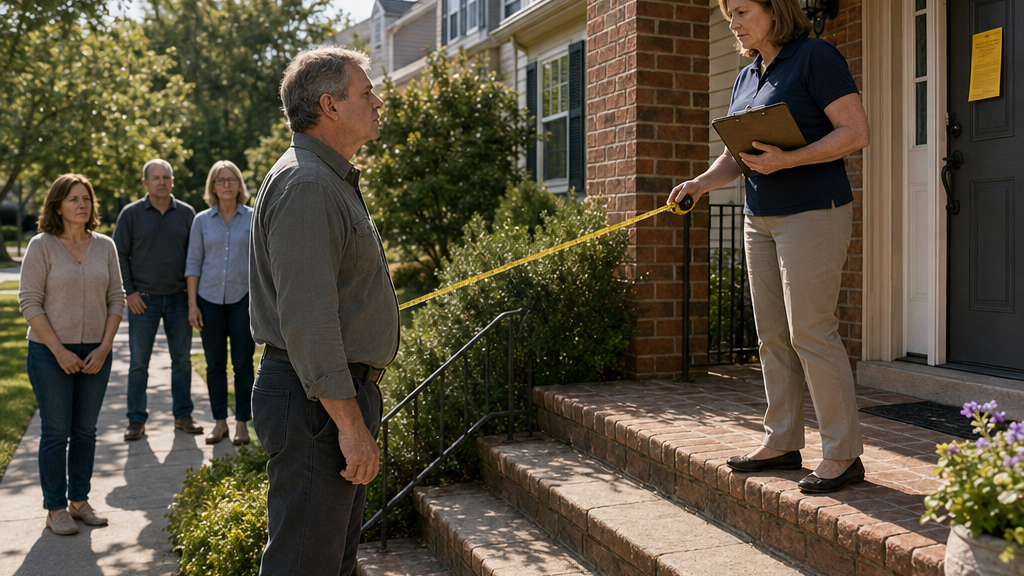
He stepped out of his garage carrying a half-empty bag of fertilizer and found Carolyn White standing on his front landing with one end of a yellow tape hooked against the brick column. Two members of the architectural committee stood below her. Rachel Allen, from three houses down, was watching from the sidewalk.
Carolyn bent over the tape.
“Forty-two and three-quarters.”
Michael set the fertilizer bag down.
“What are you measuring?”
Carolyn straightened. She wore a navy HOA polo and carried a clipboard tucked under one arm.
“Your landing.”
“I can see that.”
One of the committee members looked away.
Carolyn retracted the tape halfway. “We sent notice of an architectural inspection.”
“You sent an email Thursday saying you wanted to schedule one.”
“We’re doing the exterior inspections this morning.”
Michael looked at the old masonry steps beneath her feet. Three broad brick-and-concrete steps rose to a shallow landing bordered by the original red-brick columns. He had walked over them thousands of times. His father had stood on that landing twenty years earlier with mortar dust on his jeans, arguing about whether the railing looked better black or bronze.
Now Carolyn was measuring it like evidence.
“What’s wrong with it?”
She opened the clipboard.
“The current architectural standard requires a minimum landing depth of forty-eight inches at this configuration.”
Michael glanced at the tape.
“And you have?”
“Forty-two and three-quarters.”
“That landing was approved.”
Carolyn’s expression barely changed. “Do you have the approval?”
Michael almost answered too quickly.
He remembered a cream-colored sheet with an architectural committee stamp. He remembered keeping it with the contractor invoices and the permit documents. What he did not remember was the last time he had actually seen it.
“It was approved when the front was renovated.”
“When?”
“Years ago.”
“That isn’t really the question.”
Michael felt heat rise behind his collar.
Rachel shifted on the sidewalk. “Michael, they’re checking several houses. It’s not just yours.”
“I didn’t say it was.”
Carolyn pulled a bright violation tag from a folder.
Michael looked at it, then at her.
“You’re putting that on my door now?”
“It’s a preliminary notice.”
“You haven’t even checked the property file.”
“We reviewed the digital file before we came.”
“And?”
“There’s no final architectural approval for this landing.”
Michael stared at her for a moment.
“Write down exactly what you measured.”
Carolyn paused.
“Excuse me?”
“The measurement. Write it on the inspection sheet.”
“It’s already noted.”
“Then write the rule number beside it. And the date that version of the rule became effective.”
One of the committee members finally looked directly at Michael.
Carolyn’s mouth tightened slightly, but she uncapped her pen.
“Section four-point-seven. Revised architectural standards, effective 2018.”
Michael looked at the steps again.
“These were here before 2018.”
“That doesn’t automatically exempt them.”
“I didn’t say it did. I said they were approved.”
Carolyn attached the notice beside the front door with removable tape.
Michael had to resist the urge to pull it off while her hand was still there.
Instead he said, “What exactly are you ordering me to do?”
“At this stage, you have ten days to respond with documentation or a correction plan.”
“What correction?”
Carolyn turned a page on her clipboard and handed him a photocopied estimate.
Michael looked at the number near the bottom.
$18,740.
For a few seconds he thought he had misunderstood what he was reading.
“This is a contractor estimate?”
“Preliminary.”
“For tearing out my front entrance?”
“For bringing the landing and steps into conformity.”
He looked from the paper to the brickwork. The steps tied into the columns. The railing anchors ran into the masonry. The planting bed curved around one side. Rebuilding the landing would not mean replacing three steps. It meant opening up the entire front approach.
“Who asked for this estimate?”
“The committee requested a general scope so homeowners would understand the potential cost.”
“Before you confirmed whether the work was ever approved.”
Carolyn exhaled.
“Michael, you keep saying approved. We don’t have that approval.”
“You don’t have it in your file.”
“That is the association’s official record.”
“No. That’s the association’s current record.”
Rachel’s eyes moved toward Carolyn.
Michael noticed.
Carolyn did too.
“The distinction doesn’t change what we have in front of us today,” she said.
“That depends entirely on why the distinction exists.”
The conversation ended without shouting. That bothered Michael more than if it had become an argument.
Carolyn gave him a copy of the inspection sheet. The measurement was there. So was the rule number and the 2018 effective date, exactly as he had requested.
At the bottom, beside the compliance schedule, she had written ten calendar days.
After they left, Michael remained on the walkway.
Rachel lingered.
“You really had approval?”
Michael looked at her.
“Yes.”
“You have the paperwork?”
“I have records.”
Her hesitation was small but unmistakable.
“That’s not exactly the same thing.”
He disliked the sentence because it sounded too much like something Carolyn would say.
“It was approved, Rachel.”
“I’m not saying it wasn’t.”
“But?”
She folded her arms.
“But we’ve had people say things were approved when what they meant was somebody on an old committee told them it looked fine.”
“My father and I rebuilt this entrance with a contractor. We filed drawings.”
“I wasn’t on the committee then.”
“I know.”
Rachel looked at the notice on the door.
“I’d find the paper.”
Michael picked up the fertilizer bag.
“I intend to.”
Inside, he placed Carolyn’s inspection sheet on the kitchen counter.
Forty-two and three-quarters inches.
Section 4.7.
Effective 2018.
For years, those steps had been simply part of the house. That morning, they became a problem defined in fractions.
Michael went upstairs to the small room he used as an office. On the bottom shelf of a metal filing cabinet sat the black binder he had kept since the renovation.
He pulled it out.
Roof receipts. Window warranties. Electrical permit. Masonry invoice.
He flipped faster.
There should have been another sleeve.
He checked the pockets.
Nothing.
He opened a second folder.
Still nothing.
For the first time that morning, Carolyn’s certainty stopped feeling irritating and started feeling dangerous.
Ten days was written at the bottom of the notice.
And Michael could not find the one page he had been sure existed.
Chapter 2: The File That Should Have Been There
The empty plastic sleeve was still in Michael’s hand Monday morning when he called the management office.
He had searched the filing cabinet twice Sunday night. Then the desk. Then two storage boxes in the basement that had not been opened in years.
He found almost everything except what mattered.
There was the mason’s invoice. A railing receipt. A photograph of his father standing beside a wheelbarrow. Copies of checks. A faded sketch of the original entrance.
But no signed HOA approval.
Thomas Nelson answered on the fourth ring.
“Community management, this is Thomas.”
“Thomas, Michael Hill. Lot eighty-four.”
There was a pause long enough to suggest Thomas already knew why he was calling.
“Yes, Michael.”
“I need the complete architectural file for my property. Not just the current portal copy.”
“I can send you what we have.”
“I already know what the portal has.”
Thomas lowered his voice slightly.
“The digital file is considered the active record.”
“Is it complete?”
Another pause.
“That’s what we use for compliance.”
“That wasn’t my question.”
Thomas sighed.
“If you want, come by this afternoon.”
Michael arrived at the management office shortly after two. Thomas met him at a small conference table with a laptop and a thin printed packet.
“That’s it?” Michael asked.
“That is everything indexed to your current lot number.”
Michael sat down.
The packet contained a fence request, a roof-color approval, and a satellite-dish form that predated streaming television. The front-entry renovation was nowhere in it.
Thomas rotated the laptop toward him.
“The system shows no completed application.”
Michael studied the screen.
“Because you’re searching my name.”
“I’m searching the address and lot.”
“The previous owner filed the first phase of the exterior work. I finished it.”
Thomas typed again.
“No result.”
“You changed management companies.”
“Twice, actually.”
“When?”
Thomas gave him the dates.
The first transition had occurred only a few years after Michael completed the renovation.
Michael sat back.
“You migrated paper files.”
“Yes.”
“All of them?”
“That was the intention.”
“That’s another answer that isn’t yes.”
Thomas’s jaw moved.
“There were thousands of pages.”
Michael almost smiled, but there was nothing funny about it.
“Then why is Carolyn treating the absence of one page as proof that it never existed?”
“Carolyn is applying the current architectural standards.”
“To a twenty-year-old structure.”
Thomas folded his hands.
“If you have documentation, submit it.”
Michael stood.
“I’m trying to determine whether you have the documentation.”
At home that evening, he laid every renovation record across the kitchen table.
He sorted chronologically instead of by category.
That was when he saw it.
A folded architectural drawing had been tucked inside the masonry contractor’s invoice.
Michael opened it carefully.
Across the top was the front elevation of his house. Below it were dimensions for the landing, columns, rail placement, and stair width.
The landing dimension matched what existed now.
Forty-three inches on the drawing.
Forty-two and three-quarters in Carolyn’s measurement.
Close enough to be the same construction after mortar and finish tolerances.
In the upper-right corner was a notation Michael had overlooked for years.
ARC Review 02-184.
He stared at it.
Then he photographed the sheet and emailed it to Thomas.
Subject: Architectural Review Number.
He copied Carolyn.
Her reply came nineteen minutes later.
Michael,
Thank you. A drawing bearing a review number may indicate submission or preliminary review. It does not establish final approval. Please provide the executed approval or other final determination.
The deadline remains in effect.
Michael read the message twice.
He had expected satisfaction when he found the drawing.
Instead he felt something colder.
Carolyn was technically right.
A review number was not necessarily an approval.
He called Thomas the next morning.
“Can you search ARC 02-184?”
“I tried.”
“And?”
“It isn’t in the active database.”
“Search whatever came before the database.”
“I don’t have direct access to every archived box.”
“Who does?”
Thomas hesitated.
“The records clerk can check off-site inventory.”
“Have her check.”
“I can submit a request.”
“Today.”
“Michael—”
“Thomas, I have eight days left.”
Thomas’s voice became more formal.
“I understand.”
“No, you understand the deadline. I’m asking whether you understand the problem.”
Silence.
Michael heard office noise in the background, a printer and someone shutting a drawer.
Finally Thomas said, “I’ll send the request.”
That afternoon Michael scanned old photographs.
One showed the house before the renovation. Narrow concrete steps. Rusted railing. Cracked landing.
Another showed his father kneeling beside newly laid brick.
A third had been taken at a neighborhood cookout not long after the work was finished. The completed steps were clearly visible behind several folding chairs.
Michael checked the date printed on the back.
Fifteen years before the architectural standard Carolyn cited.
He emailed the photographs.
Carolyn replied again.
The age of an improvement does not by itself determine compliance or approval status.
Michael almost typed a response immediately.
Instead he deleted the first three versions.
His fourth was only two sentences.
Agreed. That is why I am requesting the association’s historical approval record for ARC 02-184 before enforcement proceeds.
Please confirm whether the committee will pause the deadline while management searches its archived records.
Carolyn did not answer that question.
Thomas called near five.
“I have some information.”
Michael stood at the kitchen counter.
“Go ahead.”
“The records clerk found an inventory list from the first management transition.”
“And?”
“Some architectural files were boxed under owner names rather than property addresses.”
Michael looked down at the old drawing.
“The previous owner.”
“Possibly.”
“Can you get the box?”
“I’m trying.”
“How long?”
“I don’t know.”
Michael closed his eyes.
“Carolyn’s deadline is still running.”
“I know.”
“Then tell her your file may be incomplete.”
Another silence.
When Thomas spoke again, his voice had changed.
Not defensive now. Careful.
“Michael, there’s something else you should understand. During that transition, some original paper files were transferred to storage before everything was indexed.”
Michael gripped the edge of the counter.
“So when Carolyn says the digital file is the official record—”
“I’m saying the digital file may not contain every historical document.”
It was the first sentence anyone from management had said that made Michael feel less alone.
It also made the violation notice on his front door look very different.
Chapter 3: The Estimate Made the Threat Real
The contractor stood at the bottom of Michael’s steps for less than a minute before shaking his head.
“I can’t give you a simple replacement price.”
Michael had expected measurements.
Instead, the contractor pointed at the left brick column.
“If I move this landing out to forty-eight inches, that column becomes part of the problem.”
“It stays.”
“Maybe. But the footing might not.”
He crouched and ran his fingers along the mortar joint.
“The landing is tied into the face masonry. Rail anchors are here. Your irrigation line runs along that bed. You’ve got drainage coming off the corner. If I open this up, I’m not promising we stop at the steps.”
Michael looked at the preliminary HOA estimate he had brought outside.
“Eighteen-seven-forty.”
The contractor glanced at it.
“That’s optimistic.”
“How optimistic?”
“If nothing goes wrong? Maybe close. If we uncover bad substrate or have to rebuild the column base, you’re over twenty.”
“How far over?”
“I’d rather not guess.”
Michael gave a short laugh without humor.
“That’s why I called you.”
The contractor extended his own tape measure across the landing.
“Forty-three and an eighth from finished face.”
“Carolyn got forty-two and three-quarters.”
“Depends where you catch the brick.”
“So which number is correct?”
“Both could be, depending on where somebody measures.”
Michael watched him retract the tape.
Three-eighths of an inch difference, and yet the HOA was talking about demolition as though numbers lived alone.
“Is it unsafe?”
The contractor looked at him.
“That’s not what I said.”
“I’m asking.”
“I build them. I’m not signing off on structural condition.”
“But looking at it?”
“Looking at it, I don’t see something that makes me afraid to stand here.”
Michael nodded.
That afternoon he called an independent residential engineer.
The engineer listened to the situation and asked Michael to separate the questions.
“What exactly has the association cited?”
“Landing depth under its current architectural standard.”
“Architectural or structural?”
“Architectural.”
“Then why are you asking me whether it’s safe?”
“Because I want to know what they can claim next.”
The engineer was quiet for a second.
“That’s a different problem.”
Michael leaned back in his chair.
“What do you mean?”
“A structure can fail a current dimensional preference without being dangerous. It can also meet a dimensional requirement and still have structural defects. Those are different evaluations.”
Michael looked toward the front window.
Carolyn’s bright notice was still beside the door.
“So being short of forty-eight inches does not automatically make it unsafe.”
“Not automatically, no.”
“Can you inspect it?”
“Yes.”
The first appointment available was the following week.
Michael booked it anyway.
Later that evening Rachel caught him beside the mailbox.
“I saw the contractor.”
Michael pulled an envelope from the box.
“Hard not to. His truck took half the curb.”
“Are you rebuilding?”
“No.”
She gave him a cautious look.
“Then what was he doing?”
“Showing me what rebuilding actually means.”
Rachel nodded toward the house.
“Carolyn says this has become a bigger issue.”
Michael turned.
“She said that to you?”
“She’s getting complaints.”
“About my steps?”
“About enforcement.”
Rachel lowered her voice even though nobody else was near.
“There are people saying the committee gives older homeowners passes that newer owners don’t get.”
Michael stared at her.
“So now my front entrance is supposed to prove she treats everyone equally.”
“That’s not what I said.”
“It’s what you meant.”
Rachel’s face tightened.
“Michael, this is exactly why people think you’re being difficult.”
He regretted his tone before she finished the sentence.
But pride arrived faster than apology.
“I’m being asked to spend twenty thousand dollars because your committee can’t find its own records.”
“It isn’t my committee anymore.”
“You were on it.”
“Years ago.”
“Then you know how approvals worked.”
Rachel folded her arms.
“I also know people used to assume that because they had lived here fifteen years, the rules didn’t apply to them.”
Michael took a step back.
“There it is.”
“What?”
“You think that’s what I’m doing.”
“I think you’re saying you remember an approval you can’t produce.”
He almost answered sharply again.
Instead he looked at the envelope in his hand.
The return address was the management company.
He opened it at the mailbox.
Inside was a revised compliance notice.
Michael read the first paragraph once, then again.
The wording had changed.
The original notice cited dimensional nonconformity with architectural standards.
This one referred to a “potential safety concern associated with a nonconforming landing configuration.”
Michael’s pulse slowed rather than quickened.
That was what happened when he became truly angry.
Rachel noticed.
“What is it?”
He handed her the letter.
She read the new phrase.
“Was that in the first notice?”
“No.”
“Maybe they had someone review it.”
“Who?”
“I don’t know.”
Michael took the paper back.
“Neither do I.”
He went directly inside and placed the original notice beside the revised one.
First version: architectural dimensional deficiency.
Second version: potential safety concern.
Nothing in between explained the change.
No inspection report.
No engineer.
No structural finding.
He opened his email and wrote to Thomas.
Please provide the document, inspection, professional opinion, committee vote, or other record authorizing the association to characterize the landing as a potential safety concern.
He copied Carolyn and the architectural committee.
Before sending it, he added one sentence.
Please also identify the date on which the basis for the safety characterization was first established.
He hovered over the mouse.
A week earlier, he had wanted them simply to believe him.
Now he understood that belief was useless.
If they were going to change the accusation, he was going to make them show exactly when, why, and by whose authority they changed it.
Michael clicked Send.
Chapter 4: The Rule Was Newer Than the Steps
The archive box had Michael’s lot number on the lid and someone else’s name on every folder inside.
He stood at a narrow counter in the management company’s storage room while the records clerk checked the inventory sheet again.
“Lot eighty-four?” Michael asked.
“That’s what the transfer index says.”
He lifted the first folder.
The label belonged to the man who had owned Michael’s house before him.
Inside were irrigation diagrams, a mailbox request, a tree-removal approval, and photographs of a fence that no longer existed.
Michael looked at the records clerk.
“So these were never moved into my digital file.”
“Some were. Some were scanned under the owner name that existed when the document was created.”
“Which means an address search wouldn’t necessarily find them.”
She gave a careful nod.
“I’m saying the old system and the current system didn’t index things the same way.”
Michael sat down and began sorting.
The paper smelled faintly of dust and cardboard. Several pages had staple holes without staples. Others carried stamps from committees that no longer existed.
Then he found the number.
ARC 02-184.
It appeared first on a routing sheet.
Submitted: Front Entry Renovation.
He held the page flat with both hands.
Below the title was a checklist.
Drawing received.
Material sample received.
Site review completed.
Committee action.
Beside the last line was a handwritten notation.
Approved per attached conditions.
Michael’s pulse jumped.
“Here.”
The records clerk leaned over.
“That looks promising.”
“Where are the conditions?”
They checked the folder again.
No attached page.
Michael found another sheet: a photocopy of the same elevation drawing he had discovered at home. This copy carried a date stamp and two initials.
More importantly, a note at the bottom referred to “existing setback and landing configuration accepted as shown.”
He read it twice.
For ten days, the landing had been described as an obvious violation. Now he was holding an old association record stating that the configuration had been accepted as drawn.
He photographed every page before letting himself feel relieved.
At home, he spread the archive copies across his kitchen table.
The violation notice went on the left.
The 2018 architectural standards went beside it.
The 2002 review sheet and drawing went on the right.
The chronology was clear enough that Michael could trace it with one finger.
The steps had been reviewed.
The drawing showed their depth.
The association had accepted the configuration.
Fifteen years later, a new standard required forty-eight inches.
He emailed the documents to Thomas, Carolyn, and the committee.
Carolyn called less than an hour later.
“I’ve reviewed what you sent.”
Michael remained standing at the kitchen counter.
“And?”
“It confirms there was a review.”
“It says approved.”
“It says approved per attached conditions.”
“Yes.”
“And the conditions page is missing.”
Michael closed his eyes briefly.
“You’re telling me the missing page that your archive lost is now evidence against me?”
“I’m saying neither of us knows what was on it.”
“The drawing says the landing configuration was accepted as shown.”
“It also references attached conditions.”
“So your position is that there might have been a condition overturning the approval written on the same file?”
“My position is that we need the complete record.”
Michael almost laughed.
“That is exactly what I’ve been saying since Saturday.”
Carolyn was silent.
For one second, he thought she might concede the point.
Instead she said, “The compliance deadline is still active.”
Michael’s hand tightened around the phone.
“You know now that the association approved something.”
“We know it conducted a review.”
“No, Carolyn. Your own form says approved.”
“Conditional approval is not necessarily final approval.”
Michael walked to the window and looked at the front steps.
“You’re asking me to prove what was on a page your organization failed to preserve.”
“I’m asking you not to assume what was on it.”
“That cuts both ways.”
Another silence.
This one lasted longer.
“I’ll bring the documents to the work session,” she said.
After the call, Michael stared at the papers until the anger settled enough for him to think.
He had spent years working around commercial buildings where maintenance disputes often came down to one difference: what somebody remembered versus what somebody could document.
He had always been the person asking technicians for service logs, serial numbers, inspection dates.
Now he understood how infuriating that habit must have seemed when the person standing across the desk already knew what had happened.
Knowing was not enough.
He opened the archive photographs on his laptop.
One image showed the house shortly after the renovation. The steps were unmistakable.
Another showed his father on the landing, thinner then, one hand resting on the brick column.
Michael stopped.
The photograph had been taken after the work was complete.
His father was smiling toward someone outside the frame.
For a moment the dispute shrank back into what the steps had been before any committee measured them: a place his father had helped build.
Michael closed the photograph.
Sentiment would not establish approval either.
He returned to the records.
At the bottom of the routing sheet was a tiny handwritten notation beside the archive-transfer stamp.
XFER LOG B-17.
He called Thomas.
“What is B-17?”
Thomas took several seconds to answer.
“Where did you see that?”
“On the transfer notation for ARC 02-184.”
Another pause.
“That would be a batch number.”
“For what?”
“The management transition.”
Michael sat straighter.
“You said there was an inventory list.”
“There is.”
“Does the batch have a transfer log?”
“It should.”
“Then I want it.”
“I don’t know whether we still have it.”
Michael looked at the missing-condition notation.
“Find out.”
Thomas sounded tired.
“I’ll check.”
“Before the work session.”
“I said I’ll check.”
Michael ended the call and wrote B-17 on a legal pad.
For the first time, he was no longer trying to locate one missing approval.
He was tracing what had happened to an entire file when the association changed hands.
And somewhere inside batch B-17 might be the answer to whether the final page had ever been missing at all.
Chapter 5: Carolyn Had Her Own Reason for Pushing
“This is bigger than Michael Hill’s steps.”
Carolyn said it before Michael had even finished sitting down.
The HOA clubhouse meeting room held a folding table arranged in a rectangle, four board chairs, Thomas at one end with a laptop, and Rachel in a visitor seat along the wall.
Michael placed his binder in front of him.
Beside Carolyn’s papers lay the same yellow folding tape measure she had used on his landing.
He noticed something else.
Two architectural manuals.
One current.
One older.
Carolyn rested her hands on the table.
“We have residents asking why certain longstanding properties appear to receive exceptions while newer homeowners are cited immediately.”
Michael looked at her.
“So my house is now an example.”
“It is an active compliance matter.”
“You just said it’s bigger than my steps.”
“It is.”
One of the board members shifted in his chair.
Carolyn continued.
“For years, enforcement here was inconsistent. Some owners have approvals. Some claim verbal approvals. Some improvements predate current standards. If we simply accept every statement that something was permitted twenty years ago, we have no enforceable system.”
For the first time since the dispute began, Michael heard something in her voice other than certainty.
Not hostility.
Pressure.
Rachel leaned forward.
“That part is true.”
Michael looked toward her.
Rachel continued carefully. “When I was on the architectural committee, we inherited files that were a mess.”
Carolyn turned.
“We’re discussing the Hill property.”
“Yes,” Rachel said. “And the Hill property is exactly why the file problem matters.”
Thomas stopped typing.
Rachel looked at Michael.
“I should have said this sooner. We complained about the migration more than once.”
Michael felt his attention sharpen.
“Complained to whom?”
“Management. The board. Whoever was handling records at the time.”
Carolyn frowned.
“How incomplete were the files?”
Rachel gave a small, uncomfortable shrug.
“We didn’t know. That was the problem.”
Michael looked at Thomas.
“You knew this?”
Thomas answered slowly.
“I knew there had been cleanup projects.”
“That isn’t what she said.”
“Michael—”
“She said committees complained that migrated files were incomplete.”
Thomas glanced toward the board members.
“There were historical indexing issues.”
Michael opened his binder.
“Then why did your first response to me say the digital file was the official record?”
Thomas did not answer immediately.
Carolyn stepped in.
“Because it is the record we have to administer.”
Michael turned toward her.
“No. It’s the record you have chosen to treat as complete.”
Carolyn’s expression hardened.
“And what would you have us do? Suspend every violation involving an older home because a document might exist somewhere?”
“If your own archive tells you a document should exist, yes. You pause long enough to check.”
“You refused the joint inspection I offered before the notice escalated.”
The sentence landed harder than Michael expected.
Rachel looked at him.
Michael kept his hands still on the binder.
“That’s true.”
Carolyn nodded once.
“You told me the steps had been there for years and there was nothing to discuss.”
“I told you they were approved.”
“You also told me you were not interested in another committee walking around your property looking for problems.”
Michael remembered the email.
He had written it angry and late.
He had believed the whole inspection unnecessary, and he had wanted Carolyn to know it.
Now, sitting under fluorescent lights with the correspondence in everybody’s file, the words looked less principled than he remembered.
“I shouldn’t have written it that way,” he said.
Carolyn seemed surprised.
Michael continued.
“But refusing an inspection did not create a missing archive record.”
“No.”
“And it did not create the 2002 review sheet.”
“No.”
“And it did not turn a 2018 rule into a 2002 rule.”
Carolyn looked down at the two manuals.
“No.”
The room grew quieter.
Michael finally understood why she had been pushing.
Not because she wanted his steps demolished.
Because she was terrified that backing down would look like the same favoritism residents had accused her committee of practicing.
That made her more understandable.
It did not make her right.
One board member asked, “Can we suspend the deadline until the transfer record is found?”
Carolyn stared at the papers before answering.
“If we suspend solely because an owner asserts historical approval, we create a precedent.”
Michael felt the sympathy he had begun to develop stop exactly there.
“I’m not asserting it anymore.”
He slid copies across the table.
“You have your own approval routing sheet. Your own stamped drawing. Your own archive note. The only thing missing is the final attachment.”
Carolyn picked up the routing sheet.
“The safety concern also remains unresolved.”
Michael looked at her.
“What safety concern?”
“The revised notice.”
“No. I know what the revised notice says. I asked what professional finding created it.”
Carolyn’s eyes moved briefly toward Thomas.
Thomas said, “There is no engineering report in the file.”
Michael waited.
Carolyn answered.
“The committee considered the dimensional deficiency significant enough to characterize it as a potential concern pending further review.”
“So the committee created the safety language.”
“We did not state that the landing was structurally unsafe.”
“You introduced the word safety after I challenged the architectural rule.”
Carolyn held his gaze.
“Yes.”
The admission was quiet.
Michael preferred it to another page of careful language.
The board discussed the deadline for several minutes.
When the vote came, two members favored pausing enforcement.
Carolyn did not.
Her vote kept the compliance schedule alive pending formal board review.
Michael closed his binder.
He no longer thought she was targeting him.
That almost made the decision worse.
She knew the records were questionable now.
She knew management had migration problems.
She knew there was no professional safety finding.
And she had chosen enforcement anyway because backing down frightened her more than being wrong.
The meeting ended without resolution.
Michael gathered his papers while the others spoke in low voices.
Thomas approached him near the door.
“Michael.”
He kept his voice low.
“What?”
“I found B-17.”
Michael stopped.
“The transfer log?”
Thomas nodded.
“Not just the inventory notation.”
Michael studied his face.
“What does it show?”
Thomas glanced back toward Carolyn.
“I need to verify one thing before I say more.”
Michael’s patience thinned.
“Thomas.”
“I found the log.”
He lowered his voice further.
“And there’s an entry for ARC 02-184 that you’re going to want to see.”
Chapter 6: The Missing Page Was Never Missing
Thomas placed the scanned page on the conference table face down.
Michael looked at him.
“If that’s supposed to make this dramatic, it’s working.”
Thomas did not smile.
He turned the sheet over.
At the top was the same architectural review number Michael had been chasing for nearly two weeks.
ARC 02-184.
Below it was the missing conditions page.
At the bottom were three signatures.
Michael’s eyes moved immediately to the disposition line.
Approved.
Not preliminary.
Not pending.
Approved.
The conditions addressed mortar color, railing finish, drainage away from the foundation, and completion within one year.
Nothing required a forty-eight-inch landing.
Nothing called the dimensional configuration temporary.
Nothing reserved future approval.
Michael read it again anyway.
“Where was this?”
Thomas folded his hands.
“Archived under the previous owner’s surname.”
“I thought you searched that box.”
“We searched the lot inventory box. This scan was attached to the management-transition transfer record, not the architectural folder.”
Michael looked up.
“So the approval existed in your records the entire time.”
Thomas winced slightly.
“In the transferred records, yes.”
“But not indexed to my property.”
“Correct.”
Michael sat back.
All the energy he had spent imagining this moment—anger, vindication, the satisfaction of placing the document in front of Carolyn—failed to arrive.
What he felt instead was exhaustion.
“How did you find it?”
“The B-17 transfer log listed a document count.”
Thomas opened another file.
“The architectural folder you reviewed contained seven transferred pages. The log showed eight.”
Michael leaned forward.
“So you looked for number eight.”
“Yes.”
“And?”
“It had been scanned as part of the transfer audit.”
Thomas rotated his laptop.
A spreadsheet filled the screen.
Several rows were marked with short notes.
OWNER INDEX ONLY.
ADDRESS LINK PENDING.
DUPLICATE REVIEW NEEDED.
Michael scrolled.
There were dozens.
He stopped.
“You knew there were files like this.”
Thomas looked at the screen rather than at Michael.
“Management knew there were unresolved indexing exceptions.”
“How long?”
“The transition predates me.”
“That’s not what I asked.”
Thomas took a breath.
“The current company received notes about incomplete cross-indexing when it took over.”
Michael stared at him.
“And nobody thought that mattered when Carolyn asked whether my file contained an approval?”
“We searched the active property record.”
“You searched the place you already knew might be incomplete.”
Thomas’s voice hardened.
“That is fair criticism.”
Michael had expected defensiveness.
The plain admission slowed him down.
Thomas continued.
“I should have checked the transfer exceptions after you produced the review number.”
“Yes.”
“I didn’t.”
“No.”
“I was trying to answer the question Carolyn asked: does the active file contain final approval? The answer was no.”
Michael tapped the signed page.
“But the better question was whether the association had ever approved it.”
Thomas nodded.
“Yes.”
Michael picked up the copy.
His father had been alive when those signatures were written.
Michael remembered the two of them standing on unfinished concrete while the masonry contractor complained that the requested brick was backordered. His father had insisted they wait rather than substitute something close.
“Do it once,” he had said. “Then you don’t have to explain it later.”
Michael almost laughed at the memory.
Twenty years later, he had spent two weeks explaining it anyway.
By noon, Carolyn and the board had copies of the signed approval.
Her response was shorter than Michael expected.
I acknowledge receipt. This resolves the historical architectural-approval question. The board will review the remaining safety issue with counsel before final disposition.
Michael read the sentence several times.
Remaining safety issue.
He called Thomas.
“She’s still holding onto that?”
“Counsel is reviewing it.”
“Reviewing what? There is no engineering report.”
“The question is whether current safety provisions can apply regardless of historical architectural approval.”
Michael stood at his kitchen table, looking at the signed page that was supposed to end everything.
“So now that the approval exists, the argument changes again.”
“I wouldn’t phrase it that way.”
“I would.”
An hour later, an email from the HOA attorney arrived.
The tone was careful and neutral.
The historical approval substantially resolved the architectural authorization issue, it said, but boards generally retained obligations to address present-day safety conditions when credible concerns existed.
Michael stopped at one phrase.
Credible concerns.
He read the message again.
The attorney had not said his steps were unsafe.
Had not said the board could force reconstruction.
Had not endorsed Carolyn’s measurements as proof of danger.
The message simply left the door open.
Michael called the independent engineer.
“I need the earliest appointment you have.”
“I told you next week.”
“This became more urgent.”
“What changed?”
“I found the approval.”
“That sounds like good news.”
“It was for about forty-five minutes.”
The engineer was silent.
“What are they saying now?”
“That the approval may not matter if there’s a current safety issue.”
“Do they have an evaluation?”
“No.”
“Visible deterioration?”
“Not that anyone has documented.”
“Loose rails?”
“No.”
“Settlement?”
“Not that I can see.”
“Cracking?”
“Normal mortar wear.”
The engineer exhaled.
“I can move you to Friday morning if another inspection reschedules.”
“Take it.”
“I said if.”
“I’m saying call me.”
Michael ended the call and began building a chronology.
He did not trust himself to argue the case from memory anymore.
Page one: original 2002 architectural review.
Page two: signed approval.
Page three: stamped elevation drawing.
Page four: 2018 standard.
Page five: Carolyn’s first inspection sheet showing forty-two and three-quarters inches.
Page six: original notice citing dimensional nonconformity.
Page seven: revised notice adding potential safety concern.
Page eight: his request for the basis of that safety characterization.
Page nine: Thomas’s confirmation that no engineering report existed.
Page ten: B-17 transfer log.
He arranged everything by date.
At the bottom of the chronology, he wrote one sentence for himself.
Do not argue what they believe. Establish what they did.
That evening Rachel knocked on his door.
Michael opened it but did not invite her in immediately.
“I heard they found the approval.”
“They did.”
“So that’s over?”
“No.”
Rachel looked confused.
“What else is there?”
“Safety.”
She stared at the steps between them.
“Did somebody say they’re unsafe?”
“The committee used the phrase potential safety concern.”
“Based on what?”
“That is the question.”
Rachel looked down.
The irony was almost too obvious. She was standing on the alleged problem while asking why it was dangerous.
Michael stepped aside.
She entered.
He showed her the signed approval and the transfer log.
Rachel read slowly.
“So management had been warned about incomplete indexing.”
“Yes.”
“And Carolyn knew there were record problems before the vote.”
“She knew enough to know the record was uncertain.”
Rachel placed the paper down.
“She’s going to hate this.”
Michael looked at her.
“I’m past caring whether she likes it.”
Rachel’s expression shifted.
“That’s not what I mean.”
“What do you mean?”
“She has been getting hammered for months.”
Michael said nothing.
“People accused the committee of protecting longtime owners. One family replaced windows without approval and claimed an old board member told them it was fine. Another homeowner demanded an exception because somebody else had one ten years ago.”
“That doesn’t make my approval disappear.”
“I know.”
Rachel looked toward the front window.
“I think Carolyn decided the only way not to look biased was never to bend.”
Michael considered that.
“And when the facts changed?”
Rachel’s answer came quietly.
“She didn’t.”
That was the part Michael could not excuse.
Pressure explained the first decision.
It did not explain every decision after.
His phone rang.
The engineer.
“I had a cancellation,” the man said. “Friday at eight.”
Michael looked toward the steps.
“I’ll be here.”
After Rachel left, he emailed Thomas, Carolyn, and the board.
An independent structural inspection has been scheduled for Friday morning. Please treat this as my formal request that no final enforcement action be taken until the resulting report is available.
He attached the signed approval again.
Then he added one final sentence.
At the final hearing, I will ask the board to address both the condition of the landing and the process by which an approved twenty-year-old improvement became a safety violation without a professional safety finding.
He clicked Send.
For the first time since Carolyn stretched a tape measure across his landing, Michael was no longer trying simply to save his steps.
He wanted the board to explain how it had reached the point of ordering them removed.
Chapter 7: The Second Measurement Changed the Argument
The engineer hooked his tape measure against the same brick edge Carolyn had used.
Michael noticed immediately.
“So that’s your reference point?”
“It’s the cleanest fixed face.”
The yellow tape crossed the landing, bright against the older masonry.
Carolyn stood several feet away with Thomas and one of the board members. She had brought her clipboard again, though this time she was not holding the tape.
The engineer crouched, checked the opposite edge, then read the number.
“Forty-two and seven-eighths.”
Michael looked at Carolyn.
She gave no reaction.
Two weeks earlier, three people had stood in almost the same places while forty-two and three-quarters inches seemed to prove everything. Now a nearly identical measurement was only the beginning.
The engineer checked the landing slope, railing connections, mortar joints, tread dimensions, and the visible condition of the support below. He tapped several areas with the handle of a small tool and inspected the column bases.
Michael waited until they were inside before asking anything.
The engineer wiped dust from his hands.
“I don’t see evidence of material structural distress.”
Carolyn spoke first.
“That doesn’t mean it meets current standards.”
“No,” the engineer said. “Those are different questions.”
Michael almost smiled.
It was the same distinction the engineer had made on the phone, but hearing it in front of Carolyn mattered.
The engineer continued.
“The landing is smaller than the association’s current dimensional requirement. I’m not disputing that. But dimensional nonconformity by itself does not establish that this existing structure is unsafe.”
Carolyn glanced at the board member.
“What about the landing depth?”
“It would not be designed this way under your current guideline.”
“Could it present a hazard?”
“Almost anything can present a hazard under the wrong conditions. I’m telling you what I observed today.”
He pointed toward the steps.
“No significant settlement. No loose railing. No obvious structural cracking. No evidence that would lead me to recommend demolition and replacement based on safety.”
The sentence seemed to settle over the walkway.
Michael had wanted those words for days.
When they finally came, he felt less triumph than he expected.
The steps had not changed.
Only the meaning assigned to them had.
That evening, the final hearing opened in the clubhouse.
Michael carried one binder.
He had reduced everything to what he could prove.
The original approval.
The stamped drawing.
The 2018 rule.
Carolyn’s first measurement.
The first violation notice.
The revised safety notice.
Thomas’s confirmation that no professional safety finding existed at that point.
The transfer log.
The engineering report.
Carolyn sat across from him. Rachel was along the wall again.
One board member asked Michael to begin.
He opened the binder, then stopped.
There was one thing he had not planned to say.
“I want to put something on the record before I go through these documents.”
Carolyn looked up.
Michael folded his hands.
“When Carolyn first asked for a joint inspection, I refused.”
The room went still.
“I believed the inspection was unnecessary because I knew the steps had been approved. I also sent an email saying I wasn’t interested in having another committee walk around my property looking for problems.”
He glanced toward Carolyn.
“That was dismissive. It made this harder.”
Carolyn’s expression changed slightly.
Michael continued.
“It did not make the approval disappear. It did not create the missing records. But it gave the committee a reason to think I was refusing process instead of asking for a better process.”
Rachel lowered her eyes.
Michael felt the admission cost him something.
That was probably why it mattered.
He turned the first page.
“The structure was approved in 2002. Here is the signed decision. Here is the drawing showing the landing configuration.”
Next page.
“The current forty-eight-inch standard took effect in 2018.”
Next.
“The initial notice cited architectural dimensional nonconformity.”
Next.
“After I questioned whether the current standard could be applied to an older approved improvement, the association issued a revised notice adding a potential safety concern.”
He looked at Carolyn.
“At that time, there had been no engineering inspection.”
Thomas confirmed it quietly.
“That is correct.”
Michael placed the engineering report on top.
“Now there has been one.”
A board member read the conclusion aloud.
“No material structural condition observed requiring removal or reconstruction.”
Nobody spoke for several seconds.
Then the HOA attorney asked Carolyn a question.
“When did you first learn there might be incomplete historical files related to this property?”
Carolyn looked down at her notes.
“During Michael’s challenge.”
“Before or after the compliance deadline was continued?”
She paused.
“Before.”
The answer changed the room.
The attorney did not press her.
He did not need to.
One of the board members asked, “Why did you vote against suspending enforcement?”
Carolyn took off her glasses.
For the first time since Michael had met her at the tape measure, she looked tired rather than certain.
“Because for six months I’ve had residents telling me we enforce rules depending on who someone knows and how long they’ve lived here.”
Rachel shifted in her chair.
Carolyn continued.
“We had people show up with no documents and say an old committee member gave permission. We had newer owners asking why they were being held to standards that older homes apparently ignored.”
She looked at Michael.
“When he told me his steps had been approved, and then refused the inspection, I thought I was hearing another version of the same argument.”
Michael said nothing.
“Then we found the drawing,” Carolyn said. “And I still thought backing off before we had final proof would confirm exactly what people had accused us of.”
The board member frowned.
“But after you learned the archive might be incomplete?”
Carolyn looked toward the signed approval.
“That was the point when I should have paused.”
It was not an apology.
Michael was surprised to find he preferred that.
It was an acknowledgment of the decision that mattered.
The board recessed briefly.
Michael stood in the hallway beside the vending machines.
Rachel approached.
“You could have gone after her harder.”
“I had enough.”
“You still do.”
Michael looked through the clubhouse window toward the parking lot.
“That’s not what I want anymore.”
Rachel waited.
“I want the violation gone,” he said. “I want my inspection cost reimbursed. And I want them to stop treating a missing digital record as proof that something never happened.”
“What about Carolyn?”
Michael looked back toward the meeting room.
“She made the wrong decision.”
“That’s not an answer.”
“It is.”
The hearing resumed.
The board chair asked Michael what remedy he was requesting.
He read from one page.
“Rescind the violation. Remove any associated fines. Reimburse the engineering inspection. Correct the property record.”
He paused.
“And require archive verification before enforcement against older structural modifications when the active file is incomplete or contradictory.”
Carolyn looked at him.
Michael met her eyes.
“I’m not asking you to exempt old homes from rules. I’m asking you to verify what rules and approvals actually apply before ordering somebody to tear part of a house out.”
One board member nodded.
Another turned toward Carolyn.
“Do you have a recommendation?”
Carolyn looked at the original inspection sheet.
The tape measure sat beside it.
Then she reached for the motion form.
“Yes.”
She uncapped her pen.
“I want to amend my enforcement motion.”
Chapter 8: The Steps Stayed, but the Rules Changed
Two weeks later, the first sentence of the board’s motion withdrew Michael’s violation.
He heard the words without moving.
The board chair read from the printed page.
“All architectural enforcement associated with the front-entry landing at Lot Eighty-Four is rescinded based on verified historical approval and subsequent professional evaluation.”
Michael sat at the same clubhouse table where Carolyn had once argued that suspending his deadline would create a dangerous precedent.
Now the precedent was being rewritten.
The motion removed the accumulated fines.
It directed management to restore the signed 2002 approval, stamped drawing, and related archive records to Michael’s current digital property file.
It authorized reimbursement of the engineer’s inspection fee.
Then the board chair reached the part Michael cared about most.
“For enforcement involving structural or architectural improvements predating the current standards, management shall review available historical archives, migration logs, prior-owner records, and other reasonably accessible association records before representing the absence of an active digital approval as evidence of nonapproval.”
Thomas sat straighter as the language was read.
Michael looked toward Carolyn.
She had not spoken yet.
The board chair asked for discussion.
One member supported the change immediately.
Another worried it would slow enforcement.
Thomas answered that most cases would require only an additional records check when dates or archived references indicated older work.
Then Carolyn raised her hand.
Michael expected qualification.
Instead she said, “I support it.”
The room became quiet.
Carolyn looked down at the motion.
“We cannot promise that every old file will be complete. But if we know there were migration gaps, we should not treat a gap as proof.”
Michael recognized the words.
Not because she had copied him exactly, but because the principle had finally crossed the table.
One board member asked, “Would this have changed how the Hill matter was handled?”
Carolyn did not hesitate.
“Yes.”
Michael felt something loosen in him.
Not satisfaction exactly.
Something quieter.
The vote passed.
Afterward Thomas approached with a reimbursement form.
“The engineering charge will be issued with next week’s payment batch.”
Michael checked the amount.
It matched his invoice.
“No argument?”
Thomas gave him a tired smile.
“I think we’ve had enough arguments about documents.”
Michael signed.
Thomas took the form, then paused.
“I also want you to know we’re reviewing the rest of the migration exceptions.”
“All of them?”
“The flagged ones first.”
Michael nodded.
“That’s a better use of time than measuring houses twice.”
Thomas accepted the criticism without flinching.
“Probably.”
Across the room, Carolyn was stacking papers.
Michael could have left.
Instead he walked over.
She noticed him but continued aligning the edges of the folders.
“I assume you’re pleased,” she said.
“I’m relieved.”
“That’s more restrained than I expected.”
“I’ve had two weeks to practice.”
A small smile appeared and disappeared.
Carolyn closed the binder.
“I should have paused the deadline when Thomas confirmed the archive problem.”
“Yes.”
She looked at him.
“You could make this easier.”
“How?”
“By pretending I didn’t just admit that.”
Michael almost laughed.
“I’m not going to do that.”
“I didn’t think so.”
He leaned one hand against the back of the chair.
“I was wrong too.”
Carolyn raised an eyebrow.
“About the inspection.”
“You already said that at the hearing.”
“I know. I’m saying it to you.”
She waited.
“I treated you like you had no reason to ask questions about the property because I knew the history and you didn’t.”
“That was fairly accurate.”
“It was also arrogant.”
Carolyn looked toward the door.
“There have been months when every decision I made made somebody angry. Approve something and a neighbor says favoritism. Deny it and the homeowner says harassment. Ask for records and people say we’re hiding behind paperwork.”
“That sounds unpleasant.”
“It is.”
Michael glanced at the old inspection sheet in her binder.
“But pressure doesn’t make the missing page appear.”
“No.”
“And it doesn’t make the safety concern professional just because the word safety is written on a notice.”
“No.”
Carolyn nodded slowly.
“I know that now.”
Michael studied her for a moment.
He had imagined this conversation differently during the worst days of the dispute.
In those imagined versions Carolyn apologized cleanly. Michael answered with one perfect sentence. Everyone understood who had been right.
The real exchange was less satisfying and more useful.
Carolyn had been wrong.
Michael had been difficult.
Thomas had relied on a system he knew had weaknesses.
Rachel had mistaken a documented approval for a longtime homeowner expecting special treatment.
None of those facts canceled the others.
Carolyn picked up her binder.
“For what it’s worth, I never wanted you to rebuild the steps.”
Michael looked at her.
“You voted to keep the deadline.”
“I did.”
“That would have forced me to rebuild them.”
“Yes.”
The admission stayed between them.
Finally Carolyn said, “That’s the difference between what I intended and what I was willing to let happen.”
Michael did not answer immediately.
“That,” he said at last, “is probably the most useful thing anybody has said about this whole mess.”
Three days later, Michael removed the violation notice from the inside pocket of his binder.
He had kept it even after the copy taped to his door came down.
He carried a bucket, a stiff brush, and a garden hose to the front walk.
The steps did not need rebuilding.
They needed cleaning.
He sprayed the landing until the brick darkened and the old mortar lines stood out. Dirt washed toward the edge in narrow streams.
He scrubbed along the face of the first step, then the second.
At the left column, he stopped.
His father had once knelt there with a level pressed against fresh brick.
Michael could see the memory with embarrassing clarity: his father insisting that another eighth of an inch mattered because a job should be right even when nobody else would notice.
Michael looked at the landing.
Forty-two and seven-eighths inches according to the engineer.
Forty-two and three-quarters according to Carolyn.
Forty-three on the old drawing.
For two weeks, the fractions had seemed to determine whether the entrance belonged there.
Now they were only measurements again.
Rachel crossed the street while he was rinsing the brush.
“So you’re finally doing the work.”
Michael looked at her.
“Very funny.”
She smiled.
“They updated your file?”
“This morning.”
Thomas had sent a screenshot.
ARC 02-184 now appeared under Michael’s address.
Status: Approved.
Supporting documents: complete.
Rachel looked at the wet steps.
“I owe you an apology.”
“You already changed your position.”
“That isn’t the same thing.”
“No.”
She nodded toward the house.
“I thought you were asking to be treated differently because you’d been here longer.”
“I know.”
“I was wrong.”
Michael turned off the hose.
“I made it easier to think that.”
Rachel looked surprised.
“I kept saying I knew it was approved as if everyone else should accept that because I said so.”
“Well, you were right.”
“That didn’t make it verifiable.”
Rachel glanced at the steps.
“And now?”
“Now it is.”
Later that afternoon, Michael went inside and opened the black renovation binder.
He placed one clean copy of the signed approval in a new plastic sleeve.
Behind it went the stamped drawing and the engineering report.
He wrote the review number on the tab.
ARC 02-184.
Then he opened the email Thomas had sent confirming that the same documents had been restored to the association archive.
Two records now held the same history.
One in Michael’s cabinet.
One in the HOA’s system.
He closed the binder and returned it to the bottom shelf.
Outside, the front steps were drying in the afternoon sun.
No new brick.
No wider landing.
No reconstruction crew.
Nothing about them had physically changed since the morning Carolyn stretched a tape measure across them.
But they no longer represented a homeowner demanding an exception or a committee proving its authority.
They represented something less dramatic and more durable: a record corrected before a mistake became permanent.
Michael stepped onto the landing and unlocked his front door.
For the first time in weeks, he did not look down to check the measurement.
The story has ended.