She Fought a Farm Lane Fine and Found the Association Never Owned the Land
Chapter 1: The Flags Across the Cattle Lane
The orange flags had not been there when Samantha Green checked the south pasture at five-thirty.
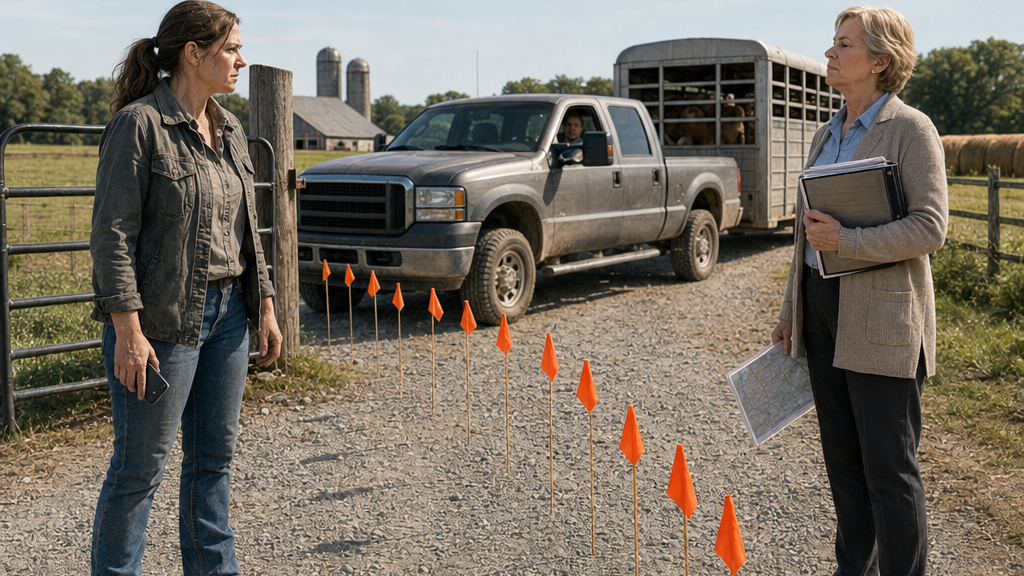
Now twelve of them stood in a hard diagonal across the gravel lane, bright as warning flares against the gray stone.
Samantha stopped halfway through fastening the cattle gate.
From beyond the curve came the low diesel growl of the trailer she was expecting. Eight bred heifers were due from a leased pasture twenty miles west, and the driver would need the full width of the entrance to swing in without dropping a wheel into the ditch.
Samantha stared at the flags.
They were not survey flags placed along a fence line. They crossed the traveled lane itself.
A pickup door shut behind her.
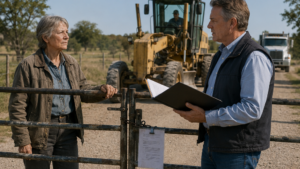
Karen Hall walked toward the gate carrying a white folder under one arm. She wore work shoes unsuited to loose gravel and stepped carefully around a shallow rut.
“Morning,” Karen said.
Samantha looked from her to the flags. “What is this?”
“Temporary control points.”
“For what?”
Karen opened the folder.
The approaching diesel grew louder.
Samantha held up one hand. “Not yet.”
Karen stopped speaking.
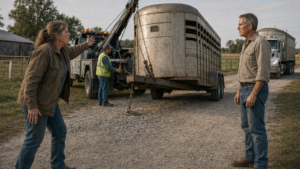
The cattle rig appeared around the bend, chrome mirrors catching the morning light. Samantha stepped into the lane and raised both arms. The driver braked twenty yards short of the first orange flag.
Air hissed from the trailer brakes.
Inside, cattle shifted against the aluminum sides.
Samantha walked to the cab.
“Give me five minutes,” she told the driver.
He looked at the flags. “Problem?”
“Apparently.”
When she returned, Karen had taken a packet from the folder.
“You’ve received three notices regarding heavy vehicle use,” Karen said.
“I received three pieces of paper.”
“You tore one up in front of two board members.”
“I remember.”
“That doesn’t make it disappear.”
Samantha folded her arms.
Karen offered the packet.
The total on the first page was large enough that Samantha read it twice.
There were lane-maintenance assessments, late charges, equipment-use violations, mud-removal fees, and penalties for what the association called prohibited commercial traffic. One line referred to machinery operation before seven in the morning. Another cited excessive gravel displacement.
Samantha turned the page.
“You’re charging me for driving cattle trailers to my cattle farm.”
“We’re charging you for repeated use of an association-maintained private lane outside the conditions established for members.”
“My family was using this lane before your association existed.”
“That isn’t the issue.”
“It feels fairly close to the issue.”
Karen’s mouth tightened.
The heifers shifted again. One bawled from inside the trailer.
Samantha looked toward the rig. Keeping cattle standing in a stopped trailer longer than necessary was stupid. Turning the truck around on the narrow county shoulder would be worse.
“What do you want me to do right now?” she asked.
“Use the north entrance.”
“That adds six miles and crosses a bridge with a posted weight restriction.”
“Then the trailer can wait.”
Samantha looked at her.
Karen did not raise her voice. That made the sentence land harder.
“You’re telling me to hold livestock on the road because of flags you put down this morning.”
“I’m telling you the board has moved to enforce its access rules.”
Samantha bent and took out her phone.
Karen frowned. “What are you doing?”
“Documenting them.”
Samantha photographed the first flag, then the next, including the gatepost and ditch in each frame. She walked the entire diagonal slowly.
A neighbor’s pickup had stopped near the far bend. Another person stood beside a mailbox watching.
Samantha could feel the shape of the story forming without anyone saying it: difficult farmer ignores rules until somebody finally stops her.
She had helped that story along.
For two years she had thrown association envelopes on the kitchen counter unopened until she needed the space. She had paid some charges because arguing cost more time than the amount demanded. She had skipped a hearing during calving season and told Karen, in front of others, that she had work more important than sitting in a folding chair discussing gravel.
All of that now sat inside the packet Karen held.
Samantha reached the final flag.
“Show me the boundary.”
Karen tapped the papers. “It’s marked.”
“No. Show me the recorded boundary.”
Karen took out a laminated map. A thick black line ran beside the lane, with a shaded strip labeled as association property.
Samantha studied it.
The line looked clean. Too clean.
“Where’s the survey stamp?”
Karen glanced down.
“County recording number?”
“It’s the association map.”
“That wasn’t my question.”
Karen’s expression changed slightly.
Samantha took the map without waiting for permission and held it beside the flag line.
The black boundary did not reference monuments, pins, bearings, distances, or a surveyor.
It was a drawing.
“What is this based on?”
“The maintenance agreement.”
“Which one?”
“The controlling agreement.”
Samantha gave the map back.
The driver leaned on his window. “Sam?”
She turned.
“We’re getting warm back here.”
That decided the immediate problem.
Samantha walked to the first flag and pulled none of them.
Instead, she opened the cattle gate wider and measured the usable space with her eyes.
“Can you hug the west edge without touching those?” she called.
The driver climbed down, studied the angle, then shook his head. “Not safely.”
Karen said, “The north entrance remains available.”
Samantha’s jaw tightened.
For one sharp second she wanted to rip every flag out, throw them into Karen’s pickup bed, and wave the trailer through.
It would have felt good.
It also would have made Karen right about her.
Samantha took another photograph.
Then she called the driver over.
“We’ll use the north entrance. Take it slow at the bridge approach. I’ll meet you there.”
Karen seemed almost surprised.
“This doesn’t mean I agree with you,” Samantha said.
“I didn’t say it did.”
“No. But you’re going to write down that I complied today.”
Karen hesitated, then nodded.
“And you’re going to email me the document this map came from.”
“You’ve been sent the rules before.”
“Not the rules. The source.”
Karen closed the folder.
The cattle trailer backed carefully down the lane. Gravel cracked beneath its tires as it disappeared around the curve.
Samantha stayed by the orange flags.
What had begun as anger was changing shape.
She walked to the weathered cedar post at the edge of the entrance. Her father had replaced it when she was sixteen. She remembered holding it upright while he tamped earth around the base.
He had once told her the lane was not theirs, exactly.
But neither was it the neighbors’.
At the time she had not asked what that meant.
Now she wished she had.
Karen moved toward her pickup.
“One more thing,” Samantha said.
Karen stopped.
“This map. Who drew it?”
“I don’t know.”
“You’re enforcing thousands of dollars in charges from it.”
“It’s been used for years.”
“That wasn’t my question either.”
Karen looked toward the lane, then toward the flags.
Finally she said, “It came out of the old maintenance file.”
“A survey file?”
Karen opened her truck door.
“No.”
Samantha waited.
Karen looked back at her.
“It isn’t a survey.”
Then she got in and drove away.
Samantha stood beside the false-bright line of orange flags while dust settled over the gravel.
For the first time that morning, the amount in the penalty packet stopped being the thing that worried her most.
Chapter 2: The Map Nobody Had Checked
Laura Davis laid the plat beneath a sheet of clear protective film and pushed it across the county records counter.
“This was recorded twenty-eight years before the association filed its articles,” she said.
Samantha did not touch it at first.
The paper had browned toward the edges. Fine black lines divided pasture, drainage, road frontage, and parcels that had since been split and sold. Near the bottom, a narrow strip curved through what was now Samantha’s south entrance.
Samantha leaned closer.
There it was.
The lane.
Not exactly where Karen’s map put it.
“Can I photograph this?”
“Yes. No flash.”
Samantha took out her phone.
Laura pointed to a notation beside the strip. “I can tell you what the record says. I can’t tell you what legal rights you have under it.”
“I understand.”
“You say that now.”
Samantha looked up.
Laura’s face remained neutral.
“People tend to hear what they want when they find an old document.”
That landed close enough to sting.
Samantha had arrived at the courthouse prepared to prove Karen wrong before lunch.
Instead, Laura had spent forty minutes making her request parcel numbers, recording references, and approximate dates. Samantha had known the farm by creek bends, fence corners, and field names. The county knew it by book, page, parcel, and instrument.
Her father’s way had been faster until the day it wasn’t.
Samantha studied the notation.
“‘Agricultural access easement,’” she read.
Laura nodded.
“Recorded with the original division?”
“Yes.”
“And this line—”
“Appears to be the easement corridor shown on the plat.”
It ran from the county road, across the current shared gravel lane, and toward the older farm parcels.
Samantha opened the photograph she had taken Saturday. The orange flags crossed the lane several feet east of where the old plat appeared to place the corridor.
She put the phone beside the protected plat.
Laura leaned over without touching either.
“That’s the current entrance?”
“Yes.”
“And those are what?”
“Association control points.”
Laura looked at Samantha.
“That’s what they called them.”
“I see.”
Samantha almost smiled.
It was the first small satisfaction she had felt since Saturday.
“So they’re wrong.”
Laura straightened.
“I didn’t say that.”
“The lines don’t match.”
“The drawings don’t match.”
“That’s the same thing.”
“No, it isn’t.”
Samantha exhaled through her nose.
Laura returned to her computer.
“The plat establishes recorded information. Your phone photograph shows stakes in gravel. Without field verification, I wouldn’t equate the two.”
Samantha disliked the answer because it was sensible.
“Fine. What else is attached to the easement?”
Laura searched by recording number.
A scanned document appeared on the screen.
The language was dense but clear enough in its purpose: agricultural ingress and egress, farm vehicles, livestock transport, maintenance obligations to be shared among benefited owners according to use.
Samantha read the last phrase again.
“According to use.”
“Yes.”
“That sounds like maintenance.”
“It does.”
“So the association can charge me.”
“I didn’t say that either.”
Samantha rubbed her forehead.
Laura almost smiled this time.
“The easement predates the association,” she said. “That answers one question. It doesn’t answer who later assumed maintenance obligations, what sections are public, what sections are private, or whether subsequent agreements changed anything.”
Samantha looked back at the plat.
The quick victory she had imagined began dissolving.
But something steadier took its place.
Karen’s map treated the entire lane as one private association asset.
The original record did not.
That mattered.
At home that evening, Samantha cleared the kitchen table.
Feed invoices went into one stack. Veterinary receipts went onto a chair. She placed Karen’s penalty packet in the center and opened her phone photographs on a tablet.
For years she had considered paperwork the least real part of farming.
A broken water line was real. A cow laboring too long was real. A tractor bearing running hot was real. Paper sat still and waited for people to pretend it mattered.
Now the paper was describing ground she crossed every day.
She printed the plat at reduced scale and placed it beside Karen’s map.
The differences were impossible to ignore.
The association boundary ran straight.
The easement followed the older lane contour.
Samantha traced it with one finger.
She remembered riding beside her father in an old feed truck, his elbow out the window. The lane had bent around a cottonwood stump then. When the stump was removed, gravel gradually straightened the approach.
“Roads move,” he had told her once when she complained about a rut. “Rights don’t move just because the tires do.”
She had forgotten the sentence until now.
Her phone rang.
Patrick Moore.
“I hear you’ve got Karen worked up.”
Samantha kept studying the maps.
“I asked for documents.”
“That’ll do it.”
“You ever see the original easement?”
“No.”
“You pay lane assessments?”
A pause.
“Everybody does.”
“For what section?”
Another pause.
“Samantha.”
“That’s not an answer.”
“I don’t want in the middle of this.”
“You’re already in it if you’re paying.”
Patrick sighed.
“You always do this.”
“Do what?”
“Turn a question into a fight.”
She almost snapped back.
Then she looked at the torn corner of an older association notice under the penalty packet.
Patrick was not entirely wrong.
“I’m trying not to,” she said.
The silence changed.
“What did you find?” he asked.
She told him about the easement.
He listened without interrupting.
When she finished, he said, “That doesn’t mean the county maintains it.”
“No.”
“Doesn’t mean we haven’t still got gravel costs.”
“No.”
“Then don’t go telling people they’ve been robbed.”
“I haven’t.”
“Yet.”
The word irritated her because she had, in fact, been thinking exactly that.
After they hung up, Samantha searched the county portal for road-maintenance records.
The system was clumsy. Half the files were scanned sideways. One year used road numbers, another used names, and older entries referred to intersections that no longer existed.
She nearly quit twice.
At ten-thirty she found a maintenance log.
The road crew had graded the county shoulder near her entrance.
Nothing unusual.
Then she found another year.
Gravel placement.
Same corridor.
A third file listed drainage work and grading beyond the county-road edge.
Samantha sat straighter.
She returned to the plat and followed the notation beside the easement.
A short code appeared along one section of the lane.
She had assumed it identified a parcel.
Now she searched it.
The code matched an old county-maintenance designation.
Samantha stared at the screen.
Saturday’s question had been whether Karen had drawn the boundary in the wrong place.
Now another question pushed past it.
If the county had been maintaining part of that corridor, what exactly had the association been charging them all to maintain?
Chapter 3: Eleven Years of Gravel Charges
Patrick dropped a cardboard box onto Samantha’s kitchen table and said, “If this turns into one of your wars, I was never here.”
The bottom of the box sagged under paper.
Samantha looked inside.
Receipts.
Association statements.
Cancelled checks.
Eleven years of them.
“You keep all this?”
“My wife did.”
Patrick pulled out a chair. “I wanted to throw it away after she died. Couldn’t make myself do it.”
Samantha’s hands slowed.
“I didn’t know.”
“It’s been three years. You knew.”
“I meant the box.”
“I know.”
He looked toward the window.
Samantha did not apologize again.
She began sorting by year.
Several assessment descriptions matched hers almost word for word: lane resurfacing, gravel restoration, drainage maintenance, corridor repair.
Patrick watched her arrange the pages.
“You really think they charged us for county work?”
“I think I don’t know what they charged us for.”
“That’s a more careful sentence than usual.”
She gave him a look.
He shrugged.
“Maybe paperwork is improving you.”
By noon, the table had become a map made of money.
Samantha laid her orange-flag photographs along the top edge and used them to divide the lane into sections: county road approach, easement corridor, association spur, farm entrance.
It was crude, but it stopped the records from blurring together.
Patrick picked up one receipt.
“Same amount.”
Samantha checked hers.
The annual assessment matched exactly.
Different property size. Different traffic. Same charge.
“That could still be legitimate,” Patrick said.
“Could.”
He looked almost disappointed that she agreed.
Samantha opened the county maintenance logs she had printed.
One entry showed grading on the approach after spring washout.
Another showed aggregate placement two years later.
A third described ditch shaping.
Patrick leaned over.
“That’s our lane.”
“Part of it.”
“The association billed us drainage work that year.”
“I saw.”
He sat back.
For several seconds neither spoke.
The refrigerator motor clicked on.
Finally Patrick said, “Maybe the county did the ditch and the association did the surface.”
“Maybe.”
“So we need invoices.”
“Yes.”
He stood.
“No.”
Samantha looked up.
“I brought receipts. That was my contribution.”
“You’re on the association.”
“I pay dues. That doesn’t make me an investigator.”
“You told me not to accuse anyone without knowing.”
“And?”
“I’m trying to know.”
Patrick rubbed a hand over his jaw.
“You go into that office asking for eleven years of books, Karen is going to think you’re trying to bury her.”
“I’m trying to find out what happened.”
“You don’t have a quiet way of doing that.”
The criticism hit because it was precise.
Samantha looked at the torn penalty notice she had clipped to the file.
“I’m learning.”
Patrick snorted.
But he stayed.
That afternoon they went to the association office together.
Karen was not there. The treasurer sat behind a folding table surrounded by binders and a desktop calculator.
Samantha asked for maintenance invoices tied to the lane assessments.
The treasurer hesitated.
“How far back?”
“Eleven years.”
“That’s a lot.”
“I noticed.”
Patrick shifted beside her.
The treasurer looked at him as if hoping he might explain Samantha away.
He didn’t.
“We’re not accusing anybody,” Patrick said. “We just want to match assessments to work.”
The phrasing helped.
Two hours later, Samantha was sitting on the floor beside an open file cabinet.
Some records were neat. Others were folded into envelopes or stapled to meeting minutes.
She found real work quickly.
A contractor had hauled crushed limestone after a severe washout.
Another invoice covered culvert replacement on the private spur past Patrick’s property.
A third showed grading after a loaded grain truck cut deep ruts in wet spring gravel.
Samantha felt something uncomfortable settle inside her.
Karen had not invented the maintenance costs.
At least not all of them.
Patrick tapped an invoice.
“You use that spur.”
“Yes.”
“More than I do.”
“Yes.”
He waited.
She knew what he wanted.
“If that section is private and the easement assigns costs by use, I owe part of it.”
Patrick nodded once.
It would have been easier if everything were false.
She kept looking.
Near the bottom of the second drawer she found an annual summary using the phrase “full corridor maintenance.”
The amount collected exceeded the private invoices attached to the file.
She checked the county log for the same year.
Aggregate placement and grading had been performed on the approach.
The association had also collected a corridor assessment from Patrick, Samantha, and at least four other properties.
The next year showed the same pattern.
Not identical work.
But overlap.
Enough to demand an explanation.
By evening, the question was no longer whether Samantha alone had been treated unfairly.
She had copies of assessments from several parcels, county work records, and association invoices that did not line up cleanly.
The total was not some dramatic number she could shout at a meeting.
That made it more convincing, not less.
Year after year, ordinary charges had accumulated under the assumption that the association controlled and maintained the whole lane.
On Thursday, Samantha drove to speak with two neighboring landowners.
The first refused to hand over records.
“I’m not fighting Karen,” he said from his porch.
“I didn’t ask you to.”
“You’re asking for receipts.”
“I’m checking charges.”
“Same thing.”
The second neighbor gave Samantha three statements but warned her not to use her name at a meeting.
“Why?”
“Because I need that road plowed when I’m seventy-eight more than I need to win an argument about ten-year-old gravel.”
That stayed with Samantha.
Back at the kitchen table, she stopped adding numbers.
The issue had seemed clean when Karen’s flags blocked a cattle trailer.
Now every page complicated it.
Some money had paid for real work.
Some residents depended on the association because no one else was going to organize repairs to the private spur.
And some charges appeared to cover sections the county already maintained.
Samantha pulled one older invoice from Patrick’s box.
The date caught her attention.
It was from before Karen became association chair.
The work description was ordinary: grading, gravel spreading, ditch cleanup.
But beneath it was a location note.
Samantha compared the wording with Karen’s current enforcement packet.
Same phrase.
Same claimed boundary.
She checked the year.
Karen had not created the description.
The assumption was older than her leadership.
Patrick, still seated across from her, read her face.
“What?”
Samantha slid the invoice toward him.
He studied it.
“So this started before Karen.”
“Yes.”
“Then maybe she didn’t know.”
Samantha looked at the photocopy of the old plat.
Maybe.
But Karen had stood beside those orange flags and enforced the line as fact.
Samantha gathered the papers into a new stack.
The question had changed again.
It was no longer who had made the first mistake.
It was who had seen enough to question it—and decided not to.
Chapter 4: The Rule Karen Inherited
Karen Hall began the meeting by admitting the records might be wrong.
Then she refused to suspend a single penalty.
The association room went quiet enough for Samantha Green to hear the old refrigerator cycling behind the kitchenette wall.
Karen sat at the folding table with three binders stacked in front of her. Patrick Moore had taken a chair near the aisle, close enough to Samantha to signal support but far enough away that no one could mistake them for a team.
Two neighboring landowners sat across the room.
The association treasurer kept a calculator beside one elbow.
Samantha had brought the original plat, copies of county maintenance logs, Patrick’s receipts, and the association invoices they had reviewed. She had arranged everything in a plain file box instead of carrying the thick penalty packet Karen had given her at the gate.
Karen placed both palms on the table.
“The board acknowledges there are inconsistencies between the historic plat and the maintenance map currently in use.”
Samantha waited.
Karen continued.
“That does not invalidate existing assessments, access controls, or penalties.”
One of the neighbors shifted in his chair.
Samantha said, “You just said your map may be wrong.”
“I said the records require clarification.”
“You put flags across my lane based on that map.”
“Temporary control points.”
“They crossed the only practical entrance for a loaded cattle trailer.”
Karen’s eyes hardened. “Because repeated notices were ignored.”
There it was.
Samantha felt every unopened envelope on her kitchen counter become part of the room.
Karen pulled out copies.
“Two requests for hearings. Three notices regarding heavy traffic. One maintenance assessment left unpaid. And a violation notice destroyed in front of board members.”
Patrick looked down.
Samantha could have argued that the notices were petty.
She could have said calving season mattered more than an association meeting.
Both were true.
Neither helped.
“I ignored them,” Samantha said.
Karen paused.
“I shouldn’t have.”
That drew more attention than denial would have.
Samantha continued before pride could stop her.
“But ignoring a notice doesn’t turn a bad boundary into a good one.”
The treasurer shifted the calculator farther from the table edge.
Karen opened another binder.
“The association did not invent this system last month. It has maintained that corridor for years.”
“So has the county.”
“Parts of it.”
“Exactly.”
A murmur moved through the room.
Karen looked toward the others.
“If we suspend collections every time somebody questions an old drawing, we have no way to maintain the private road.”
“Then separate the private road from the county-maintained section.”
“That sounds simple because you are treating this like lines on paper.”
Samantha almost laughed.
“You blocked my farm with lines on paper.”
Karen’s face flushed, but she did not raise her voice.
“The reserve account is down to less than what we spent after the last major washout.”
The treasurer looked uncomfortable.
Samantha turned toward her.
“How low?”
Karen answered first.
“Low enough that another significant repair before winter would force a special assessment.”
The room changed.
Patrick sat straighter.
One of the neighbors spoke from the back. “How much are we talking?”
Karen looked at the treasurer.
The treasurer gave the figure.
It was not catastrophic.
But it was thin.
Too thin for a culvert failure, major rutting, or a washed-out shoulder.
Samantha looked at the people around her differently.
The neighbor who had refused to give her receipts was not there. She remembered what the other woman had said on her porch: I need that road plowed when I’m seventy-eight more than I need to win an argument about ten-year-old gravel.
Karen had been wrong to enforce a doubtful boundary.
But the money had not been sitting in a secret account.
Some of it had gone into stone, drainage pipe, grading, snow removal.
Some residents depended on those things more than Samantha did.
Karen saw the hesitation.
“This is what I’ve been trying to tell you.”
“No,” Samantha said. “You’ve been telling me the map is correct.”
“I’ve been telling you the road has to function.”
“Those aren’t the same claim.”
Karen leaned back.
For the first time, Samantha could see exhaustion beneath the certainty.
“You think I enjoy calling people about dues?” Karen asked. “You think I like telling somebody on a fixed income we still need their share because the culvert doesn’t care what Social Security pays?”
Nobody answered.
Karen tapped the binder.
“When the previous chair handed this over, there was a maintenance map, a contribution schedule, contractor history, and a reserve that was already behind. I inherited a system that barely worked.”
“And then enforced it as if nobody was allowed to question it.”
“I enforced the only system we had.”
Samantha reached into her box.
She laid the old plat on the table.
Then the county maintenance records.
Then the copied invoices.
“You had another option.”
Karen looked at the pages.
“Check.”
The word was quiet.
Karen did not respond.
Samantha pointed to the overlapping years.
“I’m not asking anyone to stop paying legitimate private-road costs. I’m asking why the association collected full-corridor assessments when county records show public work on part of the same corridor.”
The treasurer leaned forward.
“We don’t know that the work overlaps exactly.”
“Then verify it.”
“And while we verify it?” Karen asked.
“Stop issuing new penalties tied to the disputed boundary.”
Karen shook her head.
“If I do that, I’m telling every member the board has no authority.”
“No. You’re telling them the authority has limits.”
“That distinction matters to you because your cattle still need through.”
“It should matter to everybody whose money you’re taking.”
Patrick finally spoke.
“She’s got a point.”
Karen looked at him.
He lifted both hands slightly.
“I don’t like how she got here. But she’s got a point.”
Samantha nearly smiled.
Nearly.
The meeting dragged another hour.
They argued about grading invoices, historical use, liability, and whether the association could commission a survey without a membership vote.
No one shouted.
That made the disagreements harder, not easier.
Every position had a bill attached to it.
Finally Karen closed the binder.
“The penalties remain pending.”
Samantha stared at her.
“Even with the records in dispute?”
“Pending is not collected.”
“The flags are still there.”
“They are control points until a survey establishes otherwise.”
Samantha felt her old anger returning.
She forced herself not to let it drive.
“When can we get a survey?”
Karen looked at the treasurer.
“We’d need estimates.”
“I’ll obtain one.”
“You don’t commission a boundary survey for the association.”
“Then I’ll commission one for my property and easement.”
Karen’s expression tightened.
“That may not settle the entire corridor.”
“No. But it’ll settle whether your flags belong where you put them.”
The chairs began scraping as people prepared to leave.
Samantha packed her files.
Karen remained seated.
Patrick was halfway to the door when Karen said, “Samantha.”
Something in her tone stopped both of them.
Samantha turned.
Karen was looking down at the original plat.
“I had seen something similar before.”
Patrick stopped moving.
Samantha set the file box down again.
“When?”
Karen did not answer immediately.
“A few months ago.”
The room seemed to contract.
“You saw the older easement?”
“A copy of the plat.”
“And you still put those flags across my lane?”
Karen’s fingers rested on the binder.
“I didn’t know whether it superseded the maintenance agreement.”
“So you checked?”
Karen looked at her.
“No.”
The answer was worse for being simple.
“Why?”
Karen closed the binder.
“Because reopening that question meant reopening everything.”
She picked up the records and stood.
For the first time, Samantha understood that Karen’s certainty had not come from ignorance.
It had been a choice.
Chapter 5: Where the Real Line Falls
The county surveyor pushed an orange flag into the ground six feet west of Karen’s first marker.
Nobody said anything.
The difference spoke clearly enough.
Samantha stood beside the cattle gate with her arms folded against the morning chill.
Karen was ten yards away beside the association’s original flag line.
Patrick leaned against his pickup.
The surveyor checked the instrument mounted on its tripod, then walked back toward a weathered iron monument near the ditch.
“Again,” he said to himself.
He measured.
Returned.
Checked.
Then drove a second flag.
This one landed even farther from Karen’s line.
Patrick let out a low whistle.
Karen ignored him.
Samantha did not.
“These are the recorded points?” she asked.
“These are the positions I’m locating from the monuments and the recorded description.”
“Not the current gravel edge.”
“No.”
He pointed down the lane.
“The traveled surface has shifted over time. That’s common.”
Samantha thought of her father saying roads moved even when rights did not.
The sentence no longer felt like family folklore.
The surveyor walked another twenty yards.
One by one, fresh orange flags appeared.
Karen’s old markers had formed a blunt diagonal across the entrance.
The new ones followed a more complicated line, bending with the recorded easement before separating from the private spur.
Samantha took photographs.
This time the flags did not feel like accusations.
They felt like punctuation.
Karen finally spoke.
“So the association map is wrong here.”
“On this portion, yes.”
The surveyor’s answer was careful.
Karen glanced at Samantha.
Samantha could have enjoyed the moment.
For two weeks she had pictured some version of it: Karen standing beside the wrong line while somebody with actual measurements placed the right one.
Instead, Samantha felt mostly tired.
“Does the agricultural easement cover the entire lane?” she asked.
“No.”
Karen looked up sharply.
The surveyor pointed toward the bend beyond Patrick’s property.
“The recorded corridor continues to that monument. Past there, the spur serving the upper parcels follows a separate private description.”
Patrick pushed away from his truck.
“That’s the section by my field?”
“Yes.”
“And her trucks use it?”
The surveyor looked at Samantha.
“Do they?”
“Sometimes.”
The answer came more slowly than she liked.
Her hay equipment used the spur during summer because it provided better turning space near the upper field. Feed deliveries occasionally used it when the main farmyard was blocked.
“How much of it is inside my easement?”
“None of that upper spur, based on what I’m seeing.”
Samantha stared down the lane.
For several seconds, the morning seemed too quiet.
Karen did not smile.
That irritated Samantha more than if she had.
“So the association does have authority there,” Samantha said.
“I’m not giving you an opinion on association authority,” the surveyor said. “I’m telling you the recorded easement you asked me to locate does not include that spur.”
Patrick folded his arms.
“And the maintenance language?”
“That’s something you’ll need to interpret from the documents.”
Samantha knew enough now not to ask him to do it for her.
She walked up the lane with the group.
At the point where the easement ended, another new flag went into the grass.
This one landed on Samantha’s side of where she had expected it.
She stopped.
“You sure?”
The surveyor looked at her.
“Yes.”
She hated the answer.
Not because she doubted him.
Because she didn’t.
Karen had been wrong about the entrance.
Samantha had been wrong about the spur.
The neat victory she had carried in her head disappeared.
Patrick came up beside her.
“That one hurt?”
“Yes.”
“Good.”
She looked at him.
He smiled faintly.
“Means you’re paying attention.”
They continued.
The surveyor marked several more points, then returned to his truck to organize notes.
Karen stood beside the new line.
“Your cattle access at the south entrance isn’t where our map shows it,” she said.
“No.”
“And the upper spur isn’t covered by your easement.”
“No.”
Neither woman seemed pleased by the balance.
Karen looked down at the fresh flag.
“The association has paid to grade that spur.”
“I know.”
“You’ve used it.”
“I know that too.”
A month earlier Samantha might have answered differently.
She might have argued that farm use was customary. That her family had always crossed there. That nobody cared until the association began measuring ordinary life in fees.
Now she heard how those arguments sounded when records existed.
Karen said, “Then some of the assessments are legitimate.”
“Some.”
“Which means your claim that the association had no right to charge you—”
“I never said no right to charge me anything.”
Karen stopped.
Samantha pulled a folded sheet from her jacket.
“I marked the invoices that appear tied to this private spur.”
“You already calculated them?”
“I calculated what I could.”
Patrick joined them.
Samantha showed him the figures.
“These are real costs. Gravel, grading, the culvert work.”
Patrick nodded.
Karen read silently.
“What are you proposing?”
“Not yet.”
Karen looked irritated.
“We finish the survey. Then compare every charge to the road section it actually served.”
“And if you owe money?”
“I pay it.”
Karen looked at her as though testing whether the sentence was another argument.
Samantha held her gaze.
“I’m not doing this to get a free road.”
The surveyor returned.
They spent another hour checking monuments along the adjoining properties.
The result did not change.
The association map had treated separate legal sections as though they were one continuous private corridor.
The recorded ground was messier.
Part county-maintained approach.
Part agricultural easement.
Part private spur.
Different rights.
Different responsibilities.
Different costs.
At the farm entrance, the visual difference was almost absurd.
Karen’s older control flags still cut across the gravel.
The new flags sat several feet away, following the recorded line.
Samantha photographed both together.
“That picture’s going to make the meeting interesting,” Patrick said.
“I’m not interested in interesting.”
“That would be new.”
Samantha ignored him.
She walked to Karen’s first flag.
For a moment she considered pulling it out.
Instead she left it in the ground.
“Why?” Patrick asked.
“Because I want everyone to see both lines.”
Karen had heard.
She looked toward Samantha.
“That’s fair.”
It was the first time either of them had used that word without sarcasm.
Later, when the surveyor had gone and Karen had driven away, Patrick stayed beside Samantha’s truck.
“You know what happens now.”
“We sort the charges.”
“No. I mean politically.”
Samantha leaned against the tailgate.
“You’re going to walk into the meeting and tell them Karen was wrong about the main boundary.”
“Yes.”
“And then tell them she was right that you owe maintenance on the spur.”
“Yes.”
Patrick rubbed his chin.
“That weakens your position.”
“No.”
“It gives her something to use.”
“Then she can use it.”
Patrick studied her.
Samantha looked at the orange flags.
She had spent years believing that the ground itself was enough. If she could point to where tractors had always driven and where fences had always stood, that should settle things.
Then she had spent two weeks wanting the paperwork to prove her completely right.
Both were forms of the same stubbornness.
She picked up the private-spur invoices.
“I’ll challenge every charge they can’t justify,” she said. “And I’ll pay every one they can.”
Patrick nodded slowly.
“That might be the first useful thing you’ve said since this started.”
Samantha closed the tailgate.
“Don’t get comfortable.”
But when she looked back at the two competing lines of orange flags, she knew the next meeting would no longer be about winning.
It would be about whether accuracy still mattered when it cost her something too.
Chapter 6: The Meeting That Could Not Stay Simple
“I owe four hundred and eighty-six dollars.”
Samantha’s opening sentence stopped Karen before she could call the meeting to order.
Every chair in the association hall was occupied.
Patrick stood along the side wall.
The association treasurer had brought three binders and a legal pad.
On the table behind Samantha lay the corrected survey, enlarged photographs of both flag lines, county maintenance records, and eleven years of assessment documents.
Karen looked at her.
“What?”
Samantha placed one invoice on the table.
“My share of verified grading and gravel work on the private upper spur. Based on documented use and the contribution formula in the old easement-related agreement, I owe four hundred and eighty-six dollars.”
Someone near the back whispered.
Samantha continued.
“I’ll pay it.”
Karen’s prepared expression slipped.
For weeks, Karen’s strongest argument had been that Samantha wanted unrestricted access without contributing to maintenance.
Samantha had just removed it herself.
She placed a check beside the invoice.
“This does not include penalties tied to the disputed entrance boundary or charges that overlap county-maintained sections.”
Karen stared at the check.
Then at Samantha.
“You calculated this yourself?”
“With Patrick checking the arithmetic.”
Patrick raised one hand from the wall.
“Unfortunately.”
A few people smiled.
The room loosened slightly.
Samantha did not.
She turned the enlarged survey around.
“These orange marks are where the association placed its control flags.”
She pointed to the first line.
“These are the recorded points located by the surveyor.”
A second line diverged visibly.
Nobody needed a legal explanation to see it.
“The entrance boundary we were enforcing was wrong,” Karen said.
The admission came before Samantha expected it.
Samantha looked at her.
Karen’s jaw tightened.
“I’m not going to argue with the survey.”
That was more than Samantha had expected too.
But Karen continued.
“That does not answer how we handle past costs.”
“No,” Samantha said. “It doesn’t.”
The treasurer opened a binder.
Samantha laid out the county records next.
“We have years where the county performed grading, drainage, or aggregate work on parts of the corridor while the association assessed members for full-corridor maintenance.”
A neighbor asked, “Are you saying we were double charged?”
“I’m saying the records overlap enough that we need an audit.”
“Same thing.”
“No.”
Samantha heard Laura Davis in her own answer.
The distinction mattered now.
“We don’t know which work duplicated public maintenance and which association invoices covered separate private sections. I’m not calling every charge improper.”
Karen leaned forward.
“Some people already are.”
She held up several printed emails.
“Since the survey results circulated, members have demanded refunds going back more than a decade.”
Samantha looked toward the room.
Several people avoided her eyes.
Karen turned to the treasurer.
“Tell them what happens if we refund every disputed assessment immediately.”
The treasurer swallowed.
“We empty most of the reserve.”
“How much remains?”
The answer caused a stir.
Karen continued.
“That reserve pays for snow clearing, emergency gravel, culvert failures, washout repair.”
A man near the door said, “So we just lose the money?”
Samantha turned.
“No.”
“Sounds like it.”
“It means we determine what was actually overcharged.”
“And then?”
“Then return or credit what can be verified.”
Karen gave a short, humorless laugh.
“With what funds?”
There was the real fight.
Not over whether the map was wrong.
That part was becoming settled.
The question was what correction would cost.
Karen stood.
“I want something clear in the minutes. I did not create this maintenance system.”
Samantha said nothing.
Karen looked around the hall.
“The map existed before I became chair. The assessment categories existed. The reserve was already underfunded. I continued the structure I was given because the road still had to be maintained.”
Patrick spoke from the wall.
“You also knew the old plat didn’t match.”
The room quieted again.
Karen looked at him.
Then at Samantha.
“When did you know?” the treasurer asked.
Karen’s face changed.
Not anger.
Something closer to resignation.
“Four months ago.”
Voices rose.
Karen lifted a hand.
“I found a copy while reviewing records for a drainage complaint.”
“And you did nothing?” someone asked.
“I did not know what legal effect it had.”
Samantha said, “You could have asked.”
“Yes.”
“Why didn’t you?”
Karen gripped the back of her chair.
“Because I knew what would happen.”
She gestured toward the room.
“This.”
No one interrupted.
Karen continued.
“Questions about every charge. Demands for refunds. People deciding nothing is enforceable until every document is perfect.”
Her eyes moved toward two older members near the front.
“We had barely enough reserve to repair the private spur last spring. One serious washout and we were short. I thought reopening the boundary issue before we knew how to fund the road would make everything worse.”
Samantha felt the anger she had carried into the first meeting rearrange itself.
Karen had not hidden the plat to enrich herself.
She had hidden uncertainty because uncertainty threatened a system she believed was holding the road together.
That did not excuse the flags.
It did not excuse continuing penalties.
But it was not the motive Samantha had once wanted it to be.
Karen looked directly at her.
“You think I enjoyed putting those markers across your entrance?”
“I think you chose to.”
“Yes.”
The answer was immediate.
“And that was wrong.”
The room stayed still.
Karen’s voice lowered.
“But if I had told everyone four months ago that our map might be unreliable, before we had a survey, before we separated public and private maintenance, we would have stopped collecting money. Then what? The first storm washes the spur and the people who depend on it are trapped because everybody is waiting for perfect records?”
Samantha glanced at the check she had written.
There was no clean side of the table anymore.
She opened her file.
“Then we stop treating this like a choice between pretending nothing happened and bankrupting the reserve.”
Karen sat slowly.
Samantha placed one page before the board.
“First: suspend all penalties tied specifically to the disputed boundary.”
Karen started to speak.
Samantha kept going.
“Second: freeze new full-corridor assessments until the lane is divided according to the survey and county maintenance records.”
The treasurer began writing.
“Third: keep collecting verified private-road costs under a temporary schedule so actual maintenance doesn’t stop.”
A neighbor asked, “And the old money?”
“Audit it year by year.”
“That could take months.”
“Yes.”
The room reacted.
Samantha raised her voice only enough to cut through it.
“So did paying it.”
Silence returned.
“Where the association charged for work that county records show was already publicly performed, issue credits or refunds. Where association invoices show separate legitimate work, no refund.”
Someone said, “I want my money now.”
Samantha looked toward the voice.
“If you want every dollar back now, including money that paid for private gravel you used, that isn’t correction.”
The man frowned.
“It’s revenge with bookkeeping.”
Patrick looked down, hiding a smile.
Samantha turned back to Karen.
“If immediate refunds would empty the reserve, stage them.”
Karen studied the proposal.
“You’re asking people who were overcharged to wait.”
“Yes.”
“You’re willing to?”
“Yes.”
“Even after the penalties?”
Samantha looked at the enlarged photograph of Karen’s flags blocking the cattle lane.
“Yes.”
The answer surprised her less than it would have a week earlier.
She had wanted Karen publicly defeated.
Now she wanted the line corrected and the road functional.
Anything else would leave them fighting over the same gravel under a different rule.
The treasurer spoke quietly.
“We could issue credits first. Cash refunds where hardship requires it. Spread the rest across two budget years.”
Karen looked at her.
“That preserves enough reserve for winter?”
“Probably, if we suspend nonessential projects.”
Patrick came away from the wall.
“I’d support an audit.”
One neighbor nodded.
Then another.
Not applause.
Not celebration.
Just people moving reluctantly toward something workable.
Karen read Samantha’s proposal again.
“If we adopt this, the minutes will show that the board enforced a boundary after I knew there was conflicting information.”
“Yes.”
Karen looked up.
“You could have left that out.”
“No.”
“I figured.”
Samantha slid the check across the table.
“And the minutes will also show that I ignored hearings, left legitimate assessments unpaid, and owe for verified use of the private spur.”
Karen looked at the check.
For several seconds neither woman moved.
Then Karen took it.
The gesture did not make them friends.
It did something more useful.
It made the same standard apply in both directions.
Karen turned to the board members.
“I’ll support suspending the disputed penalties pending audit.”
The treasurer stopped writing.
Patrick’s eyebrows rose.
Karen continued.
“And replacing the current maintenance map with the recorded survey once the county-maintained portion is confirmed.”
One of the neighbors asked, “What about the old assessments?”
Karen looked at Samantha’s proposal.
“We audit them.”
The room erupted into smaller arguments immediately: timelines, costs, who would review invoices, whether credits counted as refunds, whether a special meeting was required.
Samantha let the noise rise.
On the table, the corrected survey lay beside the photograph of the two orange flag lines.
One false.
One measured.
Weeks earlier she had thought the difference between them would settle everything.
Instead, it had only forced everyone to decide what they would do once the truth became inconvenient.
Samantha moved the final page of her proposal toward Karen.
“Start here,” she said.
Karen read the first line again: suspend disputed charges, verify ownership and maintenance responsibility, fund only documented private-road work.
She picked up a pen.
Chapter 7: The Lane After the Argument
The gravel truck stopped exactly where Karen Hall’s first line of orange flags had once crossed Samantha Green’s entrance.
The driver lowered his window.
“Here?”
Samantha looked at the corrected survey map clipped to a board in her hand, then at the two remaining flags marking the verified start of the private spur.
“Not here,” she said. “Another hundred and forty feet.”
The driver nodded and eased the truck forward.
Three weeks earlier, Samantha would have told him where to dump by pointing at the lane and saying she knew the ground.
Now she checked the map again.
The distinction made her smile despite herself.
The association had approved a narrower maintenance plan after two additional meetings, three rounds of corrected figures, and enough arguments over gravel invoices to make everyone in the room tired of hearing the word corridor.
The old blanket assessment had been suspended.
The disputed penalties against Samantha were removed pending the completed audit.
The county had confirmed which section of the approach it maintained.
The private spur remained the responsibility of the properties that actually benefited from it.
Nothing about the result felt dramatic.
There had been no declaration that one side had won.
There had mostly been signatures.
Samantha had come to appreciate signatures.
The truck reached the marked section and stopped.
“Right there,” she called.
The bed rose.
Crushed limestone began sliding out with a heavy grinding roar.
Patrick Moore stood beside his pickup watching the pile grow.
“You realize,” he said, “six weeks ago you would’ve dumped this wherever you felt like.”
“Six weeks ago I thought I knew where wherever was.”
Patrick laughed.
The driver pulled forward gradually, spreading the stone along the private spur.
Fresh gravel covered the worst ruts left from summer equipment traffic.
Only the section supported by verified invoices and recorded responsibility was being resurfaced.
No broader corridor charge.
No vague full-lane maintenance line.
Patrick looked down at Samantha’s clipboard.
“You carrying paperwork outside now?”
“Don’t start.”
“I’m concerned.”
“I can still throw it in a ditch.”
“That’s reassuring.”
Samantha checked the delivery ticket.
The association was paying its portion from the reserve. Patrick had already submitted his share.
Samantha’s check had cleared the week before.
Four hundred and eighty-six dollars.
Writing it had hurt less than she expected.
Not because she enjoyed paying.
Because for the first time in years, she knew exactly what the payment covered.
A pickup appeared at the bend.
Samantha recognized Karen’s vehicle before Patrick did.
He sighed.
“This should be peaceful.”
Karen pulled onto the shoulder and got out carrying a folder.
She no longer brought the old laminated maintenance map.
That had been removed from association use after the survey was accepted.
Samantha noticed the absence every time Karen appeared.
Karen approached the gravel pile.
“Has he started the section past the easement terminus?”
“Yes.”
Karen opened her folder and compared the survey copy with the flags.
“He’s about ten feet short of the approved endpoint.”
Samantha checked.
Karen was right.
Samantha waved to the driver.
“Carry it ten more feet.”
Patrick glanced between them.
“I miss when you two could disagree about everything.”
Neither woman answered.
The driver finished the pass and lowered the truck bed.
Karen walked along the fresh gravel, counting the survey markers.
She stopped beside one of the remaining orange flags.
“This one stays until the contractor finishes the ditch edge.”
“That’s what I was told.”
Karen looked at Samantha.
“You’ve been talking to the surveyor.”
“I’ve been reading emails.”
“That may be more alarming.”
Samantha almost smiled.
Karen closed the folder.
For a moment they stood without an argument available.
That was new.
It was also uncomfortable.
Karen finally said, “The audit committee finished the first four years.”
Samantha’s attention sharpened.
“How bad?”
“Mixed.”
“That seems to be the theme.”
Karen nodded.
“Two years show clear overlap between county aggregate work and association corridor charges. One year is uncertain because the contractor invoice doesn’t identify the exact section. Another looks legitimate.”
“Refunds?”
“Credits first.”
Samantha had expected that.
The agreement allowed verified overcharges to be returned as account credits unless a member requested hardship review for cash reimbursement.
Some residents hated the arrangement.
At the last meeting, one man had accused the board of using bookkeeping to avoid admitting what happened.
Samantha understood the anger.
She also understood that emptying the reserve before winter would accomplish very little besides producing a different emergency.
“How much for me so far?” she asked.
Karen gave her a figure.
It was smaller than Samantha once imagined.
She felt an old impulse rise—the desire to say they had wasted weeks for that.
Then she remembered the unopened notices, the wrong flags, the public work billed as private responsibility.
The amount was not the point.
Knowing what the amount meant was.
“I’ll take the credit,” Samantha said.
Karen seemed surprised.
“No cash request?”
“No.”
“You could make one.”
“I know.”
Karen tucked the paper back into the folder.
Patrick had moved farther up the lane to speak with the truck driver.
Samantha and Karen were alone near the gate.
Karen looked toward the cedar post.
“The board voted to adopt the survey as the controlling maintenance reference.”
“I saw the minutes.”
“You read them?”
“Yes.”
Karen gave her a suspicious look.
“I’m serious.”
“So am I.”
“That may be the biggest change to come out of all this.”
Samantha shook her head.
“Don’t get sentimental.”
“I wasn’t planning to.”
The truck engine idled behind them.
Karen became serious again.
“There are still people who think you should have demanded full refunds immediately.”
“There are people who think you should resign.”
“I know.”
“Are you?”
Karen looked down the lane.
“No.”
Samantha waited.
Karen added, “Not yet.”
There was no defensiveness in it.
Only fatigue.
“I made the decision to keep enforcing after I saw the older plat,” Karen said. “That belongs in the record.”
“It does.”
“I thought keeping the system stable mattered more than exposing uncertainty.”
Samantha looked at the correct flags.
“And I thought ignoring paperwork made the paperwork meaningless.”
Karen glanced at her.
“That was certainly convenient.”
“Careful.”
Karen’s mouth moved at one corner.
Then she said, “I am sorry about the cattle trailer.”
Samantha had not expected an apology.
Not after the meetings, the audit, the corrected maps.
Especially not standing in the same entrance where it had started.
She took a moment before answering.
“You should be.”
Karen nodded.
Samantha let another second pass.
“I shouldn’t have ignored the hearings.”
“No.”
“And tearing up the notice was childish.”
“Yes.”
“You don’t have to enjoy this.”
“I’m trying not to.”
That was as close to reconciliation as either of them seemed equipped to manage.
The truck finished spreading the last load.
Fresh stone lay only where the verified private maintenance responsibility began.
The county approach remained untouched.
The agricultural easement remained open.
The farm gate remained where it had always been.
But now each fact rested on something stronger than memory or repetition.
The driver brought Samantha the ticket.
She checked the tonnage, signed her name, and kept the carbon copy.
Patrick watched.
“You kept the receipt.”
“Go home, Patrick.”
He laughed and climbed into his truck.
Karen left soon afterward.
Before getting into her pickup, she pointed toward one orange flag near the entrance.
“That one’s obsolete now.”
“I know.”
“You going to remove it?”
Samantha looked at it.
It was one of Karen’s original control flags.
Most of the old markers had been pulled after the survey, but that one had remained beside the cedar post, forgotten between the newer flags.
Its plastic ribbon was faded from weeks of sun.
“I will.”
Karen drove away.
Samantha waited until the gravel truck followed.
Silence returned to the lane.
She walked to the cedar post.
The old orange flag came out easily.
Six weeks earlier, she had wanted to rip every one of them from the ground while Karen watched.
Now there was no audience.
Samantha brushed dirt from the metal stem.
Farther up the lane, two newer orange flags still marked the verified private spur while the contractor finished the drainage edge.
She left those alone.
They no longer meant somebody was claiming her land.
They meant somebody had measured before claiming anything.
Samantha carried the obsolete flag to the truck and put it in the bed.
Then she returned to the gate.
A feed truck would arrive Tuesday.
The association had a review meeting Thursday.
The next audit packet was already sitting on her kitchen table, and for once she knew she would open it before the deadline.
She swung the cattle gate wide.
Across the fresh gravel, the lane looked much as it had before all of this began.
Gray stone.
Grass at the edges.
Fence posts.
A road people used because they needed to get somewhere.
But Samantha no longer saw one piece of ground where everyone’s rights blurred together.
She saw the county approach, the recorded easement, the private spur, and the responsibilities attached to each.
Her father had known the farm by memory.
She still did.
Now she knew where the memory ended and the record began.
A cow called from the lower pasture.
Samantha latched the gate behind her and started toward the barn.
The correct orange flags remained standing up the lane.
She did not resent them.
Not anymore.
The story has ended.