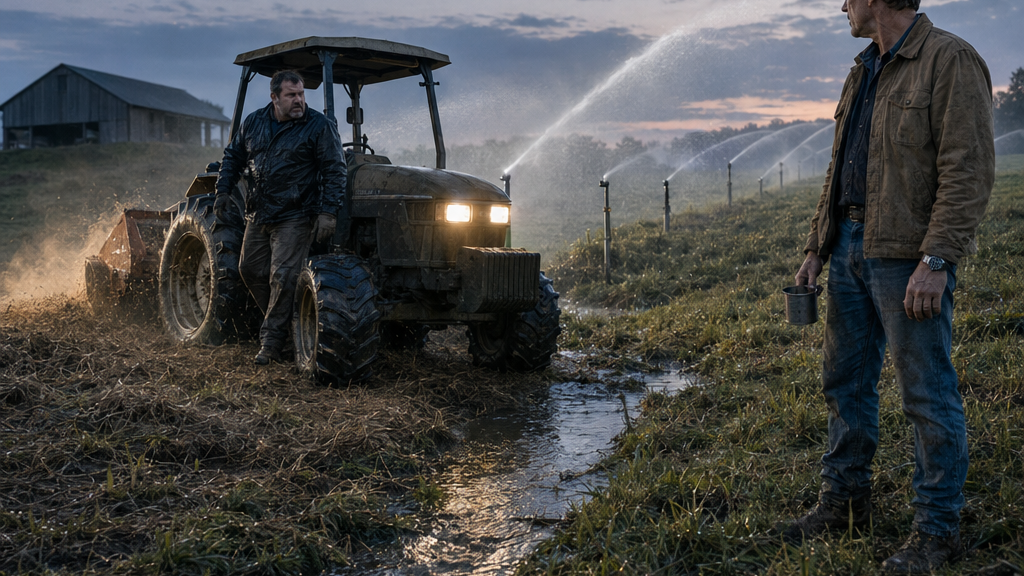
He Started the Tractor Before Sunrise Every Morning, Until the Lower Field Answered Back
Chapter 1: The Tractor Came Before the Sun Again
The headlights crossed Thomas Carter’s bedroom wall at 5:52 in the morning.
Two white bars slid through the blinds, climbed the dresser, and disappeared across the ceiling. A second later came the low diesel thrum Thomas had begun recognizing before he was fully awake.
He opened his eyes.
Beside him, Linda did not move at first. Then the engine climbed in pitch.
“You’ve got to be kidding me,” she murmured into the pillow.
Thomas reached for the alarm clock. Eight minutes remained before it was supposed to ring.
Outside, metal rattled against metal. The tractor turned off the gravel lane and dropped toward the lower field. When the rear-mounted blower engaged, the sound changed from an engine to a hard mechanical roar that seemed to push straight through the bedroom glass.
Linda pulled the sheet over one ear.
Thomas sat up.
“Eleven,” he said.
“What?”
“Eleventh morning.”
Linda lowered the sheet. “You’re counting now?”
“I started counting six mornings ago.”
“That sounds healthy.”
He ignored that.
By the time he pulled on jeans and work boots, the noise had moved below the house. The Carter place sat on a slight rise, with the cattle lot behind the barn and the lower hayfield falling away toward a shallow drainage strip that separated part of their ground from Gary Moore’s.
For years, both families had treated the gravel entrance at the bottom as if its exact edges did not matter. Tractors crossed it. Hay wagons swung wide. Pickup tires cut corners. Nobody measured much because nobody had needed to.
Lately, Gary seemed to be measuring nothing at all.
Thomas stepped outside.
The predawn air smelled of cut hay and diesel. Dew silvered the grass beyond the barn. Down the slope, Gary’s tractor lights moved beside the fence like two floating lamps.
Then a cloud of dry chaff lifted behind the blower.
Thomas watched it roll across the lower edge of his field.
He started walking.
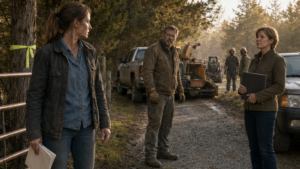
By the time he reached the gravel entrance, Gary had finished one pass and was turning around. The tractor’s right tires rode beyond the old worn track, compressing the grass beside Thomas’s irrigation risers.
Thomas raised a hand.
Gary saw him but finished the turn before throttling down.
“What?” Gary called.
Thomas waited until the blower stopped.
The sudden quiet seemed larger than the noise had been.
“You know what.”
Gary leaned one forearm on the steering wheel. “Morning to you too.”
“It’s not six yet.”
“Close enough.”
“Not in my bedroom.”
Gary glanced toward the Carter house on the hill. “You’ve lived around tractors your whole life.”
“That doesn’t mean I need yours beside the house before sunrise.”
Gary gave a short laugh. Not cruelly, exactly. Worse than cruelly, Thomas thought. Casually.
“I’m getting work done.”
“So am I. Usually after I’ve slept.”
Gary looked toward the eastern horizon, where a pale band had begun to show. “Some of us start early.”
Thomas felt the sentence settle where an apology should have been.
He pointed at the ground instead.
“And keep your pass on your side.”
Gary looked down.
The gravel track curved across the low entrance, its edges blurred by years of tires and grass. Loose hay, dust, and shredded weeds lay against Thomas’s drainage strip.
“That’s been the route since your dad was running cattle down here.”
“The route isn’t the problem. This is.”
Thomas nudged a clump of hay with his boot.
Gary shrugged. “Wind’ll move it.”
“You moved it.”
“You want me to rake every piece of straw that crosses an imaginary line?”
Thomas looked at him.
“No. I want you to stop pushing it there.”
For the first time Gary’s expression tightened.
“I’ve got thirty acres to finish before the heat comes up. I’m not spending the morning arguing over grass.”
He pushed the throttle forward.
Thomas stepped back as the tractor turned.
The blower engaged again.
A burst of chaff lifted from the gravel and scattered across the wet grass.
Thomas stayed where he was until Gary disappeared beyond the bend.
Only then did he notice the water.
A shallow patch stood in the drainage strip below the risers, dark against the dew. It was not unusual for the low ground to hold moisture after irrigation, but they had not run that zone since two evenings earlier.
Thomas crouched.
The soil was soft enough to take the edge of his thumb.
He stared at it for several seconds, then looked toward the flattened grass where Gary’s tires had passed.
Back at the house, Linda had coffee waiting.
“You talk to him?”
“Yes.”
“And?”
“He’s a morning person.”
Linda stopped pouring.
“He said that?”
“Close enough.”
She handed him a mug. “Then call the county.”
“I’m not calling the county because a man has bad manners.”
“It stopped being manners when you started keeping a diary.”
“It’s a notebook.”
“That makes it much better.”
Thomas took the spiral notebook from the counter beside the farm bills. Ten dates were already written on the last page.
He added another.
August 28. 5:52 a.m.
He hesitated, then added: blower at lower entrance, debris over edge.
After breakfast he returned to the field with his phone.
In daylight, the intrusion looked less dramatic and more irritating. Hay chaff lay in a pale fan beyond the usual tire marks. Several pieces had washed into the shallow depression where water stood among the grass.
Thomas photographed the debris.
Then he took a second picture showing the irrigation risers and Gary’s fresh tire track.
A third showed the lower entrance from farther back.
He knew what Linda would say if she saw him.
He took the pictures anyway.
Near eight, Gary returned without the blower running. He slowed when he saw Thomas beside the fence.
Thomas expected another remark.
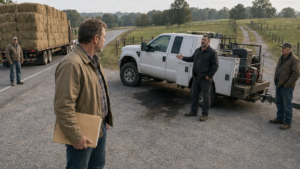
Instead Gary called down from the tractor, “Truck’s coming tomorrow.”
Thomas said nothing.
“Six-thirty pickup. I’ve got to clear the south stacks first.”
“You can clear them without running beside my house at five-fifty.”
Gary shook his head. “Tomorrow’ll be earlier than today.”
“How early?”
“Early enough.”
Then he drove on.
Thomas stood beside the row of irrigation risers until the tractor disappeared.
For ten mornings, he had treated the noise as aggravation.
On the eleventh, Gary had made it sound like a principle.
Thomas looked down at the photograph on his phone—the tire track, the chaff, the wet strip of ground—and decided that if Gary wanted to make a principle out of it, Thomas could do the same.
Chapter 2: Eleven Mornings Written in One Notebook
By nine that morning, eleven start times were lined up on Thomas’s desk beside a printed page from the county website.
5:57.
5:54.
6:02.
5:49.
5:56.
The latest was 5:52.
Linda stood in the office doorway with a stack of feed invoices.
“You found something.”
Thomas tapped the page.
“Maybe.”
“That means no?”
“That means farm equipment gets treated differently from somebody running a mower in town.”
Linda set down the invoices.
“Of course it does.”
“There are still restrictions near occupied residences. Depends on purpose, distance, duration.”
“And whether Gary decides he’s the exception to all three?”
Thomas gave her a look.
She lifted both hands. “I’m asking.”
The county guidance was less satisfying than he had hoped. It did not give him a clean sentence saying Gary Moore was wrong. Agricultural work received broad allowances, especially when timing affected crops, livestock, or weather-sensitive operations.
But the exemptions were not unlimited.
Repeated use of powered equipment near a neighboring residence for nonessential cleanup before normal daytime hours could still draw a complaint.
Thomas read that paragraph three times.
Then he looked at the notebook.
Eleven mornings.
The pattern mattered.
So did the purpose.
He scrolled through the photos on his phone. Some showed the tractor. Others showed nothing but fresh tracks and scattered hay.
The images from that morning were clearer.
One showed Gary’s tire cutting through the damp grass beyond the gravel shoulder.
Thomas enlarged it.
There, partly flattened beneath the tire mark, was the narrow crease of the drainage strip.
He leaned closer.
Linda noticed.
“What?”
“Look.”
She stepped beside him.
“That’s his tire.”
“I know.”
“No, I mean it’s not on the lane.”
Thomas moved to the next picture.
Then the one before it.
The angle changed, but the result did not.
Gary had not merely been blowing debris across the edge. His tractor had been widening the turn.
“How long has he been doing that?” Linda asked.
Thomas thought of the worn grass at the lower entrance.
“I don’t know.”
“That answer ought to bother you more than the tractor.”
It did.
By late morning Thomas was at the county office.
The receptionist listened while he explained that he was not trying to file a formal complaint yet.
“Everybody says that when they come in with photographs,” she said.
“I’m asking about the drainage easement.”
“That’s different.”
She directed him to the land-services counter, where Thomas gave the parcel numbers and waited while old digital records loaded.
The first map looked familiar enough: Carter ground to the west, Moore ground to the east, county ditch farther south.
Then the drainage layer appeared.
Thomas frowned.
“That can’t be right.”
The receptionist had moved on. A technician at another desk glanced over.
“What part?”
“The access.”
He pointed through the glass.
“The track runs here.”
The map showed something else.
The drainage easement curved through the low ground several feet west of where Thomas had always thought it ran. The informal vehicle route crossed it at an angle, then drifted back toward Gary’s side.
Thomas pulled a folded sketch from his pocket. He had drawn it that morning from memory.
The two lines did not match.
Not even closely.
“You have a survey?” the technician asked.
“Not with me.”
“This isn’t a boundary survey anyway. It’s drainage.”
“My father always treated the ditch as the edge.”
The technician nodded in the weary manner of someone who had heard that sentence many times.
“People treat fences, ditches, tree lines, tire tracks, and whatever else is convenient as boundaries. Records don’t always agree.”
Thomas did not like the implication.
“So whose ground is the access on?”
“You’d need parcel records and possibly a survey for that question. But if you’re asking whether machinery is supposed to compact the drainage easement, that answer is easier.”
“No?”
“No.”
Thomas left with copies of the drainage layer and less satisfaction than he had arrived with.
At home, he carried them directly to the lower field.
The afternoon sun had dried the surface, but a dark line remained in the grass where the morning water had stood.
He followed it.
The depression curved differently than he remembered.
At one point it disappeared entirely beneath compacted dirt and hay residue. Ten yards farther down, it reappeared.
Thomas scraped at the soil with his boot.
Something about it bothered him.
He could hear his father’s voice from years ago, complaining about having to clean “that lower run” after storms. Thomas had been busy with cattle then. Later, after his father’s health worsened, the lower pasture became one of those jobs that got pushed to another week.
Then another year.
Thomas straightened.
That memory was not evidence, he told himself.
He returned to the office and opened the photographs again.
This time he stopped looking at Gary.
He looked at the ground.
In one image, the water line bent beside an irrigation riser. In another, chaff had collected in the same shallow crease. In a third, Gary’s tire sat directly over it.
He had wanted proof that Gary was crossing where he should not.
He had found that.
But he had also found something else: Thomas himself could no longer say exactly where habit ended and the recorded drainage route began.
Linda came in as he spread the county map across the desk.
“Well?”
“There are restrictions.”
She waited.
“And?”
“The access isn’t where I thought it was.”
“That sounds important.”
“It doesn’t change him starting before six.”
“No.”
“Or pushing debris over.”
“No.”
Thomas disliked how calmly she agreed.
She touched the map.
“What does it change?”
He did not answer.
After supper, he walked back down to the irrigation controller mounted inside the equipment shed.
The lower-field zone was programmed for three mornings a week at 6:45.
Thomas opened the settings.
Zone Four supplied the row of risers along the lower entrance.
He pictured Gary’s headlights approaching before sunrise.
He pictured the tractor tires pressing through wet grass.
He pictured Gary leaning over the steering wheel and saying, Some of us start early.
Thomas moved the start time forward.
6:00 a.m.
His thumb rested over the confirmation button.
He could file a complaint. He could ask for a drainage review. He could wait weeks for letters and calls while Gary continued doing exactly what he pleased.
Or Gary could discover what an inconvenient morning felt like.
Thomas saved the new time.
Then he changed Zone Four from three mornings a week to every morning for the next seven days.
Chapter 3: At Six O’Clock the Lower Field Answered
At 5:58 the next morning, Gary Moore’s headlights appeared at the top of the shared lane.
Thomas was already waiting.
He stood beside the equipment shed with a mug of coffee he had forgotten to drink, his phone in one pocket and his old wristwatch visible beneath his jacket cuff.
The irrigation controller showed Zone Four scheduled for 6:00.
Two minutes.
Down the slope, Gary’s tractor descended toward the lower entrance.
Thomas had spent half the night telling himself he was not setting a trap.
The irrigation belonged to him.
The risers stood on his side.
The grass needed water.
The fact that Gary had announced exactly when he intended to arrive was not Thomas’s problem.
At 5:59, the tractor turned.
Its rear blower was already running.
Dry hay lifted in a pale cloud inside the headlights.
Thomas’s jaw tightened.
Gary could have taken the wider approach from his own field. It added time and required backing once near the stacks, which was why he disliked it. Instead he followed the familiar curve toward Thomas’s drainage edge.
The right front tire crossed the worn grass.
Thomas looked at his watch.
The second hand swept past twelve.
A valve clicked somewhere underground.
For half a heartbeat, nothing happened.
Then the first irrigation riser snapped upright.
Water burst across the lower field.
A second riser came alive, then a third, their overlapping fans catching the tractor broadside.
Gary jerked around.
The blower threw the water into a wild mist that flashed white in the headlights. Spray struck the tractor hood, Gary’s windshield, the open side of the cab, and the hay scattered behind him.
He cut the blower.
The silence came so suddenly Thomas could hear water pattering against metal.
Gary stared uphill.
Even at that distance, Thomas knew exactly who he was looking for.
Thomas lifted his coffee.
Gary drove another six feet.
The next sprinkler caught him full across the side window.
The tractor stopped.
A moment later Gary climbed down.
“What the hell, Thomas?”
Thomas walked halfway down the hill, no farther.
“Morning.”
Gary wiped water from his face with his sleeve.
“You changed these.”
“I changed my irrigation schedule.”
“To six?”
“Some of us start early.”
For one second Thomas saw Gary understand the sentence.
The look was worth every lost hour of sleep.
Gary’s mouth tightened.
“You think that’s funny?”
“No.”
“You’re watering a lane.”
“I’m watering my lower field.”
“You know I come through here.”
“You told me.”
Gary looked at the sprinklers, then back at Thomas.
The water continued sweeping in measured arcs.
“You could’ve soaked the blower.”
“It’s farm equipment. I assume it can survive water.”
“That isn’t the point.”
Thomas nearly smiled.
He managed not to.
Gary looked as if he recognized that too.
For the first time since the problem began, Gary was the one standing in an interrupted morning, unable to continue because another man had decided his own routine mattered more.
Thomas felt something loosen inside him.
Not kindness.
Satisfaction.
Gary climbed back into the tractor and reversed uphill out of the spray.
Thomas watched him retreat.
It should have ended there.
For nearly a minute, Thomas thought it had.
Then he heard a different sound.
Water moving.
Not spraying.
Running.
He turned.
Below the risers, the irrigation water had gathered into a shallow sheet across the grass. Instead of slipping south through the drainage crease, it was spreading sideways.
Toward his pasture.
Thomas walked quickly down the slope.
The ground beside the nearest riser was already soft beneath his boots.
“That’s not right.”
The sprinkler swept past, soaking his jeans.
He barely noticed.
Water should have followed the low channel toward the county ditch. Even after a heavy irrigation cycle, the strip had always carried runoff away.
Or he had always assumed it did.
Now the flow reached the flattened area at the vehicle crossing and stopped.
Behind it, more water accumulated.
Thomas shut down Zone Four from his phone.
The sprinklers fell one by one.
Without their hiss, the sound of pooled water became clearer.
It was creeping backward.
He stared at the shallow brown sheet moving into the lower pasture.
By six-ten, Gary had returned on foot.
He stopped on the other side of the crossing.
“Well,” he said. “Looks like you won.”
Thomas did not answer.
Gary followed his gaze.
His expression changed.
“That always hold water?”
“No.”
“You sure?”
Thomas looked at him.
Gary raised both hands slightly. “I’m asking.”
Thomas stepped into the drainage strip. Mud came over the edge of his boot.
The water reached what should have been the channel and disappeared beneath a mat of compressed hay and soil.
Thomas crouched and pulled at it.
The top layer peeled away in wet clumps.
Below it was packed dirt.
Gary came closer.
“You’ve got a blockage.”
Thomas dug with both hands.
“Go get a shovel.”
Gary did not move.
Thomas looked up.
Gary’s wet shirt clung to his shoulders. His face was still tight from the sprinkler confrontation.
“You wanted this morning,” Gary said. “You got it.”
Thomas stood slowly.
“And your tire track is sitting on top of whatever’s blocking this.”
Gary looked down.
“That route’s been there twenty years.”
“So has the drainage.”
“You don’t know that’s my doing.”
“I know your tractor crossed it yesterday.”
“And yours never has?”
The question landed harder than Thomas expected.
He looked at the rut.
He had driven that entrance himself. So had his father. So had hay wagons, cattle trailers, fertilizer trucks.
Gary turned away.
“My truck’s due in forty minutes.”
Thomas wanted to tell him to go.
Instead he saw water continuing to climb around the roots of the lower pasture grass.
“Fine.”
Gary looked back.
“Fine what?”
“Go meet your truck.”
Thomas pointed toward the crossing.
“But we’re not done with this.”
Gary’s expression suggested he could think of several answers.
He gave none.
Thomas went to the shed for a shovel.
The first six inches were compressed hay, soil, and gravel. Beneath that, the shovel struck something solid with a hollow metallic scrape.
Thomas stopped.
He cleared more dirt.
A curved, rust-dark edge appeared beneath the crossing.
Not a rock.
Not a buried fence post.
Pipe.
He widened the hole until he could see the outline of an old culvert mouth nearly sealed beneath years of compacted debris.
The opening faced directly into the drainage strip shown on the county map.
And Gary’s usual tire path ran straight across its buried top.
Thomas sat back on his heels.
Water seeped around his boots.
He had gone down to the field expecting to teach Gary Moore where one man’s inconvenience ended and another man’s rights began.
Instead the lower field had answered with a question Thomas could not put entirely on Gary.
Who had buried the culvert—and how long had both of them been driving over the truth?
Chapter 4: The Boundary They Had Both Remembered Wrong
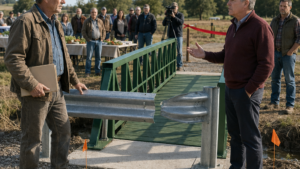
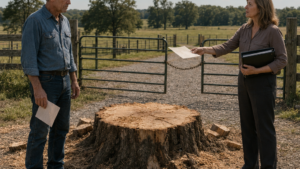
Eric Gonzalez laid the county drainage map over Thomas’s hand-drawn sketch and held both pages against the hood of his truck.
The lines missed each other by nearly twelve feet.
Thomas stared at them.
“That’s not right.”
Eric did not look surprised. “Which one?”
Thomas tapped his own drawing. “The drainage runs along the field edge.”
“The field edge you use now.”
“The field edge we’ve always used.”
Eric shifted the transparent county overlay until the parcel corner markers aligned.
The drainage easement curved west, crossing beneath the old vehicle path before continuing toward the county ditch.
Thomas looked down toward the lower field. The grass still showed muddy streaks from the irrigation mishap two mornings earlier. Where the water had pooled, a darker line now traced the route Eric’s map showed.
It was almost as if the field had drawn the answer for them.
Gary stood several yards away with his arms folded.
“So which part is mine?” he asked.
Eric glanced at him. “That’s not what I’m here to determine.”
“You’ve got the maps.”
“I’ve got drainage records. Not a current boundary survey.”
Gary looked at Thomas.
Thomas kept his eyes on the paper.
Eric pointed to the old culvert location.
“This structure predates the vehicle crossing. The county record from installation shows maintenance divided by adjoining ownership. Each side keeps its section open enough for flow.”
Thomas looked up.
“Each side?”
“Yes.”
Gary’s expression changed slightly.
Thomas noticed.
Eric continued. “The blockage at the crossing is mixed material. Soil, plant residue, gravel. Some compaction from equipment, certainly. But the upstream section is narrowed too.”
Thomas knew which direction upstream was.
His side.
They walked the ditch.
Eric used a narrow probe to test the ground. At one point he pushed through a mat of roots and packed sediment beside Thomas’s pasture.
“This hasn’t been cleaned in a while.”
Thomas said nothing.
“How long?” Gary asked.
Eric shrugged. “Years, maybe.”
Thomas felt heat climb into his face despite the cool morning.
“My father maintained this.”
Eric looked toward him.
“When?”
Thomas opened his mouth.
Nothing useful came out.
He remembered his father coming inside muddy after summer storms, leaving a shovel beside the back steps. He remembered complaints about the lower run filling again. Later, after his father’s health declined, Thomas had taken over more cattle work and less ditch work.
The lower strip had still drained.
Mostly.
Until it didn’t.
Gary kicked at a clump of dried mud.
“So it isn’t just my tractor.”
“No,” Eric said.
Gary gave Thomas a sideways look.
Thomas felt the old anger rise.
“And your tractor still shouldn’t be crossing the easement the way it is.”
Eric nodded. “That’s also true.”
Gary’s satisfaction disappeared.
Thomas almost enjoyed that.
Almost.
Eric crouched beside the buried culvert mouth.
“This is what happens with informal access. Somebody moves six inches to avoid a rut. Next person follows. Five years later, the travel path is three feet over. Twenty years later, everybody remembers the new path as the old one.”
“My dad drove it there,” Gary said.
“So did mine,” Thomas said.
Neither man sounded proud of it.
Eric straightened.
“You can clear this. You can reroute the crossing. But if you keep compacting directly above the culvert and letting debris collect, you’ll be back here.”
Gary looked toward his hay ground.
“I can’t move that approach right now.”
Thomas turned.
“You can’t keep using it.”
“I’ve got harvest traffic.”
“You heard him.”
“I heard him say both sides neglected it.”
Thomas stepped closer.
“That doesn’t turn my side into your road.”
Gary’s jaw tightened.
“And your sprinklers don’t turn the road into a pond.”
Thomas felt the sentence hit the exact place he had been avoiding.
Eric gathered the maps.
“I can explain the system. I can tell you what needs to function. I’m not refereeing the rest.”
By noon he was gone.
Thomas spent the afternoon in the equipment shed pretending to sort tools.
Linda found him holding the same wrench he had picked up ten minutes earlier.
“So?”
“We both let it go.”
“The ditch?”
“Yes.”
“And the access?”
“Gary’s still crossing where he shouldn’t.”
Linda leaned against the workbench.
“That wasn’t my question.”
Thomas set the wrench down.
“My father stopped maintaining part of it.”
“You stopped too.”
He looked at her.
She did not soften it.
“You did.”
Thomas walked to the open shed door.
The lower field shimmered beyond the barn. From here the wet strip looked harmless.
“I had cattle. Dad was sick. Then we replaced the west fence. Then—”
“I know.”
“That ditch kept working.”
“Until it didn’t.”
Thomas rubbed his jaw.
Linda said, “You can still be right about Gary and wrong about yourself.”
“I’m aware.”
“Are you?”
He turned.
She had already picked up the invoices she had brought.
“Because you sound disappointed that the facts didn’t pick one winner.”
She left before he answered.
Late that afternoon Gary’s tractor appeared on the shared lane.
Not before sunrise this time.
Thomas walked down to meet him.
“You need another route,” Thomas said.
Gary killed the engine.
“Not during harvest.”
“That culvert can’t take you crossing it.”
“It’s taken tractors for twenty years.”
“It’s buried.”
“Then we clear it.”
“And you keep driving over it?”
Gary looked toward the south stacks.
“I’ve got two weeks of this left.”
Thomas folded his arms.
“Use the east approach.”
“That adds fifteen minutes every load.”
“So?”
Gary laughed once, without humor.
“So I’m already behind.”
Thomas waited.
Gary looked away.
A long moment passed before he spoke again.
“I missed a pickup last week.”
Thomas had not known that.
“So reschedule it.”
“You think they wait around for me?”
“That’s between you and the hauler.”
Gary looked back at him.
“No. It’s between me and the bank if I keep missing them.”
The words were quiet.
Different from the usual defensiveness.
Thomas said nothing.
Gary stared toward his field.
“I’ve got another contracted pickup Monday. If I miss that one, I’m not just losing a truck slot.”
Thomas could have asked how bad it was.
Part of him wanted to.
Another part recognized the admission for what it was: not an excuse, but something Gary had not intended to say.
Gary started the tractor.
“I’ll stay off the soft edge.”
“That’s not enough.”
“It’s what I can do today.”
He drove away.
Thomas stood beside the drainage strip and watched muddy water slide slowly through the narrow opening they had cleared.
For the first time since the headlights had started crossing his bedroom wall, Gary’s problem looked less like arrogance and more like pressure.
That did not make the damage disappear.
It only made the next choice harder.
Chapter 5: Gary Finally Explained the Morning Hours
Gary came to the Carter equipment shed late Thursday afternoon without a tractor.
Thomas noticed that first.
No engine.
No blower.
No cloud of chaff rolling behind him.
Just Gary walking up the gravel lane with his hands empty.
Thomas set down the grease gun he was using.
“What?”
Gary stopped outside the open shed.
“What did the water damage?”
Thomas waited.
“You came up here to ask me that?”
“I asked, didn’t I?”
“The pasture’s fine.”
“The pump?”
“Fine.”
“The culvert?”
“Not fine before the water. Not fine after it.”
Gary nodded.
For a few seconds neither man spoke.
The irrigation pipes beside the shed lay silent in the dry afternoon. Thomas had turned Zone Four off after the flooding and had not reactivated it.
Gary looked toward them.
“You planning another six o’clock shower?”
Thomas almost said yes.
Instead: “No.”
Gary shifted his weight.
“Good.”
“That disappoint you?”
“No.”
Thomas leaned against the workbench.
Gary looked tired.
Not sleepy. Thomas knew the difference now.
The kind of tired that tightened the skin around a man’s eyes and made him stand as if every conversation cost money.
“The truck Monday matters that much?” Thomas asked.
Gary stared at the shed floor.
“It all matters right now.”
Thomas waited.
Gary rubbed his thumb across one knuckle.
“My regular farmhand left in June.”
“I heard.”
“Did you hear why?”
“No.”
“Better pay at the seed plant.”
Thomas nodded.
Couldn’t blame him.
Gary continued. “So I’m doing most of the loading. My mechanic says the baler needs work before next cutting. Diesel bill’s up. One buyer pushed payment thirty days.”
“You don’t have to explain your books to me.”
“I know.”
That was what made Thomas keep listening.
Gary looked toward the lower field.
“The hauler gives me a window. I’m ready, or he goes to the next farm. In the afternoon, those south stacks get soft if we get humidity. So I clear the access early. Load early. Move while I can.”
Thomas thought of the eleven entries in his notebook.
5:57.
5:54.
5:49.
The times looked different now.
Not acceptable.
Different.
“You could’ve said that the first morning.”
Gary’s mouth tightened.
“You came down telling me what time I was allowed to work.”
“I came down asking you not to run a blower beside my house before six.”
“You didn’t ask like that.”
Thomas remembered.
He had been angry.
Controlled, he had told himself.
But control could still carry contempt.
“You told me some of us start early,” Thomas said.
Gary looked faintly embarrassed.
“Yeah.”
“That helped.”
“I was mad.”
“So was I.”
Gary looked at the irrigation pipes again.
“Apparently.”
Thomas let that sit.
Then he said, “Your schedule doesn’t give you the right to push debris into my drainage.”
“I know.”
The answer came so quickly Thomas almost missed it.
“You know?”
Gary exhaled.
“I knew it wasn’t ideal.”
“That’s not the same sentence.”
“No.”
“And the tire path?”
Gary’s face hardened again.
“That route’s been used forever.”
“There it is.”
“What?”
“That thing you do. You admit one inch, then defend the next ten feet.”
Gary stepped closer.
“And you don’t?”
Thomas said nothing.
Gary pointed downhill.
“You ran sprinklers at me because you wanted me wet.”
Thomas’s first instinct was denial.
The irrigation needed running.
The zone was his.
The schedule was legal.
All of that was true.
None of it was the truth.
“Yes,” Thomas said.
Gary blinked.
Thomas continued, “I wanted you inconvenienced.”
A short silence followed.
Gary nodded once.
“Well. You managed that.”
Thomas almost smiled.
So did Gary.
Neither quite allowed it.
They walked down to the lower entrance.
The ground had dried enough to show the old drainage depression clearly. Eric had marked the likely culvert line with two orange flags.
Gary stood between them.
“If I move my turn east, I lose swing room.”
“Not if the entrance widens on your side.”
“That fence corner catches the wagon.”
“Move the corner.”
Gary looked at him.
“That’s your fence.”
“I know.”
Thomas had been thinking about it since Eric left.
The fence was not old, but its alignment followed the route Thomas remembered, not necessarily the route that made sense now.
He pointed.
“One tractor width east. New gravel. Keep the crossing off the drainage line.”
Gary studied the ground.
“That cuts into your approach.”
“A little.”
“And yours.”
“Yes.”
Gary looked suspicious.
“What do you want?”
Thomas pointed at the buried culvert.
“You help clear that first.”
Gary said nothing.
“We reopen the ditch from my side to yours. Then we move the travel path. After that, you stay off the drainage strip.”
“And mornings?”
“No blower beside the house before seven.”
“Seven’s late.”
“Then use the east side before seven.”
Gary frowned.
“I need access.”
“You’ll have access.”
“Longer access.”
Thomas shrugged. “You’re the one who likes starting early.”
Gary stared at him.
Thomas let the line hang for one beat, then added, “That was a joke.”
“A poor one.”
“I’ve heard worse.”
Gary walked the proposed route twice.
He measured the turn with his eyes, looking from the fence to the gravel entrance and back.
“It might work.”
“It will.”
“You don’t know that.”
“No.”
Gary glanced at him.
That answer seemed to matter.
Thomas pointed toward the culvert again.
“Saturday morning. We clear it. If the route can move, we move it.”
“And if it can’t?”
“Then we stop pretending the old way is the only way and figure out another one.”
Gary wiped dust from his palms.
For a moment Thomas thought he would agree.
Instead he said, “I’ve got work Saturday.”
“So do I.”
Gary looked toward the lower field.
His pride was visible in the way he held his shoulders.
Thomas recognized it because he had been carrying the same thing.
Finally Gary said, “What time?”
Thomas answered, “After sunrise.”
Gary gave him a flat look.
Thomas waited.
Then Gary said, “Fine.”
It was not an apology.
It was not peace.
But it was the first time either man had agreed to change something that belonged to himself.
Chapter 6: Thomas Had to Give Up the Better Revenge
At 5:50 Saturday morning, Thomas stood inside the equipment shed and deleted the irrigation schedule.
Zone Four disappeared from the list of automatic starts.
No six o’clock cycle.
No timed spray.
No chance to watch Gary discover that Thomas still controlled the morning.
His thumb hovered over the screen for a moment after the deletion.
Then he locked the phone.
Outside, the field was dark.
Thomas could hear a tractor somewhere on Gary’s side, but it stayed distant from the house.
He took two shovels, a digging bar, and a coil of chain down to the lower field.
By sunrise he had exposed most of the culvert mouth.
The blockage was worse than he thought.
Roots.
Packed gravel.
Old hay stems.
Black soil pressed hard enough to come out in slabs.
Thomas worked alone for nearly forty minutes.
Then an engine approached.
He straightened.
Gary came down the east side on his utility tractor.
No blower attachment.
A heavy chain hung from the front bucket.
Thomas looked at it.
Gary climbed down.
“Mine’s longer.”
Thomas held up his coil.
“Congratulations.”
Gary almost smiled.
They worked without much conversation.
Thomas cleared the upstream side while Gary dug out the compacted shoulder. When the opening was large enough, they fed the heavier chain through the culvert and hooked it to a packed mass of roots and debris.
Gary eased the tractor backward.
The chain tightened.
For several seconds nothing moved.
Then the blockage came free all at once.
A dark plug of roots, gravel, and rotten vegetation slid out onto the grass.
Water followed.
At first it was only a thin brown stream.
Then more came.
Thomas stepped back as the old channel filled.
For the first time in years, water traveled visibly through the culvert instead of spreading sideways into the pasture.
Gary shut off the tractor.
They stood listening.
The sound was small.
Running water over gravel.
Thomas had heard louder things his whole life and never paid them much attention.
Now it sounded like machinery starting correctly.
Gary nudged the debris pile with his boot.
“Some of that’s mine.”
Thomas looked at him.
“Some of it’s ours.”
Gary nodded.
They moved to the proposed new access.
Thomas had already marked a wider curve with stakes. To make the turn work, they needed to shift part of the gravel and remove a short section of fence.
Gary walked the radius.
“Too tight.”
“It clears.”
“With your tractor.”
“With yours too.”
“Not pulling the big wagon.”
Thomas looked at the fence corner.
He knew what Gary was going to say.
“No.”
Gary pointed.
“Four feet.”
“No.”
“Then the wagon clips it.”
“Take a wider approach.”
“Which puts me back over the ditch.”
Thomas felt irritation return.
“There’s always something.”
Gary looked at him.
“That’s what I’ve been telling you.”
Thomas turned away.
The fence had been replaced three years earlier. Good posts. Straight wire. He had set the corner himself.
Moving it would cost him usable alignment and create an awkward angle beside the lower pasture.
Not much.
Enough.
He stared at the post.
Gary said, “We can leave it and I’ll use the old crossing.”
“No.”
“Then four feet.”
Thomas kicked loose gravel from the edge.
He wanted Gary to be the one who gave something up.
That had been the shape of the whole conflict in his mind.
Gary made the noise.
Gary crossed the edge.
Gary pushed the debris.
Gary should move.
Thomas should not have to.
Then he looked at the water running through the reopened culvert.
His father had stopped cleaning part of it.
Thomas had stopped too.
Both families had followed the same drifting tire path because changing it would have been inconvenient.
He picked up the post driver.
“Three feet.”
Gary shook his head. “Four.”
“Three and a half.”
Gary looked at the turn.
“Fine.”
Thomas hated how quickly the agreement came.
They removed the corner post.
The soil beneath it was harder than expected. By the time the new hole was set, Thomas’s shoulders ached.
Gary spread gravel with the tractor bucket.
Thomas reset wire.
At noon, they tested the new approach.
Gary drove through first without a wagon.
Plenty of room.
Then he returned with an empty hay wagon.
The rear wheel passed the new fence corner by less than a foot.
Thomas watched the tires.
They stayed clear of the drainage line.
Gary stopped on the other side and looked back.
“That works.”
Thomas did not say, I told you so.
Mostly because he had not.
They spent the afternoon clearing another thirty yards of ditch.
Near three, part of the softened bank collapsed beneath Thomas’s shovel.
Mud slid into the channel.
“Stop,” Gary said.
Thomas stepped back.
The collapse cut directly toward the new fence alignment.
Gary crouched.
“If you keep that corner where it is, this’ll undermine the post.”
Thomas looked at the fresh post they had spent an hour setting.
“You’ve got to be kidding.”
Gary scraped the bank with the shovel.
“Needs another foot.”
Thomas stared at him.
Gary lifted both hands.
“I didn’t make the water.”
That almost started it again.
Thomas could feel the old answer forming.
Your tires did.
Your debris did.
Your schedule did.
Instead he looked at the channel.
The water did not care whose argument was better.
It followed the grade.
Thomas pulled the new post out.
They moved it again.
By late afternoon, the access curved cleanly east of the drainage strip. The fence sat farther into Thomas’s side than he had wanted. Gary’s route was longer than he had wanted.
Neither man had gotten the version he would have chosen alone.
Eric stopped by before dusk to inspect the work.
He walked the channel, checked the culvert opening, and looked at the new crossing.
“This should function.”
Gary said, “That a guarantee?”
Eric laughed.
“On a farm?”
“No.”
“Then no.”
Thomas looked down the ditch.
The last muddy water had begun clearing.
By the time Eric left, a narrow stream ran through the culvert toward the county ditch, catching the low evening light.
Gary collected his tools.
“I’ve got the Monday truck at six-thirty.”
Thomas nodded.
“I’ll come in from the east.”
“Good.”
“And I need to stage equipment before seven.”
“Stage it. Don’t run the blower by the house.”
Gary nodded.
It was the first agreement between them that did not sound temporary.
He climbed onto the tractor.
Before starting it, he looked toward Thomas.
“You really deleted the sprinkler schedule?”
Thomas glanced at him.
“What makes you think I did?”
Gary studied his face.
Then he smiled faintly.
“Guess I’ll find out Monday.”
He started the tractor and drove the new route.
Thomas watched the tires pass the orange flags without touching the drainage strip.
Below them, clear water continued through the old culvert, following a line both men had spent years pretending was somewhere else.
Chapter 7: The First Quiet Morning Was Not Silent
Thomas woke before the alarm because he heard a tractor.
For one hard second, his body reacted before his mind did.
His eyes opened. His shoulders tightened. He waited for the familiar rise in engine noise, the metallic rattle near the lower lane, the blower beginning its dry mechanical roar beside the house.
None of it came.
The tractor was there, but farther away.
Thomas turned his head toward the window.
The clock read 5:56.
Linda slept beside him, undisturbed.
He remained still and listened.
The engine moved across Gary’s east field, muffled by distance and the low ridge between the properties. It was the sound of farm work rather than intrusion now, no louder inside the bedroom than cattle shifting against a gate.
Thomas almost laughed at how strange that distinction felt.
He got dressed without waking Linda and went outside.
Several weeks had passed since they reopened the culvert and moved the access. Early autumn had sharpened the mornings. The grass beside the lower drainage strip was darker than the surrounding pasture, and a narrow thread of water moved through the old channel without pooling.
Thomas walked downhill.
The orange flags Eric had left were gone. In their place, the new gravel curve showed clearly where Gary’s equipment was supposed to travel. Tire tracks entered from the east, swung wide of the ditch, and passed the shifted fence corner with room to spare.
No tracks crossed the drainage strip.
Thomas stopped beside the culvert.
Water slid through it cleanly.
He crouched and pulled one small clump of leaves from the mouth before they could collect.
A month earlier, he might have walked past them.
Now he tossed them onto dry ground.
The irrigation risers stood in a row above him. Zone Four was active again, but only on its ordinary schedule, later in the morning and only when the field needed it.
Thomas no longer checked the controller to see whether Gary would be nearby.
That had taken longer to stop than he cared to admit.
The sound of a larger engine came from the county road.
Thomas straightened.
Headlights appeared beyond Gary’s barn.
A hay truck.
He glanced at his watch.
6:18.
The truck turned into Gary’s place and slowed near the staging area.
Thomas looked toward the east approach.
Gary’s tractor appeared almost immediately, carrying two forks of bundled hay toward the loading area. He could have shortened the trip by cutting through the old crossing. Even now, with the ground firm and no one standing there to object, the old route would have saved him several minutes.
Thomas watched.
Gary approached the point where the two paths separated.
The tractor slowed.
For a second, Thomas thought he would turn toward the old line.
Instead Gary steered east.
The wagon behind him followed the longer curve.
Its wheels passed over the new gravel, clear of the ditch, then disappeared beyond the fence.
Thomas released a breath he had not realized he was holding.
Nobody had inspected him.
Nobody had warned him.
Gary had simply taken the longer route because that was the agreement.
Thomas looked down at the water.
That meant more than an apology would have.
By seven, Linda had joined him near the barn with two mugs of coffee.
“You were gone when I woke up.”
“He had a truck.”
She followed his gaze toward Gary’s field.
“And?”
“He used the new route.”
Linda handed Thomas his coffee.
“You sound surprised.”
“I wasn’t sure.”
“Neither was I.”
Thomas looked at her.
She smiled into her mug.
“What? I’m allowed to be skeptical.”
The hay truck’s engine idled in the distance.
Gary’s tractor moved steadily between the stacks and loading area. No blower ran beside the Carter house. No debris crossed the drainage strip. The work was still early, still noisy by ordinary standards, but its burden remained where it belonged.
Linda nodded toward the ditch.
“That grass looks different.”
Thomas followed her gaze.
She was right.
The narrow strip that had been thin and yellow through much of the summer had turned thick and green. The repaired drainage line carried away excess water, while the weeks of regular irrigation after the blockage was cleared had revived the roots along its edge.
Thomas walked closer.
The contrast was obvious now: a ribbon of healthy grass followed the channel toward the county ditch.
Linda said, “Your revenge improved the pasture.”
“It wasn’t revenge.”
She looked at him.
Thomas took a drink.
“Fine. It started as revenge.”
“That sounds more accurate.”
He nudged the grass with his boot.
The sprinkler stunt had felt satisfying for less than ten minutes.
This felt different.
Nothing dramatic had happened. Gary had not apologized in front of anybody. Thomas had not won a ruling or forced him off the land. The county had not declared one of them right and the other wrong.
Instead there was a functioning culvert.
A longer access route.
A moved fence corner Thomas still disliked when he looked at it too long.
And a green strip of ground where muddy water had once backed into the pasture.
Later that morning, Thomas was repairing a gate latch when he heard Gary’s tractor approaching.
It stopped near the new crossing.
Thomas looked up.
Gary climbed down.
“The truck’s loaded.”
“Good.”
“Made the window.”
Thomas nodded.
Gary looked toward the drainage strip.
“Water’s moving.”
“So far.”
“You clear it again?”
“Leaves yesterday.”
Gary rubbed his chin.
“I’ll check the downstream side after I finish.”
Thomas studied him.
Gary noticed.
“What?”
“Nothing.”
“That look isn’t nothing.”
Thomas set the wrench down.
“I was just wondering if you were going to make me remind you.”
Gary’s mouth shifted.
“Don’t get used to it.”
“I won’t.”
Gary turned toward his tractor, then stopped.
“East route adds nine minutes, by the way.”
Thomas almost smiled.
“You timed it?”
“Of course I timed it.”
“Some of us start early.”
Gary stared at him.
Then, unexpectedly, he laughed.
It was brief and rough and gone almost as soon as it appeared.
“You’re going to keep that one forever, aren’t you?”
“Probably.”
Gary climbed back into the tractor.
Thomas returned to the gate latch.
The exchange was not friendship. Neither man mistook it for that.
But the sharpness that had once sat beneath every sentence had changed shape. The boundary between them remained, perhaps clearer than before, but it no longer required either man to pretend the other had no legitimate burden on his side of it.
Two mornings later, the real test came.
Thomas woke at 6:12 to the sound of Gary’s tractor moving quickly along the east field.
A weather front was expected before noon. Hay remained stacked near the south edge. Gary had every reason to hurry.
Thomas dressed and stepped onto the porch.
In the half-light, he saw the tractor approaching the new crossing.
Then it stopped.
Gary shut the engine down.
Silence spread across the lower field.
Thomas checked his watch.
6:21.
The agreed time for heavy equipment near the Carter house was seven.
Gary climbed down and walked around the tractor. He checked a tire, adjusted a chain, then leaned against the fender.
He could have driven through.
The old crossing was empty.
The new route was open.
No county technician stood nearby.
Thomas was the only person watching, and Gary did not know that.
For thirty-nine minutes, the tractor remained off.
At 6:58, Linda came onto the porch behind Thomas.
“What happened?”
“Nothing.”
She looked toward the silent tractor.
“That seems unusual.”
Thomas nodded.
At exactly seven, Gary climbed back into the cab.
The engine started.
He took the longer east curve and passed the repaired drainage line without touching it.
Thomas listened as the tractor moved beyond the lower field.
The sound was still there.
Diesel, gears, work beginning.
But it no longer crossed the bedroom wall like a challenge.
Thomas went down to the ditch later that morning.
Clear water ran beneath the culvert and through the green strip toward the county line. Fresh tractor tracks curved around it, exactly where they were supposed to be.
He stood there for a while, looking at the ground neither man had fully understood until both had made it worse.
The boundary had not become real because Thomas punished Gary.
It had become real because, when no one was forcing him, Gary stopped at it.
And Thomas no longer needed him soaked, embarrassed, or defeated to believe that mattered.
The story has ended.