The Fence Had Stood for Fifteen Years, but Four Feet of Pasture Changed Everything Between Them
Chapter 1: The Fence Was Four Feet Too Close
The mower should have cleared the gate.
Jeffrey Harris knew that before he ever climbed down from the tractor.
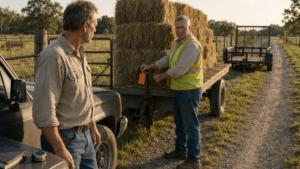
He had the folded deed sketch in the cab beside him, a county aerial printed two days earlier, and enough experience laying out commercial sites to know what twelve feet looked like without measuring it. Yet the mower deck sat crooked behind him, one wheel nearly brushing the cedar post while the opposite side hovered inches from Richard Walker’s woven-wire fence.
Jeffrey shut off the tractor.
The sudden silence made the problem look worse.
Beyond the fence, three of Richard’s black cattle stood in a narrow travel lane between the pasture and the low drainage strip. One raised its head and stared at Jeffrey as if he were the inconvenience.
He stepped down, boots sinking slightly into the soft spring ground.
His father had run equipment through this entrance for decades. Jeffrey had been away long enough that many details of the farm felt smaller than he remembered, but the width of this opening was not one of them.
He unfolded the deed sketch across the tractor hood.
The western boundary ran straight from the old iron corner pin near the county road to another monument beyond the low hayfield. According to the recorded dimensions, Jeffrey should have had several more feet between the boundary and the old equipment path.
Instead, Richard’s fence crowded the lane.
Jeffrey was still staring at it when a pickup rolled slowly down the neighboring pasture track.
Richard stopped on the other side of the gate and lowered his window.
“Trying to take that mower through there?”
Jeffrey looked at him. “That was the idea.”
Richard smiled without much humor.
“Your dad quit using this entrance with anything that wide years ago.”
Jeffrey glanced toward the fence.
“Why?”
Richard shrugged. “Because it doesn’t fit.”
“That’s what I’m trying to understand.”
Richard opened the door and climbed out. He was broad through the shoulders, gray beginning around his temples, his work jacket permanently marked with dust at the cuffs. He had the relaxed posture of someone standing on ground he had stopped questioning years earlier.
Jeffrey knew that posture.
He had seen versions of it on construction sites whenever someone said, We’ve always done it this way.
Richard rested one arm on the truck bed.
“You’ll find things changed while you were gone.”
“I expect they did.”
“Your dad and I worked around each other.”
Jeffrey folded the paper once.
“I’m not arguing with that.”
“Sounds like you might be.”
Jeffrey ignored the opening.
He walked to the old cedar post at the field edge. The post looked newer than the fence farther south. The wire had been tightened carefully, and the ground along Richard’s side had been worn into a hard lane by years of hooves.
“You remember when this section was built?” Jeffrey asked.
Richard gave a short laugh.
“Built? It’s been there fifteen years.”
“That wasn’t what I asked.”
Richard’s smile faded slightly.
“About fifteen.”
Jeffrey nodded.
He went to the tractor toolbox and pulled out a fifty-foot tape.
Richard watched him.
“You planning to survey it yourself now?”
“No.”
Jeffrey hooked the tape at the reference point shown on the farm sketch and walked toward the fence.
The first measurement made him stop.
He reset the hook and did it again.
Then a third time.
Richard remained beside the pickup.
“Well?”
Jeffrey crouched and pressed his thumb against the tape.
Four feet.
Not a few inches from an old fence settling out of line. Not enough to blame on a crooked post or an uncertain ditch edge.
Nearly four feet.
He stood.
The strip looked insignificant when viewed by itself—a narrow ribbon of grass running beside the fence. But follow it down the field and it became acreage. It also explained why his mower no longer had enough room at the entrance.
Jeffrey reached into his pocket, pulled out a small orange marking flag, and pushed it into the ground where his measurement suggested the boundary should be.
Richard looked at it.
“What’s that supposed to mean?”
“Reference point.”
“For what?”
Jeffrey reeled the tape in.
“For me.”
Richard stared at the orange flag, then at Jeffrey.
“You came back here a week ago.”
“I know when I got here.”
“You don’t know every arrangement your dad had.”
Jeffrey felt the answer rise too quickly and swallowed it.
That was precisely the kind of statement that irritated him: broad, convenient, impossible to measure.
He had spent years working around plans, grades, rights-of-way, drainage easements. When two people disagreed about where something belonged, there was usually a record.
His father had never been interested in records unless they concerned crop insurance, taxes, or equipment maintenance.
That difference had frustrated Jeffrey when he was younger.
Now, standing beside the fence, it unsettled him.
“I’ll check the records,” he said.
Richard leaned against the truck.
“You do that.”
Jeffrey gathered the tape.
He should have stopped there.
Instead, he looked along the fence line again and said, “If it’s four feet over, it’ll have to be dealt with.”
Richard’s expression changed.
Not anger. Not yet.
Something closer to disbelief.
“You think your dad let me put a fence four feet on his side and never noticed?”
“I think I need to know where the line is.”
“You think he didn’t?”
Jeffrey held Richard’s gaze.
Neither man spoke for several seconds.
A cow shifted behind the fence, rubbing its shoulder against the wire. The whole run trembled lightly.
Richard finally nodded toward the farmhouse.
“Ask Amanda.”
Jeffrey frowned.
“What does Amanda have to do with it?”
“She was around more than you were.”
The sentence landed harder than Richard seemed to intend.
Jeffrey looked away first.
His sister had stayed within thirty miles after college. Jeffrey had gone where the work was—first surveying crews, then civil contractors, then project management. He came home for holidays, harvest weekends when his father asked, and later for hospital visits.
He had known there were things he missed.
He had not expected a property line to be one of them.
Richard opened his truck door.
“You want advice?”
“No.”
Richard almost smiled again.
“Then call it information. Don’t start pulling posts until you know what your own father agreed to.”
Jeffrey watched him climb into the cab.
Before shutting the door, Richard looked once more at the orange flag.
“That fence didn’t end up there by accident.”
The pickup rolled back toward Richard’s barn.
Jeffrey remained beside the gate.
He looked from the deed sketch to the orange flag, then down the fence that had apparently stood in the wrong place for fifteen years.
For the first time that morning, the four-foot discrepancy bothered him less than Richard’s certainty.
He took out his phone and called Amanda.
Chapter 2: Orange Stakes Across the Cattle Lane
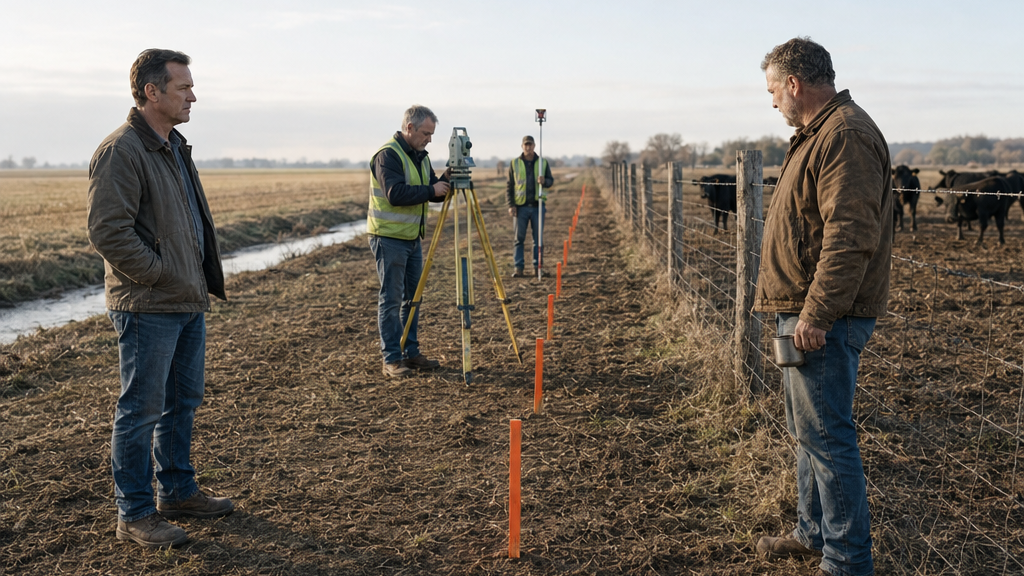
The first official survey stake landed on Richard Walker’s side of the fence.
Paul Campbell drove it into the ground with two controlled strikes, stepped back, and checked the instrument again.
Jeffrey said nothing.
Neither did Richard.
Four days had passed since the argument at the mower gate.
Jeffrey had used those days exactly as he always handled uncertainty: he gathered documents.
The county plat matched his deed. The recorded dimensions matched older tax maps. No easement appeared along the disputed edge. No boundary adjustment had been filed. No transfer had been recorded.
That still did not answer Richard’s claim about Jeffrey’s father.
So Jeffrey hired Paul.
By eight that morning, Paul and two crew members had set their tripod near the county road and begun working south.
Richard had appeared twenty minutes later carrying a steel coffee mug.
At first, he seemed entertained.
“Whole crew for four feet?” he had called across the fence.
Paul kept his eyes on the instrument.
Jeffrey answered, “Whole crew for the line.”
Richard chuckled.
“You could’ve asked anybody around here where it is.”
Jeffrey looked at the old fence.
“I did.”
Richard’s expression tightened.
Now the first bright orange stake stood nearly four feet beyond the woven wire, inside the lane Richard’s cattle had used for years.
Paul moved farther south.
One crew member carried the rod. Another marked the next point.
Jeffrey followed at a distance, hands in his jacket pockets.
He understood every step. That was part of the reason he had deliberately hired someone else.
If he marked the line himself, Richard could dismiss it as Jeffrey proving his own argument.
Paul had no reason to favor either farm.
The second stake went in.
Again, almost four feet beyond the fence.
Richard stopped drinking his coffee.
The third stake appeared near a shallow bend in the drainage edge.
Same distance.
By the fourth, the orange markers formed a straight, unmistakable line through what Richard considered his cattle lane.
The effect was stronger than any argument Jeffrey could have made.
Fence on one side.
Legal line on the other.
Four feet of worn grass between them.
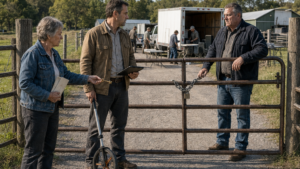
Richard came through the gate.
“You sure you’re working from the right corner?”
Paul looked up.
“Yes.”
“Old pins get moved.”
“They do.”
“So?”
“So this one hasn’t.”
Richard glanced at Jeffrey.
“You tell him what you wanted him to find?”
Paul straightened slowly.
Jeffrey spoke before Paul could.
“Don’t do that.”
Richard turned.
“Do what?”
“Make him part of our argument.”
“You brought him into it.”
“I brought him to measure.”
Richard pointed at the orange stakes.
“Looks to me like you brought him to make a point.”
Jeffrey felt the familiar temptation to explain everything he knew—how Paul had tied into recorded monuments, how closure worked, how independent verification mattered.
Instead he said, “Let him finish.”
Richard stared at him.
There it was again: the assumption that Jeffrey’s silence meant uncertainty.
Richard stepped back toward his fence.
“Your dad never needed all this.”
Jeffrey’s jaw tightened.
“That doesn’t make the measurements wrong.”
“No. It just says something.”
“About what?”
“About how people handled things.”
Paul called for the rod to move another hundred feet.
The conversation ended because the work did not need either man’s permission.
By late morning, the orange line stretched nearly the full length of the lower field.
Jeffrey’s original estimate had been right.
In places the fence was three feet ten inches over.
In others, four feet two.
The average was close enough to four feet that no one could plausibly call it a fence following uneven terrain.
It had been set parallel to the actual boundary.
That mattered.
Paul stood near one of the older cedar posts and studied the ground.
Jeffrey walked over.
“What are you looking at?”
Paul scraped dirt away with the heel of his boot.
A faint depression ran beside the existing post. Half buried beneath grass was a short rust-stained section of metal.
“Old staple?” Jeffrey asked.
“Maybe.”
Paul crouched.
He worked at it with a small hand tool until more metal appeared.
Not a staple.
A piece of old fence hardware.
Paul looked north, then south.
“Come here.”
Jeffrey stepped closer.
Paul pointed to a line in the ground Jeffrey had not noticed before. It was barely visible, a shallow change in vegetation running almost parallel to the current fence.
“Old fence line?” Jeffrey said.
“Could be.”
Richard had moved closer.
“What are you digging up?”
Paul rose.
“You know if there was another fence here before this one?”
Richard looked at the exposed rusted metal.
For the first time that day, his face revealed something Jeffrey could not immediately read.
Recognition.
Then it disappeared.
“There’ve been fences all over this place.”
Paul nodded.
“That’s normal.”
He walked twenty yards farther down, stopping at another cedar post.
Jeffrey followed.
There, partly hidden under dead grass, was another shallow depression.
Then another.
Paul took a few notes.
The evidence changed the shape of the problem.
Jeffrey had assumed Richard’s fence had simply been placed wrong.
Now it looked as though someone had moved it from an earlier line.
Deliberately.
Paul finished the main traverse after noon.
The crew ate sandwiches beside their truck while Jeffrey stood near the field entrance studying the orange stakes.
He should have felt satisfied.
The deed was right.
His measurements had been right.
The fence was over.
Instead he kept looking at the faint trace of the older line.
Richard approached without the coffee mug now.
“You done?”
“Paul’s checking closure.”
Richard nodded toward the stakes.
“You happy?”
Jeffrey turned.
“That isn’t what this is.”
Richard gave him a tired look.
“You paid a crew to put orange flags through the lane I use every day.”
“Because the fence is on my ground.”
“According to paper.”
“According to the monuments.”
“And according to your dad?”
Jeffrey said nothing.
Richard shook his head.
“That’s the part you keep skipping.”
“I’m trying to establish facts.”
“You’ve established one.”
“What’s that?”
“Where the deed line is.”
Richard pointed toward the older fence trace.
“You haven’t established why the fence moved.”
Jeffrey looked at him.
“Then tell me.”
Richard’s mouth tightened.
“Ask your family.”
Again.
Same answer.
Same confidence.
But this time it sounded less like deflection.
Paul called Jeffrey over.
He had a field tablet open and several measurements displayed.
“Everything closes.”
Jeffrey nodded.
“So we’re good?”
“On the recorded boundary, yes.”
Paul glanced toward Richard, then lowered his voice.
“But I’d be careful about treating this like a simple misplaced fence.”
“Why?”
Paul pointed toward the old depressions.
“The current fence is too consistent. Somebody offset it on purpose.”
Jeffrey looked down the orange stakes.
Four feet. Again and again.
Paul continued.
“If a farmer guesses wrong, you get crooked. If a contractor gets sloppy, you get variation. This is parallel.”
Richard stood fifty feet away, pretending not to listen.
Jeffrey felt his earlier satisfaction drain completely.
“So someone measured it.”
“Or at least knew exactly what they were doing.”
Paul closed the tablet.
“You asked me where the boundary is. I can answer that.”
He nodded toward the orange stakes.
“It’s there.”
Then he looked at the existing fence.
“But somebody meant for this fence to be here.”
Chapter 3: The Agreement Jeffrey Never Knew About
Amanda recognized the fence before Jeffrey finished describing it.
She was standing in the farmhouse office with an old photograph in her hand, squinting at the faded image.
“That’s the lower lane,” she said.
Jeffrey took the picture.
It showed their father beside an older tractor, one hand resting on the fender. Behind him, barely in focus, ran a fence line.
Not the current one.
Jeffrey moved closer to the window.
Outside, far across the field, one of Paul Campbell’s orange stakes caught the light.
He compared the photograph to what he remembered from the survey.
“The fence was closer to Richard’s side then.”
Amanda nodded.
“That picture’s old.”
“How old?”
She turned it over.
Their father’s handwriting on the back listed a date from sixteen years earlier.
Jeffrey set the photograph on the desk.
“Richard said Dad knew.”
Amanda gave him a look.
“I told you he probably did.”
“You said probably.”
“I wasn’t here measuring posts.”
“You were here more than I was.”
She sighed.
“Don’t start that.”
“I’m not starting anything.”
“You’re doing that thing where you make a sentence sound like evidence.”
Jeffrey leaned back against the filing cabinet.
That irritated him because it was accurate.
The farmhouse office had barely changed since their father’s death. Tax folders sat in one metal cabinet, seed invoices in another. A wall calendar still hung open to the month before he went into the hospital for the last time.
Jeffrey had spent three evenings sorting through papers.
Nothing mentioned giving Richard land.
Amanda placed the photograph beside him.
“I remember Dad talking about the lane.”
“When?”
“Years ago.”
“That helps.”
She ignored the tone.
“Richard had trouble moving cattle through there. Dad said he needed a safer lane.”
Jeffrey straightened.
“Those exact words?”
“Close enough.”
“What kind of trouble?”
“I don’t know.”
“You don’t remember?”
“I remember a conversation at supper, Jeffrey. I wasn’t taking minutes.”
He turned toward the window again.
The orange stake stood in rigid contrast against the field.
“If Dad agreed to move the fence, why wasn’t it recorded?”
Amanda folded her arms.
“Because Dad didn’t record every time he helped somebody.”
“This isn’t borrowing a hay wagon.”
“I know.”
“Four feet for nearly half the field is property.”
“I know.”
“You keep saying that like I’m overreacting.”
“And you keep saying ‘property’ like that settles what Dad meant.”
Jeffrey looked at her.
“What else would settle it?”
Amanda’s expression softened, which somehow made him more defensive.
“Maybe asking why.”
He pushed away from the cabinet.
“I asked Richard.”
“And?”
“He told me to ask you.”
That made her pause.
“What exactly did he say?”
“That Dad knew the fence was there.”
Amanda looked back at the photograph.
“I think he did.”
The answer sat between them.
Jeffrey had spent four days proving Richard wrong about the recorded boundary.
Now he was beginning to suspect Richard had never been arguing about the recorded boundary at all.
Later that morning, Jeffrey drove to the county records office.
The clerk pulled every recorded instrument associated with the two adjoining parcels.
Deeds.
Plats.
Old mortgage releases.
Utility easements.
A drainage notation near the road.
Nothing granting Richard permanent access.
Nothing transferring four feet.
Nothing describing a boundary adjustment.
Jeffrey checked twice.
“You sure there isn’t an agricultural access easement?” he asked.
The clerk turned the monitor slightly.
“If it was recorded under either parcel number, it would show here.”
“So nothing.”
“Nothing recorded.”
That word followed him back to the farm.
Recorded.
It was comforting because it was clean.
A recorded thing existed in a form Jeffrey understood.
A handshake between two farmers did not.
He spent the afternoon in the equipment shed, pulling open drawers of an old wooden desk his father had used before moving most paperwork into the house.
Receipts came first.
Hydraulic hoses.
Veterinary bills.
A replacement PTO shaft.
Then notebooks.
His father had kept small farm ledgers, one per year, full of short entries written in blunt pencil.
Jeffrey began scanning dates around the year shown on Amanda’s photograph.
Fuel.
Hay.
Calf weights.
Fence wire.
One entry made him stop.
“Walker—posts/labor lower lane.”
No amount.
No explanation.
He turned the page.
Two weeks later:
“Moved south section after washout.”
Jeffrey read it again.
Moved south section.
His father had not merely known.
He had participated.
Jeffrey sat heavily in the old desk chair.
For several minutes, he felt something dangerously close to embarrassment.
He thought about Richard standing beside the survey crew while orange stakes appeared through the lane. Thought about the feed-store version of the story already forming somewhere beyond the farm: son comes back from town, hires surveyors, tells old neighbor how land works.
Jeffrey hated that version.
Mostly because there was enough truth in it to sting.
The shed door slid open.
Amanda stepped inside carrying two paper cups of coffee.
“Find anything?”
Jeffrey turned the ledger toward her.
She read the entries.
“Okay.”
“That’s all you’ve got?”
“What do you want me to say?”
“That Dad moved the fence.”
“Yes.”
“With Richard.”
“Looks like it.”
Jeffrey rubbed his forehead.
“So Richard was right.”
Amanda handed him a coffee.
“About Dad knowing? Yes.”
Jeffrey looked at the ledger.
“Maybe about more than that.”
She sat on the edge of a workbench.
“You don’t know that yet.”
“If Dad moved the fence himself—”
“That doesn’t mean he gave him the ground.”
Jeffrey looked up.
“You just spent two days telling me to stop acting like paper is everything.”
“And now you’re doing the opposite.”
He frowned.
Amanda pointed at the ledger.
“One line doesn’t tell you what they agreed to.”
Jeffrey turned another page.
Nothing.
Then another.
Near the bottom, beside notes about cattle mineral and culvert work, he saw a phrase written smaller than the entries around it.
He leaned closer.
“Temporary cattle clearance.”
Amanda moved beside him.
“That’s Dad’s handwriting.”
“I know.”
The date matched the same season as the fence work.
Jeffrey traced the words with one finger without touching the paper.
Temporary.
Not transferred.
Not sold.
Not permanent.
But the word after it mattered just as much.
Cattle clearance.
He looked toward the open shed door and the low pasture beyond.
The drainage strip ran dark along the field edge, still holding spring moisture.
“What happened down there?” he asked.
Amanda shook her head slowly.
“I don’t know.”
Jeffrey closed the ledger.
For the first time since seeing the four-foot discrepancy, he no longer wanted another document.
He wanted Richard Walker to tell him why two men had deliberately moved a fence fifteen years earlier—and why a temporary cattle lane had somehow become permanent ground.
Chapter 4: What Happened Beside the Drainage Ditch
Richard Walker was waiting beside the drainage strip when Jeffrey arrived.
He had one boot planted on the bank and was pointing at something half buried in the mud.
“There,” he said.
Jeffrey stepped off the pasture track and followed the direction of Richard’s hand.
At first he saw only dead grass and dark soil. Then the shape resolved: a rusted hinge pin, thick as his thumb, leaning at an angle where an old post had once stood.
“That was the gate,” Richard said.
Jeffrey crouched.
The metal was nearly swallowed by the bank. Fifteen years of runoff had softened the ground around it, but the hinge still marked a position several feet closer to Richard’s side than the present fence.
Jeffrey looked toward the orange survey stakes farther uphill.
“So the original fence followed this line.”
“More or less.”
“And then Dad helped move it.”
Richard nodded once.
Neither man said anything about the four feet yet.
The drainage strip below them was shallow now, only a thread of water moving beneath flattened grass. But the banks were steep enough in places to hide a hole from a running animal.
Richard nudged the hinge with his boot.
“It wasn’t this tame back then.”
“What happened?”
Richard looked toward his barn instead of answering.
“Come on.”
Inside the barn, the air smelled of hay, dust, and old leather. Richard stopped beside a gate panel hanging from two hooks on the wall.
One corner was bent inward.
Jeffrey ran his eyes over it.
“That from the same place?”
“Same morning.”
Richard took a worn chain from a peg and held it loosely in one hand.
Jeffrey recognized it from the current cattle gate. The links had been polished smooth in places by years of use.
“We were moving yearlings down to the south pasture,” Richard said. “Ground had been wet three days. Your dad told me that ditch was carrying more water than usual.”
“You moved them anyway.”
Richard glanced at him.
“Yes.”
There was no defense in the answer.
Just fact.
“One steer balked at the gate. Another pushed from behind. First one turned sideways, hit the post, and the whole bunch compressed.”
Richard demonstrated with two hands, one pressing into the other.
“The bank gave under the outside post.”
Jeffrey looked again at the bent panel.
“It fell?”
“Part of it. Steer went through. Another tried to follow.”
Richard set the chain down.
“I grabbed the gate because I thought I could swing it back and stop them.”
“You got caught.”
“Almost.”
The word came quietly.
Richard rubbed his left knee through his jeans.
“Post went down, gate came across. If your dad hadn’t been there with the tractor…”
He stopped.
Jeffrey waited.
Richard did not finish the sentence.
He did not need to.
“What happened to the cattle?”
“One broke a leg bad enough we had to put it down. Another tore itself up in the wire.”
Jeffrey looked toward the barn opening.
He had expected an explanation.
He had not expected one that made the old arrangement immediately understandable.
Richard continued.
“Your dad said the lane was too tight against that drainage edge. Said there was no sense pretending a property line was worth another animal getting hurt.”
“That sounds like him.”
Richard gave a small nod.
“He brought over posts. We moved the fence.”
“How far?”
“Two feet.”
Jeffrey turned back.
“Two.”
“That’s what we agreed.”
The word agreed sharpened the air between them.
Jeffrey thought of Paul’s measurements.
“Current fence is about four.”
“I know.”
Jeffrey stared at him.
For the first time since the survey began, Richard did not look away from the number.
“You know?”
Richard picked up the gate chain again, turning one worn link between his fingers.
“The first move gave us enough room for cattle single file.”
“And the other two feet?”
Richard’s jaw shifted.
“That came later.”
“When?”
“Over time.”
Jeffrey gave a short, humorless breath.
“Fences don’t move over time by themselves.”
“No.”
“Then when?”
Richard stepped outside.
Jeffrey followed him back toward the lane.
They stopped where the orange stakes and existing fence ran parallel, two different versions of the same boundary.
Richard pointed down the strip.
“After your dad stopped running cattle on this side, I widened the lane. First at the gate. Then farther south when I replaced posts.”
“You asked him?”
Richard was silent.
“That’s a no.”
“He knew I was using it.”
“That isn’t what I asked.”
Richard’s face hardened.
“I didn’t hide it.”
“You didn’t ask.”
“No.”
The admission landed differently from the earlier explanations.
Jeffrey had spent days worried that he had misjudged Richard entirely.
Now the shape of the truth was becoming clearer.
The original move had been a favor.
The later expansion had been a choice.
“Why?” Jeffrey asked.
Richard looked at the cattle lane.
“Because it worked.”
“That’s not enough.”
“It was enough then.”
“For you.”
Richard turned sharply.
“You think I didn’t help your dad?”
Jeffrey said nothing.
“I pulled his baler out of mud twice. Fixed fence when he was in the hospital the first time. Checked his calves when you were three states away.”
There it was.
Not a legal argument.
A ledger of another kind.
Jeffrey felt the accusation because part of it was deserved.
But he kept his voice level.
“You helping him doesn’t make this yours.”
“I didn’t say it did.”
“You acted like it did.”
Richard rubbed a hand over his mouth.
“That’s fair.”
The answer stopped Jeffrey.
Richard looked tired now rather than defiant.
“I got used to it,” he said. “That’s the truth.”
Jeffrey glanced at the orange stakes.
“You got used to four feet of my ground.”
“I got used to the lane.”
“That distinction matters more to you than it does to the deed.”
Richard gave him a dry look.
“There you are.”
“What?”
“Back to the deed.”
Jeffrey nearly answered, then stopped himself.
That was his habit: retreat to something measurable whenever the conversation became uncomfortable.
He looked down at the drainage edge.
“Dad wrote ‘temporary cattle clearance.’”
Richard’s expression changed.
“He wrote that?”
“In a ledger.”
Richard stared across the field.
“Sounds like him.”
“Did he ever tell you it was temporary?”
“He didn’t have to. The first move was.”
“The first two feet.”
Richard nodded.
“And the last two?”
A long silence followed.
Wind pressed the dead grass flat along the ditch.
Finally Richard said, “Your dad had quit using this side by then. You weren’t farming here. Amanda wasn’t. I figured…”
He stopped.
Jeffrey waited.
Richard looked directly at him.
“I figured nobody was coming back to need it.”
That answer hurt more than an argument would have.
Not because it was cruel.
Because it was believable.
Richard had not stolen the strip in one dramatic act. He had absorbed it by assumption, a post here, another there, until habit looked like ownership.
Jeffrey glanced at the old hinge.
“So you knew.”
Richard nodded once.
“How much?”
Richard looked down the lane, then at the orange stakes.
“The first two feet were your dad’s favor.”
He rested one hand on the worn chain.
“The last two feet were mine.”
Chapter 5: The Favor That Became an Entitlement
Jeffrey heard his own name before he opened the feed-store door.
“—comes back after all these years and starts planting orange flags like a county road crew.”
A second voice answered.
“Walker says Jeffrey’s trying to undo an agreement their dads had.”
Jeffrey stopped with his hand on the metal handle.
Through the glass he could see two neighboring farmers beside a stack of mineral tubs. Neither had noticed him.
He considered walking away.
Instead he opened the door.
The bell above it rang.
Both men looked over.
The conversation ended so cleanly it might have been cut with wire cutters.
Jeffrey nodded.
“Morning.”
One man suddenly became interested in a feed label.
The other said, “Morning, Jeffrey.”
Jeffrey picked up the fencing staples he had come for, paid at the counter, and left without explaining anything.
By the time he reached his truck, irritation had settled behind his ribs.
It would have been easy to go back inside.
He could explain the survey. The deed. The two-foot original accommodation. Richard’s later expansion.
He could win the argument in three minutes.
He knew that because he had spent most of his adult life explaining plans to people who did not want to read them.
Instead he put the staples behind the seat.
His father had never liked public disputes.
Jeffrey used to mistake that for avoidance.
Now he wondered if there was a difference between refusing spectacle and refusing conversation altogether.
He drove home.
The orange stakes were visible before the farmhouse came into view.
Someone had tied a strip of faded survey ribbon to one of them, probably as a joke. It fluttered over the cattle lane like a tiny warning flag.
Amanda was waiting in the office with the old ledger open.
“You heard?” she asked.
“Feed store?”
She nodded.
“Richard didn’t start all of it.”
“Doesn’t matter who started it.”
“It matters if you’re planning to be mad at him for every sentence anybody says.”
Jeffrey dropped the bag of staples on the desk.
“I’m not.”
Amanda raised an eyebrow.
He looked away.
On the table lay copies of Paul’s survey and the old farm notes.
Four feet on one sheet.
Temporary cattle clearance on another.
Neither document told him what to do next.
“What do you want?” Amanda asked.
“My ground.”
“That’s the easy answer.”
“It’s also the accurate one.”
“There you go again.”
Jeffrey looked at her.
She tapped the ledger.
“Dad let Richard use part of that strip because there was a reason.”
“And Richard took more.”
“Yes.”
“So?”
“So maybe decide which problem you’re solving.”
Jeffrey stared at the survey.
That afternoon he walked the disputed line alone.
The strip widened near the lower gate and narrowed slightly where the drainage edge curved. He imagined the fence returned exactly to the deed line.
His mower would fit.
The hayfield would recover its full width.
Richard’s cattle lane, however, would become tight again near the ditch.
Not as dangerous as fifteen years earlier, perhaps.
But not generous.
Jeffrey disliked the word generous the moment it entered his mind.
Property did not become less yours because another person found it useful.
Still, usefulness was why the problem had begun.
Near the southern end, Richard approached from his pasture.
Neither man greeted the other.
Richard stopped at the fence.
“Heard you were at the feed store.”
Jeffrey almost laughed.
“News travels.”
“Always has.”
“I didn’t say anything.”
“I know.”
That surprised him.
Richard hooked both hands over the top wire.
“I didn’t tell them you were wrong on the survey.”
“What did you tell them?”
“That your dad and I had an agreement.”
Jeffrey’s jaw tightened.
“You left out the part where the agreement was two feet.”
Richard looked away.
“Yes.”
“And the part where you widened it yourself.”
“Yes.”
“Convenient.”
Richard’s hands tightened around the wire.
“What do you want me to do, Jeffrey? Walk around town confessing I moved fence posts twenty years ago?”
“Fifteen.”
Richard gave him a tired stare.
“See, that right there.”
“What?”
“You always need the exact number.”
“Because the exact number is why we’re standing here.”
“No. We’re standing here because you came home needing the exact number to settle something that was messy before you arrived.”
Jeffrey felt his temper rise.
“And you’re standing there because you decided messy meant yours.”
Richard went still.
That landed.
For a moment neither man moved.
Then Richard looked down the lane.
“I knew the extra widening was more than your dad agreed to.”
Jeffrey waited.
“I knew it when I did it.”
There was no excuse in Richard’s voice this time.
“Why didn’t you ask?”
Richard rubbed his thumb over the fence wire.
“Because I thought he’d say no.”
The bluntness surprised Jeffrey.
“And after he died?”
“I thought nobody would care.”
“You mean nobody would notice.”
Richard did not correct him.
That was the moment the dispute finally stopped being confusing.
Richard’s original reason was understandable.
His later choice was not.
The favor had not become ownership through law or agreement.
It had become ownership inside Richard’s head because no one challenged it.
Jeffrey breathed out slowly.
“I’ll give you temporary gate access while this gets corrected.”
Richard frowned.
“What does that mean?”
“It means your cattle can still move through the opening while the fence is being reset.”
“Reset where?”
“On the deed line.”
Richard shook his head immediately.
“No.”
Jeffrey looked at him.
“No?”
“You put that fence on those orange stakes and you choke the lane.”
“I said temporary access.”
“I’m not signing up to ask permission every time I move cattle through ground I’ve used fifteen years.”
“There it is.”
Richard’s face hardened.
“What?”
“You don’t want access.”
Jeffrey stepped closer to the fence.
“You want ownership without saying ownership.”
Richard pushed away from the wire.
“I want the lane left alone.”
“That’s not happening.”
“Then don’t pretend your temporary offer fixes anything.”
Jeffrey watched him walk back toward his pasture.
For weeks Jeffrey had wanted Richard to acknowledge the four feet.
Now he had.
It changed less than Jeffrey expected.
That evening Jeffrey sat at the farmhouse desk with Paul’s survey open and the contractor’s number on his phone.
He stared through the window at the orange stakes.
Amanda stood in the doorway.
“You sure?”
“No.”
She waited.
Jeffrey looked at the old ledger, then at the survey.
“Dad gave him two feet for cattle clearance. Richard took another two because he thought nobody would come back.”
Amanda said nothing.
“I can respect the first without surrendering the second.”
He called the fencing contractor.
When the man answered, Jeffrey gave him the location and described the work.
“Full line?” the contractor asked.
Jeffrey looked toward the drainage strip.
“No.”
He paused.
“Start with the unauthorized section. I want the fence taken back to the recorded boundary.”
After he ended the call, the decision did not feel like victory.
It felt like opening a gate without knowing what would come through it.
Chapter 6: Moving the Fence Without Repeating the Past
The fencing contractor stood between two orange stakes and looked at Jeffrey as if he had asked him to build a gate across a creek.
“You sure you want it right here?”
Jeffrey looked at the marked deed line.
“Yes.”
The contractor pointed toward the drainage strip.
“Then you’re going to put cattle through that pinch point again.”
Two crew members had already removed the first section of Richard’s widened fence. Cedar posts lay on the grass. Rolled wire rested beside the equipment trailer.
For the first time in fifteen years, the disputed strip was open.
Jeffrey should have felt relief.
Instead he saw the lane the way his father must have seen it after Richard’s accident: cattle funneling between fence and wet ground, one frightened animal turning sideways, every animal behind it pushing forward.
He walked the proposed line.
Near the gate, the width narrowed sharply.
“Give me the tape,” he said.
The contractor handed it over.
Jeffrey measured from stake to drainage bank.
Then again at the next point.
The numbers were legally clean and practically ugly.
“Can you set the corner back?” the contractor asked.
“Not without moving off the boundary.”
“So no.”
Jeffrey stared at the ditch.
An excavator would solve part of the drainage issue, but that was unnecessary and expensive. A barrier along the drop could keep cattle from stepping into the bank. A gate set at an angle could preserve the full deeded line while giving animals a wider turning radius during controlled moves.
The solution appeared almost automatically.
That was the part Jeffrey trusted most about himself.
Geometry did not care who was offended.
But something stopped him.
He looked at the crew.
“Hold up.”
The contractor frowned.
“You changing the line?”
“No.”
“What then?”
Jeffrey pointed along the lower section.
“Don’t pull the rest yet.”
One worker set down his post puller.
The contractor studied him.
“You’ve got me and two men here.”
“I’ll pay the time.”
“That’s not what I’m asking.”
Jeffrey looked again at the narrow passage.
“I need to change the design.”
A pickup door slammed behind them.
Richard crossed the pasture with fast, deliberate steps.
Jeffrey knew immediately how the scene looked.
Fence half removed.
Crew stopped.
Orange stakes still standing.
Richard reached the opening.
“Finally see the problem?”
Jeffrey turned.
“I see one.”
Richard glanced at the idle crew.
“Knew you would.”
There was enough satisfaction in his voice to restore Jeffrey’s irritation.
“This isn’t me agreeing the fence stays.”
Richard’s expression cooled.
“Then what are you doing?”
“Making sure I don’t rebuild the same hazard Dad moved it to avoid.”
Richard looked toward the ditch.
For a second, his face changed.
Then suspicion returned.
“So now you believe me.”
“I believed you when you showed me the hinge.”
“That survey made you forget common sense for a while.”
Jeffrey felt the old instinct—to correct, defend, list facts.
He resisted it.
“No,” he said. “It made me prove where my land is.”
Richard folded his arms.
“And now?”
“Now I decide what happens on it.”
The distinction hung between them.
Jeffrey called the contractor over and crouched near the planned gate location.
He drew in the dirt with the end of the tape.
“Fence stays on the survey line.”
The contractor nodded.
“Here, instead of running the gate square, we angle the opening back toward Richard’s pasture.”
Richard stepped closer despite himself.
Jeffrey continued.
“Barrier rail along the ditch. Not wire. Something visible enough cattle won’t crowd through it.”
The contractor studied the sketch in the dirt.
“You’d gain turning room without moving the fence.”
“That’s the point.”
“And this opening?”
“Controlled gate.”
Richard looked at him.
“For who?”
“You.”
Richard’s expression closed immediately.
“I don’t need a permission gate.”
Jeffrey stood.
“Then you don’t need the lane.”
The contractor looked between them and quietly moved away.
Richard lowered his voice.
“My cattle have used this route fifteen years.”
“And they can keep using it.”
“On your terms.”
“On my property.”
Richard shook his head.
“There’s always a hook with you.”
Jeffrey almost answered sharply.
Then he saw the worn gate chain hanging from Richard’s hand.
Richard had brought it with him from the old gate.
For fifteen years he had unhooked that chain whenever he needed the lane. No phone call. No permission. No paperwork.
Habit had become something deeper than convenience.
Jeffrey understood why Richard hated the new arrangement.
He also understood why that could not decide it.
“I’m not charging you,” Jeffrey said.
Richard stared at him.
“I’m not limiting cattle numbers. I’m not making you call me every time.”
“What are you doing?”
“Putting the boundary back.”
Jeffrey pointed to the orange stakes.
“And giving you written access through the gate for livestock movement.”
Richard’s mouth tightened.
“Written.”
“Yes.”
“So ten years from now somebody can wave a piece of paper at me.”
“So ten years from now nobody has to guess what we meant.”
That silenced him.
Jeffrey realized he was speaking as much about his father as about Richard.
His father had solved a real problem with a handshake.
The handshake had worked until memory became interpretation and interpretation became entitlement.
Jeffrey did not want to erase what his father had done.
He wanted to prevent the next version of this argument.
The contractor returned.
“If that’s the design, I can set the line today and come back for the barrier.”
Jeffrey nodded.
“Do it.”
Richard stepped toward the open lane.
“What happens to the old posts?”
“They come out.”
“All of them?”
“All the ones past the deed line.”
Richard looked down the line of orange stakes.
The crew resumed work.
A cedar post that had stood on Jeffrey’s ground for years lifted slowly from the soil. Its buried end emerged dark and wet.
Richard watched without speaking.
By midday, the visual balance of the place had changed.
New posts stood along the orange survey line.
Behind them, the widened gate opening angled toward Richard’s pasture rather than straight into the narrow drainage edge.
No one had surrendered land.
No one had recreated the old trap.
Jeffrey held the written access agreement in a plain folder.
Richard noticed it.
“You already had that made?”
“I drafted it last night.”
“Before you knew you were changing the gate?”
“The access stays the same.”
Richard gave a dry laugh.
“You really can’t help yourself.”
“Probably not.”
Jeffrey held the folder out.
Richard did not take it.
“What does it say?”
“That the boundary remains the recorded line. You get livestock access through this gate. No fence relocation, no storage, no expansion without written agreement.”
“And if you sell?”
“The access terms stay documented.”
Richard looked at the paper as though it weighed more than the fence posts.
“You could just leave things how they were.”
Jeffrey glanced at the crew setting a post exactly beside an orange stake.
“No.”
Richard’s jaw hardened.
For a moment Jeffrey thought he would walk away again.
Instead Richard looked toward the safer angled gate.
“You did that because of the accident?”
“Yes.”
“You didn’t have to.”
“No.”
That answer changed something.
Not enough to make Richard grateful.
Not enough to erase resentment.
But his shoulders lowered slightly.
Jeffrey offered the folder again.
“One condition.”
Richard looked at him.
“The fence returns to the deed line.”
Richard stared at the new posts, then at the old gate chain in his hand.
Jeffrey left the agreement extended between them.
For the first time, the question was no longer where the boundary belonged.
It was whether Richard could accept access to ground he had spent years treating as his own.
Chapter 7: Four Feet Returned, One Gate Left Open
Richard arrived before the new gate was hung.
Jeffrey saw his pickup roll down the pasture track while the fencing contractor was still leveling the final hinge post. The temporary opening stood wide between the two farms, its edges marked by fresh wood and two remaining orange survey stakes.
Richard parked fifty yards away.
He got out carrying Jeffrey’s folder.
For three days, Jeffrey had heard nothing.
No phone call.
No signed agreement.
No message through Amanda or anybody else.
He had gone ahead with the corrected fence because that decision was no longer negotiable. Paul had returned that morning to verify the new post line before the crew stretched wire. Every permanent post now stood where the recorded boundary said it belonged.
The only unfinished question was the gate.
Richard walked toward it slowly.
The contractor looked at Jeffrey.
“You want us to keep working?”
“Yes.”
Richard heard him.
“That depends.”
Jeffrey turned.
“No. It doesn’t.”
Richard stopped beside the first orange stake.
Jeffrey could see that the folder had been opened and closed enough times to soften one corner.
“The fence stays where it is,” Jeffrey said. “Whether you sign the access agreement or not.”
Richard looked along the new line.
For years, the old fence had pushed into Jeffrey’s field so gradually that the stolen width was difficult to see. Now the corrected posts made the difference obvious. The hayfield gained a clean strip of ground from the road to the lower pasture.
Four feet.
It did not look like much.
It looked like everything.
Richard tapped the folder against his leg.
“I read it.”
Jeffrey waited.
“Twice.”
“That was ambitious.”
Richard almost smiled.
Almost.
Then he looked at the angled gate opening.
“You really put the barrier in?”
Jeffrey pointed down toward the drainage edge.
A stout rail now followed the dangerous section of bank. It was set far enough back to keep cattle from stepping into the soft shoulder without moving Jeffrey’s legal boundary.
“The contractor finished it yesterday.”
Richard walked over and tested the top rail with one hand.
“That’ll hold?”
“It’s built for livestock pressure.”
“You design it?”
“With him.”
Richard looked back.
There was no mockery in the question this time.
The contractor drove another hinge bolt and deliberately kept his attention on the gate.
Richard returned to Jeffrey.
“You could’ve just closed it.”
“Yes.”
“Would’ve been easier.”
“For me.”
Richard glanced toward his pasture.
A group of cattle had gathered near the lane, not because they needed to move but because animals noticed every disruption in a routine.
“For your dad too,” Richard said.
Jeffrey did not answer.
Richard opened the folder.
“I kept thinking about that.”
“What?”
“Your dad could’ve told me no fifteen years ago.”
Jeffrey looked toward the drainage ditch.
“He probably should’ve written more down.”
Richard gave a quiet laugh.
“He’d have hated hearing you say that.”
“He hated hearing me say most things about paperwork.”
“That sounds more like him.”
For a moment, it was the closest they had come to speaking as two men who remembered the same person instead of two owners disputing a line.
Richard pulled out the agreement.
His signature was at the bottom.
Jeffrey stared at it.
“You signed.”
“I can still read.”
“I wasn’t sure you would.”
“I wasn’t sure either.”
Richard handed him the pages.
Jeffrey looked over the signature, then the terms.
Nothing had been altered.
The boundary remained Jeffrey’s recorded line.
Richard retained livestock access through the designated gate.
No storage.
No fence relocation.
No widening.
Any future changes required written agreement.
Jeffrey closed the folder.
Richard said, “I don’t like the part about permission.”
“You don’t have to call me every time.”
“I know what it says.”
“Then what part?”
Richard looked at the new fence.
“The part where it says out loud that the lane isn’t mine.”
Jeffrey waited.
Richard rubbed the heel of his hand across his jaw.
“I got used to thinking it was.”
“That’s what happened.”
“I know.”
There was no argument left in the words.
That did not make them an apology.
Jeffrey realized he did not need one.
The contractor called from the post.
“Ready for the gate.”
Jeffrey nodded.
Two workers lifted the metal gate and carried it into position.
Richard stepped aside.
As they raised it onto the hinges, Jeffrey noticed something in Richard’s hand.
The old chain.
The same worn chain from the previous gate.
“You keeping that?” Jeffrey asked.
Richard looked down at it.
“Had it a long time.”
Jeffrey nodded toward the new gate.
“It’ll still fit.”
Richard studied him.
“You want it on there?”
“If you do.”
Richard walked over after the crew finished hanging the gate.
He looped the old chain through the new latch post.
The metal looked out of place against fresh galvanized hardware, but the worn links settled naturally against the wood.
Richard pulled the gate once to test it.
It swung freely.
“Better turn than before,” he said.
“That was the idea.”
Richard closed it again.
Jeffrey thought that would be the end of the conversation.
Then Amanda’s pickup came down the farm lane.
She parked near the equipment shed and approached carrying the old ledger.
Jeffrey frowned.
“What’s that doing out here?”
“I found something.”
Richard stiffened slightly.
Amanda handed the book to Jeffrey.
“I was putting the loose pages back.”
She pointed near the bottom of a page Jeffrey had already read.
Below the entry about temporary cattle clearance, separated by several weeks of farm expenses, was another line in their father’s tight handwriting.
Jeffrey had overlooked it because the pencil had faded near the page crease.
He held the ledger toward the light.
The notation was short.
Help neighbors when it makes sense. Don’t lose the line.
Jeffrey read it twice.
Richard looked away before Jeffrey did.
Amanda said, “Sounds like Dad.”
Richard nodded.
“Yeah.”
The sentence did not settle the property question. Paul’s survey had done that.
It settled something harder.
Their father had understood the distinction all along.
Helping Richard had never meant giving up ownership.
Maintaining the boundary had never meant refusing help.
Somewhere between those two ideas, the men who came after him had each chosen only the half that suited them.
Richard had remembered the favor.
Jeffrey had remembered the line.
Neither had understood the whole thing until the fence was nearly gone.
Jeffrey closed the ledger.
“I should’ve talked to you before I brought Paul out.”
Richard looked at him.
Jeffrey continued before he could retreat into silence.
“I knew I was probably right about the measurements. I acted like that meant I knew why the fence was there.”
Richard rested his hand on the gate chain.
“You weren’t wrong to survey it.”
“That isn’t what I said.”
“No.”
Richard looked toward the new posts.
“I should’ve asked before I widened it.”
Jeffrey waited.
“I knew that then too,” Richard added.
That was as close to an apology as either man was likely to manage.
It was enough.
The fencing contractor packed his tools that afternoon. Paul’s permanent monuments remained at the required points, but the temporary orange stakes were no longer needed.
Jeffrey began pulling them one by one.
The first came easily.
The second resisted in the dry ground.
By the time he reached the lower gate, only one remained.
Richard had gone back to his pasture.
Amanda had driven home.
The lane was quiet except for the occasional metallic tap from the contractor securing equipment to his trailer.
Jeffrey wrapped his fingers around the final orange stake.
Weeks earlier, those bright markers had felt like proof.
Then accusation.
Then a public declaration that one man was right and another was wrong.
Now the corrected fence stood behind it, exact but not hostile.
Jeffrey pulled.
The stake came free with a small clump of dirt around its steel point.
He tossed it into the bed of his pickup.
The next morning, Richard was scheduled to move cattle through the lower pasture.
Jeffrey walked to the new gate.
The old chain hung through the latch.
For a second, he considered fastening it the way Richard always had.
Instead he looped it loosely over the post, leaving the gate unlocked.
The property line had not moved.
The four feet were back where they belonged.
But the way through remained.
The story has ended.