They Tore Down His Grandfather’s Farm Fence, Then Charged Him for Clearing Their Own Road
Chapter 1: The Fence Was Gone When Ronald Came Home
Ronald Carter hit the brakes so hard that the steel thermos on the passenger seat rolled into the footwell.
For three seconds he sat behind the wheel of his pickup, staring through the windshield at a piece of his farm that no longer looked like his farm.
The southern fence was gone.
Not leaning. Not damaged by a fallen tree. Not cut in one place to let equipment through.
Gone.
From the hayfield entrance all the way toward the low pasture, the line his grandfather had built decades earlier had been reduced to a row of dark holes punched through the damp earth. Roughly a hundred and eighty feet of weathered posts, woven wire, and cedar rails had vanished while Ronald was away.
He shut off the truck.
Four days earlier he had left before sunrise to work with a survey crew two counties over. Margaret had stayed at the house, but she no longer walked the lower fields alone. Her knees made the slope difficult, and from the kitchen windows the southern boundary disappeared behind the machine shed.
Ronald stepped onto the gravel.
The quiet bothered him first.
Cattle stood beyond the inner lot fence, watching him. The old boundary had always made a faint visual wall along the field. Without it, George Wilson’s land seemed to pour straight into his.
Ronald walked toward the first empty post hole.
The dirt around it was fresh.
He crouched and pushed two fingers into the loose soil. Still damp underneath.
Someone had not simply pulled loose boards. Equipment had removed the posts.
His jaw tightened.
He took out his phone.
One photograph of the first hole.
Then another showing the line.
Then a wide shot from the hay entrance.
His first instinct was to call George.
His second was stronger.
Document it first.
That habit came from survey work. Once machines moved soil, memory became an argument. Photographs did not stop arguments, but they gave them edges.
Ronald followed the missing fence south.
Near the end of the line, he saw the tire marks.
A heavy tread had come across the grass from the shared farm lane, angled toward the old fence, then curved back toward George’s side. One rut had crossed the narrow strip beside Margaret’s rose bed.
Ronald stopped.
Three bushes had been flattened.
His mother had planted them after his father died, because she said she needed something along that side of the house that came back every year whether she felt like tending it or not.
One branch lay snapped across the mud.
Ronald photographed that too.
Behind him, the screen door banged.
Margaret came across the yard in a cardigan pulled over her work shirt.
“You saw it.”
Ronald did not turn immediately.
“When?”
“I don’t know.” Her voice was careful. “Yesterday afternoon I noticed the opening. I thought you had arranged something.”
“You thought I arranged for somebody to pull the whole fence?”
“I thought maybe with George.”
Ronald looked at her then.
“Why would I arrange anything with George?”
Margaret gave him the sort of look that usually meant she had decided not to argue before breakfast.
“I said I didn’t know.”
He looked toward the neighboring fields. George’s equipment shed stood beyond a shallow rise, its roof visible over the pasture.
“Did you hear machinery?”
“Thursday morning, maybe. I heard something. I didn’t go down.”
Ronald nodded.
He kept walking.
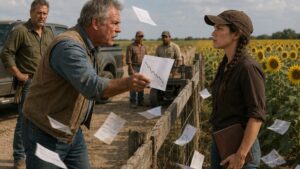
At the front entrance, a white sheet of paper had been folded inside a clear weather sleeve and stapled to the post beside the cattle gate.
He pulled it free.
At the top was the name of the agricultural access association that maintained the shared gravel lane used by five farms along the county road.
Ronald read the page once.
Then again.
Margaret came up beside him.
“What?”
He handed it to her.
The notice said the southern fence had been removed by an approved contractor because it obstructed a recognized agricultural access corridor and interfered with necessary improvements for oversized equipment.
Ronald took the page back.
“Recognized by who?”
Margaret said nothing.
Near the bottom, the notice referred to a scheduled association review and stated that costs associated with clearing the obstruction would be assessed to the responsible parcel owner.
Ronald looked at the empty post holes stretching across the field.
“They tore down my fence,” he said quietly, “and they’re charging me for it.”
Margaret folded her arms.
“Call Kathleen before you call George.”
Ronald glanced at her.
Kathleen Adams kept minutes for the association and owned the hay operation north of George.
“Why?”
“Because Kathleen will tell you what was voted on. George will tell you what George thinks was voted on.”
It was the kind of distinction Ronald normally appreciated.
Today it irritated him.
He called anyway.
Kathleen answered on the fourth ring.
“Ronald.”
“You know why I’m calling?”
A pause.
“I assume you’re back.”
“Was there a vote to remove my fence?”
Another pause, longer this time.
“There was a vote about clearing the access strip.”
“That isn’t what I asked.”
“I know.”
Ronald looked across the missing line.
“Did you vote to tear down my fence?”
“The motion authorized obstruction removal connected to the lane improvement.”
“So yes.”
“Ronald, you need to come to the review before you decide what happened.”
“I’m standing in one hundred and eighty feet of what happened.”
Kathleen exhaled.
“There are maps involved.”
“There’s a fence involved.”
“And there’s been an access problem for years.”
Ronald almost answered, but Margaret was watching him.
He stopped himself.
“When is the review?”
“Wednesday evening. Equipment barn. Seven.”
“I’ll be there.”
He ended the call.
For the next hour he measured the disturbed line, photographed every post hole, and marked the widest tire rut with two temporary flags from his survey bag. By the time he returned to the house, the anger had cooled into something more useful.
Numbers.
Dates.
Distances.
At his desk, he opened the association email account he rarely checked.
There were three new messages.
The first announced Wednesday’s review.
The second attached the contractor’s work summary.
The third contained an invoice.
Ronald opened it.
Removal equipment.
Labor.
Hauling.
Disposal.
Administrative assessment.
At the bottom, the total was just over eight thousand dollars.
He stared at it long enough for Margaret to come into the office.
“How bad?”
Ronald turned the screen toward her.
She read the number.
Her face changed.
Not dramatically. Margaret had spent fifty years around livestock, debt, weather, hospitals, funerals, and machinery repairs. She did not startle easily.
But she pulled out the chair and sat.
“They expect you to pay that?”
“Apparently.”
“For taking down your own fence?”
Ronald leaned back.
On the wall above his desk hung an old aerial photograph of the farm. Even from that height, the southern boundary was visible as a thin straight line.
His grandfather’s line.
Ronald looked from the photograph to the invoice.
Until that moment he had believed somebody had made a stupid decision.
Now he wondered whether the decision had been stupid at all.
Chapter 2: The Old Survey Did Not Settle Everything
Ronald found the survey before he finished his first cup of coffee.
It was exactly where his father had always kept important papers: in the second drawer of the green metal filing cabinet, behind machinery titles and ahead of tax records.
The folder smelled faintly of dust and old cardboard.
Inside were plats, handwritten measurements, receipts for fence posts, and a stamped survey showing the southern property line with enough precision to make Ronald’s pulse slow for the first time since he had returned home.
He carried it to the kitchen.
Margaret was slicing an apple.
“Found it?”
He spread the survey across the table.
“There.”
He placed one finger on the boundary.
“The fence is inside our parcel. Not on the lane. Not on association ground.”
Margaret leaned closer.
“You sound happy.”
“I’m not happy.”
“You sound like you won something.”
Ronald ignored that.
The survey dated back decades. An attached notation showed improvements along the same line before the agricultural association had adopted its current maintenance rules.
“The fence predates everything they’re citing,” Ronald said.
Margaret wiped the knife on a towel.
“That doesn’t answer why they think they can drive there.”
“No recorded easement crosses this section.”
“That isn’t what I said.”
He looked at her.
She returned to the apple.
By ten, Ronald was at the county records office.
The clerk behind the counter knew the Carter parcel without needing much explanation. Rural land changed hands slowly, and families with old farms produced thick files.
Ronald asked for recorded easements, road agreements, parcel adjustments, and access instruments affecting the southern strip.
The clerk brought him copies.
Nothing granted the association ownership of the fence line.
Nothing gave George a permanent right-of-way across it.
Ronald made notes beside every document.
By noon, he had a cleaner case than he had expected.
The fence was old.
The boundary was clear.
The current association rules came later.
He drove home believing Wednesday’s meeting might last twenty minutes.
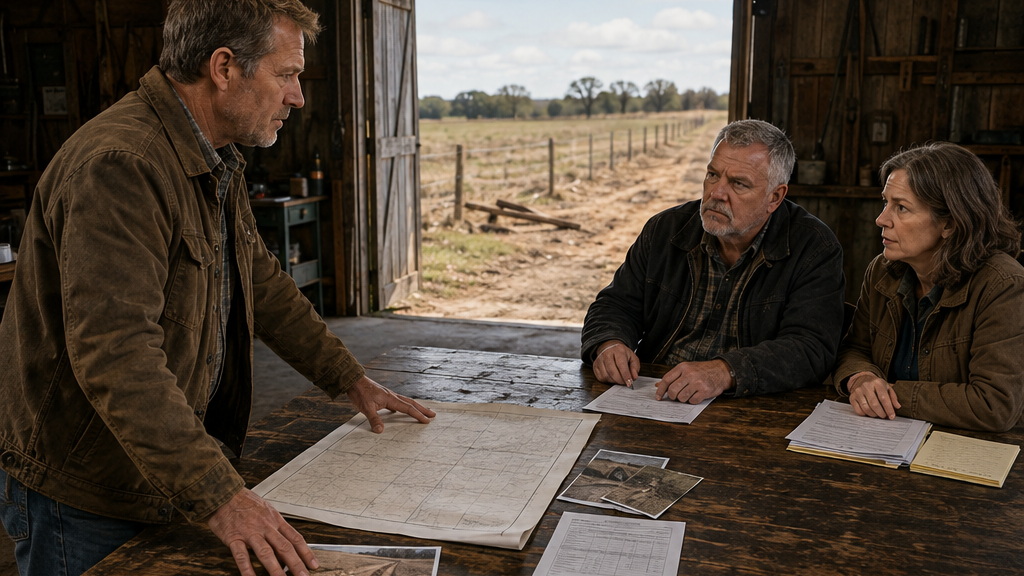
That belief survived until Kathleen unrolled a different map across the scarred table inside the association barn.
“There,” she said.
The room smelled of machine oil and dry hay. George sat at the far end with two other board members. The big sliding doors were open, and beyond them Ronald could see the distant gap where his fence had been.
Kathleen placed a finger on a faint dashed line.
Ronald leaned over.
The map was older than the current association documents. It showed a farm track coming from the county road, crossing near the southern edge of the Carter property, and bending toward what was now George’s farm.
“What year?” Ronald asked.
“1994 copy. Original may be earlier.”
George sat back.
“That track was there before half the equipment sheds out here.”
Ronald looked at him.
“A drawn track isn’t an easement.”
“No,” George said. “But it shows use.”
“Use by who?”
“Everybody who needed it.”
Ronald almost laughed.
“Everybody is not a legal description.”
George’s mouth tightened.
“That’s exactly the problem with you.”
Kathleen glanced between them.
Ronald straightened.
“What’s that supposed to mean?”
“It means every discussion turns into whether somebody can prove something to the inch.”
“I work in surveying.”
“You farm too.”
“And farmers usually care where their land ends.”
George leaned forward.
“Farmers also care whether a loaded livestock trailer can get out without putting a wheel into a ditch.”
There it was.
The access argument.
George explained that equipment had grown larger while the old lane had not. The existing turn near the drainage strip forced long trailers into a tight bend, especially during wet months. Several drivers had complained.
Ronald listened.
Some of it was true.
He had watched feed trucks reverse twice to make the turn. He had also refused, three years earlier, when George suggested widening a corner near the boundary.
At the time, Ronald had seen no reason to surrender good grass for somebody else’s convenience.
George slid the old map closer.
“This route was used long before you started treating that fence like a courthouse wall.”
Ronald placed his stamped survey beside it.
“And this shows where the property line is.”
Kathleen studied both documents.
“So the fence may be valid,” she said, “and the access history may also be real.”
Ronald looked at her.
“You voted to remove it without settling that.”
Her face hardened slightly.
“We voted to clear an obstruction from what we were told was an established access strip.”
“Told by who?”
Nobody answered immediately.
Ronald looked toward George.
George did not look away.
“The chair presented the access issue,” Kathleen said.
Ronald folded his hands on the table.
“So George.”
“Among others.”
“Which others?”
One board member shifted in his seat.
Kathleen spoke before the silence turned hostile.
“This is why we’re reviewing it.”
Ronald wanted to push harder.
Instead he took photographs of the old map and requested a copy of the minutes.
That afternoon he returned to the county office and compared the association map with recorded property documents.
The dashed track existed on historical planning material.
But it was not a recorded easement.
That distinction mattered.
Still, Ronald could no longer tell himself the association had invented the route from nothing.
He drove back to the farm near dusk.
Margaret was at the side garden, cutting away the damaged rose branches.
Ronald walked over with the two maps rolled under his arm.
“They had an old map,” he said.
She continued clipping.
“A track?”
He stopped.
“You knew?”
Margaret lowered the shears.
“I knew there used to be one.”
“Across our boundary.”
“Yes.”
“Why didn’t you say that yesterday?”
“Because yesterday you were angry enough to measure mud.”
“That doesn’t answer me.”
She set the shears on the ground.
“Your grandfather let people through there sometimes.”
Ronald stared at her.
“Sometimes how?”
Margaret looked toward the vanished fence line.
“That’s the part you don’t know.”
Chapter 3: His Grandfather Had Opened the Gate Before
Margaret put the folded paper beside Ronald’s coffee without saying what it was.
The handwriting told him before he opened it.
His grandfather had written in blocky blue ink, pressing hard enough to leave marks on the back of the page.
Ronald read the first line twice.
Permission granted for harvest access through south gate during wet conditions.
Below it were several dates spanning different years.
No legal description.
No lawyer.
No recorded easement.
Just names, seasons, and short notes about combines, hay wagons, and livestock trailers.
Ronald looked up.
“You had this?”
Margaret stood by the sink.
“It was in your father’s desk.”
“How long?”
“Long enough.”
“That isn’t an answer.”
“No. It’s the answer you’re getting until you lower your voice.”
Ronald closed his mouth.
He had not realized he had raised it.
Margaret dried her hands.
“Your grandfather opened that gate when the lower road washed out. Sometimes for George’s father. Sometimes for the farm north of us. If somebody had hay down and weather coming, he helped.”
Ronald tapped the paper.
“Then why wasn’t it recorded?”
“Because he wasn’t giving them land.”
The words landed harder than he expected.
Margaret came to the table.
“He always closed it again.”
Ronald looked toward the window.
He remembered a gate on the old fence when he was a boy, though by the time he began working the farm full-time it had been wired shut.
“He told your father temporary help had to stay temporary,” Margaret said. “Otherwise people forgot it was help.”
Ronald read the note again.
It weakened the cleanest version of his case.
He could no longer say the route had never been used.
That afternoon he assembled his hearing packet.
Survey.
County records.
Photographs.
Invoice.
Association notice.
Historical maps.
He placed the handwritten note beside the stack.
Then, after a long moment, he slid it into a desk drawer.
At seven, the association barn was brighter than Ronald expected. Portable work lights hung from rafters. Folding chairs had been set along one wall, though only a handful of landowners attended.
George sat at the head of the worktable.
Kathleen had minutes open in front of her.
Ronald placed his folder down.
George looked at its thickness.
“You planning to survey the building too?”
One board member smiled.
Ronald did not.
“I’m planning to discuss the fence.”
George pushed a contractor invoice across the table.
“Then let’s start with the outstanding assessment.”
Ronald left it where it stopped.
“You removed property before establishing a recorded right to remove it.”
“We cleared a recognized access corridor.”
“You have an old map.”
“We have decades of use.”
Ronald opened his survey.
The long sheet rolled toward George until Ronald flattened it with two metal nuts from his pocket.
“This is the recorded boundary.”
George barely glanced down.
“Nobody is disputing your deed.”
“You removed a fence sitting inside it.”
“We removed an obstruction.”
Ronald felt the old anger rise.
He reached for the next photograph: empty holes, torn soil, tire tracks.
Kathleen watched him.
“What about historic access?” she asked.
Ronald paused.
The drawer at home flashed into his mind.
He could say he had found nothing recorded.
That would be true.
Not complete, but true.
He heard Margaret’s voice: He always closed it again.
Ronald took his hand off the photograph.
“There was access,” he said.
George’s expression changed first.
Kathleen stopped writing.
Ronald opened his folder, then realized the note was not there.
“I found a handwritten record from my grandfather. He allowed equipment through the south gate during harvest emergencies and wet conditions.”
George leaned back.
“So now we’re getting somewhere.”
“No,” Ronald said. “Now we’re getting accurate.”
He described the note.
Temporary permission.
Specific seasons.
Specific conditions.
No permanent right.
No recorded transfer.
George shook his head.
“You expect us to believe people hauled through there for years but nobody had a right to?”
“I expect you to distinguish use from ownership.”
“And I expect you to understand a working farm can’t operate like a museum.”
That line hit something Ronald had not expected.
Because part of him did treat the place that way.
The old fence. His father’s filing cabinet. His grandfather’s gate hardware still hanging in the shed because Ronald had never thrown it out.
Preservation had become habit.
But habit did not give George the right to send machinery onto his land.
Ronald spread the photographs across the table.
“This track entered from the association lane. The contractor crossed my ground, damaged the rose strip, pulled the fence, and hauled it away. Show me the authorization that established the corridor before that work.”
George tapped the invoice.
“The board approved clearing.”
“Based on what?”
“Based on the access history you just admitted.”
Kathleen looked at George.
“The vote wasn’t presented that way.”
George turned toward her.
“It was presented as an access obstruction.”
“You also said the lane improvement would serve the membership generally.”
“It will.”
Ronald noticed the shift in Kathleen’s tone.
Small, but real.
He unrolled a county planning sheet he had collected that afternoon, intending only to show current road geometry.
A second line caught his eye.
A permit reference had been stamped near George’s parcel.
Ronald leaned closer.
Applicant: George Wilson.
Proposed agricultural entrance improvement.
He read the filing date.
Eight weeks before Ronald’s fence had been removed.
George saw where he was looking.
For the first time that evening, the older man’s confidence changed.
Only slightly.
But Ronald had spent enough years reading survey markers to recognize when a straight line suddenly moved.
“What entrance improvement?” Ronald asked.
George reached for the sheet.
Ronald put his palm on it.
Kathleen leaned forward.
“What is that?”
Ronald read the permit number aloud.
George’s jaw tightened.
“It’s preliminary.”
“For what?”
“A better livestock entrance.”
“Where?”
George did not answer.
Ronald looked down at the small directional sketch printed beside the reference.
It pointed toward the southern corridor.
Toward the missing fence.
Ronald slowly placed the photographs of the tire tracks beside the map.
He no longer felt triumphant.
He felt careful.
Because the permit proved George had wanted access.
It did not yet prove why the fence had been removed.
But the date changed the entire meeting.
Ronald looked across the table.
“You filed this two months before you authorized the clearing.”
George’s face went still.
And nobody in the barn spoke.
Chapter 4: The Road Application Changed What the Vote Meant
The county clerk turned the permit map toward Ronald and tapped the lower corner with one fingernail.
“That line is the proposed entrance.”
Ronald leaned over the counter.
The drawing was simple: George Wilson’s parcel, the county road, the existing farm lane, and a new approach sweeping south before straightening toward the road.
Straight through the strip where Ronald’s fence had stood.
He said nothing for several seconds.
The clerk waited.
“When was this filed?”
She checked the electronic record.
“Eight weeks before the clearing date you gave me.”
“And approved?”
“Not finally.”
Ronald looked up.
“What does that mean?”
“It means application received, preliminary review started. There were still conditions.”
She rotated the map back toward herself and pointed to several notes along the margin.
Drainage review.
Sight-distance check.
Grading specifications.
No final construction authorization.
Ronald felt the first sharp edge of satisfaction dull.
The permit was important.
It was not proof of everything he wanted it to be.
“Can I get a certified copy?”
“Yes.”
“Application too. Anything attached.”
The clerk nodded.
Ronald waited while the printer worked.
On the drive home he resisted calling George.
The urge came at every stop sign.
You filed for that road before you touched my fence.
But Ronald knew what George would say.
The application was public.
The road would help everyone.
The association clearing decision was separate.
A survey crew could make almost any line look decisive if it ignored what lay outside the frame. Ronald had spent enough years in the field to know that.
He needed the whole frame.
At the farm, he spread two maps across his workbench.
The county survey showed the Carter boundary.
George’s application showed the proposed entrance.
Ronald placed tracing paper over both and marked the relevant points.
The overlap was not approximate.
The proposed truck route crossed the cleared corridor almost exactly.
He went outside with a measuring wheel.
The missing fence line began near the hay entrance and ran toward the low ground. Ronald followed the empty post holes, then stepped into the broad tire marks left by the contractor.
He stopped halfway down.
The tracks did not simply run parallel to the old fence.
They curved through the gap and angled toward George’s side.
Ronald crouched.
The tread impressions were softened from several days of wind and light rain, but the direction remained obvious.
He photographed them again from a higher angle.
Then he walked the route backward.
From the association lane.
Across the rose strip.
Along the removed fence.
Toward George’s proposed entrance.
Margaret watched from the garden when he returned.
“You look like you found something.”
“I found a route.”
“That sounds different.”
“It is.”
He showed her the permit map.
She studied it.
“So George wanted this before the fence came down.”
“Yes.”
“And now you think that explains everything.”
Ronald folded the copy.
“It explains enough.”
Margaret looked at him.
“That answer worries me.”
He frowned.
“Why?”
“Because yesterday you thought the old survey explained everything.”
Ronald said nothing.
She went back to trimming damaged stems.
That afternoon, Kathleen called.
“I heard you were at the county office.”
Rural communities had their own version of public records.
Ronald leaned against the workbench.
“I pulled George’s access application.”
A pause.
Then Kathleen said, “I didn’t know there was one.”
“That matters.”
“Yes.”
“You voted on clearing a corridor connected to an application you didn’t know existed.”
“I voted because the turn is dangerous.”
“That isn’t the same thing.”
“No.”
The simplicity of her answer surprised him.
Ronald looked across the shop at the two maps.
“Did George tell the board he had a private permit pending?”
“Not that I remember.”
“Check the minutes.”
“I already did.”
Ronald straightened.
“And?”
“It isn’t there.”
For the first time since coming home, he felt something shift outside his own head.
Not vindication.
Not yet.
But another person had seen the gap.
Kathleen continued.
“Ronald, before you start saying George used the association to take your land, be careful.”
“I haven’t said that.”
“You’re thinking it.”
He looked at the permit.
“Yes.”
“Well, thinking it and proving it are two different jobs.”
That irritated him because it was exactly what he would have said to someone else.
“I know.”
“Do you?”
Ronald let the silence answer.
Kathleen softened.
“I’m asking for the contractor authorization. If George handled it alone, that matters. If the full board authorized the exact work, that matters too.”
“Send me whatever you get.”
“If I’m allowed.”
“You’re secretary.”
“I’m also part of an association that may be heading toward a lawsuit.”
Ronald rubbed his forehead.
“I’m not trying to sue everybody.”
“Then decide what you’re trying to do.”
He almost said, Put my fence back.
But the words felt smaller now.
The next morning an email arrived from the association attorney.
It was brief.
The association maintained that the clearing had been performed under its good-faith authority to maintain recognized agricultural access and that board members were protected when acting within that authority.
The letter denied reimbursement.
It also demanded payment of Ronald’s assessment within thirty days to avoid additional fees.
Ronald read it twice.
Then he printed it and carried it outside.
The missing boundary stretched in front of him.
For days he had imagined the problem as a straight line: his property on one side, George’s on the other.
But the documents no longer formed a straight line.
There was historic access.
There was no recorded easement.
There was a lawful old fence.
There was a dangerous turn.
There was George’s private application.
There was a contractor who had removed the fence before that application received final approval.
Ronald could accuse George now.
He could probably make the accusation sound convincing.
But sounding convincing was not the same as being right.
He folded the attorney’s letter and slid it into his shirt pocket.
If George had used the association to clear his own road, Ronald wanted more than suspicion.
And if George had not, Ronald needed to know that too.
Chapter 5: Ronald Took Evidence That Hurt His Own Case
The sheriff’s deputy flipped through Ronald’s packet, then stopped.
“Anything in here that makes your complaint look weaker?”
Ronald had expected questions about dates.
He had expected questions about the fence value, contractor damage, and whether he had spoken to George.
He had not expected that one.
They sat in a small interview room at the sheriff’s office. Ronald’s folder rested open between them.
Survey.
Photographs.
Invoice.
Association notice.
Permit application.
Attorney letter.
The deputy waited.
Ronald thought of the handwritten note sitting inside a separate envelope in his truck.
“There was historical access,” he said.
The deputy glanced down at the papers.
“Recorded?”
“No.”
“Informal?”
“Yes.”
“Do you have something showing that?”
Ronald stared at the table.
He could say Margaret had told him.
He could describe it as family history.
Instead he stood.
“I’ll be back.”
The deputy watched him leave without comment.
Ronald crossed the parking lot, opened his truck, and took the envelope from beneath the passenger seat.
Inside was his grandfather’s note.
Beside it lay a rusted fence staple Ronald had picked from the disturbed soil two days earlier.
He had slipped it into the envelope without thinking.
Now he held both in his palm.
The staple was ordinary. Bent slightly. Dark with age.
For years it had held wire to one of the cedar posts.
It had done its job quietly until somebody pulled the post out of the ground.
Ronald returned to the interview room and placed the note on the table.
“My grandfather allowed equipment through during certain harvest seasons.”
The deputy read it.
“This could support their claim that the route was used.”
“I know.”
“Why bring it to me?”
Ronald looked at him.
“Because it happened.”
The deputy gave a small nod.
Not approval exactly.
Recognition.
“That helps.”
Ronald sat down.
The deputy placed the note beside the permit application.
“These things can overlap,” he said. “You can have a civil disagreement about access and still have a separate question about whether somebody had authority to remove property.”
“So what happens?”
“I’m not deciding your boundary.”
“I didn’t ask you to.”
“I know. I’m making that clear because people hear ‘sheriff’ and think we settle land disputes.”
Ronald almost smiled.
“I work around surveys. Nobody settles land disputes quickly.”
The deputy turned to the photographs.
“What I care about is who authorized the physical work, what they believed they were authorized to do, and whether they had notice that ownership or access was contested.”
Ronald pointed to the permit.
“The application wasn’t final.”
“That may matter. It may not. Depends why the contractor was sent.”
He tapped the invoice.
“Who hired them?”
“The association.”
“Who gave them field instructions?”
“I don’t know.”
“Then that’s one of the useful questions.”
Ronald left the office feeling less victorious than he had expected.
Outside, he sat in the truck for several minutes.
Giving the deputy the handwritten note had felt like handing George ammunition.
But it had also changed something in Ronald.
For the first time since discovering the missing fence, he had told the complete version to someone who did not already have a side.
That afternoon Kathleen met him near the shared lane.
She had a folder under one arm.
“I can’t give you internal material directly,” she said.
Ronald looked at the folder.
“Then why are you here?”
“To tell you what exists.”
They stood near the bend George had complained about.
A feed truck came down the lane while they talked.
The driver slowed for the turn, swung wide, stopped, backed once, then tried again.
Ronald watched the rear tires come within inches of the drainage edge.
Kathleen waited until the truck cleared.
“That’s what we’ve been dealing with.”
“I know.”
“Do you?”
Ronald gave her a tired look.
“I just watched it.”
“That isn’t the same as having every delivery do it.”
He looked toward the missing boundary.
“No. It isn’t.”
Kathleen seemed surprised he had conceded the point.
She opened the folder but kept the papers angled toward herself.
“The contractor invoice was approved after the work. There’s also an email chain arranging the clearing beforehand.”
“From George?”
“Some messages are from George. Some from the contractor. One includes another board member.”
“What do they say?”
Kathleen hesitated.
“Enough that the deputy should request them formally.”
Ronald’s attention sharpened.
“Was final access approval mentioned?”
“That’s the problem.”
“What problem?”
“It wasn’t final when the contractor was scheduled.”
Ronald felt the old urge surge up—to seize the fact and turn it into a conclusion.
He stopped himself.
“Does any email say George wanted the fence cleared for his own permit?”
“No.”
“Does any say the board knew about his permit?”
“Not that I saw.”
“So we still don’t know motive.”
Kathleen closed the folder.
“No. But we know the work was moving ahead before the access question was finished.”
A pickup appeared at the far end of the lane.
George’s.
Kathleen saw it too.
“I need to go.”
“You’re worried about him seeing you talk to me?”
“I’m worried about everybody deciding there are teams before we know what happened.”
Ronald looked at her.
“You voted against me.”
“Yes.”
“That felt like a team.”
Kathleen accepted that without defense.
“I thought you were refusing a necessary improvement because the fence belonged to your grandfather.”
“And now?”
“Now I think George should have disclosed more.”
She walked back toward her truck.
George’s pickup passed them slowly.
He looked at Ronald.
Then at Kathleen.
He did not stop.
By evening, the deputy called.
“We’re sending a preservation request to the association.”
Ronald stood beside the cattle lot, phone pressed to his ear.
“For what?”
“Meeting records. Contractor instructions. Emails and other material tied to the clearing.”
“Does that mean you think there was a crime?”
“It means records shouldn’t disappear while people argue about what they meant.”
Ronald watched his cattle bunch near the feeder.
“That attorney already says they acted in good faith.”
“Good faith is a conclusion. I’m collecting facts.”
The phrase stayed with Ronald after the call ended.
Good faith is a conclusion.
For days Ronald had been making conclusions too.
George wanted the route.
Therefore George removed the fence for himself.
The board voted against Ronald.
Therefore the board had decided before listening.
Margaret hid the note.
Therefore she did not trust him.
Some of those conclusions might prove true.
But Ronald had spent his working life telling property owners that a marker was not where they wished it was. It was where the evidence put it.
He walked toward the old boundary and stopped at one of the empty post holes.
A few minutes later, headlights appeared at the lane.
Not George.
A county vehicle.
The deputy stepped out holding an envelope.
“The association’s been formally told to preserve the records,” he said.
Ronald took the envelope.
“What happens if those records show George gave the instructions?”
The deputy looked toward the dark opening where the fence had stood.
“Then we ask why.”
Chapter 6: George Finally Explained Why He Forced the Issue
George was halfway through calling the association meeting to order when the deputy walked into the equipment barn.
Nobody applauded.
Nobody spoke.
That silence made the entrance heavier than any dramatic reaction could have.
George’s hand remained on the table.
The open barn doors behind him framed the Carter field and the long exposed strip where Ronald’s fence had been.
The deputy removed his hat.
“I’m not here to interrupt association business,” he said. “I need to speak with Mr. Wilson afterward and confirm preservation of requested records.”
George’s face reddened.
“This is a civil access dispute.”
“Part of it may be.”
The deputy took a seat against the wall.
George looked at Ronald.
For a moment Ronald expected anger.
What he saw instead was fatigue.
Kathleen opened the minutes.
The association attorney sat beside George with a legal pad.
Ronald placed his documents on the scarred worktable.
This time he did not bring the thickest possible folder.
He brought only what mattered.
The old survey.
His grandfather’s access note.
The contractor timeline.
George’s permit application.
Photographs of the tracks.
The removal invoice.
George began.
“The purpose tonight is to resolve the assessment and future access.”
Ronald said, “And the conflict issue.”
The attorney glanced up.
George’s jaw moved.
Kathleen spoke before he could.
“That needs to be addressed.”
George looked at her.
“You’ve already decided what it means?”
“No,” Kathleen said. “That’s exactly why you should have disclosed it.”
The two other board members shifted in their chairs.
Ronald rolled the survey across the table.
Then he placed his grandfather’s handwritten note beside it.
“I want one thing clear before we discuss George’s application.”
Everyone looked at him.
“My grandfather did allow equipment through the south gate.”
George gave a short breath through his nose.
Ronald continued.
“Temporary harvest access. Wet conditions. Specific years. I gave the same note to the sheriff’s office.”
One board member frowned.
“You gave them evidence against yourself?”
“It isn’t against me if it’s true.”
The room changed slightly.
Ronald felt it.
Not in his favor exactly.
Toward seriousness.
He tapped the old note.
“This explains historic use. It does not create a recorded easement. And it does not explain why my fence was removed before this application was finally approved.”
He placed George’s permit beside the survey.
The lines were impossible to ignore when laid together.
George stared at them.
Kathleen asked, “When were you going to tell us?”
George rubbed one hand across his mouth.
“It wasn’t secret.”
“That wasn’t the question.”
“It’s a public application.”
“George.”
He looked at her.
Kathleen’s voice stayed level.
“When were you going to tell the board that the corridor we voted to clear was also the corridor you needed for your own entrance?”
George pushed back from the table.
“The whole association needs that improvement.”
Ronald said nothing.
George pointed through the open doors toward the lane.
“You watched that feed truck this week, Ronald. Don’t pretend you didn’t.”
“I watched it.”
“It had to back up in the turn.”
“Yes.”
“A livestock trailer went into the ditch last spring.”
Ronald knew about that too.
“No animals were hurt.”
“That isn’t the standard.”
George’s voice rose for the first time.
“The road is too tight. We all know it. We’ve known it for ten years.”
He turned toward the others.
“My cattle numbers are up. Kathleen’s hay trucks are bigger. Delivery rigs are bigger. Equipment is bigger. That old turn belongs to another time.”
Then he looked at Ronald.
“So does your fence.”
Ronald felt the insult, but did not answer it.
George seemed to realize he had gone too far.
He sat again.
The attorney leaned toward him, but George waved him off.
“I expanded the herd this year,” he said more quietly. “I borrowed against it.”
Kathleen’s expression changed.
George stared at the table.
“The lender requires dependable all-season trailer access before winter inspections. If I can’t show that, I’m in violation of the loan terms.”
Ronald had not known that.
Neither, judging by Kathleen’s face, had she.
George continued.
“I filed the permit because the southern route is the cleanest way to fix the turn. It helps me, yes. It also fixes the association problem.”
Ronald asked, “So why not say that before the vote?”
George looked up.
“Because I knew what you’d do.”
“What?”
“Say no.”
The answer came too quickly to be invented.
George leaned forward.
“You said no three years ago to widening six feet near the drainage strip.”
“That was different land.”
“It was the same conversation. Every time something changes, you pull out your grandfather’s survey and tell everybody where the line is.”
Ronald felt heat in his neck.
Because George was not entirely wrong.
“You could have asked again.”
“I did.”
“You suggested it.”
“I asked.”
“You never asked to remove the fence.”
George looked away.
There it was.
The choice that could not be softened by road safety, debt, or years of frustration.
He had moved from believing Ronald would refuse to deciding Ronald’s refusal no longer deserved to matter.
Kathleen closed her minutes book.
“You should have recused yourself.”
George looked at her.
“You think I did this for myself?”
“I think you had a personal interest and didn’t disclose it.”
“The road benefits you too.”
“That doesn’t erase your interest.”
The attorney finally spoke.
“The association can address governance separately from the physical access dispute.”
Ronald looked at him.
“And the assessment?”
The attorney paused.
“We are prepared to withdraw the removal charge while the matter is reviewed.”
More than eight thousand dollars disappeared from the conflict in one sentence.
Ronald had imagined that moment repeatedly.
He had expected relief.
Maybe satisfaction.
Instead he looked through the barn doors at the open land.
The fee had never been the whole problem.
The attorney continued.
“We can also discuss compensation for documented damage and a confidential resolution.”
George’s eyes stayed on the table.
Ronald understood what was being offered.
Money.
An end to the argument.
Probably language saying nobody admitted wrongdoing.
He could take it.
Rebuild the fence exactly where it had been.
Force every truck back through the bad turn.
He thought of the feed driver reversing beside the drainage ditch.
Then of his grandfather’s note.
Permission granted for harvest access during wet conditions.
His grandfather had defended the boundary and opened the gate.
Both things had been true at once.
Ronald gathered the papers into a single stack.
“No.”
The attorney looked surprised.
“No to what?”
“A cash settlement by itself.”
“Ronald,” George said.
Ronald turned to him.
“I want the charge removed. I want the damaged ground restored. I want you recused from any decision involving this corridor.”
George’s face tightened.
“And I want the land question settled properly.”
The attorney put down his pen.
“What does that mean?”
“It means I’m not signing something that pays me to stay quiet while everybody keeps arguing over the same strip.”
Kathleen watched him carefully.
Ronald continued.
“If there’s going to be access, it gets surveyed, recorded, and agreed to. If there isn’t, the fence goes back.”
George gave a bitter laugh.
“So after all this, you still get to decide.”
Ronald looked through the open doors.
“No.”
He thought of the old gate, wired shut for years because nobody had wanted to deal with what it meant.
“We decide where the boundary is first.”
Then he looked back at George.
“After that, I decide what I’m willing to open.”
Chapter 7: The New Gate Was Not Where Either Man Wanted It
Ronald knew the new fence was different before the first post went into the ground.
The contractor had stretched a bright string line across the grass, but it did not follow the row of empty holes left by the old cedar posts.
It ran farther north.
Not much.
Enough.
Ronald stood with his hands in his jacket pockets while the auger bit into soil that had never held a fence before.
George Wilson watched from the other side of the field.
Neither man spoke.
Three weeks had passed since the meeting in the equipment barn.
In that time, the removal assessment had disappeared from Ronald’s account. The association had agreed to pay for the damaged rose strip and part of the fence restoration. George had formally stepped aside from every vote involving the corridor.
None of those things had solved the road.
That had taken a county road inspector, a survey crew, and several long afternoons walking the ground instead of arguing over maps.
The safer route turned out to be about forty yards north of the old disputed line.
It required cutting a shallow bank, adding drainage stone, and grading a wider approach to the county road.
It cost more than simply using Ronald’s cleared fence line.
That was why nobody had preferred it.
It was also why it worked.
The new approach stayed outside the tightest part of the drainage strip and gave long trailers enough room to turn without backing.
George would pay the largest share because his expansion created the immediate need. The association would cover the part serving general traffic. Ronald would provide a narrow seasonal crossing point from his parcel only under written conditions.
The first time the proposal was explained, George had stared at the map and said, “That’s a lot of grading to move a road forty yards.”
Ronald had answered, “It’s a lot of fence to tear down to save forty yards.”
They had left it there.
Now the grading equipment sat farther north, and the old corridor remained open only because the replacement fence was still being built.
Margaret came down from the house carrying a thermos.
She stopped beside Ronald.
“You don’t like where they put it.”
“It’s where I told them to put it.”
“That wasn’t what I said.”
Ronald watched another post drop into the new hole.
The contractor checked it with a level.
“I thought I’d put it back exactly.”
“I know.”
Margaret poured coffee into the thermos lid and handed it to him.
“You thought that would fix something.”
“It would have fixed the fence.”
“Yes.”
Ronald looked at her.
She had replanted two of the rose bushes. The third had been too badly crushed and had come out by the roots.
“You still think I’m being stubborn?”
Margaret considered that.
“I think stubborn got you this far.”
He almost smiled.
“That sounds like a compliment.”
“It isn’t.”
She looked toward George.
“He was wrong.”
Ronald said nothing.
“He knew you would refuse, so he decided your answer didn’t matter. That was wrong.”
“I know.”
“But you were wrong too.”
Ronald turned toward her.
“There it is.”
Margaret ignored his tone.
“Every time somebody asked about that corner, you heard them asking for the farm.”
“They were asking for land.”
“They were asking for room.”
“Same thing sometimes.”
“Not always.”
Ronald stared at the string line.
The old handwritten note was folded in his shirt pocket.
He had carried it through two association meetings, the sheriff’s office, and every planning session since.
Permission granted for harvest access through south gate during wet conditions.
The language no longer irritated him.
It sounded careful now.
His grandfather had not written free access.
He had not written forever.
He had written the reason and the conditions.
Help, with edges.
Margaret nodded toward the shed.
“You still have the old latch?”
Ronald looked at her.
“Yes.”
“Thought so.”
She started back toward the house.
“Why?”
She kept walking.
“Because you keep everything.”
Ronald let her go.
By noon, the county survey crew had finished setting the permanent markers for the new agreement.
Kathleen Adams arrived with copies of the access document.
She spread them across the tailgate of Ronald’s pickup.
The language was plain.
The northern road improvement would serve association traffic.
The Carter parcel would remain outside the permanent roadway.
A gated crossing could be used during designated harvest periods and emergency conditions.
No use would create an ownership claim or expand into a permanent easement without a new recorded agreement.
Ronald read the final paragraph twice.
Kathleen waited.
“You want anything changed?”
“No.”
“You sure?”
“That surprises you?”
“Yes.”
Ronald signed.
Kathleen turned the pages toward George.
He had been standing several yards away.
Now he walked over.
His face had changed during the last three weeks.
He looked older.
Not defeated.
Just tired.
George read the agreement, then pointed to the cost allocation.
“I still think the association should take more of the grading.”
Kathleen said, “You can argue that at the next meeting.”
George looked at Ronald.
“You staying out of that one?”
Ronald shrugged.
“If it affects my bill, probably not.”
George almost smiled.
Almost.
Then he signed.
The sheriff’s inquiry had not produced the dramatic ending people around town had expected.
There had been no handcuffs, no public arrest, no sudden courtroom scene.
The evidence showed George had pushed the clearing forward before the access process was complete and had failed to disclose his private interest clearly.
The association attorney had advised formal governance changes and settlement.
The contractor records showed George had authorized the work as association chair, but they did not prove he had secretly ordered the fence removed solely for personal gain.
For Ronald, that distinction mattered.
He had wanted the truth more than he had wanted the worst possible version of George to be true.
The association reimbursed the damage.
George recused himself.
The board adopted a rule requiring disclosure of personal land interests before access votes.
It was less satisfying than revenge.
It was more useful.
Late that afternoon, the last stretch of wire went up.
Ronald walked the new line alone.
The posts were pressure-treated, clean, almost too straight.
The old fence had wandered slightly around stones and roots because his grandfather had built it with what he had.
This one followed surveyed coordinates.
Ronald reached the new gate.
It sat at the seasonal crossing, several dozen yards from the old location.
The opening was wide enough for hay equipment.
A chain hung from one side, but Ronald had not installed the latch yet.
He went to the equipment shed.
On a nail above the workbench hung the old iron hardware.
He lifted the latch down.
Rust stained his palm.
For a moment he could see the old gate as it had been when he was a boy, his grandfather lifting the latch for a neighbor’s wagon, then closing it again after the wheels passed.
Not surrender.
Not isolation.
A choice.
Ronald carried the latch outside.
George was waiting near the gate.
“I thought you’d put a new one on.”
“So did I.”
George watched him line up the old hardware.
“It’ll need work.”
“Everything does.”
Ronald drove the first screw.
George stood there another moment.
Then he said, “I should’ve asked you straight.”
Ronald kept working.
“Yes.”
“I thought I knew the answer.”
“You probably did.”
George looked at him.
Ronald tightened the screw.
“But you still had to ask.”
George nodded once.
No apology speech followed.
Ronald did not need one.
After a while George pointed north, toward the freshly graded road.
“Truck should make that turn.”
“It should.”
“Inspector says we may need more stone after the first freeze.”
“Probably.”
George put his hands in his pockets.
“You going to fight me on that too?”
Ronald finally looked at him.
“If the stone stays on the road, no.”
George laughed once.
It was the first sound between them in weeks that did not carry an argument inside it.
He walked back toward his truck.
Ronald finished mounting the latch.
Then he closed the new gate.
The old metal dropped into place with a heavy click.
Margaret stood near the rose strip watching from a distance.
Ronald rested one hand on the new post.
The fence no longer stood exactly where his grandfather had put it.
For weeks, Ronald had believed that meant something had been lost.
Now he looked north at the safer road, south at the land that was still his, and down at the old latch holding a new gate shut.
The boundary remained.
So did the choice to open it.
The story has ended.