The HOA Tried to Make Him Tear Out His Father’s Driveway—Then the Boundary Survey Changed Everything
Chapter 1: The Inspector Stopped at His Father’s Concrete
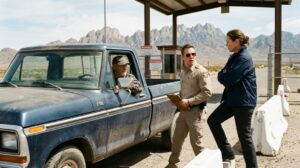
The city vehicle rolled past Jack Miller’s mailbox, slowed, then backed up until its front tire stopped almost exactly beside the pale seam in his driveway.
Jack knew that seam better than he knew most faces.
He set down the garden hose.
The inspector stepped out carrying a clipboard and looked first at the house, then at the narrow strip of concrete running along the eastern side of the original driveway.
“Mr. Miller?”
“That’s me.”
“I’m with the city. We received a complaint about an unpermitted driveway extension.”
Jack stared at him for a second.
“Unpermitted when?”
The inspector glanced down at his sheet. “Complaint just says unauthorized construction. Possible setback issue.”
Jack almost laughed, but the word setback stopped him.
The extension was twelve feet wide at its broadest point, weathered almost the same gray as the original drive. Hairline cracks had formed near the curb. A rust-colored stain remained where his father’s old pickup had leaked transmission fluid one summer thirty years ago.
There was nothing new about it.
“My father poured that,” Jack said. “Late eighties.”
The inspector looked toward the concrete again. “You have anything showing that?”
Jack folded his arms.
“I’ve lived here nineteen years.”
“That’s not what I asked.”
The answer irritated him because it was fair.
Jack had spent thirty-one years working municipal maintenance before retiring. He knew what inspectors dealt with: homeowners who swore a shed had “always been there” when satellite photos showed it appearing last spring, fence lines moved one weekend at a time, drainage ditches quietly filled with gravel.
Still, this was different.
This was his driveway.
“My father built the extension before the neighborhood had an HOA,” he said.
The inspector made a small note.
“Do you have documentation?”
“I probably do.”
“Probably?”
Jack looked at him.
The inspector’s expression remained neutral.
“That’s what we’ll need.”
Jack led him along the edge. The older concrete changed texture near the garage, where his father had finished one batch by hand after the rented mixer quit. Jack could still remember him kneeling there in work pants darkened at the knees, dragging a wooden float across wet concrete while Jack, seventeen and impatient, complained that they were missing the first inning of a ballgame.
His father had told him the driveway would still be there when the game was forgotten.
Jack had thought that was the sort of thing fathers said to justify work.
Now an inspector stood on it with a clipboard.
“Where’s the property line?” the inspector asked.
Jack pointed toward the narrow strip of lawn between his driveway and the neighboring lot.
“About there.”
“About?”
Jack’s jaw tightened.
“There’s an old pin near the back.”
“You had a survey?”
“When I inherited the house.”
“You have that too?”
“Yes.”
This time Jack was certain.
The inspector crouched and studied the concrete edge near the sidewalk.
“Complaint mentions community standards too.”
“That’s HOA business, not city business.”
“Correct. I’m only here for zoning, permits, and possible encroachment.”
“Who complained?”
“I don’t disclose that.”
Jack did not need him to.
Across the street, Deborah Green’s garage door was open. Her white SUV sat inside, polished enough to catch the morning light. Deborah herself was nowhere visible.
Three weeks earlier, she had stopped Jack while he was bringing his trash cans in.
She had asked whether he knew the driveway extension made his frontage “look inconsistent.”
Jack had said, “It’s looked inconsistent since 1987.”
She had smiled without humor.
Deborah had been HOA president for less than two years. She had lived in the neighborhood about four. In that time, reminder letters had multiplied. Trash bins. Basketball hoops. Fence stain. Boats visible behind side gates.
At the spring meeting she had promised to clean up “years of informal exceptions.”
Jack had not considered himself an exception.
The inspector straightened.
“If you can send me anything establishing construction date, I’ll add it to the file. Permits, tax photos, old appraisals. Anything credible.”
“I’ll find it.”
“And a survey if you have one.”
Jack nodded.
The inspector gave him a card.
“This doesn’t mean there’s a violation.”
“I know.”
“But it doesn’t mean there isn’t.”
That part followed Jack into the house.
He went directly to the metal filing cabinet in the spare bedroom.
The deed was easy. His father’s death certificate was easy. The 2014 estate papers were exactly where Ruth had insisted they be filed.
The old property folder was not.
He opened drawers he had not touched since moving back into the house. Utility bills. Appliance warranties. A roofing estimate from 2006. His father’s handwriting appeared on envelopes in block capitals, instantly familiar and unexpectedly irritating.
Jack found an old county tax assessment showing the house footprint but no useful driveway detail.
Then, behind a folder marked GARAGE, he found a thin envelope.
Inside was a faded receipt from a concrete supplier.
The date was August 1987.
Jack read it twice.
The address matched.
The quantity looked plausible.
There was no description beyond delivered concrete.
Not proof by itself, maybe. But something.
He placed it on the kitchen table and called Ruth.
“You still have Dad’s old pictures?”
“What kind?”
“House pictures. Eighties.”
There was a pause.
“What happened?”
“Nothing yet.”
“Jack.”
“The city sent an inspector.”
Her voice sharpened. “For what?”
“The driveway.”
Silence.
Then Ruth said, “That driveway?”
“Yes.”
“The one Dad poured?”
“Yes.”
“That’s ridiculous.”
Jack looked through the front window toward the concrete.
“That’s what I thought.”
By noon, Ruth had promised to check two storage boxes in her basement.
Jack emailed the inspector a scan of the receipt and his 2014 deed. Then he sat at the kitchen table drafting a short note to Deborah.
He deleted it.
He drafted another.
Deleted that too.
If the city said there was no problem, there was no reason to argue with the HOA.
That was how he preferred things: facts first, conversation later.
At three forty-five, a certified envelope arrived.
The return address belonged to the Sycamore Ridge Homeowners Association.
Jack opened it standing at the counter.
The letter called the extension an “unauthorized structural modification” that failed current community standards. It also referenced a possible encroachment into association-controlled setback or easement space.
Jack read that sentence again.
Then the final paragraph.
Fourteen days.
He was required to submit either evidence of prior approval or a written plan for removal and restoration.
Jack walked outside with the letter still in his hand.
The afternoon sun threw the edge of the old concrete into sharp relief.
For the first time since the inspector arrived, he did not look at it as something his father had built.
He looked at it as a line someone might actually make him cut through.
Chapter 2: The Date That Should Have Ended It
Ruth arrived on Saturday carrying a cardboard box against her hip and a photograph pinched between two fingers.
“Tell me this is old enough.”
Jack took it before she had fully crossed the kitchen.
The picture showed their father beside his brown pickup, one boot on the running board, squinting into the sun.
Behind him was the driveway extension.
Completed.
Weathered even then.
Jack turned the photograph over.
In their mother’s handwriting were four words and a date.
Labor Day picnic, 1988.
Jack looked up.
Ruth smiled. “You owe me for digging through forty years of basement dust.”
“This could do it.”
“Could?”
“I want something from before the HOA.”
“That is before the HOA.”
“I want something official.”
Ruth set the box down harder than necessary.
“You always want one more piece.”
Jack ignored that.
By Monday morning, he had the photograph, the 1987 concrete receipt, a tax appraisal from 1989 that referenced expanded off-street parking, and a copy of the HOA’s corporate filing.
The incorporation date was 1993.
Six years after the concrete delivery.
Five years after the photograph.
Jack spread the documents across the property attorney’s conference table.
The attorney read quietly, flipping between dates.
Finally, he tapped the HOA filing.
“This helps you.”
Jack leaned back.
“Meaning they can’t touch it.”
“I didn’t say that.”
Jack’s shoulders tightened.
The attorney slid the photograph aside.
“You have strong evidence the extension predates the association. That matters. They would have a difficult time treating it as a new, unapproved modification subject to architectural approval that didn’t exist yet.”
“Exactly.”
“But.”
Jack disliked the word before the attorney finished saying it.
“But grandfathering an existing improvement is not the same as giving that improvement permission to occupy land it never belonged on.”
Jack looked at the plat on the table.
“My father poured it on our property.”
“I’m not saying he didn’t.”
“I know where the line is.”
The attorney’s expression stayed mild.
“Do you?”
Jack almost answered immediately.
Instead he remembered the city inspector asking him the same thing.
About there.
The attorney turned the plat around.
“This drawing is old. Scale isn’t good enough for me to tell you whether the eastern edge is clear. If the HOA is shifting its argument to encroachment, you need a survey.”
Jack frowned.
“They already called it unauthorized construction.”
“And your evidence hurts that claim.”
“So now they get to invent a second one?”
“They get to raise whatever claim they believe the governing documents support. Whether they can prove it is another matter.”
Jack sat back.
The satisfaction he had carried into the office drained away.
He had imagined emailing Deborah the incorporation date and ending the matter with one clean correction.
Six years.
He liked numbers because they did not care who was president of anything.
But apparently one set of numbers had only opened another question.
The attorney tapped the HOA letter.
“This language about an easement is more important than the community-standards language.”
“Why?”
“Because an association may have legitimate rights involving drainage or access even when it doesn’t own the underlying lot.”
Jack stared at him.
“You think I’m in their easement?”
“I think I don’t know.”
That answer bothered him more than an accusation would have.
At home, he scanned the attorney’s short written opinion and emailed it to Deborah, Paul Anderson, and the city inspector.
His message contained four sentences.
The driveway extension existed no later than 1988. The association was incorporated in 1993. Counsel had confirmed that the HOA could not reasonably treat the extension as newly constructed work requiring retroactive architectural approval. Jack requested that the violation be withdrawn.
Deborah responded in twenty-seven minutes.
The construction date, she wrote, did not resolve the association’s concern regarding possible encroachment.
Jack read the line aloud to the empty kitchen.
“Of course it doesn’t.”
She proposed a joint site meeting the following Thursday with an association representative and a surveyor.
Jack declined.
He told himself the reason was simple: he had already provided enough.
The truth was less flattering.
He did not want Deborah standing on his father’s driveway, directing people where to measure as though it were already hers to regulate.
Paul called that evening.
“I think we should all meet.”
“I think you should read the documents.”
“I did.”
“Then you know the driveway predates the association.”
“I know that part.”
Jack leaned against the counter.
“What other part is there?”
“The boundary.”
“You have a survey?”
“No.”
“Then neither of us knows.”
Paul hesitated.
“That’s why Deborah suggested one.”
Jack looked toward the window.
“I’ll hire my own.”
“Why?”
“Because I want the surveyor working from the deed, not from whatever line Deborah thinks should be there.”
“That’s not really how licensed surveyors work.”
“I know how contractors work, Paul.”
“A surveyor isn’t a contractor hired to give you the answer you want.”
Jack’s grip tightened on the phone.
“I didn’t say that.”
“You’re acting like the meeting itself is surrender.”
That landed closer than Jack liked.
“I’ll get a survey.”
“Fine. Just send us the results.”
Jack ended the call.
Three days later, he went to the county records office himself.
He found the subdivision plat recorded when the original development was laid out. Then he found a later drawing attached to drainage improvements from the early nineties.
The clerk enlarged both.
Jack placed them side by side.
On the older plat, the eastern property line appeared to track where he had always believed it did.
On the later drawing, the easement line angled inward near the front third of his lot.
Not by much.
Several inches, perhaps.
Maybe more.
The drawings used different reference points. Different scales. Different notation.
Jack asked the clerk which controlled.
“You’d need a surveyor to interpret field conditions,” she said.
He hated hearing the same answer twice.
That night Ruth came over for dinner and found the plats spread across the kitchen table.
“You’re still doing this?”
“They changed the accusation.”
She studied the maps.
“Can you tell where the line is?”
“No.”
“Then get it measured.”
“I am.”
Ruth looked at him for a long moment.
“What?”
“You know Dad could be wrong about something.”
Jack’s face hardened.
“This isn’t about Dad being wrong.”
“You talk like cutting six inches of concrete would erase him.”
“No one’s cutting anything.”
“I hope not.”
He gathered the plats into a stack.
Ruth did not argue further.
After she left, Jack took the older survey from his 2014 closing packet and compared it to the drainage drawing.
For years he had remembered the eastern line as simple.
Straight.
Certain.
But under the kitchen light, the marks did not agree as neatly as memory did.
Near the driveway, one line sat several inches farther west than he expected.
Jack traced it with his finger until it reached the concrete edge.
For the first time, he understood why Deborah had not backed down.
Chapter 3: One Yellow Flag Changed the Argument
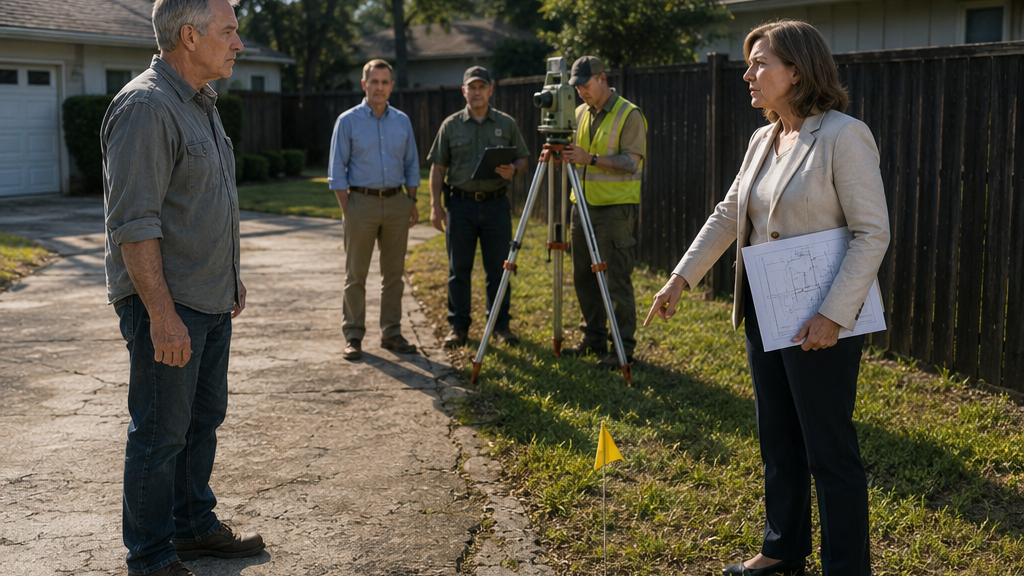
Deborah arrived at eight sixteen carrying a drawing that showed a dotted red line across Jack’s driveway.
She unfolded it on the hood of Paul Anderson’s car before the surveyor had even removed his equipment.
Jack saw the line from twenty feet away.
“What’s that?”
Deborah looked up.
“A working sketch.”
“Of what?”
“The likely correction area.”
Jack walked closer.
The dotted line cut diagonally through the eastern strip of concrete.
“You already drew what you want removed?”
“I drew the area we believe may be inside the easement.”
“We haven’t measured anything.”
“That’s why we’re here.”
Paul stood beside her with both hands in his jacket pockets.
The city inspector had arrived as an observer after Jack copied him on the correspondence. He stayed near the sidewalk, deliberately separate from the HOA group.
The licensed surveyor opened a tripod.
Jack looked at the red line once more, then folded his arms.
Two weeks earlier, he might have argued until Deborah put the sketch away.
Now he said only, “Measure everything.”
Deborah blinked.
“We intend to.”
“Good.”
The surveyor began at the front monument, then worked toward the house with a second crew member carrying the rod.
The process was slower than Jack expected.
There was no dramatic pulling of tape from one obvious point to another. The surveyor checked recorded monuments, took instrument readings, walked toward the rear, returned, checked again.
Deborah grew restless first.
“Can you tell yet whether the concrete crosses?”
“I can tell you when I have enough measurements.”
“How long?”
“As long as it takes.”
Jack almost smiled.
He didn’t.
The first yellow flag went into the grass near the front section of the driveway.
It stood about six inches east of the concrete edge.
Jack stared at it.
Deborah did too.
“That’s the property line?” Paul asked.
“Reference point,” the surveyor said. “Don’t interpret one flag by itself.”
Deborah pointed toward the drainage drawing.
“The easement is inside that.”
“I’m checking the easement separately.”
Jack kept quiet.
The surveyor moved farther up the driveway.
Another measurement.
Another mark.
The concrete that Deborah’s sketch placed across the line remained, so far, on Jack’s side.
At the garage end, however, the spacing narrowed.
The surveyor crouched to inspect an old iron pin partly buried under soil.
Jack recognized it.
“That’s the one I told the inspector about.”
The surveyor cleared dirt from the top.
“Looks consistent with the recorded corner.”
Jack exhaled through his nose.
The inspector looked at him but said nothing.
Deborah stepped closer.
“So the driveway is clear?”
The surveyor stood.
“I didn’t say that.”
Her expression changed slightly.
Neither had Jack wanted to hear those words earlier. Now he understood their purpose.
The surveyor walked toward the rear lot line.
The common drainage easement crossed behind several houses before bending along the side boundary. Deborah’s property sat one lot beyond Jack’s rear corner because the street curved, placing the back section of her fenced yard close to the same easement corridor.
Jack had never given that fence much thought.
It was cedar, six feet tall, stained a dark brown, and probably three years old.
The crew member stopped behind it.
The surveyor checked the instrument.
Then checked again.
He moved five feet and took another reading.
Deborah followed.
“What are you doing back there?”
“Verifying the easement alignment.”
“My property isn’t part of this complaint.”
“No,” the surveyor said. “But the recorded easement is part of the control work.”
Deborah looked toward Paul.
“This is supposed to be about Mr. Miller’s driveway.”
Jack felt the old anger rise.
Mr. Miller.
As though formality could turn his driveway into a case file.
But he kept his mouth shut.
The surveyor stepped through the common area and drove a second bright yellow flag into the ground.
It appeared on the far side of Deborah’s fence.
Not by much.
A narrow distance.
But enough that everyone looked at it.
Paul was the first to ask.
“What does that indicate?”
The surveyor adjusted his cap.
“Again, preliminary field mark.”
Deborah’s voice tightened.
“Preliminary for what?”
“The recorded easement boundary appears to be on this side of the fence.”
No one spoke.
A mower started somewhere down the block and then moved away.
Jack looked from the flag to Deborah.
She was staring at the ground, not at him.
The satisfaction he expected did not arrive cleanly.
He had imagined, more than once, what it would feel like to watch Deborah discover she was wrong.
Instead he noticed how still she became.
She asked, “By how much?”
“I’m not giving you a final dimension until I reduce the field data.”
“Approximately.”
The surveyor hesitated.
“Several inches.”
Paul took his hands out of his pockets.
“You mean her fence may be in the easement?”
“May be. That’s why I’m finishing the survey.”
The city inspector shifted his clipboard under one arm.
Jack finally spoke.
“Finish every measurement.”
Deborah turned toward him.
He kept his voice level.
“Mine too. Don’t stop because one flag helps me.”
Something in her face hardened, then softened into something harder to name.
The surveyor nodded.
“That was the plan.”
For another hour, they measured.
The final field marks showed most of Jack’s driveway comfortably within the boundary. Near the upper third, the margin became tight, but the surveyor said nothing suggested the concrete crossed the property line itself.
The easement question required calculation from the recorded drainage documents.
That meant Jack still did not have complete clearance.
But Deborah no longer had a red line anyone could pretend was certain.
When the surveyor packed his tripod, Paul approached Jack.
“Looks better for you.”
“Looks unfinished.”
Paul gave a short nod.
“That too.”
Deborah had moved to the rear corner and was looking through the slats of her own fence toward the yellow flag.
Jack walked partway down the driveway.
He stopped at the concrete seam where the newer extension met the older original slab.
His father had once run a finishing tool along that exact joint.
Jack could see the shallow waviness still.
For thirty-six years, the line had meant workmanship to him.
Now six yellow inches of grass beside it meant something else.
Not memory.
Measurement.
The surveyor brought over a business card.
“I’ll issue a written report after I reconcile the field data with both recorded plats.”
“When?”
“Probably within a week.”
Deborah returned before Jack could answer.
“When you send the report,” she said, “send it to the association first.”
The surveyor looked at her.
“My client is Mr. Miller.”
Her eyes flicked toward Jack.
“The association needs to review anything involving the common easement before informal conclusions are circulated.”
Jack heard Paul inhale quietly.
The city inspector turned his head.
The surveyor said, “I’ll send the completed report to my client. He can distribute it as he chooses.”
Deborah’s cheeks colored.
“I’m not trying to suppress anything. I’m asking that we not discuss the rear measurement until there’s a final report.”
Jack looked at the second yellow flag beyond her fence.
It was such a small thing.
A piece of plastic no larger than his hand.
Yet Deborah seemed more concerned about that flag than she had been about twelve feet of his concrete.
Jack said nothing.
For once, silence did not feel like stubbornness.
It felt like waiting for the measurement Deborah suddenly did not want anyone to interpret too soon.
Chapter 4: The Board Records Were Missing More Than One Line
Paul Anderson called three days after the survey and said, “I found something you’re not going to like.”
Jack stood at his kitchen counter with the surveyor’s preliminary email open on his laptop.
“About my driveway?”
“Not exactly.”
Paul lowered his voice.
“I’m at the association office. There’s an enforcement folder here with three years missing from the log.”
Jack stopped scrolling.
“What does that mean?”
“I don’t know yet.”
“That’s not much of an answer.”
“It’s the only one I have.”
The surveyor had not issued the final report, but his preliminary note was encouraging. Based on field measurements, the concrete itself appeared to remain inside Jack’s property boundary. The drainage easement was more complicated, particularly near the rear lots.
Jack had spent two days resisting the urge to walk behind Deborah’s fence and stare at the yellow flag.
Now Paul was calling about missing records.
“I asked for the history of easement enforcement,” Jack said.
“I know.”
“And?”
“And the files aren’t organized the way they should be.”
“That means what?”
Paul exhaled.
“Come see it.”
The HOA office occupied one room at the back of the clubhouse. Jack had been inside maybe five times in nineteen years.
Paul had folders spread across a folding table when Jack arrived.
Deborah was not there.
“Where is she?”
“Meeting with the management company.”
Jack looked at the files.
Some were neatly labeled by year. Others contained loose correspondence, maintenance invoices, architectural requests, photographs, and handwritten notes.
Paul opened a binder.
“Violation log jumps from late 2019 to early 2023.”
“You lost three years?”
“I didn’t lose anything.”
“The board did.”
“Yes.”
Jack pulled out a chair.
Paul slid several papers toward him.
“These were filed separately under drainage maintenance.”
Jack read the first one.
A homeowner had complained about a shed near a drainage easement.
Another concerned landscaping placed too close to an access strip.
Neither appeared to have resulted in formal enforcement.
Jack looked up.
“So Deborah wasn’t inventing the idea that there were problems.”
“No.”
“She was just choosing which ones mattered.”
Paul’s expression tightened.
“That’s what I’m trying to figure out.”
They worked through the pile.
Jack had expected to feel satisfaction.
Instead, the deeper they went, the less clean the situation became.
One letter came from a board before Deborah’s presidency. It warned that boundary records were inconsistent and recommended verifying easements before issuing structural notices.
No follow-up appeared behind it.
Another file showed that the HOA had delayed action against a retaining wall because a survey would cost more than the board wanted to spend.
Paul tapped that page.
“This is what I mean.”
“You knew about this?”
“No.”
“You’re the treasurer.”
“I became treasurer last year.”
Jack looked at him.
Paul rubbed his forehead.
“We keep reserves for roofs, landscaping, drainage, insurance. Not for reopening every property-line question the old boards ignored.”
“That doesn’t make my driveway their solution.”
“I didn’t say it did.”
Jack turned another page.
Then he stopped.
It was an email printed on plain paper.
The subject referred to drainage access behind Deborah Green’s address.
The message was nearly three years old.
A maintenance contractor had reported difficulty reaching part of the easement because a recently installed fence appeared to extend into the access corridor.
Jack read it twice.
“Paul.”
“I saw it.”
“Was this ever opened as a violation?”
“I can’t find one.”
“Was she on the board then?”
“No. Not yet.”
Jack looked at the date again.
“So somebody knew.”
“Somebody raised it.”
“And nothing happened.”
“Apparently.”
Jack leaned back.
For a few seconds, he felt exactly what he had expected to feel since the yellow flag appeared.
Vindication.
Sharp, simple, satisfying.
Deborah had accused him of encroachment while her own fence had been questioned years earlier.
Then Paul pulled out another sheet.
“This is the part you need to see.”
It was a note from a prior board meeting. Several drainage-access concerns had been postponed together pending a broader review of old plats.
That review never happened.
Deborah’s fence was one of them.
So were two other properties.
Jack’s satisfaction thinned.
“This wasn’t just her.”
“No.”
“But she knew her records were a mess.”
Paul looked toward the closed office door.
“She knew enough to know there were unresolved issues.”
“And she still sent me a removal notice.”
“Yes.”
Paul did not defend her.
That made Jack more uneasy than if he had.
He gathered copies of the relevant documents and drove home.
On the kitchen table, he placed Deborah’s red removal sketch beside the old drainage correspondence.
Two representations of certainty.
Neither earned.
That evening, the surveyor sent the completed field summary.
Jack’s driveway remained within the surveyed property boundary.
The easement margin near the upper section was narrow but did not require cutting the concrete based on the recorded documents reviewed so far.
Jack read those lines three times.
Then he reached the next section.
The rear boundary measurements indicated that Deborah’s fence crossed into the recorded common drainage easement.
The final dimension would appear in the stamped report.
Jack should have felt triumphant.
Instead he heard Paul’s voice.
Not just her.
At seven thirty, Paul called again.
“I’ve been estimating what it would cost if we had to survey every unresolved easement issue.”
“How bad?”
“Bad enough.”
“Specific.”
“Several thousand just to establish boundaries. More if structures need moving. More if anyone hires lawyers.”
“That’s the association’s problem.”
“It’s your association too.”
Jack disliked that because it was also true.
Paul continued.
“If this opens everything at once, dues could go up.”
“So we pretend the lines don’t exist?”
“No.”
“Then what?”
“I don’t know.”
Jack looked through the window at the driveway.
The old concrete had become almost silver in the evening light.
For weeks, he had treated the fight as a straight line: prove the driveway was old, prove it was his, prove Deborah was wrong.
The records had bent that line.
There was still unfairness.
But it belonged to more than one person.
The doorbell rang.
Jack opened the door expecting Ruth.
Deborah stood on the porch.
No folder.
No board badge.
No polished meeting smile.
“Can we talk?”
Jack almost said no.
Instead he stepped outside.
Deborah glanced toward the driveway before facing him.
“I know the preliminary findings.”
“Then you know you shouldn’t have sent that removal sketch.”
“Yes.”
The answer came too quickly to enjoy.
Jack waited.
She clasped her hands.
“The board has a problem bigger than your driveway.”
“I know.”
Her eyes sharpened.
“Paul showed you the records?”
“I requested them.”
“That wasn’t my question.”
“It’s the answer you’re getting.”
For a moment, they were back where they had started.
Then Deborah looked toward the street.
“There are several old easement questions. If we reopen all of them without a process, this association could spend money it doesn’t have.”
“That sounds like something the board should have considered before threatening to make me cut up concrete.”
“I agree.”
Jack stared at her.
It was the first time she had said it.
Deborah continued quietly.
“I’ll withdraw the driveway complaint.”
Jack said nothing.
“In return,” she said, “you withdraw the complaint regarding my fence.”
There it was.
Not an apology.
A trade.
Jack looked past her toward the worn concrete seam.
“You want both problems to disappear.”
“I want us to stop turning incomplete records into a neighborhood war.”
“And your fence?”
“I’ll deal with it privately.”
“What about the next person?”
Deborah’s face tightened.
“That’s a different question.”
Jack realized it wasn’t.
And the answer he gave now would decide whether he had been fighting for a driveway or for something larger than his own property line.
Chapter 5: The Deal Jack Almost Took
“We can make both problems disappear.”
Deborah said it again, more quietly this time.
Jack stood on his front porch with one hand against the railing.
His driveway case would vanish.
No hearing.
No removal order.
No more letters.
His father’s concrete would stay exactly where it was.
All Jack had to do was stop asking what lay behind Deborah’s fence.
For several seconds, the offer felt less like corruption than relief.
“What happens to the records?” he asked.
“We review them internally.”
“When?”
“When we have a process.”
“That could mean never.”
“It doesn’t.”
“It meant never for three years.”
Deborah looked away.
“That wasn’t my board.”
“But this notice was.”
Jack pointed toward the house, where the HOA letter remained in a folder on his kitchen table.
“You knew the association had incomplete boundary records.”
“I knew there were inconsistencies.”
“And you sent me fourteen days to submit a removal plan anyway.”
Her mouth tightened.
“Yes.”
“Why?”
Deborah did not answer immediately.
When she finally did, her voice had lost most of its official tone.
“Because I told everyone I could fix this place.”
Jack frowned.
She gave a short, humorless laugh.
“You probably think I enjoy sending letters.”
“I haven’t seen much evidence against it.”
“I took over after two boards that barely documented anything. People complained that rules only applied if somebody disliked you. Contractors couldn’t tell which easements were clear. Residents got architectural approvals with no measurements attached. Every meeting became somebody asking why their neighbor got away with something.”
“So you decided nobody would.”
“I decided we needed consistency.”
“You decided certainty would look like consistency.”
Deborah looked at him.
That landed.
She sat on the edge of the porch step without asking.
“When I started pulling old files,” she said, “I realized how bad they were. Missing votes. Missing diagrams. Different plat copies. Old boards making decisions nobody could reconstruct.”
“And your fence?”
She stared toward the street.
“I knew there had been a maintenance question.”
Jack felt anger return.
“You knew.”
“I knew there was an old note. I did not know the exact measurement.”
“You knew enough to ask the surveyor not to discuss it.”
“Yes.”
No excuse followed.
That, more than anything, kept him from cutting her off.
Deborah rubbed her hands together.
“If I stand up at a meeting and say our boundary enforcement records may be unreliable, every old decision becomes suspect.”
“Maybe some should.”
“And maybe some residents spend thousands fighting over three inches because now they think every line is negotiable.”
Jack leaned against the post.
“So your solution was to make an example of me.”
“No.”
“That’s what happened.”
She looked at him directly.
“My solution was to enforce what I thought we could document.”
“You couldn’t document mine.”
“I believed we could.”
“But you didn’t check first.”
“No.”
The word sat between them.
Jack had wanted Deborah to admit she was wrong.
Now that she had, it did not produce the clean satisfaction he expected.
She stood.
“The offer is still there. Withdraw your complaint. I withdraw yours. We build a better process before we reopen anything else.”
“And your fence stays.”
“For now.”
Jack shook his head.
“That’s the same problem with nicer wording.”
Deborah left without arguing.
Inside, Jack stood at the kitchen table looking at the survey documents.
He could sign one letter and be done.
He thought about doing exactly that until Ruth arrived the next morning.
She found him outside near the seam between the original driveway and the extension.
“You look terrible.”
“Thanks.”
“What did she want?”
Jack told her.
Ruth listened without interrupting.
When he finished, she walked onto the concrete and looked down.
“So you can keep it.”
“If I withdraw.”
“And you’re considering it.”
Jack looked at her sharply.
“I didn’t say that.”
“You didn’t have to.”
He bent and ran two fingers along the shallow seam his father had finished by hand.
Ruth watched him.
“You remember when he poured this?”
“Of course.”
“I remember him yelling because you stepped in the corner before it set.”
“I was seventeen.”
“You were an idiot at seventeen.”
Jack smiled despite himself.
Then Ruth said, “You know what I remember most?”
“What?”
“How mad he was when the first crack showed up.”
Jack looked down.
“He said he should’ve ordered another half yard. He complained about that crack for ten years.”
Jack laughed once.
“That sounds like him.”
“He didn’t think this driveway was sacred, Jack.”
The smile left Jack’s face.
“I never said it was.”
“You act like changing one inch means losing him.”
“That isn’t what this is about.”
“Not all of it.”
He turned away.
Ruth moved beside him.
“You were right to fight the notice. But if you take Deborah’s deal now, you’re not protecting Dad. You’re protecting yourself.”
Jack said nothing.
“She picked a rule when it hurt you and wanted an exception when it hurt her.”
“I know.”
“If you agree to that, then what exactly have you been angry about?”
Jack stared at the concrete.
For the first time, he saw the extension not as a monument his father had left behind, but as evidence of how ordinary his father had actually been.
He had measured wrong sometimes.
Ordered too little concrete.
Complained about cracks.
Fixed things.
Lived with imperfect work.
Jack’s promise to keep the place in the family had somehow grown into a second promise his father had never asked for: keep everything unchanged.
That afternoon, Jack sat at the kitchen table and drafted a letter to the HOA.
His first version demanded enforcement against Deborah.
He deleted it.
His second accused the board of selective treatment.
He deleted half of that too.
The final version was shorter.
He requested that both his driveway matter and the documented fence encroachment be placed on the agenda for the next open board meeting. He asked that the same standard of evidence be applied to both. He also requested discussion of a policy requiring verified surveys before future boundary-related enforcement.
He read it twice.
Then sent it.
Paul called fifteen minutes later.
“You really want this public?”
“I want it handled.”
“There’s a difference.”
“There shouldn’t be.”
“You know Deborah’s going to fight the survey interpretation.”
“That’s her right.”
Paul was silent.
Then he said, “You’ve changed your tone.”
Jack looked toward the window.
“Maybe.”
The next morning, Deborah’s response went to the full board.
She acknowledged Jack’s request.
She also wrote that she disputed whether the surveyor’s interpretation of the common easement required removal of her fence and intended to present the association’s position at the meeting.
Jack read the message slowly.
She was not surrendering.
Neither was he.
But for the first time, Jack did not need her to lose.
He needed the rule to survive whichever property it reached.
Chapter 6: The Same Rule Reached Both Properties
Jack’s driveway was still listed as an unresolved violation when Deborah called the monthly meeting to order.
He saw it halfway down the printed agenda.
His name.
His address.
“Driveway Encroachment Review.”
Across the clubhouse room, Deborah sat behind the folding conference table with Paul and two other board members.
Jack had expected the wording to change after the survey.
It had not.
He placed his copy of the stamped report on the table in front of him.
Deborah began with routine business.
Landscaping.
Reserve transfer.
A broken pool gate.
Jack barely heard any of it.
When they reached his item, Deborah folded her hands.
“Mr. Miller has submitted a licensed boundary survey and requested formal disposition of the pending violation.”
Jack stood.
One of the board members asked, “Does the survey show an encroachment?”
Jack looked at Deborah.
She answered carefully.
“The driveway itself does not appear to cross the surveyed property boundary.”
The room shifted.
Not dramatically.
No gasps.
Just chairs moving and pages turning.
Jack waited.
Deborah continued.
“There remains a question regarding interpretation of the drainage easement.”
The property attorney’s letter was already in the packet. So was the surveyor’s stamped drawing.
Jack opened his copy.
The concrete edge was a dark line.
The property boundary ran beside it.
The recorded easement followed a separate path.
No part of the existing concrete required removal under the surveyor’s interpretation.
Jack said, “I’d like the board to decide the driveway using the same evidence standard it uses for the other easement issue on tonight’s agenda.”
One board member looked confused.
“What other issue?”
Paul opened his folder.
“Deborah’s rear fence.”
Silence settled over the room.
Deborah’s expression did not change.
Paul continued.
“The completed survey shows a portion of the fence inside the common drainage easement.”
“How far?”
Jack looked at the drawing but did not answer.
Deborah did.
“Approximately eight inches at the measured section.”
The board member blinked.
“And we’re making her move a fence over eight inches?”
“That’s the question,” Deborah said.
Jack finally spoke.
“No. That’s not the question.”
Several faces turned toward him.
“The question is whether eight inches matters when it belongs to me and doesn’t matter when it belongs to the president.”
Deborah’s jaw tightened.
Jack raised a hand before she could respond.
“I’m not asking you to punish her. I’m asking you to use one rule.”
He slid copies of the survey drawing forward.
“If a licensed survey is good enough to decide whether my concrete stays, it should be good enough to decide whether her fence stays. If it isn’t good enough, then my case shouldn’t have been opened without one.”
Paul nodded.
“That’s the procedural problem.”
One of the other board members studied the map.
“What does the easement actually do?”
“Drainage access,” Paul said. “Maintenance corridor.”
“So the fence interferes with access?”
“Potentially.”
Deborah leaned forward.
“The contractor has been able to reach the area from the other side.”
Jack looked at her.
“That sounds exactly like asking for an exception.”
Her eyes met his.
“Yes,” she said.
The answer surprised him.
Deborah took a breath.
“And that is why I think we need to separate two issues. First, whether the fence is technically inside the easement. The survey says it is. Second, what correction is actually necessary.”
The board member asked, “Are you conceding the survey?”
“I’m conceding the measurement.”
Jack watched Paul glance at her.
Something had shifted.
Deborah continued.
“I still believe the board acted reasonably when it investigated the driveway complaint based on the information available.”
Jack almost interrupted.
Then she added, “I do not believe we acted reasonably when we issued a removal deadline before verifying the boundary.”
The room remained quiet.
It was not an apology.
But it was public.
Paul opened another packet.
“There’s also a broader issue.”
He summarized the missing enforcement records and postponed easement questions. He did not dramatize them. That made the facts worse.
Three years of incomplete logs.
Several unresolved structures.
No consistent requirement for professional boundary verification.
One resident in the back row asked, “Does this mean everybody needs a survey now?”
“No,” Paul said. “It means we shouldn’t accuse somebody of crossing a line until we know where the line is.”
Jack looked down at his father’s driveway drawn in precise black ink.
For weeks, he had wanted the meeting to reach this point.
But now practical consequences crowded in.
Deborah’s fence was not decorative only. Moving it would require new posts, labor, and likely several thousand dollars. More importantly, leaving it in place could obstruct drainage maintenance.
One board member asked whether the association might grant permission for the fence to remain.
Paul shook his head.
“Not without evaluating access and setting a precedent.”
Deborah said, “I won’t ask for special treatment.”
Jack looked up.
She continued.
“If the board determines the fence has to move, I’ll move it.”
The statement did not erase what she had done.
It did make her harder to hate.
The board discussed Jack’s driveway first.
Paul made the motion.
“Dismiss the violation based on the licensed survey, documented pre-association construction, and lack of verified encroachment.”
Another member seconded.
The vote passed.
Jack heard the words without feeling the explosion of relief he had expected.
His driveway simply ceased to be a violation.
A line on paper disappeared.
Then Deborah’s fence came up.
The board voted to require correction within sixty days, subject to a contractor confirming the minimum movement needed to restore full drainage access.
No daily fine.
No humiliation.
No unnecessary destruction.
Just correction.
Deborah recorded the vote herself.
When it was finished, Jack remained standing.
“I have one more request.”
Deborah looked at him.
“The survey policy.”
Paul already had a draft.
Boundary-related enforcement involving permanent structures would require either a recent licensed survey or equivalent verified boundary evidence before a removal notice could be issued.
The board agreed to place the policy for final adoption at the next meeting.
As people gathered papers, Deborah approached Jack.
“You got what you wanted.”
He looked toward the survey drawing.
“No.”
She waited.
“I wanted you to admit the driveway should never have been threatened.”
Her face tightened.
Then Jack said, “What I got is better.”
Deborah followed his gaze to the map.
“The same line for both of us.”
She nodded once.
Outside the clubhouse, Paul caught up with him.
“You know this is going to cost the association money.”
“I know.”
“And Deborah.”
“I know.”
“You still okay with it?”
Jack thought about the first certified letter. Fourteen days to submit a removal plan.
Then he thought about the board’s sixty-day correction order, based not on assumption but on measurement.
“Yes.”
Paul nodded.
Across the parking lot, Deborah stood alone beside her SUV, reading the same survey that had cleared Jack’s driveway and condemned part of her fence.
Jack did not feel victorious watching her.
He felt finished with one question.
The board had finally decided that the rule reached both properties.
Now he had to decide what kind of neighbor he intended to be after it reached hers.
Chapter 7: He Kept the Driveway but Changed the Rule
The fence contractors arrived behind Deborah Green’s house at seven forty on a Tuesday morning.
Jack heard the first post pull loose before he saw the truck.
He was standing beside his mailbox with a cup of coffee when the hollow wooden crack carried across the common drainage strip. For a moment, his attention went automatically to his own driveway.
Nothing had changed there.
The narrow extension remained exactly where his father had poured it, pale and worn beside the darker original slab.
Behind Deborah’s lot, another section of cedar fence came free.
Jack walked halfway down the sidewalk, then stopped.
He had imagined this scene during the worst weeks of the dispute. In those versions, Deborah watched while workers dismantled her fence, and Jack felt some clean, undeniable satisfaction.
Reality was quieter.
One contractor removed boards while another marked a new post line several inches inward. Deborah stood near the back gate in jeans and a sweatshirt, holding a folder against her side.
She noticed Jack.
Neither waved.
The contractor lifted another panel free.
Deborah walked toward the common area.
“They only have to move the rear section,” she said when she reached him.
Jack nodded. “That’s what the board ordered.”
“The drainage contractor said that restores access.”
“Good.”
She looked toward his driveway.
“No saws over there.”
“No.”
A corner of her mouth moved, but it was not quite a smile.
“I suppose you’re relieved.”
“I am.”
“You don’t look like it.”
Jack took a sip of coffee.
“I thought it would feel different.”
Deborah folded her arms.
“So did I.”
Another post came loose.
She watched the contractors for several seconds.
“The estimate was less than I expected.”
“That helps.”
“It still hurts.”
“I imagine.”
Deborah looked at him.
“You know, six weeks ago you probably would’ve enjoyed hearing that.”
“Probably.”
The answer seemed to surprise her.
Jack did not apologize for it.
There had been days when he had wanted her inconvenienced simply because she had inconvenienced him. He had wanted her to open a certified envelope and feel her stomach tighten. He had wanted someone to stand over her property with a clipboard.
He could admit that now without being proud of it.
Deborah shifted the folder under her arm.
“The policy vote is Thursday.”
“I know.”
“You coming?”
“Yes.”
She nodded once and returned to her yard.
By Thursday evening, the clubhouse meeting room had more people in it than usual.
Not a crowd. No spectacle. Just residents who had heard enough about surveys, easements, and enforcement to care about the wording of a new rule.
Paul distributed the final draft.
Any future HOA enforcement alleging that a permanent structure crossed a property boundary or recorded easement would require verified boundary evidence before a removal deadline could be issued. Depending on the circumstances, that meant a recent licensed survey, an existing recorded survey that clearly established the relevant line, or comparable professional documentation accepted by the board.
Jack read the paragraph twice.
Simple.
It would have prevented almost everything that had happened.
One board member raised a concern about cost.
Paul answered, “The association doesn’t necessarily pay for every survey. The point is that we don’t issue a structural removal demand based on somebody’s best guess.”
A resident asked what happened if the HOA could not afford verification.
“Then we investigate,” Deborah said, “but we don’t pretend uncertainty is proof.”
Jack looked up.
It was the clearest acknowledgment she had made.
The board moved to discussion.
Deborah sat straighter.
“I support the amendment.”
A few heads turned.
She continued before anyone could interpret the moment for her.
“The current procedure allowed us to move too quickly on a boundary issue without adequate evidence. That happened in Mr. Miller’s case.”
Jack waited.
Deborah glanced toward him.
“I believed I was enforcing the rules consistently. I pushed before we knew enough.”
That was all.
No sweeping apology.
No admission that every choice had been malicious, because it had not been.
No dramatic confession.
Just a sentence that put responsibility where it belonged.
Jack found that he preferred it that way.
The vote passed.
Paul made a second motion requiring the board to catalogue unresolved easement questions over the coming year rather than allowing them to remain scattered through maintenance files.
That passed too.
Afterward, Ruth met Jack outside.
“So that’s it?”
“Pretty much.”
“You sound disappointed.”
“I’m not.”
She studied his face.
“Then what?”
Jack looked toward home.
“I spent two months thinking the win was keeping the driveway.”
“And now?”
“Now I think keeping it was the easy part.”
Ruth smiled.
“Don’t get philosophical. It doesn’t suit you.”
He laughed.
They walked back toward his house.
At the driveway, Ruth stopped where the old extension met the original slab.
“You know,” she said, “Dad would have hated all this.”
“He would’ve argued with Deborah before the inspector got out of his car.”
“He would’ve argued with the inspector too.”
“And the surveyor.”
“Definitely the surveyor.”
Jack ran the toe of his shoe along the old seam.
A crack had widened near the edge since spring. Nothing serious.
Years ago, he might have treated repairing it as preserving something.
Now it was only maintenance.
That felt better.
The following Saturday, Jack found the last yellow survey flag still standing near the eastern side of the driveway.
The survey work was finished. The report was filed. The board had voted.
There was no reason for the flag to remain.
He crouched and pulled it from the soil.
For a second, he considered keeping it.
The thought embarrassed him.
He carried it toward the garage, then stopped.
Across the common area, Deborah’s rebuilt fence sat several inches farther inside her property. Unless someone knew exactly where to look, the difference was barely visible.
She was in her yard gathering loose pieces of wood left by the contractor.
Jack raised the yellow flag.
“Want a souvenir?”
Deborah looked at it and shook her head.
“No.”
“Me neither.”
He dropped it into the trash bin.
Deborah walked closer to the fence.
“For what it’s worth,” she said, “I should have checked before I sent that first notice.”
Jack leaned against the bin.
“Yes.”
She waited, perhaps expecting something softer.
Jack gave her something different.
“For what it’s worth, I should’ve agreed to the first joint survey instead of treating the meeting like you were taking something from me.”
Deborah considered that.
“You were still right about the driveway.”
“I know.”
That finally made her smile.
Jack did too.
They did not become friends.
They still disagreed at meetings. Deborah still liked rules more than Jack did. Jack still distrusted a form that asked for information nobody seemed to need.
But afterward, when the board questioned a shed, a wall, or a fence near an easement, someone checked the boundary before sending a threat.
That mattered.
On Sunday morning, Jack washed his truck.
Water ran across the driveway extension and collected briefly in the shallow texture his father had left with a broom nearly four decades earlier.
Jack watched it move toward the curb.
The concrete was still there.
So was the crack Ruth remembered.
So was the crooked finishing line near the garage.
For most of the dispute, Jack had feared that losing any part of it meant failing the promise he had made to keep the place in the family.
Now he understood the promise differently.
His father had not asked him to freeze the property in time.
He had asked him to care for it.
Sometimes caring meant defending an old line.
Sometimes it meant measuring one again.
Jack put the hose away.
At the edge of the lawn, the small hole left by the survey flag was already collapsing into the soil.
He did not replace it.
The boundary no longer needed a bright marker to prove it existed.
The story has ended.