The HOA Ordered Me to Tear Down My Grandfather’s Diamond Workshop—Then the Street Learned What His Old Bench Still Protected
Chapter 1: The Notice Beside My Grandfather’s Bench
Andrew Green arrived carrying a red folder and stopped at the edge of my driveway like he had already decided where my property ended.
“I need ten minutes,” he said.
Behind him, a white SUV idled at the curb. The HOA management representative stayed inside with a clipboard on her lap. Andrew wore a navy jacket despite the mild Saturday morning, and the folder under his arm looked too bright against it.
“What for?”
He glanced past me toward the workshop.
“That.”
He had never called it the workshop before. Usually, in emails, it was “the detached structure.”
I followed his eyes.
The building sat twenty yards behind my house, cedar siding gone silver at the corners, narrow windows catching the morning light. My grandfather had built it in the early 1950s, when the road had been gravel and the lots around us were mostly scrub and open field.
Andrew opened the folder.
The first page had the HOA logo across the top.
“This is formal notice,” he said. “The board has determined that the structure is inconsistent with the current residential-use restrictions.”
I read the first paragraph twice.
Commercial structure.
Nonconforming use.
Removal required within thirty days.
I stopped at the line about daily fines.
“You’re ordering me to tear it down?”
“We’re directing you to cure the violation.”
“That means tear it down.”
Andrew’s expression barely changed. “Or submit an approved removal plan.”
For a few seconds, all I could hear was the SUV’s engine.
Then I folded the notice once.
“You’ve been inside it?”
“No.”
“You’ve inspected it?”
“We’ve reviewed the property file.”
“That wasn’t my question.”
His jaw tightened.
I should have left it there. Instead I unlocked the side gate.
“Come on.”
He hesitated.
“If you’re going to tell me what it is,” I said, “you should at least see it.”
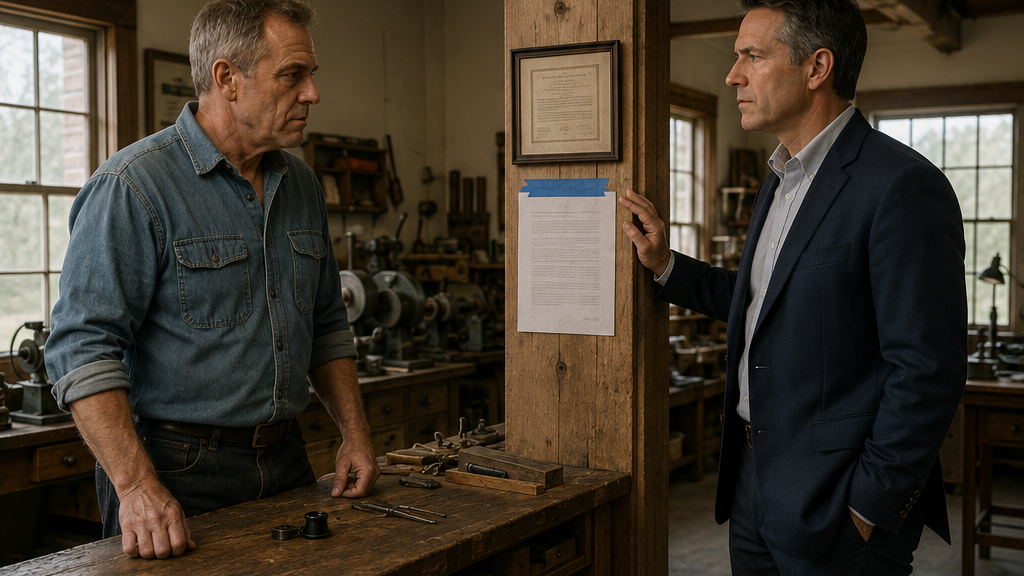
The workshop smelled the way it always had: dry wood, old oil, polishing compound, and the faint metallic scent that lived in the bench drawers no matter how long they stayed closed.
Andrew stopped just inside.
The room was smaller than people imagined when they heard diamond workshop. No glass cases. No showroom. No bright lights.
Just the long scarred workbench under the north-facing windows, two cast-iron lap wheels, an old stool, magnifying lamps, hand tools in shallow drawers, and narrow shelves filled with boxes labeled in my grandfather’s faded handwriting.
I hadn’t moved most of it in twelve years.
Andrew looked around.
“This is exactly the issue.”
I stared at him.
“What issue?”
“It’s plainly a commercial workspace.”
“It hasn’t operated commercially in years.”
“The covenant doesn’t distinguish between active and inactive structures.”
“My grandfather built this before there was an HOA.”
Andrew gave me the patient look people use when they think history is emotional evidence.
“The neighborhood has governing documents now.”
“This neighborhood didn’t exist when he built it.”
“I understand that.”
“No, you understand a date.”
His eyes shifted to the bench.
I regretted the sentence almost immediately. Andrew was wrong, but I was doing what I always did whenever anyone asked about the workshop: turning defensive before they had a chance to touch anything.
For years the board had asked for photographs during insurance reviews. I sent exterior shots.
A prior manager had asked whether an inspector could document the interior. I refused.
When the county preservation office mailed a questionnaire three years earlier, I put it in a kitchen drawer and never answered.
I had told myself none of those people needed to know what was inside.
Now Andrew was standing in the room because I had finally opened the door under threat.
He pulled a strip of blue painter’s tape from the folder.
“What are you doing?”
“Posting the notice.”
“On my grandfather’s wall?”
“On the support post.”
Before I could stop him, he taped the page to the wooden post beside the workbench.
The white sheet hung crookedly.
Three feet away, above the bench, was the framed certificate.
The paper inside had yellowed around the edges. My grandfather had hung it there in the eighties, and after he died I had never taken it down. I knew what it said in broad terms: historic recognition, workshop, date, county, state.
I had always treated it as something ceremonial.
Andrew barely looked at it.
“Thirty days begins today,” he said.
“And after that?”
“The fine schedule begins.”
“How much?”
“Five hundred dollars per day until the violation is cured, subject to the board’s enforcement policy.”
I looked back at him.
“That’s fifteen thousand dollars a month.”
“If it reaches that point.”
“You’re saying that like I control whether you fine me.”
“You control whether the structure remains.”
The sentence landed harder than I expected.
My grandfather’s hands had worn a shallow smooth place into the front edge of the bench. When I was a boy, I used to stand beside him and run one finger along that dip while he worked.
I had not sat at the bench since his funeral.
Andrew moved toward the door.
I said, “You know this building was here before the first house on the block?”
He stopped.
“The original plat is from later.”
“So?”
“So you’re trying to enforce a rule against something the rule was built around.”
“Michael, age doesn’t automatically create exemption.”
That was the first thing he said that sounded less like authority and more like something he had actually checked.
I hated that it made me hesitate.
He continued.
“If you have documentation showing a grandfathered status or recorded exception, provide it. The board will review it.”
I looked at the certificate.
Andrew followed my gaze this time.
“That?”
“I don’t know.”
He gave a small nod.
“Then find out.”
After he left, I stood alone in the workshop with the notice still taped beside the bench.
For the first time, the certificate bothered me.
Not because of what I remembered it saying.
Because I could not remember exactly what it said at all.
Laura arrived twenty minutes later after I sent her a photograph of the violation notice.
She came through the side gate without knocking, took one look at my face, then walked straight into the workshop.
“They actually posted it?”
I pointed.
She read the notice.
“Five hundred a day?”
“That’s what he said.”
She turned toward the framed certificate.
“You showed him this?”
“He saw it.”
“And?”
“He said if I have an exemption, I should provide it.”
Laura stepped closer to the wall.
“Dad, when was the last time you took this down?”
“Never.”
“I mean since Granddad died.”
“I know what you meant.”
She reached toward the frame.
“Don’t.”
Her hand stopped.
That single word came out sharper than I intended.
Laura looked at me, then at the frame.
“You want to save this building, right?”
“Yes.”
“But nobody can touch a picture frame?”
“That’s not what this is about.”
“It kind of is.”
She waited.
I said nothing.
Finally, she leaned close enough to read the smallest print without moving the certificate.
Her eyes narrowed.
“What?”
“There’s something at the bottom.”
I stepped beside her.
Under the recognition language was a line in much smaller type.
Laura read it aloud.
“Recorded instrument reference…”
Then she said a string of numbers.
I had seen the line before. Hundreds of times, probably.
I had never once asked what it meant.
Laura looked at me.
“Dad, what recording is that?”
I stared at the certificate hanging above the bench.
“I don’t know.”
Chapter 2: The Certificate Was Not the Protection
“The certificate does not, by itself, stop demolition.”
The county preservation planner said it calmly enough that for a moment I thought I had misunderstood her.
I tightened my grip on the phone.
“I thought the building was protected.”
“It may be. I’m saying the recognition certificate isn’t the same thing as a restriction on private property.”
I was standing in my kitchen with the framed certificate lying faceup on the table.
Taking it off the workshop wall that morning had felt wrong.
The nail remained behind, a clean brass hook surrounded by a rectangle of unfaded wood.
“What does the recording number mean?”
“That’s what we need to determine.”
Laura sat across from me with a legal pad.
She had written the number at the top in block letters.
The planner continued.
“If your grandfather accepted grant assistance, tax benefits, or entered a preservation agreement, there may be a separate instrument recorded against the parcel. That could matter significantly.”
“So the HOA might still be able to make me remove it.”
“I can’t answer that until we know what was recorded.”
It was not the answer I wanted.
I had expected one phone call to turn Andrew’s notice into a mistake.
Instead, I now had a framed certificate that meant less than I had believed and a reference number attached to a document I had never seen.
Laura waited until the call ended.
“You okay?”
“I’m fine.”
“You look disappointed.”
“I’m not disappointed.”
“You thought this was going to be easy.”
I picked up the certificate.
“What I thought doesn’t matter.”
“It does if you go into this assuming everybody else is wrong.”
I looked at her.
“Andrew taped a demolition notice beside your great-grandfather’s bench.”
“I know.”
“And you’re defending him?”
“No. I’m suggesting we figure out what’s true.”
That sounded annoyingly close to what Andrew had said.
By noon we were at the county records office.
The clerk entered the recording number, frowned, tried it again, then asked for the parcel address.
Our current parcel appeared immediately.
The old number did not.
“Could be indexed under a previous legal description,” she said.
“How previous?”
She clicked through several screens.
“Your neighborhood was replatted.”
“I know.”
“More than once.”
That I had not known.
The clerk pulled up an older parcel map. Our lot stretched farther along the rear line than it did on the modern subdivision map. The workshop sat near what had once been the center of the original property rather than behind a suburban house.
Laura leaned toward the monitor.
“So the building really was here before all these lots?”
“Yes,” I said.
The clerk nodded. “Looks that way.”
It was a small victory, but it was the first fact in days that felt solid.
Then she clicked another tab.
“There.”
An entry appeared under an older parcel description.
Recorded easement.
I felt my shoulders loosen.
“What kind?”
The clerk opened the scanned image.
Only the first two pages loaded.
The rest were blank placeholders.
She tried again.
“Archive migration problem.”
“Can you get the original?”
“Probably.”
“How long?”
She glanced at the clock.
“If it’s downstairs, today. If it’s off-site, longer.”
My phone buzzed.
Andrew.
I stepped into the hallway.
“We need access to the workshop this afternoon,” he said.
“For what?”
“The management representative needs interior photographs for the enforcement file.”
“You already issued the enforcement without inspecting it.”
“We reviewed exterior use and classification.”
“Classification based on what?”
“Michael.”
“No. You’re fining me five hundred dollars a day in thirty days. Based on what?”
There was a pause.
Then Andrew said, “Two o’clock.”
I almost refused.
The instinct came so quickly I recognized it for what it was.
My standard answer.
No one goes inside.
No one touches anything.
No one gets to interpret what belongs to my family.
I looked through the records-office window at Laura.
She was watching me.
“Fine,” I said. “Two.”
Andrew returned with the management representative and the same red folder.
This time I left the workshop door open.
The certificate had not been returned to the wall. It sat on the workbench beside the notice I had removed from the post.
Andrew noticed immediately.
“You took it down.”
“I needed the recording number.”
He looked at the certificate more carefully than he had on Saturday.
I opened the top drawer of the bench.
Inside was my grandfather’s loupe.
Black metal rim. Worn hinge. A faint chip on the edge of the glass.
I set it beside the certificate.
The movement steadied me.
Then I positioned Andrew’s violation notice next to both documents and took a photograph with my phone.
Andrew watched.
“What’s that for?”
“My records.”
The management representative started photographing the room.
Andrew pointed to the certificate.
“So you called preservation?”
“Yes.”
“And?”
“The certificate isn’t the protection.”
For the first time since this began, he looked almost relieved.
Then I added, “There’s a recorded instrument referenced at the bottom.”
His expression changed.
I slid the certificate toward him.
“Did the board review it?”
He read the line.
“What is it?”
“That’s what I’m asking you.”
He looked at the management representative.
She stepped closer.
Andrew said, “Was this in the title package?”
“I don’t remember seeing it.”
“So that’s a no?”
“I’d have to check.”
I looked at Andrew.
“You gave me thirty days to destroy the building. Did you check?”
His mouth tightened.
“We had counsel review the applicable covenants.”
“That isn’t what I asked.”
“We will review whatever you provide.”
“No. This is a county recording attached to my property. I shouldn’t have to discover it after you order demolition.”
The management representative stopped taking pictures.
Andrew did not answer for several seconds.
His certainty had changed, but only slightly.
He closed the folder.
“Send the document when you have it.”
“If you don’t know what it says, suspend the deadline.”
“I’m not authorized to do that unilaterally.”
“You were authorized to issue it.”
“The board authorized enforcement.”
“Without this.”
He looked again at the certificate.
“We’ll discuss it.”
That was all I got.
After they left, Laura called from the county office.
“They found the paper file.”
I sat down on my grandfather’s stool.
“All of it?”
“The clerk says there’s an original folder under the old parcel description.”
“What’s in it?”
“She won’t summarize it over the phone.”
“When can we see it?”
“She can hold it until tomorrow morning.”
I looked at the empty hook on the wall, then at the certificate lying flat on the bench.
For two days I had wanted the certificate to be the answer.
Now I knew it was only pointing toward one.
Chapter 3: The Easement Changed Both Sides
My grandfather’s signature appeared halfway down page four.
The handwriting was unmistakable.
He always made the first letter of his last name too large, then crowded the rest as if he regretted using so much space.
I touched the edge of the paper but not the ink.
Laura stood beside me at the records counter.
“That’s him?”
“Yes.”
Above the signature was a title I had never seen before.
Preservation Easement Agreement.
The county clerk had brought us a thick folder tied with cotton tape. Inside were photographs, architectural descriptions, grant correspondence, maps, and an inventory of workshop fixtures.
The easement ran twelve pages.
At first, all I could see were the parts I wanted.
No demolition without prior written approval.
No substantial exterior alteration inconsistent with historic character.
Protected interior features.
My eyes went back over those lines twice.
“So Andrew can’t tear it down.”
The clerk looked up.
“I can’t interpret it for you.”
Laura said, “Keep reading.”
I almost told her I had read enough.
Then I turned the page.
The agreement had obligations.
Maintenance standards.
Reasonable inspection access.
Preservation of specified equipment.
And a section titled Educational and Interpretive Use.
I read it silently.
Then again.
Laura leaned closer.
“What?”
I pushed the page toward her.
The language required the owner to make the workshop available on a limited periodic basis for educational demonstrations, supervised visits, or preservation-related programming, subject to reasonable scheduling and safety conditions.
Laura looked at me.
“You’ve done that?”
“No.”
“Ever?”
“Granddad did.”
“You?”
I shook my head.
The small legal victory I had felt two minutes earlier disappeared.
The clerk gave us privacy by walking to another desk.
Laura lowered her voice.
“How long has it been closed?”
“Twelve years.”
“Since he died.”
“Yes.”
“Did you know about this?”
“No.”
That part was true.
But another truth followed behind it.
I had received letters.
Not this agreement. Not these pages.
But requests.
Preservation office mail.
An inventory update.
An offer to schedule a site review.
I had ignored all of it.
Laura must have seen something in my face.
“What?”
“Nothing.”
“Dad.”
“I got mail from them before.”
“How much?”
“I don’t know.”
“You didn’t open it?”
“Some.”
“And?”
“I didn’t want people coming through the shop.”
She looked back at the agreement.
“So you didn’t know this exact rule, but you knew someone was trying to check on the property.”
“That’s different.”
“Is it?”
“Yes.”
She did not argue.
That was worse.
We spent the next hour going through the folder.
The original workshop photographs were black and white. My grandfather stood beside the same workbench, younger than I had ever known him, shirtsleeves rolled, a loupe clipped near one eye.
The bench looked newer then, but already scarred.
One inventory page listed it specifically.
Fixed hardwood jeweler’s bench with integrated drawers and tool recesses.
Protected interior feature.
The cast-iron lap wheels were listed too.
Even the north-facing work windows were described.
I had spent years believing I was preserving the room by refusing to alter it.
The agreement suggested preservation meant something more demanding.
Keep it standing.
Keep it maintained.
Let it be seen.
Let the work be explained.
Back at the HOA management office that afternoon, Andrew sat across from me with the easement photocopy between us.
The management representative had invited the HOA attorney to join by phone.
Andrew had lost some of his polish.
Not his confidence exactly.
But the easy certainty was gone.
The attorney spoke first.
“We need time to review this.”
Andrew said, “The building is still subject to association maintenance standards.”
“No one said otherwise,” I replied.
“And the easement doesn’t necessarily eliminate all association authority.”
“I didn’t say that either.”
He looked at me, perhaps expecting the argument he had been preparing for.
I slid the page containing the demolition restriction toward him.
“What it does say is you can’t treat the building like an ordinary nonconforming shed.”
The attorney answered before Andrew could.
“That appears to be correct.”
The room went quiet.
It was the first direct concession I had heard.
I should have felt triumphant.
Instead I kept thinking about page seven.
Educational use.
Reasonable access.
Maintenance.
The attorney continued.
“The association should suspend any physical removal action until this is fully reviewed.”
“Physical removal,” I said. “What about fines?”
“That will need board action.”
Andrew leaned back.
“The underlying violation has not been resolved.”
I stared at him.
“You still think the workshop itself is a violation?”
“I think we have overlapping restrictions that need interpretation.”
“That’s a different sentence from the one you used Saturday.”
His face hardened.
“We had a legitimate basis to act on the information available.”
“You didn’t have all the information.”
“Neither did you.”
That stopped me.
Laura, sitting beside me, turned slightly.
Andrew went on.
“You own the property. You’ve had this structure locked for years. You refused inspections. You never provided the association with the easement.”
“I didn’t know about it.”
“But you knew there was preservation involvement.”
I felt heat move up my neck.
The irritating part was that he was not entirely wrong.
Andrew had rushed.
He had treated uncertainty like proof.
But I had treated secrecy like protection.
The attorney interrupted.
“None of that changes the need for a complete title and covenant review.”
Andrew looked toward the speakerphone.
“What’s the timeline?”
“A few days.”
“We don’t have a few days.”
The words came too fast.
I caught them.
“So there is a deadline.”
Andrew looked at me.
“The board has deadlines all the time.”
“What deadline?”
He closed the easement packet.
“That’s association business.”
“I am the association.”
“You are one owner.”
“And you’re trying to remove my building.”
The management representative looked down at her notes.
Andrew stood.
“We’re done for today.”
“No, we’re not.”
He met my eyes.
“What is happening in a few days?”
He gathered the papers into his folder.
“The board will discuss this at an emergency hearing.”
“When?”
“Thursday.”
“That’s not what I asked.”
He ignored me.
The attorney’s voice came through the speaker.
“Andrew, I would recommend that the notice of hearing include the easement issue explicitly.”
“It will.”
He walked to the door.
I said, “If demolition is restricted, why are you still pushing?”
Andrew stopped with his hand on the handle.
For a second, something passed across his face that had nothing to do with covenants.
Pressure.
Maybe anger.
Maybe fear.
Then it was gone.
“Thursday, seven o’clock.”
He left.
That evening, I carried the easement back into the workshop.
The certificate still lay on the bench.
I looked at the empty wall above it, then at the old photographs spread across the wood.
One showed my grandfather with three young people gathered around him, all watching his hands.
I did not remember them.
On the back, in his handwriting, was a date.
I set the photograph beside the loupe.
For days I had been asking whether Andrew had the right to force me to change the workshop.
Now another question had begun to bother me more.
What if I had spent twelve years protecting the room from everyone except the one person who had actually meant to keep it alive?
Chapter 4: The Project Behind the Thirty-Day Deadline
The rendering showed my workshop as a patch of grass.
I noticed that before I noticed anything else.
The emergency-hearing packet had been left on every chair in the clubhouse. On page fourteen, a glossy site plan showed three rows of narrow townhouses, new sidewalks, ornamental trees, and a widened entrance where the older houses at our end of the street stood now.
Behind my property, where my grandfather’s workshop should have been, there was nothing.
Not even an outline.
Laura sat beside me and tapped the page.
“They planned around it by pretending it wasn’t there.”
Across the room, Andrew Green arranged papers at the board table while residents filled the folding chairs. More people came than I had ever seen at an HOA meeting.
That should have warned me.
I had expected the hearing to be about an easement.
Most of the room had come to talk about money.
Andrew opened with the drainage problem.
Our subdivision’s underground lines were old. Two culverts needed replacement. The private road surfaces near the entrance had been patched so many times that the repair map looked like a quilt.
Then he put numbers on the screen.
Without redevelopment revenue, reserves would fall short.
Without enough reserves, the board would have to consider a special assessment.
A woman behind me whispered, “How much?”
Andrew changed slides.
The projected range appeared.
The room shifted.
Chairs creaked. Someone exhaled sharply. A man near the wall muttered something I couldn’t make out.
I looked again at the rendering.
Suddenly the missing workshop had context.
Andrew was not simply trying to make the neighborhood look cleaner.
He was trying to make a financing package close.
When public comments began, I expected questions about the preservation easement.
The first homeowner asked whether the assessment could be spread over two years.
The second wanted to know whether retirees could defer payment.
The third asked if property values would fall if the townhouse proposal stalled.
Nobody mentioned my grandfather.
Then Margaret White stood.
She had lived three houses down for as long as I could remember. She had been HOA secretary years earlier and still kept old meeting binders in labeled boxes in her garage.
She looked at Andrew first.
“I supported the redevelopment study,” she said.
Then she looked at me.
“I still support fixing the infrastructure.”
There was no accusation in her voice.
That somehow made it harder.
“My monthly budget doesn’t have room for another assessment,” she continued. “I’m not the only one.”
Andrew nodded slightly.
Margaret added, “But that doesn’t mean the board gets to skip a title restriction.”
Several people shifted.
Andrew’s mouth tightened.
She sat down.
During the break, I found her near the coffee station.
“You knew about the workshop,” I said.
“I knew it was old.”
“You knew my grandfather.”
“I did.”
“And you supported a plan that removes it.”
She folded the hearing packet against her chest.
“I supported a plan that might keep me from writing a check I can’t afford.”
The answer stung because it was honest.
She glanced toward the meeting room.
“My roof is fourteen years old, Michael. My taxes went up again. I’m not choosing between history and greed.”
“I didn’t say you were.”
“You were thinking it.”
I looked away.
Margaret lowered her voice.
“Andrew thinks if he gets the parcel issues resolved, the lender will issue final terms before the quarter closes.”
“What parcel issues?”
“Yours is the worst one.”
“Why?”
“Because the project assumes access and clearance along the rear portion of your lot.”
That was the deadline.
Not thirty days because the building had suddenly become dangerous.
Thirty days because somebody else had a calendar.
Andrew appeared in the doorway.
“Michael, can we talk?”
He led me down the hallway to the small conference room.
Laura followed.
Andrew looked at her.
“She stays,” I said.
He shut the door.
For several seconds, he said nothing.
Then he slid a single-page document toward me.
It was not an HOA form.
It was a proposed settlement.
The association would withdraw the fines.
The violation would be closed.
The redevelopment entity would pay to relocate the workshop structure to another portion of my property, subject to preservation approval.
I read it twice.
“You want to move it.”
“We’re offering to solve the problem.”
“The easement identifies the location.”
“We believe there may be a process for amendment.”
“We?”
“The project team.”
Laura leaned forward.
“Does the preservation office agree?”
Andrew looked at her.
“We haven’t reached that stage.”
“So no.”
He turned back to me.
“You keep the building. You keep the equipment. You avoid fines. The neighborhood keeps the redevelopment option.”
“You want me to sign before anyone decides whether moving it is legal.”
“I want to know whether you’re willing to be reasonable.”
I looked at him.
There it was.
Not an insult.
Something more useful.
A pressure point.
“If I refuse?”
“The board continues the hearing.”
“And the full easement goes into the record?”
His silence answered before he did.
“Michael, once this becomes a broader title issue, it may affect the lender’s review.”
“That’s not my fault.”
“No. But it affects everyone.”
For the first time, I understood why he had kept pushing even after the easement surfaced.
He was not afraid of losing an argument.
He was afraid of losing the project.
Andrew rubbed one hand over the edge of the table.
“People on this street are counting on this.”
“So am I.”
“On what?”
I thought about the workshop door closed for twelve years.
The untouched bench.
The mail I had ignored.
I could not honestly say I had been using the place.
But I could say one thing.
“On decisions about my property being made after the facts are known.”
Andrew stared at me.
I pushed the settlement back.
“No.”
Laura did not move.
Andrew’s face went still.
“You understand what that may do.”
“Yes.”
We returned to the meeting.
When my turn came, I did not tell the board Andrew had offered me a deal.
I did not need to.
I placed the full easement packet on the table.
“This document was recorded against my property before the current enforcement began,” I said. “I want the complete instrument entered into the association record and reviewed before any further action.”
One board member turned toward Andrew.
“Was this in the title review?”
Andrew answered carefully.
“It has now been identified.”
“That wasn’t the question.”
For once, the pressure in the room was not pointed entirely at me.
I sat down.
Across the aisle, Margaret gave me a tired look, not approval.
Outside after the meeting, two neighbors walked past without speaking.
Andrew’s settlement remained unsigned in my folder.
The demolition fight had finally become public.
So had the cost of stopping it.
Chapter 5: Winning the Vote Cost Me the Street
“The demolition demand cannot proceed on the record we have.”
The HOA attorney said it before Andrew finished his opening remarks.
The room went silent.
Two weeks had passed since the emergency hearing. In that time, the association’s attorney had reviewed the easement, the older parcel descriptions, the covenants, and the redevelopment materials.
I had spent those same two weeks receiving fewer waves from neighbors.
The attorney sat at the end of the board table with a thick binder open in front of him.
“The recorded preservation restrictions are material,” he continued. “Any enforcement theory that assumes the workshop can simply be removed is incomplete.”
Andrew’s hands rested flat on the table.
“So the association has no authority?”
“That is not what I said.”
He looked almost relieved.
Then the attorney added, “I am saying removal cannot be ordered under the present notice.”
The relief disappeared.
One board member asked about the fines.
“My recommendation is to withdraw them.”
A murmur moved through the chairs.
I felt Laura’s shoulder touch mine.
For weeks I had imagined that sentence.
I expected it to feel larger.
Instead, I mostly felt tired.
Andrew said, “Can we address the underlying use issue separately?”
“Yes,” the attorney replied. “Through a new review based on the actual instruments.”
The management representative wrote something in the minutes.
Then the attorney turned a page.
“There is another matter.”
Andrew looked at him.
The attorney lifted an email printout.
“Before the original violation was issued, I advised the board that the property appeared to contain older title references that had not yet been resolved.”
Nobody spoke.
Andrew’s jaw moved once.
The attorney continued.
“My note recommended confirming those references before taking irreversible enforcement action.”
A man in the second row said, “So you knew?”
Andrew faced the room.
“I knew counsel had identified a title question.”
“That sounds like yes.”
“No. It means we had an unresolved question.”
I watched him carefully.
He was not caught in some dramatic lie.
The truth was worse in a quieter way.
He had known enough to slow down.
He chose not to.
Andrew looked directly at me.
“We also knew the infrastructure proposal had deadlines. We were trying to keep multiple issues moving.”
“By giving me thirty days to tear down a building you knew had unresolved title questions?”
“You refused access for years.”
“That doesn’t make your file complete.”
“No, it made the file harder to complete.”
The room tightened.
I could have gone after him then.
I had the opening.
Everyone was watching.
Instead I said, “Both things can be true.”
Andrew blinked.
“I should have responded to preservation requests. I should have opened the workshop when the association asked for records. But none of that makes a demolition notice proper when you knew you hadn’t finished checking.”
The attorney closed the binder.
“That is essentially the procedural problem.”
The vote came fifteen minutes later.
The board withdrew the demolition demand.
The fines were canceled.
Any future enforcement involving the workshop would require review of the easement and applicable preservation obligations.
No one applauded.
I was glad.
Applause would have made the room simpler than it was.
A board member then moved to suspend Andrew’s authority to act on the redevelopment matter pending a governance review.
That motion passed too.
Andrew stared at the table after the vote.
For the first time, I did not see the man who had taped a notice beside my grandfather’s bench.
I saw someone who had gambled on a deadline and lost control of the calendar.
Afterward, he caught me by the clubhouse door.
“You got what you wanted.”
“The notice is gone.”
“That’s what you wanted.”
“Yes.”
He nodded toward the residents gathering in small groups.
“Wait until they understand what else is gone.”
I did not answer.
Three days later, the lender representative notified the project team that financing review was being paused pending clarification of the preservation restrictions and revised site plan.
By the end of the week, everyone on the street knew.
Not the details.
Only the result.
The development was in trouble.
The workshop was the reason.
At least that was the version moving from driveway to driveway.
Margaret stopped me while I was taking my trash bins back.
“Congratulations,” she said.
Her tone had no celebration in it.
“Doesn’t sound like congratulations.”
“The board was wrong.”
“But?”
She looked down the street.
“My assessment doesn’t become imaginary because Andrew handled your property badly.”
“I know.”
“Do you?”
That irritated me.
Then I remembered the number on the screen at the hearing.
“I’m starting to.”
Margaret nodded.
“That’s more than some people.”
She walked away.
Two houses later, a neighbor I had known for twenty years came outside, saw me, and suddenly became very interested in something inside his garage.
The next morning another neighbor drove past while I collected the mail.
No wave.
By Saturday, I stopped expecting one.
The violation notice had been withdrawn, but I kept it.
I folded it into quarters and carried it to the workshop.
The certificate had been leaning on the workbench since Laura and I took it down.
I rehung it.
Then I placed the folded notice beneath it on the bench.
For a moment, the arrangement looked satisfying.
History above.
Bad authority below.
A clean victory.
Laura came in behind me.
“You putting the shrine back together?”
I turned.
“Don’t start.”
She leaned against the doorframe.
“I’m glad they withdrew it.”
“I know.”
“And Andrew should have waited.”
“I know.”
She looked around the room.
The workshop was exactly as it had been before any of this started.
That suddenly bothered me.
Laura walked to the bench.
Her finger hovered over one of the old photographs from the easement file.
Granddad stood surrounded by young people watching him work.
“You said this was taken in 1989?”
“That’s what he wrote.”
“Who are they?”
“I don’t know.”
“Students?”
“Maybe.”
She looked up at the certificate.
Then at the folded violation notice.
Then at me.
“You won the legal part.”
“So?”
“So what happens now?”
“I fix the roof edge. Deal with the inspection. Make sure the easement’s satisfied.”
“That’s not what I mean.”
I already knew that.
She moved toward the old bench.
“You keep saying Granddad wanted this protected.”
“He did.”
“Yes.”
She rested one hand on the back of his stool.
“But why?”
“To preserve the workshop.”
Laura shook her head.
“That’s circular.”
I felt my patience thinning.
“You think I should turn it into a museum?”
“I don’t know what you should do.”
“Then what are we arguing about?”
“We’re not.”
She looked toward the shallow drawers beneath the bench.
Then she asked the question that ruined the victory I had been trying to enjoy.
“If Granddad wanted this protected, why did he require people to be let inside?”
Chapter 6: My Daughter Opened the Drawer I Never Touched
Laura pulled the shallow drawer open before I could stop her.
“Wait.”
Too late.
The drawer slid out with a soft wooden scrape.
Nothing dramatic happened.
No hidden letter.
No secret envelope.
Just rows of small paper packets, yellow index cards, three practice stones in cotton, and a narrow notebook with a cracked brown cover.
My chest tightened anyway.
“That drawer stayed closed.”
Laura looked at me.
“Why?”
“I don’t use it.”
“That isn’t what I asked.”
I stepped closer.
The drawer had been my grandfather’s teaching drawer.
I remembered that much as soon as I saw the packets.
When I was young, he kept inexpensive stones there for beginners. He would make them practice the same movements until their hands stopped rushing.
I had not opened it since his funeral.
Laura lifted the notebook.
“Can I?”
I almost said no.
The word rose automatically.
Then I looked at the open workshop door.
At the easement copies on the bench.
At the newly returned certificate.
“Go ahead.”
She opened the notebook.
The first pages were measurements.
Angles.
Tool settings.
Short corrections written in my grandfather’s compressed handwriting.
Then the format changed.
Lesson One.
How to Hold the Stone.
Lesson Two.
Reading Light Before Cutting.
Lesson Three.
Patience Before Pressure.
Laura smiled faintly.
“That sounds like him.”
“Yes.”
“He wrote lesson plans.”
“He taught people.”
“You never told me that.”
“I didn’t think it mattered.”
She looked up.
“That’s becoming a pattern.”
I ignored the remark.
Farther into the notebook were dates and initials.
Saturday sessions.
Two names at a time, sometimes three.
Next to several dates my grandfather had written notes.
Too fast.
Good eye.
Needs confidence.
Do not let him skip polishing.
I sat on the stool.
For twelve years I had treated every tool in that room as evidence of an ending.
The notebook treated the room as a beginning.
Laura found a folded page tucked into the back cover.
It was not a letter.
It was a schedule.
Monthly demonstration days.
Quarterly preservation visits.
A note about allowing local vocational students to observe setting and cutting techniques.
At the bottom, my grandfather had written one sentence.
Bench must stay working.
Laura read it twice.
Neither of us spoke.
I looked at the workbench.
The smooth hollow worn into its front edge.
The dark rings from polishing compounds.
The tiny cuts left by blades and clamps.
All those years I had believed the untouched surface was proof of loyalty.
But my grandfather had never kept it untouched.
He had used it until the wood carried him.
Laura set the schedule down.
“Dad.”
“I see it.”
“Do you?”
I looked at her.
She did not soften.
“What happened after he died?”
“You know what happened.”
“I know you stopped working here.”
“That’s different.”
“Why?”
I stood.
“Because it was.”
She waited.
I walked to the north window and looked out at the row of back fences.
The answer had been easier to avoid when nobody asked it directly.
“I was supposed to take over more of his work.”
Laura stayed quiet.
“He slowed down his last few years. I helped weekends. Repairs. Simple settings. Polishing.”
“You were good at it.”
“I was adequate.”
“He didn’t think so.”
“He was my grandfather.”
“That doesn’t answer me.”
I rubbed my thumb along the edge of the window frame.
“I took a job with a larger jeweler because the money was steadier. Benefits. Regular hours.”
“Nothing wrong with that.”
“I told him I’d keep doing Saturdays here.”
Laura understood before I finished.
“You didn’t.”
“Not enough.”
“And after he died?”
“I stopped.”
The room seemed smaller.
“I told myself I was keeping everything the way he left it. But I think I just didn’t want to sit where he sat and find out how much I’d forgotten.”
Laura looked at the bench.
“So nobody else got to sit there either.”
The sentence hurt because there was no accusation in it.
Only accuracy.
I picked up one of the practice stones.
Worth almost nothing.
My grandfather had used cheap stones because beginners destroyed them.
“Preservation office is going to want maintenance,” I said.
Laura nodded.
“And access.”
“Yes.”
“And insurance.”
“Probably.”
“The electrical system is ancient.”
“I know.”
“The back step is loose.”
“I know.”
She smiled slightly.
“You’re already making a list.”
I turned the stone between my fingers.
For the first time since Andrew’s notice appeared, I was thinking about the workshop without imagining someone trying to take it from me.
I was imagining people coming into it.
The thought frightened me more than I expected.
“What if the HOA says opening it for demonstrations proves it’s commercial?”
“Then ask them before you do it.”
“That simple?”
“No.”
She closed the teaching notebook.
“But hiding hasn’t exactly worked.”
Over the next two days, I called the preservation planner.
We discussed the easement requirements.
Limited educational access could satisfy the interpretive-use language if it was properly scheduled and documented.
I called an insurance agent.
I called an electrician.
I walked through the shop with a building inspector who pointed out the loose step, one outdated circuit, and a railing issue.
Each visit made me uncomfortable.
Each person touched something, measured something, or asked a question I would once have refused to answer.
Nothing disappeared.
The bench remained.
The loupe remained.
Granddad remained dead.
That was the part I had spent twelve years refusing to accept.
On Wednesday evening, I sat at my kitchen table and drafted an email to the HOA board.
I deleted the first version because it sounded defensive.
I deleted the second because it sounded like I was asking forgiveness.
Laura read the third.
“This one.”
I looked at her.
“You sure?”
“You’re not asking them to decide whether Granddad mattered.”
“No.”
“You’re asking them to approve a process.”
“Yes.”
“That’s different.”
The email requested a place on the next board agenda.
Not to argue the withdrawn violation.
Not to demand sanctions against Andrew.
To present a limited-use preservation plan for the workshop: scheduled demonstrations, maintenance compliance, controlled access, no retail operation, and coordination with the preservation office.
Before I sent it, I went back outside.
The workshop lights were on.
I cleared a space on the workbench no wider than two feet.
Dust had gathered beneath a tray.
I wiped it away.
Then I placed one practice stone in the center of the open space.
For the first time in twelve years, the bench looked incomplete instead of frozen.
I returned to the kitchen.
Laura stood behind my chair.
I pressed Send.
The subject line was simple.
Workshop Use Proposal.
For weeks I had been asking the board to leave the workshop alone.
Now I was asking for permission to bring people back inside.
Chapter 7: The Bench Was Never Meant to Stay Empty
“I was wrong about the workshop too.”
That was how I opened my presentation to the HOA board.
The room reacted differently than it had the last time I stood there.
No whispering.
No chair scraping.
Just surprise.
Andrew Green was no longer seated at the center of the board table. He sat in the second row with the other homeowners, arms folded, expression unreadable. The governance review had removed him from the redevelopment matter and, not long after, from the presidency.
He still lived on the street.
That mattered.
Nothing about what happened had made him disappear.
Laura sat near the aisle. Margaret White was two rows behind her, holding the packet I had mailed to every homeowner the week before.
I placed my hands on the podium.
“For twelve years,” I said, “I treated that building like preserving it meant keeping everyone out.”
One of the board members glanced down at the proposal.
I continued.
“The HOA was wrong to order demolition without resolving the easement. I still believe that. But I was wrong to ignore the obligations that came with the same easement.”
That admission had taken me longer to prepare than the maintenance plan.
The board chair asked, “What exactly are you requesting?”
I turned to the first page.
“Approval for limited educational use consistent with the preservation agreement. No retail sales. No daily customer traffic. No exterior signage. Scheduled demonstrations only, with attendance limits.”
I had learned to speak their language.
Insurance coverage.
Parking plan.
Electrical inspection.
Accessibility improvements where feasible.
Quarterly maintenance documentation.
Advance notice for any group visit.
The strange thing was, none of it felt like surrender.
Three months earlier, every condition would have sounded like somebody trying to take ownership of my grandfather’s room.
Now they sounded like the work required to keep it open.
A board member asked about traffic.
“Six visitors maximum for regular demonstrations,” I said. “Occasional student sessions by appointment. Everyone parks in my driveway or off-site if the group is larger.”
Another asked whether cutting equipment would create noise.
“Less than most power tools people already use in their garages.”
That earned one small laugh.
Not applause.
Just enough to loosen the room.
Then the board chair turned to the harder issue.
“The infrastructure plan.”
Everyone shifted.
The townhouse proposal had never recovered.
Once the preservation restrictions forced the project team to redraw the site, the original lender withdrew. Andrew’s preferred development did not come back.
But the road and drainage problems had not vanished with it.
A revised engineering plan was now on the table.
Less ambitious.
More expensive per homeowner in the short term.
It repaired the worst drainage sections, postponed cosmetic entrance work, and used a smaller reserve contribution instead of redevelopment revenue.
The board chair summarized it.
“We can proceed without affecting Mr. Hall’s property.”
A man near the back said, “For more money.”
“Yes,” she replied.
Nobody pretended otherwise.
Another homeowner asked how much more.
The number was lower than the original feared assessment but higher than what the redevelopment deal had promised.
A few people shook their heads.
One woman whispered something to her husband.
Margaret raised her hand.
When recognized, she stood slowly.
“I don’t like the cost.”
Several people looked at her.
She continued.
“I also don’t like making permanent property decisions because we’re afraid of an assessment.”
Her eyes moved briefly toward me.
“That doesn’t mean Michael gets a free pass. If he’s asking us to recognize the workshop’s protected use, then he ought to meet every requirement attached to it.”
“I agree,” I said.
Margaret nodded once and sat.
That was as close to reconciliation as we had come.
And it was enough.
Andrew raised his hand.
The chair hesitated before recognizing him.
He stood.
For a second I wondered whether we were about to start the whole fight again.
Instead he looked at my proposal.
“You’re actually going to open it?”
“Yes.”
“To the public?”
“Limited scheduled access.”
He glanced around the room.
“And you’re comfortable with that after fighting inspection for years?”
“No.”
That caught him.
I added, “But I’m going to do it anyway.”
Andrew studied me.
Then he sat down.
I never learned whether he respected the answer.
I no longer needed to.
The board approved the workshop-use plan with conditions.
They also adopted a new review process requiring title-history checks before enforcement involving pre-existing or potentially historic structures. No future board president could issue a demolition demand on an old property simply because the current covenant language looked clear.
The infrastructure plan passed too.
Nobody celebrated either vote.
Outside, people divided into small groups.
Some came over to ask when the workshop would open.
Others walked directly to their cars.
One neighbor who had stopped waving months earlier passed within ten feet of me and kept his eyes on his phone.
That part did not repair itself.
Maybe it never would.
A month later, the electrician finished the new circuit.
The loose back step was rebuilt.
The inspector signed off on the railing.
The insurance certificate arrived in my email on a Tuesday morning.
On Saturday, Laura helped me set out four stools.
Four.
Not twenty.
I could handle four.
The first visitors were two adults and two teenagers from a vocational program.
I almost canceled the night before.
At seven that morning, I stood alone in the workshop and stared at the bench.
The two-foot space I had cleared months earlier had grown.
The old trays were organized now.
The lap wheel had been serviced.
Practice stones waited in small paper packets.
The room no longer looked untouched.
That still hurt.
But it hurt differently.
Laura came through the door carrying a small box.
“You ready?”
“No.”
“Good.”
“What’s in the box?”
“Safety glasses.”
She set them on the side table.
I picked up Granddad’s loupe.
For years I had treated it like something fragile.
It wasn’t.
The hinge still worked.
The glass was still chipped.
The black metal still warmed in my hand.
When the students arrived, they entered quietly, as if they had been warned they were walking into a church.
I understood why.
I had trained everyone to think of the place that way.
I pointed to the stools.
“You can come closer.”
One of the teenagers hesitated.
“Are we allowed to touch anything?”
The question nearly made me laugh.
“Not everything.”
I opened the teaching drawer.
“But some things.”
I handed over a practice stone.
Then another.
Laura stood near the north window.
For the first few minutes, my hands felt clumsy.
I explained how light moved through a stone.
How pressure mattered.
How rushing ruined work faster than lack of talent.
Then I heard myself say, “You don’t force the cut because you want it finished.”
The sentence stopped me.
I remembered the notebook.
Lesson Three.
Patience Before Pressure.
Granddad had written it for students.
It could have been written for Andrew.
It could have been written for me.
I adjusted the lamp.
“Try again,” I told the student.
The teenager leaned closer.
I showed where to place her fingers.
This time, she slowed down.
The wheel turned softly.
A faint mechanical hum filled the workshop.
For twelve years, the loudest sound in that room had been the door opening and closing.
Now there were questions.
Small mistakes.
A chair leg scraping the floor.
Laura laughing when one of the students nearly dropped a practice stone.
At some point I looked toward the wall.
The preservation certificate hung in its old place.
The folded HOA violation notice was no longer beneath it.
I had moved that paper into a file cabinet.
Not thrown away.
Just put where records belonged.
When the demonstration ended, the students packed their tools.
One of them left a new plastic loupe on the workbench by mistake.
I picked it up.
Then I stopped.
Granddad’s old loupe was already sitting near the lamp.
For a moment, the two objects lay beside each other.
Old black metal.
New plastic.
Same purpose.
Laura noticed.
“You going to chase them down?”
I looked toward the driveway, where the students were still talking with their instructor.
“In a minute.”
I placed the new loupe beside my grandfather’s instead.
Not in his drawer.
Not behind glass.
On the worn part of the bench where hands could reach it.
Outside, one neighbor drove past without waving.
Another slowed enough to look toward the open workshop door.
I did not know whether the street had forgiven me.
I was no longer certain forgiveness was the right measure.
The redevelopment never came back.
The repairs cost us money.
Andrew and I never became friends.
Margaret still complained about assessments.
Some neighbors remained convinced I had protected one old building at everyone else’s expense.
They were allowed to believe that.
The workshop was not saved because everyone finally agreed on its value.
It was saved because we stopped pretending value was simple.
I ran my fingers over the shallow hollow worn into the front of the bench.
For years I thought that mark meant no one should change anything.
Now I understood what had made it.
Use.
Work.
Hands returning to the same place, over and over, until the wood carried proof that somebody had been there.
Behind me, the student hurried back through the open door.
“I forgot my loupe.”
I stepped aside.
“It’s on the bench.”
She picked it up carefully.
Granddad’s remained beside it.
Then she looked at the old tool.
“Was that his?”
“Yes.”
“Do you still use it?”
I looked at Laura.
Then I fitted the loupe against my eye.
“I do now.”
The story has ended.