The HOA Called My Family Bridge Community Property—Then Their Only Exit Became My Decision
Chapter 1: The Morning They Claimed My Bridge
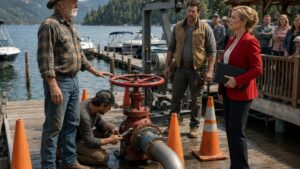
The first orange stake was driven into the ground six feet from the bridge my grandfather built.
I saw it before sunrise because its reflective strip caught my porch light when I stepped outside with coffee. A second stake stood beyond it, then a third beside the paved approach leading into the subdivision across Boone Creek.
By the time I reached the bridge, a white contractor truck was idling near the guardrail.
Two men were unloading measuring equipment.
“What are you doing?”
One of them glanced toward the subdivision.
“You’ll need to talk to the association.”
That answer irritated me more than if he had simply told me to move.
The bridge had been there since 1961. My grandfather had set the first timbers when the road beyond it was still used for hauling cut trees. The deck had been repaired plenty of times since, but some of the beams underneath were older than the houses visible through the trees.
Now someone had planted stakes around it as if I had missed a meeting about my own land.
A dark SUV came down from the subdivision.
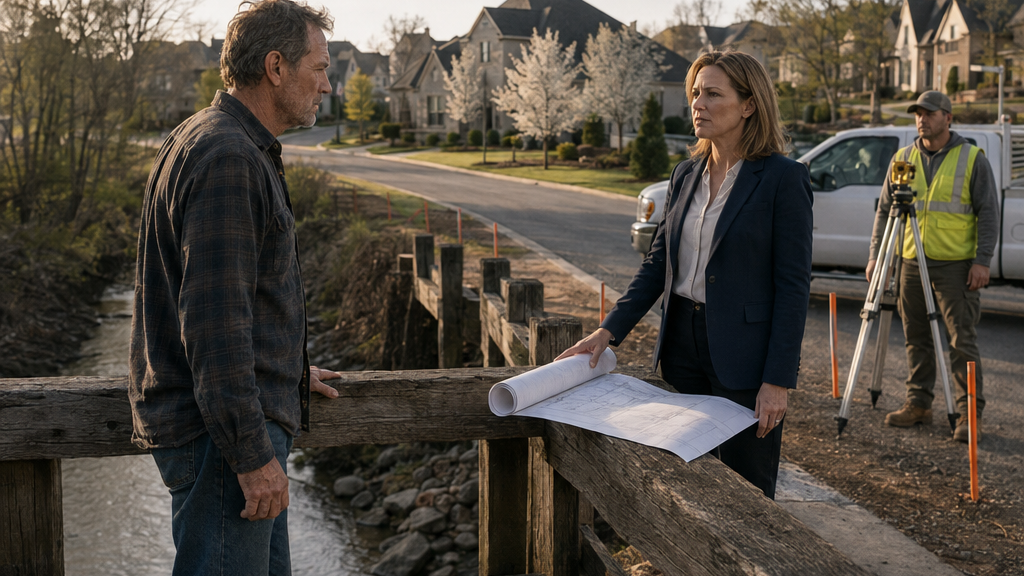
Catherine Roberts stepped out carrying a rolled plan beneath one arm.
I knew her by sight. HOA president. Always composed. Always moving like she had another appointment after the one she was standing in.
“Andrew,” she said. “I hoped we could catch you before the work started.”
“That makes one of us.”
She looked at the stakes.
“The board approved improvements to the entrance. We’re widening the approach slightly, replacing the exposed timber barrier, and making the bridge consistent with the neighborhood standards.”
I looked from her to the contractor.
“You’re replacing what?”
“The visible rails. Possibly some surface material.”
“On my bridge?”
Her expression tightened just enough to show she had expected resistance.
“This bridge serves the community.”
“That wasn’t my question.”
A sedan approached from behind her. Catherine stepped aside, and it rolled over the boards between us. The timbers gave their familiar low thump beneath the tires.
She waited until the car passed.
“Eighty-plus households use this crossing, Andrew. It has functioned as the subdivision entrance for years.”
“Still not an answer.”
I could feel my temper building in the place behind my ribs where it always started. My father used to tell me that silence was cheaper than regret. I had relied on that advice too long.
When the developer first paved the old logging road, I complained to my father but not to anyone holding a clipboard.
When the traffic increased, I complained to Margaret.
When delivery trucks started using the bridge every day, I replaced loose boards and told myself somebody would eventually ask whose bridge it was.
Nobody did.
My silence had become convenient.
Catherine unrolled her plan across the timber rail.
There were clean lines, measurements, landscaping marks, a wider entrance apron.
“See?” she said. “Nothing unreasonable.”
I studied the drawing.
“Where’s the property line?”
She hesitated.
“This is an infrastructure plan.”
“Then show me the line where your infrastructure becomes my property.”
One contractor looked away.
Catherine folded her arms.
“The association maintains the entrance.”
“No. The association uses the entrance.”
“Andrew—”
I turned toward the house.
“Stay here.”
I walked back before my anger could decide the conversation for me.
Margaret stood at the kitchen door.
“What happened?”
“They’re redesigning the bridge.”
Her eyes closed briefly.
“You mean asking?”
“No.”
I went to the cabinet where I kept property papers in a dented metal box that had belonged to my father.
The deed was folded inside a plastic sleeve.
When I returned, Catherine was talking quietly with the contractor.
I laid the deed on top of her bright new plan.
“Point to it.”
She frowned. “Point to what?”
“The part that says the HOA owns this bridge.”
She glanced down without touching the paper.
“I never said the association owns the underlying parcel.”
“You called it community infrastructure.”
“Because functionally it is.”
“Functionally my driveway could be a shortcut to town. That wouldn’t make it yours.”
Her jaw set.
“You have allowed unrestricted use for years.”
There it was.
Not ownership.
Use.
I looked at the contractors.
“No work today.”
Catherine’s voice sharpened.
“The board has already authorized it.”
“The board can authorize whatever it wants on HOA property.”
She stared at me.
Then she tapped one finger against the plan.
“This is the only practical entrance to the community. You cannot treat it like a private footpath because your family built it sixty years ago.”
For a second, I almost told her exactly what I thought of that sentence.
Instead I folded the deed.
“If it’s your entrance,” I said, “show me what gives you the right to it.”
Catherine gathered her plan.
“You’re making this more difficult than it needs to be.”
“No. I’m asking the question everybody skipped.”
She left with the contractors.
The stakes stayed.
I pulled them that afternoon and stacked them beside my shed rather than throwing them away.
Then I spent three hours going through old property papers.
Most were what I expected: surveys, tax receipts, handwritten repair notes, invoices for timber.
Near the bottom of the box was an older photocopy attached to a deed reference.
I nearly passed over it.
Then one word stopped me.
Easement.
I read the paragraph once.
Then again.
The language was narrow, older than I was, and written for a road that existed before anyone imagined a subdivision.
My grandfather had granted passage across the property.
But not to the public.
Not to a developer.
The document named one company.
A timber company.
And beside the description of its rights was another word Catherine Roberts had never mentioned.
Revocable.
Chapter 2: The Agreement Nobody Had Read Closely
Revocable.
I kept looking at the word as though it might change if I stared long enough.
The easement had been recorded decades earlier, when trucks came through the hollow carrying logs instead of groceries and schoolchildren. It granted a named timber company access along the road and across the creek.
Nothing in the paragraph mentioned successors in general.
Nothing mentioned residential development.
I knew enough to know that did not make me a lawyer.
By nine that morning, I was at the county records office.
The clerk helped me trace the recording references. The original instrument was older than the photocopy in my box, but the wording matched.
Then we looked for the company.
The trail ended in 1987.
Dissolved.
I sat in my truck afterward with copies spread over the passenger seat.
My first feeling was satisfaction.
My second was anger.
For years I had watched traffic cross a route tied to a company that had not existed since Ronald Reagan was president.
By noon, I was imagining a chain across the entrance.
Margaret stopped that thought before it became a plan.
“You’re not blocking those people in.”
“It’s my land.”
“I didn’t say it wasn’t.”
“They’re telling me what kind of rail I’m allowed to put on my own bridge.”
“And that makes locking eighty families behind a chain right?”
I pushed my chair back.
“I didn’t say I was doing it.”
“You’re thinking it loud enough.”
That afternoon I called Eric Miller.
He listened without interrupting while I explained the road, the bridge, the timber company, the HOA.
Then he asked the question I did not want.
“How long has the subdivision been using it?”
“Years.”
“With your knowledge?”
“Yes.”
“Any written objections before now?”
“No.”
“Any toll, access agreement, maintenance agreement, gate, written reservation?”
“No.”
Silence.
“So the easement is worthless?” I asked.
“I didn’t say that.”
“It sounds like you’re saying it.”
“I’m saying property cases are not vending machines. You do not insert one old document and receive the result you want.”
That irritated me enough that I almost ended the call.
Instead I drove to his office the next morning.
Eric read everything twice.
“The deed matters,” he said. “The named easement matters. The company’s dissolution matters. Your ownership matters.”
“Good.”
“But so does what happened afterward.”
He leaned back.
“Courts look at reliance. Notice. Longstanding use. What people reasonably believed. What you allowed. Whether another legal theory applies. And they care a great deal about consequences.”
“So because I didn’t start a fight ten years ago, they get my property?”
“No. But because you didn’t clarify the arrangement ten years ago, the remedy may be more complicated than you want.”
That landed harder because it was true.
I had been proud of staying out of subdivision business.
Now that silence had become part of their argument.
Eric recommended a survey before we did anything else.
Brian Lee met me at the bridge the following afternoon with a tripod, receiver, old plats and the dispassionate manner of a man who had learned never to join someone else’s property feud.
“You want me to tell you where the lines are,” he said. “Not who wins.”
“Fine.”
He worked his way from an old monument near the creek toward the paved approach.
A subdivision resident slowed while passing.
“What’s going on?”
“Survey,” Brian said.
The driver looked at me, then kept moving.
Three hours later Brian stood near the bridge with his field tablet.
“The road doesn’t leave your tract where you thought.”
I frowned.
“What do you mean?”
“You thought the subdivision boundary started before the bridge.”
“Yes.”
“It doesn’t.”
He walked me along the edge and pointed.
The paved road crossed onto my property well before the creek, continued over the bridge, and remained there farther toward the subdivision than I had realized.
“So all this…”
“Physical location only,” he reminded me.
He marked the approximate line with temporary flags.
Bright orange against old grass.
For the first time I could see the dispute instead of imagining it.
The subdivision’s clean blacktop did not simply touch my land.
It lay across it.
I should have felt vindicated.
Instead I heard Eric’s voice.
What happened afterward matters.
That evening I stood on the bridge while cars passed.
Nobody looked at me.
A woman waved.
A teenager drove too fast.
A pickup hauling landscaping equipment slowed over the boards.
Ordinary people.
Ordinary use.
Years of it.
I had mistaken my refusal to complain for proof everybody understood the arrangement.
Maybe nobody had understood anything.
The certified letter arrived the next morning.
Margaret signed for it.
I opened it at the kitchen table.
The HOA demanded that I cease interfering with authorized maintenance and refrain from obstructing community access. It referred to established use, resident reliance and the association’s responsibility to maintain safe infrastructure.
The wording was polished.
Careful.
Nothing about the timber company.
Nothing about my deed.
At the bottom was Catherine Roberts’s signature.
Margaret read over my shoulder.
“Does that sound like negotiating to you?”
I folded the letter.
“No.”
For the first time since the stakes appeared, the issue was no longer whether Catherine had overstepped.
The HOA had put its position in writing.
They were not asking for the bridge.
They were saying they already had the right to use it.
Chapter 3: Eighty-Six Homes and One Crossing
At 7:12 Monday morning, eleven vehicles were waiting to cross my bridge.
I knew because I counted them.
A school bus had stopped on the subdivision side while an electric utility truck approached from my side, and neither driver wanted to meet the other on the narrow deck.
Behind the bus came sedans, pickups and an SUV with a child pressing both hands against the rear window.
The bridge had never looked smaller.
The utility truck finally backed up.
Traffic moved.
Thirty-six vehicles crossed before eight.
By nine, I stopped counting.
Eric had advised me not to interfere with access while he reviewed the HOA’s claim. Catherine’s certified letter sat on my workbench under a wrench so the breeze would not carry it away.
I read it every time I passed.
Authorized maintenance.
Community access.
Established use.
Words designed to make my name disappear from my own property.
That afternoon Nicole came by.
She parked near the house instead of crossing the bridge from the subdivision side.
“You know people are talking about this?”
“People always talk.”
“Not like this.”
She followed me toward the shed.
“Someone told me you’re planning to gate the road.”
“I’m not.”
“They said the HOA had to stop work because you threatened to cut off access.”
“I stopped contractors from changing my bridge.”
“That isn’t what people heard.”
I looked toward the creek.
Catherine had not needed a judge to change the argument.
She only needed to change the story.
By dinner, Margaret had heard another version.
She put a serving dish on the table harder than necessary.
“A woman at the pharmacy asked if we were really going to make residents park outside and walk home.”
I set down my fork.
“That’s ridiculous.”
“She believes it.”
“I haven’t blocked one car.”
“I know that.”
“Then why are you looking at me like that?”
Margaret sat back.
“Because I want to know what you would do if Eric called tomorrow and said you had every legal right to close it.”
I answered too quickly.
“I’d close it until they came to the table.”
She stared at me.
There was no accusation in her face.
That made it worse.
“What if an ambulance needs it?”
I opened my mouth.
Nothing came out.
She continued quietly.
“What if that little boy who waves at you every afternoon needs it? What if somebody’s mother falls? What if there’s a fire?”
“They can’t just take the property because emergencies exist.”
“I didn’t say they could.”
That sentence sounded familiar.
She had used it before.
She was not asking me to surrender.
She was asking whether being wronged gave me permission to stop seeing everyone except the people who wronged me.
I pushed my plate away.
“I won’t block emergency vehicles.”
“Only emergency vehicles?”
The question irritated me because it exposed the weakness in my answer.
I went outside.
A vehicle crossed the bridge, tires humming over the boards.
Then another.
My grandfather had built it to move timber out of the hills.
My father had repaired it because it was ours.
I had maintained it because that was what we did with things we intended to keep.
Somewhere along the way, keeping it had begun to mean something different.
The next morning I called Eric.
“I want this clear,” I said. “Whatever we file, I’m not physically shutting residents in.”
“That is a very good sentence for you to keep repeating.”
“I mean it.”
“I know. Put it in writing.”
We sent a response stating that I disputed the HOA’s claimed rights but had no intention of interrupting emergency access or ordinary resident passage while the legal issue was being addressed.
It felt like giving something away.
Eric called it protecting my credibility.
Two days later, Catherine held an HOA meeting.
I did not attend.
I heard about it anyway.
Nicole sent me a screenshot from a neighborhood message thread. No threats. Nothing dramatic. Just a summary saying the board was “responding to a private landowner’s challenge to established community access” and taking steps to ensure residents were not deprived of the entrance on which they had long relied.
My name was not included.
It did not need to be.
Everyone knew whose land sat at the bridge.
What bothered me most was how reasonable the language sounded.
If I had lived in one of those houses, maybe I would have believed her too.
A resident stopped near my mailbox that evening.
He kept both hands on his steering wheel.
“My mother lives with me,” he said. “She’s seventy-eight.”
“All right.”
“I just need to know if I’m going to wake up one morning and find a chain there.”
“No.”
He studied me.
“No?”
“I’m not locking you in.”
His shoulders dropped slightly.
“Thank you.”
He drove away before I could tell him the second half.
That I still intended to make the HOA answer for what it had done.
The distinction mattered to me.
I was no longer sure it mattered to anyone else.
By the end of the week, I had learned there were eighty-six completed homes in the development.
Eighty-six families.
One practical entrance.
My bridge.
The number changed the weight of everything.
Then Brian called.
“You expecting another survey?”
“No.”
“You might want to walk the north side of the subdivision.”
I met him near the edge of the woods.
There, beyond the neat lawns and decorative fencing, orange flags had appeared in a line through the trees.
Not ours.
They ran away from the existing road toward higher ground.
At the far end, tied to a branch, was fresh survey ribbon.
I followed the line until I could no longer see the bridge behind me.
Catherine had found another answer.
If the HOA could build a second road, they would never have to recognize what crossed my land at all.
Chapter 4: The Road That Could Have Ended It
The excavator arrived before the county had approved anything.
I heard the diesel engine from my shed and followed the sound through the north woods until the trees opened onto the back edge of the subdivision.
The orange survey flags I had seen days earlier now formed a clear corridor through brush and young poplars. At the near end sat a tracked excavator on a trailer, its bucket chained down. Two workers were measuring the slope.
Catherine stood beside a pickup with a folder in her hands.
She saw me before I reached the flags.
“This isn’t your property,” she said.
“I know.”
That seemed to unsettle her more than an argument would have.
I stopped several feet short of the nearest marker.
“So this is the second entrance.”
“It’s a proposed access route.”
“Meaning you found a way around the bridge.”
“We’re evaluating options.”
I looked beyond her toward the line of flags climbing the ridge.
For the first time since the contractors had shown up at my bridge, I felt something close to panic.
If they built this road, my legal position might still matter, but my leverage would disappear. The HOA could stop using my land entirely. Catherine could tell every resident I had forced them to spend hundreds of thousands of dollars because I refused to cooperate.
Part of me wanted to find a reason to object.
Drainage.
Noise.
Traffic.
Anything.
Instead I asked, “Is it all on subdivision property?”
“The planned corridor is.”
“Then I’m not stopping you.”
Catherine lowered the folder.
“You’re not?”
“If the county approves it and it stays off my land, build whatever road you’re allowed to build.”
She studied me as if searching for the trap.
“There’s no objection?”
“I object to you pretending my bridge is yours. I don’t object to you solving your own access problem.”
One of the workers glanced between us.
Catherine’s expression shifted, not softer exactly, but less certain.
“I expected you to fight this.”
“That says more about what you think I want than what I’ve said.”
I left before she could answer.
On the walk home, relief and disappointment took turns.
If the road went through, the fight would become simpler.
No daily traffic across my bridge.
No elderly resident wondering whether I might close the route.
No HOA claiming necessity.
But it would also let Catherine avoid the one thing I wanted more than money.
Acknowledgment.
She would never have to say they had built their neighborhood around access they had never secured properly.
Margaret found me at the workbench that afternoon.
“Well?”
“They’re trying another route.”
“Can they?”
“Maybe.”
She watched me clean grease from a wrench that was already clean.
“You don’t sound happy.”
“I thought you wanted them off the bridge.”
“I do.”
“Then another road solves it.”
“I know.”
She leaned against the bench.
“You wanted them to admit it.”
I set the wrench down.
“Wouldn’t you?”
“Yes. But that’s different from needing it.”
I did not answer.
Two days later, Eric called.
“You filed an objection to the alternate access?”
“No.”
A pause.
“Good.”
“You sound surprised.”
“I’m learning.”
“That road could destroy my bargaining position.”
“It could.”
“And you still think I should let them build it?”
“I think if your stated goal is property control, fighting a lawful route off your property would make your motives easier to attack.”
The same lesson kept returning in different clothes.
The more I tried to defend the land, the more carefully I had to prove I was not trying to control everyone beyond it.
A week passed.
No grading began.
The excavator stayed on its trailer.
Then the trailer disappeared.
I drove to the county planning office.
A staff member pulled up the preliminary review.
The route crossed a low area behind the subdivision where water collected after heavy rain. On the map it looked like an inconvenience.
In the environmental review, it was something else.
Wetland.
Not the dramatic swamp people imagine. No broad sheet of water. Just soft ground, sedges, shallow drainage and soil that stayed wet long enough to matter.
The proposed road would require fill and disturbance beyond what the county could approve under the submitted plan.
“What does that mean?” I asked.
“It means they need another design, another route, or additional federal review and permitting.”
“Can they get that?”
“Maybe. Not fast.”
The answer should have felt like victory.
Instead, I pictured the resident who had stopped at my mailbox to ask about his mother.
When I got home, orange mud clung to my boots.
Margaret was waiting on the porch.
“You found out?”
I nodded.
“Denied?”
“For now.”
She looked toward the bridge.
A delivery van crossed, followed by a sedan.
“So nothing changes.”
“Everything changes.”
Because now Catherine knew exactly what I knew.
There was no easy second road.
No quick bypass.
No clean way to stop depending on the bridge.
The alternate route had been her exit from the argument.
The county had just closed it.
Chapter 5: When the Dispute Followed Us Home
The note was folded beneath my windshield wiper at the gas station.
I noticed it after I had already opened the truck door.
At first I thought it was a receipt.
Then I saw my name.
Andrew—
Stop holding the whole neighborhood hostage over an old bridge.
The rest was worse.
Not threatening.
Just contemptuous.
A line about people like me standing in the way of progress.
A suggestion that if I did not like the subdivision, I should have sold before it was built.
I read it twice.
Then I folded it and put it in my pocket.
A man at the next pump looked over.
“You Andrew Carter?”
I turned.
He lifted both hands.
“I’m just asking.”
“Yes.”
“My sister lives up there.”
I waited.
“She says people are scared you’re going to shut the road.”
“I’m not.”
“That’s not what they’re hearing.”
“Then somebody’s telling it wrong.”
He looked toward my truck.
“People got a lot tied up in those houses.”
“So do I.”
He nodded once, but his face said the sentence had not reached him.
At church that Sunday, conversations did not stop when Margaret and I walked in.
They changed.
That was worse.
People smiled.
They asked how we were.
Then they lowered their voices after we passed.
Nicole caught me looking.
“Dad.”
“I’m fine.”
“No, you’re counting who won’t look at you.”
“I said I’m fine.”
She waited until we reached the parking lot.
Then she said, “They think you’re planning to chain the bridge.”
“I already told people I’m not.”
“You told one man.”
“I put it in writing to the HOA.”
“That doesn’t mean residents saw it.”
I looked at her.
“What are you asking me to do?”
“Say it where they can hear you.”
“I’m not joining their message board.”
“I didn’t say you had to.”
“What, then?”
“Stop acting like silence makes you clearer.”
That hit harder than she intended.
Or maybe exactly as hard.
I had spent years believing that if I stayed calm and minded my business, other people would understand where the lines were.
The bridge had proved otherwise.
The subdivision had interpreted silence as permission.
Now residents were interpreting it as threat.
That afternoon, I wrote a short statement with Eric’s help.
I disputed the HOA’s claim of permanent access rights.
I would not obstruct emergency vehicles.
I would not suddenly prevent residents from reaching their homes while the matter was being resolved.
I wanted the status of the property addressed lawfully.
No threats.
No accusations.
Eric sent it to the association and asked that it be distributed to residents.
Catherine replied that the board would “review appropriate communication.”
“Meaning no,” I said.
“Meaning maybe,” Eric said.
“You’re generous.”
“I bill by the hour. Optimism is extra.”
It was the first time I had laughed in days.
Then he stopped smiling.
“I found something.”
He turned his monitor toward me.
It was an email from the HOA’s outside counsel to Catherine and two board members, dated months before the contractors appeared at my bridge.
The language was careful.
The recorded access instrument appeared limited.
The chain of rights into the modern development was not clear.
Counsel recommended confirming permanent residential access before significant capital improvements were made to the bridge.
I read the paragraph again.
“She knew.”
“She had notice there was a problem.”
“She stood on my bridge and acted like I was inventing this.”
“Yes.”
“Why didn’t she come talk to me then?”
Eric scrolled down.
Another message.
Catherine’s reply.
She asked whether raising the title issue with residents could affect refinancing, insurance review or future sales.
She also asked whether the board should pursue a secondary entrance before disclosing an unresolved access question.
My anger sharpened so quickly I had to stand.
“She knew.”
“Andrew.”
“She knew enough to look for another road.”
“Yes.”
“And while she did that, she told everyone I was interfering with community access.”
Eric folded his hands.
“This helps us.”
“That’s not what I’m thinking about.”
“What are you thinking about?”
I pictured Catherine on the bridge with her improvement plan.
Not confused.
Not uninformed.
Afraid.
And willing to make me look unreasonable while she tried to solve the problem quietly.
That evening, I stood near the creek after rain.
Mud had gathered between the old bridge boards where dozens of tires carried it back and forth.
The bridge looked tired.
Not fragile.
Just used.
That was what had happened to the truth too.
Too many people had driven over it until nobody could remember what had been underneath.
Nicole came down from the house.
“Mom said you found something.”
“Catherine knew the access wasn’t clean.”
Nicole’s face changed.
“So she lied?”
“She avoided saying what she knew.”
“That sounds like lying.”
“It may.”
I surprised myself by defending the distinction.
Not Catherine.
The truth.
A truck crossed behind us.
The driver slowed and lifted two fingers from the wheel.
I returned the gesture.
Nicole watched.
“You really won’t close it?”
“No.”
“Even now?”
“Especially now.”
She looked at me as if hearing the answer for the first time.
The next morning I called Eric.
“I want a meeting with Catherine before we use those emails.”
“I can ask.”
“She gets one chance.”
But Catherine never took it.
At 2:17 that afternoon, a process server walked up my driveway carrying a sealed packet.
The HOA had filed suit.
Chapter 6: What Catherine Was Trying to Save
The email Catherine never expected me to read began with four words.
We need another entrance.
Eric placed the printed page in front of me during discovery review.
The message was nearly a year old, written before the orange stakes, before the bridge plans, before Catherine ever told me the association considered the crossing community infrastructure.
She had sent it to the developer representative.
The rest was blunt.
The recorded access language was inadequate for the neighborhood’s long-term needs.
The subdivision should not depend on one crossing controlled by land outside association ownership.
A second route needed to be secured before more homes closed.
I looked at Eric.
“She tried to fix it.”
“Yes.”
“And the developer didn’t.”
“Keep reading.”
The response came three days later.
The second entrance would be expensive. Final phases were already approved. Residents had used the existing bridge without interruption. Counsel could address any issue if one arose.
Catherine replied once more.
This time the tone was sharper.
She warned that leaving the neighborhood dependent on disputed access would eventually become the board’s problem.
Then the correspondence stopped.
“What changed?” I asked.
Eric slid another folder toward me.
“The developer turned control of the HOA over to the residents. Catherine became president. And the problem she warned about became hers.”
It did not excuse anything.
But it rearranged the picture.
I had imagined Catherine seeing my bridge and deciding it belonged to the HOA because she wanted control.
Instead she had seen the same defect before I did.
She had tried to get someone else to fix it.
When they refused, she inherited it.
Then she made her mistake.
She hid it.
At mediation, Catherine looked different without a board table in front of her.
Still composed.
But tired.
Her attorney sat beside her. Eric sat beside me.
For an hour, everyone spoke in careful phrases.
Historical use.
Recorded rights.
Reliance.
Maintenance.
Resident safety.
Potential remedies.
Finally I pushed the papers away.
“Why didn’t you tell me?”
Her attorney started to answer.
I looked at Catherine.
“I asked her.”
She stared at the table.
“Because I didn’t know what would happen.”
“That’s the reason?”
“No.”
She took a breath.
“If I told eighty-six households that the only dependable entrance to their homes might not be permanently secured, what do you think happens next?”
“That depends whether it’s true.”
“It was not established.”
“You knew it was possible.”
“Yes.”
The word settled between us.
Catherine continued.
“We had owners refinancing. Homes under contract. Insurance renewals. Two residents whose parents depend on medical transport. If the board announced an unresolved access defect before we had another route, I could have created a crisis without solving anything.”
“So you decided I should carry it.”
“I decided we needed another entrance first.”
“And when that failed?”
Her mouth tightened.
“I made the wrong call.”
Eric said nothing.
Neither did her attorney.
I had waited weeks to hear something like that.
It did not feel as satisfying as I expected.
“What wrong call?”
Catherine looked at me.
“I treated continued use like certainty. And I thought if the bridge improvements moved forward, the practical reality would strengthen the association’s position.”
There it was.
Not confusion.
A decision.
She had known enough to hesitate and chosen momentum instead.
“You tried to make the facts on the ground harder to undo.”
“Yes.”
“That’s why the contractors showed up.”
“Yes.”
I sat back.
For the first time, I understood her and trusted her less at the same time.
Catherine rubbed one thumb along the edge of her folder.
“I was not trying to take your family property.”
“You were trying to make my permission irrelevant.”
Her face tightened.
“I was trying to keep people from waking up one morning and learning their houses had an access problem.”
“You made me the problem instead.”
She did not answer.
That silence was the closest thing to agreement I expected.
The mediation moved to numbers.
The HOA offered compensation for a broad permanent easement.
More money than I had expected.
Margaret would have looked at the figure twice.
I did.
Then I read the conditions.
The association would receive extensive authority to maintain, widen, redesign and replace the bridge as required for community standards and safety.
I pushed it back.
“No.”
Eric looked at me.
Catherine’s attorney frowned.
“Mr. Carter, perhaps you should consider the value of—”
“It’s not the amount.”
Catherine leaned forward.
“What is it, then?”
“You still want control.”
“We need the ability to maintain safe infrastructure.”
“You need access. That doesn’t mean you get to redesign whatever sits inside the access.”
“A bridge carrying eighty-six households cannot be maintained according to one owner’s personal preference.”
“And it cannot become HOA property because you attach a maintenance clause to a check.”
Her attorney started speaking about objective engineering standards.
I barely heard him.
For weeks I had told myself I wanted recognition.
Now someone had put enough money on the table to test whether that was true.
If I accepted, I could walk away richer.
The neighborhood would keep its road.
The legal bills would stop.
But the first time an HOA committee decided the old timber rail did not match an entrance monument, we would be back where we started.
Only then I would have signed away the argument.
Catherine watched me.
“What do you want, Andrew?”
I almost answered.
Then I realized I did not know how to say it yet.
Not in legal terms.
Not in a settlement clause.
I knew what I did not want.
I did not want the residents trapped.
I did not want the HOA owning the bridge in everything but name.
I did not want money to become permission to erase the boundary.
And I no longer wanted to spend the rest of my life standing beside the creek angry that nobody had asked.
“I want it decided properly,” I said.
Catherine exhaled.
“That means court.”
“Yes.”
Outside, Eric waited until the mediation-room door closed.
“You understand you could get less.”
“I know.”
“You could also get a remedy you don’t like.”
“I know.”
“You’re unusually calm about that.”
I looked back through the glass at Catherine gathering her files.
“No. I’m just finally arguing about the right thing.”
Not whether I could punish them.
Not whether they could outspend me.
The question was simpler.
Could a community depend on something for years and turn dependence into ownership without ever asking the person who carried the burden?
I folded Catherine’s rejected offer and handed it back to Eric.
“Let the judge hear it.”
Chapter 7: The Judge Asked the Question They Avoided
The HOA’s attorney called my bridge “indispensable community infrastructure” before the hearing was ten minutes old.
I was sitting beside Eric at a wooden table in the county courtroom, looking at an enlarged survey mounted on an easel.
The bridge sat at the center of it.
My bridge.
My parcel.
Their road.
Three different sets of lines made that simple picture look complicated enough to start a war.
The HOA’s attorney spoke about reliance first.
Eighty-six households.
Years of uninterrupted use.
Emergency access.
Deliveries.
School transportation.
Property values.
He never said the timber company’s name.
He never said revocable.
He never said Catherine had warned the developer before the association inherited the problem.
Instead, he built the case around consequences.
If I were allowed to withdraw access, he argued, ordinary residents would suffer for decisions they had never made.
That part was true.
I hated that it was true.
Then he called the bridge a community asset.
Eric touched my sleeve before I could react.
“Let him finish.”
The judge looked down at the file.
“Community asset in what sense?”
The attorney shifted.
“In practical function, Your Honor.”
“Ownership?”
“No.”
“Recorded easement?”
“We contend continued use and reliance establish enforceable access rights.”
The judge looked toward our table.
Eric rose.
He did not argue that I should be allowed to barricade the road.
That mattered.
Instead, he walked through the records.
The deed.
The old easement.
The timber company.
The company’s dissolution.
Brian’s survey.
The absence of any later recorded document granting permanent residential access.
Then he addressed my silence before the HOA could use it.
“Mr. Carter did not object to ordinary use for years. We are not pretending otherwise. But tolerated use is not the same as transfer of ownership, and it does not automatically grant an association unilateral authority to widen, redesign or characterize privately owned improvements as its own.”
The judge turned toward me.
“Mr. Carter, have you threatened to close the bridge?”
I stood.
“No, Your Honor.”
“Have you prevented residents from using it since this dispute began?”
“No.”
“Emergency vehicles?”
“No.”
“Contractors?”
“I stopped contractors from altering the bridge.”
“Not from crossing it?”
“No.”
The judge nodded once.
The HOA’s attorney rose again.
“Your Honor, the distinction sounds neat in hindsight, but the association is responsible for safe access. It cannot fulfill that responsibility if one private owner can veto necessary maintenance.”
That word again.
Necessary.
The judge looked at Catherine.
She was seated behind counsel with two board members.
“Ms. Roberts, did the association investigate the recorded access before approving the bridge work?”
Her attorney objected to the phrasing.
The judge rephrased.
“Did the association have notice that the recorded access rights might be uncertain?”
Catherine’s face changed.
Only slightly.
But I saw it.
“Yes.”
“When?”
“Before the improvement plan.”
“And what did the association do?”
“We pursued a secondary entrance.”
The judge glanced at the exhibits.
“The route that was not approved?”
“Yes.”
“And before that issue was resolved, the association authorized work on Mr. Carter’s bridge?”
Catherine looked at her attorney.
Then back at the judge.
“Yes.”
“Why?”
The courtroom went very still.
Catherine did not give the answer I expected.
She did not blame the developer.
She did not say she had been advised the HOA would prevail.
She said, “Because I believed delay would make the residents more vulnerable.”
The judge watched her.
“More vulnerable to what?”
“To losing access.”
“And you thought improving the bridge would reduce that risk?”
Catherine swallowed.
“I thought continued investment and maintenance would strengthen the community’s position.”
There it was, now said in open court.
Not theft.
Not ignorance.
A calculated attempt to make the existing reality harder to challenge.
I should have felt triumphant.
Instead I felt tired.
The judge looked at the survey again.
Then at the old easement.
Then at the subdivision plat.
He tapped one finger against the page.
“How did eighty-six homes get built with one practical access point and no clearly recorded permanent residential easement across this parcel?”
Nobody answered immediately.
The developer representative was not in the room.
The board members stared at their folders.
Catherine looked straight ahead.
The judge repeated the question more quietly.
“I’m not asking who is angry now. I’m asking how the development reached this point.”
The HOA attorney began explaining approvals, historical use and assumptions carried forward from the development stage.
The judge stopped him.
“Assumption is what concerns me.”
That was the moment the balance changed.
Not because the judge gave me everything.
He did not.
The court recognized that the underlying property belonged to me and that the HOA had not shown a clear recorded instrument granting it ownership or unrestricted permanent residential easement rights on the terms it claimed.
But the judge also refused to treat eighty-six occupied homes as if they were empty lots on a plat.
Years of use mattered.
Reliance mattered.
Emergency access mattered.
My own long silence mattered.
Eric had warned me.
Ownership was not a vending machine.
The judge ordered the parties to negotiate a formal access arrangement under court supervision if necessary.
Neither side received absolute control.
The HOA could not simply declare the bridge community property.
I could not simply wake up the next morning and close it.
The ruling should have felt incomplete.
Instead, as I listened, I realized it was forcing exactly the decision I had avoided for years.
I had to say what I actually wanted.
Outside the courthouse, Catherine came down the steps behind us.
Residents were not waiting with signs.
There was no crowd.
Just lawyers, cars, and people going back to ordinary lives.
Catherine stopped a few feet away.
“We’ll make a proposal.”
“I’ve already seen your proposal.”
“A different one.”
I looked at her.
She seemed smaller without the board around her.
Not defeated.
Just stripped of the assumption that she could define the terms alone.
“When?” I asked.
“Soon.”
Eric and I walked toward his car.
He unlocked it, then looked back at me.
“You got the important part.”
“What part?”
“The court did not give them the story they wanted.”
“And it didn’t give me mine.”
“No.”
He opened the driver’s door.
“That may be why this has a chance of ending.”
Three days later, just after seven in the morning, I heard tires on the bridge.
One vehicle.
No contractor truck.
No board members.
No attorney.
Catherine’s SUV stopped at the far end.
She got out alone and began walking toward me.
Chapter 8: The Terms Written Beside the Old Timbers
Catherine carried no plans when she came back to the bridge.
No folder.
No rolled drawings.
No contractors measuring my rails.
Just a legal pad tucked under one arm.
I was standing near the same timber where I had laid my deed across her improvement plan weeks earlier.
She stopped on the bridge and looked down at the boards.
“They’re louder when you’re walking instead of driving.”
“They’ve always been loud.”
“I never noticed.”
“That was part of the problem.”
She accepted that without arguing.
For a few seconds, cars passed behind her one at a time.
She stepped aside for each one.
No one honked.
No one stopped.
Finally she said, “What do you want?”
I had spent three days preparing for that question.
Not with Eric.
Not with Margaret.
By myself.
Because the answer had to belong to me before a lawyer turned it into clauses.
“I don’t want to close the road.”
Catherine nodded.
“I know.”
“I don’t want to sell the bridge.”
Her expression tightened slightly.
“The board thought you might.”
“No.”
“That would be the simplest solution.”
“For you.”
“For everyone.”
“No. It would be simplest on paper.”
I rested a hand on the rail.
“My grandfather built this crossing. My father repaired it. I’ve maintained it most of my life. Selling it because your developer failed to secure access would fix your records by erasing mine.”
Catherine looked toward the creek.
“What does that leave?”
“An easement.”
She looked back.
“A permanent one?”
“Yes.”
That surprised her.
I continued before she could mistake it for surrender.
“Recorded. Defined width. Defined use. No expansion without my written consent. No decorative redesign because a committee decides the bridge looks old.”
Her mouth almost moved toward a smile.
Almost.
“Safety repairs?”
“Required repairs, yes. Based on engineering need, not appearance.”
“Maintenance responsibility?”
“The HOA pays for the wear caused by neighborhood traffic.”
“Insurance?”
“Covered.”
“Liability?”
“Allocated properly. Eric can write it.”
She began making notes.
“Compensation?”
“Yes.”
“How much?”
“That’s for the lawyers to argue about.”
She stopped writing.
“That’s not what I expected.”
“What did you expect?”
“A number.”
“I had a number before. It wasn’t enough.”
Her eyes narrowed.
“The offer was substantial.”
“The offer came with control.”
Catherine closed the pad.
“Andrew, the board cannot agree to permanent access while having no say in whether the bridge remains safe.”
“You’ll have a say. You won’t have ownership.”
“That distinction is going to require careful language.”
“That’s what lawyers are for.”
A pickup crossed behind us.
The driver lifted a hand.
I returned it.
Catherine watched the exchange.
Then she said, “The court changed how people are talking.”
“I’m sure.”
“Some of them are angry with the board now.”
“I’m not interested in that.”
“You should know.”
“I already spent too much time caring who was angry.”
She looked at me for a long moment.
Then she said, “There’s something else.”
I waited.
“The secondary entrance.”
“The wetland route?”
“We’ll keep studying alternatives.”
“Good.”
“I want the agreement to say that.”
“That you’ll build another road?”
“That the association will maintain a funded plan to pursue a second emergency access where legally feasible.”
I had not expected her to offer that.
“Why?”
“Because I was right about one thing before I started being wrong about everything else.”
I raised an eyebrow.
“No neighborhood should depend forever on one crossing.”
That was true.
It had been true before the lawsuit.
It had been true when the developer ignored her.
It had even been true when she tried to solve the problem by turning my bridge into something the HOA could control.
I nodded.
“Put it in.”
Catherine opened the pad again.
“There’s also replacement.”
“What about it?”
“This bridge will not last forever.”
I looked down.
One surface timber near my boot carried a dark split that had been there for two winters.
She was right.
The bridge was inheritance, but inheritance was not immortality.
“If it needs full replacement,” I said, “the new bridge stays inside the agreed corridor. Ownership of the land stays mine. Design is based on safety and function.”
“And the association funds it?”
“For the share of use you create.”
She sighed.
“We’re going to spend months defining that sentence.”
“Probably.”
She wrote it anyway.
When she finished, she leaned against the rail.
“I owe you an apology.”
I did not rescue her from saying it.
She looked uncomfortable.
Good.
Not because I wanted her humiliated.
Because some sentences should cost something.
“We treated continued permission as if it were ownership,” she said. “I treated your objection as a threat before you made one. And I should have come to you when I first learned the title issue might exist.”
I looked across the creek toward the subdivision.
“You should have.”
“I was afraid.”
“I know.”
“That doesn’t make it right.”
“No.”
Another silence.
Then I said, “I should’ve spoken years earlier too.”
Catherine looked surprised.
“I knew the road was being used. I knew more traffic kept coming. I told myself if I stayed quiet, everybody understood it was still mine.”
“That helped create the assumption.”
“Yes.”
It hurt to say.
But not as much as pretending otherwise had.
The agreement took four months.
Eric and the HOA attorney fought over language that Catherine and I had described in twenty minutes.
There would be a recorded access corridor.
The land beneath it remained mine.
Residents, guests, emergency vehicles, delivery services and ordinary subdivision traffic received defined passage rights.
The HOA assumed specified maintenance costs and insurance obligations.
No widening, decorative reconstruction or relocation could occur without written consent except for documented emergency safety work.
A reserve fund would be created for eventual bridge replacement.
The association also committed annual funds toward a feasibility study for secondary emergency access.
The compensation was fair.
Not life-changing.
That mattered to me more than I expected.
I did not want my family bridge to become a story about how much money I extracted from frightened homeowners.
I wanted the record to say what everyone should have said at the beginning.
Permission has terms.
Ownership has boundaries.
Need does not erase either.
When the final documents were ready, Catherine met me at the bridge again.
Eric came this time.
So did Brian.
The agreement rested on the same old rail where I had once spread my deed across Catherine’s construction plan.
She signed first.
I signed second.
No photographs.
No board ceremony.
No speeches.
Brian returned several weeks later to set permanent corridor markers.
Small survey caps went into the ground at measured points along the access.
The orange temporary flags disappeared.
For months, those flags had looked like threats.
Now the markers meant something different.
A boundary everyone had finally agreed to see.
The first major repair under the new agreement came before winter.
One of the old rail timbers had to be replaced.
The contractor set the weathered piece aside.
I picked it up before they hauled away the debris.
It was heavier than it looked.
A long crack ran through one end, and the grain had gone dark from decades of rain.
Nicole found me carrying it toward the shed.
“You keeping that?”
“Yes.”
“What are you going to do with it?”
“I don’t know yet.”
She smiled.
“Sounds familiar.”
I laughed.
A vehicle crossed behind us.
Then another.
The bridge gave the same low wooden thump it always had.
The neighborhood was still there.
My land was still mine.
Catherine was still HOA president.
Not everyone liked the agreement.
Not everyone liked me.
Nothing had become perfectly fair.
But the bridge no longer belonged to whoever spoke with the most confidence.
For the first time, the record matched the reality.
People could cross because I had agreed to terms that protected them.
And those terms protected what my family had carried forward.
I set the old timber inside the shed instead of leaving it outside to rot.
Then I walked back toward the creek as the evening traffic moved over the bridge.
This time, when the boards sounded beneath the tires, I did not hear people taking something from me.
I heard something being used according to terms I had finally learned to say out loud.
The story has ended.