My Neighbor Poured Concrete Across My Driveway—Then His New House Sat Dark for Forty-Seven Days
Chapter 1: The Concrete Was Still Wet Saturday Morning
The concrete was still wet when Jack Anderson stepped onto his front porch.
For a few seconds, he simply stared.
The pale gray slab began at the edge of Ryan Campbell’s construction entrance next door, widened across the narrow strip between the properties, and continued several feet into Jack’s driveway. It had been poured thick enough to bury the lower edge of the old asphalt and seal the path between Jack’s garage and the street.
His car sat behind it.
So did the rolling tool cabinet he used for small electrical jobs.
A wooden form board still hugged one side of the fresh pour. Damp concrete glistened beneath the morning light.
Jack looked toward the neighboring property.
Nobody was working.
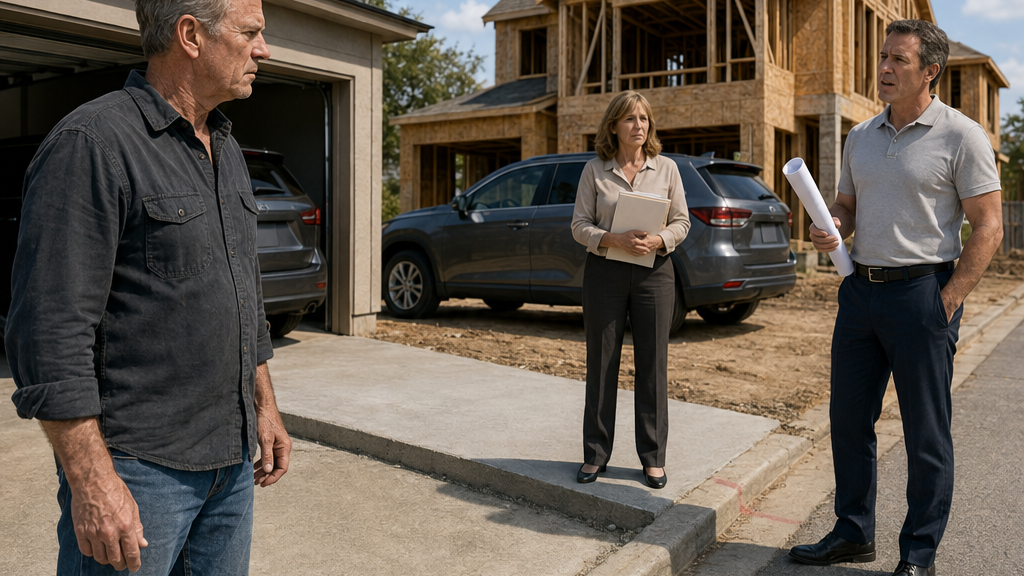
The half-finished custom house rose beyond temporary fencing, its roofline already towering above every ranch house on the block. A mixer chute had left streaks in the dirt near Ryan’s side of the property. Tire tracks ran from the construction entrance toward Jack’s driveway.
This had not washed over accidentally.
Someone had meant to put it there.
Jack stepped off the porch and stopped three feet short of the wet surface.
“Unbelievable.”
He took out his phone.
His first impulse was to call Ryan.
Instead, he opened the camera.
Four photographs from the street. Three from the garage side. One showing the forms. Another showing the tracks from the neighboring construction site. He crouched and photographed the point where the new concrete crossed the older asphalt.
Only then did he notice the time.
7:18.
His first delivery block started at nine.
Jack went into the garage and pressed the remote anyway. The door climbed, revealing the nose of his aging SUV.
There was no way around the concrete without driving across the lawn, dropping over the curb and risking the sprinkler line. Even if he tried it, Ryan’s contractors had left stacked lumber close to the side boundary.
Jack called the delivery dispatcher.
“I’ve got a property access problem,” he said. “I may not make the first block.”
“How late?”
“I don’t know yet.”
The dispatcher paused. “Saturday routes are full. If we release yours, I can’t promise another one today.”
Jack looked at the SUV.
“What about tomorrow?”
“Depends what opens.”
He did the math without needing paper.
Two weekend blocks, possibly Monday morning if the driveway stayed inaccessible. The better routes paid more because of mileage and volume.
“Worst case?”
“If you miss everything you usually take? Twelve, fourteen hundred, somewhere in there.”
Jack closed his eyes.
“Okay. Release this morning.”
“You sure?”
“No choice.”
After the call, he stood beside the garage workbench with his phone still in his hand.
Fourteen hundred dollars was not ruinous. But it was not nothing. Retirement had not turned out quite as comfortably as he had once expected, and the delivery work covered insurance, property taxes, and the ordinary expenses that had a habit of arriving together.
He called Ryan.
No answer.
He called again.
Voicemail.
At 7:46, a pickup entered the neighboring construction site. Jack walked over before the driver could disappear behind the temporary fence.
The man getting out wore work boots and a fluorescent vest.
“You with the concrete crew?”
“Not concrete.”
“Do you know who poured last night?”
The man glanced at the driveway.
“Oh. Yeah. They finished the approach.”
“My approach?”
The worker looked more carefully.
“That’s the approved apron, far as I know.”
“It’s across my driveway.”
The man lifted both hands. “I’m not the GC.”
“Who told them to pour it?”
“You need to talk to Ryan.”
Jack gave a humorless nod.
“I’ve been trying.”
By nine, the concrete had begun losing its shine.
By ten, two neighbors had slowed while driving past.
Jack hated that almost as much as the obstruction itself.
The subdivision had been quiet when he bought the house twenty-three years earlier. Over time, houses changed hands. Remodels got bigger. Then the HOA started sending thicker architectural packets and thinner explanations.
Jack had stopped attending meetings years ago.
He told himself it was because he valued his time.
The less flattering truth was that he had grown tired of speaking in rooms where confidence seemed to matter more than accuracy.
Three months earlier, when the HOA mailed notice of Ryan’s major rebuild, Jack had glanced at the envelope and dropped it into a kitchen drawer unopened.
Ryan finally returned the call at 10:17.
“I’m standing at my driveway,” Jack said.
“So am I.”
Jack turned.
Ryan stood across the fresh concrete near his construction fence, phone against his ear.
He lowered it.
Jack did the same.
“You poured onto my property.”
Ryan walked closer but stayed on his side of the wet slab.
“My contractor poured the approved approach.”
“Approved by who?”
“The architectural committee. County plans too.”
Jack pointed toward his trapped SUV. “Whatever somebody approved, that blocks my driveway.”
Ryan exhaled through his nose.
“Jack, the entrances were being tied together because of the grading change. You got the neighborhood packet.”
“That doesn’t give you permission to pour concrete over my access.”
“It isn’t over your access. It’s the widened approach.”
Jack stared at him.
“You can see my garage.”
“I can also see the approved site plan.”
“Then show it to me.”
Ryan’s expression tightened, but he turned toward the construction trailer.
He returned with a rolled set of plans.
The top sheet showed the front of both lots, Ryan’s new drive, drainage arrows, setback lines and a broad concrete apron near the street.
Ryan tapped one corner.
“There.”
Jack followed his finger.
The drawing was cleaner than Jack expected.
A widened approach did appear to overlap the area where Jack’s driveway met the street.
Then he saw the box in the lower right corner.
Architectural review.
Approved.
The HOA’s stamp sat directly beneath it.
Jack looked from the stamp to the concrete hardening across his driveway.
The argument had just become larger than Ryan Campbell.
Chapter 2: The Plan Everyone Said Was Approved
“The plan is approved, Jack.”
Ryan said it again that afternoon as if repetition could turn a drawing into a property line.
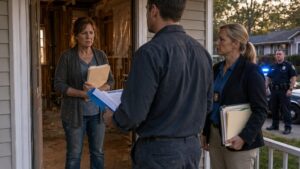
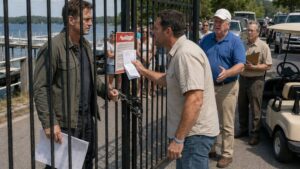
They stood beside the now-solid concrete while Cynthia Wilson held the architectural packet against the hood of her SUV. Brenda Torres, one of the committee members, stood a few feet away with her arms folded.
Jack had asked for an HOA representative.
Ryan had apparently asked for witnesses.
Cynthia adjusted the pages.
“The committee approved the exterior plan and site presentation,” she said carefully. “That doesn’t necessarily adjudicate private property rights.”
Ryan looked at her. “You approved the approach.”
“We approved what was submitted.”
“There. Exactly.”
Jack pointed toward his garage.
“Then tell me how I’m supposed to drive out.”
Nobody answered immediately.
The silence irritated him more than an argument would have.
Ryan finally said, “The contractor can feather the transition.”
“Feather it?”
“When everything cures.”
“You buried the existing edge.”
“It’s a few feet of concrete.”
“It’s the only few feet connecting my driveway to the street.”
Cynthia stepped between their lines of sight without literally standing between them.
“Jack, we’re trying to separate two questions. One is access. The other is whether the construction matches the approved plan.”
“They’re the same question from where I’m standing.”
Brenda looked toward the slab.
“I thought the old driveway came farther toward Ryan’s side.”
Jack turned to her.
“Based on what?”
She hesitated.
“The plan.”
That was the problem.
Everyone kept pointing back to the same sheet.
Jack asked Cynthia to spread it on the hood.
He traced the property boundary with one finger.
The line was thin and gray. Near the street it disappeared beneath dimensions, grading notes and the wide depiction of the new concrete apron.
“Where did this base drawing come from?”
Cynthia said, “It was included in the architect’s submission.”
“Survey?”
“I assume so.”
“Recorded plat?”
“I’d have to check.”
Ryan gave a short laugh.
“Come on. Are we really doing this?”
Jack straightened.
“Yes.”
“You got notice months ago. Nobody heard a word from you.”
That landed harder than Jack wanted it to.
Because Ryan was right.
The HOA had sent notice.
Jack had ignored it.
Ryan continued, “We went through review. We revised the plans twice. I paid for engineering, permits, architectural changes, drainage changes. Now that concrete is on the ground, you decide there’s a problem?”
“I decide there’s a problem because I can’t get my car out.”
“You could’ve raised it before.”
“I should have.”
The admission quieted everyone for a moment.
Jack did not enjoy making it.
But he would not let his own mistake become permission for someone else’s.
“I should’ve read the packet,” he said. “That still doesn’t make my driveway yours.”
Ryan’s jaw tightened.
“I’m already carrying months of delays. I’m not stopping an entire build because you suddenly want to debate a corner of an apron.”
“I lost work this morning.”
“I’m sorry about that.”
“You don’t sound sorry.”
“What do you want me to say?”
“That you’ll fix it.”
Ryan glanced at Cynthia.
“Before we know whether anything was done wrong?”
Jack felt his temper rise.
He had spent years learning to recognize the exact moment when anger made people sloppy. In engineering meetings, the person who raised his voice usually stopped listening two minutes before everyone else noticed.
Still, he heard himself say, “You poured across somebody else’s driveway overnight.”
Ryan’s expression cooled.
“And if you want to turn that into litigation, call an attorney.”
“I’d rather you correct it.”
“My attorney bills more in a morning than you lost on your delivery route.”
Brenda looked away.
Cynthia’s face hardened. “Ryan.”
“What? He keeps threatening trespass.”
“I said the concrete crossed my access.”
“You’re acting like I sent somebody over here with a jackhammer.”
Jack almost answered.
Instead, he looked down.
At the curb beside the fresh concrete was a faded mark he had noticed that morning without really seeing it. A narrow line of old paint, nearly bleached away. Red once, though sun and tire dust had turned it rusty pink.
He crouched.
The others fell quiet.
Ryan said, “What now?”
Jack rubbed his thumb beside the paint without touching it.
There were small remnants farther back in the grass. Not survey paint. Utility paint, or something that had been renewed over an older route.
His eyes followed the alignment.
It did not track with the driveway.
It angled toward Ryan’s property.
Toward the new house.
Jack stood slowly.
“Cynthia.”
“Yes?”
“Which utility-overlay drawing did the architectural committee use?”
Her expression changed by less than an inch.
But Jack saw it.
“What do you mean?”
“The utility overlay. Existing easements, underground routes, service corridors. Which sheet was reviewed with this?”
Ryan gave an impatient shrug.
“That’s county stuff.”
Jack ignored him.
Cynthia flipped through the packet.
Site plan.
Drainage.
Landscape.
Elevations.
Lighting.
Materials.
She went through them again, slower.
Brenda moved closer.
“There was a utility sheet, wasn’t there?”
“I thought there was.”
Ryan said, “The engineer handled utilities.”
“That isn’t what I asked,” Jack said.
Ryan turned toward him. “And suddenly you’re the engineer?”
Jack met his eyes.
He could have answered that.
He chose not to.
Cynthia kept flipping pages.
“What exactly are you suggesting?”
“Nothing yet.”
“Then why are we looking for a utility overlay?”
“Because that marking doesn’t make sense with this drawing.”
Brenda looked from the faded red line to Ryan’s house.
“What marking?”
Jack pointed.
She crouched now.
Cynthia remained by the hood, one hand resting on the packet.
Ryan said, “That could be from anything. Cable. Old locator paint. Irrigation.”
“Could be,” Jack said.
That seemed to irritate Ryan more than an accusation.
Cynthia closed the packet.
“If you have evidence that the concrete crossed your surveyed property, submit it to management. Until then, I’m not ordering work stopped based on an old paint mark.”
Jack nodded once.
“That’s fair.”
Ryan stared at him, apparently surprised.
Jack took several photographs of the faded marking, then one showing its angle relative to the new house.
Cynthia asked, “What are you going to do?”
“Look at the records.”
Ryan shook his head.
“You’re going to spend your weekend chasing an old stripe of paint?”
Jack looked again at the approval packet.
“No.”
He pointed at the missing place in the stack.
“I’m going to find the sheet you should already have.”
Cynthia opened the packet a third time.
This time she did not defend it.
There was no utility-overlay sheet inside.
Chapter 3: The Map Jack Had Not Opened in Years
Jack recognized the notation before he noticed the date.
UE.
Permanent.
Twenty feet.
The scanned document filled his computer screen just after ten Saturday night, its paper background yellowed into digital gray. A faded red line crossed the lower portion of the property diagram, clipped by handwritten references and an old recording stamp.
Jack leaned closer.
He had spent most of the evening telling himself not to find what he wanted to find.
That was an old discipline.
Fourteen years in utility electrical engineering had taught him that the most dangerous person examining a plan was often the one who already knew what conclusion he preferred.
So he began with the driveway.
County parcel map.
Recorded subdivision plat.
Jack’s deed.
Ryan’s parcel.
Older survey references.
He printed each one and laid them across his dining table.
The original property line supported Jack’s memory. His driveway was his. The newer construction drawing depicted a widened apron with graphics that visually blurred the edge between the two properties, but Jack could find no recorded transfer, shared-drive agreement or easement giving Ryan rights over Jack’s access.
That should have felt like victory.
Instead, Jack kept thinking about the faded red paint.
At 8:40 he opened the county recorder’s older document index.
At 9:12 he found a reference number tied to a utility easement.
At 9:47 he downloaded the scan.
Now he sat looking at it.
The easement had been granted decades before either Jack or Ryan owned their homes. It reserved a corridor for utility infrastructure across the side of what later became the two residential lots.
Jack found the legal description.
Then he found the words that mattered.
Permanent easement and right of access.
He pushed his chair back.
“No.”
The word came out quietly.
He pulled Ryan’s current site plan onto the second monitor.
The scale differed, so he did not trust a visual comparison. He found two fixed references common to both documents, checked dimensions, converted the old bearings and plotted the corridor against the newer foundation footprint.
The red line crossed the side of Ryan’s new house.
Jack stared at the screen for several seconds.
Then he checked again.
A third time.
On the most conservative interpretation, the foundation edge appeared to intrude by roughly four feet.
The driveway was suddenly the smaller problem.
He stood and walked into the kitchen.
On the counter sat the unopened remnants of the HOA mail he had ignored over the previous months. He found the drawer where he had shoved Ryan’s original construction notice.
There it was.
He opened it for the first time.
The packet announced a major architectural application, listed meeting dates and gave adjacent owners a period to submit comments.
Jack had done nothing.
He remembered seeing the envelope.
He remembered thinking the same thing he always thought when the HOA mailed something thick: somebody wanted to justify a decision already made.
That habit had once felt like self-respect.
Tonight it looked more like laziness dressed as principle.
If he had opened the packet, would he have noticed the easement months ago?
Maybe.
Maybe not.
But he would at least have been in the room.
Jack returned to the computer.
For years, people who knew him only as the man in the older SUV had assumed delivery work was what he had always done. Jack never corrected them. He had left utility engineering after fourteen years, then spent another stretch doing contract technical work before gradually reducing his hours.
He did not miss the meetings.
He did miss the precision.
A line on a utility map was never merely a line. It represented clearance, access, maintenance rights, liability, serviceability. Sometimes safety.
And unlike an HOA drawing, a recorded permanent easement did not disappear because a cleaner plan left it off.
At 11:20, Jack began constructing a proper comparison.
Not an accusation.
A record.
He downloaded the deed reference tied to the easement. He found the county parcel dimensions. He checked whether later filings released or modified the corridor.
Nothing.
He searched under the utility’s former corporate name.
Nothing.
He checked for abandonment.
Nothing.
The easement remained in the chain of title.
That mattered.
But it still did not prove Ryan’s house violated it.
Jack knew enough to know the difference.
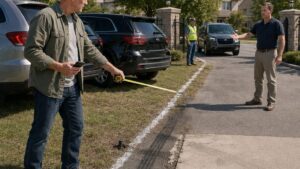
The following morning, he carried a tape measure to the front yard before the neighborhood was fully awake.
He did not enter Ryan’s construction property.
He stayed on his own side and used visible fixed points from the recorded plat to make rough checks.
The faded utility paint aligned almost exactly where the old map suggested it would.
From there, the corridor angled toward Ryan’s foundation.
Jack lowered the tape.
The house was enormous from this close.
Stone veneer had begun appearing along the front elevation. New windows reflected the houses across the street. Electrical service equipment had not yet been installed permanently, but conduit stubs and temporary construction power were visible near one side.
He imagined Ryan standing there the day before, telling him how expensive his attorney was.
For one ugly second, Jack enjoyed what he knew.
He could walk next door with the map.
He could place it on Ryan’s hood and watch his face change.
He could make a bargain.
Fix my driveway today, or I make one phone call.
The thought satisfied him for perhaps five seconds.
Then it bothered him.
If the easement mattered enough to stop a house from being built over it, it was not a poker chip.
And if he used it as one, Ryan would be right about at least one thing: this would become personal.
Jack went back inside.
He enlarged the 1987 scan and read the granting language one more time.
The easement gave the utility continuing access for installation, operation, inspection, maintenance and replacement of facilities within the described corridor.
The word permanent appeared twice.
At 9:05 Sunday morning, his phone rang.
Ryan.
Jack let it ring once before answering.
“You get your records?” Ryan asked.
“I did.”
“And?”
“The concrete crossed my access.”
Ryan sighed. “We can deal with that Monday.”
Jack looked at the red line on his screen.
“That isn’t the part I’m concerned about anymore.”
Silence.
“What does that mean?”
“It means I found the utility document that wasn’t in the HOA packet.”
Another pause.
Ryan’s tone changed.
Not much.
Enough.
“What document?”
“A recorded easement from 1987.”
“So?”
“I’m still verifying it.”
“Does it affect my property?”
Jack could have said yes.
Instead he said, “I think you should have your engineer check the recorded easements before any more permanent work happens on that side.”
Ryan was quiet long enough that Jack could hear construction equipment backing somewhere in the distance.
Then he said, “Are you telling me to stop my build?”
“No. I’m telling you what I found.”
“Jack, I have crews scheduled tomorrow.”
“I know.”
“If this is about the driveway—”
“It isn’t.”
Ryan exhaled.
“You could just tell me what you think is wrong.”
“I think the recorded document needs to be verified by the utility or county.”
“That serious?”
Jack looked at the overlay he had made.
Four feet.
Maybe a little less.
Maybe a little more.
Serious enough that guessing would be irresponsible.
“Yes,” he said.
After they hung up, Jack opened the county utility compliance page.
There was a form for easement questions and suspected encroachments.
He filled in the property information, attached the recorded plat and current site plan, and stopped with the cursor hovering over Submit.
The driveway could be negotiated.
The lost income could be calculated.
Concrete could be cut out and repoured.
But once he submitted this, the question would no longer belong to Jack or Ryan or the HOA.
He reread the 1987 filing one final time.
Permanent.
Jack clicked Submit.
Chapter 4: Four Feet Changed the Entire Dispute
The utility inspector arrived Monday morning carrying a measuring wheel, a tablet, and two cans of marking paint.
No attorney.
No HOA representative.
No dramatic warning.
Just a county vehicle parked beside Jack’s curb and a man checking parcel numbers before he stepped onto the grass.
Jack watched from his driveway.
Ryan came out of the construction trailer almost immediately.
“What’s this?”
The inspector looked up. “Easement verification.”
Ryan’s eyes shifted toward Jack.
“You called them?”
“I submitted the recorded document.”
“You could’ve talked to me first.”
“I did.”
“That wasn’t a conversation. You told me to stop work.”
“I told you to have your engineer check the easement.”
Ryan looked toward the unfinished house.
A framing crew was already working on the far side. Compressors thumped. A saw whined and stopped.
The inspector asked both men to remain clear while he established reference points.
Jack stayed on his property.
That mattered to him.
So did not saying, I told you so.
The inspector checked the 1987 filing against current parcel data, then walked the corridor with the utility easement technician who arrived twenty minutes later.
They placed small flags.
Then red paint.
A faded line that had barely been visible beside Jack’s driveway became something unmistakable.
The technician sprayed a fresh mark in the grass.
Another ten feet farther.
Then another.
The line continued toward Ryan’s house.
Ryan followed several yards behind.
At first, he seemed convinced the measurement would end near the driveway.
It did not.
The inspector stopped beside the new foundation wall.
He checked the tablet.
Measured again.
Moved his reference point.
Measured a third time.
Ryan folded his arms.
“Well?”
The inspector did not answer immediately.
Jack understood that silence.
It was the silence of someone making sure a bad number was actually a bad number.
Finally, the inspector said, “The recorded easement corridor extends through this area.”
Ryan pointed at the ground.
“This area meaning what?”
The technician placed the end of the tape against the foundation.
“Based on the recorded description and today’s field verification, this corner appears to encroach approximately four feet.”
The construction noise seemed louder after that.
Ryan stared at the wall.
“That can’t be right.”
“We’ll issue a written determination after we confirm the record,” the inspector said.
“My engineer signed this.”
“I’m not reviewing your engineer’s work today. I’m verifying the recorded easement.”
“The county permitted the foundation.”
“The building permit doesn’t extinguish a utility easement.”
Ryan looked at Jack.
Jack kept his hands in his pockets.
That was harder than he expected.
For most of the weekend he had imagined this moment as clean satisfaction: a simple reversal after Ryan’s dismissive comments.
Instead, four feet looked very small on the ground.
Four feet of concrete.
Four feet of wall.
Four feet that could cost more than Jack wanted to guess.
Ryan asked, “What happens now?”
The inspector turned the tablet toward himself.
“Until the easement issue is resolved, no permanent utility connection should be approved in the affected area.”
Ryan’s face changed.
Not dramatically.
Just enough.
“What do you mean ‘no permanent utility connection’?”
“Temporary construction service is one thing. Final service and occupancy are another.”
“My electrical rough-in is already inspected.”
“This isn’t an electrical-code issue. It’s access and encroachment.”
Ryan stepped closer.
“So you’re telling me the house can’t get power?”
“I’m telling you permanent service is on hold until the utility confirms the easement is clear or an acceptable correction is approved.”
Ryan looked at Jack again.
This time there was no irritation in his expression.
Only calculation.
“What does an acceptable correction look like?”
“That’s between you, your engineer, the utility, and the building department.”
The inspector marked one more point.
Red paint landed on the ground almost directly below the corner of Ryan’s house.
Jack felt no triumph.
Only weight.
By noon, the framing crew had stopped working on that side.
At 1:30, Ryan’s attorney arrived.
Jack saw the dark sedan pull up and expected the man to come over.
He did not.
He went straight to Ryan.
They stood beneath the temporary shade canopy near the construction trailer for nearly forty minutes.
At one point Ryan pointed toward Jack’s house.
The attorney looked.
Jack went inside.
He did not want to perform for them.
He spent the afternoon organizing the driveway photographs and calculating the income he had actually lost.
Not what he might claim.
What he could document.
Two canceled blocks.
One smaller replacement block he had been able to take after borrowing a neighbor’s car.
Fuel difference.
Nothing inflated.
At four, Cynthia called.
“Jack, I just got an email from management.”
“About the inspection?”
“Yes.”
Her voice had the strained carefulness of someone trying not to say too much before understanding liability.
“Apparently there’s a utility easement issue.”
“There is.”
“Did you know about it before Saturday?”
“No.”
“You sound very sure now.”
“I worked utility engineering for fourteen years.”
Silence.
Then: “You never mentioned that.”
“Nobody asked.”
“That’s not really the point.”
“It is a little.”
She let out a breath.
“Management wants a copy of everything you submitted.”
“I’ll send it.”
“And the driveway photographs.”
“I’ll send those too.”
Another pause.
“Jack, I need to ask something.”
“Go ahead.”
“When you received Ryan’s architectural notice, did you review it?”
There it was.
“No.”
“Why not?”
He looked through the kitchen doorway toward the drawer where the unopened notice had sat.
“Because I stopped believing the meetings mattered.”
Cynthia did not answer.
Jack continued.
“That was my mistake.”
“I appreciate you saying that.”
“It doesn’t fix the plan.”
“No.”
Something in her voice had changed.
Jack heard papers moving.
“Cynthia?”
“I’m looking at the review checklist.”
“And?”
“There’s a box for utility conflicts.”
“Checked?”
“Yes.”
“Supporting sheet?”
More paper.
“I don’t see one.”
Jack leaned against the counter.
“Who checked the box?”
“I don’t know yet.”
By Tuesday morning, the county sent the preliminary notice.
The easement remained active.
The encroachment required formal resolution.
Permanent electrical service was placed on administrative hold.
Ryan came to Jack’s front walk holding a copy.
He did not cross onto the driveway.
“Did you know they’d shut down power?”
“No.”
“You knew it was possible.”
“Yes.”
Ryan looked back at the house.
“My lender gets nervous when completion dates move.”
“I figured.”
“I have a lease ending in six weeks.”
Jack said nothing.
Ryan folded the notice once, then unfolded it.
“You could’ve brought this to me before filing.”
“And what would you have done?”
“Called my engineer.”
“I told you to.”
Ryan looked down.
For a second, Jack thought he might acknowledge it.
Instead he said, “This is bigger than a driveway now.”
“Yes.”
“That what you wanted?”
Jack felt the question strike exactly where Ryan intended.
He considered lying.
“No.”
Ryan studied him.
“I wanted my driveway back.”
“That all?”
“At first.”
Ryan gave a tired shake of his head and walked away.
Later that afternoon, Cynthia called again.
This time she skipped the careful introduction.
“We have a problem.”
Jack waited.
“I found the architectural review packet we used.”
“You found the utility sheet?”
“No.”
Her voice tightened.
“I found proof that we approved the project without it.”
Chapter 5: The Missing Sheet in the HOA File
Brenda Torres placed two versions of Ryan’s property file side by side on the conference table Wednesday evening.
“That one,” she said, touching the thicker folder, “is from the older archive.”
Then she tapped the thin digital printout.
“And this is what the committee actually reviewed.”
Jack did not need her to explain the difference.
The old file contained a utility exhibit with the easement corridor drawn in faded red.
The newer packet did not.
Cynthia sat at the end of the table with the HOA management representative beside her. Ryan sat opposite Jack, his attorney on his right.
Nobody looked comfortable.
Brenda slid the older exhibit forward.
“I found this in the storage scan from a prior exterior application,” she said. “It wasn’t attached to Ryan’s submission.”
Ryan’s attorney spoke first.
“Was my client required to supply it?”
The management representative answered. “The architectural checklist requires identification of known recorded easements affecting the work.”
“That isn’t what I asked.”
Cynthia stepped in.
“The committee also has an obligation to review required documentation before issuing approval.”
Ryan looked at her.
“So now this is the HOA’s fault?”
“I didn’t say that.”
“You approved it.”
“We approved an incomplete package.”
“That’s worse.”
Brenda looked down.
Jack could see what she was trying not to show.
Guilt.
Three days earlier she had assumed Jack’s complaint was another neighbor argument over construction inconvenience.
Now the old red line sat in front of her.
Jack said, “Who removed the sheet?”
“No one necessarily removed anything,” Brenda said. “The architect submitted a clean digital site plan. The committee reviewed what came in.”
“Then how did the utility box get checked?”
Cynthia turned the current review sheet around.
A small checkmark sat beside UTILITIES/EASEMENTS REVIEWED.
Brenda stared at it.
“I checked that.”
The room went still.
Cynthia asked, “Based on what?”
“The general site plan.”
“You thought it showed all utilities?”
“I thought the engineer’s drawing incorporated them.”
Ryan’s attorney leaned forward.
“So your committee represented that easements were reviewed without reviewing the recorded easement?”
Brenda’s face flushed.
“I relied on a licensed submission.”
Jack almost interrupted.
He stopped himself.
There was a familiar rhythm starting in the room: everyone locating the nearest person to blame.
He had seen enough of that in his engineering years.
A bad drawing could travel through six desks while every person assumed the previous desk had checked the missing thing.
The management representative said, “We need to separate the HOA architectural approval from county and utility obligations.”
Ryan laughed once.
“That distinction didn’t seem important when you were collecting review fees.”
Cynthia’s jaw tightened.
“Ryan, we are trying to determine what happened.”
“What happened is I built from plans your committee stamped.”
“You also had an engineer.”
“And a contractor. And county permits. That’s why people hire professionals.”
Jack looked at him.
There it was again.
The same belief, only without the arrogance now: if enough qualified people signed something, responsibility could be distributed until nobody personally carried it.
Cynthia turned toward Jack.
“We also need to address the driveway.”
Ryan’s attorney shifted in his seat.
Jack placed his photographs on the table.
The concrete crossing was obvious.
The older plat made it worse.
The management representative studied the documents.
“I don’t see a recorded shared-access agreement.”
“There isn’t one,” Jack said.
Ryan rubbed his forehead.
“So we cut it back.”
Jack looked at him.
“That simple?”
“For the driveway? Yes.”
His attorney murmured something.
Ryan shook his head.
“No. I’m not tying this one to the easement fight.”
That was the first thing Ryan had said all evening that Jack had not expected.
Cynthia asked, “You’re agreeing to restore Jack’s access?”
“Yes.”
“Immediately?”
Ryan looked at Jack.
“Within whatever curing and contractor schedule makes sense. But yes.”
Jack nodded once.
“Thank you.”
Ryan looked almost annoyed by the politeness.
Then Cynthia asked the question nobody had addressed.
“If you thought the plans were correct, why did you keep working after Jack warned you Sunday?”
Ryan’s attorney said, “My client doesn’t need to answer that.”
Ryan leaned back.
For several seconds, he stared at the older utility exhibit.
Then he said, “Because stopping would have cost me money.”
His attorney turned toward him.
Ryan continued before anyone could stop him.
“My construction loan has milestone dates. I have rate-lock exposure. The framing crew was scheduled. Stone was already ordered. We’re in a temporary rental that ends soon.”
Jack said, “That explains Saturday.”
Ryan looked at him.
“What?”
“The pressure explains why you wanted the concrete done. It doesn’t explain Sunday.”
Ryan’s expression hardened.
“You called the county.”
“After I told you what I found.”
“And I didn’t know if you were right.”
“You were worried I might be.”
Silence.
Jack had not planned to say it.
But once it was out, Ryan did not deny it.
Cynthia folded her hands.
“Were you?”
Ryan looked toward the closed conference-room door.
“Yes.”
The word changed the room more than any document had.
Ryan’s attorney stopped taking notes.
Brenda looked at him.
Ryan continued quietly.
“After Jack mentioned the utility overlay, I called my engineer. He didn’t answer. I called the contractor. He told me easements would’ve been handled during permitting.”
“So you kept going,” Cynthia said.
“I had people scheduled.”
“You could have paused that side.”
“I could have.”
Jack watched Ryan’s face.
The man who had joked about attorney fees on Saturday was gone.
Not replaced by someone innocent.
Just someone more recognizable.
Afraid of losing control.
Ryan said, “You want the ugly answer? I thought if I stopped every time somebody raised a question, this house would never get finished. I’d already spent months dealing with revisions. Drainage. Roof pitch. Materials. Setbacks. I was done being delayed.”
Jack understood that impulse better than he wanted to.
He had spent years avoiding HOA meetings for a different version of the same reason.
He had decided engagement was pointless before anyone could waste his time again.
Ryan had decided caution was pointless before anyone could delay him again.
Different choices.
Same arrogance hidden inside exhaustion.
Brenda pushed the old exhibit toward Cynthia.
“We should’ve caught it.”
Cynthia nodded.
“Yes.”
The admission came without qualification.
Jack felt something loosen.
Not satisfaction.
Something quieter.
The driveway problem was formally acknowledged before the meeting ended. The HOA management representative confirmed that the approved architectural drawing did not grant Ryan property rights over Jack’s access. Ryan agreed in writing to remove the encroaching concrete and restore the driveway.
It was the first actual resolution Jack had received.
Yet when he left the meeting, the larger conflict remained untouched.
Ryan followed him into the parking lot.
“Jack.”
Jack stopped.
Ryan held his keys but did not move toward his car.
“I meant what I said about the driveway.”
“Okay.”
“I’ll fix it.”
“I believe you.”
Ryan gave him a tired look.
“You don’t have to sound surprised.”
“I am a little.”
For the first time, Ryan almost smiled.
It disappeared quickly.
Then he said, “I knew Sunday night there might be something wrong.”
Jack waited.
Ryan looked across the dark parking lot.
“And Monday morning, before the inspector came, my engineer finally called.”
Jack’s attention sharpened.
“What did he say?”
“That he couldn’t confirm the easement had been cleared.”
“And you still let the crews start.”
Ryan nodded.
Once.
“I did.”
Chapter 6: The House Could Stand but Not Turn On
By the third week, Ryan’s house looked finished from the street.
Stone covered the lower walls.
The driveway on Ryan’s side had been cleaned.
Landscaping crews had installed shrubs and young trees.
Exterior light fixtures flanked the front doors in polished black metal.
At dusk, they remained dark.
Temporary construction power still fed tools through an approved panel, but permanent residential service had not been released.
The house could stand.
It could be painted.
Floors could go in.
Cabinets could be installed.
But the county would not issue final occupancy while the utility easement remained obstructed.
Jack noticed the darkness every evening.
At first, he hated that he noticed.
There was a part of him that wanted the scene to feel satisfying.
Ryan had poured concrete across his driveway.
Ryan had mocked his lost income.
Ryan had ignored the warning.
Now the biggest house on the block sat dark while every smaller house around it lit up.
It should have felt like balance.
Instead, Jack kept thinking about four feet.
That was all.
Four feet had become engineers, attorneys, revised structural calculations, lender calls, contractor delays and a family still living somewhere else.
The driveway restoration happened before the easement dispute was resolved.
Ryan kept his word.
A concrete crew arrived early one Thursday, saw-cut the offending section and removed it without touching the original base more than necessary.
Jack stood nearby while they worked.
The saw screamed through the slab.
Gray dust rose and settled across the temporary barriers.
The sharp new line that had crossed Jack’s access disappeared piece by piece.
By afternoon, the approach was usable again.
Ryan walked over while the crew cleaned up.
“They’ll come back for the finish work after it cures.”
Jack nodded.
“I appreciate it.”
Ryan shoved his hands into his pockets.
“My attorney thinks I shouldn’t talk to you.”
“That makes two of us. Cynthia probably thinks I shouldn’t talk to anybody.”
Ryan smiled briefly.
Then he looked toward his own house.
“The utility rejected the first correction proposal.”
Jack had heard.
The idea had been to modify access around the encroachment without touching the foundation.
“Why?”
“Not enough clearance for maintenance.”
Jack nodded.
That had been his suspicion.
Ryan studied him.
“You knew that would happen?”
“No.”
“You thought it might.”
“Yes.”
Ryan looked irritated, then seemed to decide he no longer had the energy for it.
“What would you do?”
Jack took a second before answering.
Three weeks earlier he would have enjoyed being asked.
Now he was careful.
“I’d listen to your engineer.”
“He says part of the foundation probably has to come out.”
“Then he knows more about your structure than I do.”
“Four feet.”
“That’s what they measured.”
Ryan kicked lightly at loose gravel.
“Four feet.”
Neither man spoke for a while.
The following Monday, the engineering conclusion became official.
The encroaching section could not remain.
The utility required its permanent access corridor restored to the recorded dimensions. Ryan’s structural engineer designed a correction that involved supporting part of the affected wall, removing the offending foundation section, rebuilding within the legal footprint and reworking several connected elements.
Jack read the notice only because Ryan sent him a copy.
No message.
Just the PDF.
Jack replied with two words.
Got it.
Demolition started four days later.
The sound was different from the driveway saw.
Lower.
Heavier.
A hydraulic breaker struck the foundation in measured bursts.
Jack stood at his kitchen window for less than a minute before turning away.
He had no desire to watch.
That surprised him.
What he wanted now was finality.
Not spectacle.
The delay stretched.
Thirty days.
Thirty-five.
Ryan’s temporary rental had to be extended.
A utility scheduling window was missed while concrete cured.
Then another inspection found that one relocated conduit needed revised documentation.
Jack heard fragments of the process from Cynthia, from construction activity, and occasionally from Ryan himself.
Their conversations became shorter and less hostile.
One afternoon Ryan crossed to Jack’s side carrying an envelope.
“Documented delivery losses,” he said.
Jack did not take it immediately.
“You don’t have to do that today.”
“I should’ve done it three weeks ago.”
Jack opened the envelope.
The amount matched the calculation he had provided through management.
No extra.
No apology note.
Just a check.
“That covers it,” Jack said.
Ryan nodded.
Then he looked at the repaired driveway.
“You could probably make a claim for more.”
“I could probably make a claim for a lot of things.”
Ryan waited.
Jack folded the envelope.
“I wanted access restored. I wanted the lost work covered. That’s done.”
“And the rest?”
“The rest isn’t mine to price.”
Ryan looked toward his dark house.
“Feels like everybody else has.”
Jack almost told him not to feel sorry for himself.
But that would have been easy.
Instead he said, “You made the choice after you knew there was a problem.”
Ryan’s face tightened.
“I know.”
“That’s the part you own.”
Ryan nodded slowly.
“And the part before?”
“Shared around more than people want to admit.”
That seemed to land.
By week six, the corrected foundation passed structural review.
The utility technician returned and rechecked the corridor.
Fresh red paint appeared in the grass again, but this time the marks ran cleanly past the rebuilt wall.
No intrusion.
No ambiguity.
Cynthia stopped beside Jack’s mailbox that evening.
“We’re drafting a new architectural procedure.”
Jack looked at her.
“For what?”
“Recorded easement overlays. Major rebuilds won’t get final HOA approval without them.”
“That should’ve already been happening.”
“I know.”
He expected her to defend the board.
She did not.
Instead she said, “Brenda found three older files where the same checkbox was marked without supporting exhibits.”
Jack frowned.
“Any active construction?”
“No. We checked.”
“Good.”
Cynthia hesitated.
“We could use somebody with utility experience to review the language.”
Jack laughed once.
“No.”
“I thought you’d say that.”
“I stopped doing unpaid committee work a long time ago.”
“This wouldn’t be engineering approval.”
“It starts that way.”
Cynthia gave him a level look.
“You also stopped attending meetings.”
Jack said nothing.
She left before he had to answer.
That night, he stood at the end of his repaired driveway.
The seam between old asphalt and new concrete was visible but clean.
On Ryan’s property, the house was still dark.
Day forty-six.
Jack realized Cynthia’s question bothered him because she was right.
He had spent years complaining privately about a process he refused to participate in.
That did not excuse what happened.
But it had helped create the conditions where nobody challenged assumptions until concrete was already hard.
The next morning, utility trucks arrived before eight.
Ryan stood beside the service equipment with the inspector, his electrician, and the utility technician.
Jack did not walk over.
He watched from his porch.
The technician checked the rebuilt corridor one final time.
The inspector signed something on a tablet.
Then Ryan turned.
Across both driveways, he looked directly at Jack.
He raised one hand.
Not a wave exactly.
More like confirmation.
Day forty-seven had arrived.
And for the first time since the concrete was poured, the utility crew was there to turn something on instead of stop it.
Chapter 7: The Line They Finally Agreed to Respect
The exterior lights on Ryan Campbell’s house came on at 4:16 that afternoon.
Jack Anderson knew the exact time because he happened to be standing at his mailbox when it happened.
For forty-seven days, the fixtures beside Ryan’s front doors had been nothing more than expensive black shapes against stone. Now they glowed even in full daylight, followed a few seconds later by lights inside the entry hall.
A utility truck remained at the curb.
The technician closed the service cabinet.
Ryan stood near the front walk with his electrician and the inspector. When the inspector handed back the signed paperwork, Ryan looked toward Jack’s property.
Neither man celebrated.
Ryan simply raised his hand.
Jack returned the gesture.
The strange thing was how ordinary the moment looked.
No cheering.
No angry confrontation.
No line of people watching Ryan finally get what he had been denied.
Just a finished house receiving electricity after a problem that should have been caught before the first shovel went into the ground.
Jack collected his mail and went inside.
There was a check from Ryan on the kitchen counter for the delivery income Jack had documented. Jack had not deposited it yet.
He did that the next morning.
Nothing more.
The dispute could have ended there.
His driveway was open.
His losses had been covered.
The foundation had been corrected.
Ryan’s house had power.
But the HOA meeting the following Tuesday had one final item on the agenda.
Architectural review procedures.
Jack nearly skipped it.
At six forty-five, he stood in his kitchen staring at the meeting notice while an old irritation rose in him.
He had spent years avoiding that room.
The folding chairs.
The arguments over paint colors and fences.
The people who used phrases like “community standards” as if they had been carved into stone tablets.
He had told himself he was done with all of it.
Then he looked through the window toward the repaired edge of his driveway.
The concrete seam was clean now.
A narrow line separating old asphalt from the new correction.
Nothing dramatic.
But it was exactly where it belonged.
Jack picked up the meeting notice.
The HOA room was almost full when he arrived.
Cynthia noticed him before he sat down.
“You came.”
“Don’t make it an event.”
“I wasn’t going to.”
“You were thinking about it.”
She smiled and handed him a packet.
Ryan was already seated across the room.
No attorney.
No contractor.
Just Ryan.
Brenda sat beside the architectural committee files with the old 1987 utility exhibit on top.
That surprised Jack.
For weeks the red-line map had felt like evidence.
A weapon, almost.
Now it looked like what it had always been.
A record somebody should have checked.
Cynthia opened the meeting without mentioning the dispute by name.
“We’ve completed a review of the architectural process for major structural applications.”
She explained the proposed change.
Any future rebuild involving foundations, expanded driveways, utility relocation, or substantial grading would require a current recorded-easement overlay before final HOA architectural approval.
No checkbox without the supporting document.
No assumption that a general site plan contained every restriction.
Brenda added, “If something is missing, the application stays incomplete.”
Ryan raised his hand.
Cynthia looked almost startled.
“Yes?”
“I think the owner should sign that they’ve reviewed the easement sheet too.”
The room stayed quiet.
Ryan continued.
“Not just the architect. Not just the engineer. The owner.”
Jack looked at him.
Ryan did not look back.
Cynthia wrote something down.
“That’s reasonable.”
One board member asked whether the procedure would create delays.
Jack nearly laughed.
Instead Brenda answered.
“A few days reviewing the right document is cheaper than forty-seven days correcting the wrong one.”
Nobody applauded.
Jack was grateful for that.
The rule passed after twenty minutes of discussion.
When Cynthia moved to the next agenda item, Ryan slid his chair back and walked toward the hallway.
Jack followed a minute later.
Ryan was standing near the door when Jack came out.
“I wanted to talk before I left,” Ryan said.
Jack waited.
Ryan held an envelope.
“If that’s another check, I don’t want it.”
“It is.”
“Then keep it.”
Ryan frowned. “It’s for inconvenience beyond the documented delivery losses.”
“What inconvenience?”
“The car. Time. Meetings. All of it.”
Jack shook his head.
“You paid what I could document.”
“That doesn’t mean it covered everything.”
“No. It means it covered what I’m willing to put a number on.”
Ryan looked down at the envelope.
“A month ago you would’ve taken this.”
“A month ago I probably would’ve asked for more.”
That drew the smallest smile from Ryan.
Then it disappeared.
“I was wrong, Jack.”
Jack said nothing.
Ryan went on.
“Not about everything at first. The plan was approved. I honestly thought the contractor was following it.”
“I know.”
“But after Sunday…”
He stopped.
Jack waited.
“I knew there might be a real problem,” Ryan said. “And I kept going because I was scared that if I paused, everything would start falling apart. Loan deadlines. Contractors. The rental. My family asking when we were finally moving.”
He rubbed the envelope between his fingers.
“So I acted like certainty was the same thing as being right.”
Jack looked through the open meeting-room door.
Cynthia was already arguing with someone about landscaping rules.
“That happens.”
Ryan studied him.
“That’s it?”
“What do you want me to say?”
“I don’t know.”
“You want me to tell you forty-seven days makes us even?”
Ryan did not answer.
“It doesn’t,” Jack said. “Your house sitting dark didn’t put money back in my pocket. The check did. Fixing the driveway did. Correcting the easement solved the utility problem. Those are separate things.”
Ryan nodded.
“And the lawyer comment?”
“That was stupid.”
“It was.”
“I’m sorry.”
Jack believed him.
Not because Ryan sounded defeated.
Because he sounded embarrassed.
There was a difference.
Jack looked at the envelope again.
“Keep it.”
Ryan tucked it into his jacket.
They walked outside together.
The repaired driveway lay beneath the parking-lot lights, the new concrete meeting the old surface in a straight seam.
Ryan stopped beside it.
“I thought you were just trying to stop the house.”
Jack gave him a sideways look.
“I thought you were just another guy who believed approval meant he could do whatever he wanted.”
“Maybe we were both lazy.”
“You poured concrete over my driveway.”
“Okay. Maybe not equally lazy.”
Jack laughed.
It surprised both of them.
Ryan looked toward his house down the street.
The exterior lights were visible through the trees now.
“You know what the worst part of those forty-seven days was?”
“The bills?”
“Second worst.”
“What was first?”
“Driving past the house every night knowing there was nothing wrong with ninety-nine percent of it.”
Jack understood immediately.
“All because of four feet.”
Ryan nodded.
“Four feet.”
Jack looked at the driveway seam.
“Lines matter most when people think they’re small.”
Ryan considered that.
Then he said good night and walked home.
Jack went back into the meeting.
Cynthia was gathering papers.
“You stayed,” she said.
“Apparently.”
She handed him a draft copy of the new review checklist.
“I want you to look at something.”
“I already told you I’m not becoming the HOA engineer.”
“You wouldn’t be.”
“That sentence has trapped a lot of people.”
She pointed to one paragraph.
“We’re not asking anyone here to validate engineering. We’re asking the committee to verify that the required record exists before approving an application.”
Jack read it.
The wording was reasonable.
Clear, even.
“What do you want from me?”
“Tell us if the utility terminology is understandable.”
Jack sighed.
Then he pulled out a chair.
“Five minutes.”
Twenty minutes later, he was still there.
He removed one ambiguous phrase, suggested that recorded easements and field utility markings be treated as separate things, and insisted the checklist specify that HOA approval did not replace county, utility, or private-property requirements.
Cynthia wrote it all down.
When they finished, she said, “Next month?”
“No.”
“Two months?”
Jack stared at her.
She smiled.
“Worth trying.”
He left carrying the old red-line map because Brenda had asked him to compare it with the revised checklist.
At home, Jack set it on his desk.
For weeks, that map had meant leverage.
Then proof.
Then consequence.
Now it was simply a reminder that important lines could disappear when people stopped looking for them.
The following month, Jack attended another architectural review meeting.
There was no dispute.
No angry neighbor.
No multimillion-dollar construction crisis.
A homeowner wanted to extend a garage.
Brenda worked through the new checklist.
“Recorded plat?”
“Attached.”
“Setbacks?”
“Sheet three.”
“Drainage?”
“Sheet four.”
She reached the new line.
“Recorded easements?”
The homeowner passed over a utility overlay.
Brenda placed it beside the site plan.
Jack sat near the end of the table with the 1987 map folded inside his folder.
Nobody asked him to solve anything.
Nobody needed him to.
That was the point.
Before the committee voted, Brenda checked the overlay one more time.
Then she looked at Jack.
He gave a small nod.
Outside, his repaired driveway would be waiting exactly where it had always belonged.
And next door, Ryan’s house would be lit.
The story has ended.