He Blocked the Farm Lane Nineteen Mornings—Then the Irrigation Timer Changed What Both Men Thought They Owned
Chapter 1: Nineteen Mornings at the Same Farm Gate
The livestock hauler was already backing traffic onto the county road when Jeffrey Martin saw Patrick White’s pickup sitting sideways across the farm entrance.
Jeffrey stopped his own truck twenty yards inside the gate and looked from the long silver livestock trailer to Patrick’s dark pickup, then to the little produce trailer hitched behind it. Together they occupied nearly the entire gravel throat where Jeffrey’s lane met the road.
The hauler’s driver leaned out his window.
“You want me to keep coming?”
“There’s nowhere for you to come,” Jeffrey said.
The driver glanced at Patrick’s truck. “That yours?”
Jeffrey almost laughed.
“No.”
Across the ditch, Patrick’s roadside farm market was already coming to life. Two seasonal workers carried crates from a small delivery van toward the open-sided market shed. Patrick was nowhere in sight.
Jeffrey checked his watch.
7:06.
He reached behind the passenger seat and pulled out a narrow spiral notebook with a dirt-stained cover.
August 24. 7:03 a.m.
He added another line beneath it.
Blocked—pickup and produce trailer.
Then he left a blank space for the ending time.
The livestock hauler had been scheduled for seven sharp. Jeffrey had six young cattle going to a buyer two counties west, and the driver had another pickup after his. Every minute the trailer sat half on the county road made the situation worse.
At 7:17, Patrick finally appeared from behind the market shed carrying a cardboard tray of coffee cups.
He saw the hauler.
He saw Jeffrey.
Then he slowed, as though surprised that either man expected him to hurry.
“Need you to move,” Jeffrey called.
Patrick set the coffees on the hood of his truck. “I’m loading.”
“You’re blocking my entrance.”
“I’ll be done in a minute.”
Jeffrey looked at his notebook.
“You said that last Thursday.”
Patrick’s mouth tightened. “What?”
“Nothing. Just move it.”
Patrick moved it at 7:29.
Twenty-six minutes.
Jeffrey wrote the number down before climbing back into his truck.
It was the nineteenth entry in three weeks.
The first few times, he had not written anything at all. He had waited. Patrick had apologized once, lifted two fingers from his steering wheel another time, and on several mornings simply moved before Jeffrey needed the lane.
The market had started small years earlier: folding tables, sweet corn, tomatoes, jars of preserves. Patrick had expanded it that summer. More produce came in from neighboring farms. There were weekend events now, a refrigerated trailer, more customer parking, more delivery traffic.
And more mornings when Patrick discovered that Jeffrey’s wide gravel entrance made a convenient place to stage a truck.
Jeffrey had told himself it was temporary.
Then temporary became regular.
He had started the notebook after missing an appointment with a livestock buyer who eventually told him, politely, that the buyer’s time mattered too.
That night Jeffrey sat at his kitchen table with the notebook, his invoices, and his laptop.
He counted the delays.
Nineteen.
Shortest: eleven minutes.
Longest: thirty-four.
Average, a little over twenty.
He looked at two rescheduled hauling charges, one missed equipment-service appointment, and the reduced price he had accepted from the livestock buyer after failing to meet the original pickup window.
The number came to a little more than four hundred dollars.
Jeffrey stared at it.
Four hundred dollars was not ruinous. That almost made it worse. It was just small enough for somebody else to call petty.
The following afternoon he walked across the lane to Patrick’s market.
Patrick stood behind the shed checking boxes against a delivery sheet.
“We need to settle something,” Jeffrey said.
Patrick kept counting for another few seconds before setting down his pencil.
“What’s that?”
“The entrance.”
Patrick exhaled through his nose. “Again?”
“That’s nineteen mornings.”
“You counted?”
“Yes.”
That earned the first real reaction. Patrick looked at him as if the notebook itself were more unreasonable than the parked truck.
Jeffrey opened it.
“Seven-oh-eight to seven-twenty-nine. Six-fifty-six to seven-seventeen. Seven-oh-one to seven-thirty-five.”
“Jeff.”
“I’ve had trucks waiting on the county road. I’ve missed appointments. You need somewhere else to load.”
Patrick crossed his arms.
“The road isn’t yours.”
“The lane is my access.”
“And I’m not keeping you out all day.”
“That isn’t the point.”
Patrick gave a short, tired laugh. “Twenty minutes isn’t taking your road.”
Jeffrey felt something in him tighten.
Not because Patrick raised his voice. He didn’t.
It was the easy certainty of the sentence.
Twenty minutes.
As though Patrick got to decide what twenty minutes of another man’s morning was worth.
Jeffrey closed the notebook.
“I’m asking you plainly now. Don’t block it again.”
Patrick picked up his pencil.
“I heard you.”
It was not agreement.
Jeffrey walked home knowing the difference, and annoyed with himself for how many years it had taken him to learn it.
The next morning he was in the equipment yard before seven.
At 6:58, he heard gravel crunch near the road.
He looked through the open shed door.
Patrick’s pickup rolled into the entrance, angled across the lane, and stopped in exactly the same place.
Chapter 2: What Patrick Never Knew About the Water Lines
At 5:42 the next morning, Jeffrey stood inside the pump shed with one finger resting on an irrigation controller he had not reprogrammed in years.
The display glowed green in the dim room.
ZONE 3 — 6:15.
He pressed ENTER.
For four years in his thirties, before cattle and hay became his full-time life, Jeffrey had installed agricultural irrigation systems. Vineyards, vegetable farms, horse properties, orchards—anything that needed water delivered where it was supposed to go, when it was supposed to arrive.
He knew pressure loss.
He knew arc adjustment.
He knew how badly one misaligned riser could soak a road shoulder.
And he knew exactly where his own property ended.
That mattered.
He carried a screwdriver and a small wrench down the hayfield edge.
Three old risers stood in the grass beside the shallow drainage strip. They normally watered the front corner of the field in broad overlapping arcs. Jeffrey had kept them because the soil there dried faster than the low ground.
He adjusted the first head.
Then the second.
Then the third.
He never aimed them across the road. He never stepped onto Patrick’s land.
He simply narrowed the arcs so that the outside edge of each sweep reached the gravel margin where Patrick habitually left his truck half over Jeffrey’s access.
Jeffrey tested the first riser for five seconds.
Water hissed into the morning air, crossed the grass, touched the gravel, and stopped.
He shut it off.
There was a moment, standing there with the wrench in his hand, when he could have put everything back.
Instead he returned to the pump shed.
On the workbench lay the spiral notebook.
Nineteen mornings.
He set the wrench beside it.
At 6:07 a delivery van arrived at Patrick’s market.
Earlier than usual.
Jeffrey watched through the shed opening as two workers began unloading crates. Then Patrick appeared in his pickup towing the small produce trailer.
He could have parked on his own gravel apron.
There was room for the pickup, barely.
Not for the trailer.
Patrick turned instead toward Jeffrey’s entrance.
Jeffrey felt his jaw set.
The pickup stopped where it always stopped.
6:12.
Jeffrey did not move.
He did not go outside.
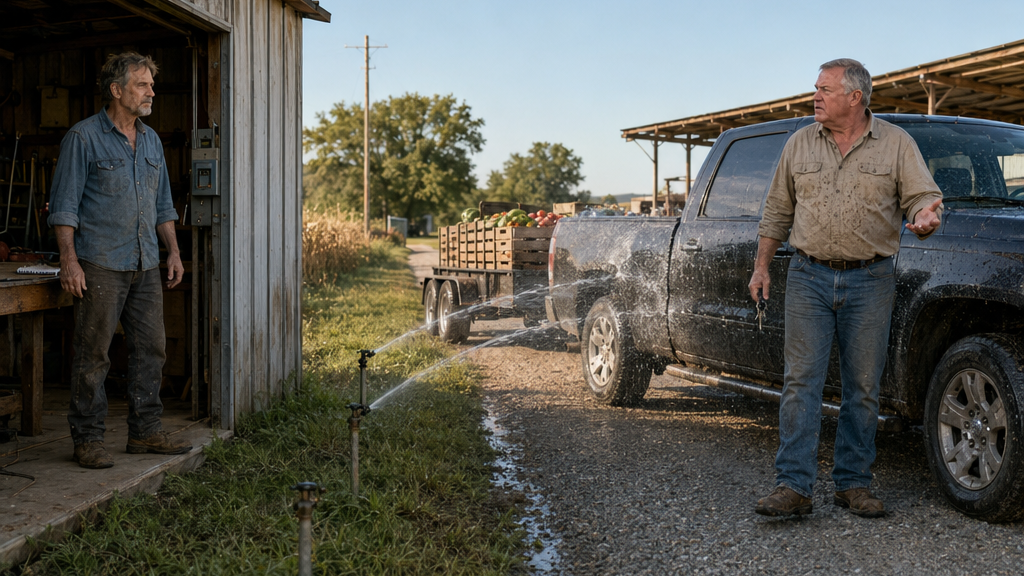
At 6:15, a valve opened beneath the soil with a faint mechanical knock.
The first riser rose.
A fan of water swept across the grass.
It struck the passenger side of Patrick’s produce trailer with a flat metallic patter.
A second riser came alive farther down.
Then the third.
Patrick stepped out of the market shed.
For several seconds he simply watched.
The spray was not violent. It was ordinary irrigation water moving through ordinary irrigation heads, repeating the same clean arcs every few seconds.
Grass.
Gravel.
Trailer.
Grass.
Gravel.
Pickup door.
Patrick hurried to the truck.
One of his workers laughed before seeing Patrick’s face and immediately looked down at a crate.
Jeffrey stayed inside the shed.
That was the part he would remember later—not the water.
The satisfaction.
Patrick had told him twenty minutes did not matter.
Now every sweep of the sprinklers seemed to say something Jeffrey had been too restrained to say himself.
Patrick climbed into the pickup and pulled forward.
For the first time in weeks, the lane was clear before Jeffrey needed to ask.
Jeffrey looked at the notebook but did not write anything.
The next morning Patrick parked farther toward the market.
The morning after that, he tried the entrance again.
At 6:15 the risers came on.
By the fourth day Patrick had learned the schedule.
So had his workers.
Jeffrey could see it in the way they hurried to unload before quarter past six.
It should have ended there.
Instead, Jeffrey found himself checking the pump controller each evening.
Making sure the clock had not drifted.
Making sure the heads had not shifted.
The precision pleased him.
That bothered him more than he admitted.
On the seventh morning Patrick’s pickup sat across the entrance at 6:14.
The first sprinkler activated.
Water struck the lower edge of the truck, then swept away.
Patrick emerged instantly, as if he had been waiting for it.
He yanked open the driver’s door, moved the truck ten feet, climbed back out, and stared toward Jeffrey’s equipment shed.
Jeffrey was standing in the doorway.
Patrick crossed the lane.
His shirt sleeve was wet. Water ran from the keys in his clenched hand.
“You doing this on purpose?”
Jeffrey leaned one shoulder against the doorframe.
“I’m irrigating my field.”
“At six-fifteen every morning?”
“That’s when Zone Three runs.”
Patrick looked toward the risers.
“You changed those heads.”
“Yes.”
The direct answer appeared to unsettle him more than denial would have.
“You’re spraying my truck.”
“I’m watering my property.”
“You think that makes this cute?”
“No.”
“Then shut them off.”
Jeffrey straightened.
“Don’t park there.”
Patrick stared at him.
For one dangerous second Jeffrey wanted Patrick to argue. He wanted to hear that same line again—twenty minutes isn’t taking your road—so he could watch the water answer it.
That realization cooled him.
Patrick pointed one wet key toward the shed.
“You’d better be sure about what you’re doing.”
Then he turned and walked back toward the market.
Jeffrey watched him go.
The sprinklers continued their measured sweep behind him.
Three days later, Patrick stopped parking in the entrance entirely.
Jeffrey should have felt finished.
Instead, on the following Monday morning, a county vehicle slowed on the road and turned through his gate.
Chapter 3: The Complaint That Made the Old Courtesy Matter
The county vehicle stopped beside Jeffrey’s gate at 8:11, and the woman who stepped out already had a clipboard in her hand.
Jeffrey recognized Katherine Green before she reached the cattle guard.
“Been a while,” she said.
“Usually better when county people don’t visit.”
“That depends what you’ve been doing.”
Jeffrey looked across the road.
Patrick stood outside the market shed with his arms folded.
So that was how the morning was going to go.
Katherine had worked around agricultural drainage and land-use matters for the county for more than a decade. Jeffrey knew her from his irrigation-contracting years, when the two of them had occasionally ended up at the same properties after owners discovered that water had consequences beyond wherever they wanted a pipe installed.
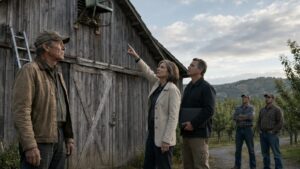
She pointed toward the field edge.
“I got a complaint about irrigation being intentionally directed onto a vehicle and interfering with access.”
“His access?”
“That’s one of the things I’m trying to understand.”
Jeffrey brought out the notebook.
Katherine did not take it immediately.
“What’s that?”
“Nineteen times he blocked my lane.”
“That isn’t what I asked.”
“It’s why I changed the heads.”
“I figured.”
That irritated him.
“You haven’t even looked.”
“I’m here to look.”
They walked the edge together.
The ground was damp around the three risers. Katherine crouched beside the nearest one, checked the head, then followed its arc with her eyes toward the gravel margin.
“Run it.”
Jeffrey went to the controller and switched the zone manually.
Water rose and swept across the grass.
Katherine watched two full rotations.
Patrick came over from the market.
“There,” he said. “You see where it hits?”
“I see it,” Katherine said.
“It hits my loading area.”
Jeffrey turned toward him. “My entrance isn’t your loading area.”
Patrick ignored him.
Katherine switched her attention between them.
“Let me make one thing clear. I can look at drainage, road shoulder impact, right-of-way issues, and whether Jeffrey’s irrigation is causing a county problem. I’m not here to declare which one of you is morally right.”
Patrick gave a humorless smile.
“I’m not asking for moral.”
Jeffrey said, “Neither am I.”
Katherine looked directly at him.
“Yes, you are.”
He closed his mouth.
She walked farther down the lane.
The county right-of-way complicated the first few feet near the road, but beyond that the gravel entrance served Jeffrey’s farm. Patrick’s market frontage sat beside it, narrow and increasingly crowded with coolers, signs, customer parking, and delivery space.
Katherine stopped near Patrick’s gravel apron.
“You expanded this?”
Patrick nodded. “This spring.”
“Delivery volume too?”
Another nod.
Jeffrey looked over the market as if seeing it from above for the first time.
Patrick had not simply become more inconsiderate.
He had run out of room.
A refrigerated unit occupied the place where delivery vehicles once turned. Customer spaces filled most of the usable frontage. The easiest remaining maneuver was obvious: swing through Jeffrey’s wider entrance, stop along the edge, unload, move on.
It explained the behavior.
It did not excuse nineteen mornings.
Katherine returned to her vehicle and made several notes.
“As far as today goes, I’m not seeing irrigation damage to the county road. I’m not issuing anything over those heads.”
Patrick’s face hardened.
“So he can spray my truck?”
“That is not what I said.”
“He aimed them there.”
“And you parked there.”
Patrick looked at Jeffrey.
Jeffrey felt the small rush of vindication he had been waiting for.
Then Katherine continued.
“But Jeffrey, being on your property does not automatically make every use of that property reasonable. If you’re intentionally creating a nuisance or interfering with some established access arrangement, that can become a different question. One I’m not deciding standing here.”
The satisfaction disappeared.
“What established arrangement?” Jeffrey asked.
Patrick spoke before Katherine could.
“The one we’ve had for years.”
“We have no arrangement.”
Patrick actually looked surprised.
“You’re serious?”
“Yes.”
“My dad loaded there every harvest season.”
“Sometimes.”
“You told him it was fine.”
Jeffrey folded his arms.
“I told him I didn’t mind once in a while.”
“You told him it was no problem.”
“That doesn’t mean you get to block my lane whenever you want.”
Patrick stepped closer, not threateningly, but with a certainty Jeffrey had not expected.
“You think I made this up?”
Jeffrey looked at Katherine.
She was no longer taking notes.
“What exactly are you saying?” he asked Patrick.
Patrick’s jaw worked once.
“I’m saying you’re acting like I just started using that space because I felt like taking something from you. That isn’t what happened.”
“You started blocking me this summer.”
“I started getting more deliveries this summer.”
“And I told you to stop.”
“After years of saying it was fine.”
Jeffrey felt the argument shift beneath his feet.
He disliked that feeling enough to reach for the notebook.
“Nineteen times.”
Patrick glanced down at it.
“You can write twenty-nine if you want. It doesn’t erase what you told us.”
Katherine raised one hand.
“Before either of you turns this into something bigger, find out what actually existed. Not what you remember existed.”
Patrick gave a short nod.
Jeffrey said nothing.
The county vehicle left without a citation.
By noon the story Jeffrey had been telling himself had become harder to keep clean.
Patrick was still wrong to block the lane after being directly asked to stop. Jeffrey knew that.
But the question had changed.
It was no longer only why Patrick kept doing it.
It was why Patrick believed he had the right.
Near four that afternoon, Patrick crossed from the market carrying a yellowed sheet of paper folded twice.
He did not say hello.
He opened it on the hood of Jeffrey’s truck.
Jeffrey saw the handwriting before he read a single word.
His own.
Patrick pressed one finger beside a faded sentence near the bottom.
“There,” he said. “That’s what I’ve been talking about.”
Jeffrey stared at the note.
The ink was old, but the words were unmistakable.
Chapter 4: The Note Jeffrey Wished He Had Written Differently
Jeffrey knew the handwriting before he understood the sentence.
The capital J leaned too far forward. His lowercase r disappeared into the next letter. He had written thousands of work orders and feed notes that way.
Patrick kept one finger beside the faded line.
Jeffrey read it twice.
Then a third time.
Patrick’s father had written above it in darker ink:
Use lane edge for harvest loading?
Below that, Jeffrey had answered:
No problem. Just keep the travel lane open when you can.
There was no date beyond a year in the upper corner.
Eleven years earlier.
Jeffrey lifted the paper from the hood.
“When you can,” Patrick said.
Jeffrey looked at him.
“That isn’t permission to block me.”
“I didn’t say it was.”
“You just brought it over here like a deed.”
“I brought it because you told the county we never had an arrangement.”
“We didn’t.”
Patrick tapped the note.
“Then what do you call that?”
Jeffrey folded the sheet carefully along its old crease.
“A favor.”
Patrick gave him a tired look.
“That’s easy to say now.”
Jeffrey felt heat rise behind his collar.
He wanted to point to the nineteen entries in his notebook. He wanted to tell Patrick that nothing written eleven years ago could turn twenty-minute delays into something reasonable.
Instead he looked back at the note.
His father had still been alive when he wrote it.
That explained something about the wording.
His father distrusted fences that appeared suddenly and papers that arrived after disagreements. If two neighbors could fix something with a gate chain, a borrowed tractor, or a sentence over coffee, he considered that the better way.
Jeffrey had inherited more of that than he liked admitting.
The next morning he set the old note on his kitchen table beside the newer spiral notebook.
The contrast bothered him.
The old page was loose, friendly, careless.
The new notebook was exact.
7:03.
7:24.
6:56.
7:17.
Every minute accounted for.
Jeffrey could remember the season the note came from.
Patrick’s father had been shipping pumpkins and late sweet corn through a temporary roadside stand. A delivery truck had trouble turning inside the narrow entrance on his side. For several weeks, they had used the broad mouth of Jeffrey’s lane to straighten trailers before backing toward the market.
Jeffrey had never objected.
Once, when a truck sat longer than expected, Patrick’s father had walked over and asked if it was causing trouble.
Jeffrey had waved him off.
“No problem.”
He could hear himself saying it.
That was the problem.
He had said it so often that the phrase had become a kind of invisible infrastructure.
Patrick arrived shortly after ten.
Jeffrey met him at the lane instead of inviting him inside.
“I remember the note,” Jeffrey said.
Patrick nodded.
“So you remember what I mean.”
“I remember giving your dad room during harvest.”
“And I kept doing what we were doing.”
“No. You expanded it.”
Patrick’s face tightened.
“You changed the rules.”
Jeffrey almost answered immediately.
Then stopped.
That was not completely false.
“I should’ve been clearer back then,” Jeffrey said.
Patrick seemed caught off guard.
Jeffrey continued before the admission could be mistaken for surrender.
“But I was clear this month. I told you not to block the lane.”
“You told me after putting nineteen entries in that book like I was sneaking around.”
“You were blocking me.”
“I was loading.”
“You were doing both.”
Patrick looked toward his market.
A refrigerated trailer occupied one side of the gravel apron. A stack of empty produce bins stood on the other. Two cars were parked near the shed.
“You know what it’s like over there,” Patrick said.
“I know what it looks like.”
“No, you know what it looked like ten years ago.”
Jeffrey folded his arms.
Patrick pointed toward the crowded frontage.
“I lost half my turning room when we put the refrigeration unit in. Customers don’t back out well. Delivery trucks won’t pull all the way in because they can’t get out without crossing the ditch.”
“Then change the entrance.”
Patrick laughed once.
“With what money?”
The answer came so quickly Jeffrey knew it had been waiting.
“Your business expanded.”
“That doesn’t mean the cash did.”
“You added events.”
“Because produce alone wasn’t paying.”
“You added refrigeration.”
“Because losing inventory was costing more.”
Jeffrey said nothing.
Patrick rubbed a hand over his mouth.
“I’m not asking to own your road.”
“You’ve been acting like you do.”
“I’m asking for what we’ve always done.”
“No. You’re asking me to absorb the cost of your business.”
That landed.
Patrick looked away first.
Later that afternoon, Katherine Green called.
Jeffrey stood beside the kitchen counter while she spoke.
“The county road inspector looked at the entrance,” she said. “Nothing there gives me authority to settle private use between you two.”
“So what does that mean?”
“It means exactly what it sounds like.”
“What about the note?”
“A note between neighbors doesn’t become something else because I look at it.”
“Does it give him a right?”
“I’m not giving you a property-law opinion.”
Jeffrey exhaled.
“Katherine.”
“You want me to tell you the county can solve this. It can’t.”
“So he keeps parking there?”
“I didn’t say that either.”
She paused.
“You have two different questions. One is whether Patrick should block a working farm entrance after being told not to. The other is whether you spent years letting his family believe some use was acceptable. Those can both matter.”
Jeffrey stared at the old note on the table.
He disliked answers that left room for two people to be wrong.
“What would you do?” he asked.
“I’d stop asking a government office to decide what the two of you never bothered to define.”
After the call, Jeffrey walked the boundary.
The lane itself was unchanged. Gravel. Shallow ditch. Hayfield on one side. Patrick’s crowded market on the other.
Only the meaning had shifted.
For years Jeffrey had thought of his patience as something he was giving.
He had never considered that someone receiving it might build plans around it.
At dusk Patrick came over again.
This time there was none of the earlier defiance in him.
“If you want me completely off that entrance,” he said, “I need another turnout.”
“That’s what I said.”
“You know what that involves?”
“Gravel, pipe, grading.”
“And moving the drainage.”
“Yes.”
Patrick stared at him.
“You used to price that kind of work.”
“I did.”
“So price it.”
Jeffrey gave him a rough number.
Patrick’s expression changed before Jeffrey finished.
“That much?”
“You need enough width for delivery trailers. Culvert pipe. Base stone. Top gravel. Machine time.”
Patrick looked toward his market.
Jeffrey could almost see the calculation happening.
Finally Patrick said, quietly, “I can’t afford that right now.”
It was the first thing he had said since the dispute began that sounded less like an argument than a fact.
Chapter 5: Why Twenty Minutes Had Become Patrick’s Business Plan
Jeffrey noticed the timing because Patrick’s workers moved too quickly when his truck appeared.
At 6:52 on Friday morning, Jeffrey drove past the market on his way to check cattle in the lower field. A delivery truck was waiting on the shoulder.
One of Patrick’s workers stood near the entrance, watching Jeffrey.
The moment Jeffrey passed, the worker lifted an arm.
The delivery truck pulled across.
Jeffrey slowed.
In his mirror he watched it swing partially into his lane.
Not accidentally.
Not because the driver was confused.
They had waited for him to leave.
That afternoon Jeffrey crossed to the market.
Patrick was stacking empty boxes behind the refrigeration trailer.
“You know my schedule.”
Patrick kept working.
“I know everybody’s schedule around here.”
“You had that truck waiting for me to leave.”
Patrick set down the box.
“It needed room.”
“That isn’t what I said.”
Patrick leaned against the trailer.
For several seconds neither man spoke.
Then Patrick said, “You usually leave after seven.”
Jeffrey stared at him.
Patrick seemed to realize, too late, what he had admitted.
“So that’s how you’ve been doing it.”
“I try not to be in your way.”
“You’ve been timing me.”
“I’ve been trying to use twenty minutes when you don’t need the lane.”
“And when I do?”
Patrick looked down.
“That’s where it got messy.”
Jeffrey almost laughed.
“Messy.”
“I’m not pretending I handled it right.”
“After nineteen mornings?”
Patrick rubbed both hands over his face.
“You think I wake up wanting to fight with you over ten feet of gravel?”
“Twenty feet when the trailer’s there.”
“Fine. Twenty.”
Jeffrey pointed toward the market.
“Why didn’t you just tell me you couldn’t afford the turnout?”
Patrick looked at the customers browsing under the open shed.
“Because then you’d know.”
“Know what?”
Patrick’s eyes moved to the refrigeration unit.
“That this place isn’t doing what it looks like it’s doing.”
Jeffrey waited.
Patrick lowered his voice.
“The events look busy. That doesn’t mean they make money. Refrigeration payment. Insurance. Temporary help. Produce I pay for before I sell it. Half the time I’m moving money from Saturday to cover Tuesday.”
There was no self-pity in his tone.
That made it harder to dismiss.
“My dad could run this place with one pickup and a folding table,” Patrick continued. “People bought what he had. Now they want parking, card payments, bathrooms, cold drinks, weekend stuff for kids. If I don’t grow, I lose customers. Every time I grow, it costs more than I have.”
“So my lane became cheaper.”
Patrick looked at him.
“Yes.”
The word struck harder than another excuse would have.
“You knew.”
“I knew it bothered you.”
“No. You knew you were blocking me.”
Patrick’s mouth tightened.
“I knew most mornings you weren’t leaving yet.”
“You don’t get to make that decision.”
“I know that now.”
“You knew it when I told you.”
Patrick did not answer.
That silence restored something Jeffrey had nearly lost in the previous chapter of the dispute.
Understanding Patrick did not make Patrick innocent.
It simply made the harm less mysterious.
The next Monday brought proof.
A feed truck arrived just before seven, earlier than scheduled.
At the same time Patrick’s produce supplier pulled in from the opposite direction.
For a few seconds both drivers tried to judge the entrance.
Patrick waved the produce truck forward.
It turned across Jeffrey’s lane.
Then the feed truck rounded the curve.
Its driver braked hard and stopped partly in the county road.
Jeffrey heard the engine before he saw what had happened.
He came out of the equipment yard at a run.
The feed driver had his hazard lights on.
Patrick was already trying to guide the produce truck backward.
“Hold it,” Jeffrey shouted.
Patrick raised a hand.
“We’re moving.”
A car approached from behind the feed truck and slowed sharply.
Jeffrey stepped to the road edge.
The scene lasted less than three minutes.
That was enough.
When the lane finally cleared, the feed driver rolled down his window.
“This needs sorting out,” he said.
Jeffrey nodded.
“I know.”
Patrick stood beside his pickup, looking at the road.
Nobody argued.
There was nothing left to argue about.
That evening Jeffrey went into the pump shed.
The irrigation controller glowed on the wall.
ZONE 3 — 6:15.
He thought about moving the heads farther.
He could have increased the arc slightly and still kept most of the water over his own grass. He could shorten the cycle and raise the pressure. He knew exactly how to make Patrick’s preferred loading spot unpleasant without touching a single piece of Patrick’s equipment.
That was the easiest leverage he had.
He opened the controller panel.
Then he stopped.
He remembered himself standing in the equipment-shed doorway, watching Patrick hurry through the sprinklers.
The satisfaction had been real.
So had the warning buried inside it.
Jeffrey pressed the program button.
ZONE 3.
OFF.
The display blinked.
He shut the cover.
The following morning Patrick appeared near the lane just after six.
He glanced toward the risers.
Jeffrey was standing outside the pump shed.
“You shut them down?” Patrick asked.
“Yes.”
Patrick waited.
“Why?”
“Because I’m done solving this that way.”
Patrick studied him as if trying to identify the trap.
“What does that mean?”
“It means the water won’t settle it.”
Patrick looked toward the lane.
“What will?”
Jeffrey picked up the spiral notebook from the workbench.
For the first time since he began keeping it, he did not open to the page of nineteen incidents.
He closed it.
“That’s what we’re going to find out.”
Chapter 6: The Morning Jeffrey Refused the Easy Revenge
At 6:58 Monday morning, Patrick’s pickup rolled into the farm entrance again.
The irrigation heads stayed down.
Jeffrey watched from beside the equipment shed.
Patrick stopped with half the truck on the gravel margin. Behind him, a small produce trailer angled toward the market.
For one second Jeffrey felt the old reflex.
6:15.
Water.
Move the truck.
Problem solved.
But the risers were dry.
Patrick climbed out.
“You expecting something?”
“Yes.”
“What?”
“A buyer at seven-ten.”
Patrick looked at the trailer.
“We’ll be gone.”
Jeffrey walked toward him.
“No.”
Patrick frowned.
“What do you mean, no?”
“I mean move it now.”
“I just need to unload.”
“You need to move it.”
Patrick glanced toward the market, where two workers were waiting.
“Jeffrey.”
“No twenty minutes. No ten minutes. No ‘when you can.’ Keep the travel lane clear.”
Patrick’s expression changed at the last phrase.
They both heard the old note inside it.
“When you can.”
Jeffrey continued.
“I wrote that eleven years ago because I didn’t want to make a problem over harvest loading. I should’ve written something better.”
Patrick folded his arms.
“So now the answer is nothing?”
“The answer is clear terms.”
“You think that book gives you the right to dictate everything?”
Jeffrey held up the notebook.
“This book doesn’t give me anything.”
That surprised Patrick.
Jeffrey opened it.
“Nineteen mornings. I kept this because I wanted proof you were the problem.”
“You saying I wasn’t?”
“I’m saying proof isn’t the same thing as a solution.”
Patrick looked toward the road.
Jeffrey flipped past the incident pages to a blank sheet.
“I went over the entrance again yesterday.”
Patrick’s attention returned.
“There’s enough room on your side for a turnout if the drainage pipe shifts six feet and you widen behind the refrigerator unit.”
“I told you what that costs.”
“I know.”
Jeffrey drew a rough rectangle on the page.
“Not the full rebuild I priced before. Smaller. Delivery staging only. Trucks enter here, nose forward, unload, and leave without crossing my lane.”
Patrick looked down despite himself.
“What about the ditch?”
“Pipe extension.”
“County?”
“Katherine said the drainage side can be reviewed. That doesn’t mean they build it for you.”
Patrick traced the drawing without touching the paper.
“And until then?”
Jeffrey turned the page.
“I know your produce truck usually comes Tuesday and Friday.”
Patrick looked up sharply.
“You’re keeping my schedule now?”
“You knew mine.”
Neither smiled.
Jeffrey wrote two time windows.
“Temporary loading. Specific mornings. Before six-forty or after eight, provided the lane stays passable.”
“You expect me to sign that?”
“I expect you to decide whether you want permission or whether you want to keep pretending you already have it.”
Patrick’s jaw tightened.
A vehicle appeared on the county road.
The livestock buyer.
Early.
Patrick looked at the trailer behind his own truck.
Jeffrey looked at him.
Neither man moved for a second.
Then Jeffrey stepped into the lane.
He did not switch on a pump.
He did not raise his voice.
He pointed toward Patrick’s market.
“Move it.”
Patrick opened his mouth.
Jeffrey cut him off.
“No. Not this time. He is not waiting on the county road while we debate how temporary your blockage is.”
The buyer’s truck slowed.
Patrick stared at Jeffrey, then at the approaching vehicle.
Something in his posture gave way.
He climbed into his pickup.
The trailer moved.
The lane opened completely.
Jeffrey guided the buyer through.
Only after the vehicle disappeared toward the cattle pens did Patrick come back.
“You could’ve done that three weeks ago,” Patrick said.
Jeffrey nodded.
“Yes.”
The answer stopped Patrick.
Jeffrey looked at the notebook.
“I should’ve.”
Patrick waited.
“I thought not making a fuss was the same as being reasonable,” Jeffrey said. “Then when I finally got tired of it, I went the other direction.”
“The sprinklers.”
“Yes.”
Patrick looked at the dry risers.
“They were effective.”
“That’s not the same thing as useful.”
For the first time in weeks Patrick almost smiled.
It vanished quickly.
“What happens if I don’t agree?”
Jeffrey answered without hesitation.
“Then the informal arrangement ends. Completely.”
Patrick’s face hardened again.
“You can’t erase what your note said.”
“I’m not erasing it. I’m clarifying what it means from now on.”
“And if I say no?”
“You use your own entrance. Every delivery. Every time.”
Patrick looked toward his narrow frontage.
The refrigerated trailer boxed in one side. Customer parking consumed the other.
“You know that hurts the market.”
“I know.”
“So you understand the situation and you’d still do it?”
Jeffrey paused.
That was the question he had been avoiding in different forms for years.
“If keeping your business convenient requires my business to absorb the inconvenience, then yes.”
Patrick looked away.
A long silence followed.
Then Jeffrey turned the notebook toward him.
“These aren’t punishment hours. They’re the times I can live with until you build something better.”
Patrick read them again.
“Tuesday and Friday.”
“For regular deliveries.”
“And special events?”
“You ask beforehand.”
Patrick gave a dry laugh.
“So now we need paperwork for a truck.”
“No. We need clarity because we proved we’re bad at guessing.”
Patrick looked at him for a long moment.
Then his attention returned to the rough turnout sketch.
“How much if I do the gravel myself?”
Jeffrey told him.
Patrick asked about the pipe.
Jeffrey answered.
“What if I rent the machine instead of hiring the whole job?”
“You’ll spend less if you know how to run it.”
“I don’t.”
“I do.”
Patrick looked up.
There it was: the first opening neither man had expected.
“You offering?”
“Not for free.”
“I didn’t ask for free.”
Jeffrey nodded once.
Patrick stared at the sketch again.
The argument had not disappeared. Neither had the money problem, the irritation, or the soaked truck.
But the shape of the conflict had changed.
Patrick tapped the drawing with one finger.
“What would the turnout actually cost if we did it that way?”
Chapter 7: The Clear Lane Meant More Than Either Man Expected
The excavator arrived on Patrick’s side of the lane at 7:12 on a Thursday morning.
Jeffrey heard the diesel before he saw it.
For one disorienting second, he thought somebody had driven into his entrance again.
Then he stepped out of the equipment shed and saw the machine turning onto Patrick’s frontage instead.
The operator lowered the bucket beside the shallow ditch.
Patrick stood nearby in work gloves, holding a roll of marking flags.
No truck blocked the lane.
No produce trailer sat half across the gravel.
Jeffrey looked at his watch out of habit.
7:14.
He almost reached for the spiral notebook in his shirt pocket.
Then he stopped.
Patrick noticed.
“You going to write down that I showed up?”
Jeffrey looked at him.
“Might.”
Patrick gave the smallest hint of a smile.
It had taken them nearly three weeks to get from the rough drawing in Jeffrey’s notebook to machinery on the ground.
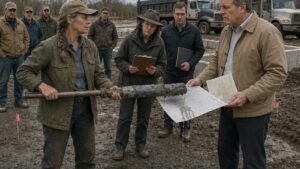
Katherine had reviewed the drainage layout and confirmed that extending the culvert pipe would work if they maintained the ditch grade. The county road inspector had checked the roadside portion and marked where the work had to stop.
Nothing had been waived.
Nobody had declared a winner.
Patrick had priced stone from three suppliers and discovered Jeffrey’s original estimate had not been exaggerated. He had cut costs where he could, agreed to do most of the labor himself, and paid for the pipe, gravel, and rented machine.
Jeffrey contributed what he had offered: equipment time, grading experience, and enough knowledge to keep Patrick from turning a simple turnout into an expensive drainage problem.
That first morning, the two men barely spoke beyond measurements.
“Another foot.”
“Too deep.”
“Hold there.”
“Bring the base stone.”
Their conversations had become easier when attached to something physical.
A grade could be checked.
A pipe had a diameter.
A truck needed a known turning radius.
There was less danger in twelve inches than in phrases like no problem and when you can.
By noon the old ditch was open and the new culvert section lay beside it.
Patrick stood inside the cut, shovel in hand.
Jeffrey was checking the slope with a level when Patrick said, “My dad would hate all this.”
Jeffrey kept his eyes on the bubble.
“The pipe?”
“The measuring.”
Jeffrey looked up.
Patrick rested both hands on the shovel.
“He would’ve said we spent three weeks arguing over something we could’ve fixed in an afternoon.”
“He also would’ve parked a trailer in my lane.”
Patrick nodded.
“Probably.”
Jeffrey looked back at the level.
“My father would’ve told me not to make a federal case out of it.”
“Didn’t stop you making a notebook case.”
That made Jeffrey laugh despite himself.
Patrick did too.
The sound did not repair anything.
But it made the work easier.
Two days later, they spread the final top layer of gravel.
Patrick drove his pickup through the turnout first.
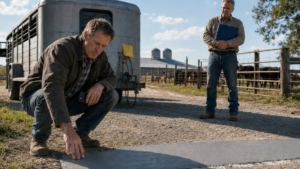
He entered from the county road, swung behind the refrigeration trailer, stopped in the new loading space, then pulled forward and exited without putting a tire on Jeffrey’s lane.
He circled back once more with the produce trailer attached.
This time Jeffrey stood beside the gate watching the clearance.
Patrick stopped.
“Well?”
“You’ve got two feet to spare.”
“That means it works.”
“It means you can’t blame me when you hit the post.”
Patrick looked at the post.
“Could move that.”
“No.”
Patrick grinned.
“All right.”
The practical problem was solved.
The harder part waited on Jeffrey’s kitchen table.
The old yellowed note lay near the center.
Beside it sat the spiral notebook.
Katherine’s suggested drainage measurements had been copied onto a separate sheet. Jeffrey had added a one-page access agreement in plain language.
No legal flourishes.
No threats.
Regular deliveries could use Patrick’s turnout at any time.
Temporary use of the edge of Jeffrey’s entrance required advance agreement.
The travel lane itself was to remain open.
Special-event overflow loading had specific windows.
Emergency or farm-service access took priority.
Patrick read every line.
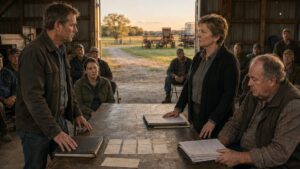
Two neighboring landowners sat at the other end of the table as witnesses, mostly silent.
Patrick stopped at the section about temporary access.
“This makes it sound like everything before today was my fault.”
Jeffrey read the line again.
“It says you’re responsible for keeping the lane clear.”
“That’s not what I said.”
“What do you want it to say?”
Patrick leaned back.
“That we had an arrangement before this.”
Jeffrey felt the familiar resistance rise.
The old instinct was to refuse.
Nineteen mornings.
Four hundred dollars.
A feed truck stopped on the county road.
A complaint filed against him.
Then he looked at the yellowed note.
His handwriting.
No problem.
Just keep the travel lane open when you can.
Jeffrey uncapped his pen.
“What if we put this in?”
Patrick watched him write.
Previous informal loading permission existed between the properties but was never intended to grant unrestricted obstruction of the travel lane.
Jeffrey stopped.
Then added another sentence.
Both parties acknowledge that the lack of defined limits contributed to the present dispute.
Patrick read it.
One of the witnesses shifted in his chair.
Jeffrey waited.
Patrick looked at him.
“You’re putting yourself in it.”
“I was already in it.”
Patrick said nothing for several seconds.
Then he picked up the pen.
He signed.
Jeffrey signed beneath him.
The two witnesses added their names.
Patrick slid the paper back across the table.
“What about the sprinklers?”
Jeffrey looked toward the window.
The three risers were visible beyond the yard, small dark points along the field edge.
“What about them?”
“You going to put something in writing about those too?”
“No.”
Patrick raised an eyebrow.
Jeffrey said, “I already shut them off.”
“That isn’t what I asked.”
Jeffrey understood.
“You want an apology?”
Patrick considered it.
“No.”
Jeffrey waited.
“I want to know if you think that was reasonable.”
The question took him back to the equipment-shed doorway.
Patrick’s wet keys.
The first satisfying sweep of water.
Jeffrey could have defended every inch of it.
His property.
His irrigation.
His field.
Instead he said, “I think I liked it too much.”
Patrick looked down at the agreement.
“That sounds about right.”
“And I think you earned some of it.”
Patrick nodded.
“That sounds about right too.”
Nobody shook hands.
That surprised Jeffrey.
He had imagined, somewhere in the back of his mind, that an agreement would end with the kind of gesture his father trusted.
Instead Patrick folded his copy of the document and put it in his shirt pocket.
“I’ve got a delivery at six tomorrow.”
“Use the turnout.”
“I plan to.”
Then he left.
For the next several weeks, the new arrangement proved almost boring.
That was its greatest success.
Produce trucks entered Patrick’s turnout.
Customers stopped using Jeffrey’s lane to turn around after Patrick added a simple barrier at the edge of his frontage.
The refrigerated trailer stayed where it was.
The market kept operating.
Jeffrey’s cattle haulers came and went without waiting.
He and Patrick spoke when necessary.
Sometimes about drainage.
Sometimes about deliveries.
Once about a broken gate hinge.
They did not return to the easy neighborliness that had existed before.
Jeffrey was not sure they should.
Something had been lost when courtesy turned into entitlement and resentment turned into retaliation.
But something cleaner had replaced it.
On a Tuesday morning near the end of September, Jeffrey stepped outside just before seven.
A produce truck was already backed neatly into Patrick’s new turnout.
Patrick stood beside it checking boxes.
Jeffrey’s lane was empty.
He reached into his shirt pocket.
The spiral notebook was still there.
He had continued carrying it even after the agreement, though he had not written an incident in weeks.
He opened to the final blank page.
For a moment he looked across the road.
Patrick noticed him and lifted one hand.
Not an apology.
Not permission.
Just acknowledgment.
Jeffrey looked at his watch.
6:58.
He wrote one final line.
6:58 — lane clear.
Then he closed the notebook.
The story has ended.