They Ordered the Old Farmhand Off the Harvest Stage—Then Learned Why the Festival Could Not Open Without Him
Chapter 1: The Man Mark Told to Clear the Pavilion
“Sir, I need you off the demonstration floor.”
Robert Hall heard the voice without looking up.
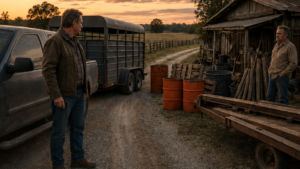
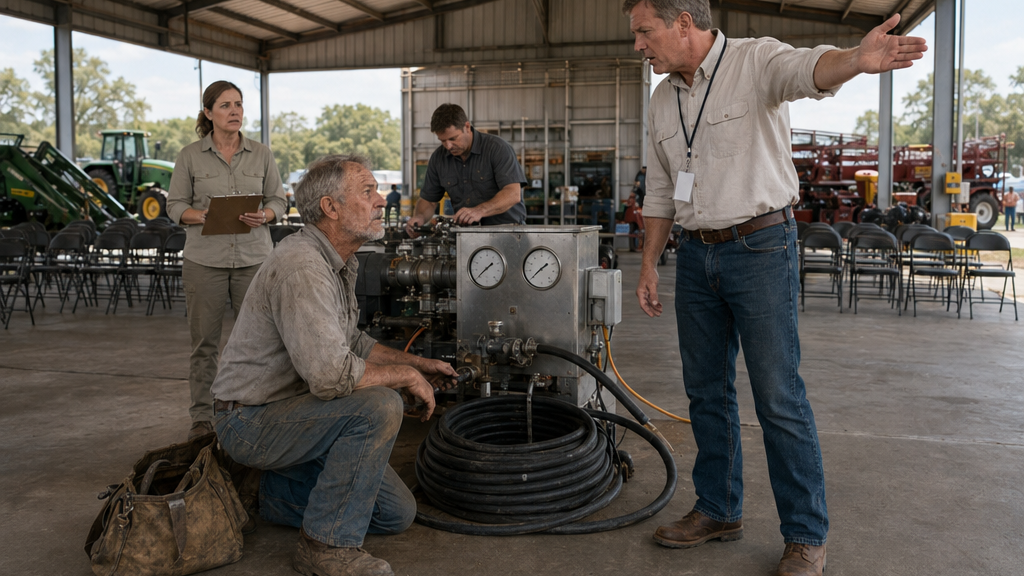
He was kneeling beside the pump-control box at the east end of the harvest pavilion, one knee pressed into sawdust and crushed gravel. A coil of black irrigation hose lay beside him. Temporary electrical cords ran under rubber covers toward the youth crop tables, where neat rows of corn, soybeans, pumpkins, and soil trays waited for Saturday’s demonstrations.
Robert turned the brass adjustment screw another eighth of a turn.
The pressure gauge climbed to forty-two.
“Did you hear me?”
“I did.”
Robert reached into the grease-stained canvas bag beside his boot and pulled out a short wrench.
Mark Nelson stopped three feet away.
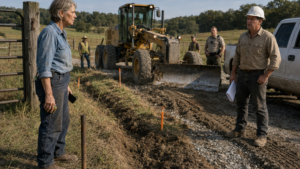
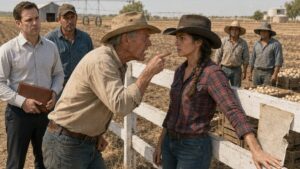
His clean work boots had barely collected dust. He wore pressed jeans, a pale button-down shirt, and the festival credential that identified him as operations chairman. Behind him, two representatives from an equipment dealer stood near a polished tractor display while volunteers arranged folding chairs beneath sponsor banners.
Mark glanced from Robert’s faded shirt to the open tool bag.
“We’ve got exhibitors coming through in twenty minutes,” he said. “This area needs to be cleared.”
“Four minutes.”
“What?”
“Give me four minutes and I’ll have the line balanced.”
Mark frowned at the control panel. “The contractor already finished this.”
Robert looked at the gauge.
“No. He pressurized it.”
“That sounds finished to me.”
Robert set the wrench down.
The system feeding the youth demonstration plots had grown piece by piece over almost two decades. A newer pump pushed water from the holding tank, but half the buried line remained from the old installation. The main feed split behind the pavilion: one branch supplied the vegetable beds, another the demonstration sprinklers, and a third ran toward the old irrigation shed.
Robert knew where every coupling narrowed.
He knew which valve had been replaced after the winter freeze seven years earlier.
He knew the sound the pump made when air entered the west branch.
And he knew the contractor had opened the new feed too quickly.
Sarah Clark appeared at the end of the table row, clipboard tucked against her side.
“Robert,” she said carefully.
He could tell from her face that she had already spoken with Mark.
Mark pointed toward the public aisle.
“I’m not trying to make this difficult. We’re changing how this festival looks. Sponsors shouldn’t be stepping around tools and maintenance people while they’re being shown the pavilion.”
Robert’s hand stopped over the bag.
Maintenance people.
He had been called worse things without minding. The words themselves were not the problem. The way Mark said them was.
As if work became embarrassing once someone important arrived to look at it.
Robert rose slowly. At sixty-four, getting off one knee required more thought than it once had.
Mark seemed relieved.
Then Robert said, “If your contractor switches that feed sequence before the west line settles, the second gauge will fall.”
The contractor, working near the pump trailer, looked over.
“It’s holding fine.”
“For now.”
Mark folded his arms. “We paid for a professional installation.”
“You paid for new controls on an old system.”
The contractor stepped closer. “We tested every branch.”
Robert pointed with the wrench.
“You tested them separately.”
Silence lasted just long enough for one of the dealer representatives to look away.
Mark’s jaw tightened.
“This is what I’m talking about,” he said. “Everybody around here has their own way of doing things because that’s how they’ve always done it. We’re trying to run an organized event.”
Robert looked at Sarah.
She said nothing.
Her pen moved once across the clipboard.
Robert knew that gesture. Sarah documented changes when responsibility might later become unclear.
He should have told Mark then.
Not everything. Just enough.
He could have explained who had rebuilt the original feed manifold after the old pump failed. He could have told him why the extension office still called Robert before changing anything connected to the youth plots. He could have pointed toward the faded shed beyond the pavilion and said that half the operating history of the system was written in his handwriting.
Instead he felt something old and stubborn close inside him.
If Mark needed a title before he could hear a warning, Robert did not intend to provide one.
“Four minutes,” Robert repeated.
Mark shook his head.
“No. Pack it up.”
Sarah finally spoke. “Mark, he should probably finish the balance test.”
“We open tomorrow. I’ve got sponsors walking this floor today, and I’ve got a contractor telling me the system is done.”
Robert watched Mark for another second.
There was anxiety beneath the impatience. Robert recognized it because farmers carried the same look when rain threatened cut hay: the need to control whatever could still be controlled.
But recognizing it did not make the decision wiser.
Robert crouched again, not to continue working but to close his bag.
The canvas was dark at the corners with thirty years of grease. One handle had been stitched twice. A pair of pliers, three wrenches, electrical tape, spare seals, a pressure key, and a stubby screwdriver disappeared beneath the flap.
Mark stepped aside.
“Thank you.”
Robert slung the bag over his shoulder.
As he passed Sarah, she said quietly, “I’ll call you if something changes.”
“Don’t call because something changes.”
She looked at him.
“Call if somebody wants to listen.”
He walked out through the side opening of the pavilion.
Behind him came the ordinary sounds of a festival preparing to look effortless: forklifts backing, metal chairs scraping concrete, volunteers testing microphones, somebody laughing near the food-vendor lane.
Robert reached his pickup and set the canvas bag on the passenger floor.
He could have left then.
Instead he stood with one hand on the open door.
From inside the pavilion came the contractor’s voice.
“Go ahead. Switch it.”
A pump motor deepened.
Water moved through the main line.
For several seconds, nothing happened.
Robert almost smiled at himself.
Maybe Mark had been right about one thing. Maybe experience sometimes became a habit of expecting old problems from new equipment.
Then Sarah called from inside.
“Hold it.”
Robert turned.
Through the pavilion opening he could see the pump-control box.
The first gauge held steady.
The second needle trembled.
It dropped from forty-one to thirty-eight.
Then thirty-four.
The contractor bent toward it.
Mark stepped closer.
The needle fell again.
Twenty-nine.
Exactly the gauge Robert had named.
Chapter 2: The Failure That Followed His Warning
Sarah’s county SUV came up Robert’s lane while he had both hands buried inside the knotter assembly of his baler.
He heard the tires on gravel before he saw her.
Robert kept working.
The hay in the south field had been cut the previous afternoon, and he had a narrow window to get it baled before the forecast humidity climbed overnight. The old machine had picked that morning to start missing knots every sixth bale.
Sarah stopped beside his pickup.
Robert’s canvas tool bag remained on the passenger floor where he had left it.
She got out.
“You going to make me ask twice?”
“Depends what you’re asking.”
“The west branch won’t stabilize.”
Robert pulled a strand of twine from the knotter.
“Contractor still there?”
“Yes.”
“Then you’ve got help.”
Sarah put both hands on her hips.
“They’ve changed the regulator, bled the upper line, reset the controller, and blamed the old pipe.”
“Any of those fix it?”
“No.”
Robert reached for a wrench lying on the baler deck.
Sarah waited until he stopped turning it.
“Come back.”
“No.”
“Robert.”
“I’ve got hay down.”
“You also know what’s wrong.”
“So does the man Mark paid, if he keeps looking.”
Sarah glanced toward the pickup, then back at him.
“This isn’t about Mark anymore.”
Robert knew that.
That was why the refusal irritated him even as he made it.
He wiped his fingers on a rag.
“What did they change after I left?”
Sarah opened her clipboard.
“Feed sequence like you said. Then they opened the east isolation valve another quarter turn because the vegetable beds looked weak.”
Robert nodded once.
“There.”
“There what?”
“The old bypass.”
Sarah stared at him.
“There hasn’t been a bypass on that plan since I started.”
“Because it isn’t on that plan.”
“Where is it?”
“Behind the south panel. Low pipe. Somebody painted over the handle years ago.”
She wrote quickly.
“Close it?”
“Halfway. Not all the way. Then bleed the west branch at the last riser before the youth plots.”
“How long?”
“If nobody’s damaged the valve, five minutes.”
Sarah shut the clipboard.
“You could have saved us three hours.”
Robert looked at her.
“I asked for four minutes.”
The words came out sharper than he intended.
Sarah did not flinch.
“That’s exactly the problem.”
“What is?”
“You think being right means you’re finished.”
He turned back to the baler.
Sarah remained where she was.
“When you helped put that line in,” she said, “did you imagine everybody twenty years later would know what you knew without you telling them?”
Robert’s wrench stopped.
So there it was.
Not the whole history, but enough of it.
He stared into the grease-dark mechanism.
“We had plans.”
“We have three versions of those plans.”
“County copied the wrong revision.”
“And you knew that.”
“Yes.”
“Mark didn’t.”
“He didn’t ask.”
Sarah gave a short, humorless laugh.
“No, Robert. He asked the contractor. Because as far as the operating sheet says, you’re an informal volunteer.”
Robert looked at her then.
“That sheet worked fine for fifteen years.”
“Because everybody running the festival knew who you were.”
The sentence settled harder than Mark’s insult had.
Robert hated that she was right.
The festival had survived for years on things nobody wrote down because the same people kept showing up. A retired electrician knew which breaker heated under load. A grower remembered where the buried drain crossed the livestock lane. Robert knew the irrigation system.
Knowledge passed through conversations, truck windows, coffee at six in the morning.
Until one year the people changed.
Sarah softened her voice.
“Come back and show them.”
“No.”
“Why?”
“Because if Mark wants me there, he can ask.”
“He removed your maintenance access from tomorrow’s operating plan.”
Robert’s face went still.
Sarah watched him carefully.
“He did what?”
“After this morning. Contractor-only inside the control area.”
Robert set the wrench down.
“That line feeds the youth plots.”
“I know.”
“And the old shed?”
“Listed as restricted storage.”
Robert looked past Sarah toward his fields.
For years, his name had not mattered at the festival. That had been the point.
Now, suddenly, not having his name attached to anything mattered very much.
Sarah’s phone rang.
She answered, listened, and said, “Do exactly what I told you. Halfway, not closed.”
A pause.
Then her expression changed.
“That did it?”
She looked at Robert.
“Pressure?”
Another pause.
“Forty-one?”
Robert picked up the wrench again.
Sarah ended the call.
“Forty-one and holding.”
“Good.”
“You don’t even look pleased.”
“Water went where it was supposed to go.”
“That used to be enough for you.”
“It still is.”
Sarah glanced toward his pickup and the closed canvas bag inside.
“No,” she said. “I don’t think it is.”
Robert said nothing.
She walked back to the SUV, then stopped with her hand on the door.
“One question.”
He waited.
“Does Mark even know who guaranteed that equipment when the festival couldn’t pay for it?”
Robert’s grip tightened around the wrench.
Sarah saw the answer before he gave one.
“No,” he said.
Her expression sharpened.
“Then what exactly do you think he’s making decisions about?”
Chapter 3: The Year the Festival Nearly Closed
Sarah placed the folder on the extension-office table and pushed it toward Robert.
The label had faded until only the last two digits of the year were easy to read.
Robert did not open it.
Outside the records room, festival traffic moved along the county road in bursts. Trucks hauling display equipment rattled past the building. Somewhere across the grounds, a loudspeaker crackled through a sound check.
“You dug this out on purpose,” Robert said.
“Yes.”
“I told you not to.”
“You told me not to tell Mark.”
“That includes putting it under my nose.”
“No, it doesn’t.”
Robert sat back.
His canvas tool bag rested on the floor beside his chair. He had brought it from the truck without thinking, the way a man carried a pocketknife even when he had no immediate use for it.
Sarah opened the folder herself.
On top lay an equipment invoice.
Below it were bank papers, extension-board minutes, insurance forms, and a guarantee agreement bearing Robert Hall’s signature in black ink.
He knew every page.
He wished he did not.
“The festival was six weeks from cancellation,” Sarah said.
“I remember.”
“The county grant froze.”
“I remember that too.”
“The bank wouldn’t finance the replacement pump without collateral.”
Robert looked toward the window.
“Sarah.”
“And the equipment dealer wouldn’t release the control system without somebody guaranteeing the balance.”
“I know what happened.”
“Mark doesn’t.”
Robert pulled the invoice toward him.
The numbers were smaller than the ones people imagined when they heard that somebody had “saved” something. There had been no giant ceremonial check. No wealthy benefactor arriving with money to spare.
There had been a bridge loan.
A machinery guarantee.
Crop income pledged against the following season.
Enough risk that Robert had spent a year waking before dawn with arithmetic in his head.
Sarah tapped one page.
“You guaranteed the pump, controller, and installation.”
“Yes.”
“And covered the first payment when the festival account came up short.”
“Temporarily.”
“Eleven months.”
“They paid it back.”
“Eventually.”
Robert closed the folder.
“That’s why nobody needs to know.”
Sarah stared at him.
“You think repayment erased the risk?”
“It settled the obligation.”
“That isn’t what I asked.”
Robert stood and carried the folder to the metal shelf.
Sarah blocked him before he could put it away.
“Your farm was collateral.”
“Part of my equipment was.”
“Your combine.”
“And two wagons.”
“And future crop income.”
He looked at her.
“You read thoroughly.”
“It’s my job.”
“No. Your job is agricultural extension. This is archaeology.”
Her mouth almost smiled, but didn’t.
“Why did you do it?”
Robert lowered the folder.
“Festival needed a pump.”
“That’s not an answer.”
“It’s the only one you’re getting.”
Sarah stepped aside.
Robert slid the folder onto the shelf.
For a moment neither spoke.
The records room smelled of paper, dust, and old cardboard. Through the thin wall came the ring of a desk phone.
Sarah finally said, “You know what Mark thinks happened that year?”
Robert shrugged.
“He probably doesn’t think about it.”
“He thinks the county stabilized the festival and local sponsors rebuilt it.”
“Close enough.”
“No.”
Sarah pulled another sheet from her clipboard.
“This is tomorrow’s opening program.”
Robert read the schedule without touching it.
Youth crop demonstration.
Equipment showcase.
Sponsor recognition.
Opening remarks.
Then a line near the bottom caught him.
A regional equipment company was being credited with “helping preserve the future of the county harvest festival.”
Robert looked up.
“That’s not false.”
“They came in three years later.”
“They’ve helped.”
“I didn’t say they haven’t.”
“Then leave it alone.”
Sarah’s frustration finally surfaced.
“You always say that.”
Robert’s eyes narrowed.
“What?”
“Leave it alone. Don’t make a fuss. Doesn’t matter who gets credit. Let the work speak.”
“It usually does.”
“Except now the people making decisions don’t know what the work was.”
Robert looked again at the program.
He felt something he disliked because it was too close to resentment.
Not toward the company. They had supported machinery demonstrations, paid for tents, and funded student prizes. They deserved thanks.
The problem was the word preserved.
Robert remembered the year behind that word.
The pump failure had come after two bad seasons. Attendance had slipped. County money was tied up. Vendors wanted deposits the festival did not have. The youth plots were going to be the first thing cut because they brought in almost no revenue.
He remembered sitting at his kitchen table with bank papers spread beside seed catalogs.
He remembered signing anyway.
Not because he thought his name should someday appear on a program.
Because some things disappeared when everybody waited for somebody else to save them.
Sarah watched him.
“You’re angry.”
“No.”
“You’re a terrible liar.”
“I’m irritated.”
“That’s your version of angry.”
Robert sat again.
“What do you want me to do?”
“Tell Mark enough that he understands why his contractor-only rule is dangerous.”
“He already knows the system failed.”
“He thinks that’s a contractor problem.”
“It is now.”
Sarah shook her head.
“There. That.”
“What?”
“You’re punishing him by stepping away.”
Robert’s voice dropped.
“He told me to step away.”
“And you were happy to make it permanent.”
That landed.
Robert looked down at his hands.
His first instinct was to reject it. He had gone home to bale hay. He had given Sarah the bypass fix. He had not sabotaged anything, withheld a safety warning, or demanded an apology.
But underneath those facts was something smaller and less comfortable.
When Sarah had told him Mark removed his access, part of Robert had thought: Fine. Let him learn.
He disliked seeing that thought clearly.
Sarah sat across from him.
“I’m not asking you to embarrass him.”
“Good.”
“I’m asking you to stop making everybody earn the right to know what you refuse to say.”
Robert rubbed his thumb along the edge of the table.
The office door opened.
A volunteer leaned in.
“Sarah? Mark wants the final sponsor notes before seven.”
“Tell him I’ll bring them over.”
The volunteer disappeared.
Robert looked at the program again.
“Is he reading that wording tomorrow?”
“Yes.”
“The company approve it?”
“Yes.”
“Then don’t change it.”
Sarah stared at him.
“You’re serious.”
“They helped keep the festival going.”
“Robert—”
“Don’t correct the announcement.”
She leaned back slowly.
“Why?”
He picked up the canvas bag.
Because the alternative would require explaining the difference between wanting no recognition and watching history become convenient.
Because once his name entered the story, another name would follow.
Because the reason he had signed those papers had never belonged entirely to him.
He walked toward the door.
Sarah called after him.
“Robert.”
He stopped.
“If you won’t correct the record for yourself,” she said, “you may eventually have to correct it for somebody else.”
Robert did not answer.
He stepped outside with the tool bag in his hand, leaving the old guarantee file on the shelf and the false version of the festival’s rescue still printed on tomorrow’s program.
Chapter 4: The Promise Robert Never Explained
The brass key fell out of Robert’s canvas tool bag at six fourteen Saturday morning and struck the kitchen floor hard enough to make him stop.
He stood over it for several seconds.
The key was small, dull at the edges, with a strip of faded red tape wrapped around its head. He had not used it in months. He had forgotten it was clipped inside the bag’s inner pocket.
Robert bent and picked it up.
The old irrigation shed.
His wife had put the red tape on the key years ago after Robert misplaced it twice in one week.
“You can rebuild a gearbox from memory,” she had told him, “but apparently a key needs help finding you.”
He could still hear the dry amusement in her voice.
Robert closed his fingers around the brass.
The kitchen was otherwise empty. His coffee had gone cold beside the sink. Through the window, the first loaded pickups were already moving along the county road toward the festival grounds.
He put the key on the table.
Then he moved it back into the tool bag.
He told himself that meant nothing.
Twenty minutes later, headlights swung into his drive.
Paul Johnson climbed out of an older pickup before Robert had finished buttoning his work shirt.
Paul did not knock. He opened the screen door and leaned inside.
“You awake?”
“No.”
“Good. Then I can leave.”
Robert poured the cold coffee down the sink.
“What do you want?”
Paul looked at the canvas bag on the chair.
“Sarah called me.”
“That was unnecessary.”
“She disagreed.”
“I figured.”
Paul came inside and closed the door.
He was dressed for the festival already, clean shirt tucked in, boots brushed, an index card sticking from his front pocket. He had served as master of ceremonies often enough that he no longer needed much preparation, but he still carried handwritten notes for every public appearance.
Robert nodded at the card.
“Practicing your jokes?”
“Trying to prevent one.”
Robert waited.
Paul’s expression changed.
“The youth plots may not be there next year.”
Robert’s hand stopped halfway toward the coffee tin.
“What?”
“The operations proposal Mark sent the board Thursday night. They’re considering shifting the sponsor hospitality area across the east side.”
“That’s where the youth beds are.”
“I know where they are.”
“And the irrigation shed.”
“Would stay. Barely.”
Robert looked toward the back window.
The youth plots sat on less than an acre. To an accountant, they probably looked inefficient: vegetables, grain varieties, soil experiments, drip lines, small signs made by teenagers. No ticket revenue. No equipment sales. No corporate dinners.
“They approved it?”
“Not yet.”
“Then why are you telling me like it’s decided?”
“Because Mark has enough support that it may as well be unless somebody gives them a reason to stop.”
Robert’s eyes narrowed.
“You.”
Paul shook his head.
“They’ll listen politely to me. Then they’ll talk about revenue.”
“Sarah.”
“She’s county staff. She can make recommendations. She can’t tell the fair board what to do.”
Robert looked at the bag again.
Paul saw it.
“You carrying that back today?”
“Maybe.”
“To fix the water?”
“If it needs fixing.”
Paul pulled out one of the kitchen chairs.
“This is what Sarah meant.”
Robert’s voice cooled.
“You and Sarah been holding meetings about me?”
“No. Mostly we take turns being aggravated.”
Robert almost smiled.
Paul did not.
“You’ve spent twenty years making sure nothing here depends on your name,” he said. “I respected that.”
“Past tense?”
“I’m starting to wonder if we respected it too long.”
Robert stepped toward the window.
Across the road, one of his fields lay in rows of cut hay waiting to be hauled. He preferred those problems. Hay did not require anyone to interpret his intentions. It needed baling, hauling, stacking. If the knot slipped, you fixed the knot.
People required explanations.
His wife had understood that better than he did.
The youth agriculture program had been hers before it was his concern. She had argued for keeping the plots when attendance fell, found donated seed when the budget tightened, and persuaded growers to let teenagers spend Saturdays learning how soil moisture changed between rows.
When the festival nearly failed, she had not talked first about the machinery pavilion or food vendors.
She had said, “If they cut those kids because they don’t make money, they won’t put them back.”
Robert had signed the guarantee two days later.
After she died, a board member suggested naming the plots after her.
Robert refused.
Another suggested recognizing both of them on a plaque.
He refused that too.
She had never wanted children walking into a memorial.
She wanted them walking into a garden.
Paul spoke behind him.
“Was it her?”
Robert turned.
“What?”
“The reason you kept your name out.”
Robert’s face gave him enough answer.
Paul leaned back slowly.
“I thought so.”
“She didn’t ask for that.”
“No?”
“No. I did.”
“Why?”
Robert looked toward the chair where the canvas bag sat.
“Because once people start naming something after the person who helped it, they start treating the helping like it’s finished.”
Paul considered that.
“That sounds like something you’ve told yourself a lot.”
“It happens to be true.”
“Sometimes.”
Robert faced him.
“You came here to argue philosophy before breakfast?”
“I came because Mark’s plan puts a sponsor tent where she fought to keep those plots.”
The sentence landed cleanly.
Robert’s anger did not flare. It tightened.
“Does Mark know that history?”
“No.”
“Of course he doesn’t.”
“And whose fault is that?”
Robert stared at him.
Paul did not look away.
There it was again.
Sarah’s point in a different voice.
Robert had spent years insisting that good work should not need explanation. But every year someone retired, moved away, or stopped volunteering. Each departure carried away a piece of the reason things were arranged as they were.
Mark had inherited the shape of the festival without its memory.
That did not excuse him.
But Robert could no longer pretend the missing memory had nothing to do with his own silence.
His phone rang.
Sarah.
Robert answered.
“What happened?”
“No water at the youth line.”
His shoulders tightened.
“How long?”
“Just started. Pump is running. Controller shows flow. Nothing past the east split.”
“Contractor?”
“On his way.”
“How long until the demonstration?”
“Forty minutes.”
Robert closed his eyes briefly.
Paul stood.
Robert said, “Tell them not to reset anything until I get there.”
Sarah hesitated.
“Are you coming?”
“Yes.”
He ended the call.
Paul pointed at the chair.
“You taking the bag?”
Robert picked it up.
The brass key inside clicked against a wrench.
He stopped at the door.
“What exactly does Mark want where the youth beds are?”
“Covered hospitality deck. Dealer tables. Catered section.”
Robert opened the screen door.
For the first time since Mark had ordered him off the pavilion floor, the problem no longer felt like Robert’s pride.
He drove toward the festival with the grease-stained canvas bag on the passenger seat and the old brass key clipped securely inside it.
Chapter 5: The Morning Everything Had to Work
The first group of teenagers arrived carrying seed trays while no water was coming out of the demonstration line.
Robert saw them from the gravel lane as he pulled behind the pavilion.
They wore matching agricultural-club shirts and moved toward the youth plots with the nervous energy of people about to demonstrate something they had practiced for weeks. One of them turned a hose bib.
Nothing happened.
Mark Nelson stood ten yards away with a contractor, two volunteers, and a radio in his hand.
When Robert stepped out of the pickup, Mark looked at the canvas bag before he looked at Robert.
“You came.”
“Sarah said the line was dry.”
“We’ve got thirty minutes.”
Robert walked past him.
The second gauge sat at forty. The main pump was running. The west branch had pressure. The youth line showed flow at the controller but no discharge at the beds.
Robert crouched beside the control box.
Mark came closer.
“Contractor thinks the actuator failed.”
“Did he reset it?”
“Twice.”
Robert looked up sharply.
“I told Sarah not to reset anything.”
“He got here before she could stop him.”
The contractor spoke from behind Mark.
“The controller was throwing a communication fault.”
Robert opened his tool bag.
“So you cleared the fault.”
“Yes.”
“And the position memory.”
The contractor frowned.
“That shouldn’t matter.”
“It does on this one.”
Robert removed a screwdriver.
Mark lowered his voice.
“Can you fix it?”
Robert looked toward the youth beds.
Families were beginning to gather along the walkway. A volunteer was trying to redirect them toward a machinery demonstration, but the teenagers had already taken their places behind the crop tables.
Robert stood.
“Clear this area.”
Mark blinked.
“What?”
“Everybody inside the cones goes out except me and whoever I ask for.”
“We don’t have time—”
“Then you have less time to argue.”
Mark’s face changed.
Friday morning, he had stood over Robert and issued instructions in front of sponsors.
Now Robert watched him decide whether he could tolerate receiving one.
“Why do they need to move?”
“Because I don’t know whether you’ve got a dead actuator, trapped pressure, or both. I’m not opening that line with people standing beside it.”
The contractor nodded reluctantly.
“That’s fair.”
Mark lifted the radio.
“Clear the east control area.”
Robert did not move until the volunteers began pushing the crowd line back.
“Farther.”
Mark looked at him.
“Robert—”
“Full control or get somebody else.”
For one second the old irritation returned to Mark’s face.
Then he keyed the radio again.
“Move everyone back to the second barrier.”
Robert turned to the panel.
“Thank you.”
He did not say it kindly or cruelly. He simply went to work.
The actuator responded when he tested it manually.
That eliminated the obvious failure.
Robert followed the line by touch and sound, moving from the control box toward the first buried junction. The pipe vibrated faintly under his palm.
He looked at the contractor.
“What staging did you add yesterday?”
“Only the sponsor platform.”
“Power?”
“Separate panel.”
“Water?”
The contractor hesitated.
Mark answered.
“We moved one wash station closer to hospitality.”
Robert looked at him.
“How?”
“We tied into the service stub behind the pavilion.”
“The capped stub?”
“Yes.”
Robert stood very still.
“That stub wasn’t capped because it was spare.”
Mark’s expression tightened.
“What was it?”
“Pressure relief return.”
The contractor shook his head.
“It was tagged unused.”
“New tag or old?”
No answer.
Robert closed the canvas bag halfway.
Sarah arrived at a fast walk.
“What is it?”
“They opened the relief return for the sponsor wash station.”
She stared at Mark.
“You approved that?”
“It was on the contractor revision.”
“After I told you the old diagrams weren’t complete?”
Mark’s jaw worked.
“I was told it was an unused service.”
Robert held up a hand.
“Doesn’t matter right now.”
It did matter. They all knew it did.
But the teenagers were waiting.
Robert traced the pressure path in his head.
The new wash station had changed the balance, but that alone should not have dried the youth line completely. There had to be another restriction.
He looked toward the old irrigation shed beyond the vegetable beds.
The faded building sat partly hidden behind two temporary banners.
“What’s locked out in the controller?”
The contractor checked.
“East branch protection. Automatic.”
“Because it thinks the relief line is open too far.”
“So override it.”
“No.”
Mark exhaled.
“Why not?”
“Because the old system has a manual balancing valve before the shed. Override the protection without opening that first and you can hammer the line.”
The contractor looked toward the shed.
“I didn’t see a manual valve on the drawing.”
“You wouldn’t.”
Robert zipped the bag.
Sarah said, “The shed is listed as restricted storage.”
Mark glanced at her.
“I know.”
Robert started walking.
Mark followed.
“Do you have access?”
Robert did not answer.
They crossed behind the youth plots. The teenagers watched them go. One boy held a dry hose end in his hand.
At the shed door, Robert reached inside the tool bag.
The brass key came out.
Mark stared at it.
“You have the key?”
“Yes.”
“Why?”
Robert inserted it into the old padlock.
“Because nobody asked me for it.”
The lock resisted before turning.
Mark stepped closer.
“What’s in there?”
“The part of the system your plan doesn’t show.”
Robert pulled the door open.
Inside, dust floated through a narrow bar of daylight. Old pipework ran along the back wall. A manual balancing valve sat beside the original pump manifold, its handle marked by years of use.
Robert set the tool bag on a workbench and turned the valve slowly.
“Watch the gauge.”
Sarah remained at the doorway with her radio.
“Thirty-three.”
Robert turned another quarter.
“Thirty-six.”
Another.
“Thirty-nine.”
Then, from outside, somebody shouted.
“Water!”
Robert stopped.
A cheer started among the teenagers, small and spontaneous, then quickly faded into the sounds of volunteers resetting the demonstration.
Mark looked back toward the door.
Robert did not.
He tightened the packing nut on the old valve.
“Forty-one,” Sarah said.
The line held.
Robert reached for his bag.
Then Mark noticed the shelf above it.
Dusty binders.
Old equipment invoices.
Maintenance notebooks.
And, on the wall, a yellowed sheet bearing a bank stamp and Robert Hall’s signature.
Mark stepped inside.
“What is all this?”
Robert’s hand remained on the canvas handle.
Sarah said nothing.
Mark pulled the top ledger from the shelf and opened it.
Robert watched his eyes move over the handwriting.
Page after page.
Year after year.
The same name.
Robert Hall.
Chapter 6: The Records Behind the Locked Shed
Mark turned another page.
Robert’s signature was at the bottom.
He turned the next.
Again.
Maintenance dates. Pressure readings. Pump replacements. Winterization notes. Emergency repairs. Equipment serial numbers.
Robert Hall.
Mark looked from the ledger to Robert.
“You maintained this entire system?”
“Not by myself.”
“For how long?”
“Long enough.”
Sarah came into the shed and shut the door partway behind her, muting the noise from the festival.
Mark lifted the bank document from the wall.
“This says guarantor.”
Robert reached for it.
Mark did not let go immediately.
“What did you guarantee?”
“The equipment.”
“How much?”
“Enough.”
“Robert.”
“Does it matter right now? The water’s running.”
Mark released the paper.
“Yes,” he said. “It matters.”
The answer surprised Robert.
Mark set the ledger on the bench beside the canvas tool bag.
“I made decisions yesterday because every operating document I received said contractor responsibility. Sarah told me the drawings were incomplete. Nobody told me you had twenty years of maintenance records locked in a shed.”
“I didn’t lock them away from you.”
“You had the only key.”
“There are others.”
“Where?”
Robert paused.
Sarah answered.
“Extension office had one. It disappeared during the building move.”
Mark gave her a look.
She did not defend herself.
Robert almost appreciated that.
Nothing about the situation was as clean as he wanted it to be. Mark had ignored warnings. Sarah had known more than she disclosed. Robert himself had allowed essential knowledge to remain informal because for years that had seemed simpler.
Mark tapped the guarantee paper.
“What happened?”
Robert looked toward the narrow window.
“You really need the whole history before your opening program?”
“I need to know what I’ve been managing.”
That phrase held less authority than it had the day before.
Robert pulled the old ledger toward him.
“County funding stalled one year. Pump failed the same summer. Festival account couldn’t cover replacement.”
“And you paid?”
“No.”
Mark frowned.
Robert continued.
“I guaranteed the equipment package. Bridge loan covered installation and operating costs. Festival repaid most of it over the next year.”
“Most?”
“There were expenses.”
“How much did you lose?”
Robert closed the ledger.
“That isn’t relevant.”
Sarah’s voice was quiet.
“It was relevant to his barn.”
Robert looked at her.
“Don’t.”
Mark turned.
“What barn?”
Sarah hesitated.
Robert could see her weighing his privacy against the exact problem she had spent two days accusing him of creating.
She chose.
“The storm that year took part of Robert’s machinery roof.”
Mark looked back at him.
Robert said, “It damaged it.”
“You postponed repairs?”
“I patched it.”
“For how long?”
“Two seasons.”
Mark stared at the canvas bag.
Robert knew what he was seeing now: not a dramatic fortune, not some hidden reserve of money, but the ordinary arithmetic of sacrifice.
One repair delayed.
One piece of machinery kept longer.
One crop check promised before it existed.
Those were choices a farmer understood.
Mark was a farmer too.
That mattered.
He lowered himself onto the edge of an old storage cabinet.
“My dad nearly lost our north eighty when I was seventeen.”
Robert said nothing.
Mark rubbed one thumb over the edge of the document.
“Bad corn year. Variable-rate loan. I remember him putting bills in a drawer because he couldn’t stand looking at them.”
The confession was not an apology.
Robert appreciated that too.
Mark continued.
“When I took this chairman job, the first numbers they showed me were attendance, sponsor renewals, vendor revenue. All going the wrong direction.”
“So you made it prettier.”
“I made it sellable.”
“At a cost.”
“Yes.”
Mark’s answer came without argument.
“But if the sponsors leave,” he said, “the youth program doesn’t matter because the whole festival goes down.”
Robert leaned against the bench.
“That’s what you believe.”
“That’s what the numbers say.”
“Numbers told us to cut the youth plots before.”
Mark looked at him.
“When?”
“The year of that guarantee.”
Something shifted.
Sarah set her clipboard on the shelf.
“They were one of the proposed cuts,” she said.
“Why weren’t they?”
Robert looked down.
There were questions a person could refuse for years because nobody asked them directly enough.
Mark asked one now.
“Why did you risk your farm for a youth garden?”
Robert’s eyes went to the canvas bag.
The red-taped brass key lay beside it.
He picked up the key.
“My wife believed if they cut that program once, they’d never bring it back.”
Mark waited.
Robert rarely spoke about her at the festival. There were still people who remembered, but fewer each year.
“She recruited half the growers who taught those kids. Found seed. Got people to loan equipment. When attendance fell, somebody proposed naming the plots after her to help raise donations.”
“After she died?” Mark asked.
“Yes.”
“You refused.”
Robert nodded.
“She wanted the kids learning. She didn’t want them visiting a memorial.”
Sarah looked at the key.
“So when you guaranteed the festival—”
“I was keeping the program alive.”
Robert clipped the key back inside the bag.
“That’s all.”
Mark stood.
“No. It isn’t.”
Robert’s shoulders tightened.
Mark gestured toward the ledgers.
“This is exactly why I didn’t know what I was walking into.”
“And you think that excuses yesterday?”
“No.”
The word came quickly.
“I was wrong yesterday.”
Robert had expected qualifications.
None came.
Mark looked toward the pavilion.
“I saw an old system, old habits, volunteers working wherever they wanted, and sponsors telling me they needed a cleaner event. I decided anything informal was part of the problem.”
“You also decided anybody dressed like me belonged out of sight.”
Mark’s face tightened.
“Yes.”
That acknowledgment cost him more than a polished apology would have.
Robert let the silence remain.
Mark finally said, “The sponsor announcement is in twenty minutes.”
Sarah glanced between them.
Mark continued.
“I can change it.”
Robert shook his head.
“The equipment company did nothing wrong.”
“But the language is wrong.”
“It’s incomplete.”
“That’s the same thing if everybody walks away believing it.”
Robert looked at Sarah.
The sentence sounded painfully familiar.
Mark added, “Tell me what you want said.”
Robert did not answer.
Outside, the demonstration microphone came alive. Paul’s voice carried faintly through the wall as he welcomed families toward the main pavilion.
A knock sounded at the shed door.
Paul opened it just enough to look inside.
“There you are.”
His gaze moved from Mark to the ledgers to Robert.
“I’ve got five minutes before I need to be onstage.”
Nobody spoke.
Paul understood enough.
He looked directly at Robert.
“What am I allowed to say?”
Robert’s instinct rose immediately.
Nothing.
Keep it about the program.
Let the festival move on.
His wife had wanted no monument. He had wanted no praise. Those things remained true.
But the youth plots were now being weighed against a hospitality deck by people who did not know why those plots had survived the last crisis.
Silence had once protected the purpose.
Now it was hiding it.
Robert took the canvas bag from the bench.
“Tell them the funding fell through.”
Paul nodded.
“Tell them the equipment was guaranteed locally.”
“By you?”
Robert paused.
“Yes.”
Sarah watched him carefully.
Paul asked, “And your wife?”
Robert’s fingers tightened around the bag handle.
“No speech about her.”
Paul waited.
Robert looked through the shed doorway toward the youth plots, where water once again ran through the demonstration line.
“Tell them why the program is still here,” he said. “Leave the rest to me.”
Chapter 7: The Seat Robert Never Asked For
Paul Johnson was supposed to announce the sponsor at two o’clock.
Instead, he stepped to the microphone, looked at the card in his hand, and said, “We’re going to hold that for a minute.”
The main pavilion had filled beyond the rows of folding chairs. Families stood along the back rail. Equipment-company representatives occupied the first section near the stage. Teenagers from the youth program clustered beside their crop displays, still flushed from a morning that had nearly collapsed before it began.
Robert stood near the side opening in the same faded work shirt he had worn when Mark ordered him off the floor the day before.
His canvas tool bag rested beside his boot.
He had considered leaving it in the truck.
Then he had carried it in.
Paul adjusted the microphone.
“Some of you were here this morning when the youth irrigation system quit.”
A few people turned toward the crop plots.
“We got it running. That part you already know.”
Robert watched Mark from across the pavilion.
Mark stood near Sarah, no jacket, sleeves rolled up now. The polished operations-chairman look from Friday had softened beneath a day of actual problems.
Paul continued.
“What most people don’t know is that the system almost didn’t exist in the first place.”
The crowd quieted.
Robert felt the old resistance rise.
This was exactly why he had kept his name out of things. Public attention had a way of simplifying years into one sentence and one person. He had no desire to become the answer to a story that had required dozens of volunteers, county staff, growers, teachers, parents, and teenagers.
Paul looked toward him.
Robert gave the smallest nod.
“Years ago,” Paul said, “this festival went through a funding crisis. We lost access to money we were counting on. The irrigation pump failed. Several programs were being considered for cuts.”
He paused.
“One of those was the youth agriculture program.”
That changed the room.
The teenagers stopped whispering.
Several older growers looked toward the demonstration plots as if seeing them from farther back in time.
Paul did not dramatize it.
“The replacement equipment was released because a local farmer guaranteed the package and backed the bridge financing until the festival could recover.”
A murmur moved through the chairs.
Robert looked down at the bag.
Paul said, “That farmer was Robert Hall.”
Heads turned.
Not all at once. That would have felt theatrical.
A few people looked toward the stage first, then followed Paul’s gaze to the side opening. Others recognized Robert before they understood why his name had been said.
Robert remained where he was.
Paul smiled faintly.
“Robert, you can stand there all afternoon if you want, but I’ve been told not to do the rest for you.”
A ripple of quiet laughter moved through the pavilion.
Robert picked up his tool bag.
He walked toward the front.
The same canvas bag that Mark had wanted removed from the sponsor-facing floor brushed against Robert’s leg with every step.
Paul moved away from the microphone.
Robert stopped beside it.
For a moment he simply looked out.
He recognized more faces than he expected. Families he had known for years. Farmers he only saw during harvest season. County employees. Dealer representatives. Kids who probably knew him only as the older man who appeared whenever a valve leaked or an engine would not start.
He found Mark near the aisle.
Then Robert spoke.
“I didn’t guarantee that equipment because I thought anybody ought to thank me for it.”
His voice carried without effort.
“The festival was in trouble. The youth plots were going to be cut. My wife thought that was a bad idea.”
He paused.
“She was usually right often enough that I learned to pay attention.”
A few older people smiled.
Robert kept his hands away from the microphone.
“The festival paid back what it could. Other people helped. Sponsors helped later. County staff helped. Volunteers helped before and after me.”
He glanced toward the equipment-company section.
“So the sponsor recognition scheduled today should still happen.”
Paul looked at him, surprised.
Robert continued.
“They earned it.”
The tension in the sponsor section eased.
“But there’s something else that needs fixing.”
Now Robert looked directly toward the fair-board members.
“The problem yesterday wasn’t that somebody didn’t know my name.”
Mark lowered his gaze slightly.
“The problem was that nobody had a clear record of who knew the system, who had authority to change it, and why certain parts of this festival were protected in the first place.”
Robert could feel Sarah watching him.
He had spent years believing that explaining himself would turn service into self-promotion.
Standing there, he understood the distinction he had refused to make.
“I helped create that problem.”
Several people shifted.
Robert saw Mark look up.
“I kept too much in my head. I kept records where people weren’t looking. I assumed the people who needed to know would always know.”
He shook his head once.
“That works until they don’t.”
The room remained quiet.
Robert gestured toward the youth plots.
“If this festival wants to keep going another twenty years, it can’t depend on one old farmer having the right key in his pocket.”
His fingers brushed the canvas bag.
“So I don’t want a plaque. I don’t want a title. I don’t want my name added to the program next year.”
Paul smiled to himself.
Robert looked at the board.
“I want a maintenance reserve that can’t be spent on presentation expenses without a recorded vote. I want the system drawings corrected. I want every change to the irrigation and power layout documented.”
Mark’s expression tightened—not defensively, but with the recognition that Robert was no longer asking for courtesy.
“And I want the youth plots protected as part of the festival plan.”
That caused a sharper murmur.
One board member leaned toward another.
Robert let it happen.
“If somebody wants to move them someday, fine. Maybe there’ll be a good reason. But they ought to have to say publicly what replaces them and why.”
He stepped back.
“That’s what I want.”
Paul looked at the fair-board section.
Before he could speak, Mark moved.
He walked toward the microphone.
Robert’s shoulders stiffened.
Mark stopped beside him.
“I need to say something too.”
Robert did not move away.
Mark faced the crowd.
“Yesterday morning, I ordered Robert off the demonstration floor.”
The pavilion went still.
Mark did not soften the wording.
“He warned me there was a problem with the system. I chose to rely on the contractor plan instead.”
He glanced at Sarah.
“I had also been warned those plans were incomplete.”
Robert watched him carefully.
“I thought I was making the festival more professional,” Mark said. “I was worried about sponsors, presentation, attendance, revenue. Those are real problems.”
He paused.
“But I let those concerns convince me that old meant outdated, informal meant irresponsible, and somebody carrying a tool bag had less authority than somebody carrying a credential.”
No one laughed.
That mattered.
Mark looked at Robert.
“That was my mistake.”
Robert gave no visible answer.
Mark turned back toward the board.
“I support the maintenance reserve. I support corrected system records. And I’m withdrawing the hospitality proposal from the youth-plot area.”
That brought the loudest reaction yet, but it was not applause so much as movement—whispers, heads turning, teenagers looking at each other.
Robert preferred that.
Real decisions usually sounded less clean than cheering.
One of the board members stood.
“We’ll put the protections on Monday’s agenda.”
Robert nodded.
“Good.”
Paul returned to the microphone.
“Now,” he said, “unless somebody else has been secretly holding this festival together without telling us—”
A laugh broke the tension.
Robert stepped away before Paul could finish.
As he reached the side of the pavilion, Sarah caught up with him.
“You know that was almost a speech.”
“Don’t spread it around.”
“You admitted you were partly wrong in public.”
“I’m getting old.”
She looked at the bag.
“You keeping that with you?”
Robert glanced down.
“Yes.”
Mark approached them a few minutes later.
He did not offer his hand.
Robert was relieved.
A handshake would have been too easy.
Instead Mark held out a folded sheet of paper.
“What’s this?”
“Draft operating responsibilities for next year.”
Robert did not take it.
“You already wrote next year’s plan?”
“Started one.”
“That’s the problem with you.”
Mark almost smiled.
“Probably.”
He unfolded the paper himself.
“I want you to help rewrite it.”
Robert looked toward the youth plots, where water was moving through the irrigation line again.
“Help,” he repeated.
“Not run it.”
Robert looked back at him.
Mark understood the distinction.
“That’s what I’m asking.”
Robert took the paper.
Trust had not returned.
But for the first time, Mark had asked before deciding what Robert’s role ought to be.
Chapter 8: What Robert Chose to Leave Visible
Mark arrived at Robert’s farm three weeks later carrying a binder instead of an answer.
Robert saw him through the open machinery-shed door and kept tightening the fitting on a hydraulic line.
Mark parked beside the gravel apron, got out, and waited.
He did not walk inside.
That was new.
Robert finished the fitting, wiped his hands, and said, “You planning to stand there all morning?”
“I wasn’t sure if you wanted company.”
Robert glanced at him.
“You’ve learned one thing.”
“Sarah says I’m up to three.”
“That sounds generous.”
Mark lifted the binder.
“Board approved the new operating plan last night.”
Robert’s wrench stopped.
“All of it?”
“Most.”
Robert walked toward him.
Mark handed over the binder.
The cover was plain. No ceremony. No festival logo embossed in gold. Robert approved of that immediately.
He opened it.
The first section established a permanent maintenance reserve funded before discretionary event upgrades.
The second required updated diagrams for electrical, water, temporary structures, and restricted-access equipment.
The third listed responsibilities by role rather than habit.
Robert turned another page.
Youth agriculture plots: protected educational program area.
Any relocation required public review, extension-office recommendation, and approval before sponsor contracting.
Robert read that section twice.
“Who argued?”
“Three board members.”
“About?”
“Hospitality revenue.”
“And?”
“We found another place.”
Robert looked up.
“You mean you asked before promising it?”
Mark nodded.
“Painful experience.”
Robert closed the binder.
“This is better.”
“That may be the nicest thing you’ve ever said to me.”
“Don’t get used to it.”
Mark leaned against the side of his pickup.
“There’s one more page.”
Robert reopened the binder.
Near the back was a proposed position.
Senior Festival Infrastructure Steward.
Robert stared at it.
“No.”
Mark exhaled.
“I figured.”
“Then why print it?”
“I wanted you to reject the actual language instead of accusing me of hiding it.”
“Remove it.”
“Already have a replacement draft.”
Mark pulled a loose page from his pocket.
Robert read it.
Volunteer Technical Adviser.
Limited seasonal hours. No routine maintenance responsibility. Consultation required before major changes to legacy infrastructure. Authority to train designated successors.
Robert looked at Mark.
“Successors.”
“That was Sarah’s word.”
“It’s a good word.”
“I hated it.”
“Then it was probably hers.”
Mark smiled.
Robert studied the page again.
For most of his life, when something needed doing, he did it.
That habit had made him useful.
It had also made people dependent on him in ways neither side acknowledged.
He thought about the old shed. The missing extension-office key. Plans that no longer matched pipes in the ground. Knowledge passed verbally until there was nobody left who remembered the first conversation.
“I’ll advise,” Robert said.
Mark nodded.
“Not maintain.”
“Understood.”
“I’m not coming every time a valve sticks.”
“Understood.”
“I’m not answering calls during hay cutting because somebody forgot to inspect a pump.”
Mark hesitated.
Robert raised an eyebrow.
“Mostly understood.”
“Make it completely understood.”
Mark nodded.
“Completely.”
Robert handed the page back.
“I’ll sign that version.”
Mark did not congratulate him.
Another improvement.
They walked toward the machinery shed.
Robert’s canvas tool bag hung from a wooden peg beside the door.
For decades it had usually lived under a truck seat, behind a tractor cab, or on the floor beside whatever needed fixing.
Now it was visible.
Not displayed.
Just not hidden.
The faded brass shed key hung from a separate hook beside it.
Mark noticed.
“You finally took that out of the bag.”
“I got tired of digging for it.”
“You have another copy?”
“Had three made.”
Mark laughed quietly.
A week later, Robert carried one of those copies back to the festival grounds.
The crowds were gone. The machinery pavilion stood open and empty. Sponsor banners had been removed. The youth plots remained, late-season plants leaning over their rows.
A teenager from the agriculture program waited beside the old irrigation shed with Sarah.
The teenager had spent the summer helping with crop demonstrations and had asked more questions about pumps than Robert thought reasonable for one person.
Sarah held a new maintenance binder.
Robert held a key.
“You understand what this opens?” he asked.
“The shed.”
Robert looked at him.
The teenager corrected himself.
“The balancing valve, original manifold, old maintenance records, spare seals, pressure tools.”
“Better.”
Sarah said, “And?”
The teenager sighed.
“And I don’t change anything without recording it.”
Robert nodded.
“Now you’re dangerous.”
He handed over the brass key.
The teenager turned it over in his palm.
“What if I lose it?”
“Then Sarah gives you grief and I charge you five dollars for another one.”
Sarah said, “I’ll do the first part for free.”
The teenager clipped the key to a belt loop.
Robert watched him unlock the shed.
For an instant the movement carried him backward—to his wife’s red tape around the old key, to bank papers at the kitchen table, to years when keeping something alive had seemed more important than explaining why.
He did not regret the silence entirely.
Some things had needed protecting from attention.
But silence had a season like anything else.
Leave it in place too long and it stopped protecting the work. It protected misunderstanding.
The teenager opened the door.
Inside, the old ledgers had been moved into labeled shelves. Updated diagrams hung beside them in clear sleeves. A new logbook waited on the workbench.
Robert set his canvas bag down.
The teenager looked at it.
“You bring that everywhere?”
“Pretty much.”
“My granddad has one like it.”
“Then he probably owns too many dull screwdrivers.”
The teenager grinned.
Sarah handed Robert a second brass key.
“I thought you gave yours away.”
“I did.”
“This is the duplicate.”
Robert looked at it.
He clipped it onto the outside loop of the canvas bag instead of hiding it in the inner pocket.
Sarah noticed but said nothing.
From the youth plots came the click of irrigation starting.
The teenager stepped toward the doorway.
“Pressure should be forty-one, right?”
Robert folded his arms.
“You tell me.”
The teenager checked the gauge.
“Forty-one.”
Robert nodded.
“Then leave it alone.”
They walked outside.
Beyond the festival grounds, harvested fields stretched toward Robert’s farm. There would always be something that needed fixing. A pump would fail. A board would change. Someone would forget why an old decision had once made sense.
Robert no longer believed the answer was to make himself indispensable.
He also no longer believed useful work had to remain invisible to stay honorable.
The teenager locked the shed and kept one key.
Robert carried the duplicate home on the outside of his tool bag, where anyone could see it.
The story has ended.