They Fined an Old Farmer for His Pond Until the Drainage Map Showed Whose Land They Needed
Chapter 1: The Morning They Put Flags Beside His Pond
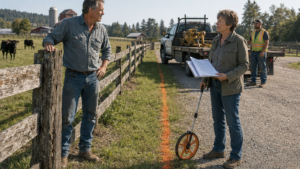
The first orange flag stood exactly where James Mitchell had planted his left boot every morning for nearly forty years.
He stopped halfway down the pond bank with his fishing rod in one hand and a dented thermos in the other. Three more flags ran away from the water in a neat fluorescent line, crossing the patch of short grass he kept mowed between the gravel lane and the cattails. A fifth had been pushed into the soil beside the flat limestone where he usually set his coffee.
James stared at them long enough for the steam from his thermos to thin in the cool air.
Then he set everything down.
The flags were new. The ground around them was still dark from the metal stakes being driven in. Beyond the pond, on the newer houses of Briar Creek Estates, porch lights were going out one by one as people left for work.
James pulled the nearest flag free.
A strip of pink tape had been tied around it. Black marker showed a number he did not recognize.
He walked ten yards farther and found white paint sprayed through the grass.
That irritated him more than the flags.
The grass, the pond, the gravel track, the low southern swale—none of it belonged to Briar Creek Estates. The subdivision had been pasture when James bought the acreage. Before that, his father had leased part of the ground for cattle. James could still remember fence staples in trees that had since grown thick enough to swallow them.
A truck door slammed behind him.
He turned.
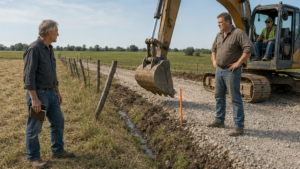
A contractor’s pickup had stopped near his farm entrance. Two men in reflective vests were unloading a post-hole auger from a trailer.
James walked up the lane.
“You boys looking for somebody?”
The older worker glanced at a clipboard. “Mitchell?”
“That’s me.”
The man’s expression changed slightly. “We were told the association had access.”
“For what?”
“Fence line.”
James looked back toward the pond.
“What fence?”
The worker turned the clipboard so James could see a printed work order. At the top was the name of the Briar Creek property association. Beneath it, a line drawing showed a fence beginning near the gravel track and following the exact path of the orange flags.
James read it twice.
“This comes through my ground.”
“We just install where they mark.”
“Then don’t install today.”
The younger worker shifted his weight. “You need to talk to the association.”
“I expect I do.”
James pulled the remaining flags from the grass while the workers watched.
He laid them carefully beside the trailer instead of breaking them.
The older man made a phone call.
James returned to the pond, but he did not cast.
His fishing rod rested across his knees while the water remained untouched in front of him.
Twenty minutes later, a dark SUV came down the subdivision road and stopped where pavement met his gravel.
Christine Carter got out carrying a folder.
James knew her by sight. She had been elected association president that summer. Before that, he had seen her jogging past the pond a handful of times and once at a county planning meeting where she had asked three questions about stormwater maintenance.
She walked toward him without stepping off the gravel.
“Mr. Mitchell.”
“Morning.”
“Our contractor says you removed survey markers.”
“I removed flags from my yard.”
Christine opened the folder.
“They aren’t random flags. They mark the association maintenance boundary.”
James looked at her over the top of his glasses.
“Since when?”
“The board approved the work last month.”
“That wasn’t what I asked.”
For a moment she did not answer.
Then she handed him a notice.
James read the first paragraph. It referred to an “unapproved water-adjacent condition,” a required perimeter barrier, and a weekly assessment of two hundred dollars beginning after the compliance deadline.
He looked toward the pond.
“You’re fining me for my pond?”
“We’re enforcing safety and drainage standards along association-controlled property.”
“This pond was here before those houses.”
“I understand that.”
“No, ma’am. I don’t believe you do.”
Christine’s jaw tightened.
“The association’s maps show this shoreline strip connecting to the southern drainage corridor. Residents have had standing-water complaints, and the board cannot keep ignoring liability.”
James folded the notice once.
“Your maps are wrong.”
“Then provide documentation.”
“I have documentation.”
“Good. Send it.”
James looked at the orange flags beside the contractor’s trailer.
“You sent men with an auger before asking.”
“We sent a contractor to property our records identify as association-controlled.”
“That sounds like asking backward.”
Christine drew a slow breath.
Behind her, one of the workers pretended to check a strap on the trailer.
“I’m not here to argue,” she said. “If you believe the boundary is different, file your objection. Until then, the assessment stands.”
James slipped the notice into his jacket pocket.
He could have told her about the old iron pin near the bank.
He could have told her where the original fence had run before the eastern corner was cleared.
He could have driven to the courthouse that morning and pulled the recorded plat.
Instead he picked up his rod.
“I’ve owned this ground since 1983.”
“And I’m asking you to prove where your ground ends.”
James’s face stayed still, but something in him closed.
“I don’t need permission to know where my own land is.”
Christine nodded once, as if that answer confirmed something.
“Then we’ll have the county verify it.”
She turned and walked back toward her SUV.
The contractors packed the auger away.
James watched them leave.
Only after the lane was quiet again did he go inside the farmhouse.
The safe was in a narrow closet off the back bedroom. James knelt, spun the old dial, and pulled out a flat envelope yellowed along one edge.
Inside were the deed, an early plat, tax records, and several handwritten notes his father had kept before James bought the place.
The deed smelled faintly of paper and dust.
Across the first page, beneath the legal description, was the date James already knew without reading it.
He spread the document across the kitchen table.
The property description followed bearings and distances that meant more to a surveyor than to him, but James remembered the practical version: from the road corner to the old oak, along the southern drainage ground, then north past the pond.
He found a photocopied plat behind the deed.
The pond was clearly drawn inside his parcel.
James sat back.
For the first time that morning, he felt something close to satisfaction.
Then the phone rang.
Christine.
He let it ring three times before answering.
“Mr. Mitchell,” she said, “I’ve scheduled a county boundary verification for Thursday morning.”
James looked at the plat.
“All right.”
“Our contractor will also be present so the work can proceed if the boundary supports our records.”
James’s thumb rested on the edge of the 1983 deed.
“And if it doesn’t?”
There was a short pause.
“Then we’ll address that when we have facts.”
James almost smiled.
“Thursday, then.”
He hung up and looked through the kitchen window toward the pond.
From this distance, the missing flags were invisible.
But the line they had drawn through his morning was not.
Chapter 2: The Survey Pin Under His Fishing Boot
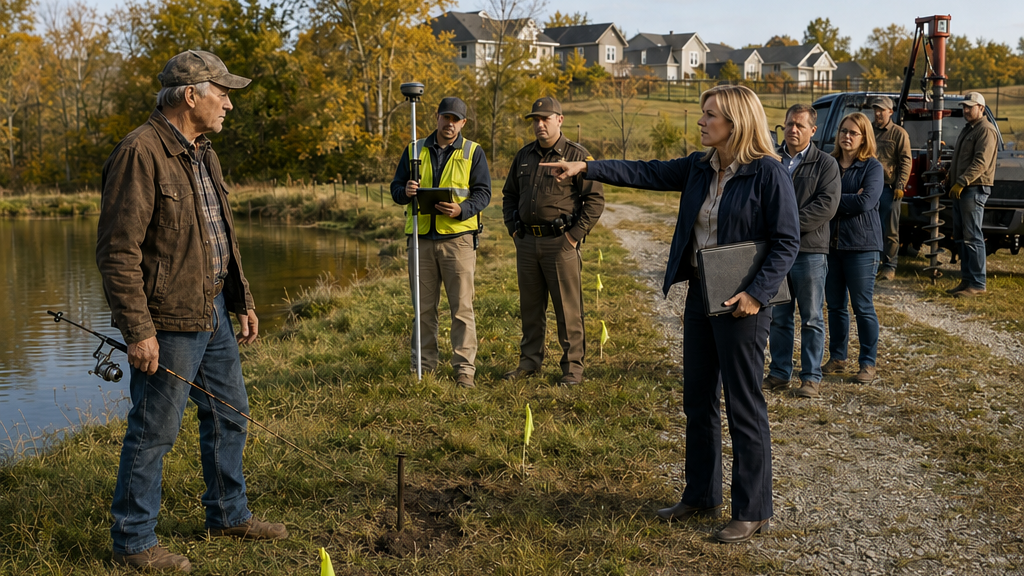
The deputy arrived before the fence crew did.
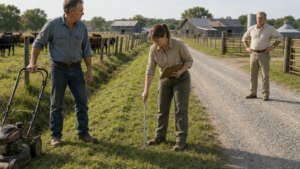
James saw the county cruiser stop near his gate at 8:12 Thursday morning, followed less than a minute later by Christine Carter’s SUV and a truck towing the same post-hole auger.
He was already at the pond.
His line rested in the water, though he had not watched the bobber once.
Christine walked down the gravel track with two board members behind her. One carried a rolled plan. The other kept glancing toward the contractors as if the delay itself were costing him money.
The deputy stopped several yards from James.
“Mr. Mitchell?”
“Yes, sir.”
“I’m here because there’s a property-access dispute.”
Christine spoke before James could answer.
“He has been interfering with association work and occupying a maintenance strip our records show as common property.”
James reeled his line in.
The deputy looked between them.
“Anybody threatening anybody?”
“No,” James said.
Christine said, “Not physically.”
The deputy gave her a level look.
“Then this stays a civil boundary issue unless something changes.”
Christine opened her folder.
“We requested county verification. The association has maintained this drainage edge for years.”
“Maintaining ground doesn’t necessarily mean owning it,” the deputy said.
“That’s why the survey technician is coming.”
A county pickup appeared at the end of the lane.
James set his fishing rod on the grass.
The survey technician climbed out carrying a receiver pole, a tablet, and a narrow case. He introduced himself by role rather than offering unnecessary conversation, then asked to see both parties’ records.
Christine handed over a clean printed site plan.
James handed him the old photocopy from his kitchen.
The technician studied both.
“These aren’t the same type of document,” he said.
Christine frowned. “Ours is the current association map.”
“And his appears to derive from a recorded parcel plat.”
“Which is controlling?”
“I haven’t checked the monumentation yet.”
Christine glanced toward James.
He said nothing.
That seemed to bother her more than an argument would have.
The technician entered information into his tablet, then walked slowly toward the pond edge.
James followed.
He knew where the old corner marker should be. For years it had sat nearly flush with the ground beside a tuft of switchgrass. He had seen it whenever he trimmed the bank, though he had stopped noticing it in the way people stop noticing a fence post or a familiar scar.
The technician’s receiver beeped.
“Should be somewhere close.”
Christine stepped forward.
James looked down.
The toe of his boot was almost touching the spot.
He pushed aside dead grass with his heel.
A dark circle appeared in the soil.
He scraped once more.
Rust-dark metal caught the morning light.
The technician crouched.
“There it is.”
Christine went silent.
James moved his boot aside.
The survey pin was no bigger than a coin at the top, scarred by decades of weather and mower blades.
The technician cleaned around it, checked the cap, then entered the identification into his tablet.
The deputy leaned slightly to see.
“Matches?”
The technician waited for the receiver to settle.
“Let me verify the second point.”
They walked farther along the gravel edge.
The contractors remained by their truck. No one unloaded the auger.
At the next monument, the technician repeated the process.
Then he returned to the first pin and opened a county parcel layer on his tablet.
“The recorded Mitchell boundary runs here.”
He traced a line with one finger.
Christine stepped beside him.
“That puts the entire shoreline on his side.”
“Yes.”
“What about the maintenance strip?”
“There is no separate association-owned strip shown between this boundary and the pond.”
Christine’s face changed, not dramatically, but enough that James saw it.
She looked toward the fence flags the contractors had replaced that morning.
Several stood nearly twelve feet inside the line the technician had just identified.
One of the board members said, “That can’t be right. We’ve had crews down there.”
The technician shrugged slightly.
“Access and ownership are different questions.”
Christine turned toward James.
“You knew about this marker.”
“I knew where my corner was.”
“And you let us schedule all this instead of simply showing us?”
James met her eyes.
“You sent notices. You sent contractors. You told me what you owned.”
“You could have responded with documentation.”
“I told you your line was wrong.”
“That isn’t documentation.”
“No. This is.”
He pointed to the pin.
The remark landed harder than he intended.
Christine looked away first.
The deputy stepped between the tone of the conversation and the facts.
“So as far as the allegation that Mr. Mitchell was occupying association property?”
The technician shook his head.
“Not according to the recorded parcel boundary.”
The deputy turned to Christine.
“Then there’s no trespass here.”
One of the board members muttered something under his breath.
Christine closed her folder.
James expected relief.
He had imagined this moment twice since Tuesday: the county record matching the land he remembered, the contractors leaving, Christine forced to withdraw the notices.
Instead he felt only a tight, quiet satisfaction.
The technician was still studying the screen.
“Hold on.”
James looked at him.
The technician zoomed out.
A narrow shaded corridor appeared along the southern part of James’s acreage, beginning near the subdivision side and following a shallow low area before turning toward the road culvert.
“What’s that?” Christine asked.
“Recorded access reference.”
James stepped closer.
The corridor crossed his property.
He recognized the route immediately.
The old swale.
For years, crews had occasionally entered from the south to cut brush or clear debris. Long before Briar Creek Estates had a formal board, someone would call James first. Sometimes he opened the gate. Sometimes he rode along in the pickup and showed them where the ground stayed soft after rain.
He had never thought much about why.
Christine pointed to the screen.
“That’s ours.”
The technician shook his head.
“I didn’t say that. I said it’s an access reference.”
“What kind?”
“I’d need the recorded instrument.”
Christine looked at James.
“Do you have it?”
James frowned.
“I’ve got the deed.”
The technician tapped a number on the screen.
“This references a separate instrument recorded in 1983.”
The year struck James harder than it should have.
He leaned toward the tablet.
There, in small text beneath the corridor, was a book-and-page reference he had not looked at in decades.
The deputy said, “Sounds like you both ought to read that before anybody drills another hole.”
The contractor began securing the auger again.
Christine did not object.
James picked up his fishing rod, but before he could return to the bank, the technician spoke.
“Mr. Mitchell?”
James turned.
“You may own every foot around that pond.”
James waited.
“But somebody recorded a drainage right across the southern part of your farm the same year you bought it.”
Chapter 3: The Paragraph Neither Side Had Read
James found his father’s signature before he found the paragraph that mattered.
It sat at the bottom of a photocopied easement agreement the county clerk had pulled from an old record book, the handwriting unmistakable even after four decades: blocky first letters, hard downward strokes, the same signature James had seen on feed invoices and cattle-sale receipts as a boy.
He stared at it through the scratched plastic sleeve.
His own signature appeared three lines below.
He had forgotten that completely.
The clerk waited behind the counter.
“Would you like a certified copy?”
“Yes.”
James kept looking at the page.
The agreement had been recorded in September 1983, less than two months after he closed on the acreage. At that time the property east of his farm was not Briar Creek Estates. It belonged to a developer preparing roads and drainage for what was then only a small cluster of houses.
James remembered meetings at his parents’ kitchen table. He remembered men talking about runoff, culverts, grades, and access.
He remembered wanting them to finish so he could get back to work.
Apparently, he had signed more than he remembered.
The clerk returned with stamped copies.
James drove home with them lying on the passenger seat.
His fishing rod remained where he had left it that morning, propped beside the back door.
For the first time in years, he passed it without reaching for it.
At the kitchen table, he spread the 1983 deed, the modern county parcel map, and the drainage agreement side by side.
The first pages were ordinary enough.
The agreement granted limited access across a defined corridor along the southern low ground for inspection, clearing, drainage maintenance, and necessary repairs.
Not ownership.
Not control of the pond.
Not the right to move the boundary.
James felt his shoulders loosen.
Then he kept reading.
The access was tied to conditions.
Work was to remain within the described corridor except in emergencies. Disturbed ground was to be restored. The servient owner—James—was to receive reasonable notice when practical. Existing property boundaries were to remain unaffected by the access right.
He read that sentence twice.
Existing property boundaries were to remain unaffected.
Christine’s claimed fence line had done exactly the opposite.
James turned another page.
A handwritten notation referenced a drainage sketch.
That sketch showed the swale as it had originally existed: narrow, shallow, curving along the natural low point before emptying through a culvert near the county road.
James carried the map outside.
The southern pasture lay beyond the equipment shed. He crossed the grass slowly, comparing the old sketch with the ground.
At first the route looked familiar.
Then he reached the bend.
The modern ditch was wider.
Not by a foot or two.
By several feet in places.
Fresh soil had been thrown onto one side, though weeds had begun growing through it. Tire impressions remained visible beneath the grass. Farther uphill, the disturbed area angled north toward the pond.
James crouched and touched one of the tracks.
The soil beneath was still packed hard.
Someone had brought equipment through recently.
He followed the marks.
They crossed the line shown on the old drainage sketch.
James stood still.
A memory surfaced.
Late spring.
A yellow excavator beyond the southern hedge.
He had seen it from his tractor while moving hay equipment and assumed the association was clearing the swale as crews had done before.
No one had called him.
He had been annoyed.
Then he had decided annoyance was easier than dealing with the board.
That decision no longer looked quite so harmless.
A pickup approached along his lane.
Thomas Harris climbed out.
He shut the door and looked at the papers in James’s hand.
“County?”
James nodded.
Thomas had farmed the adjoining acreage for most of his adult life. He was younger than James but old enough to remember when the subdivision road ended in mud.
“Well?” Thomas asked.
“They’ve got access.”
Thomas leaned against the truck.
James added, “They don’t own anything around the pond.”
“I figured that much after Thursday.”
“The easement runs through the south swale.”
Thomas looked toward it.
“That’s been there forever.”
“Since ’83.”
“Your dad agreed to that, didn’t he?”
James looked at him sharply.
“You remember?”
“I remember him complaining about having strangers drive across wet ground.”
James glanced at the signature again.
Thomas smiled faintly.
“Sounds like him.”
James did not.
“The agreement says they stay inside the corridor.”
Thomas’s smile disappeared.
“They haven’t.”
“You noticed?”
“I noticed they cut it wider this summer.”
James folded the drainage sketch.
“You could’ve mentioned that.”
Thomas gave him a long look.
“I thought you knew.”
The answer irritated James because it resembled too closely the excuse he had been giving himself.
They walked the swale together.
Thomas stopped where the newer cut angled toward the pond.
“That wasn’t there last year.”
James studied the ground.
“No.”
“The association said they were fixing backup after the spring storms.”
“They say a lot of things.”
Thomas kicked lightly at a ridge of excavated dirt.
“Doesn’t mean every one of them is wrong.”
James looked at him.
Thomas pointed downhill.
“Water’s been sitting longer down by the development. You know that.”
James said nothing.
He did know.
By midsummer, sedge had thickened in the shallowest part of the swale. He had caught pieces of it on his fishing line where drainage water fed into the pond after rain. He had even mentioned the buildup to Thomas once while they were repairing a gate.
He had not called the association.
He had told himself it was their problem.
Now he looked at the widened ditch and wondered whether their attempt to fix it had created another one.
Back in the kitchen, James called his attorney.
He read parts of the agreement aloud.
The attorney asked him to send copies of the full instrument and county map.
“Does this mean they can come through whenever they want?” James asked.
“Not from what you’re reading.”
“Can they fence the pond edge?”
“Not under a drainage easement.”
James let out a breath.
“But,” the attorney continued, “don’t confuse being right about the boundary with having no obligations around the easement. Those are separate questions.”
James looked through the window toward the southern field.
“What if they’ve worked outside it?”
“Document it. Don’t touch anything yet.”
James disliked those last four words.
He had spent half his life solving things by touching them.
A broken hinge got welded. A blocked culvert got cleared. A loose post got reset.
Paperwork required waiting while somebody else decided what obvious facts meant.
That afternoon he walked the entire corridor with the old sketch.
Near the road end, the swale matched almost perfectly.
Near the middle, the newer grading wandered.
Closer to the pond, the machine tracks left the historic corridor entirely.
They crossed grass James had always considered part of the pasture and climbed toward the disputed shoreline.
James stopped beside one track wide enough to hold rainwater.
He looked from it to the rust-dark survey pin now visible near the pond bank.
The same crews that claimed the boundary had shifted had apparently been working beyond the drainage line as well.
He took out his phone and photographed the track.
Then another.
Then the excavated ridge.
He had spent days wanting proof that Christine was wrong.
Standing there with the old agreement in one hand and fresh machine marks in front of him, James understood that the harder question was no longer whether she had crossed his boundary.
It was how much had already been changed after she did.
Chapter 4: The Flooded House Behind Christine’s Anger
The waterline on Nancy Green’s utility-room wall was higher than James expected.
It ran in a dull brown stripe behind the water heater, almost level with the bottom of the electrical panel. Nancy had not painted over it. The mark cut across the room like evidence left in place on purpose.
“That was three weeks ago,” she said.
James stood just inside the doorway with his hat in his hands.
The room smelled faintly of bleach and damp drywall.
Nancy pointed toward a stack of warped baseboards leaning against the wall. “We pulled all that out ourselves.”
James looked down.
“You get water before?”
“Not inside.”
Christine stood near the open back door, arms folded. She had asked James to come see the lower lots before the association meeting that afternoon. He had almost refused.
Then Nancy had called him herself.
Not the board.
Not a contractor.
Nancy.
“My husband was out of town,” she said. “I woke up because the sump alarm started screaming. By the time I got downstairs, water was coming under that door.”
James followed her outside.
The backyard sloped gently toward a narrow drainage channel at the edge of the subdivision. Grass there lay pressed flat in one direction.
“Where’d it come from?” he asked.
Nancy looked toward the fields beyond the houses.
“Christine says the farm drainage backed up.”
Christine answered carefully. “I said the system wasn’t moving water the way it should.”
“That’s not the same sentence you used in the notices.”
Christine’s mouth tightened.
“No.”
James appreciated the admission more than he wanted to.
Nancy walked to the rear fence.
“You two can fight about the line all day. I don’t care where the paperwork says the pond belongs. I care whether this happens again.”
James looked at the damaged grass.
He could see where runoff had spread beyond the shallow channel and crossed the yard.
That much was real.
“How many houses?”
“Three had water against foundations,” Christine said. “Nancy’s was the worst.”
“And you think my swale caused it?”
“I think something upstream changed.”
James looked at her.
“That’s different too.”
Christine met his eyes.
“Yes.”
They walked along the rear lots toward the association meeting building.
At one fence, a homeowner had stacked sandbags against a basement window. At another, muddy straw still clung to the bottom rail.
James had spent the last week thinking about unauthorized grading, false claims, and the old agreement.
He had not pictured anyone carrying wet carpet out of a basement.
Inside the meeting room, half a dozen residents were already seated.
The atmosphere changed the moment James entered.
Conversation thinned.
A man near the back said, “So now he shows up.”
James heard it.
He kept walking.
Christine called the meeting to order and began with the survey result.
“The pond shoreline is confirmed as Mr. Mitchell’s property,” she said. “The association’s prior boundary representation was inaccurate.”
There were murmurs around the room.
One board member leaned toward his microphone.
“The maintenance issue remains unresolved.”
James sat with his arms crossed.
A resident across from him said, “He stopped the crews.”
James looked over.
“They were setting fence posts on my land.”
“You also haven’t let them maintain the drainage.”
“That’s not true.”
“Then why did we flood?”
James started to answer.
Thomas Harris spoke from the side wall.
“Because that swale’s been filling in for a while.”
James turned.
Thomas had not told him he was coming.
Christine looked at him. “How long?”
Thomas shifted his cap in his hands.
“At least since spring.”
The room changed again.
James felt it before anyone spoke.
Christine looked directly at him.
“Did you know that?”
James’s jaw tightened.
Thomas did not rescue him.
James could have said he had only noticed vegetation.
He could have said he did not know whether it mattered.
Both would have been true.
Neither would have been the whole truth.
“I knew water was sitting longer.”
Nancy stared at him.
“You knew?”
“I knew the swale wasn’t clearing like it used to.”
“And you didn’t tell anyone?”
James looked toward Christine.
“She had a board. She had contractors.”
“That’s not what I asked,” Nancy said.
The words hit harder because they sounded like something James himself would say.
He looked down at his hands.
“No.”
The room stayed quiet.
Christine did not look triumphant.
That made it worse.
James said, “I figured if your people were responsible for maintaining it, they’d see it.”
Thomas shook his head.
“That’s what everybody figured.”
James glanced at him.
Thomas leaned back against the wall.
“You figured they’d know. They figured you were blocking them. Nobody talked until somebody’s basement filled.”
James stood.
Not abruptly.
Just enough to end the feeling that he was being examined from every direction.
“I’m not taking responsibility for work I didn’t authorize.”
Christine nodded. “You shouldn’t.”
A few residents looked at her.
She continued.
“But we need to separate that from whether there was a drainage problem.”
James said, “There was.”
It was the first time he had admitted it out loud.
After the meeting, he returned to the pond alone.
He needed something ordinary.
He cast once from the limestone near the bank.
The lure traveled cleanly and landed close to the cattails.
On the retrieve, the hook snagged.
James pulled gently.
A long strand of brown-green vegetation came loose from the water, wrapped around the line.
He stared at it.
The same thick sedge grew along the slow section of the southern swale.
He had noticed it months earlier.
He had cursed it when it caught his lure.
He had never treated it as a warning.
By late afternoon, Christine called.
“I found the contractor invoice.”
James set the rod across his knees.
“What does it say?”
“Emergency channel widening and debris removal.”
“Who approved it?”
Silence.
“Christine.”
“I did.”
James looked toward the southern pasture.
“With county approval?”
Another pause.
“I’m checking.”
“That means no.”
“I was told it was routine maintenance.”
“Who told you?”
“The contractor said they had done work there before.”
James stood.
“How far did you authorize them to widen it?”
“I gave them permission to restore flow.”
“That isn’t a distance.”
“I know.”
The answer was quiet.
James gripped the phone.
“When?”
“Six weeks ago.”
Before the worst flooding.
James’s gaze settled on the machine tracks still visible beyond the pasture.
“You widened that ditch before Nancy’s house took water.”
“Yes.”
“Did anyone survey the easement first?”
“No.”
The irritation in James vanished.
Something colder replaced it.
“Send me the invoice.”
“I already did.”
James walked back to the farmhouse and opened his email.
The invoice was there.
At the bottom, beneath the work description, was a notation referencing “field expansion as needed for drainage capacity.”
No survey number.
No county permit.
No recorded-width reference.
James called his attorney.
The attorney read the document while James waited.
Then came a long exhale through the phone.
“James, don’t let anyone touch that swale again.”
“Why?”
“Because if they widened it beyond the recorded corridor without approval, we may not be looking at a maintenance dispute anymore.”
James looked out toward the low ground.
“What are we looking at?”
“A modification.”
The word sounded small.
The machine tracks outside did not.
Chapter 5: The Ditch They Changed Without Asking Him
The new channel was carrying water in the wrong direction by sunrise.
James saw it from the pasture gate after a night of steady rain: a brown ribbon cutting diagonally across ground that had never held a ditch before.
He stood with his coat unbuttoned and watched water leave the widened swale, spill over the excavated ridge, and carve through the grass toward the subdivision.
The original route curved south.
This one pushed east.
He called Christine before six-thirty.
“You need to see this.”
She arrived twenty minutes later in rubber boots and a rain jacket.
No folder.
No board members.
James pointed.
Christine followed the flow with her eyes.
“That wasn’t there yesterday.”
“The cut was.”
“I mean the water.”
James stepped over a shallow rut.
“You widened the channel. It found a new low spot.”
“We widened what was already there.”
“No. Your contractor widened what he thought was there.”
Christine looked at him.
“That’s not the same thing.”
“No.”
For once, the correction belonged to him.
A county survey technician arrived later that morning with measurements from the recorded easement. James’s attorney had requested verification after reviewing the invoice.
They walked the southern corridor together.
The technician set a temporary marker at the documented edge.
Then another.
By the third, the problem was obvious.
Freshly excavated ground extended several feet beyond the legal corridor.
Near the bend, it was worse.
The technician measured again.
“Eight feet outside here.”
Christine looked at the widened ditch.
“How much farther down?”
“We’ll check.”
At the next station, the disturbance was ten feet beyond.
Near the pasture fence, nearly twelve.
Christine rubbed a hand over her forehead.
James felt anger rising again, hot and familiar.
“You sent men onto my land.”
“I authorized maintenance.”
“You authorized excavation.”
“I did not tell them to leave the easement.”
“You didn’t tell them where it was.”
Christine looked at him sharply.
Then looked away.
The survey technician kept working.
James watched her face.
For weeks, she had spoken in clean terms: standards, control, maintenance, liability.
Now the ground itself looked messy.
There was no clean line between protecting residents and making a mistake.
Thomas arrived around noon with his pickup and walked out to the swale.
He took one look and said, “That water never ran there before.”
Christine asked, “You’re certain?”
“I’ve cut hay in this field.”
James said, “He knows.”
Thomas squatted near the new channel.
“Used to bend around there.”
He pointed toward the original low ground.
“This ridge wasn’t built up either.”
The survey technician looked up.
“Excavated spoil.”
Thomas nodded.
“They piled dirt on the inside of the curve.”
James understood before anyone explained it.
The ridge had acted like a small berm.
Water entering the widened channel had been pushed away from the old route.
Christine stared at it.
“So the work could have made the flooding worse.”
The technician stood.
“I can tell you where the legal corridor is. Hydrology is another question.”
James said, “But the ditch is outside it.”
“Yes.”
“And the dirt pile is outside it.”
“Yes.”
Christine closed her eyes for a second.
When she opened them, the defensiveness was gone.
“I approved the emergency work.”
James waited.
She spoke toward him, not the technician.
“We had water standing behind three lots after the spring storms. Residents were calling every day. Insurance renewals were coming up. The contractor said the channel had lost capacity and could be opened back up quickly.”
“You never asked me.”
“I thought the association controlled the corridor.”
“You thought you controlled the pond too.”
“I know.”
James heard no challenge in it.
That unsettled him.
Christine stepped closer to the eroded edge.
“I should have verified it.”
“Yes.”
“I didn’t.”
The admission should have felt like a victory.
Instead James looked at the water cutting through his pasture.
“What happens now?”
The survey technician packed his receiver.
“That depends on the county, the property owner, and whoever is responsible for correcting the drainage.”
Christine said, “The association will fix what it caused.”
James glanced at her.
“You don’t know what that costs.”
“No.”
“You don’t even know what the fix is.”
“No.”
“But you’re promising it.”
She met his eyes.
“I’m responsible for approving it.”
James had not expected that either.
By afternoon, his attorney called with a clearer answer.
“The work exceeded the easement,” he said. “That gives you grounds to suspend nonessential access until they cure the violation.”
James stood beside the kitchen window.
“Meaning I can shut the gate.”
“Yes.”
“All of it?”
“Subject to emergency considerations and whatever obligations remain under the agreement. But you are not required to let them keep operating as if nothing happened.”
James looked at the farm entrance.
A heavy chain hung from one gatepost where he kept it year-round.
He could close the gate before dark.
He could require every truck, surveyor, contractor, and board member to stop at the road.
After the last two weeks, the thought brought a sharp sense of relief.
Then he remembered the brown stripe across Nancy Green’s utility-room wall.
“What happens downstream if I do?”
His attorney paused.
“That’s not strictly a property question.”
“I didn’t ask what kind of question it was.”
“No.”
James waited.
“If the current drainage condition is unstable and another significant storm hits, blocking repair access could increase risk.”
James rubbed his thumb along the window frame.
“So legally I can close it.”
“You have strong grounds to suspend the access they’ve been abusing.”
“But practically?”
“That depends on how much rain is coming.”
As if summoned by the words, James’s phone buzzed.
A county weather alert filled the screen.
Heavy rainfall was expected within forty-eight hours.
He read it twice.
Christine called less than five minutes later.
“You saw the forecast?”
“Yes.”
“We need to stabilize the swale before then.”
“We?”
“The association.”
“You need access.”
“Yes.”
James looked toward the chain on the gate.
For the first time since the orange flags appeared, the leverage was entirely his.
He could make Christine wait.
He could insist on lawyers, engineers, written guarantees.
He could lock the gate and point to the easement violation every time someone complained.
Every part of him that had resented the development wanted that.
Then Nancy’s flooded wall came back to him.
James said, “Nobody comes through tonight.”
Christine was quiet.
“Tomorrow morning?”
“I’ll tell you.”
He ended the call.
Near sunset, Thomas stopped by.
James was standing at the gate with the chain in his hands.
Thomas looked at it, then at him.
“You closing it?”
“I can.”
“That wasn’t my question.”
James hooked one end of the chain through the gate but did not pull it tight.
“They crossed my boundary.”
“Yep.”
“They changed my ground.”
“Yep.”
“They blamed me for their mistake.”
Thomas nodded.
James looked toward the subdivision roofs beyond the trees.
Thomas said, “And the rain’s still coming.”
James hated him a little for saying it plainly.
“What would you do?”
Thomas shrugged.
“Probably something stubborn first.”
James almost laughed.
“Then?”
“Regret how satisfying it felt.”
The first drops began to tap against the metal gate.
James held the padlock in his palm.
Tomorrow, he would have to decide whether the boundary was a shield, a weapon, or something else entirely.
Chapter 6: The Gate James Had Every Right to Close
James threaded the chain through the farm gate at seven the next morning.
Then he stopped before closing the padlock.
Beyond the gate, a contractor’s truck waited at the county road. Behind it sat a small excavator, a load of clean stone, and a utility trailer carrying erosion-control fabric.
No one had entered.
Christine stood beside her SUV holding a rolled set of plans.
Nancy was with her.
James looked at the padlock in his hand.
His fishing rod rested across the top rail of the open gate where he had set it while walking down from the pond.
The sight of it annoyed him.
He had brought the rod out of habit, as if there might still be time that morning to disappear beside the water and let someone else argue.
There was not.
Christine stayed on the road side of the gate.
“We won’t enter without your permission.”
“That’s a change.”
“Yes.”
James placed the padlock on the post instead of fastening it.
“What are you proposing?”
Christine unrolled the plan across the hood of her SUV.
“Temporary stabilization only. Remove the spoil ridge, redirect flow back into the historic swale, armor the worst eroded section, then stop.”
“Who designed it?”
“A drainage engineer reviewed it last night.”
“County?”
“They’ve seen the temporary plan. Permanent work still needs review.”
James scanned the drawing.
A heavy dashed line showed the recorded corridor.
The proposed work stayed inside it.
Mostly.
He tapped one point.
“What’s this?”
“Equipment turnaround.”
“Outside the easement.”
Christine looked.
The contractor leaned over the hood.
“We need somewhere to swing.”
“No.”
The man opened his mouth.
James looked at him.
“No.”
Christine took a pen and crossed out the turnaround.
“Back out along the same route.”
The contractor sighed but nodded.
Nancy watched James.
“You can really keep them out?”
James answered without looking at her.
“Yes.”
She was silent for a moment.
“My insurance company says if we get another water intrusion before repairs, they may not renew.”
James looked up.
Nancy did not sound accusing this time.
Just tired.
He folded the temporary plan.
“I want forty-eight hours.”
Christine frowned. “For what?”
“Emergency access. Written. Limited to this plan. No widening. No fence work. No work near the pond. No equipment outside the recorded corridor.”
“We can agree to that.”
“I’m not done.”
Christine waited.
“Photographs before and after. County markers stay visible. Any change gets approved by me in writing first.”
The contractor shifted.
“That could slow us down.”
James looked toward the clouds.
“Then don’t change anything.”
Christine said, “Fine.”
“And you sign that the previous widening was authorized by the association without confirming the easement boundary.”
The silence that followed was different.
Christine’s eyes narrowed slightly.
“You want an admission.”
“I want a record.”
“The association attorney will want to review language.”
“Then call them.”
“We don’t have time for a full legal negotiation.”
“You had time to fine me two hundred dollars a week.”
Nancy turned toward Christine.
“Sign it.”
Christine looked at her.
Nancy’s voice stayed calm.
“If what he’s asking is true, sign it. If it isn’t, we shouldn’t be here.”
One of the board members had arrived behind them and heard enough to understand.
“We need access,” he said.
Christine looked from Nancy to James.
Then she pulled out her phone.
The emergency board session happened forty minutes later in the association meeting room.
James sat at the far end of the table with the temporary access language in front of him.
His attorney joined by speakerphone.
The association attorney did the same.
The room felt less dramatic than the pond confrontation had.
No deputy.
No contractors.
No raised voices.
But James understood that more was being decided here.
The association attorney revised one sentence.
James’s attorney revised it back halfway.
Christine sat through both.
Finally, the agreement stated that emergency access would be granted for forty-eight hours solely to stabilize existing drainage, without waiving James’s property claims or expanding the recorded easement.
It also stated that the association had authorized prior grading without independently verifying the corridor.
Christine read that sentence for a long time.
James watched her.
“You can refuse.”
She looked at him.
“And you can close the gate.”
“Yes.”
“What happens if I sign?”
“You get two days.”
“And after that?”
“We figure out what the permanent agreement actually says and whether there’s enough trust left to use it.”
One board member whispered, “This is ridiculous.”
Nancy turned.
“My basement had nine inches of water.”
The man stopped speaking.
Christine picked up the pen.
Before she signed, she looked at James.
“I was wrong about the pond.”
James said nothing.
“I was wrong to send contractors before checking the survey.”
Still he waited.
“And I approved the widening because I thought waiting would put more homes at risk.”
“That part I believe.”
Christine’s expression shifted.
“You do?”
“Yes.”
“Doesn’t change what you did.”
“No.”
James leaned back.
“It changes what I do with it.”
Christine signed.
The crews entered fifteen minutes later.
James opened the gate himself.
For most of the day, he stayed near the southern swale.
Not to police every shovel.
To make sure the marked line remained the line.
The excavator removed the spoil ridge that had diverted runoff. Clean stone went into the eroded section. Fabric was pinned into place. The contractor backed the machine down the same narrow route he had entered.
At one point the operator stopped and pointed toward a softer patch outside the corridor.
“Would be easier if I cut through there.”
James shook his head.
The operator nodded and reversed.
No argument.
By late afternoon, water entering the swale followed the older curve again.
Thomas arrived and stood beside James.
“Looks more like it used to.”
“Almost.”
“You lock the gate tonight?”
“No.”
Thomas glanced over.
James nodded toward the forty-eight-hour agreement tucked into his jacket.
“Not yet.”
The storm arrived after dark.
Rain struck the farmhouse roof hard enough to wake James twice.
Before dawn, he drove down to the swale with headlights washing across wet grass.
Water ran fast but stayed in the corrected channel.
He followed it until the road culvert.
No overflow.
Not yet.
When he returned to the gate, Christine was there beneath an umbrella.
“You sleep at all?” James asked.
“Not much.”
They stood listening to water move through the ditch.
Christine said, “The board wants to know what happens after the forty-eight hours.”
“That depends.”
“On?”
“Whether they still think an easement means ownership.”
“They don’t.”
“Whether they’re willing to put maintenance limits in writing.”
She nodded.
“And?”
James looked toward the pond, barely visible through the rain.
“Whether I’m willing to stop pretending none of this is my concern because the houses aren’t mine.”
Christine studied him.
James did not like saying it.
That was part of why he knew it was true.
She folded the umbrella slightly against a gust.
“Can the old agreement be saved?”
James looked at the open gate.
His fishing rod was still resting across the top rail, dark with rain where he had forgotten it the day before.
He lifted it carefully.
“The old one?”
Christine waited.
James wiped water from the cork handle.
“No.”
Her face fell.
Then he added, “But maybe we write a better one.”
Chapter 7: The Map That Changed the Meeting
The first thing James noticed when he entered the association meeting room was the empty chair beside Christine.
The second was the projection screen already lowered at the front.
His fishing rod was still in the truck.
He had almost carried it that morning out of habit, then stopped with his hand on the rod case. Going to the pond would have been easier. The fish did not ask him to explain boundaries, easements, mistakes, or what happened after a man discovered he had the legal right to shut a gate other people needed open.
So he left the rod behind and walked inside carrying two rolled maps.
Conversation faded as he crossed the room.
Nancy sat near the front. Thomas leaned against the rear wall. Several residents James recognized from the flood meeting occupied the middle rows.
Christine stood when he approached.
“The board attorney is joining by phone,” she said.
James nodded.
“And we have the engineer’s estimate.”
“That the good one or the expensive one?”
Christine gave him a tired look.
“Depends which option you mean.”
James took his seat.
The meeting began with numbers.
Repairing the historic drainage route, including restoration of the improperly widened section, would cost far less than constructing a completely independent path around James’s property.
The rerouting estimate produced the first real sound in the room.
A board member leaned toward Christine.
“That’s preliminary?”
“Yes.”
“And it could go higher?”
“Yes.”
James did not need to see the figure again.
It was enough to know the board now understood something it had ignored when the orange flags first appeared: the subdivision’s drainage system worked cheaply because, for decades, it had crossed his land.
Not because the association owned that land.
Because somebody had once negotiated permission.
The association attorney’s voice came through the speakerphone.
“The existing easement remains disputed because of the unauthorized work and the failure to observe its limits. Litigation would be uncertain and expensive. A negotiated replacement is the most practical option.”
One of the board members turned toward James.
“So what do you want?”
James looked at him.
The question was sharper than it needed to be.
Maybe because everyone in the room expected the answer to be money.
Maybe James had expected that too.
He stood and carried the first map to the front.
“This is the 1983 drainage sketch.”
He clipped it to the display board.
The old map was faded, the lines thin and uneven.
Then he connected his laptop and projected the newer county survey beside it.
The corrected parcel boundary appeared in clean digital lines.
The room went quiet.
James pointed to the pond.
“This is mine.”
Nobody argued.
He traced the southern line.
“This is the recorded drainage corridor.”
Then he pointed to the newer excavation marks, overlaid in red by the county measurements.
“This is where the work went outside it.”
Someone in the second row shifted uncomfortably.
James continued.
“When this started, I wanted all of you off my ground.”
Christine lowered her eyes.
James looked at the board.
“I figured the easiest answer was a locked gate.”
Thomas watched him from the back.
James said, “I had the right to do it, at least until the dispute got sorted out.”
Nancy spoke quietly.
“But you didn’t.”
“No.”
He tapped the map again.
“Because rights aren’t the only thing water pays attention to.”
That brought a few faint smiles, but no one laughed.
James preferred it that way.
He turned toward Christine.
“The old agreement was too loose. People stopped calling. Crews came through because crews had always come through. The board started treating access like ownership. I started treating every request like another piece of my farm somebody wanted.”
Christine looked at him.
“That’s fair.”
James shook his head.
“Some of it.”
He glanced at Nancy.
“I knew that swale was slowing down. I didn’t know her basement would flood. But I knew enough to make a phone call.”
Nancy held his gaze.
James added, “I didn’t make it.”
No one rescued him from the silence.
He had learned not to expect that.
Then he switched the projection.
A third map appeared.
The corridor was narrower than before, defined by fixed coordinates and numbered access points.
“This is what I’ll agree to.”
The board member beside Christine leaned forward.
“What exactly are we looking at?”
“A replacement access agreement. Same drainage function. Better limits.”
James pointed to the first condition.
“Advance notice except in a genuine emergency.”
Second.
“No equipment outside the marked corridor without written permission.”
Third.
“Any excavation requires county-reviewed plans.”
Fourth.
“Before-and-after photographs.”
Fifth.
“The association restores damaged pasture, fencing, or access surfaces.”
“And the pond?” Christine asked.
“Not part of it.”
She nodded.
James continued.
“The association also acknowledges the recorded property boundary. No maintenance map gets to redraw it.”
The board attorney spoke through the phone.
“These conditions are workable in principle.”
One board member frowned.
“What about permanent access? He could sell the farm.”
“That’s what a recorded replacement agreement is for,” James said.
The man looked surprised that James understood the point.
James almost resented the surprise.
Then he remembered how little he had bothered explaining before.
Christine slid a document across the table.
“There’s another item.”
James read the heading.
Formal Withdrawal of Assessments and Boundary Notice.
The two-hundred-dollar weekly fines were rescinded.
The fencing demand was withdrawn.
The association acknowledged that its earlier pond-boundary representation had been incorrect.
James signed only the line confirming receipt.
He did not smile.
He felt something quieter than satisfaction.
A piece of the problem had finally been named correctly.
Christine addressed the room.
“The grading authorization was mine.”
Several heads turned.
She continued before anyone interrupted.
“I approved emergency work without verifying the recorded limits. I also supported the original boundary enforcement before confirming the county survey.”
A board member said, “We were working from the association maps.”
Christine looked at him.
“I was president. I approved it.”
James watched her.
The woman who had arrived at his pond with contractors and certainty now looked neither defeated nor heroic.
Just responsible.
That mattered more than an apology would have.
Nancy raised her hand.
“I move that the board authorize counsel to negotiate the replacement agreement based on Mr. Mitchell’s proposed corridor.”
Another board member seconded.
The vote was not unanimous.
One man objected to giving James what he called “veto power.”
James answered before Christine could.
“You don’t need my permission to maintain your property.”
He pointed to the map.
“You need it to cross mine.”
The room settled.
The motion passed.
Afterward, chairs scraped back and people gathered papers.
No one applauded.
No one came over to congratulate James.
Nancy stopped beside him.
“I’m glad you came.”
James rolled the maps.
“So am I.”
She smiled slightly.
“That sound painful.”
“It is.”
At the doorway, Christine caught up with him.
“The attorney will send revised language tomorrow.”
James nodded.
She hesitated.
“I don’t expect you to trust the board because of one vote.”
“Good.”
“I do expect us to follow the new agreement.”
“That would be a start.”
Outside, James opened his truck.
His fishing rod lay across the passenger seat.
He looked at it, then back at the meeting-room windows.
For most of his life, the pond had been where he went when other people became too complicated.
Now the line on the map was correct.
The fines were gone.
The gate was still his.
But whether any of them could keep the arrangement working after the urgency faded—that part could not be surveyed.
Chapter 8: He Cast From the Same Bank Again
The next hard rain reached Nancy Green’s culvert before it reached her basement door.
James knew because he was standing in the southern pasture watching the flow.
Water entered the restored swale, followed the old curve, passed between the new permanent markers, and disappeared beneath the county road without spilling across the lower yards.
He waited another ten minutes.
Then another.
No new channel formed through his grass.
No muddy sheet moved toward the subdivision.
Thomas stood beside him with his hands in his coat pockets.
“Well,” Thomas said.
James kept watching.
“Well what?”
“Looks like water can read paperwork after all.”
James gave him a sideways look.
Thomas grinned.
“You said it couldn’t.”
“I said it didn’t care.”
“Close enough.”
James walked the corridor once more.
The new agreement had been recorded eleven days earlier.
It did not resemble the old 1983 document much.
The language was clearer. The surveyed coordinates were attached. The association’s obligations were specific. So were James’s.
Emergency access remained possible.
Routine access required notice.
The pond and shoreline were expressly excluded.
Permanent boundary markers had been reset where decades of grass and soil had nearly hidden the old ones.
James had insisted on that.
Facts should not have to be dug out with a boot every forty years.
By afternoon, the clouds thinned.
James returned to the pond.
His old chair still sat beside the limestone slab.
He carried his thermos and fishing rod down the bank, then stopped.
The spot where he normally planted his left boot was inches from the new survey marker.
Not a fluorescent flag.
Not spray paint.
A small permanent monument set flush with the ground, its cap visible above the trimmed grass.
James rested the fishing rod against his shoulder.
Forty years of mornings had made the bank feel unchanged.
It was not unchanged.
He was not either.
A vehicle door closed near the lane.
James turned.
Christine Carter was walking toward him.
Alone.
No folder tucked under her arm this time.
No contractor behind her.
She held one envelope.
James waited until she reached the bank.
“Morning.”
“Morning.”
She offered him the envelope.
“Your recorded copy.”
James took it.
The county stamp appeared on the first page.
“You could’ve mailed it.”
“I know.”
He looked at her.
Christine glanced toward the pond.
“I wanted to see whether the repair held.”
“It held.”
“Nancy called me before seven.”
“I expect she did.”
“She said her sump barely ran.”
James nodded.
For a few seconds they listened to water dripping from the trees.
Christine pointed toward the new marker.
“That the original location?”
“Within the survey tolerance.”
“You sound like the technician now.”
“I paid attention.”
She almost smiled.
James opened the envelope and checked the first pages.
The replacement agreement recognized his ownership and gave the association no rights beyond the defined drainage corridor.
The arrangement would outlast Christine’s presidency.
It would likely outlast James.
That was the point.
Christine looked toward the chair.
“Forty years?”
“Closer to that than I care to count.”
“You really fish every morning?”
“Most.”
“Catch much?”
“No.”
She looked confused.
James said, “That’s not entirely the purpose.”
Christine nodded as though she understood more than he had expected.
Then she looked toward the subdivision.
“I owe you an apology.”
James folded the papers.
“You already admitted what you did.”
“That isn’t the same thing.”
“No.”
She waited.
James could see she intended to say it anyway.
“I was wrong to assume your silence meant you didn’t understand the situation.”
James glanced down at the rod in his hand.
“I understood part of it.”
“And I was wrong about the rest.”
“So was I.”
Christine frowned.
James pointed toward the southern ground.
“I knew that swale was filling.”
“You didn’t authorize the grading.”
“No. But I could’ve called.”
“That wouldn’t have made the association check the survey.”
“Might’ve made somebody look before Nancy got water in her house.”
Christine did not argue.
That was another change.
James tucked the recorded agreement beneath his thermos.
“Don’t make me regret signing that.”
“I could say the same.”
James looked at her.
Christine smiled cautiously.
“There are maintenance obligations on your side too.”
“I read them.”
“Twice?”
“Three times.”
“Then we’re probably safe.”
She started back toward the lane.
James called after her.
“Christine.”
She turned.
“You planning to put another fence around my pond?”
“No.”
“Good.”
She laughed once, surprised, then continued toward her SUV.
James watched until she disappeared behind the trees.
They were not friends.
He did not expect them to become friends.
Trust did not return because paperwork had been filed, and an apology did not erase the morning contractors had arrived to drill holes into his ground.
But the next maintenance crew had called before entering.
James had answered.
That was enough for now.
He set the thermos on the limestone slab.
Then he looked at his chair.
It had sat in the same shallow depression for years, angled toward the cattails.
James picked it up.
The legs left four small impressions in the damp soil.
He carried it several feet down the bank.
Not far.
Just enough that the new survey marker no longer sat beside his boot.
From there he could see farther along the southern edge of the pond and, beyond the trees, the top of the repaired drainage corridor.
He sat.
The old rod rested naturally in his hands.
He tied on one of the lures he had carried for decades, its paint chipped almost to bare metal.
Then he cast.
The line unrolled cleanly across the water.
The lure landed with a small sound near the cattails.
James leaned back.
Behind him, the farm gate remained closed but unlocked.
Beyond it, the subdivision roofs caught the last of the afternoon light.
The land had not become theirs.
The pond had not become shared.
His boundary had not moved an inch.
But James no longer needed the boundary to mean that nobody on the other side mattered.
He reeled slowly.
For the first time since the orange flags appeared, he watched the water instead of the shoreline.
The story has ended.