The HOA Dug Beside His Water Line, Then Learned Why Eleven Inches Could Stop Everything
Chapter 1: The Morning the Water Came Out of the Ground
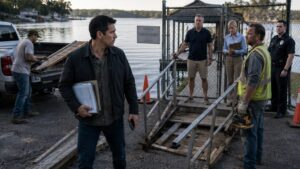
Benjamin Lewis heard the excavator change pitch three seconds before the water came up.
He was halfway across his kitchen with a coffee mug when the machine outside gave a hard metallic scrape, followed by a dull knock he felt more than heard. Then somebody shouted.
Benjamin set the mug down and went through the front door.
A column of water was already rising beside the excavator.
It shot six or seven feet above the open trench, clear at first, then brown as loose soil collapsed into it. The operator had lifted the bucket and frozen with both hands on the controls. Water spread across the graded dirt, carrying clumps of red clay toward the curb.
Benjamin did not run.
At fifty-eight, he had spent too many years around ruptured lines, failed valves, flooded crawlspaces, and men who made things worse by moving fast before they understood the problem.
He stepped off his porch and looked first at the trench.
Then at the colored utility flags.
Then at the blue plastic pipe visible beneath the excavator bucket.
“Kill the machine,” he said.
The operator stared at him.
“Shut it down.”
The engine dropped to idle.
By the time Benjamin reached the edge of his lawn, water was running across the southern strip of his corner lot—the narrow section where the neighborhood drainage project had been creeping closer all week.
His hand went automatically to the tape measure clipped at his belt.
He stopped himself before pulling it free.
First things first.
“Where’s your foreman?”
The operator pointed toward a white pickup parked near the temporary construction fence.
Benjamin took out his phone and began photographing.
The trench.
The exposed pipe.
The bucket.
The water.
The utility flags.
Especially the flags.
There were yellow and blue markers near the sidewalk, but the nearest blue flag was several feet west of where the line had actually surfaced. A second blue flag stood farther back, almost in line with Benjamin’s mailbox.
That was wrong.
Not necessarily proof of negligence. But wrong enough that Benjamin photographed it twice.
A truck door slammed behind him.
Jack Roberts came across the muddy ground wearing khakis, work boots that were too clean for the job site, and the navy polo he wore to nearly every HOA meeting.
Jack had been president of the Crescent Mill Homeowners Association for three years. For the drainage project, the board had also made him its liaison with the contractor.
He carried a phone in one hand and irritation in his face.
“What happened?”
Benjamin looked at him.
“You tell me.”
Jack glanced toward the pipe.
“The operator says he may have clipped something.”
“That something is my water service.”
Jack frowned at the trench. “You sure?”
Benjamin gave him a level look.
“I’m a licensed plumbing contractor, Jack.”
The operator looked away.
Jack knew that. Everyone on the board knew it. Benjamin had submitted his license information years earlier when the HOA asked him for an opinion about recurring pressure problems at the clubhouse.
Still, Jack crouched near the trench as though proximity might change what the pipe was.
“Could’ve been compromised already.”
Benjamin stared at him.
Water continued to pour into the dirt between them.
“What?”
“I’m saying older service lines can weaken. If the bucket barely touched it—”
“That pipe wasn’t leaking at seven this morning.”
“I didn’t say it was.”
“You just said it might’ve been compromised.”
Jack stood. “Benjamin, I’m trying to figure out what happened.”
“No. You’re explaining it before anybody has figured it out.”
Jack’s jaw tightened.
That tone between them was not new.
Over eleven years, Benjamin and the HOA had disagreed about fence setbacks, drainage swales, parking notices, and once about whether the association could require homeowners to replace exterior hose bibs that were not association property. Benjamin had been right often enough to become unpleasantly certain he would be right the next time too.
He knew that about himself.
Knowing did not always stop him.
Jack stepped away and called the contractor.
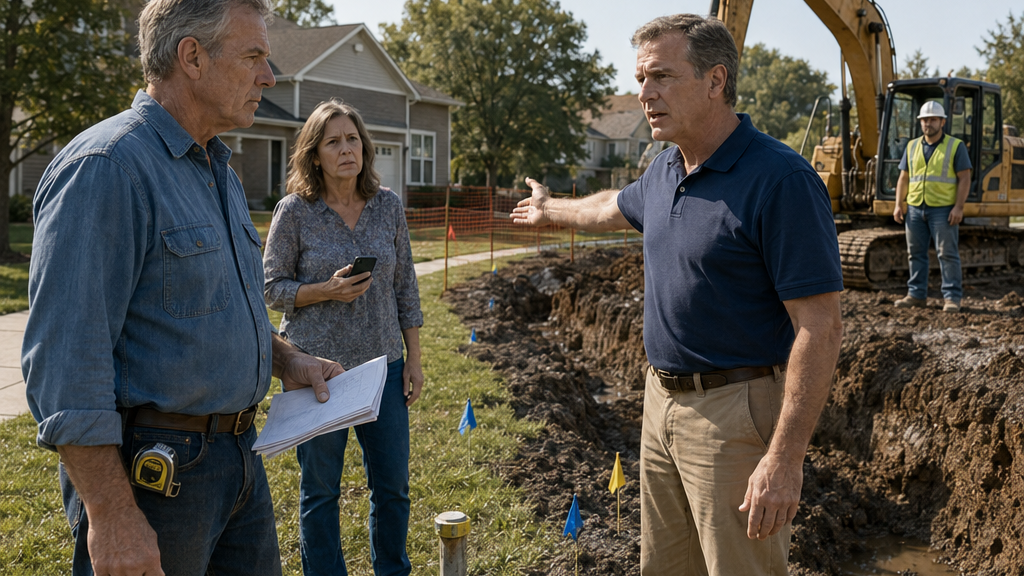
Benjamin walked the length of the trench.
The drainage project had been approved after two years of complaints about standing water along the southern edge of the neighborhood. Crews were installing new underground piping and reshaping part of the common drainage path.
The problem was that Benjamin’s recorded utility easement also ran along that side of his lot.
He had mentioned it at the planning meeting.
Jack had said the engineers knew where everything was.
Now muddy water was crossing Benjamin’s driveway.
Amanda Green came out of the house next door holding her phone.
“What happened?”
“They hit my service.”
Her face changed. “Your water?”
Benjamin nodded.
Amanda looked at Jack, then at the excavator.
“Are they fixing it?”
“We’re assessing it,” Jack said before Benjamin could answer.
Benjamin almost laughed.
Instead he said, “They’re turning the street-side valve off first.”
The emergency plumber arrived forty minutes later. The damaged section could not simply be patched in place. The line had been distorted near the break, and the surrounding trench was unstable.
The plumber gave Benjamin a preliminary explanation and said he would need parts and a clear work area.
Jack stood nearby listening.
“How long?” Benjamin asked.
“If everything goes right? Could have service back sooner, but permanent repair may take a few days.”
Jack exhaled as if the delay belonged to him.
“I’ll have the contractor’s office send someone out to assess responsibility,” he said.
“When?”
“I don’t control their claims people.”
“When?”
“A week or two, maybe.”
Benjamin turned toward him slowly.
“A week or two?”
“For the formal assessment. We’ll deal with immediate access.”
“My house has no water.”
“I understand that.”
“No, Jack. You understand the sentence. That’s different.”
Amanda glanced between them.
Jack lowered his voice. “I’m not going to stand here and argue in front of the crew.”
“Good.”
Benjamin took another photograph.
Jack looked at the phone. “You documenting me now?”
“I’m documenting the site.”
“You always do this.”
Benjamin met his eyes. “Do what?”
“Turn everything into a case.”
For one second, Benjamin almost answered with the old grievance that had taught him exactly why he documented things.
Years earlier, a contractor on a commercial job had denied damaging a line Benjamin later had to replace at his own expense. No photographs. No signed incident sheet. Just one man’s word against another’s and a repair bill Benjamin still remembered down to the dollar.
He said nothing about it.
Instead he looked again at the colored flags.
Something was bothering him.
The trench was not merely close to the blue marks.
It was close to the recorded easement itself.
Jack was already walking back toward the white truck.
“Jack.”
He stopped.
“Are you stopping excavation along this side until we know where the protected line is?”
Jack looked toward the crew.
“We’ve got work outside the immediate break area.”
“That wasn’t my question.”
“The approved work area is already established.”
Benjamin’s fingers rested against the tape measure on his belt.
“By who?”
“The engineer. The contractor. The permit.”
The last word stayed with Benjamin after Jack walked away.
Permit.
Two weeks earlier, when machinery had first appeared at the neighborhood entrance, Benjamin had gone online and pulled the county permit out of professional habit more than suspicion. He had skimmed it on his phone and taken screenshots of several pages because some of the conditions looked unusually specific.
He had almost forgotten about them.
Now he went inside.
The kitchen faucet gave him half a second of water before pressure vanished.
Benjamin opened his photo archive and searched the date.
There they were.
Five images.
County header.
Project address.
Site conditions.
Special conditions.
He enlarged the final photograph and began reading.
Then he reached the numbered section he remembered photographing for no particular reason at all.
Benjamin leaned closer to the screen.
Outside, the excavator started again.
Chapter 2: Eleven Inches Changed the Entire Argument
The words were halfway down the permit page.
Benjamin read them once.
Then again.
Condition 7: no excavation, grading, equipment disturbance, or material placement within eighteen inches of any recorded utility easement unless separately approved and verified before work.
He stood in the kitchen with no running water and listened to the excavator outside.
Eighteen inches.
He opened the recorded plat he kept in a folder with the closing documents for the house. The easement line was exactly where he remembered it: along the southern boundary, passing close to the stretch currently opened by the contractor.
Benjamin carried the folder outside.
Amanda was still near her driveway.
Jack had returned to the trench, speaking with the excavator operator.
“Jack.”
Jack turned.
Benjamin held up the permit.
“Before you dig another foot, I want to measure something.”
Jack’s expression hardened immediately. “Benjamin, the crew is working outside the damaged section.”
“That’s why I want to measure.”
“We’re not stopping the whole project every time you have a concern.”
Benjamin felt the familiar surge in his chest, the one that usually made his voice sharper than he intended.
He kept it down.
“I didn’t ask you to stop the whole project.”
“You’re standing in front of active equipment.”
“I’m standing on my property.”
Amanda moved closer.
“What are you measuring?”
Benjamin unfolded the plat.
“The easement.”
Jack gave a short breath through his nose. “The contractor has the approved limits.”
“Then this should take thirty seconds.”
He walked toward an old survey marker near the grass edge. The metal pin itself sat low, almost hidden, but Benjamin knew where it was. A faded cap and the alignment with the plat made the reference clear enough for an initial measurement.
He finally pulled the tape from his belt.
The steel blade snapped outward.
Jack looked at it and shook his head.
“You’re not the county inspector.”
“No.”
“You’re not the project engineer.”
“No.”
“Then what exactly are we doing?”
“Checking whether eighteen inches looks like eighteen inches.”
That got Amanda’s attention.
“Eighteen?”
Benjamin handed her the permit.
“Condition seven.”
She read it silently.
Jack’s face changed just enough for Benjamin to notice.
Not surprise.
Recognition.
Benjamin felt something inside him tighten.
“You’ve seen this condition.”
Jack folded his arms. “I’ve seen the permit.”
“That’s not what I asked.”
“The contractor is working from engineered drawings.”
Benjamin crouched and hooked the end of the tape at the easement reference.
“Hold this.”
Jack stared at him.
Benjamin looked up.
“If I’m wrong, you get to tell everybody I measured it myself and still got it wrong.”
Amanda covered a smile with her hand.
Jack did not.
After several seconds, he stepped forward and took the end of the tape.
Benjamin walked the blade toward the nearest clean edge of excavation.
The numbers passed under his thumb.
Six.
Eight.
Ten.
He stopped.
Eleven.
He checked the angle.
Reset it.
Measured again.
Eleven inches.
Not seventeen and a half.
Not close enough to argue about whether somebody had leaned the blade.
Eleven.
Benjamin looked at Jack.
Jack looked at the tape.
The excavator operator had climbed down from the cab.
Amanda still held the permit.
“It says eighteen,” she said.
Nobody answered her.
Benjamin took his phone out.
“Amanda.”
She understood immediately.
He handed her the phone.
“Get the tape, the trench edge, and that permit page in the same frame.”
Jack released the tape.
Benjamin said, “No. Hold it.”
Jack looked at him.
“You wanted to know what we were doing. We’re documenting.”
“This proves nothing about where the engineer’s control line is.”
“Then your engineer can explain why the permit condition and recorded easement don’t match the trench.”
“You’re assuming your reference is exact.”
“I’m assuming eleven is less than eighteen.”
Amanda took the photograph.
Then another.
Benjamin moved the permit beside the blade so the condition could be read in the same image.
Jack stepped back.
For the first time that morning, he did not have an immediate answer.
Benjamin should have felt satisfied.
Instead he noticed the operator looking toward the white pickup, waiting for direction.
Jack followed his gaze.
“Continue on the north section,” Jack said.
Benjamin straightened.
“Jack.”
“We are not working at this exact cut.”
“You’re still excavating along the same alignment.”
“The north section is clear.”
“Verified by who?”
“Benjamin, enough.”
There it was.
Not an explanation.
A command.
Benjamin reeled the tape back slowly. The blade hissed into its case and snapped home.
“Your choice,” he said.
Jack’s eyes narrowed. “What’s that supposed to mean?”
“It means I measured. You saw it. Amanda photographed it. What happens next belongs to whoever keeps digging.”
Amanda shifted uncomfortably.
“Maybe everybody should just stop until the county looks at it.”
Jack turned toward her.
“If this project loses days every time somebody questions a marking, every homeowner here pays for it.”
“That doesn’t make the measurement different,” she said.
Benjamin glanced at her.
Jack’s tone softened, but only slightly.
“This drainage project was approved because half the south side floods after heavy rain. People have been demanding action for two years. We finally have a contractor mobilized, equipment on site, permits open. You don’t stop that casually.”
Benjamin looked at the water-soaked dirt in front of his house.
“My service line got opened with an excavator.”
“And we’re addressing it.”
“In a week or two?”
“That’s the claims assessment.”
“Stop saying assessment like water comes out of it.”
Jack turned away.
Benjamin felt anger rise again, but now it had changed shape.
Before the measurement, he had wondered whether the crew had made an ordinary mistake.
Now he knew one concrete thing: the cut sat inside a clearance described plainly in the permit.
What he did not know was why Jack seemed less surprised by Condition 7 than he should have been.
That afternoon Benjamin organized the evidence at his kitchen table.
Photographs.
Recorded plat.
Permit screenshots.
Repair estimate.
Times.
Names.
Amanda came over just before five.
She stood in the doorway holding two gallon jugs of water.
“You looked like you might refuse these on principle,” she said.
“I have bottled water.”
“These are for flushing, not drinking.”
Benjamin took them.
“Thank you.”
She glanced at the papers covering the table.
“You really are building a case.”
“I’m keeping a record.”
“That sounds like the same thing when you say it.”
Benjamin leaned back.
She was not entirely wrong.
Amanda walked to the table and looked at the photograph she had taken. The tape stretched cleanly across the frame.
“Eleven inches,” she said.
“Yes.”
She tapped the permit.
“And they needed eighteen.”
“Yes.”
“So why didn’t he stop?”
Benjamin said nothing.
Amanda looked toward the window.
The machinery had gone quiet for the evening.
“I keep thinking about Friday.”
“What happened Friday?”
She frowned.
“Maybe Thursday. Before they started digging by your side.”
Benjamin waited.
“There were two utility locator guys out there. Bright vests. One of them had spray paint. I was getting groceries out of the car.”
“What were they doing?”
“Talking to the operator.”
“Talking how?”
Amanda hesitated.
“Not friendly.”
Benjamin sat forward.
“What did you hear?”
“Not enough to quote anybody.”
“Amanda.”
“I’m serious. I heard one of them say something about the marks not matching the plan. Then Jack came over.”
Benjamin looked at the photograph again.
Eleven inches.
Eighteen required.
A water line already broken.
And now, possibly, a warning before the first bucket went into the ground.
“What happened after Jack came over?”
Amanda shook her head.
“I went inside.”
Benjamin looked toward the darkening frontage.
For the first time, the question was no longer whether somebody had made a mistake.
It was whether somebody had been told there might be one and decided to dig anyway.
Chapter 3: The Warning Nobody Wanted on the Agenda
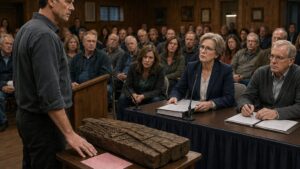
Benjamin’s complaint was number nine on an eight-item agenda.
He noticed it as soon as he walked into the HOA clubhouse Wednesday evening.
The printed agenda lay in neat stacks beside the sign-in sheet. Landscaping contract. Pool closing date. Reserve study. Drainage project update. Insurance renewal. Homeowner comments.
Then, added at the bottom in smaller type:
Additional homeowner concern—Lewis property.
No number.
No scheduled time.
No mention of the broken water service.
Amanda, standing beside him, read it too.
“You’re last.”
“I’m not even last. I’m punctuation.”
“Don’t start angry.”
Benjamin picked up a copy.
“I’m not angry.”
Amanda gave him a look.
“You alphabetized your evidence.”
“That means organized.”
“With tabs.”
“That means very organized.”
She almost smiled.
Inside the meeting room, Jack sat at the center of the folding tables with Samantha Taylor two seats down. Samantha had served as treasurer for nearly four years and had the habit of reading every financial page while other people argued.
Benjamin placed his folder on an empty chair.
The measuring tape sat in his jacket pocket.
He had brought it without deciding whether that was necessary.
The meeting dragged through landscaping complaints and pool expenses before Jack reached the drainage update.
“Work experienced a minor interruption yesterday due to a residential service-line issue,” he said.
Benjamin stared at him.
Minor interruption.
Residential service-line issue.
Not excavator.
Not rupture.
Not no water.
Jack continued.
“The contractor is coordinating an assessment, and work is proceeding in unaffected areas.”
Benjamin raised his hand.
Jack ignored him until the sentence was finished.
“Homeowner comments are at the end.”
“This is about my property.”
“And you’ll have time.”
“You’re giving the board a project update that leaves out the permit clearance.”
Several heads turned.
Jack’s mouth tightened.
“Benjamin.”
Samantha looked up from her papers.
“What permit clearance?”
The room changed.
Not dramatically.
Just enough.
Jack glanced toward her.
Benjamin saw it.
He opened his folder.
“Condition 7 of the county permit. Eighteen inches of zero disturbance from a recorded utility easement.”
A homeowner near the back said, “What does that have to do with the water line?”
Benjamin held up the photograph Amanda had taken.
“The trench beside my service measures eleven inches from the easement reference.”
Jack spoke immediately.
“That is a homeowner measurement, not an official survey.”
“Correct.”
Benjamin kept his voice flat.
“That’s why I asked the county to inspect it.”
A murmur passed through the room.
Jack stared at him.
“You filed a county complaint?”
“This morning.”
“You told me yesterday you were documenting.”
“I was.”
“You could have brought this to the board first.”
Benjamin nearly laughed.
“My water line was broken in front of you.”
“That’s not the same as filing an enforcement complaint that could shut down a neighborhood project.”
There it was.
The sentence carried more fear than anger.
Benjamin heard it, but he was not ready to care.
“You had the permit before I did.”
Jack leaned back.
“The contractor is responsible for field compliance.”
Samantha spoke.
“Jack.”
He looked at her.
She had gone very still.
“What?”
Samantha closed the folder in front of her.
“Was there a utility marking discrepancy?”
Silence.
Benjamin looked from her to Jack.
Jack said, “There were routine field questions.”
“That isn’t what I asked.”
Jack’s face reddened slightly.
A homeowner said, “What discrepancy?”
Samantha did not answer them.
She kept looking at Jack.
“Was there a utility marking issue reported before excavation?”
Jack rubbed a thumb along the edge of his agenda.
“There was a locator note.”
Benjamin felt the room narrow.
“What kind of note?” he asked.
Jack looked at him.
“Preliminary. The contractor believed the field marks could be reconciled with the plan.”
“Who believed that?”
“The site supervisor.”
“Was it put in writing?”
Jack hesitated.
That was enough.
Samantha looked down.
Benjamin’s anger sharpened, but so did something else.
Until that moment, he had suspected carelessness.
Now he was hearing prior notice.
“Did the board receive it?” he asked.
Jack said, “This is exactly why these matters should be discussed in context.”
“Did the board receive it?”
“Yes.”
The answer landed without drama.
Amanda exhaled beside him.
A homeowner across the aisle muttered something under his breath.
Jack raised a hand.
“Everybody needs to understand the project schedule. The drainage contract has mobilization costs, and our insurance renewal depends in part on completing the corrective drainage work within the current period. We cannot treat every field note as an emergency shutdown.”
Benjamin looked at Samantha.
She would not meet his eyes.
So that was part of it.
Not just stubbornness.
Money.
Deadlines.
Insurance.
Pressure that involved everybody in the room.
For one unwanted second, Benjamin understood why Jack had been afraid to stop the project.
Then he looked at the photograph of muddy water crossing his lawn.
Understanding was not absolution.
After the meeting, Benjamin drove to the county permit office before it closed.
The clerk behind the counter listened without expression while he explained the damage and handed over copies of the permit, plat, photographs, repair documentation, and written chronology.
“You’re alleging work inside a protected easement clearance?”
“I’m asking you to determine whether it is.”
The clerk looked at the photograph.
“Who took this?”
“My neighbor.”
“And the reference point?”
“Recorded marker location. I’m not presenting my measurement as a survey.”
The clerk nodded once.
That answer seemed to matter.
“We can open a field-compliance complaint.”
“What happens then?”
“Inspector reviews the permit conditions and site. If there’s a violation, they handle it from there.”
“When?”
“Depends on scheduling.”
Benjamin’s jaw tightened.
The clerk glanced at him.
“You want it done right, or you want me to guess?”
Benjamin recognized his own kind of impatience coming back at him.
“Right.”
“Then leave the packet.”
He did.
Walking back to his truck, Benjamin felt something close to relief.
Not victory.
The county might measure differently. The contractor might produce another control point. The permit language might be interpreted in a way he had missed.
But the dispute was no longer confined to Jack’s version against his.
An official process had begun.
His phone rang before he reached home.
Amanda.
“You need to come to the clubhouse.”
“Why?”
“Samantha’s still here.”
Benjamin looked at the time.
“For what?”
“She asked me if I knew where you were.”
Twenty minutes later, he found Samantha alone near the clubhouse entrance, holding a thick HOA folder against her chest.
She did not invite him inside.
“I’m not giving you board records,” she said immediately.
“I didn’t ask.”
“I know.”
Benjamin waited.
Samantha looked toward the parking lot as though Jack might appear.
“The locator email came Friday afternoon.”
Benjamin said nothing.
“It said the field markings along your side did not cleanly reconcile with the utility exhibit. They recommended verification before excavation in that section.”
His mouth went dry.
“Recommended?”
“That was the word.”
“And what happened?”
Samantha gripped the folder more tightly.
“We had already paid mobilization. The contractor said a pause could push the schedule. Jack said the discrepancy was probably old mapping.”
Benjamin felt the tape measure in his pocket.
He did not touch it.
“You agreed?”
Samantha’s expression tightened.
“I didn’t stop him.”
“That isn’t what I asked.”
“No.”
The answer was quiet.
“I didn’t agree.”
Benjamin watched her.
For the first time, she looked less like an HOA officer and more like somebody who had spent twenty-four hours replaying a decision.
“I told him we should stop for a day,” she said.
Benjamin said nothing.
Samantha finally looked directly at him.
“I told Jack to stop for a day.”
And Benjamin understood that the next question was no longer whether the board had been warned.
It was why Jack Roberts had decided one day was too expensive to lose.
Chapter 4: The Stop Order Was Not the End
The county inspector arrived Thursday morning carrying a measuring wheel.
Benjamin saw him before Jack did.
The man parked beside the temporary fence, pulled on a reflective vest, and stood for a moment studying the trench without speaking to anyone. Then he took photographs of the utility flags, the exposed repair area, and the survey reference near Benjamin’s lawn.
Benjamin stepped outside with his folder.
The measuring tape was in his pocket again.
The inspector held up a hand before Benjamin could begin.
“I’ve read your complaint.”
Benjamin stopped.
“Good.”
“I’d rather see the site before I hear everybody’s interpretation of it.”
That was fair.
Benjamin stayed back.
Jack arrived five minutes later with the contractor’s site supervisor. He looked tired rather than angry, which somehow made the morning feel more serious.
The inspector asked for the approved plans.
The supervisor produced a rolled set from the truck.
Then the inspector began measuring.
No arguments.
No speeches.
Just distances.
He established the recorded easement reference, compared it to the permit documents, checked the contractor’s alignment, and rolled the measuring wheel along the disturbed edge.
Benjamin watched the numbers.
Jack watched Benjamin.
At one point the inspector crouched beside the same place Benjamin and Jack had measured two days earlier.
He used his own tape.
Then he stood and wrote something on a clipboard.
Jack finally spoke.
“Is there an issue?”
“There are several things I need to verify.”
“Can work continue on the north section?”
The inspector looked at the plans again.
“Not until I finish.”
Jack’s shoulders lowered.
For perhaps the first time since the line broke, somebody other than Benjamin had told him no.
The inspection lasted almost two hours.
Before leaving, the inspector photographed Benjamin’s picture showing the eleven-inch measurement and copied the permit condition into his notes.
He gave Benjamin no prediction.
By four that afternoon, a county truck returned.
The notice was impossible to miss.
Bright orange paper.
Black lettering.
STOP WORK ORDER.
It was fastened to the construction fence where every car entering Crescent Mill could see it.
The excavator bucket rested in the dirt.
The engine stayed silent.
Benjamin stood across the street with his arms folded.
For two days he had imagined this moment.
He expected satisfaction.
He got something closer to relief.
The question of whether he had been inventing a technicality was over.
Amanda came outside and stood beside him.
“So you were right.”
Benjamin looked at the orange notice.
“The county says the work can’t continue under the current conditions.”
“That was a very Benjamin answer.”
He almost smiled.
She nodded toward his hand.
“You brought the tape.”
He looked down.
He had taken it out without noticing and was holding the closed case against his palm.
He set it on top of the folded permit resting on his truck hood.
For a few minutes neither of them spoke.
Then Amanda’s phone buzzed.
She read the screen.
Her expression changed.
“You should check your email.”
Benjamin already knew from her face that the stop order had created another problem.
The HOA message had gone to every homeowner.
Temporary suspension of drainage project.
Potential remobilization costs.
Possible schedule extension.
Potential impact to current insurance remediation requirements.
And one sentence near the bottom:
Additional costs resulting from regulatory interruption may require board consideration of a supplemental homeowner assessment.
Benjamin read it twice.
Amanda said, “People are going to think that means you.”
“It says regulatory interruption.”
“They’re not going to read it that carefully.”
She was right.
Within an hour, two neighbors who normally waved drove past without doing it.
Another stopped at the curb.
“Ben, is this thing really shut down because of your complaint?”
“Because the county found a permit issue.”
“Same difference if we get another assessment.”
“No. It isn’t.”
The neighbor lifted both hands.
“I’m just saying people are already stretched.”
“So am I. I just paid for an emergency plumbing repair.”
“I know.”
But his tone said the conversation was not about Benjamin’s repair anymore.
By Friday morning, the story had changed.
Yesterday Benjamin had been the homeowner whose line was hit.
Now he was the homeowner whose complaint had stopped the project.
Those were not the same social role.
Jack found him near the mailbox after lunch.
He held a stapled packet.
“You wanted to know why I didn’t shut everything down Friday.”
Benjamin looked at the packet but did not take it.
“I wanted to know why you ignored the warning.”
“Because there was more at stake than one field discrepancy.”
“One field discrepancy became my water line.”
“I know that now.”
“You knew enough then to check.”
Jack rubbed his forehead.
“Yes.”
The admission surprised Benjamin more than an argument would have.
Jack handed him the packet.
The top page was a project schedule. The next was correspondence related to the association’s insurance renewal.
The south-side drainage work had been listed as a corrective condition after repeated standing-water claims.
A delay beyond the current compliance window could trigger another review.
Below that was a contractor estimate for remobilization if heavy equipment had to leave and return later.
Benjamin scanned the numbers.
They were not small.
Jack pointed toward one line.
“If we lose three weeks, that’s the projected exposure.”
Benjamin read it.
Then read it again.
The figure was far larger than his plumbing bill.
“That doesn’t justify ignoring the permit.”
“I didn’t say it did.”
“You acted like it did.”
“I thought the locator issue could be reconciled while the crew kept moving.”
“You gambled.”
Jack’s face hardened.
“Yes.”
The word stopped Benjamin.
Jack looked toward the silent excavator.
“You think I wanted this?”
“I think you wanted the schedule.”
“I wanted seventy-eight homeowners not to get another assessment because the board missed an insurance condition.”
Benjamin said nothing.
“My mistake,” Jack continued, “was deciding a one-day pause was more dangerous than a field discrepancy.”
“That wasn’t your only mistake.”
“No.”
Jack looked at him directly.
“I also decided your complaint would be harder to manage than the project delay.”
There it was.
Not greed.
Not corruption.
Something smaller and more ordinary.
Pride.
Pressure.
A man convincing himself that control was the same as judgment.
Benjamin looked again at the projected cost of a three-week shutdown.
The number did not excuse Jack.
But it changed what victory looked like.
If Benjamin pushed every available complaint as far as possible, the people paying for it might include Amanda, retirees two streets over, young families who had never seen Condition 7, and homeowners who had already voted reluctantly for the first assessment.
Jack tapped the packet.
“You wanted accountability. You got the county involved.”
“This isn’t finished.”
“I know.”
Benjamin folded the pages.
For the first time since the water burst out of the ground, being right felt heavier than being dismissed.
Chapter 5: What Jack Was Trying to Protect
The attorney’s estimate arrived Monday morning, and the number at the bottom was almost three times Benjamin’s emergency plumbing bill.
It included potential repair recovery, temporary water expenses, property restoration, attorney fees if litigation expanded, and possible damages tied to loss of service.
Benjamin stared at the figure on his laptop.
A week earlier, he would have called it leverage.
Now he saw the association’s projected shutdown costs beside it.
Two sets of numbers.
Both real.
Neither belonging entirely to the people who had made the mistake.
He closed the laptop.
On the kitchen table, his measuring tape sat beside the permit.
Benjamin picked it up, extended six inches of blade, then let it retract.
Click.
The sound irritated him.
He set it down.
That afternoon he went to the HOA records room to review the project timeline Samantha had agreed to make available under the association’s document rules.
She was already there.
A stack of emails and meeting notes sat on the table.
“I marked the relevant dates,” she said.
Benjamin glanced at the tabs.
“You alphabetized them?”
She looked at him.
“Don’t start.”
For the first time since the dispute began, he laughed.
It lasted only a second.
Samantha pushed the first email toward him.
Friday, 2:14 p.m.
Utility locator noted discrepancy between field markings and utility exhibit along the southern work segment. Recommended verification prior to excavation.
The next email came from the site supervisor.
He believed work could continue in areas not directly conflicting with visible markings.
Then came Jack’s message.
Proceed with scheduled mobilization. Verify conflict as encountered.
Benjamin read that sentence twice.
“Verify as encountered.”
Samantha nodded.
“That was the problem.”
“You knew.”
“I knew enough to be uncomfortable.”
“But not enough to stop it.”
“No.”
She did not defend herself.
That made it harder for Benjamin to stay angry in the simple way he preferred.
“I told Jack to pause the south segment,” she said. “He said if we delayed mobilization, the contractor could charge standby or move the crew to another job.”
“And you let him decide.”
“Yes.”
“Why?”
Samantha looked toward the closed records-room door.
“Because I had spent six months telling homeowners the assessment would be enough.”
Benjamin waited.
“If the insurance review went badly, or if the contractor came back with more charges, I would have to stand in that room and tell everyone we needed more money.”
“That’s your job.”
“I know.”
Her voice tightened.
“That doesn’t mean I wasn’t afraid of doing it.”
The answer was so ordinary that Benjamin had no response ready.
She pushed another document toward him.
A timeline.
Warning Friday.
Mobilization Monday.
Water-line strike Tuesday.
County complaint Wednesday.
Stop order Thursday.
Five days.
Benjamin traced the dates with one finger.
Samantha said, “I should have put my objection in the minutes.”
“Yes.”
“I should have insisted.”
“Yes.”
“I’m giving you this because you need the timeline. Not because I think the association should be destroyed over it.”
Benjamin looked up.
“Neither do I.”
She studied him.
“I’m not sure everyone believes that.”
He left before asking what she meant.
Amanda explained it thirty minutes later.
She caught him at the sidewalk while he was bringing in his mail.
“You know people are blaming you now.”
“I know some are.”
“More than some.”
“For the county enforcing a permit?”
“For the project being stopped.”
“That’s not the same thing.”
“I know that.”
“Then why say it like I caused it?”
“Because that’s what they’re saying, Benjamin.”
He shoved the mail under his arm.
“They should read the facts.”
Amanda crossed her arms.
“You think everybody lives inside a folder.”
“That would solve a lot of problems.”
“No, it would make everybody as exhausting as you.”
He stared at her.
She sighed.
“That came out wrong.”
“No. Probably came out exactly right.”
“Benjamin.”
He turned toward his house.
Amanda stepped off the sidewalk.
“You rejected the informal meeting before you filed the licensing complaint.”
“Because Jack had already ignored a warning.”
“I’m not saying you were wrong.”
“You sound like it.”
“I’m saying there’s a difference between being wrong and having no reason for what you did.”
He stopped.
She continued more quietly.
“Jack was scared of the assessment. Samantha was scared of admitting the board had made a mistake. You were scared they’d do what that old contractor did to you and leave you holding the bill.”
Benjamin looked at her sharply.
He had told Amanda that story years ago, once, while helping replace a leaking shutoff at her house.
She remembered.
“You keep acting like this started Tuesday,” she said. “Part of it didn’t.”
Benjamin said nothing.
Amanda looked toward the silent construction equipment.
“You’re allowed to make them fix it. You should make them fix it. But if you use every possible complaint just because you can, don’t pretend that’s only about the pipe.”
She walked back toward her house.
Benjamin stood with the mail under his arm.
That evening he opened the draft complaint to the state contractor licensing board.
It was complete.
Dates.
Permit condition.
Photographs.
Prior warning.
County stop order.
He had only to attach the final documents and send it.
His finger hovered over the trackpad.
The complaint was legitimate.
That was not the question anymore.
The question was what he wanted it to accomplish.
Accountability?
Correction?
Punishment?
He had spent years treating those as variations of the same thing.
Now the distinctions mattered.
He closed the complaint without submitting the final attachment.
Then he called Samantha.
“I want a meeting.”
“With the board?”
“Jack. You. Contractor representative. HOA attorney if you need them.”
“What for?”
“A corrective agreement.”
There was silence.
Samantha said, “Are you withdrawing the complaint?”
“No.”
“The county case?”
“No.”
“The licensing complaint?”
“Not yet.”
Another silence.
“What exactly are you offering?”
Benjamin looked at the measuring tape on the table.
For years, measurement had meant certainty to him.
Right distance.
Wrong distance.
Within tolerance.
Outside tolerance.
People were harder.
“I’m offering Jack one chance to fix the problem without making the neighborhood pay for his refusal to stop.”
Samantha exhaled slowly.
“I’ll call him.”
“No,” Benjamin said.
“What?”
“Give me his number.”
“You already have his number.”
Benjamin looked at his phone.
She was right.
He had Jack’s contact saved from years of HOA notices.
The fact that he had called Samantha instead told him more about himself than he liked.
He ended the call and dialed Jack directly.
Jack answered after three rings.
“What is it?”
Benjamin heard caution immediately.
“I want a meeting.”
“For what?”
“To settle what can be settled.”
A long pause.
“And what can’t?”
“We’ll find out in the room.”
“When?”
“Tomorrow if you can do it.”
Jack said nothing for several seconds.
Then, “Clubhouse. Six-thirty.”
Benjamin looked at the unsent licensing complaint on his screen.
“All right.”
He hung up before either of them could turn it into another argument.
For the first time since the excavator struck his line, Benjamin had deliberately chosen not to use the strongest tool available to him.
He was not yet sure whether that was restraint or weakness.
Tomorrow would tell him.
Chapter 6: The Meeting Where Nobody Got Everything
Jack Roberts opened the meeting with a demand.
“We need all complaints withdrawn.”
Benjamin had barely sat down.
The HOA clubhouse felt different without rows of homeowners in folding chairs. Only five seats were occupied: Benjamin, Jack, Samantha, the contractor representative, and the HOA attorney.
On the table in front of Benjamin sat the permit.
Beside it, the measuring tape.
Closed.
He had placed it there intentionally.
Jack continued.
“County complaint, licensing complaint, any potential civil filing. If we’re going to negotiate in good faith, the project needs a path forward.”
Benjamin looked at him.
“That isn’t negotiation.”
“It’s the practical starting point.”
“No. It’s the ending you want.”
The attorney raised a hand.
“Maybe we establish the undisputed facts first.”
Benjamin nodded.
“Good idea.”
Jack leaned back.
The contractor representative looked uncomfortable.
The attorney read from a prepared sheet.
Benjamin’s water service was damaged during HOA-authorized project excavation.
The county identified noncompliance with the required utility-easement clearance.
A prior locator discrepancy had been communicated before excavation.
Work was currently stopped.
No one objected.
The attorney continued.
“The contractor’s insurer has indicated it will cover documented direct damage to the residential service, subject to standard review.”
Benjamin looked at the contractor representative.
“How much?”
“Emergency repair, permanent line restoration, reasonable property restoration tied directly to the incident.”
“My temporary water expenses?”
“We can include documented temporary service costs.”
“And the attorney letter?”
The representative hesitated.
“That would need separate discussion.”
Benjamin nodded.
He had expected that.
Jack tapped a pen against the table.
“If direct damage is being covered, then we need the enforcement matters resolved so work can restart.”
Benjamin turned toward him.
“The stop order is the county’s. I can’t withdraw it.”
“You can notify them the homeowner dispute is resolved.”
“The permit violation isn’t a homeowner dispute.”
Jack’s pen stopped.
Benjamin opened the permit but did not touch the tape.
“I’ll support reopening the project when the county approves a corrected work plan.”
The contractor representative said, “We can submit revised limits.”
“Not just revised limits.”
Jack frowned. “Here we go.”
Benjamin ignored the comment.
He slid a single sheet across the table.
“Five conditions.”
The attorney picked it up.
“First, all work near recorded utility easements gets field-verified before excavation. Not verified as encountered. Before.”
Jack looked at the paper.
“Second?”
“Any locator discrepancy pauses that segment until resolved in writing.”
The contractor representative nodded slowly.
“That’s workable.”
“Third, my repair and directly related costs are paid by the responsible insurer or contractor. Not passed through an HOA assessment.”
Samantha spoke for the first time.
“I support that.”
Jack looked at her.
She did not look away.
Benjamin continued.
“Fourth, the board adds utility-clearance verification to its project procedures for future work.”
Jack said, “That’s an internal governance issue.”
“Yes.”
“So you don’t dictate it.”
“No. The board votes on it.”
Benjamin met Samantha’s eyes.
“But I won’t support closing my complaint without it.”
The attorney looked at the fifth item.
“And this.”
Benjamin leaned back.
“Written acknowledgment that the earlier locator warning was overridden.”
Jack’s face changed.
“That’s not happening.”
Samantha said quietly, “It should.”
Jack turned toward her.
“You want me to sign a confession?”
“I want the record to say what happened.”
“We all knew there was a discrepancy.”
“No,” Samantha said. “We knew there was a recommendation to verify. I told you to pause. You decided not to.”
The room went still.
This was the thing Benjamin had not expected.
Not the document.
Not the insurer.
Samantha.
At the public meeting she had admitted the warning existed. Here she was accepting her own part in remaining silent and refusing to let Jack hide behind the board collectively.
Jack stared at her.
“You agreed we couldn’t lose mobilization.”
“I agreed that losing mobilization would be expensive.”
“That’s the same practical decision.”
“No.”
Samantha’s voice stayed even.
“I didn’t make the decision. You did. And I let you make it without forcing the objection into the record.”
Jack looked away.
Benjamin felt no satisfaction watching him absorb it.
That surprised him too.
The contractor representative cleared his throat.
“If I can say something—the revised plan can probably keep equipment mobilized. We’d shift the trench farther from the easement and hand-expose near the crossing.”
Jack looked at him.
“You told us a stop could cost weeks.”
“A full demobilization could. If the county accepts the revised plan quickly, we may not need that.”
The room changed again.
Not solved.
But narrowed.
Jack looked at Benjamin’s conditions.
“What happens to the licensing complaint?”
Benjamin answered carefully.
“I haven’t completed it.”
Jack’s eyes lifted.
“You threatened one.”
“I prepared one.”
“So this whole time—”
“I said I had options. I didn’t say I’d used all of them.”
Jack gave a humorless laugh.
“And I’m supposed to be grateful?”
“No.”
Benjamin finally picked up the measuring tape.
Jack watched him.
Benjamin did not open it.
“I’m asking for a corrected line, reimbursement, a procedure that prevents this from happening again, and an accurate record.”
“That record follows me.”
“It should.”
“For how long?”
Benjamin looked at him.
There was the real fear.
Not jail.
Not financial ruin.
A board record.
Neighbors remembering that Jack had been warned and chose schedule over caution.
Benjamin understood the fear because he had his own version of it: the old repair bill, the denial, the memory of being left responsible because he had trusted somebody else to admit what happened.
“You stay on the board if the board wants you there,” Benjamin said.
Jack frowned.
“I’m not asking you to resign.”
Samantha looked surprised.
Benjamin continued.
“But you step down as project liaison for this job.”
Jack’s jaw tightened.
“Why?”
“Because you made the call that created the conflict.”
“I know more about this project than anyone on the board.”
“That’s part of the problem.”
The attorney looked at Jack.
“That may be a reasonable separation of roles.”
Jack looked around the table.
No one rushed to defend him.
For a moment Benjamin saw how easily he could push harder.
He could insist Jack resign entirely.
He could finish the licensing complaint.
He could refuse any settlement until every dollar of consequential damage was negotiated.
He had leverage.
The old Benjamin—the one Amanda had described without saying the words—would have measured success by how much pressure remained on the other side.
Instead Benjamin set the closed tape back beside the permit.
“I don’t need you gone,” he said. “I need the next person standing over a trench to stop when somebody says the marks don’t match.”
Jack stared at him.
The silence lasted long enough that the air-conditioning unit clicked on.
Finally Jack pulled the proposed agreement toward himself.
“I won’t sign language saying I knowingly endangered a utility.”
“That isn’t what it says.”
“It says I overrode the recommendation.”
“You did.”
Jack read the line again.
Samantha said, “So did I, by staying quiet.”
He looked at her.
Then at Benjamin.
“What if the acknowledgment says the board proceeded after receiving a recommendation for additional verification, and that as liaison I authorized continued mobilization?”
Benjamin considered it.
The wording was less satisfying.
It was also accurate.
“Add that future discrepancies require a pause.”
The attorney wrote the change.
The contractor representative agreed to submit revised plans and coordinate with the insurer.
Samantha agreed to place the new verification rule on the next board agenda.
The attorney added language protecting direct repair costs from being allocated specifically to Benjamin or converted into an assessment against his lot.
Nobody smiled.
Nobody shook hands.
It was not that kind of meeting.
Jack signed last.
Before he did, he looked at Benjamin.
“I’m not resigning from the board.”
“I know.”
“I was elected.”
“I know.”
“And if people think I made the wrong call, they can vote.”
Benjamin nodded.
“That’s how it’s supposed to work.”
Jack signed.
Then he removed his name from the project-liaison line.
Samantha gathered the papers.
The contractor representative left first, already calling someone about revised drawings.
The attorney followed.
Benjamin slipped the tape measure into his pocket.
Jack remained seated.
“You could have made this worse for me.”
Benjamin paused near the door.
“Yes.”
“Why didn’t you?”
Benjamin thought about giving him the clean answer.
Because neighbors should not pay.
Because correction mattered more than punishment.
Because he was trying to be better than his anger.
All of those were true.
None was complete.
“I got tired of confusing maximum pressure with the right amount.”
Jack looked down at the signed agreement.
Benjamin opened the door.
Behind him, Jack said, “I should’ve stopped it Friday.”
Benjamin stood still.
It was not an apology.
Not quite.
But it was the first sentence Jack had spoken since Tuesday that did not contain a defense.
Benjamin looked back once.
“Yes,” he said. “You should have.”
Then he left the clubhouse with the county case still open, his repairs still unpaid, and no guarantee the revised project would satisfy anyone.
But for the first time, the conflict had boundaries.
And Benjamin had chosen where to draw them.
Chapter 7: The Line Stayed Where It Belonged
The excavator returned to Benjamin Lewis’s corner lot three weeks later.
He heard the diesel engine before he saw it, and his body reacted faster than his judgment.
Benjamin was out the front door with his measuring tape clipped to his belt before the machine had finished backing into position.
Then he stopped at the edge of the driveway.
Everything looked different.
The old trench had been filled and compacted. Fresh orange and blue utility markings crossed the work area in clean, deliberate lines. Small stakes showed the limits of excavation, and a bright painted boundary ran well away from Benjamin’s easement.
The county inspector was already there.
So was the contractor representative.
Jack Roberts stood near the fence holding rolled plans, but he was not directing anyone.
A board member Benjamin recognized only by sight was handling the project-liaison questions.
That distinction mattered more than Benjamin expected.
The inspector saw him and nodded.
“Morning.”
Benjamin walked over.
“Revised plan?”
“Approved yesterday.”
The inspector pointed toward the new alignment.
“Field verification was completed before authorization. Utility crossings are being hand-exposed where required.”
Benjamin looked toward the painted line.
“How far off the easement?”
The inspector gave him the faintest smile.
“You planning to check me?”
Benjamin touched the tape measure.
“Occupational habit.”
“Go ahead.”
Benjamin crouched at the same survey reference where Jack had held the tape weeks earlier.
He hooked the blade.
Extended it.
The steel slid across the grass.
Eighteen inches passed.
Then twenty-four.
Then thirty.
The marked excavation limit sat comfortably beyond the protected clearance.
Benjamin checked it once more because that was who he was.
Then he let the tape retract.
Click.
The inspector watched him.
“Satisfied?”
“With that distance.”
“That sounds like progress.”
Benjamin stood.
Across the work zone, Jack glanced in his direction.
Neither man waved.
The excavator operator began removing soil several feet beyond the marked boundary. Near the utility crossing, the machine stopped entirely while two workers exposed the area by hand.
No drama.
No argument.
No water exploding out of the ground.
Just slower work.
Correct work.
Benjamin discovered that watching people follow a procedure was far less exciting than watching them violate one.
He also discovered he preferred it.
Amanda came outside carrying a travel mug.
“You measuring their homework?”
“They passed.”
“Did you tell them?”
“The inspector knows.”
“That wasn’t what I asked.”
Benjamin looked at her.
She smiled into her coffee.
Some things had not changed.
His phone buzzed.
An email from the contractor’s insurer.
Payment issued.
Emergency plumbing repair.
Temporary water costs.
Lawn restoration.
The final reimbursement amount did not include every dollar Benjamin had originally listed through his attorney, but it covered the damage that could be directly documented.
A week earlier, he had accepted that distinction.
The old version of him might have treated every excluded dollar as another insult.
Now he read the payment confirmation twice, saved it to his records, and put the phone away.
Amanda noticed.
“Good news?”
“They issued the repair payment.”
“All of it?”
“What they agreed was directly connected.”
She waited for the complaint.
It did not come.
“That’s very restrained of you,” she said.
“Don’t make it weird.”
The neighborhood meeting happened four nights later.
Benjamin almost skipped it.
Then Samantha Taylor texted him the agenda.
Utility Verification Procedure.
He went.
The clubhouse was fuller than usual, partly because people wanted an update on the resumed drainage work and partly because the possibility of another assessment had frightened half the neighborhood.
Jack sat in his regular board seat.
He no longer sat at the center for the project report.
Samantha presented the proposed rule.
Any future HOA-funded excavation near recorded utilities or easements would require documented field verification before work began. Conflicting locator marks would trigger an automatic pause for that segment. The resolution would have to be recorded before excavation resumed.
No more “verify as encountered.”
Benjamin listened from the third row.
One homeowner raised a hand.
“How much is this going to add to future projects?”
Samantha answered, “Some verification cost and possibly time.”
Another asked, “So we’re creating more red tape because of one accident?”
Benjamin felt his shoulders tighten.
Jack leaned toward his microphone.
“No.”
The room quieted.
Jack looked down at the agenda before continuing.
“We’re creating a procedure because there was a warning before the accident, and I authorized the project to continue without resolving it.”
Benjamin looked at him.
No one applauded.
A few people shifted uncomfortably.
Someone in the back whispered something.
Jack continued.
“That was a project-management mistake. The new procedure makes sure the next liaison doesn’t get to make the same judgment call alone.”
It was less than an apology.
It was more than Benjamin expected.
The measure passed.
Not unanimously.
But comfortably.
Outside afterward, Benjamin found Jack near the parking lot.
For several seconds they stood beside each other without speaking.
Finally Jack said, “Project should finish next week.”
“Looks like it.”
“The contractor says the revised alignment is better anyway.”
Benjamin glanced at him.
“That must hurt.”
Jack almost smiled.
“A little.”
Another silence.
Then Jack said, “People are still mad about the delay.”
“They’ll survive.”
“Probably.”
Jack put his hands in his pockets.
“You know, I still think filing with the county before coming back to the board made everything harder.”
Benjamin felt the old response arrive immediately.
You had already ignored me.
You had already been warned.
You had already let them dig.
All true.
He could have said them.
Instead he considered the part Amanda had forced him to see.
“I probably would’ve filed either way,” Benjamin said. “But I could’ve talked to Samantha before deciding everyone on the board was the same.”
Jack nodded once.
That was as close as either of them was likely to come to saying they had learned something from the other.
“You going to run for the board now?” Jack asked.
Benjamin stared at him.
“No.”
“Good.”
“Why?”
“You’d bring a tape measure to every meeting.”
Benjamin looked down at the case on his belt.
This time he did laugh.
The drainage work finished the following Friday.
The equipment left Crescent Mill without ceremony. The temporary fence came down. Fresh seed and straw covered the disturbed ground. The repaired section of Benjamin’s water service disappeared beneath compacted soil and restored grass.
Only the utility markings remained for a while, bright against the ground until rain and mowing began to fade them.
One evening Benjamin walked to the southern edge of his lot.
The old property marker was exactly where it had always been.
Nothing about it looked important.
A small metal reference near the grass.
Easy to overlook.
Easy to assume somebody else had checked.
Benjamin pulled the measuring tape from his belt one last time.
He measured from the marker to the completed work.
Plenty of clearance.
He stood and looked at the number for a moment.
Then he released the lock.
The blade slid home with a soft metallic whisper.
For weeks the tape had been accusation, evidence, leverage.
Now it was only a tool again.
Amanda called from her driveway.
“You planning to inspect the whole neighborhood?”
“No.”
“Sure?”
Benjamin clipped the tape back onto his belt.
Then he reconsidered.
He took it off and carried it into the garage.
The next morning, water came from his kitchen faucet with steady pressure.
Outside, the property marker remained where it belonged.
So did the line beneath the ground.
And for once, nobody needed Benjamin to prove the distance between them.
The story has ended.