The HOA Fined Him for a Violation Nobody Could Show—Then the Missing Photo Changed the Entire Case
Chapter 1: The Fine Arrived Without the Proof Behind It
The second fine arrived before Samuel Walker had figured out what the first one was for.
He found the envelope wedged behind a grocery circular in his mailbox, the association logo showing through the window. He opened it standing at the kitchen counter, expecting another reminder about annual dues.
Instead, a bold line halfway down the page stopped him.
SECOND NOTICE — CONTINUING EXTERIOR VIOLATION.
Below it, the amount had doubled.
Samuel read the letter twice. Then a third time, slower.
“Unapproved alteration affecting common visual standards and adjacent drainage area.”
No dimensions. No description of the alteration. No location beyond his street address.
The notice said photographic evidence had been included with the original violation.
Samuel set the paper flat and opened his laptop.
He had spent thirty-two years supervising maintenance crews in municipal buildings. He had learned early that memory was unreliable and paperwork was only useful if you kept your own copy. His HOA emails went into labeled folders by year. Every notice he received was scanned.
The first violation was still there.
He opened it.
Three pages.
Page one: violation notice.
Page two: correction instructions.
Page three: hearing procedures.
No photograph.
He logged into the homeowner portal and opened the digital version.
A small gray heading read ATTACHMENTS.
Beneath it was empty space.
Samuel stared at the screen.
He clicked again.
Nothing.
He checked his downloads, then the message history.
The original portal message contained a sentence he had skimmed the first time.
“See attached photograph documenting condition.”
There had never been an attachment.
Samuel leaned back.
Until then, he had assumed the HOA had simply written a bad notice. That irritated him, but mistakes happened.
Now they were fining him for failing to correct something they claimed to have shown him but apparently had not.
He went outside.
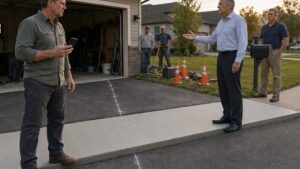
His house sat near the end of a curved street in a subdivision built in the late nineties. The front beds were trimmed. The siding was clean. The mailbox matched the approved style. He walked the side yard, studying everything as though he were an inspector seeing it for the first time.
The narrow strip between his property and Christine Baker’s sloped toward a shallow drainage channel. Years earlier, management had approved a small adjustment there after water repeatedly collected against Samuel’s foundation. A landscaping contractor had reshaped part of the grade and placed low stone edging around a planted area.
Nothing had changed recently.
Samuel crouched near the stones.
No fresh digging.
No new pipe.
No broken swale.
Christine’s yard on the other side looked much the same as it had all summer.
He stood and looked toward her windows.
For two weeks, he had wondered whether she had complained.
They were not enemies. They also were not friends. They waved. They exchanged packages left at the wrong door. Once, when Christine was away, Samuel had pulled her trash bin in before a storm.
But three weeks earlier, she had watched a landscaping crew near the shared edge and asked Samuel what they were doing.
“Cleaning up the washout,” he had said.
She had looked at the stones and frowned.
“Does that change where the water goes?”
“No.”
That had been the whole conversation.
Samuel went back inside.
He opened the community manager’s email address and typed:
Please provide the photograph referenced in both violation notices and identify the exact condition requiring correction.
He stopped there.
He considered adding that the side-yard work had been approved years earlier. Somewhere in his files was an old email chain about it.
But the association had accused him.
It was their job to say what they were accusing him of.
He deleted the extra sentence before he could type it.
Two hours later, the manager replied.
Mr. Walker,
The violation documentation was provided with the original notice. The Board expects correction within the stated compliance period. If you believe you received incomplete materials, you may request a hearing.
Samuel read the message once.
Then again.
His irritation sharpened.
He replied:
The original notice contains no photograph. The portal also shows no attachment. Please resend the evidence.
The answer came near four.
The Board’s records indicate photographic documentation exists. The hearing process is available if you contest the violation.
Samuel clicked through the portal again.
The hearing deadline was Friday.
Two days away.
He printed the original notice and the new one, then printed screenshots of the portal message showing the blank attachments field. He placed them in a manila folder.
The second fine was not large enough to threaten him financially. That was almost beside the point.
He had spent much of his working life dealing with situations where someone said a work order had been completed because a box on a screen said COMPLETE.
He had learned to ask one question.
Show me.
Sometimes the repair existed.
Sometimes someone had closed the ticket without ever opening the door.
By early evening, Samuel had cooled enough to think clearly.
He called the management office.
The community manager answered.
“I’m looking at your notices now,” she said after he explained.
“Then tell me what I’m supposed to fix.”
“It’s an exterior alteration.”
“What alteration?”
There was a pause.
“It relates to the side-yard drainage area.”
“Which part?”
“The inspection notes should clarify that.”
“They don’t.”
Another pause.
Samuel heard typing.
“The board has the full enforcement packet.”
“Do you?”
“I have the record available in the system.”
“Have you seen the photograph?”
The typing stopped.
“I’m not the one who conducted the inspection.”
“That isn’t what I asked.”
Her voice tightened slightly.
“Mr. Walker, the hearing is the proper place to dispute evidence.”
Samuel looked at the empty attachment field on his monitor.
“I’m not disputing evidence,” he said. “I’m asking to see it.”
He ended the call before the conversation could turn into an argument.
At seven fourteen that evening, another email arrived.
This one came directly from Deborah Martin, the HOA president.
Samuel knew Deborah mostly from meetings. She was efficient, rarely raised her voice, and had been elected after a noisy year in which residents complained that the previous board ignored violations for some homeowners while enforcing them against others.
Her message was short.
Mr. Walker,
Your hearing request has been accepted for Monday evening.
Please understand that requesting a hearing does not suspend the existing compliance requirement. Continued noncompliance may result in additional fines under the association’s enforcement policy.
Regards,
Deborah Martin
Board President
Samuel read the last sentence several times.
Continued noncompliance.
They still had not told him what compliance required.
He opened his folder and added Deborah’s email behind the notices.
Then he printed one more page.
The homeowner portal.
Under ATTACHMENTS, the space remained blank.
Chapter 2: Everyone Had Seen the Evidence Except Nobody Had
Deborah Martin began Samuel’s hearing by putting his fine total on the clubhouse screen.
Samuel had expected the violation notice.
Instead, the first thing twenty people in the room saw beside his name was a balance of two hundred dollars.
A few residents shifted in their folding chairs.
Samuel felt heat move up the back of his neck.
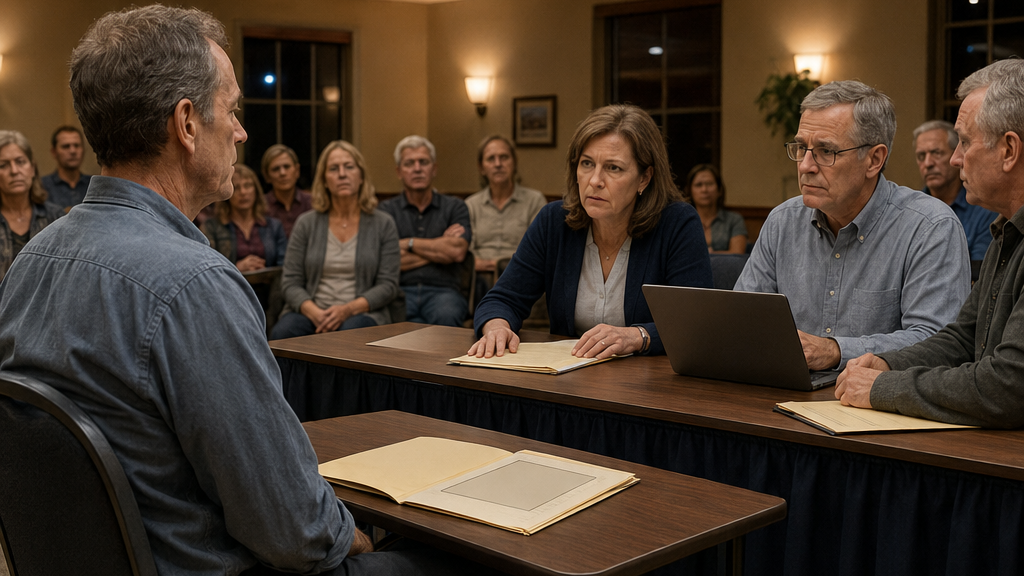
The meeting room was usually used for holiday potlucks and children’s craft events. That night, three folding tables formed a shallow U at the front. Deborah sat in the middle with two board members. Raymond Lewis, the treasurer, had a laptop open beside a stack of printed packets.
Samuel sat alone at a smaller table facing them.
Deborah looked down at her notes.
“Mr. Walker is appealing an exterior modification violation related to the drainage boundary along the east side of his property.”
Samuel immediately noticed the wording.
Drainage boundary.
That phrase had not appeared on either notice.
Deborah continued.
“The violation was observed during an inspection following a homeowner concern. Mr. Walker has not completed the requested correction within the compliance period.”
Samuel raised one hand slightly.
“What correction?”
Deborah stopped.
“You’ll have an opportunity to speak.”
“I’m asking because it still hasn’t been identified.”
A board member glanced at Deborah.
She kept her voice controlled.
“The cited condition is documented in the enforcement packet.”
Samuel opened his folder.
“Then can we look at the documentation?”
Deborah nodded toward Raymond.
Packets were passed across the table.
Samuel took one.
The cover sheet carried his name, property address, case number, dates of notices, and fine history.
Behind it was an inspection form.
Then the first violation notice.
Then a page labeled PHOTOGRAPHIC DOCUMENTATION.
Samuel looked at it.
The center of the page contained a large blank rectangle.
Beneath the rectangle was a filename.
IMG_1847.JPG.
No image.
Samuel slid the page out and placed it on top of the packet.
“This is what I received.”
Deborah looked at Raymond.
Raymond leaned forward.
“The image may not have printed.”
“It didn’t appear in the portal either,” Samuel said.
“The record indicates one was attached.”
“Where?”
Raymond touched his keyboard.
“In the archived inspection entry.”
Samuel looked around the front table.
Three board members.
The manager.
Raymond.
Deborah.
Residents behind him.
He felt the old impulse to say less.
That habit had saved him trouble many times. In meetings at work, the person who kept talking usually gave everyone else more material to argue with.
But silence had already been interpreted for him.
Deborah folded her hands.
“Mr. Walker, regardless of the printing issue, you received notice of the violation and had an opportunity to correct it.”
Samuel looked at the blank rectangle again.
Then he slid the page toward the center of the table.
“Who here has seen the photo?”
No one answered immediately.
Someone in the audience coughed.
Deborah’s eyes moved to Raymond.
Raymond looked at his laptop.
One of the other board members picked up his packet as if the picture might appear on a second look.
Samuel waited.
He did not raise his voice.
“Has anyone at this table actually seen the photograph?”
Deborah said, “The inspection was conducted through management.”
“That wasn’t my question.”
A murmur moved through the chairs behind him.
Deborah’s expression changed only slightly, but Samuel saw it. The certainty was still there. The footing underneath it was not.
Raymond cleared his throat.
“I’ve seen the file reference.”
Samuel turned to him.
“The filename?”
“Yes.”
“The image?”
Raymond hesitated.
“Not the image itself.”
Samuel nodded once.
He looked at the community manager.
She shook her head before he asked.
“I wasn’t present for the inspection.”
One board member said, “I assumed it was in the electronic packet.”
The other said nothing.
Deborah leaned back.
“The absence of a printed image doesn’t mean the underlying violation did not exist.”
“No,” Samuel said. “But it does mean you’re asking me to correct something based on evidence nobody in this room can say they saw.”
Deborah’s jaw tightened.
“This board deals with dozens of violations. We rely on management records.”
“I understand that.”
“Then you understand we cannot personally reinspect every file every time a homeowner objects.”
Samuel looked at the fine total still glowing on the wall behind her.
“I didn’t ask you to reinspect my yard. I asked you to show me what you fined me for.”
The room became very still.
Samuel could feel the residents behind him now—not as allies, exactly, but as witnesses.
That embarrassed him more than he expected.
He had not wanted an audience.
He wanted an attachment.
Deborah turned toward Raymond.
“Can the archived file be retrieved?”
Raymond typed for several seconds.
“There is an image identifier associated with the inspection entry.”
“Can you open it?”
“Not from this interface.”
Deborah exhaled through her nose.
Samuel looked down at his packet.
The blank rectangle no longer felt like an administrative omission.
It had become the center of the entire hearing.
Raymond clicked through another screen.
“The record shows the image was uploaded the same day the inspection note was entered.”
Samuel looked up.
“So the photo exists?”
“There’s a filename,” Raymond said carefully. “And a storage path.”
Deborah seized on the distinction.
“Which supports that documentation was created.”
Samuel almost laughed, but stopped himself.
“A filename supports that there’s a filename.”
Deborah’s eyes hardened.
“Mr. Walker.”
Samuel closed his mouth.
There it was again—that line he sometimes crossed without noticing until he was already standing on the other side. He did not like being treated as careless, and when that happened, his patience could become its own form of arrogance.
He folded his hands.
“All right. Retrieve it.”
Deborah conferred quietly with Raymond.
The board paused the hearing for ten minutes.
People stood, stretched, whispered.
Samuel remained seated.
A resident he recognized from two streets over stopped beside his table.
“I thought they sent pictures with all these.”
“So did I,” Samuel said.
The resident looked at the blank rectangle.
“That’s strange.”
Samuel did not answer.
Across the room, Deborah was speaking to the community manager in a low voice. Raymond remained at the laptop, moving through folders.
When the hearing resumed, Deborah announced that the board would defer a final decision until the archived photograph could be recovered.
“The existing fine remains pending,” she said. “No additional fine will be assessed before we reconvene.”
It was less than Samuel wanted.
More than he had walked in with.
He gathered his papers.
Raymond approached him near the door.
“I found the storage location.”
Samuel stopped.
Raymond lowered his voice.
“The system won’t preview it, but the file is still on the archived server.”
“How long?”
“I should have access within a few days.”
Samuel glanced back toward Deborah.
She was stacking packets at the front table.
“And if it shows my yard?”
Raymond looked at him evenly.
“Then at least we’ll finally know what we’re arguing about.”
Samuel put the blank-photo page back into his folder.
For the first time since the notices began, there was an answer coming.
He just did not know yet whether it would clear him or prove that everyone else had been right.
Chapter 3: The Recovered Photograph Showed Someone Else’s Yard
The fence in the recovered photograph was white vinyl.
Samuel’s was weathered cedar.
He knew the case had changed before Raymond Lewis said a word.
They stood in the small management office the following Tuesday, crowded around Raymond’s laptop. Deborah was there, along with the community manager. The recovered image filled most of the screen.
White fence.
Red mulch.
A decorative metal bird near a downspout.
Samuel stared at it.
“That isn’t my property.”
Raymond nodded slowly.
“I know.”
Deborah leaned toward the screen.
“Are we certain?”
Samuel turned to her.
“My fence is brown.”
“I mean whether this is definitely the image associated with your inspection entry.”
Raymond clicked back to the archive list.
“IMG_1847.JPG. Same filename printed in Mr. Walker’s enforcement packet.”
The community manager frowned.
“There were multiple inspections that afternoon.”
Raymond opened the metadata.
“Uploaded at 2:16 p.m.”
He clicked another record.
“The properties were entered sequentially.”
Samuel felt a strange, unsatisfying relief.
He had imagined this moment several times over the past week. In most versions, the picture appeared and plainly showed nothing wrong.
He had not imagined someone else’s yard.
Deborah folded her arms.
“This indicates a documentation error.”
Samuel looked at her.
“A documentation error you fined me twice for.”
“Yes,” she said, “and the photographic component clearly cannot be relied upon.”
He waited.
She did not say the violation was dismissed.
Samuel felt the relief drain away.
“So we’re done.”
Deborah shook her head.
“Not necessarily.”
Raymond glanced toward her.
Samuel said nothing.
Deborah continued.
“The original enforcement action did not originate solely from the image. There was also an inspection note and a homeowner concern regarding the drainage edge.”
Samuel looked at Raymond.
Raymond did not meet his eyes.
“Show me the note.”
The manager opened another file and rotated the monitor slightly.
The inspection note was only four lines.
Possible unapproved alteration along east side drainage boundary. Stone edging and grade adjustment observed. Potential effect on neighboring drainage. Review against property modification records.
Samuel read it twice.
At the top was his correct address.
His stomach tightened.
“The address is mine.”
“Yes,” Deborah said.
“But the photograph isn’t.”
“That is why we need to separate the two.”
Samuel stepped closer to the screen.
“When was this written?”
The manager checked.
“Same afternoon.”
“Before or after the photograph was uploaded?”
Raymond pulled up timestamps.
“Note entered at 2:21.”
Five minutes after the wrong image.
Samuel pictured the inspection route.
A person moving house to house.
Photo.
Address.
Note.
Next property.
A simple clerical mix-up would explain the photograph.
It would not explain why the note described his side yard.
Unless someone had actually looked at it.
“Who inspected it?”
The manager named only a role: an architectural-review volunteer working with management.
“Are they available?”
“Not today.”
Samuel looked again at the wording.
Stone edging and grade adjustment observed.
That part was true.
The stone edging existed.
So did the grade adjustment.
They had existed for years.
Deborah tapped the screen lightly.
“This is why I don’t think it would be responsible for the board to simply dismiss the matter based on the image error.”
Samuel stared at her.
“You had the wrong photograph.”
“Yes.”
“You sent me a blank page.”
“Yes.”
“You fined me twice.”
Deborah’s voice remained level.
“And now we have identified a legitimate problem in the record. I am acknowledging that.”
“But you’re keeping the accusation.”
“I am saying the note independently describes a condition on your property.”
Samuel felt the old instinct return—the urge to stop explaining anything at all.
Let them prove it.
Let them dig through their own files.
Let them discover how much of their certainty was built from assumptions.
He looked toward the window.
From the management office, he could see the clubhouse parking lot and a narrow strip of grass beyond it.
Raymond broke the silence.
“The complaint should tell us what prompted the inspection.”
Samuel turned back.
“What complaint?”
Deborah answered.
“A homeowner contacted management about possible changes affecting drainage between two lots.”
“Which homeowner?”
There was a short pause.
Samuel already knew.
“Christine Baker?”
The manager looked at Deborah before replying.
“Yes.”
Samuel nodded.
For three weeks he had tried not to make Christine the villain in his mind.
Now the association had attached her name to the case.
“What exactly did she say?”
The manager clicked through the record.
“I don’t have the full message displayed here. There’s a summary.”
“Read it.”
She hesitated, then read from the screen.
“Neighbor concern regarding work near shared drainage edge. Requested review of possible alteration.”
Samuel felt his jaw tighten.
“That sounds like a complaint.”
Deborah said, “It was sufficient to trigger inspection.”
“That isn’t what I asked.”
Raymond looked toward Samuel.
“Then ask Christine.”
The suggestion irritated him precisely because it was obvious.
Samuel had spent weeks communicating through notices, portals, managers, board packets, and hearing procedures.
Christine lived thirty feet away.
He left the office with copies of the inspection note and the recovered photograph.
At home, he carried them directly outside.
He stood at the shared side yard and compared the image to what was in front of him.
Nothing matched.
No white fence.
No red mulch.
No metal bird.
His cedar fence ran along the back half of the lot. The low stone edge curved beside the drainage strip exactly where it had for years.
Christine’s back door opened.
She stepped onto her patio carrying a watering can.
She noticed Samuel and stopped.
For a second neither spoke.
Samuel held the recovered photograph at his side.
Christine looked at it.
“What’s that?”
“The picture they used for my violation.”
She crossed partway across her lawn.
Samuel held it out.
She studied the image.
“That isn’t your house.”
“I know.”
Her eyebrows drew together.
Samuel watched her carefully.
“The board says your complaint is the other basis for the fine.”
Christine looked up sharply.
“My complaint?”
“That’s what they called it.”
Her expression changed—not defensive, exactly. Confused.
“I asked management a question.”
“About my yard.”
“About the drainage.”
Samuel waited.
Christine seemed to realize there was more behind his silence than the photograph.
“What did they tell you I said?”
“That I reported an alteration affecting the shared drainage edge.”
Christine stared at him.
“I asked whether the landscaping work needed approval.”
Samuel said nothing.
She shifted the watering can to her other hand.
“I didn’t report you for a violation.”
“Then what did you send them?”
Christine looked toward her house.
“I still have the email.”
Samuel felt the case change again.
The wrong photograph had not ended anything.
It had only stripped away the first explanation.
Now the board was leaning on Christine’s message.
And Christine was telling him the message did not say what they claimed it said.
Chapter 4: The Neighbor Complaint Said Less Than the Board Claimed
“I never filed a violation against you.”
Christine Baker said it before Samuel had fully crossed the grass between their yards.
She stood beside the narrow drainage strip with her watering can still in one hand. Samuel had expected hesitation, maybe an explanation shaped carefully enough to avoid blame. Instead, she sounded irritated.
Not at him.
At the sentence itself.
Samuel held up the wrong-property photograph.
“The board says your complaint is an independent basis for the enforcement.”
“My complaint.” Christine repeated the words as though testing them. “That’s what they’re calling it?”
“Yes.”
She set the watering can down.
“I sent management an email because the landscaping crew was working near the drainage line. I asked whether the work had been approved and whether it would affect runoff.”
Samuel said nothing.
Christine looked toward the low stones along his side of the swale.
“You remember that storm two summers ago?”
He nodded.
Water had collected ankle-deep along the shared edge before draining toward the street. Christine had lost two shrubs. Samuel had spent the next morning clearing leaves from the inlet.
“I didn’t want that happening again,” she said. “That was it.”
“You mentioned my property.”
“Because the work was on your property.”
Samuel felt the simple logic land harder than he wanted it to.
For weeks he had treated Christine’s name like a piece of evidence against her.
She looked at the photograph again.
“What exactly did they say I reported?”
“That you raised a concern about an alteration affecting drainage.”
“I raised a question.”
“They don’t seem to see much difference.”
Christine’s mouth tightened.
“I do.”
She picked up her phone from the patio table.
“I still have the email.”
Samuel followed her only as far as the edge of her patio. Christine scrolled, then stopped.
“Here.”
She held the phone toward him.
The message was short.
Hello, I noticed landscaping work today near the shared drainage area between my property and the Walker property. Does the stone edging or grading require association approval? I’m mainly concerned about whether it changes runoff direction. Please let me know if this is something management reviews.
Samuel read it twice.
No accusation.
No claim that he had violated anything.
No request for enforcement.
He handed the phone back.
“What did they answer?”
Christine scrolled farther.
“They said they would review the area.”
“That’s all?”
“That’s all I received.”
Samuel looked back toward his house.
For weeks, he had thought of the problem as a straight line.
Christine complained.
Management inspected.
The board fined him.
Now the first point in that line had moved.
Christine had asked a question. Management had turned it into a concern. Somewhere after that, a concern had become an alleged violation.
“They quoted you at the office,” Samuel said. “Not the whole message. A summary.”
Christine gave a humorless laugh.
“Of course.”
Samuel almost agreed too quickly.
Then he stopped.
There was something uncomfortable in the ease with which he wanted to move Christine from one side of the conflict to the other.
“What did you think the crew was doing?” he asked.
“I honestly didn’t know.”
“They were cleaning the washout.”
“You told me that.”
“And you didn’t believe me.”
Christine met his eyes.
“I didn’t know whether you were right.”
The answer was fair enough to bother him.
Samuel folded the photograph in half along an existing crease.
Christine noticed.
“I probably should’ve talked to you before emailing management.”
“You did ask me.”
“I asked you one question in the yard and then went around you.”
Samuel looked at her.
She shrugged slightly.
“I don’t like arguments.”
“That makes two of us.”
Christine smiled once, briefly.
“No. You don’t like losing arguments.”
Samuel almost objected.
Then he didn’t.
She had known him twelve years.
He looked down at the drainage edge.
“When did you realize they’d turned it into enforcement?”
“Today.”
“You never got copied?”
“No.”
Samuel took a breath.
“All right.”
Christine studied him.
“That’s it?”
“What else should I say?”
“I don’t know. You’ve looked irritated with me for three weeks.”
“I was.”
“And now?”
Samuel glanced at her phone.
“Now I’m irritated more accurately.”
That earned a real laugh.
It broke something small between them.
Not the whole distance.
Enough.
Later that afternoon, Samuel drove to the management office with a printed copy of Christine’s original email. She had forwarded it to him before he left her yard.
The community manager read it silently.
Samuel waited.
Finally she said, “This is the original message, yes.”
“Then why does the enforcement summary call it a complaint regarding an unapproved alteration?”
“The review resulted in an inspection.”
“That isn’t what I asked.”
She looked tired.
Samuel recognized that look from years of maintenance meetings: someone trapped between what a record said and what everyone had already done because of it.
“The summary was created after the inspection,” she said.
“By whom?”
“The file doesn’t show a separate author field.”
“So Christine’s question got rewritten after somebody inspected the property.”
“I wouldn’t describe it that way.”
Samuel pointed to the printout.
“How would you describe it?”
The manager hesitated.
“The concern was categorized based on what the inspector observed.”
Samuel nodded slowly.
That was the first explanation that made sense.
It was also worse.
The inspection note had not merely documented Christine’s concern. It had changed its meaning.
Samuel gathered his papers.
As he did, the manager said, “Mr. Walker, if you have prior approval for the grading, you should submit it.”
His hand stopped.
There it was.
Prior approval.
The phrase stirred a memory he had deliberately left untouched.
Years earlier, after water had pooled against the foundation, Samuel had exchanged emails with a previous management company. He remembered sending photographs. He remembered a contractor sketch.
He also remembered receiving permission to proceed.
He had thought about that email the first week.
Then he had refused to look for it.
Not because he believed it was gone.
Because he believed he should not have to prove an approval until the association first proved what it was accusing him of.
The manager watched his face.
“Do you have something?”
Samuel closed the folder.
“I might.”
That evening, he sat at his kitchen table with an external hard drive plugged into his laptop.
He searched the year the drainage work had been done.
Nothing.
Then the contractor’s company name.
A dozen old messages appeared.
He opened them one by one.
Estimate.
Scheduling.
Invoice.
Photographs.
Then he saw the subject line.
SIDE-YARD DRAINAGE MODIFICATION — APPROVED.
Samuel did not open it immediately.
For nearly a month, he had accused the association of moving forward without the evidence it needed.
Now, sitting alone in his kitchen, he was looking at evidence he had known might exist and had chosen not to provide.
He opened the message.
The old community manager had written:
The proposed minor grading correction and stone edging shown in your submitted sketch are approved as maintenance of an existing drainage condition. Please ensure runoff continues toward the established swale and does not redirect onto the neighboring lot.
Attached was the sketch.
Samuel stared at the date.
Six years earlier.
The work the current board called an unapproved alteration had been specifically approved by management.
He should have felt vindicated.
Instead, he sat back slowly.
The email proved the board had a bad case.
It also proved something about him he liked less.
He could have sent it weeks ago.
And he had not.
Chapter 5: Samuel Had the Answer and Chose Not to Send It
The email sat on Samuel’s kitchen table like an accusation with his own name on it.
He had printed it that morning.
One page.
Six years old.
Clear approval.
He read the sentence again.
The proposed minor grading correction and stone edging shown in your submitted sketch are approved.
There was no ambiguity.
Samuel had spent weeks insisting that the association produce its source material before expecting him to respond.
Yet from the beginning, he had possessed—or at least suspected he possessed—the one document that could have clarified the physical condition faster than anything else.
He picked up the page, then set it down.
His instinct still argued with him.
They accused you. They should have checked their own records.
That part remained true.
But another truth had arrived beside it.
He had allowed the dispute to harden because he wanted them to discover their mistake without help.
He wanted the correction to belong entirely to them.
By nine, he had emailed the approval to Raymond Lewis and the community manager.
The message took three lines.
Attached is the prior written approval for the side-yard grading and stone edging referenced in the current violation file. I should have submitted this earlier. Please add it to the complete hearing record.
Samuel read the middle sentence several times before sending.
I should have submitted this earlier.
It felt more difficult than the rest.
Twenty minutes later, Raymond called.
“Can you come by this afternoon?”
Samuel looked at the clock.
“What happened?”
“I found more of the archive.”
“What kind of more?”
There was a pause.
“Enough that I’d rather show you than explain it badly over the phone.”
At two thirty, Samuel entered the records room behind the management office.
It was barely a room—two file cabinets, a copier, a narrow table, and shelves full of labeled boxes from previous management companies.
Raymond had a laptop open beside a printed timeline.
He pointed to the approval email Samuel had sent.
“This closes the physical question for me.”
Samuel remained standing.
“For you.”
“For me,” Raymond repeated.
Samuel pulled out a chair.
Raymond turned the timeline toward him.
“I went back through the violation case from the beginning.”
Across the top were dates.
Christine’s email.
Inspection.
Image upload.
Inspection note.
First notice.
Samuel’s request for evidence.
Second notice.
Hearing request.
Board packet.
The sequence looked almost harmless reduced to lines on paper.
Raymond tapped the first notice.
“The original package generated with an image reference, but the attachment failed to populate.”
“We know.”
“Yes.”
He moved his finger down.
“Before the hearing, you asked for the photograph twice.”
“I know that too.”
Raymond looked at him.
“Deborah knew.”
Samuel did not move.
“Knew what?”
“That the packet was incomplete.”
Samuel leaned back.
Raymond opened an email.
It was between Deborah and the community manager, dated the afternoon before the first hearing.
The manager had written:
Photo does not appear in exported packet. Archive shows filename, but image has not yet been verified. We can either postpone enforcement review pending retrieval or proceed based on inspection note and homeowner concern.
Deborah’s reply appeared beneath it.
Proceed with hearing. We have a documented inspection and resident concern. We can supplement the photo if needed.
Samuel read it twice.
Then a third time.
The heat he had felt in the clubhouse returned, but differently.
At the hearing, Deborah had spoken as though the missing image were a printing problem discovered in the room.
She had known before Samuel walked through the door.
Raymond watched him.
“She wasn’t hiding that the file had a problem exactly.”
Samuel looked up.
“What would you call it?”
“She believed the rest of the record was sufficient.”
“That’s generous.”
“It may also be true.”
Samuel pushed the paper away.
Raymond did not defend her further.
After a moment he said, “You should know why she’s sensitive about enforcement.”
Samuel almost laughed.
“I know the speeches. Previous board ignored violations. Rules need consistency.”
“That’s not just a speech.”
Raymond closed one file and opened another.
“Last year, three homeowners filed formal complaints saying the board waived violations for people they knew. One of those complaints was justified. The association had to reverse several fines because enforcement records were inconsistent.”
“And now they’re fixing that by enforcing bad records consistently?”
Raymond grimaced.
“That’s the problem.”
Samuel stood.
He walked to the copier, then back.
The approval email in his folder suddenly felt heavier.
“You knew I had a point at the hearing.”
“I knew the photo issue was real.”
“You said there was a filename like that settled something.”
“I was trying to keep the meeting from turning into a public fight.”
Samuel nodded.
“That worked well.”
Raymond took the remark without reacting.
Then he pointed at Samuel’s approval.
“You could have sent this the first day.”
Samuel looked at him.
Raymond did not soften the statement.
Samuel felt the familiar defense form immediately.
Not my responsibility.
They should check their own archive.
They were the ones imposing fines.
All still true.
None complete.
“I know,” Samuel said.
Raymond seemed surprised.
Samuel looked at the printed timeline.
“I wanted them to prove their case before I helped them dismantle it.”
“That sounds like you.”
Samuel gave him a flat look.
Raymond almost smiled.
Then his expression changed.
“There’s something else.”
He turned the laptop.
A new calendar notice filled the screen.
FINAL ENFORCEMENT REVIEW — WALKER PROPERTY.
Scheduled for Thursday evening.
Samuel stared at it.
“They scheduled a vote?”
“This morning.”
“After receiving my approval?”
“I forwarded it before lunch.”
Samuel felt his patience narrow.
“So Deborah has the wrong photograph, Christine’s actual email, and prior written approval.”
“Yes.”
“And she still scheduled a final enforcement vote.”
“Yes.”
Samuel closed his folder.
“What exactly is left to vote on?”
Raymond was silent.
Samuel waited.
Finally Raymond said, “Whether the board rescinds the violation or treats the approval as insufficient because the current condition may differ from the original work.”
Samuel looked at him.
“Does anyone have evidence it differs?”
“No verified evidence that I’ve seen.”
Samuel let out a slow breath.
There it was again.
Not proof.
Possibility.
An empty space filled by confidence.
Raymond lowered his voice.
“Samuel.”
He waited until Samuel looked at him.
“She knew the packet wasn’t complete before the hearing.”
Samuel nodded once.
This time the information no longer felt like a technical failure.
It felt like a choice.
And by Thursday night, Deborah Martin was going to have to explain why she had made it.
Chapter 6: The Board President Was Afraid of Looking Weak
Deborah Martin offered Samuel a private compromise forty minutes before the final hearing.
He was crossing the clubhouse parking lot with his folder under one arm when she stepped away from her car.
“Samuel.”
He stopped.
She rarely used his first name.
Most of their exchanges had begun with Mr. Walker, even when they stood ten feet apart.
Deborah walked toward him holding a thin file.
“I’d like to resolve this before the meeting.”
Samuel looked at the clubhouse doors.
Residents were already going inside.
“What does resolve mean?”
“We reduce the fines to the original amount, mark the property compliant, and close the matter.”
He stared at her.
“Reduce?”
“Yes.”
“Not remove.”
Deborah’s expression tightened.
“The initial inspection did identify a condition requiring review.”
“The condition was approved six years ago.”
“We know that now.”
“You had the wrong photograph.”
“We know that too.”
“And Christine didn’t file the complaint you described.”
“She raised the concern that triggered the inspection.”
Samuel shifted the folder under his arm.
“So what exactly am I paying for?”
Deborah looked toward the clubhouse.
“For failing to respond constructively during the original compliance period.”
Samuel almost laughed.
He did not.
“You mean failing to prove your case for you.”
“I mean the matter could have been resolved weeks ago if you had provided the approval you already possessed.”
Samuel felt the words strike where they were meant to.
He did not deny them.
“I should have sent it earlier.”
Deborah seemed momentarily disarmed.
Samuel continued.
“That does not make the violation valid.”
“No. But it is part of what happened.”
“I agree.”
The answer unsettled her more than argument would have.
Samuel opened his folder and pulled out two pages.
The wrong photograph.
His delayed approval email.
He held one in each hand.
“That’s the complete problem.”
Deborah looked at them.
“You had something you didn’t provide. The board relied on something it hadn’t verified.”
“Those aren’t equal.”
“I didn’t say they were.”
Samuel studied her.
For the first time, he heard fatigue underneath her control.
He lowered the pages.
“Then why are we still doing this?”
Deborah looked across the parking lot.
A pickup rolled slowly past, then turned toward the clubhouse spaces.
“When I took this position,” she said, “half the complaints I received were that the previous board enforced rules only when it was convenient. People kept records. They compared notices. They accused each other of getting favors.”
Samuel waited.
“We spent months rebuilding the enforcement process. Same timelines. Same hearings. Same fine schedule.”
“And now you think dismissing mine makes all of that look fake.”
“It makes it look like the board backs down whenever someone pushes hard enough.”
Samuel looked at her.
“That’s not what happened.”
“I know that.”
“Do you?”
Her eyes sharpened.
“Yes.”
The single word carried more anger than anything she had said to him in weeks.
Samuel understood then.
Deborah did know.
That was the problem.
She understood the file was weak. She understood the photograph was wrong. She understood Christine’s email had been stretched beyond its wording.
But she had tied board credibility so tightly to never reversing direction that correction itself now felt like failure.
Samuel looked again at the two pages in his hands.
“I’m not paying anything to close this.”
Deborah’s face hardened.
“Then the board will decide.”
“Good.”
“You may not like the result.”
“That’s possible.”
He tucked the pages back into the folder.
“But if I take your deal, the file still says I had a valid violation and we negotiated the amount.”
Deborah said nothing.
“That isn’t closing the matter,” Samuel continued. “That’s preserving a mistake because correcting it is embarrassing.”
For a moment he expected her to walk away.
Instead, she said quietly, “You have no idea what it is like to sit in that room and have everyone assume every correction is favoritism.”
Samuel looked at the clubhouse.
“No. But I know what it’s like to have a work order say something is fixed when nobody checked the room.”
She frowned.
“What?”
“It’s what I did for thirty years. Buildings. Maintenance. Contractors. Reports.” He tapped the folder. “A completed box is not the same thing as completed work.”
Deborah’s gaze dropped briefly.
Samuel could have pushed harder.
He could have mentioned the email Raymond showed him. He could have told her he knew she had been warned before the first hearing that the photograph was unverified.
He wanted to.
Instead he said, “I’m going inside.”
The meeting began at seven.
This time Samuel’s fine total did not appear on the screen.
The case number did.
Deborah summarized the record in a clipped, formal tone. She acknowledged the incorrect photograph. She acknowledged the earlier approval Samuel had produced.
Then she said, “The remaining question is whether the association’s original enforcement action was reasonable based on the information available at the time.”
Samuel heard the trap immediately.
Reasonable at the time.
Not correct.
When his turn came, he walked to the front table carrying only four pages.
Christine’s original email.
The inspection note.
The wrong photograph.
His old approval.
He placed them side by side.
“I’m not asking the board to decide whether every person involved acted badly,” he said.
The room stayed quiet.
“I’m asking you to decide whether this file supported a fine.”
He pointed to Christine’s email.
“This asked a question.”
Then the inspection note.
“This described a condition.”
Then the photograph.
“This showed somebody else’s property.”
Finally, his own email.
“And this approved the condition six years earlier.”
Deborah watched him.
Samuel could feel the sharper speech he had prepared sitting behind his teeth.
He had planned to expose the email showing Deborah knew the photograph was missing before the hearing.
He could embarrass her with it.
He could make the room understand exactly how avoidable the public confrontation had been.
Instead, he looked at Raymond.
Raymond gave no signal.
Samuel returned his eyes to Deborah.
“I also should have provided the approval when management first asked me to correct the condition.”
Several residents shifted.
Deborah’s expression changed.
“I didn’t,” Samuel said. “Because I believed the association should first show me what it claimed I did. I still believe that. But withholding useful information made this take longer.”
He let the sentence stand.
Then he touched the wrong photograph.
“That does not turn missing evidence into evidence.”
One of the board members leaned forward.
“So what are you asking for?”
“Withdraw the violation.”
Samuel paused.
“And preserve the record of why.”
Deborah looked at him.
“Meaning?”
“Don’t delete the case and call it resolved.”
The room seemed to tighten again.
Samuel continued.
“The hearing record should include every source document used to make the decision.”
Deborah’s eyes narrowed slightly.
“Every document?”
“Yes.”
“The resident email?”
“Yes.”
“The inspection note?”
“Yes.”
“The incorrect photograph?”
“Yes.”
“And your approval?”
Samuel looked down at it.
Including that page meant preserving his own delay beside the board’s failures.
He felt the cost of the answer before giving it.
“Yes.”
Deborah stared at him for several seconds.
Samuel added, “And note when I submitted it.”
Raymond slowly leaned back in his chair.
The board member beside Deborah looked from Samuel to the four pages.
The meeting no longer felt like a contest over who had made fewer mistakes.
It had become something harder.
Whether the association could leave an accurate record when accuracy embarrassed everyone differently.
Deborah closed her file.
“The board will take the matter under review and issue a final determination at the next scheduled meeting.”
Samuel gathered his documents.
No one applauded.
He was grateful for that.
As people began moving toward the doors, Raymond caught up with him near the hallway.
“You surprised her.”
Samuel kept walking.
“I surprised myself.”
Outside, Deborah remained inside the clubhouse.
Samuel could see her through the glass, sitting alone at the table with the wrong photograph in front of her.
Now the board had everything it needed.
The only question left was whether it would correct the record—or simply make his fine disappear and pretend the rest had never happened.
Chapter 7: The Fine Disappeared, but the Record Had to Stay
Deborah Martin withdrew the violation in the first three minutes of the next board meeting.
Samuel should have felt relief.
Instead, he looked at the draft minutes on the screen behind her and saw the problem immediately.
“Case closed following additional documentation provided by homeowner.”
That was all.
No wrong photograph.
No incomplete packet.
No distinction between Christine’s question and the complaint summary.
No mention that the physical condition had been approved six years earlier.
The fine was disappearing.
The record was disappearing with it.
Deborah sat at the center table with the same controlled posture she had carried through every hearing.
“The board has reviewed the complete file,” she said. “Based on the prior approval submitted by Mr. Walker, the exterior violation is withdrawn and all associated fines will be removed.”
One board member nodded.
Raymond Lewis looked down at his copy of the packet.
Samuel remained seated.
He had imagined hearing those words for weeks.
All associated fines will be removed.
They should have been enough.
A month earlier, they probably would have been.
Deborah continued.
“The property will be considered compliant, and the enforcement matter will be closed.”
She moved her hand toward the next agenda item.
Samuel raised his.
Deborah saw it.
For half a second, neither moved.
Then she said, “Mr. Walker?”
Samuel stood.
“I have one request about the minutes.”
Her expression changed slightly.
“The case is being withdrawn.”
“I heard.”
“The fines are being removed in full.”
“I appreciate that.”
A resident near the back shifted in his chair.
Samuel glanced at the projected sentence again.
“The minutes say the matter was closed because I provided additional documentation.”
“That is part of what happened.”
“Yes.”
Samuel opened his folder.
He had brought fewer papers this time.
Not because the record mattered less.
Because he finally understood which parts mattered most.
He placed his old approval email on the table.
Then the incorrect photograph beside it.
“I did provide this late,” he said, touching the approval. “That should stay in the record.”
Deborah watched him carefully.
Samuel moved his finger to the photograph.
“So should this.”
One board member leaned forward.
“What wording are you asking for?”
Samuel had thought about it all week.
Not a speech.
Not an accusation.
One sentence.
“The violation was withdrawn after review found that the photo associated with the case was misidentified, the original complaint summary overstated the resident’s inquiry, and prior approval for the existing condition was later supplied by the homeowner.”
The room stayed quiet.
Deborah looked at him.
“That’s more detailed than our normal minutes.”
Samuel nodded.
“So was the mistake.”
Raymond lowered his eyes, but Samuel caught the brief movement at the corner of his mouth.
Deborah did not smile.
“The board’s minutes are not intended to document every administrative step.”
“I’m not asking for every step.”
“You’re asking us to memorialize internal errors.”
“I’m asking you to memorialize why the fine was withdrawn.”
Deborah folded her hands.
Samuel could see the choice working through her.
She could agree and leave a permanent record that the board had moved forward with defective evidence.
Or she could refuse, erase the financial consequence, and preserve the cleaner institutional version.
A month ago Samuel would have pushed harder.
He would have forced the distinction until there was nowhere left for her to retreat.
Now he added something else.
“And the minutes should state that I did not submit my approval when I first had the opportunity.”
Deborah looked up sharply.
Samuel heard a whisper somewhere behind him.
He continued.
“I’m not asking the board to write a version where I did everything right.”
Raymond finally looked at him.
Samuel touched the wrong photograph.
“But this cannot become a version where the only problem was that I submitted something late.”
Deborah looked at the projected sentence.
Then at the other board members.
The first board member said, “I think that’s fair.”
The second hesitated.
“If we start listing evidence problems in minutes, every enforcement appeal could turn into a trial transcript.”
Raymond spoke for the first time.
“It doesn’t need to be every case.”
He lifted the packet.
“But if we withdraw a fine because the evidence chain failed, the record should say that.”
Deborah turned toward him.
“You’re proposing a policy change now?”
“I think we need one.”
The room stirred.
Raymond opened a prepared page.
Samuel realized then that Raymond had come ready.
“Before a violation advances to a hearing,” Raymond said, “management should verify that any referenced photo, inspection record, or supporting attachment is actually present and matches the property.”
The language was plain.
Almost painfully obvious.
That was what made Samuel feel something loosen inside him.
No sweeping reform.
No dramatic confession.
Just a rule requiring someone to look at the evidence before using it.
Deborah read the proposal.
“Who verifies it?”
“Management first. Records liaison if disputed.”
“And if the complaint is verbal?”
“Then the file identifies it as verbal. We stop converting uncertainty into something stronger on paper.”
Samuel looked at him.
That sentence mattered almost as much as the fine.
Deborah rubbed one thumb slowly against the edge of her packet.
Finally, she said, “We can vote on both items separately.”
The first vote was unanimous.
Samuel’s violation was withdrawn.
All fines removed.
The second vote took longer.
One board member wanted shorter wording in the minutes. Deborah revised Samuel’s sentence aloud until it became less personal and more procedural.
“Enforcement withdrawn following review of misidentified photographic documentation, clarification of the originating homeowner inquiry, and confirmation of prior approval subsequently provided by the property owner.”
Samuel listened.
It was not his exact wording.
It was accurate.
“That works for me,” he said.
Deborah glanced at him once.
The motion passed.
Then Raymond’s verification procedure came up.
There was discussion about workload, management contracts, archived systems, and whether every violation really needed a second review.
Samuel stayed silent.
This part was no longer his argument to win.
Eventually Deborah spoke.
“We created stricter enforcement because people stopped trusting exceptions,” she said. “That doesn’t help if they stop trusting the evidence instead.”
Samuel looked at her.
She did not look back.
The board adopted the procedure.
After the meeting, Samuel waited while most of the room emptied.
He was putting his papers away when Deborah approached.
For once, neither had a table between them.
“The revised minutes will be posted after approval,” she said.
“All right.”
“The case file will also be corrected.”
Samuel nodded.
Deborah hesitated.
“The photograph will remain in the archive, but it will be marked misidentified and unsupported for your property.”
Samuel looked down at the copy in his folder.
White vinyl fence.
Red mulch.
Someone else’s yard.
For weeks the photograph had mattered because nobody could produce it.
Then it mattered because it was wrong.
Now its final usefulness would be that it stayed exactly where it belonged: inside the record of a mistake.
“Good,” Samuel said.
Deborah shifted her folder under one arm.
“I should have postponed the first hearing.”
Samuel met her eyes.
It was not an apology dressed for public consumption.
It was smaller than that.
And more useful.
“I should’ve sent the approval earlier.”
“Yes,” Deborah said.
Samuel almost smiled.
“You could let me have one minute.”
“You asked for an accurate record.”
“That I did.”
A faint smile reached her face.
Then she left.
The following Saturday, Samuel was trimming dead growth near the side-yard swale when Christine Baker came through her gate carrying a small cardboard box.
She stopped before stepping onto his property.
“Do you have a minute?”
Samuel set down the clippers.
“What happened?”
“Nothing yet.”
She opened the box.
Inside were two small plants and a narrow plastic edging strip.
“I want to replace the dead shrubs on my side. The nursery suggested raising the soil an inch or two around them.”
Samuel looked toward the drainage channel.
Christine added quickly, “Before I touch anything, I wanted to ask whether you think it’ll interfere with the runoff.”
Samuel looked at her.
“You’re asking me?”
“I figured that was cheaper than another board hearing.”
He laughed.
It surprised both of them.
Samuel walked over and crouched near the edge.
“If you keep the soil behind this line, you’ll be fine. Don’t build it up against the channel.”
Christine nodded.
“Want me to send you a picture before I do it?”
Samuel stood.
“Yes.”
She stared at him for a second.
Then he added, “Not because I don’t trust you.”
“Because you like records.”
“I like records.”
Christine smiled.
“I’ve noticed.”
Two days later, Samuel received another HOA notice.
The association logo appeared in his inbox, and for one unpleasant second his stomach tightened before he opened it.
ROUTINE ARCHITECTURAL REVIEW NOTICE.
He clicked.
The message concerned a fence replacement farther down the street and had been sent to adjacent homeowners for comment.
There was an attachment.
Samuel opened it.
A clear photograph appeared immediately.
Correct property.
Correct fence.
Date stamp.
Reference number.
He stared at it longer than necessary.
Then he laughed quietly and closed the file.
For years, Samuel had believed dignity meant refusing to explain himself to people who should have known better.
The last month had changed that.
Some records needed to be demanded.
Some needed to be offered.
And sometimes the difference between an accusation and the truth was no more dramatic than whether somebody had bothered to attach the right picture before pressing Send.
The story has ended.