The HOA Ordered Samuel to Shut Down His Generator—Then the Heat Exposed a Rule Nobody Had Actually Passed
Chapter 1: The Cord Crossing Raymond’s Driveway
Rebecca Anderson laid the violation notice on top of Samuel Martinez’s generator while it was still running.
The paper shivered against the black plastic housing with every pulse of the engine.
Samuel stared at it, then at her.
“You probably don’t want that there.”
Rebecca glanced down. “Why?”
“Exhaust side.”
She moved the notice two feet to the left.
Behind her, the HOA management representative held a clipboard against his chest. His pale button-down shirt had darkened between the shoulder blades. The temperature on Samuel’s garage thermometer had passed 116 degrees before noon, and the concrete beneath them seemed to throw the heat back upward.
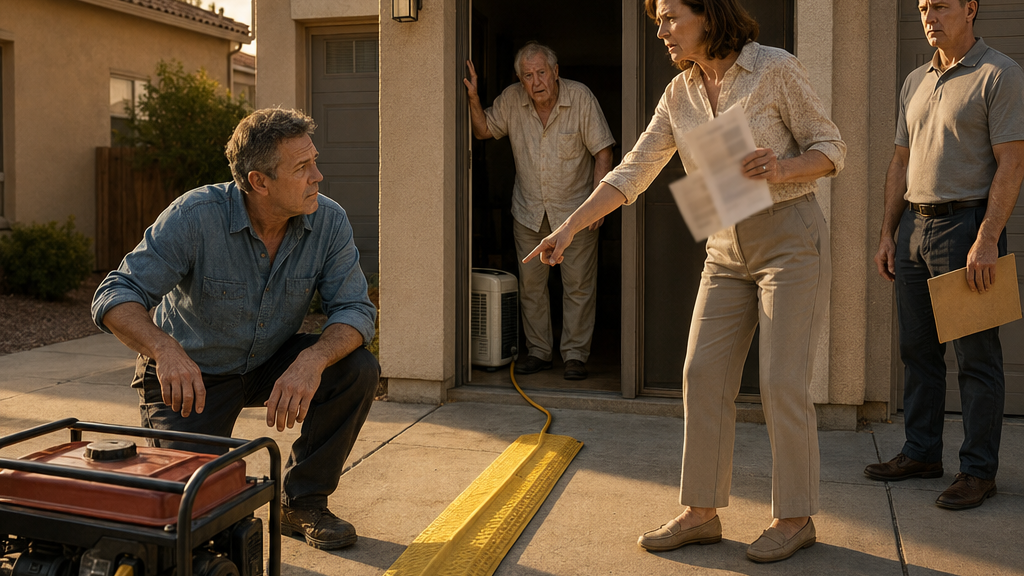
The generator sat on the outer edge of Samuel’s driveway, well away from the open garage. A heavy orange extension cord ran from it across the strip between the two properties, protected beneath a low rubber cable ramp Samuel had placed where Raymond Green’s driveway began.
The cord disappeared through Raymond’s side door.
Rebecca pointed at it.
“That has to be disconnected.”
Samuel crouched beside the generator and rested two fingers against the cord near the plug.
“No.”
The management representative looked up from his clipboard.
Rebecca’s jaw tightened. “Samuel, this isn’t optional.”
Samuel checked the cord again. Warm, not hot. He glanced at the load meter clipped beside the outlet.
Raymond’s refrigerator, a portable cooling unit, two lamps, and a medical-device charger. Less than half the generator’s continuous rating.
“What exactly isn’t optional?” Samuel asked.
“The emergency generator restriction.”
“Show me the adopted rule.”
Rebecca blinked once.
Then she pulled another sheet from the folder under her arm.
“This was distributed yesterday.”
Samuel did not take it immediately.
The heading identified the community association. Beneath it, in bold type, was an emergency notice ordering residents to discontinue portable-generator use because of noise, fuel-storage hazards, carbon-monoxide exposure, and fire risk.
Samuel read to the bottom.
The penalty was five hundred dollars for continued noncompliance.
“You wrote a notice,” he said.
“The board issued a directive.”
“That isn’t what I asked.”
A curtain shifted in the front window across the street. Two doors down, someone stood beneath a porch overhang watching them. The blackout had been going on for more than twenty hours, long enough that the neighborhood had developed a strange quiet beneath the scattered mechanical hum of generators.
Rebecca lowered her voice.
“You know exactly why we’re doing this.”
“I know why generators can be dangerous.”
“Then shut yours down.”
Samuel looked past her toward Raymond’s house.
“No.”
The word came out flatter than he intended.
Rebecca’s expression changed.
Not anger exactly. Recognition.
For years Samuel had made a point of staying out of HOA meetings unless a vote affected his property directly. When neighbors asked electrical questions, he usually gave them a contractor’s number instead of becoming the street’s unpaid consultant.
Rebecca knew that.
She had once joked that getting Samuel onto a committee would require a court order.
Now she stepped closer.
“You don’t get a professional exemption.”
“I didn’t ask for one.”
“Then you’re knowingly violating an emergency safety directive.”
Samuel took the sheet from her.
“Which section authorizes it?”
Rebecca tapped a line near the bottom.
“Article Seven. Nuisance and hazardous activity.”
“That’s broad language.”
“It’s still authority.”
“Maybe.”
The management representative shifted his weight. “Mr. Martinez, we’ve already given warnings on three other properties.”
Samuel looked at him. “Did you shut their generators down?”
“We instructed owners to comply.”
“That wasn’t my question.”
Before the man could answer, something struck the inside wall of Raymond’s house.
A dull thump.
Samuel turned.
“Raymond?”
No answer.
He crossed the cable ramp, took the two front steps at once, and pushed through the unlocked side door.
The heat inside was immediate.
Raymond had closed most of the blinds, but the house still held the dry, trapped warmth of a parked car. The portable cooling unit in the living room pushed a narrow stream of air toward an armchair.
Raymond stood near the kitchen counter with one hand against the wall.
The other was reaching for a glass that had fallen onto the tile.
“Leave it,” Samuel said.
“I’m fine.”
“You’re leaning.”
“I’m seventy-three. Leaning is permitted.”
Samuel caught his elbow when Raymond tried to straighten.
For half a second, Raymond’s knees softened.
That was enough.
Samuel guided him into the chair.
“You drink anything in the last hour?”
“Water.”
“How much?”
Raymond pointed vaguely toward the kitchen.
Samuel picked up the bottle beside the chair. Nearly full.
Rebecca had followed as far as the doorway.
Her face lost some of its firmness.
“Does he need an ambulance?”
Raymond looked toward her. “I need everybody to stop treating my driveway like city hall.”
Samuel pressed the back of his fingers to Raymond’s neck.
“Drink.”
Raymond obeyed reluctantly.
The portable cooling unit hummed beside them.
Samuel looked at Rebecca.
“That unit is drawing nine hundred watts. His refrigerator cycles around two hundred. The medical charger barely registers. The cord is twelve gauge, outdoor-rated, protected at the crossing, and the generator is outside with clearance on every side.”
Rebecca folded her arms.
“That doesn’t make every generator in the neighborhood safe.”
“No. It makes this one safe.”
“And if I allow yours, everyone says theirs should be allowed.”
“Then inspect them.”
“With whom?”
Samuel said nothing.
Rebecca’s point landed harder than he wanted it to.
The HOA did not have an electrical inspector waiting behind the clubhouse. It had volunteers, a management company, and a president trying to control dozens of residents in the middle of a failing grid.
Raymond drank again.
Rebecca looked at him, then back at Samuel.
“One hour.”
Samuel frowned.
“One hour for what?”
“To disconnect it.”
“If I don’t?”
“Two violations. One for the generator and one for the cross-property connection.”
Raymond laughed once from the chair, but there was no humor in it.
“You going to fine the orange cord too?”
Rebecca’s expression tightened.
“I’m trying to keep another emergency from becoming worse.”
Samuel heard the emphasis on another.
Before he could ask what she meant, Rebecca stepped outside.
The management representative placed two blank forms under his clipboard clip.
Samuel followed them to the driveway.
“You still haven’t shown me the adopted rule.”
Rebecca turned near the sidewalk.
“You have the notice.”
“That isn’t the same thing.”
“You have one hour, Samuel.”
She walked away.
He watched her stop at another house where a small generator was running behind a stucco wall.
The management representative followed.
Samuel went back to Raymond.
“Keep drinking.”
“You going to shut it off?”
“No.”
Raymond settled deeper into the chair. “Good.”
Samuel looked at him.
“Don’t make me regret that.”
By dusk, the sun had dropped behind the roofs without giving the neighborhood much relief. Samuel carried his old HOA binder to the kitchen table and placed Rebecca’s notice beside it.
Article Seven.
He found the section.
Noise nuisances. Improper storage. Offensive activity. Conditions creating unreasonable risk to neighboring property.
He read it twice.
Then he opened the amendment index.
Generators appeared nowhere.
He searched “emergency equipment.”
Nothing.
“Temporary power.”
Nothing.
“Portable engines.”
Nothing.
He went back to Rebecca’s notice.
At the bottom was a reference number: 7.14-E.
Samuel turned through the binder again.
Article Seven ended at 7.13.
He sat still for several seconds.
Outside, the generator continued its steady mechanical rhythm.
Then Samuel pulled his laptop closer and opened the HOA portal.
Because whatever Rebecca had handed him, section 7.14-E did not exist in the governing documents on his table.
Chapter 2: The Rule Missing From Every Page
At 8:17 that evening, Samuel found section 7.14.
It concerned decorative lighting.
There was no 7.14-E.
He leaned closer to the screen as though another line might appear if he stared long enough.
The HOA portal contained scanned declarations, amendments, architectural standards, meeting summaries, enforcement policies, pool rules, landscape guidelines, and thirty-two pages on vehicle parking.
Samuel searched every document for “generator.”
Three results appeared.
One was a contractor invoice for clubhouse maintenance.
One was a board discussion from two years earlier about renting a generator during a planned electrical upgrade.
The third was Rebecca’s emergency notice from yesterday.
Nothing else.
Samuel printed the search results.
The generator hummed outside the kitchen wall. Every time the refrigerator compressor started, the sound changed slightly.
He had spent too many years around electrical equipment not to notice.
His phone vibrated.
A message from the resident across the cul-de-sac:
They hit us with $500 too. Do you know if this is legal?
Samuel stared at it.
Then another came.
Young couple near mailboxes got notice. They have a baby.
He set the phone facedown.
He did not want this.
That thought embarrassed him almost as soon as it formed.
Not because the situation was unimportant. Because he knew what came next whenever people discovered someone nearby understood a technical problem.
Can you look at mine?
Can you tell me what to buy?
Can you talk to the board?
Can you guarantee this is safe?
Years earlier, at a utility job he no longer discussed, a recommendation had stalled between departments after Samuel hesitated to put his name behind a shutdown he believed was necessary but could not prove was urgent. Nothing catastrophic had happened, but equipment had been damaged, and afterward everyone remembered who had been uncertain.
Samuel had learned the lesson in the wrong direction.
If he was not responsible for a system, he preferred not to become responsible for it by accident.
His phone buzzed again.
This time the sender was Nicole Williams.
Samuel opened it.
Rebecca says you’re challenging the emergency directive. What are you looking for?
Samuel typed:
The authority adopting it.
Three dots appeared.
Then:
It was discussed by the board.
Discussed or approved?
A pause.
Samuel stood and went to the back door. Across the property line, Raymond’s living-room lamp glowed weakly through the blinds.
Finally Nicole replied.
Emergency policy was discussed. I wasn’t at the full meeting.
Which meeting?
Monday.
Before the outage.
Samuel checked the portal.
Monday’s meeting summary contained landscaping, pool maintenance, delinquency collections, and “summer emergency preparedness.”
Nothing about generators.
He sent Nicole a screenshot.
The response came almost immediately.
That summary isn’t complete.
Do you have minutes?
Not finalized.
Samuel looked at Rebecca’s violation notice lying on the table.
Five hundred dollars.
A formal penalty based on minutes that had not been finalized and an adopted section that apparently did not exist.
He typed:
Was there a vote?
Nicole took almost a minute.
I assumed there was.
Samuel sat back.
Outside, someone shouted across the street, followed by the cough of a generator starting.
A few seconds later, his doorbell rang.
The young father from near the mailboxes stood outside holding a violation notice.
Sweat had soaked the collar of his T-shirt.
“I’m not asking you to fix anything,” he said quickly. “I just need to know if I’m about to make this worse.”
Samuel looked at the paper.
Same language.
Same reference: 7.14-E.
“You running a generator?”
“Behind the block wall. Twenty feet from the house.”
“What are you powering?”
“Portable AC in the nursery. Refrigerator. That’s it.”
“Fuel?”
“Five-gallon can in the shed.”
“Move the fuel out of the shed if it gets hotter in there. Keep it shaded and away from ignition sources.”
The man nodded rapidly.
“Do I shut the generator off?”
Samuel hesitated.
There it was.
The moment he hated.
A question that sounded simple but transferred weight the instant he answered it.
“I can’t tell you your setup is safe without seeing it.”
The father’s face fell.
Samuel added, “But this notice does not prove it’s prohibited.”
“So what do I do?”
Samuel handed the paper back.
“Keep the baby cool. Don’t run the unit in a garage. Don’t backfeed your house through an outlet. Don’t refuel it while it’s hot.”
The man exhaled.
“That sounds like a no.”
“It sounds like exactly what I said.”
After he left, Samuel hated himself a little for the precision.
He reopened the portal.
By ten o’clock he had built a list.
Declaration: no generator ban.
Rules and regulations: no generator ban.
Architectural standards: no generator ban.
Emergency preparedness summary: no generator ban.
Enforcement schedule: no generator violation category.
Article 7.14-E: nonexistent.
He photographed the documents and wrote notes on Rebecca’s notice.
No section.
No vote located.
No penalty schedule.
No adoption date.
The paper no longer looked official.
It looked improvised.
At 10:26 Nicole called.
“I found something,” she said.
Samuel leaned back. “Minutes?”
“No.”
“What?”
“A fire-safety file.”
He stopped writing.
Nicole continued. “Rebecca has been keeping it with the insurance correspondence. I didn’t know it was separate from the regular board records.”
“What’s in it?”
“I only saw the folder.”
“Then why are you calling me?”
“Because you’re assuming she invented the whole thing.”
“I’m assuming she cited a rule I can’t find.”
“That part may be a problem.”
“May be?”
Nicole lowered her voice. “Samuel, there was a generator fire here.”
He looked toward the dark window.
“When?”
“Last summer. During that outage in July.”
“I remember the fire department coming in.”
“A resident ran a portable generator inside his garage with the door halfway open.”
Samuel closed his eyes.
Nicole said, “Rebecca was there.”
“That still doesn’t create a rule.”
“I know.”
But her tone had changed.
So had his certainty.
“Can you send me the file?”
“I don’t have it.”
“You said you found it.”
“I found where it’s listed. Rebecca has the physical copies.”
Samuel rubbed his forehead.
“Convenient.”
“Don’t do that.”
“What?”
“Decide what I mean before I say it.”
He went quiet.
Nicole continued. “I’m telling you there’s something behind this. That doesn’t mean the fines are valid.”
Samuel looked at his notes again.
The clean argument he had been building suddenly had a second column.
Unauthorized rule.
Possible legitimate hazard.
At 10:41, a message arrived from Nicole.
Image attached.
Samuel opened it.
A photograph filled the screen.
A garage door stood blackened and warped. The stucco above it was stained gray. Inside, barely visible through the opening, sat the melted frame of a portable generator.
Under the image Nicole had written only four words.
This is what Rebecca saw.
Samuel stared at the photograph until the generator outside his own house changed pitch under load.
For the first time that night, the question was no longer why Rebecca had acted.
It was why, with a danger that real, she had chosen a ban she apparently had no authority to enforce.
Chapter 3: The Fire Rebecca Never Forgot
Rebecca spread six photographs across the HOA conference table before Samuel had finished sitting down.
“Tell me which one is acceptable.”
The clubhouse had no power except for a battery lantern in the center of the table and a portable fan that barely moved the warm air. Nicole sat to Rebecca’s right. Two other board members had joined by phone, their voices occasionally breaking through the speaker.
Samuel looked at the photographs.
The burned garage.
A scorched ceiling beam.
A melted fuel container.
A blackened electrical panel.
A close photograph of soot around a door leading from the garage into the house.
The last image showed an extension cord with part of its insulation fused into a dark lump.
Rebecca tapped that one.
“You see a cord. I see that.”
Samuel kept his eyes on the picture.
“That cord didn’t cause the garage fire.”
“That isn’t the point.”
“It matters if we’re talking about safety.”
Rebecca slid an insurance letter toward him.
The carrier had recommended tighter controls on portable fuel-powered equipment after the incident, including requirements for outdoor placement, fuel separation, minimum clearance, and resident education.
Samuel read the final paragraph twice.
It did not recommend a ban.
Rebecca watched him.
“You think I enjoyed telling people they couldn’t use generators?”
“I think you issued fines under a rule I can’t find.”
“I asked you about the photographs.”
“And I’m answering the policy.”
Her mouth tightened.
Nicole glanced between them. “Can we separate those?”
Rebecca leaned back.
“Fine. Separate them.”
Samuel gathered the photographs into a straight line.
“This generator was operated in a garage. That is dangerous. The door being partially open doesn’t make it safe. Carbon monoxide accumulates. Heat accumulates. The fuel container should never have been stored beside the unit.”
Rebecca pointed toward him.
“Exactly.”
“No. Not exactly.”
He slid the insurer letter back.
“This recommends controls.”
“We tried education.”
“When?”
“After the fire.”
“I never received anything.”
“You weren’t the one running a generator inside a garage.”
“That’s not education. That’s correcting one resident.”
Rebecca looked toward the dark window.
For a moment, the defensiveness went out of her face.
“When I got there, the woman who lived in that house was standing in the street barefoot. She kept saying her dog was still inside.”
Nobody spoke.
Rebecca touched the corner of one photograph.
“The garage was full of smoke. The side door was hot. We waited for the fire department because nobody could go in.”
“Was the dog okay?” Nicole asked quietly.
“Yes.”
Rebecca looked back at Samuel.
“The fire department said another fifteen minutes could have put fire into the attic. Three neighboring houses are less than twenty feet away.”
Samuel understood now.
Not agreement.
Understanding.
Rebecca had watched one resident’s bad decision almost become a block-wide emergency. Then, a year later, the grid failed during temperatures that pushed half the community toward portable generators at once.
Her fear was not imaginary.
The mistake was what she had done with it.
Samuel picked up the insurer letter.
“This gives us a framework.”
Rebecca frowned.
“For what?”
“Outdoor operation only. Minimum twenty feet from occupied openings where possible. Exhaust directed away from structures. No fuel stored inside garages. No refueling while hot. Heavy outdoor-rated cords. No improvised backfeeding.”
“One resident ignores any of that and we own the consequences.”
“No. You document the conditions.”
“We are an HOA, Samuel. We are not an electrical inspection agency.”
“Then stop pretending a blanket prohibition turns you into one.”
Nicole inhaled sharply.
Rebecca’s face hardened.
Samuel continued before she could answer.
“You have a real hazard. I’m not minimizing it. But ‘generators can be dangerous’ does not mean ‘every generator must be shut off during a prolonged blackout.’ Those are different statements.”
One of the board members crackled through the speaker.
“What happens if somebody dies from carbon monoxide?”
Samuel looked toward the phone.
“What happens if somebody dies from heat after you order them to shut down safe emergency power?”
Nobody answered.
The portable fan clicked as it oscillated.
Rebecca folded her arms.
“So your position is generators are safe.”
“No.”
She seemed surprised.
Samuel pointed to the burned-garage photograph.
“Anyone who tells this neighborhood generators are simply safe is being irresponsible.”
Nicole looked at him more carefully.
He continued.
“They’re engines. They create heat, exhaust, carbon monoxide, electrical hazards, and fuel hazards. Some people absolutely should not be operating them without help.”
Rebecca said, “Then you understand why I acted.”
“I understand why you were afraid.”
The words landed differently than an accusation.
For a second Rebecca looked almost tired.
Then she straightened.
“Fear had nothing to do with it.”
Samuel let that pass.
He pulled a legal pad from his folder.
“I can write a one-page temporary safety sheet. We can distribute it today. Volunteers can visually check placement without touching equipment. Anyone running inside a garage gets shut down. Anyone backfeeding through a receptacle gets shut down. Fuel storage corrected immediately.”
Rebecca shook her head before he finished.
“You’re proposing we approve equipment we aren’t qualified to inspect.”
“I’m proposing risk controls.”
“And when somebody says Samuel Martinez inspected my generator and then something happens?”
“I didn’t say I’d certify equipment.”
“That’s what they’ll hear.”
Her answer struck closer than she knew.
Samuel remembered another conference room years earlier. Another group of people waiting for him to say whether a system could remain energized. He remembered choosing careful language until the decision passed upward and then sideways, responsibility spreading until no one quite owned it.
He looked down at the legal pad.
Rebecca took his silence as concession.
“This is exactly the problem. Everyone wants an exception until something goes wrong.”
Nicole leaned forward.
“But we’re issuing fines now.”
Rebecca turned to her.
“We’re enforcing an emergency directive.”
“Was it actually voted?”
The room changed.
Rebecca’s eyes moved to Nicole.
“We discussed it.”
“That isn’t what I asked.”
Samuel recognized his own words from the driveway.
Rebecca noticed too.
“We authorized emergency action.”
One board member on the speaker said, “I remember approving safety measures.”
The other said, “I don’t remember voting on fines.”
Rebecca’s hand flattened against the table.
“The fine schedule is already in the enforcement policy.”
“For nuisance violations,” Samuel said.
Rebecca looked at him.
“You came here to discuss safety.”
“I’m discussing both.”
“Then hear me clearly. Until the board resolves the language, the generator directive remains in effect.”
Nicole stared at her. “Rebecca—”
“No. We have temperatures above one hundred fifteen, portable gasoline engines appearing on patios and in garages, and an insurer that has already warned us after one fire. I am not withdrawing the directive in the middle of this.”
Samuel’s anger returned, but it no longer had the simple shape it had carried the night before.
He understood what Rebecca feared.
That made the choice she was making harder to dismiss.
And harder to forgive.
“What happens to the existing notices?” he asked.
Rebecca closed the fire-safety folder.
“They stand.”
“The five-hundred-dollar penalties?”
“They stand.”
Samuel looked at Nicole.
She looked down.
Rebecca added, “Beginning tonight, repeated noncompliance will trigger the next level of the schedule.”
Samuel stared at her.
“You’re increasing them?”
“We’re escalating enforcement.”
“In a blackout.”
“In an emergency.”
That distinction, spoken with complete conviction, ended the meeting.
Samuel walked home under a sun already high enough to bleach the street into hard white light. Several homes had sheets taped inside west-facing windows. A generator sat silent behind one driveway gate with an HOA notice attached to the handle.
He stopped.
The extension cord had been neatly wrapped around the generator frame.
For a moment he imagined knocking on every door himself.
Checking fuel.
Checking cords.
Checking clearances.
Becoming exactly what he had spent years avoiding.
His phone vibrated.
He ignored it.
Then he heard the siren.
Not distant.
Close.
Samuel looked up.
An ambulance turned into the subdivision, lights flashing without the siren now, and moved past him.
He started walking faster.
The ambulance made the second turn.
Toward his street.
By the time Samuel reached the corner, it had stopped directly in front of Raymond Green’s house.
Chapter 4: When Safety Became Something Else
The orange extension cord lay coiled beside Raymond’s side door while two paramedics carried him past it.
Samuel stopped at the edge of the driveway.
For a second he looked only at the cord.
It had been unplugged from the portable cooling unit and wound into three careful loops, as if Raymond had wanted to prove he could follow instructions properly even while the house heated around him.
One of the paramedics called back, “Family?”
“Neighbor.”
“Do you know his medical history?”
“Some.”
Raymond’s eyes opened on the stretcher.
“Don’t answer for me,” he said weakly.
Samuel came closer.
“You picked a great time to get territorial.”
Raymond tried to smile. It lasted half a second.
His skin looked wrong—too flushed around the cheeks, too dull everywhere else. An IV line had already been started.
“What happened?” Samuel asked.
Raymond looked past him toward the house.
“Got warm.”
The paramedic gave Samuel a look that said it had been more than that.
Raymond’s daughter arrived as they were loading him into the ambulance. She stepped out of her car before it had fully stopped and ran toward the stretcher.
Samuel moved back.
He felt suddenly unnecessary.
Then she saw the coiled cord.
“What is that?”
Samuel followed her gaze.
“Generator connection.”
“Why is it unplugged?”
He didn’t answer quickly enough.
Her face changed.
“Did they make him shut it off?”
“The HOA ordered generators disconnected.”
“And you let them?”
“No.”
The answer came too fast.
Samuel corrected himself.
“I kept mine running. Raymond still had power yesterday.”
“Yesterday.”
The ambulance doors closed.
Raymond’s daughter stared at Samuel for another second, then climbed into the passenger side.
Samuel stood in the driveway until the ambulance turned out of sight.
Only then did he go inside Raymond’s house.
The air hit him harder than before.
The portable cooling unit sat silent beside the armchair. The refrigerator display was dark.
On the kitchen counter was Raymond’s own smaller generator instruction manual.
Samuel picked it up.
Several pages had been folded down.
He remembered the conversation.
Two evenings before the main outage, Raymond had rolled the generator out of his garage and asked whether he could connect it directly to the house.
Samuel had looked at the adapter Raymond bought online.
“No.”
Raymond frowned. “No what?”
“No to all of that.”
“I haven’t even told you what I’m doing.”
“You don’t need to. That plug doesn’t belong there.”
Raymond had grumbled.
Samuel had taken the adapter away.
“Until I can look at the panel, don’t improvise.”
“You coming back?”
“When I have time.”
Samuel had not come back.
Instead, when the blackout became serious, he ran the outdoor cord from his own generator and powered Raymond’s essential loads.
Then Rebecca arrived.
Then the fines.
Now the cord was on the ground.
Samuel looked at it for a long time.
At the hospital, Raymond’s daughter found him near the vending machines forty minutes later.
“He’s stable.”
Samuel nodded.
“Heat exhaustion?”
“That’s what they’re saying. Dehydration too.”
“Good.”
She stared at him.
“Good?”
“I mean good that it isn’t worse.”
“I know what you meant.”
Samuel sat down.
The waiting area air-conditioning was almost painfully cold after the neighborhood. Families sat under fluorescent lights charging phones from wall outlets that nobody had to debate.
Raymond’s daughter remained standing.
“My father said you told him not to use his generator.”
Samuel looked up.
“I told him not to backfeed his house with an unsafe adapter.”
“He heard ‘don’t use it.’”
“I gave him power from mine.”
“Until today.”
Samuel’s jaw tightened.
“I did not unplug that cord.”
“I didn’t say you did.”
Her voice was not angry. That made it worse.
“He trusts you.”
Samuel looked toward the hallway leading to the treatment rooms.
“He shouldn’t trust me blindly.”
“That isn’t really up to you.”
The sentence sat between them.
Samuel leaned forward, elbows on his knees.
“I should have checked his panel.”
“When?”
“Two days ago.”
“Would that have changed today?”
“Maybe.”
She nodded once.
“Then maybe matters.”
She walked toward the nurses’ station.
Samuel stayed where he was.
For years he had told himself that boundaries were responsible.
He did not work on equipment he had not been hired to inspect.
He did not certify systems he did not control.
He did not become the unofficial expert simply because he lived nearby.
Those rules had protected him.
Sitting under hospital lights while Raymond received fluids for heat exhaustion, they looked less clean.
By the time Samuel returned home, small fluorescent tags had appeared on three generators along the street.
NOTICE OF NONCOMPLIANCE.
One was tied to a handle with a plastic loop.
Another was taped to a fuel tank.
The HOA management representative was halfway down the block with a second employee.
Samuel stopped his truck.
“What are you doing?”
The representative looked uncomfortable.
“Documenting equipment visible from common areas.”
“Documenting?”
“Tagging units scheduled for enforcement follow-up.”
“Scheduled for what?”
The man hesitated.
“Removal if required under management authority.”
Samuel got out.
“Do not touch mine.”
“We haven’t.”
“Do not touch anybody’s equipment without documented authority.”
The representative looked toward the other employee.
“We’re following board direction.”
Samuel almost laughed.
That phrase again.
Board direction.
Emergency directive.
Authority.
Everything sounded official until someone asked where it was written.
He went inside and opened his laptop.
This time he did not search quietly.
He drafted a formal technical objection.
He listed the carbon-monoxide risks Rebecca had correctly identified. Fuel hazards. Improper placement. Backfeeding. Extension-cord overload.
Then he listed the risks of a blanket prohibition during prolonged extreme heat.
Medical-device failure.
Loss of refrigeration.
Loss of localized cooling.
Heat exposure among older residents.
He included Raymond’s hospitalization without naming his condition.
At the bottom he wrote:
I recommend immediate suspension of blanket generator enforcement pending adoption of a temporary safety protocol based on placement, ventilation, load, fuel storage, and connection method.
He read it twice.
Then he typed his name under it.
Samuel Martinez.
He was about to send it when he stopped.
Rebecca had said the board authorized emergency action.
Nicole had said the policy was discussed Monday.
Samuel opened the meeting archive.
Monday’s summary again.
No vote.
He searched the document index for attachments.
Agenda.
Insurance correspondence.
Emergency-preparedness packet.
Draft minutes unavailable.
He emailed Nicole.
Need the actual minutes from Monday.
Her reply came six minutes later.
I’m looking.
Ten minutes.
Nothing.
Then:
There aren’t any in the folder.
Samuel called her.
“What do you mean there aren’t any?”
“I mean the draft minutes aren’t where they should be.”
“Who keeps them?”
“I do.”
Samuel was silent.
Nicole continued quickly. “I missed the second half of the meeting. Another board member was supposed to take notes.”
“Were they uploaded?”
“No.”
“Were they ever written?”
“I don’t know.”
Samuel looked at the formal objection on his screen.
“Nicole, was there actually a vote?”
“I thought there was.”
“That’s not an answer.”
“I know.”
Outside, the management employee tied another fluorescent tag to a generator.
Samuel clicked Send on his technical objection.
Then he opened the original Monday agenda.
At the bottom, beneath Emergency Preparedness, someone had uploaded one extra file.
TEMPORARY GENERATOR SAFETY—DRAFT.
Samuel opened it.
The word DRAFT appeared across the top.
No signatures.
No adoption date.
No fine schedule.
And no blanket ban.
He reached for the phone.
Because if those missing minutes did not contain a vote, Rebecca had not merely stretched an emergency rule.
She had been enforcing a rule the board might never have passed.
Chapter 5: The Meeting That Never Passed the Ban
Nicole placed the unsigned document on the HOA office counter and said, “This is the version Rebecca used.”
Samuel did not pick it up.
The first page looked almost identical to the emergency notice residents had received.
Almost.
The title was different.
Temporary Generator Safety Guidance.
Not prohibition.
Not directive.
Guidance.
Samuel turned the page.
The draft listed outdoor placement, fuel separation, ventilation, and warnings against backfeeding. Near the bottom, a bracketed note read:
Board to determine enforcement mechanism if emergency conditions require.
Nothing followed it.
“No five-hundred-dollar fine,” Samuel said.
Nicole shook her head.
“No.”
“No shutdown requirement.”
“No.”
“No 7.14-E.”
Nicole looked embarrassed.
“I don’t know where that came from.”
Samuel did.
“Rebecca tied it to the nuisance section.”
“That still doesn’t explain the E.”
“No. It explains what she wanted it to look like.”
Nicole sat behind the desk.
The HOA office was dim and warm, running on a small battery unit that powered one computer and a fan. Through the front window, the parking lot shimmered.
Samuel pulled the original violation notice from his folder.
He had marked it so many times that the margins were crowded with arrows and section numbers.
He placed it beside the draft.
Nicole stared at the two pages.
“Those are not the same document.”
“No.”
“I thought this was approved after I left.”
“You said that.”
“I know what I said.”
Her irritation was mostly with herself.
Samuel pointed at the draft.
“Who was taking minutes?”
“One of the other board members.”
“And?”
“They thought I was going to reconstruct them from the agenda afterward.”
Samuel looked at her.
Nicole gave a short, humorless laugh.
“Yes. I know.”
“So nobody recorded the second half properly.”
“Apparently.”
“Did anyone vote?”
“I’ve called both members who stayed.”
“And?”
“One remembers agreeing that Rebecca could issue safety guidance. The other remembers saying we needed to stop dangerous generator use.”
“That isn’t a vote on a ban.”
“I know.”
Samuel picked up the draft.
“And neither remembers authorizing fines?”
Nicole shook her head.
“Rebecca says the board gave her emergency discretion.”
“Where?”
“That’s the argument.”
“No. Where?”
Nicole looked toward the closed conference-room door.
“She’ll be here in twenty minutes.”
Samuel gathered the papers.
“I’m going to county emergency management first.”
“For what?”
“To make sure we aren’t building another bad argument on top of this one.”
At the county office, the clerk behind the temporary emergency desk had heard variations of the same question all morning.
Home generators.
Cooling centers.
Neighborhood restrictions.
Fuel storage.
Samuel kept his request narrow.
“I’m not asking whether the county approves a particular HOA rule. I need the current public emergency guidance for residential backup power.”
The clerk handed him a printed packet.
The county guidance did not order associations to allow all generator use.
It also did not support a blanket shutdown.
Instead, it emphasized carbon-monoxide safety, outdoor placement, clearance from openings, safe fueling, and medical vulnerability during prolonged outages.
Samuel read the section twice.
It was not a magic law.
Good.
Magic laws made bad stories and worse policy.
This was more useful.
A defensible standard.
By the time Samuel returned to the HOA office, Rebecca was already there.
She looked at the two versions of the policy on the table.
“I know what you’re going to say.”
Samuel sat opposite her.
“Then save us time.”
“You think I exceeded authority.”
“I think the board discussed safety guidance and you enforced a prohibition.”
“The board told me to act.”
“Did they vote on fines?”
“No formal roll-call vote.”
“Did they vote on a blanket ban?”
“They authorized emergency control.”
Nicole said quietly, “That is not what the draft says.”
Rebecca turned to her.
“The draft was written before the outage became this serious.”
“Then we amend it properly.”
“We didn’t have time.”
Samuel slid the county guidance across the table.
“You had time to issue thirty-four violation notices.”
Rebecca’s eyes flashed.
“And if another garage caught fire while we scheduled a meeting?”
“Then you shut down the dangerous setup.”
“How do we determine dangerous?”
Samuel opened the folder he had brought.
This time it contained a one-page checklist.
Generator outdoors.
Exhaust away from doors and windows.
Minimum clearance.
No garage operation.
No interior fuel storage.
No hot refueling.
Outdoor-rated cords sized to load.
No improvised backfeeding.
Priority consideration for medical and cooling needs.
Rebecca read it.
Then again.
“You wrote this?”
“Yes.”
“When?”
“Last night.”
“Who approved it?”
“No one.”
Rebecca pushed it back.
“Then you see the problem.”
Samuel almost answered sharply.
Instead, he stopped.
She was right about that part.
His document was also just a document.
Technical competence did not automatically create public authority.
He pulled it back toward himself.
“Fine.”
Rebecca seemed surprised.
Samuel took out a pen.
“We don’t call it approved. We call it proposed temporary protocol. The board votes on it in an emergency meeting.”
“We don’t have trained inspectors.”
“Then nobody certifies equipment. Volunteers only flag obvious hazards. Resident remains responsible for operation.”
“Liability.”
“Document that too.”
“Insurance.”
“Call them.”
Rebecca looked at him.
Samuel pointed to the old fire letter.
“They already recommended controls. Not prohibition.”
Nicole leaned forward.
“We can convene electronically this afternoon.”
Rebecca did not respond.
Samuel watched her eyes move between the draft guidance and his checklist.
For the first time, the missing vote was no longer the most important thing in the room.
Rebecca had overreached.
That was clear now.
But Samuel could feel the next question pushing past it.
What replaced the overreach?
If he forced the board to withdraw the ban and someone dragged a generator into a garage that night, proving Rebecca wrong would not protect anyone.
He tapped the checklist.
“This is the alternative.”
Rebecca looked at him.
“You want enforcement suspended?”
“Yes.”
“And unsafe units?”
“Correct them immediately.”
“And if a resident refuses?”
“Then use the actual nuisance authority for a documented hazard.”
Nicole nodded slowly.
Rebecca’s expression remained guarded.
“No.”
Samuel stared at her.
Nicole said, “Rebecca.”
“No blanket suspension until there’s a complete replacement process.”
“There is one in front of you.”
“There’s a page in front of me.”
Samuel felt his patience thinning.
“What else do you want?”
“Names. Responsibilities. Who checks what. What counts as failure. What happens when fuel is stored incorrectly. What happens when a cord crosses common area. What happens when someone says their medical need overrides placement requirements.”
Samuel leaned back.
It would have been easier if she were simply unreasonable.
Instead, she was forcing him to do the thing he had avoided since the beginning.
Own the details.
Nicole looked at him.
“You can build that.”
Samuel did not answer.
Rebecca said, “That’s what I thought.”
Something about the line irritated him enough to clarify his own position.
“I can.”
Rebecca’s eyebrows lifted.
“I can build it,” Samuel repeated. “But if I do, you bring it to a vote today.”
Nicole said, “I’ll schedule the meeting.”
Rebecca folded the unsigned draft.
“Today.”
Samuel spent the next three hours converting one page into an actual emergency-use procedure.
Not a certification system.
Not an HOA electrical code.
A narrow protocol.
Placement.
Connection.
Fuel.
Visibility.
Complaint response.
Immediate shutdown only for identifiable hazards.
He removed anything residents could misunderstand as a guarantee.
At two in the afternoon, Nicole brought him a printed copy of the original agenda from Monday.
Samuel laid Rebecca’s violation notice over it.
Emergency preparedness discussion.
No generator-ban motion.
No fine authorization.
The contradiction was complete.
Nicole stood beside him.
“I should have caught this.”
“You weren’t there.”
“I’m the secretary.”
Samuel looked at her.
“And I knew the restriction was dangerous before Raymond went to the hospital.”
Nicole did not offer him absolution.
He appreciated that.
His phone rang.
The utility’s automated message began before he could speak.
Due to continuing load instability and equipment damage, service restoration to the affected area was not expected before late the following day.
Samuel looked toward the window.
Another night.
The hottest houses had already spent more than a day without central air.
Nicole heard enough of the message to understand.
“We need the meeting now.”
Samuel folded the checklist and slid it into his folder.
This morning he had wanted proof that Rebecca lacked authority.
Now he had it.
It no longer felt like enough.
Chapter 6: One Night Without Another Ambulance
Rebecca placed Samuel’s text message in the center of the conference table.
“Read the timestamp.”
Samuel looked at his phone printout.
Monday, 9:42 p.m.
Two days before Raymond’s hospitalization.
Rebecca tapped the page.
“And read what you wrote.”
Samuel did not need to.
Nicole sat at the end of the table with the emergency-meeting agenda open in front of her. The two other board members were present this time instead of calling in. Six residents waited against the back wall because word had spread that the generator policy might change.
Rebecca pushed the paper closer.
Samuel read aloud.
“Blanket generator shutdown during extended heat-related outage may create greater life-safety risk than controlled outdoor use. Recommend targeted restrictions instead.”
Rebecca folded her hands.
“You knew.”
Samuel met her eyes.
“Yes.”
“Why didn’t you file that formally?”
The room went still.
He could have said because she was president.
Because the board had responsibility.
Because a text to the president should have been enough.
All of those things contained truth.
None of them answered the question.
“I didn’t want to own the policy.”
A resident near the wall shifted.
Rebecca said, “But you expected me to.”
“No. I expected you not to ban everything.”
“That isn’t the same as giving us an alternative.”
Samuel looked down at his printed protocol.
“No.”
The admission surprised several people, including Rebecca.
Samuel continued.
“I warned you privately because I wanted to be able to say I warned you without becoming responsible for what came next.”
Nicole watched him without moving.
He thought of Raymond’s coiled extension cord.
“I was wrong about that.”
Rebecca’s face softened almost imperceptibly, but only for a moment.
“You were still right that I exceeded what the board formally approved.”
“Yes.”
“So here we are.”
Samuel opened the protocol.
“Then let’s fix both problems.”
He did not give a speech.
He walked them through the page.
Outdoor placement.
Exhaust direction.
Doors, windows, and vents.
Fuel storage.
Cord rating.
Load limits.
No backfeeding.
Immediate correction for obvious hazards.
Residents responsible for equipment operation.
The association responsible only for enforcing the temporary conditions adopted by vote.
One board member stopped him.
“Who decides whether a cord is overloaded?”
“If there’s visible damage, heat deformation, undersized cable identified from labeling, or obvious unsafe use, it gets corrected. We do not pretend volunteers are performing electrical inspections.”
“And if it’s not obvious?”
“Then we don’t invent certainty.”
Rebecca looked at him.
That line belonged to both of them.
Nicole moved to the next item.
“Medical priority?”
Samuel nodded.
“Doesn’t waive safety. It affects response urgency. If somebody needs cooling or powered medical equipment, we help them create a compliant setup instead of just issuing a notice.”
A woman in the back said, “That would have helped yesterday.”
Nobody answered.
Rebecca turned the page.
“Enforcement suspension.”
Nicole read the motion.
“All generator-specific fines issued under the temporary directive are suspended pending board review. Emergency operation may continue under the interim safety protocol if adopted tonight.”
One board member raised a concern about insurance.
Nicole held up an email.
“I called the carrier.”
Rebecca looked at her.
“And?”
“They won’t certify individual setups. They do support documented risk controls consistent with their post-fire recommendations.”
Samuel watched Rebecca absorb that.
Not defeat.
Removal of one more reason to keep the ban intact.
Nicole called for discussion.
A resident near the back asked, “What about the units they tagged for removal?”
The management representative answered from beside the door.
“No equipment will be removed while the board reviews the directive.”
Another resident said, “And the fines?”
Nicole repeated, “Suspended tonight. Cancellation is a separate vote after review.”
Rebecca looked toward Samuel.
“You understand that if this protocol passes, people are going to say you approved their generators.”
“I understand.”
“And?”
“I’ll correct them.”
A few people smiled.
Samuel didn’t.
Rebecca picked up the checklist.
“I want your name on this.”
Nicole looked at her sharply.
“Rebecca—”
“No. He designed it. He says these are the conditions that reduce the risk. I want him to sign the technical recommendations.”
Samuel felt the old resistance return instantly.
There it was.
The transfer.
The weight.
The thing he had spent years avoiding.
He could almost hear himself saying he was only advising.
That the board owned adoption.
That residents owned operation.
That the insurer owned its recommendations.
All technically true.
All carefully limited.
Raymond was still in the hospital.
Samuel took the pen.
“I’ll sign the technical basis,” he said. “Not individual equipment.”
Rebecca nodded.
“That’s fair.”
Samuel signed.
The vote passed three to one.
Rebecca voted with the majority.
No one applauded.
Chairs moved. People immediately started asking practical questions.
“What about fuel cans?”
“How far from a window?”
“Can two refrigerators run on one cord?”
Samuel answered only what he could answer.
When he didn’t know, he said so.
By sunset, he was back on the street with the management representative, Nicole, and two resident volunteers.
They did not inspect engines internally.
They looked for obvious hazards.
One generator was moved out of a garage.
Another was turned so exhaust no longer pointed toward a bedroom window.
A resident removed gasoline from an attached storage room.
Samuel replaced a lightweight indoor cord running a portable air conditioner with a properly rated outdoor cable the homeowner already had.
At Raymond’s house, the orange cord still sat coiled beside the door.
Samuel picked it up.
The rubber felt warm from the day.
Raymond’s daughter had returned from the hospital and stood on the porch.
“He’s staying overnight.”
Samuel nodded.
“Doing okay?”
“Complaining about the food.”
“Good sign.”
She watched him uncoil the cord.
“You putting it back?”
“Yes.”
Samuel checked the generator placement again.
Clearance.
Exhaust direction.
Load.
Cable ramp.
He connected the plug.
Inside Raymond’s house, the refrigerator display lit.
A second later the portable cooling unit started.
The cord crossed the property line exactly where it had before.
But now a small laminated tag was fixed beside the connection.
TEMPORARY EMERGENCY USE—SAFETY CONDITIONS VERIFIED.
Samuel looked at it.
He still disliked the wording.
Verified sounded too broad.
He made a note to change it to Visual Conditions Checked.
Nicole approached from the sidewalk.
“Meeting’s technically still open.”
“Why?”
“Rebecca wants one final statement entered.”
Samuel looked toward the clubhouse.
When they returned, most residents had gone.
Rebecca stood near the conference table collecting the burned-garage photographs.
Nicole resumed the minutes.
Rebecca waited until Samuel sat.
Then she said, “The temporary protocol passed. The original directive is suspended.”
Nicole typed.
Rebecca continued.
“I also want the record to show that the board’s process failed.”
Samuel expected her to stop there.
She didn’t.
“I issued enforcement language without a formal vote on the final version. That was my decision.”
One board member looked down.
Rebecca slid Samuel’s earlier text back across the table.
“But I will not let the record pretend I created every failure alone.”
Samuel looked at her.
She spoke quietly.
“You warned me privately. The board discussed safety vaguely. Nicole assumed minutes would be reconstructed. Other members assumed I had authority. Management enforced what it was given.”
Nicole stopped typing.
Rebecca gathered the photographs into the folder.
“I’ll take responsibility for what I did. I won’t take everyone else’s because it makes the story cleaner.”
Samuel thought of the street outside.
Of the generator that had been inside a garage.
Of the young father who had asked Samuel whether to shut his down.
Of Raymond trusting a caution Samuel had never followed up on.
Rebecca closed the folder.
“If the board wants my resignation after this, I’ll give it.”
No one spoke.
Then she looked directly at Samuel.
“But if I resign, don’t let them turn you into the hero so nobody else has to remember what they failed to do.”
Samuel had no answer ready.
For once, he did not reach for one.
Chapter 7: After the Power Came Back On
Every generator fine appeared on the agenda under the same notation.
Recommended for cancellation.
Samuel noticed it before he sat down.
Thirty-four entries filled nearly two pages. Some belonged to residents he knew. Others were only lot numbers to him. Each one had the same amount beside it, followed by the same short recommendation from management.
Cancel.
The power had returned twelve days earlier.
Since then, the neighborhood had gone back to sounding ordinary. Air conditioners hummed behind stucco walls. Garage doors opened in the morning. Sprinklers ran before sunrise. The emergency cooling center had closed. The temporary generator tags had been removed.
Nothing looked urgent anymore.
That, Samuel had learned, was when people were most tempted to simplify what had happened.
Nicole sat at the front table arranging copies of the revised emergency policy.
Rebecca arrived last.
She carried the old fire-safety folder under one arm.
No one spoke to her as she took her seat.
Samuel had expected anger in the room. Instead, the mood felt heavier than that. Residents did not seem interested in another fight. They wanted the thing finished properly.
Nicole called the meeting to order.
The first vote concerned the fines.
One board member moved to cancel all generator-specific penalties issued under the emergency directive. The other seconded it.
Rebecca raised her hand with the majority.
The vote was unanimous.
A few residents exhaled audibly, but there was no applause.
Samuel preferred it that way.
Next came the equipment issue.
Two generators had been removed from common-facing areas before the suspension order stopped further action. Management had already arranged their return.
Nicole read the resolution into the record.
Then she moved to the revised emergency-power policy.
Samuel recognized much of his temporary checklist, but the language had been changed.
Visual hazard review instead of inspection.
Resident responsibility instead of approval.
Immediate correction instead of blanket shutdown.
The insurer had added written comments as well.
Nicole held up their letter.
“The carrier does not recommend a blanket generator prohibition during prolonged outage conditions. They support controlled outdoor use with documented fuel, ventilation, placement, and connection requirements.”
Someone behind Samuel murmured, “Would’ve been nice to know that two weeks ago.”
Rebecca heard it.
She did not turn around.
Nicole continued.
“The carrier also recommends annual resident education before peak summer season.”
Samuel looked down at the policy.
That part had not been his idea.
It was better because of it.
The revised document no longer depended on one person knowing everything.
It assigned responsibilities.
Residents received safety guidance.
Management documented visible violations.
The board retained emergency authority within defined limits.
Technical questions went to licensed professionals or utility resources when needed.
No one person got to convert fear into policy simply because everybody else was uncertain.
Nicole asked whether there was discussion.
Rebecca lifted her hand.
The room tightened.
She did not open the fire-safety folder.
Instead, she placed both palms on the table.
“I want to say something before the vote.”
Nicole nodded.
Rebecca looked toward the residents.
“When the outage began, I believed we were facing two emergencies.”
Her voice was quieter than Samuel remembered from the driveway.
“One was heat. The other was uncontrolled generator use.”
She paused.
“Last summer I stood outside a house while smoke came through a garage door because someone thought halfway open was enough ventilation.”
No one interrupted.
“I watched a resident stand in the street asking whether her dog was still inside. I watched firefighters pull apart part of that garage wall because the heat had moved farther than anyone realized.”
Rebecca looked down at the folder.
“When this outage started, I saw generators appearing everywhere. I thought if we hesitated and another fire happened, everyone would ask why the board had done nothing.”
Samuel watched her carefully.
Rebecca continued.
“So I did something.”
She looked at Nicole.
“Too much.”
Then toward Samuel.
“I took guidance that had not been formally adopted as a prohibition, tied it to an existing nuisance authority, and allowed fines to be issued under it.”
There was no excuse in the wording.
Also no performance.
“I told myself speed mattered more than procedure because the situation was dangerous.”
Rebecca folded her hands.
“That was wrong.”
A resident near the back shifted.
Rebecca went on before anyone could respond.
“It was also not the only failure.”
Samuel knew what was coming.
She said it anyway.
“The board discussed safety without defining authority. Minutes were not properly recorded. Management enforced language without questioning whether the final version had been adopted. Residents assumed every generator was either perfectly safe or completely prohibited.”
Then she looked at Samuel.
“And someone with the strongest technical objection chose to give it privately instead of formally.”
Samuel met her eyes.
“Yes.”
A few people turned toward him.
He did not explain.
Rebecca nodded once.
“I’m not saying that to divide responsibility until mine disappears.”
Her fingers touched the folder.
“I’m saying it because if the only lesson is that one HOA president made a bad decision, then the next emergency will produce a different bad decision.”
Silence held for several seconds.
Then Nicole asked, “Anything else?”
Rebecca shook her head.
“No.”
The revised policy passed.
Again, unanimously.
Afterward, while residents collected copies, one of the board members approached Samuel.
“You should take the open seat.”
Samuel almost laughed.
“No.”
“I’m serious.”
“So am I.”
“You basically wrote the emergency policy.”
“I helped write one policy.”
“You understand the operational side better than most of us.”
“That is not a qualification for approving landscaping budgets and arguing about paint colors.”
The board member smiled.
“We can teach you.”
“That’s exactly what I’m afraid of.”
Nicole overheard and came closer.
“What about a safety committee?”
“No.”
“Seasonal advisory role?”
Samuel looked at her.
She had learned how to negotiate.
“One annual review,” he said.
Nicole waited.
“One,” Samuel repeated. “Before summer. Emergency power, heat response, contact list, nothing else.”
Nicole extended her hand.
“Done.”
Samuel shook it.
“Do not call it a committee.”
“I’ll try to survive the disappointment.”
Outside, the evening air was still hot, but it no longer carried the oppressive stillness of the outage.
Raymond was waiting in his driveway.
He had returned home three days earlier with orders to hydrate, limit heat exposure, and stop pretending age was an administrative error.
Beside his garage wall sat a plastic emergency bin.
Inside were bottled water, flashlights, batteries, fuel-handling gloves, printed instructions, and the adapter Samuel had told him never to use.
Cut in half.
Raymond had done that himself.
“You see?” he said. “I learn.”
“Slowly.”
“Still counts.”
Samuel opened the bin.
The orange extension cord lay on top, neatly coiled.
A laminated card was attached to it.
Outdoor use only.
Rated load.
Cable ramp at driveway crossing.
Connection points listed.
Emergency contact numbers.
Raymond watched Samuel read it.
“You going to inspect my handwriting too?”
“I’m considering it.”
“You’re unbearable with official authority.”
“I have no official authority.”
“Good. You were worse without it.”
Samuel looked at him.
Raymond’s expression remained mild.
“You know,” Raymond said, “your problem wasn’t that you didn’t care.”
Samuel waited.
“It was that you wanted caring to come with a boundary line.”
Samuel looked toward the strip of concrete between their driveways.
“That sounds like something you practiced.”
“I had twelve days.”
Samuel picked up the extension cord.
“Come on.”
“Where?”
“You’re going to learn how to run this yourself.”
Raymond sighed dramatically.
“I thought the whole point was that you’d do it.”
“No.”
“Then I withdraw my support for the new policy.”
Samuel set the cable ramp on the ground.
Raymond bent carefully and helped him position it.
Samuel showed him where the cord should cross, how to keep the connection off the ground, how to check the plug for heat, what loads belonged on the circuit, and what never did.
Raymond listened without interrupting for once.
When they finished, Samuel unplugged the cord and began coiling it.
Raymond stopped him.
“You’re doing it wrong.”
Samuel stared at him.
Raymond took the cord.
“Too tight.”
He made wider loops.
Samuel watched him finish.
The same orange line that had looked like a violation two weeks earlier now rested neatly in Raymond’s hands.
Not proof that generators were harmless.
Not proof that Samuel had been right about everything.
Just something understood better than before.
Raymond placed the coil back in the emergency bin.
“You’ll come over next summer and check this?”
“Once.”
“Twice.”
“Once.”
Raymond closed the lid.
“Fine.”
Samuel started toward his house.
Behind him, Raymond called, “Samuel.”
He turned.
Raymond tapped the top of the emergency bin.
“Next time, don’t wait until the ambulance.”
Samuel stood there for a moment.
Then he nodded.
“I won’t.”
The story has ended.