The Safety Pin
Part I — The Order
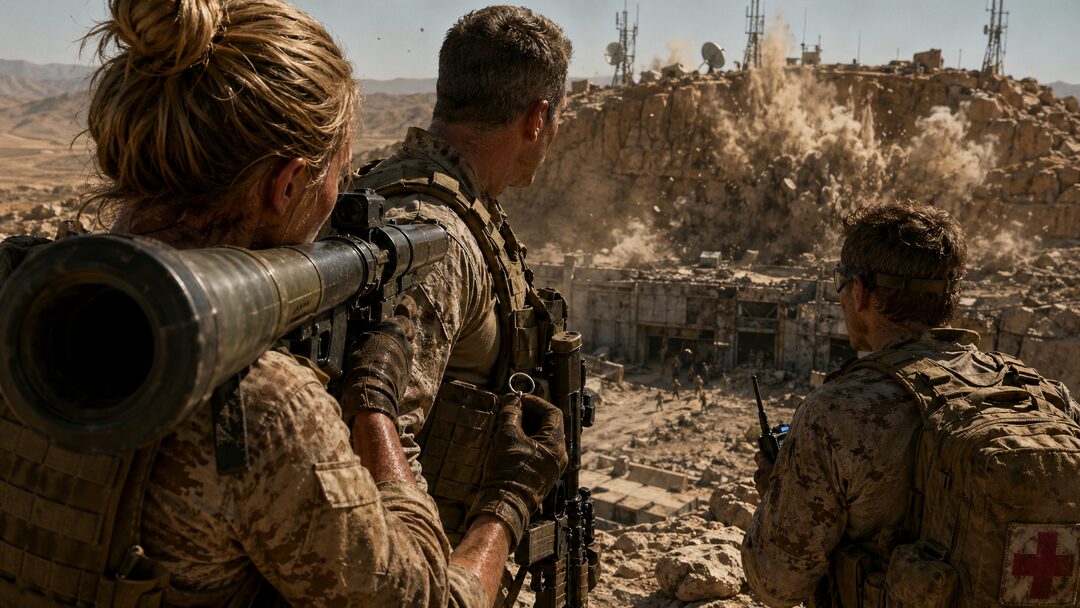
Sergeant Mara Voss had the launcher on her shoulder, the relay station in her sights, and a direct order in her ear.
“Fire.”
The desert held its breath.
Wind dragged grit across her cheek. Somewhere beyond the ridge, something heavy thudded into the earth and rolled its echo through the dry hills. The abandoned relay station sat below her in a wash of yellow dust and broken concrete, its antenna bent like a snapped bone.
Mara did not fire.
Her finger stayed outside the trigger guard.
Inside her glove, the launcher’s safety pin pressed into her palm, warm from her own hand. She had pulled it free three seconds ago. Three seconds was nothing. Three seconds was a lifetime if everyone was waiting for you to become the kind of soldier they needed.
“Voss,” Captain Rourke said over the radio, his voice flat with warning. “Execute.”
Mara kept the sight on the relay.
The station was supposed to be cold. Empty. Cleared two hours ago by drone and marked safe to strike if the Ashen Gate tried to use it again. That was what the mission card said. That was what the briefing said.
But Mara had seen movement.
Not a weapon flash. Not a fighter’s silhouette. Just a pale shape in the lower shadow of the relay’s cracked service bay. A sleeve. A hand. Something human enough to split her concentration open.
“Sergeant,” Rourke said.
Behind Mara, boots shifted in the sand.
She could feel the platoon watching her. Not looking. Watching. There was a difference. Looking was what people did when nothing had happened yet. Watching was what they did when they were waiting to see who would survive the next mistake.
“Mara,” Corporal Theo Ames whispered from somewhere behind her left shoulder. Not over the radio. His real voice. Small, tight, scared.
She swallowed dust.
“Confirm civilians clear,” she said.
The radio crackled.
“Negative delay,” Rourke snapped. “Target is active.”
“Confirm civilians clear.”
There was another impact beyond the ridge. Closer now. A brief orange pulse flashed on the far slope and vanished.
“Fire before they fire first,” Rourke said.
The phrase moved through her like an old bruise touched too hard.
Fire before they fire first.
She had heard him say it in another valley, under another sun, before a compound bloomed apart in a column of smoke and a man named Samir disappeared inside it forever.
Mara’s mouth went dry.
The relay station did not move.
The pale shape in the lower bay did not return.
“Voss,” Rourke said. “Last order.”
She lowered the launcher half an inch.
Not enough to stand down.
Enough to say no.
Part II — The Man Who Never Paused
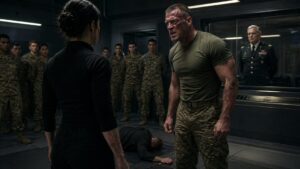
Captain Elias Rourke crossed the firing line himself.
No one spoke as he came down the slope toward her. He moved fast for a man carrying a rifle, plates, dust, and forty-one years of command worn like armor. His face was burned brown from the desert, his jaw locked so hard the muscle jumped near his ear.
Mara kept the launcher balanced across her shoulder.
Rourke stopped close enough that she could see the gray at his temples and the red dust caught in the creases beside his eyes.
Then he ripped the radio cord from her shoulder strap.
The earpiece tore loose and swung against her vest.
“What are you doing?” he shouted.
The sound hit harder without the radio. It was no longer command channel. It was public.
Every soldier behind her heard it.
Mara kept her eyes on him. “I saw movement.”
“You saw heat shimmer.”
“I saw movement in the lower bay.”
“You were ordered to fire.”
“I’m asking for confirmation.”
Rourke stepped closer. His rifle was angled down, but his grip on it was white-knuckled. “You are not asking. You are refusing.”
A line of sweat slipped down Mara’s temple and cut through the dust.
The relay station waited below them, ugly and silent. Its concrete walls were pocked by old fire. The antenna leaned toward the convoy road like it was listening.
“The convoy is six minutes out,” Rourke said. “There are wounded men in those trucks. If Ashen Gate uses that relay to coordinate the strike, they die because you needed to feel clean.”
A few feet behind Mara, metal clicked.
She did not turn.
She knew the sound.
Two rifles had come up.
Not fully. Not aimed into her spine. Not yet.
But up.
Her shoulder tightened under the launcher’s weight. The weapon seemed heavier now that everyone was afraid of it. When she had lifted it, it had been equipment. Now it was a question pointed at a valley.
“Stand down, Voss,” Rourke said. “Or I will have you secured.”
Theo moved first.
He stepped sideways, awkward under the bulk of his medical pack, and placed himself between Mara and the riflemen. He was twenty-three and narrow-shouldered, with dusty protective lenses and hands that always seemed to be checking for blood even when there was none.
“Captain,” Theo said, voice low. “She hasn’t swung on anyone.”
“Move, Ames.”
Theo did not move.
He looked sick about it. That made it braver.
Private Jalen Knox stood behind him, tall and steady, rifle raised but not locked into his shoulder. His mirrored lenses hid his eyes, but Mara knew his face well enough to read the set of his mouth.
Knox did not want to aim at her.
That did not mean he would not.
Rourke noticed him hesitate.
“Knox,” he barked. “Maintain control of the line.”
Knox’s rifle lifted one more inch.
The movement was small.
It cut Mara deeper than Rourke’s shouting.
She had eaten beside Knox. Shared bad coffee with him. Watched him tape a picture of his daughter inside his helmet before patrol because he said nobody shot straight when they remembered what home smelled like.
Now his barrel stood between obedience and friendship.
Mara lowered the launcher another fraction, enough for Theo to see her trigger hand open.
“I am not turning this weapon on anyone,” she said.
Rourke laughed once. There was no humor in it.
“No. You’re doing something worse. You’re turning doubt into policy.”
Mara’s hand tightened around the safety pin.
A hard little loop of metal.
The line between ready and irreversible.
“You told us it was cold,” she said. “Two hours ago.”
“It changed.”
“Then who confirmed the change?”
“The enemy did, when they started ranging the convoy road.”
“That’s not civilian clearance.”
Rourke’s eyes hardened.
The silence after that was too clean.
Mara heard it. Theo heard it. Knox heard it.
Even Rourke knew he had left something in the open.
Part III — The Sound Under the Static
Rourke turned his head slightly, never taking his eyes off Mara.
“The relay is being used to coordinate indirect fire,” he said. Each word was clipped, shaped for the soldiers listening. “Ashen Gate scouts are on the ridge. Convoy Phoenix has nine wounded on board and no route around. That station goes down now, or we explain to nine families why their sons and daughters burned in trucks because Sergeant Voss saw a ghost.”
Mara absorbed the hit.
A ghost.
There were ghosts in every soldier’s kit. They rode in pockets, in old phrases, in the smell of hot dust. You did not speak of them. You did not point at another person’s ghost in front of the platoon.
She almost fired because of that.
Not at the relay. Not at anything.
Just to end the shame.
That was the terrifying part. Authority did not always make you obey because it convinced you. Sometimes it made disobedience feel too humiliating to survive.
Theo’s voice came from her left, barely audible.
“Sergeant.”
Rourke snapped his attention toward him.
Theo stopped.
Mara looked at him.
Under his dusty lenses, his eyes were wide. His fingers were pressed against the side of his field receiver, the way he held it when trying to isolate a frequency.
“What?” Mara said.
Theo’s mouth opened, then closed.
Rourke took one step toward him. “Corporal.”
Theo flinched at his rank.
Mara saw the truth then. Not all of it. Enough.
“You picked something up,” she said.
“No,” Rourke said immediately.
Mara turned fully now, the launcher still resting across her shoulder but angled away from the platoon.
Theo looked at Rourke.
That was answer enough.
“What did you pick up?” Mara asked.
Theo’s voice cracked. “Weak emergency ping. Lower structure.”
The desert seemed to tilt.
Someone behind Knox muttered a curse.
Rourke moved so fast Mara almost lifted the launcher on instinct.
“I gave you an order about that signal,” he said to Theo.
Theo stared at the sand. “You said it was contamination.”
“It is contamination.”
“It repeated.”
The word landed softly.
Repeated.
Not random. Not interference. Not some ghost in the machine.
Repeated.
Mara’s stomach tightened. “When?”
Theo swallowed. “Before the fire mission came down.”
Rourke’s face changed.
Only for a second.
The rage did not leave. It narrowed. Became cleaner. More dangerous.
“You listen to me,” he said, not loudly now. That was worse. “A direct refusal in a live-fire zone is not a conversation. It is not a moral seminar. It is insubordination under hostile pressure. You want charges? You want her career dead by sundown? Keep feeding her excuses.”
Theo’s face went pale beneath the dust.
Mara wanted to tell him to step back.
She wanted to tell him he had done enough.
But he had not. Neither had she.
The relay station sat below them. Cold, they had said. Abandoned, they had said. Empty enough to destroy.
Words could kill if everyone agreed to use them quickly.
Mara looked back through the sight.
The lower service bay was a black rectangle.
Her memory supplied another doorway.
A compound wall. A courtyard. A blue scarf caught on rebar after the blast.
Samir had worn a blue scarf the last week because his youngest daughter had tied it around his neck and told him soldiers listened better to men who looked like teachers.
He had been their interpreter for three months. He knew which old men lied, which children carried messages, which widows would spit at them and still warn them about buried explosives. On the day of the strike, intelligence marked the compound hostile. Rourke gave the order. Mara was younger then. Faster.
She fired before she doubted.
Afterward, they found Samir’s notebook half-burned under a collapsed beam.
Rourke filed the report upward. Took the heat. Protected the unit. No one called Mara guilty.
That did not make her innocent.
“Sergeant,” Rourke said.
His voice was lower now.
Almost private.
“You remember Mazar?”
She did not answer.
“Good. Then remember the convoy that hesitated. Remember what was left of it.”
His brother had been in that convoy. Mara knew because everyone knew. First Lieutenant Daniel Rourke, killed in the three-minute delay between suspicious movement and confirmed threat. Elias Rourke had buried a brother and built a doctrine on the grave.
Fire before they fire first.
He was not only shouting at Mara.
He was shouting at the moment that had taken Daniel.
That made him human.
It did not make him right.
Mara’s hand ached around the safety pin.
“How many times,” she said, “do we get to call the dead necessary before we stop checking?”
Rourke’s eyes flashed.
“For the living,” he said. “As many times as it takes.”
Part IV — The Voice
The next impact landed close enough to throw sand against Mara’s boots.
Everyone ducked except Rourke.
He stood there as if refusing to flinch could make the world obey him.
Theo’s receiver chirped.
Once.
Then again.
The sound was small and obscene in all that space.
Mara’s head turned.
Theo froze with one hand against the receiver. His lips parted. Knox lowered his rifle half an inch without realizing it.
A thread of static came through.
Then a voice.
Thin. Childlike. Broken by distance and fear.
“Help. Please. We here. Please.”
No one moved.
The whole platoon seemed to become one body, one breath held too long.
The voice dissolved into static.
Mara felt something inside her settle.
Not calm.
Something colder than calm.
Confirmation was not relief. It was responsibility arriving late.
Theo stared at the receiver as if it had bitten him. “I—”
Rourke cut him off. “Recorded lure.”
The words came fast.
Too fast.
“Captain,” Knox said.
It was the first time he had spoken.
Rourke turned on him. “You have something to add, Private?”
Knox’s jaw moved once. He looked toward the relay, then at Mara, then at Theo. His rifle remained raised, but the barrel had dipped toward the sand.
“I heard a kid,” he said.
“You heard what they wanted you to hear.”
“Maybe.”
“Maybe gets people killed.”
“So does pretending maybe is nothing.”
The words surprised Mara. They seemed to surprise Knox too. His mouth closed immediately after, as if he wanted them back and was glad they were gone.
Rourke’s expression emptied.
“Enough.”
He walked toward Mara again, slower this time. Every soldier on the slope watched him come. The air around them was full of dust and judgment.
“Convoy Phoenix enters the kill box in three minutes,” he said. “The relay station is the node. Your task is to remove it. This is not complicated unless you need it to be.”
Mara shifted the launcher’s weight. Her shoulder burned. Her arms were steady anyway.
“There are people inside.”
“There may be people inside.”
“That was a child.”
“That may have been a recording.”
“Then give Theo sixty seconds to verify.”
“We do not have sixty seconds.”
“You had enough time to bury the ping.”
Rourke’s hand came up so fast Theo stepped back.
He did not strike her.
For one suspended second, Mara saw how badly he wanted to do something simpler than think.
Then he pointed past her.
“Knox. Barlow. Secure Sergeant Voss’s weapon.”
The slope changed.
Not visibly. Not dramatically.
But every person there felt the line move.
Knox did not obey immediately.
That was all the room Mara had.
Rourke’s voice sharpened. “Now.”
Theo stepped fully in front of Mara.
Not halfway. Not angled. Fully.
His medical pack made him look smaller, not larger. His hands were open. They shook.
“Captain,” he said, “I can reach the lower bay.”
“You take one step down that slope and you are disobeying a direct order.”
Theo nodded once, as if he had been expecting that and hated that it still frightened him.
“I know.”
It was not a speech.
That was why it worked.
Mara looked at the relay. The station. The ridge above it. The convoy road beyond, just visible between two cuts of rock. Dust was already rising in the distance. Phoenix was coming.
If she refused, the relay might coordinate fire.
If she fired, people in the lower bay might die.
If she waited, both could happen.
There was no clean option.
Clean was a story people told afterward so they could sleep.
Mara looked through the sight again.
Not at the relay this time.
At the ridge above it.
A shelf of brittle rock jutted over the wash, fractured from old blasts and weather. If it came down, it might block the line of sight from the upper ridge. It might throw enough dust to cover the convoy’s turn. It might also do nothing. It might trap the service bay. It might bring fire onto them.
A bad choice.
But hers.
“Mara,” Theo said, and in his voice was not a plea for caution.
It was permission to become responsible.
Rourke saw her shift.
“No,” he said.
She adjusted the launcher.
“Voss.”
She exhaled.
Rourke’s voice broke open.
“Fire before they fire first!”
Mara answered without looking at him.
“No, sir.”
Then she fired.
Part V — The Third Path
The ridge exploded.
Not like in training videos. Not clean. Not grand.
It cracked with a brutal, ugly cough that punched the air from Mara’s chest and drove heat across her face. Rock tore loose above the relay station. Dust erupted in a brown wall. Shards clattered down the slope and hit the concrete roof with sharp, panicked snaps.
For one second, nobody knew if she had saved anyone or killed everyone.
Mara dropped to one knee under the spent weight of the launcher.
Rourke was shouting, but the blast had stolen the words. His mouth moved. His face was fury, disbelief, something like fear.
Then the incoming fire changed.
The rounds that had been walking toward the convoy road struck high and blind, kicking dust along the ridge instead of the wash. Phoenix’s lead truck swerved behind the new cloud. Its outline vanished, reappeared, vanished again.
“Move!” Theo yelled.
He ran.
Not gracefully. Not heroically. He slid more than once on the loose sand, medical pack bouncing hard against his back. Two soldiers followed him after half a heartbeat of uncertainty.
Knox was one of them.
His rifle was lowered now.
Not discarded. Not forgotten. Lowered.
That was the first victory, if anything in that place could be called victory.
Mara stayed on one knee, breathing hard, the launcher hot against the ground beside her. Her right hand was still closed around the safety pin. She had forgotten it was there until the metal bit into her skin.
Rourke grabbed her vest and hauled her half upright.
“What did you do?” he snarled.
She met his eyes.
“What you ordered,” she said. “I protected the convoy.”
“You disobeyed the target.”
“I obeyed the mission.”
He looked as if the distinction hurt him physically.
Behind him, dust swallowed the relay station. Voices burst over the radio, layered and frantic. Phoenix reporting loss of visibility. Phoenix reporting minor damage. Phoenix still moving. Phoenix not hit.
Then Theo’s voice came through, breathless.
“Lower bay occupied. Repeat, lower bay occupied. I have civilians. Three alive. One child. Need stretcher.”
The desert did not become quiet.
There was still fire. Still shouting. Still the grinding noise of trucks forcing their way through the dust. Still Rourke’s hand twisted in Mara’s vest.
But something irreversible happened in the men around them.
They heard it.
They all heard it.
Three alive.
One child.
Mara looked at Rourke’s hand until he released her.
His face had not softened. Men like him did not soften in public. But something had cracked behind his eyes, and the crack was worse than anger because he could not command it away.
Knox’s voice came through next.
“Civilians moving. Relay structure damaged but standing. We’re bringing them up.”
Mara turned toward the station.
Through the dust, she saw shapes climbing the slope. Theo first, bent under the weight of a small body wrapped in his arms. Then Knox, guiding an older woman whose scarf was gray with concrete powder. Another soldier carried someone who could not walk.
The child’s face was pressed against Theo’s neck.
Alive.
Mara felt no triumph.
Triumph belonged to clean victories, to parades, to stories told after the cost had been edited out. What she felt was nausea, relief, and the terrible knowledge that if she had been slower, faster, weaker, prouder, angrier, all of them might be dead.
Rourke stepped away from her.
No order followed.
For the first time since Mara had known him, Captain Elias Rourke seemed to have reached for command and found only himself.
Part VI — What Remains in the Hand
By dusk, the aid tent glowed like a paper lantern against the desert.
The convoy survived, though one truck limped in with its side torn open and a driver bleeding from glass cuts along his jaw. Two wounded men from Phoenix were carried in cursing, which everyone took as a good sign. The civilians from the relay station lay on cots near the back: an old woman, a teenage boy with a broken wrist, and a little girl who would not let go of Theo’s sleeve.
No one called Mara a hero.
No one called her a traitor either.
That was almost worse.
Soldiers looked at her and then away. Some with gratitude. Some with fear. Some with the guarded expression of people who had watched a rule bend and were waiting to see who would be punished for noticing.
By evening, Rourke had been relieved of field command pending review.
The words came through clean and official.
Mara heard them while sitting on an ammo crate outside the tent, drinking warm water from a bottle that tasted like plastic and dust. Her hands had stopped shaking. That did not mean she was calm.
A lieutenant she barely knew had taken her statement.
Then another.
Then someone from battalion had asked where exactly she had aimed, what information she had at the time, whether she understood the order, whether she believed she had disobeyed.
“Yes,” she had said.
The officer paused.
“To which part?”
Mara looked past him toward the aid tent, where Theo sat on the ground because the little girl still had his sleeve in both fists.
“The part that matters,” she said.
Now the sun was almost gone.
The desert cooled quickly, as if all its cruelty belonged only to daylight.
Theo came out once, saw her, and stopped. There was blood on his cuff. Not much.
“You okay?” he asked.
Mara almost smiled.
It was such a medic question. Impossible and necessary.
“No,” she said.
Theo nodded. “Me neither.”
He rubbed the back of his neck and looked toward the command trucks. “They’re going to come for you.”
“They already did.”
“I mean harder.”
“I know.”
Theo shifted his weight. “I should’ve said something sooner.”
Mara looked at him then.
He seemed younger without the lenses. The fear was still there, but now it had room to become something else.
“You said it when it counted,” she told him.
He shook his head. “That’s what people say when they want to forgive the part before.”
Mara had no answer for that.
Inside the tent, the child began crying. Theo turned before the sound finished.
He gave Mara one last look, then went back in.
A few minutes later, Knox appeared from the dark with his rifle slung across his chest. His mirrored eye protection was gone. Without it, his face looked tired and ordinary and much harder to judge.
He stood beside her, not quite sitting.
“You know I wasn’t going to shoot you,” he said.
Mara stared ahead. “I didn’t know that.”
Knox absorbed it.
Then he nodded once.
“I didn’t either,” he said.
That was the closest thing to an apology he could offer without making it smaller than it was.
Mara accepted it by saying nothing.
After a while, Knox walked away.
The night settled.
Generators hummed. Radios murmured. Somewhere near the medical tent, someone laughed once, too loudly, then stopped as if remembering where they were.
Mara opened her right hand.
The safety pin lay across her palm.
A little curved piece of metal. Nothing more.
She had held it through the shouting, the blast, the first report of survivors. Its shape was pressed red into her skin. It looked too small to have mattered.
Most things that mattered did.
Boots stopped in front of her.
Mara closed her hand before looking up.
Rourke stood there without his rifle.
That was the first thing she noticed.
The second was that he looked older. Not broken. Not sorry in the way people wanted men like him to be sorry. Just stripped of the force that had made him seem larger than the rest of them.
For a moment, neither spoke.
Behind him, two officers waited near a vehicle. They were not close enough to hear. They were close enough to escort him.
“You gave your statement?” he asked.
“Yes, sir.”
The sir came out by habit. It surprised them both.
Rourke looked toward the aid tent.
The little girl’s crying had stopped.
“Convoy Phoenix made it through,” he said.
“I heard.”
“Driver may lose an eye.”
Mara looked down.
“But he’s alive,” Rourke added.
The words were not comfort. They were accounting.
She nodded.
Rourke took something from his pocket.
For one sharp second, Mara thought it was her safety pin, and her fist tightened around the one she already had.
But it was not the same one.
This pin was blackened at the edge, scratched from heat and dust. The spent pin from the launcher after the shot. Someone must have recovered it from the firing point.
Rourke held it out.
Mara did not take it at first.
His hand stayed there.
“I won’t say you were right to disobey me,” he said.
She looked up.
His face gave nothing away easily. It never had.
“But you saw it before I did.”
There were a hundred things Mara could have wanted from him.
An apology. A confession. A promise that Samir’s name would appear somewhere it mattered. A full admission that he had heard the ping and buried it under urgency. A different man standing in front of her.
She got one sentence.
It had to be enough because it was all he could afford to give and all she could afford to receive.
Mara opened her hand.
The first safety pin lay in her palm, clean and warm from her skin.
Rourke saw it.
Something passed across his face. Not surprise. Recognition.
She took the spent pin from him and placed it beside the first.
One before.
One after.
The line and the consequence.
Rourke’s hand dropped.
The officers behind him shifted.
He turned to leave, then stopped without looking back.
“For what it’s worth,” he said, “I thought pausing was how people died.”
Mara closed her fingers over both pins.
“Sometimes it’s how they live.”
Rourke stood still for a breath.
Then he walked toward the waiting vehicle.
No music rose. No one saluted. No one cheered.
The desert kept its secrets and gave back only echoes.
Mara sat outside the aid tent until the cold reached through her uniform. Inside, Theo murmured to the child in a voice too soft to carry words. Knox’s silhouette passed once beyond the generator light, rifle lowered, head bowed.
Tomorrow there would be more questions.
Tomorrow, people who had not stood on that slope would decide what her refusal meant.
But tonight, the relay survivors were breathing.
The convoy drivers were cursing.
And in Mara Voss’s closed fist, two small pieces of metal rested against the mark they had made in her skin.