He Trusted a Neighbor to Watch His Tennessee Farmstead—Then Found Strangers Paying to Sleep There
Chapter 1: The Strangers Who Had Paid for His Farm
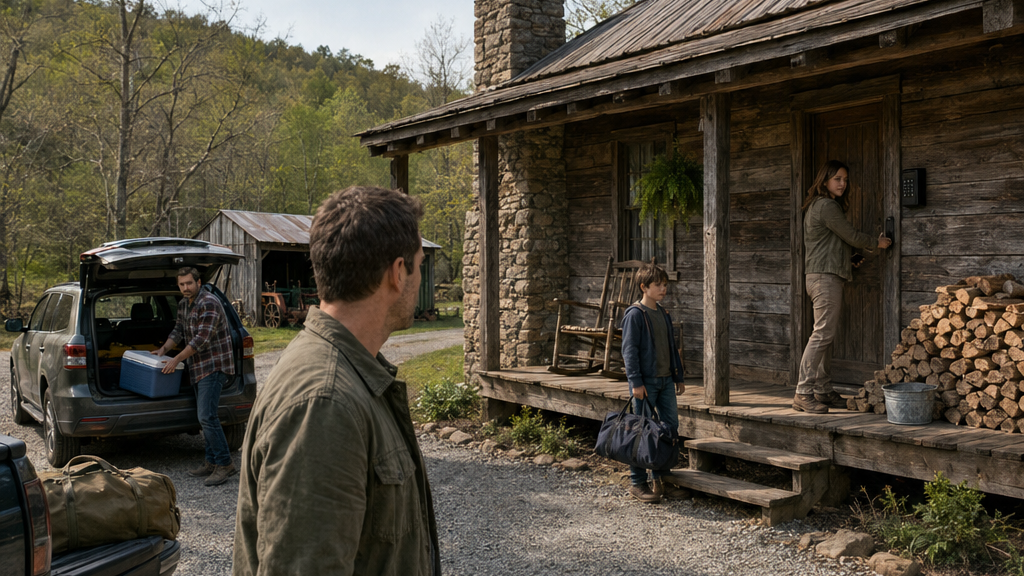
The woman at Jacob Harris’s front door was holding his spare key.
For several seconds, he simply watched her turn it in the lock.
A boy stood behind her with a duffel bag. A man was unloading two coolers from an SUV parked where Jacob usually backed his utility trailer. Another vehicle sat near the equipment shed, its rear hatch open, fishing rods angled toward the trees.
Jacob had been home from deployment for less than an hour.
He stopped halfway across the gravel yard.
“Excuse me.”
The woman looked over her shoulder but did not move away from the door.
“Can I help you?”
Jacob glanced at the brass key between her fingers. He knew the scratch across its head. He had made it years ago while forcing it through a stiff padlock.
“I was about to ask you the same thing.”
The man by the SUV straightened.
“We rented the place.”
Jacob looked at the cabin behind them—the dark logs, the broad porch, the stone chimney rising above the roofline. His cabin. His five acres. His firewood stacked beneath the lean-to.
He had imagined coming home differently.
Maybe sitting on the porch before unpacking. Maybe walking down to the creek and listening to water over the flat rocks until the last months seemed farther away.
Instead, strangers had coolers on his porch.
“Who rented it to you?”
The woman frowned as though the answer should have been obvious.
“William.”
Jacob felt something tighten behind his ribs.
“William Clark?”
“Yes.”
The man came closer, no longer friendly.
“If there’s some maintenance issue, we can call him.”
“Maintenance?”
“The instructions said the owner doesn’t live here.”
Jacob stared at him.
The sentence landed harder than an accusation.
The woman raised her phone. “We paid for three nights. We checked in exactly like the listing said.”
Jacob kept his hands at his sides.
Training had taught him how much trouble could grow from one fast reaction. He had spent months operating inside rules designed to prevent mistakes made in seconds.
That habit saved him now.
“Can I see the reservation?”
The man looked at the woman. She hesitated, then turned the phone around.
Jacob read the name at the top.
William Clark.
Below it were photographs of Jacob’s cabin.
His stone fireplace.
His porch.
His creek.
The description called the property a private mountain retreat with five wooded acres.
Jacob scrolled.
Firewood included.
Private creek access.
Parking beside the equipment shed.
Walking space along the pasture boundary.
“Don’t go through the gate near the cattle,” one instruction read. “Neighbor sometimes runs stock there.”
Jacob read that twice.
The cattle were not William’s.
The fence line was not William’s.
The pasture was Jacob’s, leased informally to the farmer next door for grazing.
The woman mistook his silence for doubt.
“See? We’re supposed to be here.”
Jacob handed the phone back.
“Would you mind showing me how you got the key?”
The woman pointed beside the front door.
Jacob had not noticed the lockbox at first.
It was black, screwed into the porch post beneath the outdoor light.
He walked toward it.
A four-digit combination opened the box. Inside hung the brass key he had given William fourteen months earlier.
For a moment Jacob was somewhere else entirely, standing beside his pickup with a deployment bag in the bed, pressing that same key into William’s palm.
Just keep an eye on things.
That had been the arrangement.
Not this.
He photographed the lockbox.
Then the vehicle plates.
Then the reservation screen, after asking permission.
The man’s expression hardened.
“I don’t understand what’s going on.”
“Neither do I yet.”
“You saying this isn’t William’s?”
“No.”
Jacob walked to his truck and opened the glove compartment.
His closing papers were still inside the document envelope he had brought home rather than leave overseas. He removed the deed copy and returned.
“My name is Jacob Harris.”
He pointed at the printed line.
“That’s me.”
Nobody spoke.
The woman slowly looked back at the cabin.
The boy stopped dragging his duffel toward the steps.
The man said, “We already paid.”
“I believe you.”
“We drove six hours.”
“I believe that too.”
The anger in Jacob’s chest was not aimed at them. That made the situation harder rather than easier.
They had done what travelers did. They had found a listing, paid through a platform, followed check-in instructions, and arrived expecting a quiet weekend.
Someone had sold them permission he did not possess.
The woman’s face changed.
“So what are we supposed to do?”
Jacob looked at the child, the coolers, the rods, the bags.
Throwing them off the property might have felt satisfying for about ten seconds.
After that, he would still have the same problem.
“What time did you check in?”
“Twenty minutes ago.”
“And you’re booked until Monday?”
“Yes.”
The man crossed his arms. “There’s supposed to be another car coming. My sister and her husband.”
Jacob closed his eyes briefly.
Another car.
More people.
He looked toward the narrow gravel lane.
“How many guests does the reservation allow?”
“Six.”
Jacob nodded once.
“Don’t unload anything else yet.”
He called William.
The phone rang until voicemail.
He called again.
Nothing.
The woman tried the number attached to her booking.
They all heard the same unanswered ringing from her speaker.
That was when Jacob understood that William already knew he was back.
He had sent William his return date weeks earlier.
The woman asked quietly, “Did he know you were coming home?”
“Yes.”
Jacob walked behind the cabin while the guests waited.
The creek ran where it always had, cold and shallow beneath sycamore shade. Somebody had arranged six plastic chairs along the bank. A metal fire ring sat near the water where Jacob had never kept one.
Empty beverage cans had been crushed into a grocery bag beside the trail.
The property looked almost right.
That was what disturbed him most.
Nothing had been stolen in the obvious sense.
The cabin was standing.
The windows were intact.
The grass had been mowed.
Someone had even restacked the firewood.
Yet Jacob had the unmistakable feeling of entering a room after strangers had searched every drawer and put everything back.
He returned to the guests.
“I’m not blaming you,” he said. “Stay here for a few minutes. I need to find out how far this goes.”
He sat in his truck and searched the property address.
The first result appeared before he finished typing.
The listing showed eighty-seven reviews.
Jacob stared at the number.
Then he found a second platform.
Same cabin.
Different photographs.
Same host.
William Clark.
And both listings were active.
Chapter 2: The Handshake That Left Too Much Unsaid
Fourteen months earlier, William Clark had leaned against Jacob’s pickup and asked a question that seemed too ordinary to remember.
“So the place is just going to sit empty?”
Jacob had been tightening a strap around two deployment bags.
“Mostly.”
William looked toward the cabin.
“Long time for a house to sit.”
“I’ll be back before it knows I’m gone.”
William gave him the half-smile he used whenever Jacob said something he considered younger-man foolishness.
“Houses know.”
Jacob laughed.
That was the problem.
He had laughed.
William had lived along that road longer than Jacob had owned the property. He knew which culvert clogged during heavy rain and which part of the gravel lane washed first. He knew the previous owner. He knew where the old spring box had been before it collapsed.
When Jacob bought the place, William had helped pull a dead oak away from the fence line without asking for anything but gas money.
Trust had accumulated through small things.
A borrowed chainsaw returned sharpened.
A gate closed after cattle slipped through.
A text after a storm saying, Roof looks good.
So when deployment orders came, Jacob did not call a property manager.
He crossed the road.
“I need somebody to keep an eye on things.”
William nodded as if Jacob had confirmed something already understood.
“Mow?”
“Enough that it doesn’t look abandoned.”
“Check pipes?”
“Sure.”
“Storm damage?”
“Call me if it’s more than you can handle.”
“What about the creek after heavy rain?”
“Just make sure nothing gets blocked.”
They settled on a monthly amount.
Not much.
Enough, Jacob thought, for two or three visits and mowing when necessary.
William mentioned propane.
Jacob told him to keep the tank from running empty.
William mentioned the shed.
Jacob said he could go inside if he needed tools for something on the property.
Then William asked, “Anybody staying here while you’re gone?”
“No.”
“Family?”
“No.”
“So it’ll just sit empty.”
Jacob remembered the exact pause now.
At the time, he had heard concern.
Sitting in a motel room fourteen months later, staring at two active rental listings, he heard possibility.
He had handed William the brass key and shaken his hand.
That was all.
No contract.
No written scope.
No list of what William could or could not do.
Jacob had always disliked making friends sign things.
It felt accusatory.
He had seen people turn simple arrangements into three pages of rules because they expected betrayal before anyone had earned distrust. He had promised himself he would not live that way.
Now he sat with his laptop open and realized there was a difference between distrust and clarity.
He had never told William he could let anyone stay.
That much was certain.
He had never authorized rental income.
He had never discussed listing platforms, guest deposits, creek access, the shed, or the pasture.
But other questions were harder.
Could William hire someone to clear a fallen tree?
Jacob had never said.
Could he buy gravel if the lane washed out?
They had not discussed it.
Could he spend his own money and seek reimbursement later?
Nothing.
Jacob had been half packed, thinking about orders, travel, equipment, family calls, and everything he needed to secure before leaving.
William had been standing there with the key.
They had trusted the gaps to take care of themselves.
His phone buzzed.
A message from the guests.
William still wasn’t responding.
Jacob had arranged temporary lodging for them after calling the platform and explaining there was an ownership dispute. He had not forced them onto the road. The decision had cost him an afternoon and perhaps weakened whatever clean satisfaction he expected from reclaiming his own cabin, but it had been the only choice that did not punish the wrong people.
Now he sat fifteen miles from home because he no longer wanted to sleep in the cabin until he knew who had been inside it.
He reopened the first listing.
Reviews went back more than a year.
“Quiet place.”
“Beautiful creek.”
“Host was helpful.”
“Loved the fireplace.”
One reviewer thanked William for bringing extra firewood.
Another mentioned seeing deer from the pasture trail.
Jacob felt his jaw tighten.
There was no pasture trail.
There was a worn maintenance strip along the fence.
His phone rang.
Brenda Harris.
He answered.
“You home?” she asked.
“Yeah.”
There was a pause.
“You sound tired.”
“I found people at the cabin.”
Another pause, longer this time.
“What kind of people?”
“Renters.”
Brenda said nothing.
Jacob sat straighter.
“Aunt Brenda.”
“I didn’t know they were renters.”
“You knew people were there?”
“I saw cars now and then.”
“How often?”
“I don’t know. I don’t drive your road every day.”
“Why didn’t you call me?”
“Because William was checking the place.”
“That doesn’t answer me.”
Her voice sharpened. “Because I figured you knew.”
Jacob closed his eyes.
There it was again.
Assumption.
Everyone seemed to have one.
He asked, “What made you think that?”
“A woman at the feed-and-hardware place months back asked me if I knew where the ‘private creek rental’ was.”
Jacob felt his hand stop moving.
“When?”
“Spring. Maybe March.”
“What did she say?”
“She was showing the clerk directions on her phone. Said there was a stone fireplace and a creek behind the cabin. I thought of your place, but there are plenty of rentals around here.”
“Did she say William’s name?”
“No.”
“Anything else?”
Brenda hesitated.
“She said the host told them they could park by an old equipment building because the main turnaround was tight.”
Jacob looked at the dark motel window.
His shed.
“Why are you telling me now?”
“Because you said renters.”
Her voice softened.
“I thought William had your permission, Jacob.”
Jacob rubbed a hand over his face.
“So did everybody else, apparently.”
“That’s not what I meant.”
“I know.”
And he did.
That was the worst part.
Nobody had needed to conspire.
William had the key.
William mowed the place.
William met repairmen.
William had been seen there for years.
To anyone watching from the road, permission would have looked natural.
Jacob thanked Brenda and ended the call.
He sat without moving.
Then he opened the listings again.
This time he stopped reading them as advertisements.
He read them as records.
Dates.
Promises.
Photos.
Access instructions.
Review histories.
The question was no longer whether William had crossed a line.
It was how many people had watched him cross it and reasonably believed the line had never existed.
Chapter 3: The Listing Promised More Than a Cabin
The review that made Jacob get out of his chair said, “Our kids loved walking the pasture path down to the creek every morning.”
There was no pasture path.
At seven the next morning, he stood beside the fence with his phone in one hand and the listing open in the other.
The photograph on the screen had been taken from near his shed.
It showed the creek beyond the lower field and a caption describing “five private acres to explore.”
Jacob lowered the phone.
The actual property looked different from the photograph only because he knew what belonged where.
The strip beside the pasture gate had been worn down by tires.
Not one vehicle.
Many.
The gravel ended in two muddy ruts that crossed the grass and curved toward the shed.
One gate hinge sagged.
The lower wire had been bent outward enough to leave a gap.
Jacob crouched and touched the post.
Fresh splintering showed pale against older wood.
He photographed it.
Then the ruts.
Then the widened parking area.
He had spent the previous night downloading every public page he could find. Screenshots covered his laptop desktop. Reviews. Host responses. Check-in instructions. Photographs of furniture he owned and views from windows only someone inside could take.
Now he was matching the digital promises to physical ground.
Firewood included.
The stack beneath the lean-to had been cut down by more than half.
Private creek area.
Six plastic chairs, one damaged.
Outdoor fire ring.
Never authorized.
Equipment-shed parking.
Fresh scrape marks along the door frame.
Jacob tried the shed padlock.
His key did not fit.
He stood very still.
Then he tried it again.
Different lock.
He photographed that too.
A vehicle slowed on the county road.
For one unreasonable second, he thought another guest was arriving.
It was the neighboring cattle farmer.
The truck stopped with the window down.
“Heard you were back.”
“Yesterday.”
The farmer glanced toward the cabin.
“Everything all right?”
Jacob considered the question.
“You ever see people down here?”
The farmer looked toward the pasture.
“Sure.”
“How many?”
“Couldn’t tell you.”
“You think they were friends of mine?”
“I figured they were William’s people.”
“Did they go inside the pasture?”
“Not among the cattle. Mostly walked that edge.”
He pointed.
“I told one group last summer to keep their dog leashed.”
Jacob looked up.
“Last summer?”
“Yeah.”
“How long has this been happening?”
The farmer’s expression changed.
“That something I shouldn’t have seen?”
“I’m figuring that out.”
The man rested an elbow on the truck window.
“William told me you were letting the place earn its keep while you were overseas.”
The phrase hit Jacob differently from the rental listings.
Earn its keep.
That sounded like William.
Not an advertisement.
A justification.
“Did he say I told him that?”
“He made it sound arranged.”
Jacob nodded.
“Thanks.”
The farmer drove on.
Jacob returned to the cabin and printed the guest instructions.
He carried them to the kitchen table along with the property survey and an old hand-drawn map he used for contractors.
The rental instructions divided the land into attractions.
Cabin.
Creek.
Firewood.
Parking.
Walking area.
Shed.
Jacob’s map divided it differently.
Residence.
Drainage.
Fence.
Pasture lease.
Equipment storage.
Septic field.
Access lane.
He laid the pages side by side.
The difference was not geography.
It was authority.
William had taken ordinary parts of Jacob’s property and renamed them as amenities.
Jacob kept reading.
One platform advertised the cabin for up to six guests. The other occasionally allowed eight with an additional fee.
Pets permitted with approval.
Creek access unrestricted.
Complimentary firewood.
“Please stay along fence line when cattle are present.”
Jacob stared at that sentence.
William had written rules governing land he did not own.
His instinct was to cross the road immediately.
He could picture William on his porch, coffee in hand, acting as if Jacob had misunderstood something obvious.
Jacob wanted that confrontation.
Instead, he heard his own voice from years of military briefings: establish what happened before deciding what it means.
He made another folder.
Screenshots.
Dates.
Guest claims.
Physical damage.
He called both platforms and opened ownership disputes.
Neither representative could provide full booking records immediately, but one confirmed future reservations existed.
“How many?”
“I’m not able to disclose complete account information until ownership is verified.”
“Are people scheduled to arrive this week?”
A pause.
“Yes.”
Jacob gripped the phone.
“How many reservations?”
“I can confirm multiple upcoming stays.”
The word multiple transformed the situation again.
These were not remnants of something William had already stopped.
The operation was still moving toward Jacob.
Reservation by reservation.
Car by car.
He submitted the deed, identification, utility statement, and property tax information the platform requested.
Then Brenda arrived carrying coffee and an expression that said she had spent the night feeling guilty.
“You didn’t cause this,” Jacob told her before she could speak.
“I could’ve called.”
“So could I.”
“You were deployed.”
“I had a phone.”
She looked at the printed pages covering the table.
“What is all this?”
Jacob handed her the guest instructions.
She read quietly.
Her finger stopped.
“Pasture walking?”
“Apparently.”
“He doesn’t own that.”
“I know.”
“William knows that.”
“I know.”
That mattered.
The first ambiguities Jacob could blame partly on himself.
He had not written down maintenance limits.
He had not specified emergency spending.
But William knew where his own property ended.
He knew Jacob leased the pasture edge.
He knew the equipment shed held Jacob’s tools.
There was no reasonable misunderstanding that transformed those places into amenities.
Brenda set the paper down.
“You talked to him?”
“Not yet.”
She seemed surprised.
“I’m trying not to do this backward.”
Jacob showed her the review dates.
Most were spread steadily across fourteen months.
Then he noticed something he had missed the night before.
The host profile showed recent activity.
He clicked one listing.
Updated four days ago.
Jacob stared at the date.
Four days.
He opened the messages on his phone.
Three weeks earlier he had texted William:
Landing on the 18th. Should be back at the place by afternoon.
William had replied:
Good. I’ll make sure everything’s ready.
Jacob placed the phone beside the listing.
Brenda read both.
Neither spoke.
Until that moment, Jacob had been trying to determine whether William had drifted across a boundary slowly enough to convince himself it was legitimate.
But four days before Jacob’s scheduled return, William had still been updating the rental.
He had known the owner was coming home.
And he had kept taking bookings anyway.
Chapter 4: William Called Forty Thousand Dollars Maintenance
“You came back to a place that was still standing.”
William Clark said it before Jacob could accuse him of anything.
He was sitting on his porch with a coffee mug beside one boot and a folder on the chair next to him, as if he had known exactly when Jacob would cross the road.
Jacob stopped at the bottom step.
“That your answer?”
“It’s a fact.”
“To what?”
William looked toward Jacob’s property through the trees.
“To whatever you came over here wanting to say.”
Jacob had rehearsed half a dozen openings during the walk. None survived that sentence.
“You rented my cabin.”
William nodded once.
No denial.
No surprise.
No demand to know what Jacob was talking about.
“You listed it on two platforms.”
“Yes.”
“You took money from people to stay there.”
“Yes.”
“You gave them access to my creek, my shed, my pasture edge.”
William’s jaw moved slightly.
“I told them where they could and couldn’t go.”
“That wasn’t your decision.”
“Somebody had to make decisions.”
Jacob climbed one step.
“You knew I was coming home.”
“I did.”
“And four days before I got back, you updated one of the listings.”
William reached for his coffee but did not drink.
“You want to talk about four days, or fourteen months?”
Jacob stared at him.
“Fourteen months sounds worse for you.”
“Maybe.”
William pushed the folder toward the edge of the empty chair.
“Open that.”
“I didn’t come for paperwork.”
“You ought to.”
Jacob almost turned away.
Then he remembered the altered shed lock, the damaged gate, the reviews, the wording William had used with the cattle farmer: letting the place earn its keep.
He picked up the folder.
The first receipt was from a plumbing company.
A winter service call.
Emergency labor.
Replacement pipe.
The total was high enough to make Jacob read it twice.
The next receipt was for gravel.
Then propane.
Then chainsaw fuel and hauling.
A handwritten invoice for storm cleanup.
A hardware-store receipt for fittings, insulation, and a replacement exterior faucet.
Jacob looked up.
“What is this?”
“What you didn’t see.”
“You had my number.”
“I used it.”
Jacob shook his head.
“You never told me you were renting the place.”
“That’s not what I said.”
“What did you say?”
“That I used your number.”
William leaned back.
“January freeze. Pipe split behind the kitchen wall. I called twice. You sent a message three days later saying, ‘Handle whatever needs handling.’ So I handled it.”
Jacob remembered the exchange vaguely.
Different time zone. Long day. A message read between tasks.
Handle whatever needs handling.
He had meant repair the pipe.
William had apparently heard something wider.
“That didn’t mean open a business.”
“No. It meant I paid the plumber.”
“Then you send me the bill.”
“I did.”
Jacob frowned.
William opened the folder to a printed email.
Jacob recognized the subject line.
Farm expenses.
He remembered seeing it.
He had skimmed it, intended to return to it, then forgotten.
There were three follow-up messages beneath it.
Jacob felt heat rise in his face, but not the clean kind of anger he wanted.
“You could’ve waited.”
“The water couldn’t.”
“I’m talking about reimbursement.”
“So am I.”
William’s voice stayed level.
“The storm took two trees across your lane. I cleared them. The ditch washed out. I brought gravel. Propane dropped low. I paid it. Your shed roof peeled loose on the back corner. I fixed it before another rain came.”
“You were being paid every month.”
“For checking the place.”
“That included maintenance.”
“It included mowing, walking through, checking pipes. You know what you paid me.”
Jacob did.
It had seemed fair when he left.
William tapped the folder.
“That wasn’t contractor money.”
“So you decided to charge guests instead.”
“I decided the place could cover what it was costing.”
Jacob laughed once, without humor.
“You made forty thousand dollars.”
“Gross.”
The word stopped him.
William looked directly at him.
“You keep saying forty thousand like I put forty thousand in a coffee can.”
“You didn’t have the right to put one dollar in a coffee can.”
“Maybe not.”
“Maybe?”
William stood.
He was shorter than Jacob remembered, or maybe age had settled into his shoulders while Jacob had been gone.
“I’m not saying I did everything right.”
“You listed property you don’t own.”
“And kept it from falling apart while you were gone.”
“Those are two different things.”
“They didn’t feel different from here.”
Jacob stared at him.
There it was.
Not innocence.
Not exactly.
Something more dangerous because William believed it.
“You think fixing a pipe made you the owner?”
“No.”
“You think buying gravel made you the owner?”
“No.”
“Then why did you make rules for my pasture?”
William’s expression tightened.
“Because guests were already there.”
“You put them there.”
“I know.”
“Why?”
William looked past Jacob toward the road.
For the first time, the calm dropped slightly.
“My contracting work dried up last winter.”
Jacob said nothing.
“Then the freeze hit. Then another repair. Then your monthly payment didn’t cover half the time I was putting in.”
“You could have told me.”
“I tried.”
“You could have stopped.”
William gave a tired smile.
“That part’s true.”
It was not the answer Jacob expected.
William picked up the brass key from a small table beside the porch door.
Jacob recognized it immediately.
The scratch across the head.
William placed it on the railing between them.
“You handed me that and said keep the place right.”
“I said keep an eye on it.”
“You said both things, different days.”
“Neither one means rent it.”
“No.”
Again, William did not fight the obvious point.
That made Jacob angrier than denial would have.
“Then say it.”
“Say what?”
“That you had no permission.”
William’s face closed.
“I had responsibility.”
“That is not the same thing.”
“It felt like it when the pipes froze and you were seven time zones away.”
Jacob reached for the key.
William did not stop him.
The metal was warm from the sun.
For fourteen months, Jacob had imagined that key resting on a hook in William’s kitchen, used only when a storm came through or the grass needed cutting.
Now he wondered how many hands had touched duplicates.
“How many keys?”
William’s eyes shifted.
Jacob saw it.
“How many?”
“I had copies made.”
“How many?”
“Three.”
Jacob closed his fingers around the brass key.
“Where are they?”
“One’s in the lockbox.”
“I found that.”
“One was for cleaning.”
“Who has it?”
“No one now.”
“And the third?”
William hesitated.
“For backup.”
“Where?”
“In my truck.”
“I want all of them.”
“You’ll get them.”
“Today.”
William’s mouth tightened.
“You came over here wanting a confession. I’m giving you facts.”
“I’m asking for my keys.”
“And I’m telling you there’s still money tied up in bookings.”
Jacob went still.
“What bookings?”
William looked down at the folder.
“Reservations already made.”
“I know there are future stays.”
“More than a few.”
“How far out?”
William did not answer quickly enough.
Jacob stepped closer.
“How far?”
“Six weeks.”
Jacob stared at him.
“Six weeks after I came home?”
“They were booked before.”
“You updated the listing four days before I landed.”
“That wasn’t a new reservation.”
“What was it?”
“A calendar change.”
Jacob shook his head.
“Listen to yourself.”
“I am.”
“No, you’re explaining around the part that matters.”
William’s voice rose for the first time.
“And you’re pretending the place took care of itself.”
Silence fell between them.
A truck passed on the road without slowing.
William’s breathing settled first.
“So what happens now?”
Jacob looked at the folder in his hand, then at the key.
He wanted one clean answer.
One clean villain.
Instead, he had real receipts, missed messages, legitimate repairs, unauthorized guests, altered locks, and six more weeks of strangers who believed they had already purchased access.
“I don’t know yet.”
William nodded.
“That’s the first honest thing either of us has said today.”
Jacob turned toward the steps.
Behind him, William spoke again.
“You cancel those bookings, some of those deposits have to go back.”
Jacob looked over his shoulder.
“Then give them back.”
William did not move.
And in that pause, Jacob understood there was still money William either could not return or would not.
Chapter 5: Taking Back the Land Without Becoming Reckless
“Do not cut that lockbox off.”
Jacob had bolt cutters in his hand when Amy Miller said it.
He was standing on the cabin porch, phone wedged between his shoulder and ear, staring at the black metal box screwed into his own post.
“I own the post.”
“I’m aware.”
“I own the box if it’s attached to my post.”
“Maybe. Don’t make me argue property-law philosophy before coffee.”
Jacob lowered the cutters.
“You told me to secure the place.”
“I told you to stop unauthorized access. I did not tell you to destroy something that may show how guests were given access.”
“It’s a lockbox.”
“It’s a lockbox containing your original key after someone used it for fourteen months of bookings. Photograph it. Record the combination if you have it. Preserve it.”
Jacob looked at the brass key resting on the porch table.
William had returned the other two copies the night before, one in an envelope and one loose.
Jacob had no way to know whether more existed.
“So I leave it there?”
“For now.”
“And if somebody shows up?”
“You call the platforms. You tell them ownership is disputed and the listing is unauthorized. You do not personally improvise a hotel policy in your driveway.”
“I already did that once.”
“I know. That’s why we’re speaking.”
Amy had been recommended by the county clerk after Jacob spent half a morning being redirected between offices.
He had expected someone aggressive.
Instead, she spoke like a person trimming rotten boards from a structure before deciding what could still carry weight.
By afternoon she was at the cabin table with his screenshots arranged in stacks.
“Your problem,” she said, “is that you have three problems.”
“Only three?”
“Access, money, and physical damage.”
Jacob sat opposite her.
“And trust.”
“That one is outside my hourly rate.”
He almost smiled.
Amy turned a laptop toward him.
“Both platforms have suspended the public listings pending verification.”
Jacob stared at the screen.
The pages that had appeared so easily three days earlier now showed unavailable.
A small relief moved through him.
“So it’s done.”
“No.”
The relief disappeared.
“Existing reservations are separate.”
“How many?”
“We’re still waiting on complete records, but enough to matter.”
Jacob leaned back.
Amy slid a page toward him.
“Also, gross revenue is not the same as what William kept.”
“I know.”
“Do you?”
He looked at her.
She tapped the page.
“Platform fees. Cleaning. Taxes, depending on how these were handled. Repairs. Guest refunds. We need records.”
“He had no permission.”
“I agree that is the central issue.”
“Then why are we treating his expenses like they excuse anything?”
“We’re not.”
Her tone stayed even.
“We’re separating what you can prove from what you feel.”
Jacob looked away.
Outside, the pasture gate still leaned slightly from the damaged hinge.
He had spent days documenting things he wanted to fix immediately.
The changed shed lock.
The ruts.
Trash near the creek.
A scorched patch around the unauthorized fire ring.
Every time he stopped himself, he felt as if William still controlled the property by forcing him to preserve the evidence of its misuse.
Amy said, “How much do you think he owes you?”
“Forty thousand.”
“Why?”
“Because that’s what the rentals made.”
“That’s what the public figures suggest they grossed.”
“He used my land.”
“Yes.”
“My cabin.”
“Yes.”
“My utilities.”
“Yes.”
“My furniture. My firewood.”
“Yes.”
Jacob stopped.
Amy waited.
He understood what she was doing.
“What number do you think?”
“I don’t know yet.”
“That’s convenient.”
“No. It’s professional.”
She gathered the receipts William had shown Jacob.
“These appear real.”
“Some of them.”
“We verify all of them.”
Jacob picked up the plumbing invoice.
It still bothered him more than the false listing.
The listing proved William had crossed the line.
The invoice proved Jacob had left a gap before he did.
Amy pointed at a timestamped email.
“You received this.”
“I saw it late.”
“You replied, ‘Handle whatever needs handling.’”
“I meant the pipe.”
“I believe you.”
“Would a judge?”
“A judge might believe you meant the pipe and still ask why you never clarified reimbursement afterward.”
Jacob pushed the paper away.
“I was deployed.”
“And William knew that. That matters too.”
His phone rang.
A platform representative.
Jacob put it on speaker.
Ownership verification had been accepted.
The listing would remain suspended.
Future reservations were being contacted.
Then the representative said, “We have also received a preservation request for host account records.”
Jacob looked at Amy.
She nodded.
“What can you tell us now?” she asked.
The representative could not provide full account data yet, but confirmed bookings dating back roughly fourteen months.
Repeat guests.
Multiple future stays.
And activity after William had been notified of Jacob’s return date.
Jacob’s hand tightened around the edge of the table.
“How recent?”
The representative gave dates.
One reservation had been accepted nine days before Jacob came home.
Another five days before.
William had not merely failed to shut down an old arrangement.
He had kept feeding it.
Amy wrote the dates carefully.
“That matters,” she said after the call.
Jacob stood.
“I’m going across the road.”
“No.”
“He knew.”
“We already knew he knew.”
“He took another reservation five days before I got back.”
“And if you go over there furious, what do you gain?”
“Maybe my money.”
Amy looked at him.
“Is that what you think is sitting in his house?”
The question stopped him.
Jacob remembered William’s hesitation about deposits.
“You think it’s gone.”
“I think we don’t know.”
That phrase again.
We don’t know.
Jacob hated it.
He had spent his adult life working inside systems where uncertainty was something to reduce.
Here, every answer created another category.
Authorized maintenance.
Unauthorized lodging.
Legitimate costs.
Questionable costs.
Damage.
Deposits.
Revenue.
Refunds.
Amy closed the folder.
“File the complaint. Preserve the records. Let the platforms unwind the reservations. Give William written notice that no one has permission to enter or use the property.”
“You want me to send my neighbor a letter telling him he can’t enter my land.”
“Yes.”
Jacob let out a humorless breath.
“That’s exactly the kind of thing I always thought was ridiculous.”
“How’s the handshake working out?”
He looked at her.
She did not soften it.
The next morning, Jacob delivered the written notice.
He did not cross William’s porch.
He left it where the process server later confirmed delivery.
By the end of the week, both listings were suspended and guests had stopped appearing at the lane.
For the first time since Jacob returned, no strange vehicle sat beside the shed.
He changed the shed lock after Amy cleared it.
He repaired the gate temporarily.
Brenda helped haul trash from the creek bank.
It looked, briefly, like control returning.
Then William sent a written response.
He would surrender any remaining access materials and cooperate with future reservation refunds, but only after Jacob reimbursed him for outstanding maintenance expenses and deposits William claimed to have advanced from his own funds.
Amy read the letter twice.
“There’s something else.”
She opened the spreadsheet they had started from William’s receipts.
The total at the bottom was far larger than Jacob expected.
Not forty thousand.
But not trivial.
Plumbing.
Storm cleanup.
Gravel.
Propane.
Roof repair.
Tree removal.
Emergency labor.
Some charges were questionable.
Several were not.
Amy turned the screen toward him.
“If even half of this verifies, your clean forty-thousand-dollar claim gets complicated.”
Jacob looked at the number.
For the first time, he wondered whether winning the dispute required him to give up the version of it that felt best.
Chapter 6: The Accounting Neither Man Wanted to See
The first accounting sheet made Jacob angry because it was fair.
He sat across from Amy in her office, staring at columns that refused to arrange themselves into victim and thief.
Gross rental revenue.
Platform deductions.
Cleaning expenses.
Refunded stays.
Verified property repairs.
Unverified expenses.
Physical damage.
Utility use.
Caretaker payments Jacob had already made.
The numbers did not absolve William.
They did something more uncomfortable.
They made him specific.
“So this is what you think I should ask for?”
Jacob tapped the bottom line.
Amy shook her head.
“This is where the evidence currently points.”
“It’s less than I expected.”
“It’s more defensible than what you expected.”
“He made money from my property.”
“Yes.”
“Without permission.”
“Yes.”
“Then why am I crediting him for anything?”
“Because some of those repairs preserved your property.”
“I never approved them.”
“You approved some in broad terms. Others appear genuinely urgent.”
Jacob stood and walked to the window.
Several weeks had passed since the listings came down.
The cabin was quiet again.
The quiet should have felt like victory.
Instead, the dispute had moved into paper.
Amy said, “If you want to argue that every dollar William spent was worthless because he later acted without authority, you can.”
Jacob turned.
“You think I’ll lose.”
“I think you’ll become less credible.”
That was worse.
She closed the spreadsheet.
“The strongest case is also the least emotionally satisfying one.”
A farm inspection two days later sharpened the distinction.
The damaged pasture gate was real.
So were the vehicle ruts.
The changed shed lock had been unnecessary.
The creek bank needed cleanup.
But the roof repair William claimed was visible from the ground, and the replacement flashing was correctly installed.
The gravel on the washed section of lane was new.
The plumbing work existed.
So did insulation added after the freeze.
Jacob stood inside the cabin while the inspector photographed the repaired wall.
William had protected the place.
William had exploited it.
Both statements remained true.
At mediation, William arrived carrying the same folder he had brought to his porch.
He looked older under fluorescent lights.
For twenty minutes, he answered questions about receipts and dates.
Then Amy asked when the first paying guest stayed.
William stared at his hands.
“February.”
“After the pipe repair?”
“Yes.”
“Whose idea was it?”
“Mine.”
Jacob looked up.
Amy did not react.
“Did Jacob authorize it?”
William’s answer came slowly.
“No.”
The room seemed to contract.
For weeks, William had talked about responsibility, maintenance, unanswered messages, and what the property needed.
Now there was no ambiguity.
Amy asked, “Why did you do it?”
William rubbed his thumb along the folder edge.
“I was behind.”
“On what?”
“Everything.”
He glanced at Jacob once.
“Contracting jobs had dropped off. I had paid the plumber. Bought material. Had a heating bill of my own I wasn’t keeping up with.”
“So you rented the cabin?”
“One weekend.”
Jacob said, “And forgot to mention it?”
William looked at him.
“No.”
The plainness of the answer hurt more than defensiveness.
“You knew I wouldn’t agree.”
“Yes.”
“Then why keep going?”
William’s face tightened.
“The first people left the place cleaner than they found it.”
Jacob almost laughed.
William continued.
“They paid. Nothing broke. I replaced what I’d spent. Then another request came.”
“You listed it.”
“After the second stay.”
“So this whole thing about misunderstanding what I meant—”
“I misunderstood plenty.”
William’s voice rose, then settled.
“But not that.”
Silence.
There it was—the surprise Jacob had both wanted and feared.
No contract language could erase it.
No missed email had caused the first rental.
William had known.
He had simply decided the line could be crossed once.
Amy asked, “When did it become regular?”
William leaned back.
“Summer.”
“Why?”
“Because it worked.”
The answer was almost quiet.
“I’d fix something at Jacob’s place, pay for it, rent the cabin, get the money back. Then I stopped separating it.”
“Meaning?”
William looked toward Jacob.
“The place needed things. I needed things. Money came in. I told myself it was all part of keeping it going.”
Jacob said, “You were paying your own bills.”
“Some.”
“With my cabin.”
“Yes.”
“And you kept charging me the caretaker payment.”
William’s mouth hardened.
“I did the caretaker work.”
Jacob started to respond, but Amy lifted one hand.
William continued.
“You want me to say I planned to steal from you. I didn’t.”
“I didn’t say steal.”
“You’ve thought it.”
Jacob said nothing.
“I thought you’d come home to a better place than you left. Road fixed. Roof fixed. Pipes fixed. Brush cleared.”
“And strangers in my bed.”
William looked down.
“Yes.”
The word sat between them.
Later, during a break, Jacob walked outside.
William followed after a minute but stayed several feet away.
“You remember when I gave you the key?” Jacob asked.
“Yes.”
“What did you think it meant?”
“At first?”
Jacob turned.
William put his hands in his coat pockets.
“That you trusted me.”
“And later?”
William took time answering.
“That you weren’t here.”
Jacob felt something inside him settle—not soften, exactly, but become clear.
Access had changed meaning because no one had stopped it from changing.
William said, “Every time I used it and nothing happened, the next thing seemed smaller.”
“The first rental wasn’t small.”
“It felt small when it was one weekend.”
“That’s how you got to fourteen months?”
William nodded.
It was the first time Jacob believed he was hearing the full explanation.
Not justification.
Explanation.
Back inside, Amy proposed a settlement based on verified expenses credited against unauthorized net proceeds, plus specific physical damages.
William read it.
His face changed before he reached the bottom.
“This says I acknowledge I had no authority to rent the property.”
“Yes,” Amy said.
“I won’t sign that.”
Jacob stared at him.
“You just admitted it.”
“I said Jacob didn’t approve it.”
“That’s the same thing.”
William shook his head.
“No. I was responsible for the place.”
“You were responsible for taking care of it.”
William pushed the paper back.
“That’s what I did.”
“And you still need that to mean more than it meant.”
William looked at him.
For a second, Jacob saw the thing underneath the money.
Pride.
Not the loud kind.
The kind built from years of being the person neighbors called when a tree fell, a pipe froze, a tractor would not start.
To sign the settlement, William would have to admit that all his labor had never given him the authority he had begun to feel.
He stood.
“I won’t sign it.”
Amy said, “Then the next step is court.”
William picked up his folder.
“That’s your choice.”
“No,” Jacob said.
William stopped.
Jacob looked at the settlement figure one last time.
Weeks earlier he would have inflated the demand if he thought he could.
Now he understood that accuracy mattered more than anger.
“You made the first choice when you rented it without asking.”
William said nothing.
Jacob slid the unsigned agreement back to Amy.
“File it.”
William left without looking at him again.
Jacob watched the door close.
The old handshake was gone now whether the court gave him a dollar or forty thousand.
What remained was the question he had avoided from the beginning: whether a clear boundary could arrive late enough to matter.
Chapter 7: The Judgment Returned Control, Not the Old Trust
William was already sitting in the courtroom when Jacob arrived.
For months, Jacob had assumed he would stay away.
William had ignored the last settlement offer. He had accepted service without comment. He had not called, written, or crossed the road since the mediation ended. Even Brenda had stopped mentioning whether she had seen his truck.
Yet there he was in the second row, wearing a clean button-down shirt instead of his usual work clothes, the familiar receipt folder resting across his knees.
Jacob stopped just inside the door.
William looked up.
Neither man nodded.
Amy touched Jacob’s elbow.
“Come on.”
The hearing itself was smaller than the conflict had become in Jacob’s mind.
No crowded gallery.
No dramatic confrontation.
Just a clerk, the judge, Amy, William, and stacks of paper that reduced fourteen months of resentment to dates, expenses, bookings, repairs, and permissions.
The platform records had finally arrived in full.
Gross revenue was close to forty thousand dollars.
Not exactly.
Close enough that Jacob remembered standing on William’s porch and throwing the number like an accusation.
But the accounting also showed platform fees, cleaning charges, refunded reservations, and expenses that never passed through William’s hands as usable income.
Then there were the repairs.
The plumbing invoice had verified.
So had the roof work.
So had most of the gravel, propane, storm cleanup, and materials.
Some claimed expenses had been rejected because William could not document them. Others had been reduced.
The damaged gate, creek cleanup, shed lock, and property restoration were listed separately.
Nothing looked simple anymore.
The judge asked William whether he disputed that Jacob owned the property.
“No, sir.”
Whether Jacob had authorized short-term rentals.
William hesitated.
“No, sir.”
Jacob felt Amy glance at him.
The answer was clear.
Still, the judge continued.
“Then explain why you believed you had authority to accept paying guests.”
William looked down at his folder.
For several seconds, all Jacob could hear was paper shifting somewhere behind them.
“I didn’t believe he had specifically given me permission.”
The judge waited.
William lifted his head.
“I believed I had responsibility for the property.”
“That was not my question.”
“I know.”
His hands tightened around the folder.
“The first time, I knew he wouldn’t have agreed if I’d called and asked.”
Jacob had heard the admission at mediation.
It still landed differently in court.
William continued.
“There had been a freeze. I’d spent money. Work was slow. Somebody I knew needed a place for a weekend. I told myself one stay wouldn’t hurt anything.”
“And after that?”
“They paid. Nothing went wrong.”
William swallowed.
“Then another request came. And another.”
The judge asked, “At what point did you believe Mr. Harris had authorized this?”
William looked toward Jacob.
“I didn’t.”
The room seemed to become very still.
“I convinced myself I didn’t need to ask anymore.”
Jacob felt something in him loosen.
Not because William had finally lost.
Because William had finally stopped trying to turn responsibility into permission.
William looked back at the judge.
“I was taking care of the place. I was fixing things. I was there when he wasn’t. After a while, I started thinking the work counted for more than it did.”
The judge said, “And the income?”
“Some went back into the property.”
“Some?”
“Yes, sir.”
“And the rest?”
William’s voice lowered.
“My own bills.”
There it was.
No elaborate defense.
No claim that every dollar had been noble.
Jacob looked at the brass key on the table in front of him.
Amy had suggested he bring it because the lockbox photographs and access records referenced it repeatedly.
The scratched head caught the courtroom light.
When Jacob had first given William that key, it had meant one sentence he had never needed to say aloud:
I trust you when I am not here.
The meaning had changed because neither man had protected its limits.
When it was Jacob’s turn to speak, Amy kept the questions narrow.
Did he authorize rentals?
“No.”
Did he authorize William to advertise five private acres?
“No.”
Creek access for paying guests?
“No.”
Shed parking?
“No.”
Pasture-edge recreation?
“No.”
Had William performed legitimate maintenance?
Jacob paused.
“Yes.”
Across the aisle, William raised his eyes.
Amy asked, “Do you believe he should receive credit for documented work that preserved your property?”
A few months earlier, Jacob would have hated the question.
Now he answered without forcing it.
“Yes.”
“Why?”
“Because it happened.”
Amy waited.
Jacob added, “The work was real even though the rentals weren’t authorized.”
William looked away.
The judge studied Jacob.
“And if the court credits those expenses, you understand the award may be lower than the full gross rental revenue?”
“Yes, sir.”
“You’re asking for an accounting rather than the gross amount?”
“Yes.”
The judge made a note.
Jacob could have stopped there.
Instead, he looked at William.
“I should’ve answered the repair messages better.”
Amy did not interrupt.
Jacob continued.
“I should’ve written down what I expected before I left. I thought putting rules on a handshake meant I didn’t trust somebody.”
William’s expression changed slightly.
Jacob turned back toward the judge.
“But I never gave permission to rent the property. Not saying enough doesn’t mean somebody else gets to decide everything.”
The judgment came after a recess.
The court credited William for verified emergency repairs and necessary maintenance beyond the caretaker payments Jacob had already made.
It rejected his argument that those expenses created any right to commercial use.
Jacob was awarded the remaining unauthorized rental proceeds supported by the records, plus specific amounts for physical damage and restoration.
Less than forty thousand.
More than William could pay immediately.
The judge approved an enforceable payment arrangement and judgment rather than pretending a piece of paper could produce money that did not exist.
Jacob listened without satisfaction rising in him the way he once expected it would.
Control had been returned.
The math had been settled.
The old relationship had not.
Outside the courthouse, William caught up with him near the steps.
“Amy got the figures right,” he said.
Jacob turned.
“That’s why I used them.”
William nodded.
He looked tired rather than defeated.
“I did save that roof.”
“I know.”
“And you were right about the rest.”
Jacob said nothing.
William rubbed his thumb over his palm, the same gesture he used when thinking through a repair.
“I kept telling myself you’d see everything I’d done and understand.”
“I do understand some of it.”
“That’s not the same as saying it was okay.”
“No.”
William gave a small nod.
“No. It isn’t.”
They stood there another moment.
Then William walked toward his truck.
He did not offer a handshake.
Jacob was grateful for that.
Weeks later, Brenda held the new porch light while Jacob removed the lockbox.
The screws had bitten deep into the old post. When the box finally came free, it left four dark holes in the wood.
“You replacing the post?” Brenda asked.
“No.”
“You’ll see the holes.”
“That’s all right.”
He filled them instead.
Inside the cabin, the locks had already been changed. The shed had a new padlock. The pasture gate had been repaired. Future access instructions for anyone working the property now existed on a single typed page.
What to inspect.
What could be spent in an emergency.
Who to call.
What required permission first.
Jacob had once thought such a page would make a relationship feel cold.
Now it looked like care.
He picked up the original brass key from the kitchen counter.
He had considered throwing it away.
Instead, he slipped it onto his own key ring.
Then he locked the cabin and tested the door once.
The creek was running high from rain two days earlier.
Jacob walked down the familiar path until the cabin disappeared behind the trees.
The plastic guest chairs were gone. The fire ring had been removed. The bank was clear except for leaves and smooth stones darkened by water.
He stood there listening.
The creek sounded exactly as it had before he left.
That did not mean nothing had changed.
It meant some things could remain themselves even after people had mistaken access for ownership, labor for authority, and trust for permission.
Jacob closed his hand around the key in his pocket.
Then he let it go and walked farther down the bank.
The story has ended.