The Purple Lunchbox
Part I — The Child in the Tiara
The old man had learned how to make himself invisible.
He sat in the hollow of the bakery window where the wind hit less sharply, his back against the brick, his coat buttoned wrong because one of the buttons had long since come off. Morning traffic moved around him in practiced arcs. Shoes clicked. Coffee cups steamed. A stroller rolled past. A man in a navy overcoat glanced down, then away, already reaching for his phone. No one was cruel. That was almost worse. They were simply skilled at not seeing.
Walter kept his eyes on the sidewalk.
The bakery behind him had just opened, and the smell of warm bread drifted through the cracked door each time someone stepped inside. Butter. Sugar. Coffee. It was the kind of smell that didn’t just remind you that you were hungry. It reminded you that somewhere, other people had kitchens and tables and ordinary mornings. Somewhere, people sat down without counting coins in their pockets first.
He flexed his hands inside his sleeves and tried not to think about food.
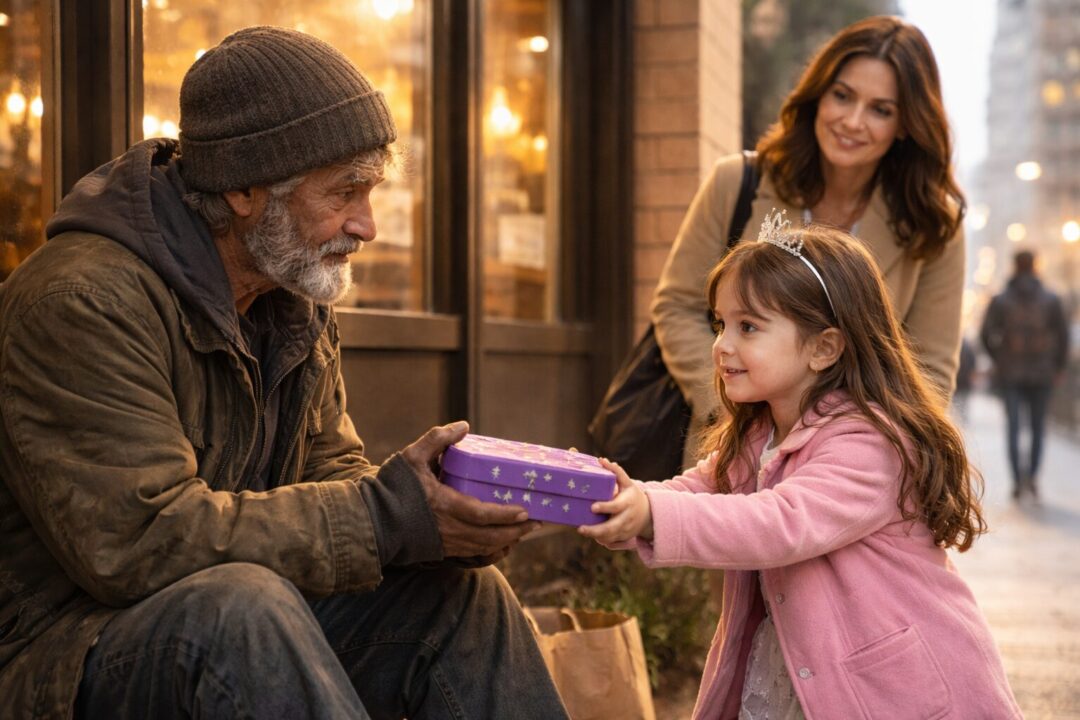
That was when a pair of bright pink shoes stopped directly in front of him.
Walter looked up slowly, expecting a parent to tug a child away, or an awkward apology, or the kind of curious stare children gave when they had not yet been taught how to look past suffering. Instead he found himself staring at a little girl dressed as if she had stepped out of another world entirely.
She wore a pale pink coat over a fluffy dress, and on her dark hair sat a tiny silver tiara that glittered when it caught the weak winter light. In both hands she held a small purple lunchbox decorated with fading stars. Everything about her looked soft, cared for, protected. She looked like the child version of a promise the world made to itself: that some people would be kept safe from ugliness for as long as possible.
Yet here she was, standing inches away from it.
Behind her, a woman in a beige coat paused with one hand on a black handbag. She was young enough to be the girl’s mother and tired enough to confirm it. She had the attentive stillness of someone who had learned that children were always about to do something unexpected. Her face held caution, but not alarm.
The girl looked at Walter with a seriousness that did not belong on such a small face.
“Mom,” she asked softly, without taking her eyes off him, “can I give him my lunch?”
The woman blinked once, as if she had already guessed and still felt the ache of hearing it aloud. Then she bent slightly, bringing herself down closer to her daughter’s height.
“If that’s what you want to do, honey,” she said.
Walter should have looked away. He should have spared them all the embarrassment of having to go through with a kindness that felt too large once spoken. He knew how these moments usually went. A child noticed him. A parent smiled sadly and said maybe next time. Or they offered a dollar they could afford to lose, then continued on with the soft relief of having done something.
But this girl did not move on.
She stepped closer.
The lunchbox remained clutched in both her hands, and Walter noticed the detail with a strange tug in his chest. It was worn along the edges, the handle rubbed smooth by use. This was not a bag bought for charity. It belonged to her. It had traveled with her. It had been part of her day.
“You can have it,” she said.
Walter stared at the lunchbox, then at her mother, almost certain he had misunderstood.
“For me?” he asked.
The girl nodded. “Yeah. I want you to eat.”
There was no performance in her voice. No pride. No fear. Just a clear, unadorned wish, as simple as if she were offering a toy to a friend who looked sad.
The mother did not interrupt. She stood just behind her daughter, close enough to catch her if she stumbled, far enough to let the kindness remain the child’s own.
Walter reached for the lunchbox carefully, as if it might dissolve if he moved too fast. His fingers brushed the girl’s knuckles. Her hands were warm.
“Thank you,” he said, and his voice came out rougher than he meant it to. “Thank you, sweetheart.”
The girl watched him with solemn concentration, as though gratitude was not the point. As though the important thing was whether he would actually take it.
He opened the latch slowly.
Inside was a sandwich wrapped in wax paper, apple slices in a neat row, a small cookie in a folded napkin, and a little container of crackers. It was the kind of lunch someone packed in a kitchen while thinking of the child who would open it later. Nothing fancy. Everything deliberate.
Something about that order undid him.
Walter swallowed hard and lowered his gaze so they would not see too much in his face. He had eaten from soup kitchens, from church basements, from foil trays handed through serving windows, from plastic sacks left on benches by people too shy to approach. He had been hungry enough to accept all of it gratefully.
But this was different.
This lunch had been made for one small girl in a tiara.
And she had chosen to put it in his hands.
Part II — The Meal from Home
Hazel had packed the lunch that morning while the apartment was still quiet.
She had spread everything across the kitchen counter with the efficiency of habit: bread, turkey, sliced cheese, apple, crackers, the frosted cookie left from yesterday’s birthday party. Her daughter, Junie, still half-dressed for school, had climbed onto a chair at the table in her pink sweater and party skirt, refusing to take off the plastic tiara she had worn the night before.
“It’s Tuesday,” Hazel had reminded her, smoothing down the child’s hair.
“I know,” Junie had said. “Princesses have Tuesdays too.”
Hazel had laughed despite herself. Some mornings, Junie’s certainty felt like sunlight entering a room before the blinds had been opened.
She had packed the purple lunchbox while Junie swung her legs under the table and hummed to herself. Not because there was plenty to give, but because routine was one of the ways Hazel held their life together. She worked part-time at a dental office, stretched groceries with care, paid rent on time unless the car needed something unexpected, and taught Junie to say please and thank you and to put her shoes by the door. Stability, Hazel had learned after the divorce, was not a grand condition. It was a thousand tiny acts repeated until they began to resemble peace.
That morning had felt ordinary enough.
Now, standing on the sidewalk outside the bakery, Hazel looked at the open lunchbox in Walter’s hands and felt the strange doubling that mothers often felt: the memory of a morning still warm in her body, and the sight of that morning handed away to a stranger.
For one sharp second, a practical thought flashed through her. Junie would be hungry later. They still had errands. There wasn’t another packed lunch in the car. The day was long.
Then she looked at her daughter’s face.
Junie was not flushed with self-congratulation. She was not even smiling. She was studying Walter with wide, steady attention, as if the world had placed a question in front of her and she had answered it in the only way that made sense.
Hazel felt something in her chest loosen.
Walter lifted the sandwich first. He took one bite, then another, slowly, almost respectfully. He chewed with his eyes lowered. The cold strain in his features began to shift, replaced by something more human and more vulnerable. Not relief exactly. Relief belonged to the body. This was deeper. This was what happened when a person who had been treated like an inconvenience was suddenly treated like someone whose hunger mattered.
Junie stayed beside him.
Most children would have been embarrassed by the intensity of the moment, or distracted after the first exchange, or eager to hurry on to the next bright thing in the world. Junie remained rooted to the spot, one hand slipped into her mother’s, the other hanging at her side. She seemed to need to witness the effect all the way through.
Hazel squeezed her daughter’s hand.
Walter looked up after a few bites. “You gave me your whole lunch?”
Junie nodded.
“What about you?”
She shrugged in the untroubled way only children could manage. “I can eat later.”
Hazel almost corrected her, almost said they would stop somewhere and get something else, almost rescued the moment with adult logistics. But Walter had already heard the line, and the way his face changed told her it had landed exactly where it needed to.
He was not just receiving food. He was receiving evidence that someone had considered him worth discomfort.
He lowered the lunchbox and looked at Hazel for the first time with full attention. There was dignity in his gaze despite the sidewalk, despite the coat, despite the fact that he was eating a child’s lunch outside a bakery window.
“You raised a good kid,” he said.
Hazel felt heat gather unexpectedly behind her eyes. “She keeps raising me too,” she said before she could stop herself.
Walter gave a small huff of laughter, almost startled by it.
The city went on around them. A delivery truck idled at the corner. Someone inside the bakery knocked pans together. The traffic light changed. But in the strip of pavement by the window, time slowed into something gentler.
Walter finished the sandwich and closed the lunchbox carefully, as though he did not want to leave crumbs in it. He wiped his hands on a napkin from inside the box. Junie’s eyes followed every movement.
Then Walter looked toward the bakery door.
He checked his coat pocket with the reflex of a man who knew disappointment by touch. Hazel assumed he had found nothing; his expression flattened for an instant, and she was already preparing to say goodbye, to take Junie onward before the sweetness of the moment thinned into awkwardness.
Instead, Walter pushed himself to his feet.
It was a small act, getting up from the ground, but it changed the geometry of everything. He was taller than Hazel had realized, stooped only a little, his gray beard catching the light. Standing, he no longer looked like part of the pavement. He looked like a man who had once taken up space in rooms, who had once been expected at tables, who had once walked into shops without hesitation.
“I’ll be right back,” he said.
“You don’t have to—” Hazel began.
But he was already shaking his head.
“I want to.”
And then he went inside the bakery with the purple lunchbox still in one hand, leaving Hazel and Junie on the sidewalk with the bell over the door trembling in his wake.
Part III — What Hunger Took
Hazel might have left then if Junie had asked.
Children lived in moments; they gave themselves fully and then often moved on. But Junie stayed where she was, staring through the bakery glass with the solemn expectation of someone waiting for a promise to be completed.
Inside, Walter stood near the counter, speaking to the young woman behind the register. Hazel could not hear the words through the glass, but she saw his posture: the careful humility, the instinct not to take up too much room. Then the cashier leaned in, listened, glanced once toward the window, and something in her expression softened.
Hazel looked away, giving him privacy.
Junie leaned against her side. “Do you think he liked it?”
Hazel brushed a strand of hair from her daughter’s cheek. “I think he did.”
“Was he very hungry?”
The question carried no drama. It was clinical in the way children sometimes approached pain, wanting facts they did not yet know how to absorb emotionally.
“Yes,” Hazel said quietly. “I think maybe he was.”
Junie considered that. “I’m glad he ate the cookie too.”
Hazel laughed through the ache in her throat. “That was your favorite part.”
“I know.” Junie tipped her head, thinking. “But maybe it can be his favorite today.”
Hazel kissed the top of her head.
Looking through the window, Hazel had the strange feeling that she was seeing not only Walter as he was now, but the shape of the life that had preceded him. She knew, abstractly, that no one arrived on a sidewalk all at once. There were jobs and losses, injuries and debts, pride and bad luck, estrangements, moments missed by inches. There were phone calls not returned, landlords who stopped waiting, doctors too expensive, winters that lasted longer than hope did.
Yet like most people, Hazel had learned to let that understanding remain abstract. It was easier that way. Easier to hand over a bill and continue walking than to imagine the long story that had brought someone there.
Junie had not done that. She had skipped past categories entirely.
Hungry, her daughter had seen. Mine to give, her daughter had decided.
Nothing in Hazel’s adult vocabulary sounded as clean.
When Walter reappeared, he was carrying a small white paper bag folded neatly at the top. The purple lunchbox was tucked beneath his arm. He stepped back onto the sidewalk with more steadiness than before, as if the act of crossing into the bakery and back out again had restored some part of his former shape.
He stopped in front of Junie and held out the bag.
“For you,” he said.
Junie blinked. “For me?”
Walter nodded. “It’s just a little thing.”
Hazel lifted a hand automatically. “You really didn’t have to.”
“I know.” His eyes shifted to hers, kind but firm. “That’s why I wanted to.”
There was no false pride in it. No attempt to settle a debt. The distinction mattered. He was not trying to erase what Junie had done. He was claiming his own place inside the exchange.
Hazel let her hand fall.
Junie took the bag with both hands, mirroring the way she had held out the lunchbox before. Inside was a small sugar cookie shaped like a star and a warm cinnamon roll wrapped in paper. The sweet smell rose into the air between them.
Her face lit, not with greed, but with wonder at the completion of something she had not known to expect.
“You got this for me?”
Walter smiled, and the transformation in him was so quiet it might have been missed by anyone not standing close. The exhaustion was still there. The weathering. The poverty. None of that had vanished. But another layer had returned over it: the self who could still choose, still offer, still delight a child.
“Please let me get her something,” he said, repeating himself more softly, almost as if he were speaking to some older humiliation inside him. “Please.”
Hazel nodded. “Then thank you.”
Junie looked up at him. “We can share it,” she said.
Walter let out a short laugh and pressed a hand over his mouth as if he had not expected the sound. “Yeah,” he said after a second. “Yeah, that’s a good idea.”
The three of them stood there on the sidewalk sharing the cinnamon roll in torn pieces while traffic moved past and the city continued pretending it was made of separate lives. Walter spoke a little then. Not much. Enough.
He had once worked maintenance at an apartment building across town. He had injured his back two winters ago. The pills after the injury had become another problem, and by the time that problem eased, the job was gone. Then the room he rented. He had a daughter in Michigan he had not seen in years. He said this last part with a flattened tone that told Hazel not to ask more.
Hazel did not ask.
Junie listened with the intense politeness children used when they sensed they were being trusted with adult sadness.
When the cinnamon roll was gone, Walter folded the empty paper around itself with careful fingers. Hazel noticed his nails were clean despite everything. Some forms of self-respect survived longer than circumstances.
He handed the purple lunchbox back to Junie.
She accepted it like a relic.
“Thank you for letting me borrow it,” he said.
Junie hugged it to her chest. “You can borrow it again if you’re hungry.”
Walter looked at her for a long moment. The city noise seemed to recede around them.
“You be careful saying things like that,” he said gently. “People might break your heart.”
Junie frowned, considering the warning as if it were a riddle rather than a threat. “Maybe,” she said. “But maybe they won’t.”
Walter glanced at Hazel, and something passed between the two adults then, something wordless and almost unbearable in its tenderness. Not optimism. Not exactly. Something harder won than that. The knowledge that innocence was fragile, yes, but also that sometimes it told the truth faster than experience did.
Part IV — The Walk Home
They said goodbye at the corner.
Walter did not ask for more. Hazel did not offer money. The moment had found its own shape and seemed complete enough to respect. He touched two fingers to the brim of an imaginary hat for Junie, and she laughed. Then he turned and walked slowly down the block, paper cup and blanket still beside the bakery wall where he had left them, though somehow they no longer seemed like the whole story of him.
Junie watched until he disappeared into the pedestrian flow.
As Hazel led her toward the car, the purple lunchbox bumping lightly against Junie’s leg, she felt the strange unreality that followed certain brief encounters. As if an entire room had been opened in the middle of the day and then quietly closed again.
They sat in the parked car for a minute before Hazel started the engine.
Junie opened the white paper bag again, just to look. “Do you think he was happier after?”
Hazel rested her hands on the wheel. “I think maybe he felt less alone.”
Junie traced the edge of the star cookie with one finger. “Because I gave him lunch?”
“Because you saw him,” Hazel said.
Junie fell quiet, absorbing that.
The drive home took them past laundromats, bus stops, and narrow houses with bicycles tilted against porches. Junie eventually ate half the star cookie and insisted Hazel have the other half. At a red light, Hazel caught her daughter staring out the window with an expression too thoughtful for seven years old.
“What are you thinking about?” Hazel asked.
Junie did not answer right away. “That he said people might break my heart.”
Hazel’s grip tightened slightly on the wheel. “Some people might.”
Junie turned to her. “But if nobody gives anything, then everybody stays hungry.”
Hazel looked at her daughter, at the smudged tiara and the crumbs on her coat and the fierce little logic that had arranged the world so simply.
Everybody stays hungry.
Not just for food, Hazel thought.
When they got home, Hazel unpacked the empty lunchbox and set it on the counter. The kitchen looked exactly as it had that morning, and yet it didn’t. The bread bag still sat half-folded. The apple slices she had not used had browned slightly at the edges. The ordinary domestic scene now contained the memory of a sidewalk, a worn coat, a pair of grateful hands.
Junie wandered off to her room, humming again.
Hazel stood at the sink for a long time without running the water.
She thought about Walter’s face when he opened the box. The startled dignity of his insistence on giving something back. The way Junie had crossed, without hesitation, a boundary adults spent entire lives keeping intact. Comfort here. Need there. My child here. Suffering there. We say we preserve innocence, Hazel thought, but sometimes what we are really preserving is distance.
That night, as Hazel tucked Junie into bed, the tiara finally abandoned on the nightstand, Junie asked, sleepy-eyed, “Do you think he has a mom?”
Hazel smoothed the blanket over her. “He did once.”
“Do you think she packed him lunches?”
The question struck Hazel with such quiet force that she had to look down before answering.
“Yes,” she said. “I think somebody probably did.”
Junie seemed satisfied with that. She turned onto her side and closed her eyes.
After she fell asleep, Hazel sat alone in the dim living room and thought of all the people moving through the city under the weight of stories no stranger could see. She thought of how little it had taken to alter the direction of one morning. A lunchbox. A pause. A child who had not yet learned the etiquette of looking away.
The next week, Hazel began keeping extra granola bars and bottled water in the back seat of her car. Then small pairs of socks. Then hand warmers. It was not enough, and she knew that. The city’s wounds were bigger than paper bags and careful gestures. But enough was not always the first useful measure. Sometimes the first measure was simply whether a person let themselves remain reachable.
A month later, they passed the bakery again.
Walter was not there.
Junie looked for him anyway, craning her neck from the back seat. When she saw only the brick wall and the window and people hurrying past with coffee in hand, she sat back with a quiet sigh.
Maybe he had found somewhere warmer. Maybe not. Hazel did not offer guesses. Some stories refused neat endings.
But that evening, as she rinsed out the purple lunchbox after school, she found a folded note tucked into the outer pocket.
She frowned and opened it.
The handwriting was uneven, pressed hard enough to dent the paper.
For the little princess with the kind heart—
Thank you for reminding me who I still am.
—Walter
Hazel stared at the note until the words blurred. She had no idea when he had slipped it there. Perhaps that morning at the bakery, when he handed the box back. Perhaps she had missed it because life had resumed too quickly, as it always did.
Junie came running when Hazel called her name.
She took the note in both hands and read it slowly, lips moving over the words. Then she looked up.
“What does he mean?”
Hazel knelt in front of her daughter.
“It means,” she said carefully, “that sometimes when people have been hurt for a long time, they start to forget they’re more than what happened to them.”
Junie looked back at the note.
“And I reminded him?”
Hazel touched the purple lunchbox, then the child’s small wrist, amazed by the simplicity of what she was about to say and the size of its truth.
“You fed him,” she said. “But that isn’t all you gave him.”
Junie held the note against her chest for a second, like something warm.
Outside, the city kept moving in all its hard, indifferent rhythms. Lights changed. Doors opened and shut. Strangers passed each other carrying private griefs and invisible mercies. Somewhere, perhaps, an old man walked a little straighter than he had before. Somewhere, a child still believed hunger was a question that should be answered if you could answer it.
And in the kitchen, under the ordinary yellow light, a purple lunchbox sat between mother and daughter like a small, bright proof that one sincere act could travel farther than anyone saw at the time.
Not because it solved the world.
Because, for one moment, it refused to let the world stay cold.