The Handprint Inside The Mirror Remembered His Forgotten Childhood Secrets
CHAPTER 1: THE PRINT INSIDE THE SILVERING
The subterranean archival vaults of the Ashford Museum of Antiquities smelled of pulverized limestone, hundred-year-old rag paper, damp horsehair plaster, and the dry, bitter scent of zinc liniment. It was 11:30 PM on a sodden Tuesday in late October. High above, through the heavy barred clerestory grating at street level, the cold autumn rain of the Berkshire Hills splashed against the massive granite foundation stones, casting flickering, watery shadows across the towering rows of floor-to-ceiling iron shelving. Every few minutes, the muffled rumble of a passing coal truck on Main Street shook the ancient masonry, sending faint drifts of mortar dust sifting down like grey snow through the stagnant air.
Thomas Voss stood alone under the yellow glare of an adjustable steel work lamp clamped to an antique oak cataloging table.
He was forty-two years old, tall, slight of build, wearing wire-rimmed reading spectacles with round tortoise-shell temples, a rumpled grey tweed waistcoat over a frayed white cotton shirt, and dark corduroy trousers chalked with white archival powder. His fingers were long and slender—the hands of a master paper restorer who had spent twenty years handling fourteenth-century vellum, unrolling brittle papyrus scrolls, and cataloging forgotten probate deeds. He was a quiet, solitary man whose life was measured in accession numbers, acid-free archival boxes, and pH-neutral preservation pastes, finding peace in the silence of centuries rather than the chaotic friction of living people. In town, people thought of him as an eccentric piece of living museum furniture, an orphan without history or family, living in a rented garret above the print shop.
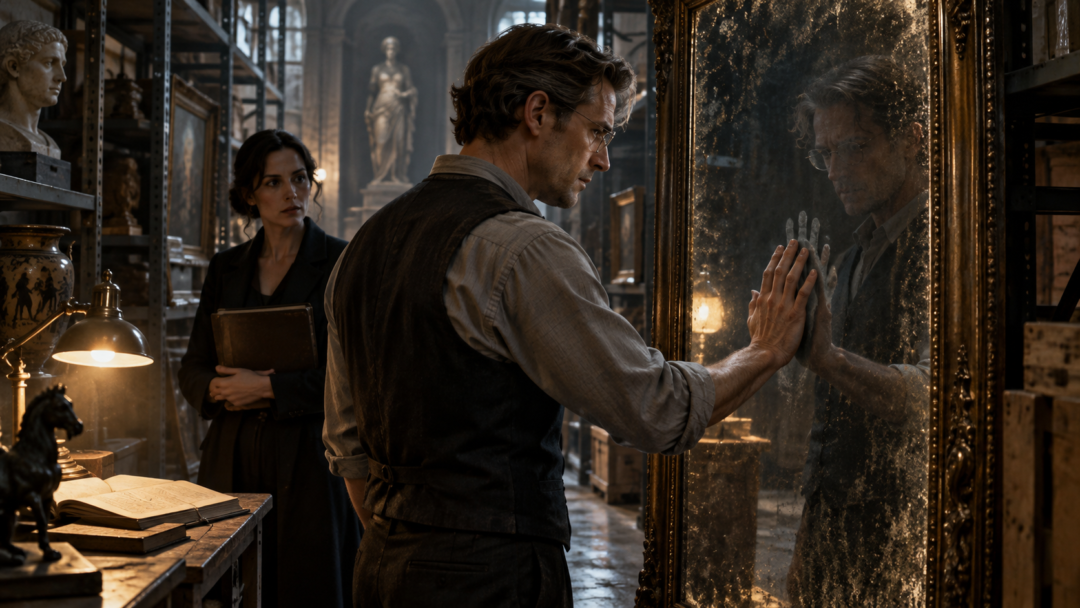
Before him, leaning against the damp brick wall of the decommissioned North Storage Wing, stood a towering, eight-foot Victorian pier glass mirror.
Its heavy, carved mahogany frame was decorated with intricate acanthus leaves and twin gargoyles perched at the crest, their wooden claws clutching stylized serpents. For over forty years, the entire apparatus had sat forgotten beneath a water-stained, lead-weighted white linen shroud, tucked behind stacks of nineteenth-century carriage parts, disassembled pipe organs, and ecclesiastical woodwork. It had been cataloged merely as Item 89-004: Unidentified Architectural Glass.
Thomas pulled the heavy linen shroud back with slow, reverent care, letting the dusty cloth pool at his work boots. The smell of aged linseed oil and dry rot rose from the frame.
The antique plate glass was four feet wide, cold, flawless, and extraordinarily thick—easily twice the weight of standard residential plate. But as the yellow beam of the work lamp caught the silvering, Thomas’s breath caught in his throat.
Dead center on the glass, precisely four feet off the floor, was a clear, grease-free palm print.
Thomas leaned in until the tip of his nose was barely two inches from the glass. His breath fogged the surface in a small, translucent circle.
The print was not on the outer surface. The fogging confirmed it instantly. When he wiped his thumb across the condensation, the outer glass was perfectly smooth, clean, and icy cold to the touch.
The handprint was trapped inside the lamination—pressed against the silver nitrate backing between two vacuum-sealed sheets of heavy industrial plate. It had been sealed there when the glass was manufactured or laminated.
“How did this get in there?” Thomas murmured to himself, his own whisper echoing faintly down the empty vaults. He adjusted his spectacles, his heartbeat quickening as he examined the anatomical contours of the impression.
He lifted his right hand. Slowly, with a strange, icy sensation crawling up the nape of his neck, he flattened his palm against the glass directly over the mark.
It was an exact, anatomical match.
Every ridge of the thumb, every whorl of the fingertips aligned with terrifying precision. Most chilling of all, the print possessed a distinct, jagged interruption across the knuckle of the fourth metacarpal—the exact zigzag scar Thomas had carried since an early childhood accident he could never fully remember. It was the scar of a seven-year-old child whose hand had been crushed in a car latch thirty-five years ago.
He pulled his hand back as if the glass were red-hot iron.
His heart thudded against his ribs like a trapped bird. He stared at his trembling palm, then back at the glass. The mark remained, frozen beneath the silvering like a fossil trapped in river ice. He felt the room tilt slightly beneath his boots, a sudden wave of nausea gripping his throat as memories that did not belong to his waking life seemed to scratch at the back of his skull.
A sharp, rhythmic clicking of high heels sounded from the concrete ramp behind him.
“Cataloging out of hours again, Thomas?”
Dr. Helena Raines stepped into the pool of yellow lamplight.
She was fifty years old, the Executive Director of the museum, dressed in a sharply tailored charcoal wool blazer with silk lapels and dark trousers. Her silver-streaked black hair was pulled into a severe French twist, and her pale blue eyes surveyed the open shroud with razor-sharp, clinical impatience. Under her left arm, she held a hard leather clipboard with a gold clasp; in her right hand, she twirled a silver ballpoint pen.
“Dr. Raines,” Thomas said, his voice hitching slightly. He pointed a trembling finger at the glass. “This mirror… where did it come from?”
Raines stopped two paces away, her gaze flicking dismissively over the ornate mahogany frame. “It was part of the 1989 municipal salvage acquisition when the old county hospital on Mill Hill was demolished. It’s been in deep storage since before I took over the board. Why?”
“Look at the glass, Helena,” Thomas insisted, stepping aside to let the lamp beam strike the center pane. “There’s a palm print. Inside the glass. It’s sealed between the dual panes. And look at the fourth knuckle.”
Dr. Raines walked to the mirror. She stood six inches from the glass.
She did not touch it. She didn’t lean forward. Instead, her knuckles tightened on her clipboard until the leather groaned beneath her grip.
With her right hand, she uncapped her silver pen. She began making rapid, vigorous writing motions across the intake ledger on her clipboard—yet Thomas’s keen archivist’s eye noticed immediately: the ballpoint tip was retracted. The pen was dry. She wasn’t writing a single letter.
“It’s an optical defect, Thomas,” Raines said, her voice unnaturally flat, smooth, and practiced. “A moisture smudge from the mercury bath during manufacturing. Victorian float glass often develops localized silvering decay that mimics biological patterns. Wrap the linen back over it. We’re moving this wing to off-site auction next Tuesday.”
“It’s not decay,” Thomas said, his spectacles slipping down his nose. “It matches my hand, Helena. Look at the scar.”
Raines snapped the clipboard shut with a loud, authoritative crack that reverberated through the hall. “You’ve been working seventy-hour weeks in the basement, Thomas. The damp air down here causes sensory fatigue. Go home. Sleep it off. That’s an executive order.”
Raines turned on her heel and walked briskly up the concrete ramp, the sound of her footsteps echoing through the cavernous vaults until the heavy fire door slammed shut.
Thomas stood motionless in the silence.
He turned back to the mirror, holding the work lamp up to illuminate the glass. He pressed his hand to the print once more, feeling the impossible coldness of the glass vibrating against his skin.
Then his eyes shifted to the reflection behind him.
In the deep, shadowed recesses of Row 12, twenty feet back in the gloom, sat a six-foot heavy oak shipping crate banded with blackened iron straps. Stenciled across the pine planks in bold black ink was a label he had never seen in twenty years of working in this building:
ACQUISITION NO. 89-004: ESTATE OF THOMAS VOSS. DO NOT OPEN BY ORDER OF CONSERVATOR.
Thomas’s chest locked. “That’s my name… I’ve never been back here before…”
He turned his eyes back to his own reflection in the pier glass.
His reflection stared back at him—haggard, pale, eyes wide behind wire spectacles.
Thomas blinked hard to clear his blurred vision.
His reflection did not blink.
Half a second later, the reflection’s eyelids fluttered down, reopened slowly, and the mirrored face tilted two inches to the left with an expression of quiet, agonizing sorrow.
Thomas froze, his blood turning to liquid ice.
“You’re not me…” he whispered into the dark.
CHAPTER 2: THE STENCILED PINE IN ROW TWELVE
The cold subterranean air seemed to suck the warmth directly from Thomas’s skin.
He stood pinned to the concrete floor, his knuckles white around the brass stem of the work lamp. In the towering pier glass before him, the figure behind the silvering remained perfectly still, its head tilted, its dark eyes boring through the glass with an intensity that felt terrifyingly human, rational, and desperately alive.
Thomas took half a step backward, his boots scraping the grit on the floor.
The reflection did not follow. It stood five inches taller than Thomas’s own slumped posture, its shoulders broader, its face carrying a thin, pale surgical scar that ran from the corner of its left eye down into the jawline—a scar Thomas had never seen in any mirror in his life.
The figure slowly lifted its right hand and pressed its palm against the inside of the glass, aligning its fingers perfectly with the child’s handprint sealed within the plate.
Tap. Tap.
The sound was not an echo. It was a dull, physical vibration transmitted through the lamination from the other side of the glass.
Thomas spun around, ripping a heavy, eighteen-inch forged-iron crate pry-bar from the tool rack on the catalog table. He sprinted toward Row 12, his work boots pounding the concrete, breathing in ragged gasps of adrenaline and cold dust.
The oak shipping crate sat wedged between two massive limestone sarcophagi. The pine slats were aged to a dark, oxidized amber, smelling of old turpentine and damp sawdust. The stenciled letters—ESTATE OF THOMAS VOSS — 1989—were crisp, unweathered, as if preserved under glass for decades.
Thomas jammed the chisel tip of the iron bar beneath the center iron strap.
He braced both feet against the limestone sarcophagus and threw all his weight into the lever.
SCREECH.
The rusted square-cut iron nails sheared through the oak with a deafening metallic screech. Thomas wrenched the front panel away, letting the heavy timber crash to the floorboards in a cloud of dried moss and straw.
Inside the crate lay no museum antiquities.
Stacked on shelves of faded green baize were twenty thick, black buckram-bound binders, six sealed manila envelopes stamped with red wax, and an antique 1980s reel-to-reel tape recorder.
Thomas seized the top binder and flipped open the heavy cardstock cover under the beam of his flashlight.
Printed across the title page in embossed black typography were the words:
THE VOSS FAMILY CHARITABLE TRUST — FOUNDED 1912.
PRINCIPAL ASSETS: ASHFORD FOUNDRY, FOUR THOUSAND ACRES TIMBERLAND, MUNICIPAL WATER BOND TRUST.
TOTAL VALUATION: $42,000,000.
SOLE BENEFICIARIES: THOMAS VOSS AND JULIAN VOSS.
Thomas’s hands began to shake so violently the heavy pages rattled against his knees.
Julian Voss.
A wave of vertigo crashed over him. Memory—fragmented, violent, buried beneath thirty-five years of chemical suppression and forced isolation—ripped through his mind like a lightning strike:
A wet autumn night on the Berkshire highway in 1989. The blinding glare of oncoming headlights. The sound of shearing metal. His mother’s scream. Cold water rising around his waist. And another small hand gripping his fingers in the dark, whispering: “Don’t let go, Thomas. Don’t let go.”
He turned to the second page of the binder.
Tipped into the flyleaf was a certified medical intake report from the Ashford Children’s Psychiatric Sanitarium, dated November 3, 1989—two weeks after the fatal car crash that killed their parents.
The report was signed by Dr. Richard Raines—Helena Raines’s father:
Patient A (Thomas Voss, age 7): Exhibits post-traumatic retrograde amnesia following severe closed head trauma. Subject is compliant, docile, and easily managed. Recommend permanent placement as an institutional ward, stripped of legal identification, to be integrated into museum maintenance staff upon reaching majority.
Patient B (Julian Voss, age 7): Exhibits violent agitation, refusal to accept trauma narrative, and persistent insistence regarding family trust assets. Subject represents a catastrophic legal liability. Recommend permanent indefinite isolation in Sub-Level Ward C under clinical sedation.
Thomas felt the breath leave his lungs in an agonizing gasp.
He had never been an orphan taken in by the museum’s charity. He was the rightful owner of the entire museum endowment, the land it stood upon, and the forty-million-dollar estate that funded the entire Berkshire cultural trust.
Helena Raines and her father had stolen everything. They had turned Thomas into an unpaid clerk in his own basement while keeping his twin brother buried alive in the catacombs beneath their feet.
Suddenly, a loud, metallic clatter echoed from the end of the aisle.
The heavy steel fire door at the top of the ramp slammed open with concussive force.
“Thomas Voss!”
Dr. Helena Raines stepped onto the landing, flanked by two armed security guards in black tactical gear carrying high-intensity searchlights and expandable batons. Standing beside them was Arthur Pendelton—Chairman of the Museum Board of Trustees, a silver-haired patrician in an expensive camel-hair coat.
“Secure the aisle!” Raines commanded, pointing her silver pen down the stairs. “Mr. Voss has suffered a severe psychotic break. Restrain him immediately and prepare the medical transport.”
“Stay back!” Thomas shouted, hoisting the heavy iron pry-bar like a battle-axe, backing toward the rear of Row 12. “I know who I am, Helena! I have the trust ledger! I know about Julian!”
Arthur Pendelton stepped forward, his patrician face darkening with cold, murderous venom. “The ledger doesn’t leave this basement, Thomas. And neither do you.”
Pendelton nodded to the two guards. “Take him down. Use whatever force is required.”
CHAPTER 3: THE SUBTERRANEAN FLUE
The two tactical guards charged down the concrete ramp, their heavy combat boots pounding the pavement with concussive, military rhythm. Their twelve-hundred-lumen tactical lights cut through the floating dust, blinding Thomas in a blinding wall of pure white glare.
Thomas didn’t try to fight them head-on. He was an archivist, not a brawler—but he knew every square foot of the museum’s subterranean architecture better than any living soul on earth. For two decades, he had mapped the foundations, crawled through the ductwork during heating failures, and documented the forgotten brick vaults built during the Civil War.
As the lead guard lunged with an extended steel baton, Thomas hurled a ten-pound cast-iron card catalog drawer straight at his shins.
The heavy drawer caught the guard across the knees with a loud, metallic clang. The guard crumpled with a howl of pain, skidding on his face across the dusty concrete, his tactical flashlight spinning into the shadows.
The second guard swung his baton in a savage horizontal arc aimed at Thomas’s collarbone.
Thomas ducked, rolling across the oak catalog table with an agility born of desperate survival. He seized the work lamp and shoved the boiling-hot hundred-watt bulb directly into the second guard’s face.
The guard screamed, throwing his arms up to shield his blistering eyes as the filament shattered in a shower of sparks.
Thomas didn’t hesitate. He grabbed the 1989 trust ledger, tucked it tightly inside his tweed waistcoat, and bolted toward the rear wall of Row 14.
Behind the towering steel shelving units of the archaeological section was an antique cast-iron cleanout door—the access hatch to the building’s original 1890s gravity heating flue, which connected the museum basement to the abandoned municipal steam tunnels beneath the town square.
Thomas jammed the pry-bar into the rusted iron latch, threw his entire body weight against it, and wrenched the door open with an explosive shriek of tearing metal.
He dove headfirst into the soot-stained brick chimney flue, pulling the iron hatch shut behind him just as a burst of electric taser prongs sparked against the outer iron frame.
The flue was three feet in diameter, sloping downward at a twenty-degree angle into the darkness. Thomas scrambled on his hands and knees through thirty-five years of dried coal soot and cobwebs, his lungs burning with the acrid dust, dragging the heavy ledger along his belly.
Ten yards down the shaft, the flue opened into a vast, vaulted subterranean brick corridor smelling of river damp, wet mortar, and old electrical insulation.
Thomas dropped six feet onto the stone floor, his knees buckling under the impact. He picked himself up, coughing black soot onto his sleeve, and shone his penlight down the dark corridor. The masonry here was damp and cold, water trickling between the lime joints.
Carved into the limestone lintel above the archway were three weathered words: WARD C — PRIVATE.
“You’re thirty-five years late, Thomas.”
A low, raspy voice came from the shadows behind a stack of rusted steel hospital beds.
Thomas raised the iron bar, his heart hammering in his throat like an anvil.
Stepping out from behind the rusted iron bedframes was Marcus Webb—the museum’s sixty-four-year-old night groundskeeper, dressed in a faded green wool work coat, holding an antique double-barrel twelve-gauge shotgun broken open over his forearm.
“Marcus?” Thomas gasped, lowering the bar. “You’re down here?”
“I’ve been down here every night since nineteen eighty-nine, son,” Webb said, his weathered face creased with decades of buried sorrow. He snapped the shotgun closed with a heavy, oiled clack. “I was the volunteer ambulance driver who pulled you and your brother out of the wreckage on Mill Hill. Your father was a good man. When Dr. Richard Raines took over the trust, he threatened to have my pension revoked and my daughter thrown in jail if I ever spoke a word to the county magistrate.”
“Marcus,” Thomas stepped forward, his eyes burning with tears. “Where is my brother? Where is Julian?”
Webb pointed the barrels of the shotgun down the corridor toward a heavy, reinforced steel door set with a four-inch viewing glass.
“They’ve kept him in the observation suite behind the pier glass for thirty-five years, Thomas,” Webb said softly, his voice trembling with old guilt. “Raines told the board he was an anonymous clinical research patient from the state hospital. But every year on your birthday, Julian would walk up to that one-way glass and press his hand against the silvering, waiting for you to see him.”
Thomas’s throat closed up. The handprint inside the mirror. The delayed blink. It wasn’t an illusion. It wasn’t madness. It was his brother, waiting in the dark.
“Arthur Pendelton and Helena Raines are at the loading dock right now,” Webb said, his voice hardening into gravel. “They have an industrial document-shredding truck backed up to the freight bay. They’re loading twenty crates of your family’s original gold certificates and deed books into the hydraulic teeth. If they grind those papers, there won’t be enough left of the Voss estate to buy a cup of coffee.”
“Unlock the door, Marcus,” Thomas said, his spectacles gleaming in the gloom. “I’m getting my brother.”
CHAPTER 4: THE TWIN BEHIND THE MASONRY
Marcus Webb pulled a heavy ring of brass barrel keys from his work jacket, selected an antique skeleton key, and inserted it into the heavy iron deadbolt of Ward C.
The lock released with a heavy, resounding clunk.
Webb pushed the three-inch solid oak door open on well-oiled bronze hinges.
Thomas stepped across the threshold into a twenty-foot square room illuminated by a single warm halogen floor lamp. The room was not a barren asylum cell; it was an exact, mirror-image recreation of an Edwardian library. The walls were lined with thousands of classical literature volumes, architectural drawings, and detailed sketches of the museum’s exterior gardens and Berkshire hills.
Standing at the far end of the room, looking through the backside of the massive pier glass mirror, was a man.
He was Thomas’s exact double—identical height, identical angular cheekbones, identical shock of dark hair streaked with silver at the temples. But unlike Thomas’s bookish, stooped posture, this man stood with the erect, coiled power of a captive panther. He wore a simple dark wool sweater and canvas trousers, his face marked by the pale scar running down his cheek.
The man slowly turned around.
His dark eyes, identical to Thomas’s own, locked onto Thomas’s face.
For five eternal seconds, neither man breathed. The silence was absolute, heavy with the weight of thirty-five stolen years, filled only by the distant hum of the building’s ventilation system.
“Thomas,” the man whispered. His voice was lower than Thomas’s, slightly husky from decades of limited conversation, but vibrating with unmistakable familial resonance.
“Julian,” Thomas choked out.
Julian took three slow steps forward, his hands trembling at his sides. He stopped an arm’s length away, reached out with his right hand, and gently touched the frame of Thomas’s wire-rimmed spectacles, just as their father used to do when checking their homework by firelight.
“You took your time,” Julian whispered, a faint, heartbreaking smile breaking across his lips.
Thomas broke. He dropped the iron pry-bar and pulled his brother into a fierce, desperate embrace. Julian wrapped his arms around Thomas’s shoulders, holding his twin with bone-crushing strength, his chest shuddering with thirty-five years of unshed tears.
“I didn’t know, Julian,” Thomas wept into his brother’s shoulder. “They made me forget. They told me I was an orphan.”
“I know,” Julian said, stepping back and gripping Thomas’s shoulders with iron fingers. “I saw you through the glass every day. I watched you clean the display cases. I watched you catalog the rare books. I kept tapping on the plate, but the glass was soundproofed dual-pane lamination. Raines told me that if I ever made a scene, she’d have you fired and cast into the street to freeze.”
Thomas pulled the heavy 1989 trust ledger from his waistcoat and pressed it into Julian’s hands. “The trust is here. Our parents left everything to both of us. Helena Raines and Arthur Pendelton stole it.”
Julian looked down at their parents’ signatures on the parchment, his jaw hardening into granite. “Pendelton was here twenty minutes ago. He was talking into his cell phone. He told Raines that the state auditor is arriving at 8:00 AM. He ordered the shredder crew to destroy the original trust bonds and incinerate the basement files.”
Julian turned to the corner of the room, pointing to an antique bank of closed-circuit surveillance monitors mounted on the wall.
On the third screen, illuminated by the halogen floodlights of the museum’s rear loading dock, sat a massive white industrial mobile shredding truck. Four private security guards were wheeling wooden crates up the hydraulic lift gate, feeding thick armfuls of bound parchment ledgers directly into the whirling steel grinding teeth.
Standing by the truck’s cab, checking his gold pocket watch under the rain, was Arthur Pendelton.
“We have twelve minutes before the primary deed ledger goes into the teeth,” Julian said, his eyes flashing with lethal clarity. “If that ledger is shredded, our legal title is destroyed forever.”
Thomas looked at the monitors, then at his brother. The hesitant, fearful paper conservator was gone. In his place stood an heir of the Voss estate, ready to reclaim his birthright.
“The loading dock power runs through the master breaker panel in the boiler room beneath Ward C,” Thomas said. “If we trip the main three-phase industrial transformer, the shredder’s hydraulic feed jams instantly.”
Julian grabbed a heavy steel crowbar leaning against his drawing table. A ferocious, confident grin spread across his scarred face.
“Show me the breakers, brother,” Julian said. “Let’s shut them down.”
CHAPTER 5: THE GLASS ROOM IN THE DARK
The boiler room beneath Ward C was an iron cathedral of hissing steam pipes, massive brick-encased boilers, and humming industrial transformers installed during the New Deal. The heat radiated in waves off the iron flues, contrasting sharply with the freezing autumn gale blowing in through the upper air intakes.
Thomas and Julian moved through the steam pipes like shadows, their movements eerily synchronized—two halves of a single mind operating with seamless, instinctual rhythm. Marcus Webb brought up the rear, his twelve-gauge shotgun held at low ready, covering the stairwells.
Thomas stopped before a six-foot wall-mounted electrical cabinet painted industrial grey, secured with a heavy bronze padlock.
“This is the three-phase distribution box for the loading dock,” Thomas said, pointing to the thick, two-inch conduit running through the ceiling masonry. “It feeds thirty thousand volts directly to the exterior industrial outlets.”
Julian jammed the flat edge of his crowbar behind the padlock hasp, put his boot against the wall, and threw his weight backward.
CRACK.
The bronze hasp sheared clean off the sheet metal. Thomas yanked the cabinet doors wide.
Inside sat three heavy copper knife switches, each rated for four hundred amps, glowing with amber indicator lamps.
Thomas reached in, grabbed the three insulated handles simultaneously, and yanked them down with a single, violent pull.
A deafening electric arc hissed through the cabinet, throwing bright blue sparks against the concrete ceiling.
Above them, the deep, mechanical churning of the hydraulic shredder truck died instantly, replaced by the screech of grinding gears seizing in mid-cycle, followed by angry shouts from the loading bay.
“Breakers are tripped!” Thomas yelled. “The shredder is dead!”
“Move to the loading bay!” Julian called out. “Secure the crates before they find the manual release!”
They vaulted up the iron spiral staircase leading from the boiler room directly onto the loading dock mezzanine.
The loading bay was vast, open to the cold autumn rain blowing in from the courtyard. Outside, the white shredder truck sat dead on its springs, its intake hopper jammed with half-shredded paper.
Two security guards were on their knees beneath the truck bed, swearing as they banged on the hydraulic pump with wrenches. Arthur Pendelton stood on the loading apron, his camel-hair coat drenched, screaming into his mobile phone in hysterical rage.
“Hey, Arthur!” Marcus Webb bellowed from the mezzanine railing.
Pendelton spun around, his eyes going wide with shock as he saw the groundskeeper standing above him with the shotgun.
Julian vaulted over the railing, dropping eight feet onto the wooden loading pallet below with the fluid grace of an athlete. He didn’t say a word. He stepped into Pendelton’s personal space and drove the flat heel of his palm straight into the trustee’s chest.
The concussive blow lifted Pendelton off his polished leather shoes, sending him sprawling backward into a stack of empty archive boxes. The mobile phone flew from his grip, shattering on the wet asphalt.
The two security guards scrambled up, reaching for their batons.
Thomas swung down from the mezzanine ladder, wielding his heavy iron pry-bar with two hands, sweeping the legs out from under the first guard. As the guard crashed into the floor, Julian seized the second guard by his tactical vest, executed a crisp hip throw, and slammed him onto the steel lift gate, knocking the wind from his lungs.
Marcus Webb leveled the double-barrel shotgun at the three fallen men. “Don’t twitch, gentlemen. Buckshot makes a terrible mess of expensive coats.”
Thomas sprinted to the intake hopper of the shredder truck.
There, wedged between the jammed steel teeth, was a thick, leather-bound volume stamped in gold leaf: MUNICIPAL LAND TITLE & CHARITABLE TRUST — VOLUME I: 1912 TO PRESENT.
Thomas grasped the spine with both hands, bracing his boot against the steel frame, and pulled with everything he had.
With a tearing sound of binding cloth, the massive ledger slipped free from the grinding blades, eighty percent intact, the primary signatures and seal completely unblemished.
“We have it!” Thomas shouted, holding the book high in the rain.
Suddenly, the overhead mercury-vapor floodlights in the loading bay flickered and died.
Total darkness plunged the loading dock into a pitch-black void, save for the pale ambient streetlights filtering through the Berkshire rain.
From the dark entrance of the museum gallery behind them came the sharp, unmistakable sound of a steel revolver hammer being pulled back to full cock.
“Drop the ledger, Thomas,” a voice rang out—cold, aristocratic, and completely devoid of mercy.
Dr. Helena Raines stepped out from the shadows of the doorway, holding a nickel-plated .38 snub-nosed revolver aimed directly at Thomas’s heart.
“You’ve always been too clever for your own good, Thomas,” Raines whispered in the dark. “And clever people don’t survive in my museum.”
CHAPTER 6: THE PIER GLASS UNDER FIRE
The cold rain blew through the open loading bay, misting against Thomas’s spectacles.
He did not drop the ledger. He stood dead center on the wooden pallet, holding the massive book against his chest like an iron breastplate.
“Put the gun down, Helena,” Thomas said, his voice echoing off the brick walls with an authority he had never possessed in his life. “The breakers are tripped. The police have already received Marcus Webb’s emergency call. You can’t shoot your way out of thirty-five years of grand larceny.”
Raines’s lips parted in a vicious, trembling sneer. The silver pen was gone; the polished director’s mask had fallen away completely, exposing the terrified, cornered predator beneath.
“You think this is about larceny, Thomas?” Raines snarled, taking a slow step onto the loading apron. “This museum was bankrupt in nineteen eighty-nine! My father built this institution! He bought the Greek bronzes, he endowed the university chairs, he put Ashford on the cultural map! And he did it with the Voss trust! You were two brain-damaged boys who would have spent your lives drooling in a state asylum! We saved this town!”
“You didn’t save anything, Helena,” Julian’s voice emerged from the shadows to her left—deep, resonant, and chillingly calm. “You stole our childhood. You buried me in a cell for thirty-five years while you drank champagne in the boardroom.”
Raines spun toward the sound of Julian’s voice, her eyes widening in hysterical terror as she saw the identical twin stepping from behind a stack of crates.
“Stay back!” Raines shrieked, swinging the revolver toward Julian. “You’re dead! You died in the sanitarium fire in ninety-two!”
“Look closer, Helena,” Julian said, taking another step forward into the dim light. “I’m very much alive.”
Raines panicked and pulled the trigger.
BANG!
The gunshot was deafening beneath the concrete loading canopy. The muzzle flash lit up the darkness in a brilliant orange bloom.
Julian wasn’t there.
He had already dropped beneath the shot, his boots skidding across the wet boards. The bullet ricocheted off an iron roof truss with an angry whine, showering the dock with hot lead fragments.
Raines re-aimed, but Thomas moved.
He didn’t use a weapon. He lunged forward, hurling the twenty-pound leather-bound trust ledger through the air like a missile.
The heavy book struck Raines squarely across her forearm and chest.
The impact tore the revolver from her hand, sending the weapon spinning across the wet concrete into the flooded drainage gutter.
Raines screamed in fury and lunged for the fallen gun.
Julian moved faster. He stepped inside her reach, caught her wrists in an iron grip, and twisted her arms behind her back with surgical precision.
Raines thrashed and spat like a wild animal, her bespoke blazer tearing at the seams, but Julian’s grip was unbreakable. He forced her down onto her knees on the wet loading apron.
“Let me go!” Raines wept, her arrogance completely collapsing into hysterical sobs. “You have no proof! The county deed recorder is my cousin! The digital records have already been expunged!”
Thomas stepped through the rain, knelt beside her, and pulled the silver pen from her blazer pocket. He held it up to her eyes.
“You should have checked your tools, Helena,” Thomas said softly.
He unscrewed the barrel of the silver pen.
Inside was no ink reservoir. There was only a high-definition omnidirectional digital microphone and a micro-SD audio recording module—the very covert surveillance pen Raines had used to record her secret board meetings with Arthur Pendelton.
Thomas pressed the small playback button on the side of the pen.
Raines’s own voice crackled through the tiny speaker, crystal-clear over the sound of the rain:
“…The shredder truck will be at the dock at 11:30 PM. Once the Voss trust ledgers are destroyed, we transfer the remaining fourteen million to the offshore accounts in Zurich. Nobody will ever look for Julian Voss again…”
Raines’s head fell forward. She stopped struggling.
From the street outside, the night exploded in a blinding kaleidoscope of red and blue emergency flashers.
Sirens wailed down the mountain road as four Massachusetts State Police cruisers and an unmarked command vehicle tore into the museum courtyard, tires screeching on the wet gravel.
State troopers in heavy rain slickers leaped from the cruisers, assault rifles drawn, led by Assistant Attorney General David Vance.
“Massachusetts State Police!” Vance’s voice bellowed through an amplifier. “Step away from the vehicle and show your hands!”
Marcus Webb lowered his shotgun, resting the butt on the concrete. “Over here, General Vance! We have the board members in custody, and the evidence is intact!”
CHAPTER 7: THE TRUE REFLECTION IN DAYLIGHT
The Berkshire dawn broke over Ashford in a magnificent tapestry of crisp autumn gold, amber, and deep cobalt blue. The storm had blown east toward the Atlantic, leaving the morning air sharp, invigorating, and sweet with the clean scent of fallen sugar maple leaves and damp pine.
Outside the main limestone entrance of the Ashford Museum of Antiquities, a crowd of two hundred students, university professors, townspeople, and local reporters had gathered on the manicured lawns in stunned silence.
Parked along the circular drive were six state police cruisers and a federal mobile forensic unit.
Flanked by two uniformed troopers, Arthur Pendelton was escorted down the grand marble steps in handcuffs, his camel-hair coat ruined, his head bowed in complete disgrace as television cameras captured every second of his ruin. Behind him walked Dr. Helena Raines, her face pale as parchment, clutching an evidence envelope containing her own surveillance recordings as federal agents led her toward the transport van.
On the upper terrace, beneath the soaring neoclassical columns, stood Thomas and Julian Voss.
They had washed the soot and rain from their faces. Thomas wore a clean grey tweed jacket, his wire spectacles polished, while Julian wore a matching dark wool coat provided by Marcus Webb. For the first time in thirty-five years, they stood side by side in the open sunlight—identical, unbroken, and free.
Assistant Attorney General David Vance walked up the terrace steps, carrying the authenticated 1989 Voss Family Trust ledger in a protective archival binder.
He stopped before the brothers, a warm, reverent smile on his face.
“Gentlemen,” General Vance announced, his voice carrying clearly across the quiet lawn. “The State Supreme Court has just issued an emergency declaratory injunction. By unanimous decree, all fraudulent conservatorships, property transfers, and embezzled corporate structures enacted by Helena Raines and Arthur Pendelton are hereby declared null and void. The entire Voss estate—forty-two million dollars in municipal trust assets, the museum building, and four thousand acres of conservation timber—is officially returned to Thomas and Julian Voss.”
A spontaneous cheer erupted from the crowd on the lawn, led by the museum staff, docents, and groundskeepers who had suffered under Raines’s tyrannical rule for decades.
Thomas and Julian looked at each other. A shared, silent understanding passed between them—an unspoken bond that thirty-five years of stone walls and iron bars had never been able to sever.
“What do we do now, Julian?” Thomas asked softly.
Julian looked up at the towering limestone pediment of the museum, where the bronze letters read: ASHFORD MUSEUM OF ANTIQUITIES.
“We open the doors, Thomas,” Julian said, his voice rich, confident, and full of life. “We take the shrouds off every mirror. We tell the real history of this town. And we make sure no one is ever hidden in the dark again.”
Marcus Webb stepped forward, holding the heavy brass master keys to the museum’s front bronze entrance. He placed them gently into Thomas and Julian’s hands.
“Your grandfather built these doors, boys,” Marcus whispered with tears in his eyes. “It’s time to unlock them.”
Thomas and Julian turned together toward the grand bronze portal. Side by side, each brother placed a hand on the heavy iron handles, pushing them wide open into the brilliant, unclouded morning light.