Unit Fourteen Held The Photograph Elias Never Saw
CHAPTER 1: THE DOOR THAT SWUNG SHUT
Dusk settled over the rust-red brick textile mills, abandoned freight yards, and rain-swollen river locks of Ashford Falls like a heavy, sodden wool blanket. Along the narrow interior access corridor of Valley Self-Storage—a sprawling, cinder-block warehouse compound wedged between the rusted tracks of the Boston & Maine railroad spurs and the municipal canal—overhead fluorescent tubes flickered with an irregular, high-voltage hum that set Elias Rook’s teeth on edge. The air was cold, damp, and thick with the heavy scent of wet cement, oxidized galvanized steel siding, damp corrugated cardboard, and twenty years of trapped dust motes hanging in the stagnant drafts.
Elias Rook stood beneath the buzzing tubes, his round reading glasses pushed up into the thick, unruly tangle of his silver-grey beard.
He was fifty-two years old, built with the broad, stooped shoulders of a man who had spent three decades hauling ten-pound county deed ledgers, restoring crumbling nineteenth-century leather bindings, and cataloging municipal probate archives in subterranean courthouse basements. He wore a rumpled brown Donegal tweed jacket with reinforced suede elbow patches over a heavy navy wool cardigan, dark corduroy trousers, and sturdy leather work oxfords chalked with the fine grey dust of old rag paper. In his right hand, he held his heavy brass master ring of keys, thumbing through them slowly under the flickering fluorescent glare.
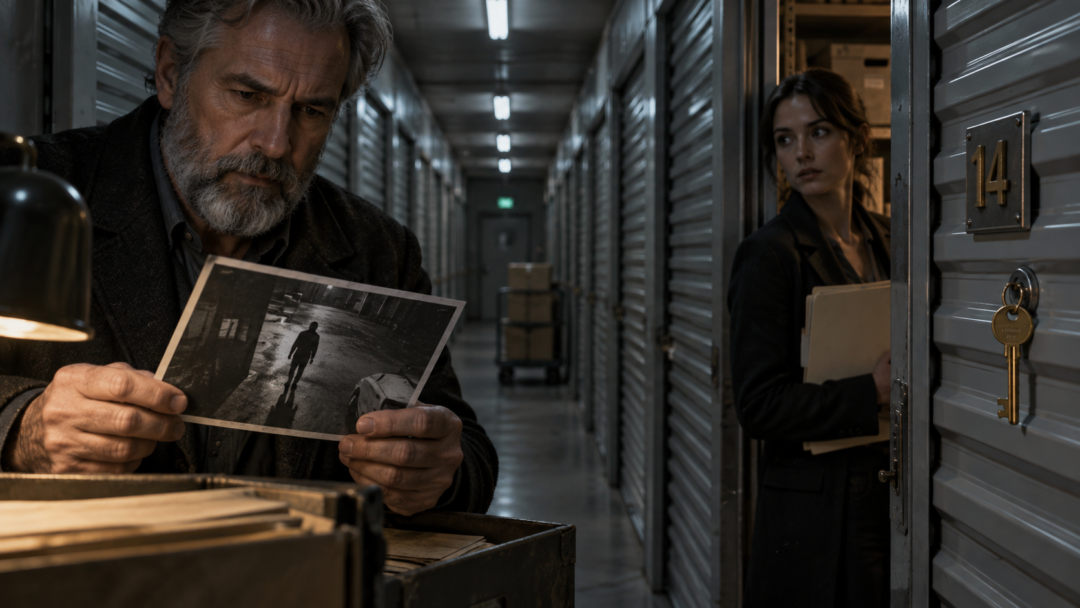
Among the familiar, notched brass teeth—his antique bookshop front lock, his apartment deadbolt, the municipal archive vault key, the church belltower padlock—was a small, unfamiliar cylinder key.
It was barely two inches long, forged from solid polished naval brass, its collar stamped with three crisp, clean numbers: 014.
“I’ve never seen this key,” Elias murmured to himself, turning the cold metal over in his palm. His voice had the dry, hushed timbre of an archivist who spent most of his days speaking only to ancient paper. “It wasn’t on this ring when I left the shop this morning.”
Beside him, clutching an aluminum clipboard against her ribs and wrapping a heavy cream-colored wool scarf tight around her throat against the penetrating chill, stood Nora Pike.
Nora was twenty-nine, the registrar for the Ashford Historical Society. She had sharp, observant hazel eyes that missed nothing, short dark hair tucked neatly behind her ears, and an encyclopedic photographic memory for municipal accession numbers that had made her an indispensable expert witness in county boundary disputes. Her breath billowed in faint, rhythmic white plumes in the unheated corridor, and she kept her sturdy leather boots planted firmly on the center expansion joint of the concrete slab, watchful and tense.
She leaned in close, her gloved index finger gently tilting the small brass key toward the overhead light. Her expression changed in an instant—not with sudden panic, but with the sharp, sickening shock of immediate recognition.
She stepped back two paces, her boot heels clicking sharply on the concrete.
“That’s from Unit 14, Elias,” Nora said, her voice dropping into a guarded, urgent whisper that barely carried down the corridor. “Unit 14 was leased to David Cole. It was emptied six years ago after the coroner’s inquest was closed. I signed the municipal release certificate myself.”
“David Cole?” Elias frowned, his bushy grey brows knitting together as he looked down the long, dim row of corrugated roll-up doors. “The county investigative reporter who died in the river accident out by the limestone weir?”
“It wasn’t an accident, Elias,” Nora whispered, her eyes darting nervously toward the shadowed entrance of the storage corridor where the rain was beating against the corrugated loading bay doors. “Everyone in town hall knows it wasn’t an accident. David was looking into the canal reclamation funds. And his storage unit was supposed to be completely cleared, inventoried, and locked by the county sheriff.”
They walked fifty feet down the corridor, their footsteps echoing off the cinder blocks, stopping at the far end of Aisle B.
The corrugated steel roll-up door of Unit 14 was not locked. It was standing open by four inches, revealing a dark, yawning concrete void beyond the rubber bottom seal.
Elias reached down, gripped the rusted galvanized lifting handle, and hauled the door upward. The heavy spring-loaded rollers screeched in their metal tracks with a sound like tearing sheet iron, sending cascades of rust flakes and grey dust down the jambs.
Inside, the ten-by-ten concrete cubicle was completely empty, save for a single olive-drab industrial steel storage locker standing against the back wall, its door unlatched and resting slightly ajar.
Nora stopped dead at the threshold, her arms crossing tightly across her chest as she stepped back onto the main aisle. “I’m not going in there, Elias. Something is wrong about this.”
“It’s just an empty locker, Nora,” Elias said gently, trying to soothe her obvious dread. “Perhaps the manager used the space for maintenance storage.”
“David Cole died less than twenty-four hours after he signed the release for this building,” Nora said, her voice trembling with an old, cold fear. “There is nothing in that locker that belongs to us.”
Elias stepped across the threshold. His leather oxfords crunched softly on the gritty concrete floor. He pulled a heavy brass penlight from his tweed jacket pocket and clicked it on.
The warm yellow beam swept over the interior of the steel locker.
On the rusted metal bottom shelf lay a single five-by-seven photographic print, lying face-down on the cold iron plate.
Elias reached in, his fingers lifting the glossy paper by its white border.
He turned it over under the beam of his flashlight.
His breath caught in his throat. His knees went instantly hollow, and the air seemed to vanish from the room.
The photograph showed Elias Rook—taken from behind, through the rain-streaked windowpane of his second-floor brick apartment above the bookshop on Canal Street. He was sitting at his own kitchen table, beneath the green glass shade of his banker’s lamp, holding a ceramic mug of black tea, reading an open folio with his spectacles perched on his nose.
Printed across the bottom white border in red digital timestamp ink was: YESTERDAY — 11:42 PM.
Elias slowly turned the print over.
Scrawled across the white backing in black carpenter’s grease pencil were five sharp, menacing words:
You left the door open.
“I live alone,” Elias whispered, the words barely making it past his dry lips. “I locked both deadbolts at ten o’clock. The chain was on the door all night.”
A sudden, terrifying sound echoed behind him.
The heavy corrugated steel roll-up door of Unit 14 began moving. It descended slowly, deliberately, rolling down its tracks on well-oiled ball bearings, completely on its own, cutting off the fluorescent light from the hallway.
Elias spun around in blind panic, lunging toward the shrinking rectangular opening.
Nora was gone from the corridor.
Before Elias could reach the threshold, the heavy steel door slammed down with an earth-shaking, concussive BANG, seating itself against the concrete slab with finality.
Outside in the corridor, a heavy padlock hasp snapped shut with an echoing, metallic click.
Elias hammered both fists against the corrugated steel until his knuckles bruised. “Nora! Nora, open the door! Nora!”
From somewhere distant down the corridor, Nora’s voice drifted back—frantic, echoing off the concrete blocks, filled with desperate, breathless dread:
“Elias—who else has your key?”
Then came the sound of running heavy boots, a muffled cry, the violent thud of a body hitting a metal door, and the screech of tires outside the loading bay.
CHAPTER 2: THE FIRE UNDER THE STEEL
The darkness inside Unit 14 was absolute, thick as wet velvet, pressing against Elias’s eyeballs like a physical weight.
Elias pressed his ear against the cold corrugated steel of the roll-up door, his chest heaving, his heart hammering against his ribs like a sledgehammer. The heavy padlock on the outside held the bottom lip completely flush against the concrete floor. Outside in the main aisle, the faint sound of rain against the warehouse roof was the only noise remaining.
Then, from the hairline gap beneath the rubber weather-stripping, came a sharp, chemical hiss.
A pungent, volatile stench filled the small concrete room—the unmistakable, oily reek of lighter fluid, paraffin wax, and commercial diesel fuel being poured across the exterior threshold.
A moment later, through the gap beneath the steel door, a tongue of bright yellow flame bloomed with a soft whump, crackling as the fuel ignited across the concrete. Thick, acrid black smoke began curling inward, stinging Elias’s eyes and burning his throat with toxic fumes that smelled of synthetic petroleum.
“Think, Elias,” he muttered aloud, his voice dropping into the quiet discipline he used when repairing fire-damaged eighteenth-century manuscripts. “Panic is an accelerant. Find the structural weakness.”
He clicked his brass penlight back on.
The unit was concrete on three sides, but the dividing partition between Unit 14 and Unit 15 was not reinforced masonry. It was standard five-eighths commercial drywall mounted on lightweight steel studs—installed twenty years ago when the warehouse was subdivided into smaller storage lockers.
Elias ran to the single steel locker at the back of the unit.
He wedged his boot against the base of the locker, grabbed the top galvanized shelf with both hands, and wrenched it upward with all his strength, using his back and legs.
SCREECH.
The rusted sheet-metal shelf sheared free from its stamped brackets with a scream of tearing metal, giving Elias a three-foot, razor-sharp steel lever with a rigid folded lip.
He ran to the center of the drywall partition.
He drove the corner of the steel shelf into the gypsum board like an axe. The sheetrock shattered in an explosion of white powder. Elias hacked and tore at the wallboard, kicking the studs until the gypsum gave way, tearing open an eighteen-inch gap between the vertical metal channels.
The smoke in Unit 14 was dropping fast, filling the ceiling and descending toward his chest in suffocating grey sheets.
Elias took a deep breath of the lower air, dropped onto his belly, and squeezed his shoulders through the torn opening into Unit 15.
The adjoining unit was empty, its roll-up door unlatched.
Elias rolled onto the cold floor of Unit 15, threw his shoulder against the interior handle of the roll-up door, and shoved it upward two feet.
He rolled out into the rear drainage alley behind the storage facility, gasping in great, cold lungfuls of the damp evening air, coughing violently as rainwater washed the black soot from his face.
Behind him, through the roof vents of Unit 14, orange flames were licking the roofline, dense black smoke pouring into the dusk sky like an industrial chimney.
Elias stood up, wiped his spectacles with a soot-stained handkerchief, and sprinted along the muddy gravel lane toward the main parking apron.
The parking lot was deserted, save for two sets of fresh tire tracks cut deep into the wet gravel near the facility’s front sliding electronic gate.
Elias crouched beside the tracks in the driving rain.
There, half-buried in the mud and crushed under a heavy tire tread, lay Nora’s cream-colored wool scarf. The knit wool was torn, stained with black motor grease, and smelled of cheap menthol tobacco. Beside the scarf lay an embossed plastic parking placard that had fallen from the vehicle:
VANCE MUNICIPAL REDEVELOPMENT AUTHORITY — OFFICIAL VEHICLE.
Elias picked up the placard, his fingers trembling with cold fury.
Garrett Vance. The County Planning Commissioner who had spent six years buying up every industrial parcel along the Ashford Falls canal, pushing through eminent domain condemnations, and running roughshod over the town council.
Nora hadn’t run away. Vance’s men had ambushed her in the corridor and thrown her into the back of a company car.
Elias looked down at the brass key still clutched in his left hand, and then at the surveillance photograph tucked inside his tweed vest.
David Cole hadn’t left his files in Unit 14. He had used Unit 14 as a decoy—a trigger to see who held the key.
“The book,” Elias realized, the memory flashing like lightning through his mind. “David Cole came into the shop the afternoon before he died. He bought the 1884 County Survey Atlas.”
Elias turned on his heel, tucked his head into the rising wind, and sprinted down the rail spur toward his bookstore on Canal Street.
CHAPTER 3: THE DESK IN THE BOOKSHOP
Canal Street was deserted at 6:45 PM, bathed in the amber glow of antique cast-iron streetlamps that reflected off the black, slow-moving water of the locks. A cold wind blew down the river valley, carrying the smell of wet soot and rotting river weeds from the canal gates.
Elias reached the weathered red-brick storefront of Rook’s Antiquarian Books, his breath ragged and wheezing, his wet tweed jacket heavy on his shoulders. The large plate-glass window, painted with faded gold lettering that read RARE VOLUMES, CARTOGRAPHY & HISTORICAL BINDINGS, looked dark and peaceful from the sidewalk, but as Elias stepped onto the granite threshold, his hand stopped in mid-air.
The brass front door lock had been drilled out.
A neat, half-inch hole had been bored through the bronze deadbolt cylinder, the bright brass shavings glistening like spilled glitter on the fiber welcome mat.
Elias pulled the door open slowly, the antique shop bell chiming with an innocent, cheerful tinkle that felt monstrous in the quiet night.
Inside, the bookstore had been torn apart with methodical, professional violence.
Floor-to-ceiling mahogany bookshelves had been stripped, thousands of rare volumes tossed across the pine floorboards like autumn leaves. Desk drawers were overturned, the glass display cases containing eighteenth-century nautical charts were shattered, and the floor was littered with torn vellum, loose map sheets, and broken bookcloth.
The intruders had searched for hours, ripping the backs off framed prints, peeling up the oriental floor rugs, and slashing open the upholstery of the reading armchairs.
Elias stepped through the wreckage to his private conservation bench in the back alcove behind the cast-iron woodstove.
There, sitting completely untouched on a green velvet display stand in the center of the restoration table, lay the single object the intruders had overlooked:
The 1884 Atlas of Ashford County and the Canal Basin.
It was a massive elephant folio, twenty-four inches tall, bound in heavy full calfskin with blind-stamped floral borders and twin brass clasps. Its leather was dark, scuffed by a century of municipal land surveyors, but the spine was intact, secured by heavy raised cords. Because Elias had placed it under an archival linen cleaning sheet with a label reading 1912 Township Assessment: Tax Records, the thieves had disregarded it as ordinary administrative scrap.
David Cole had not hidden his papers inside the book; he had had the entire folio rebound before he died.
Before Elias could touch the leather, the shop’s vintage black Western Electric rotary telephone on the desk rang with a loud, metallic clatter.
BRRRRRING.
The sound cut through the silence of the shop like an alarm bell.
Elias stepped to the desk, took a slow, deep breath, and lifted the heavy Bakelite receiver to his ear.
He did not speak.
A smooth, cultured voice purred through the earpiece—unhurried, resonant, and entirely devoid of human empathy:
“Good evening, Elias. I’m glad to see you survived the fire in Unit 14. My men can be somewhat… overzealous when tidying up loose ends.”
Garrett Vance.
“Where is Nora Pike, Vance?” Elias asked, his voice steady as granite.
“Miss Pike is currently enjoying the hospitality of our maintenance facility at the old limestone quarry,” Vance replied, the sound of a fine crystal glass clinking against ice audible in the background. “She is unharmed, Elias. For the moment. But the quarry pumps operate on an automated timer, and the lower shaft has an unfortunate tendency to fill with groundwater when the river locks are opened at midnight.”
“What do you want, Vance?”
“I want what David Cole stole from my private vault six years ago,” Vance said, his tone sharpening into cold steel. “The original soil toxicology analysis and the unredacted state engineering reports for the canal development project. Cole had them reduced to microfiche and slipped them into an antique book he bought from you on the afternoon of October 12, 2018.”
“And if I bring you the book?”
“Then you and Miss Pike walk out of the quarry, take the morning train south, and forget this town ever had an archive,” Vance said. “If you do not arrive at the quarry pump house by 8:00 PM with the atlas in your hands, Nora goes into the deep sump, and your little bookshop burns to the foundation. You have seventy minutes, Elias. Don’t be late.”
The line went dead with a hollow click.
Elias hung up the receiver. He walked to his conservation bench, drew a scalpel-sharp English bookbinder’s bone-folder and a slender surgical scalpel from his tool drawer, and sat down before the 1884 Atlas.
“Let’s see what you died for, David,” Elias whispered.
CHAPTER 4: THE MICROFICHE IN THE BINDING
The grandfather clock in the corner of the bookstore ticked with relentless, rhythmic cadence, counting down the seventy minutes with every hollow swing of its brass pendulum.
Elias adjusted his wire spectacles, switched on his magnifying inspection lamp, and laid the massive elephant folio flat on the green self-healing cutting mat. He ran his calloused fingertips along the outer gutter of the rear calfskin board where the leather was glued to the heavy binder’s board.
To an untrained eye, the binding appeared completely original to 1884—aged, patinated, cracked with fine craquelure, smelling of old hide glue and cedar sawdust.
But to Elias, who had rebound a thousand folios in his life, the telltale anomaly was immediate: the linen sewing thread along the rear kettle stitch was modern six-cord waxed unbleached Irish linen, not the raw hemp twine of the nineteenth century.
David Cole had had the rear cover hollowed out and resewn by a master binder in Albany.
Elias took his surgical scalpel, carefully inserted the fine curved blade between the pastedown endpaper and the millboard, and made a single, surgical slit along the inner joint.
He lifted the marbled paper flap with his bone-folder.
Inside the hollowed core of the dense cardboard sat a sealed, waterproof Mylar sleeve containing two transparent microfiche cards and an audio microcassette tape.
Elias brought the microfiche cards beneath his 40x jeweler’s loupe.
What he saw made his blood run cold.
The first card contained the official, stamped toxicological analysis conducted by the New York State Department of Environmental Conservation in August 2018.
Across Section 4, highlighted in red grease pencil, was the laboratory finding:
Site 9 (Ashford Canal Basin): Core soil samples reveal lethal concentrations of industrial trichloroethylene and polycyclic aromatic hydrocarbons directly overlying the municipal aquifer. The site represents an immediate, catastrophic public health hazard.
The second card was an unredacted copy of an internal memo from County Planning Commissioner Garrett Vance to the Ashford Town Council, dated two weeks later:
Site 9 re-zoning approved unanimously for commercial residential redevelopment and the new Ashford Community Elementary School. Environmental clearance issued without conditions.
Vance hadn’t just covered up a minor chemical spill; he had deliberately concealed an industrial poison zone directly beneath the foundation of the town’s newly constructed elementary school to secure thirty million dollars in state development bonds and pocket a twelve-million-dollar private developer’s fee.
David Cole had discovered the fraud. When Cole confronted Vance, Vance had had him run off the road into the canal, staging it as a late-night drunk-driving accident.
Elias picked up the microcassette tape, inserted it into his pocket Dictaphone, and pressed play.
Garrett Vance’s voice filled the earphone, clear and undeniable, recorded during a private meeting at the Ashford Country Club:
“…Cole is an annoyance, Ray. If he takes those soil cores to the state attorney in Albany, the whole bond issue is revoked and we’re facing twenty years in Attica. Make sure he never leaves the storage facility with those cards…”
Elias pulled the earphone out, his hands clenching into iron fists.
David Cole hadn’t died in an accident. He had been murdered to protect a poisoned real estate empire. And now Garrett Vance had Nora Pike tied up in a flooding quarry pump house.
Suddenly, the front window of the bookstore reflected the sweeping yellow beams of a vehicle turning slowly onto Canal Street.
A silver town car pulled up to the curb, idling with a low, menacing hum.
The driver’s side door opened. Stepping onto the sidewalk was Ray Calloway—Vance’s chief corporate fixer, wearing a dark trench coat, his hand tucked suspiciously inside his right lapel.
Elias didn’t panic. He took the microfiche cards, slipped them into the hidden inner pocket of his tweed vest, and closed the atlas.
He picked up a heavy, cast-iron book-press screw lever from his workbench—a three-foot bar of solid twelve-pound iron—and stepped behind the heavy oak revolving bookcase near the door.
CHAPTER 5: THE AMBUSH IN THE STACKS
The antique shop brass bell chimed with a clear, crystalline note as Ray Calloway pushed the front door open, stepping over the drilled bronze lock into the dark, ransacked bookstore.
Calloway was forty-four years old, built like a fire hydrant, with a thick bull neck, slicked-back black hair glistening with rain droplets, and cold, dead eyes that evaluated rooms only to identify escape routes, blind spots, and sightlines. In his right hand, drawn from beneath his wet charcoal trench coat, was a suppressed Walther PPK pistol, fitted with an eight-inch carbon-fiber baffle that eliminated both flash and acoustic signature. In his left hand, he carried a heavy, rubber-armored tactical flashlight emitting a narrow, pencil-thin beam of red light designed to preserve night vision.
“Elias?” Calloway called out, his voice a low, gravelly rasp that bounced softly off the high wooden ceiling and the dark mahogany shelving. “Mr. Vance told me to come collect you early. He doesn’t like waiting out in the cold at the quarry. And you really shouldn’t be wandering around town when there’s an active warrant being drafted for your arrest.”
He took three slow, deliberate strides into the center aisle, stepping carefully over piles of scattered nineteenth-century encyclopedias and torn legal folios, his rubber-soled oxfords making almost no sound on the wide pine floorboards. He paused every few feet, tilting his head, listening for the sound of breathing, the rustle of wool, or the creak of an old floor joist.
He stopped beside the central conservation bench, his narrow red flashlight beam catching the open, empty 1884 Atlas lying flat on the green cutting mat.
Calloway’s eyes narrowed into slits. He leaned forward to inspect the severed rear lining, his gloved fingers reaching out to touch the exposed cardboard hollow where the Mylar packet had been concealed for six years.
“So the old archivist found it,” Calloway murmured under his breath, his thumb easing the safety off the Walther pistol with a faint, metallic click. “Clever old man.”
From behind the towering mahogany stacks of the Local History section, Elias struck with the quiet, ruthless fury of a man defending his home.
He didn’t swing the twelve-pound iron book-press lever at Calloway’s head—a high blow could be blocked or deflected by a seasoned street fighter. He swung it low, two-handed, like an agricultural scythe, putting his hips, core, and shoulders into the blow, striking the enforcer squarely across the back of the knees.
The heavy, cold iron bar crushed cartilage and tendons with a concussive, sickening THUD.
Calloway roared in shock and blinding agony, his knees buckling violently outward. His pistol discharged into the floorboards with a muffled phut, kicking up a splinter of pine as he crashed flat onto his face amidst a pile of scattered county assembly records.
Before Calloway could roll over or reach for a secondary weapon, Elias dropped his full weight down.
He drove his left knee directly into Calloway’s lower spine, while jamming the heavy iron book-press lever across the back of the enforcer’s neck, pinning his windpipe and carotid against the floor.
“Move an inch,” Elias said, his voice flat, icy, and totally devoid of mercy, “and I sever your spinal cord right here on the floor of the county history section.”
Calloway gasped, his fingers clawing desperately at the floorboards, spitting blood and tooth fragments onto a leather-bound volume of the 1892 State Legislative Assembly records. “Rook… you crazy old bastard… you have no idea who you’re touching… Vance will skin you alive and burn this whole street…”
“Garrett Vance is a murderer who poisoned this town’s children,” Elias whispered, pressing the iron bar half an inch deeper into Calloway’s neck until the enforcer gagged. “Where is Nora Pike?”
Elias reached down with his free hand, seized Calloway’s suppressed Walther pistol, and tossed it straight into the glowing coals of the open cast-iron woodstove. He then grabbed Calloway’s trench coat collar, hauling the enforcer’s head back until their eyes met in the red glow of the flashlight.
“Where is Nora?” Elias repeated, his voice dropping into an octave of absolute finality.
“The limestone quarry…” Calloway wheezed, his face turning an alarming purple under the pressure of the iron bar. “Pump House Number Three… at the bottom of the pit… Vance has her handcuffed to the forty-eight-inch river drainage valve…”
“And the automated pumps?”
“The timer is set for eight o’clock!” Calloway choked out, his eyes rolling back in terror. “The river intake valve opens automatically on the municipal canal schedule… the shaft fills with twenty feet of river water in ten minutes! You can’t stop the flow once the gears trip! You can’t stop it from here!”
Elias pulled a fifty-yard roll of heavy, reinforced two-inch linen bookbinding tape from his workbench drawer. He pulled Calloway’s wrists behind his back, wrapping fifteen tight layers of the unbreakable linen tape around his wrists, elbows, and ankles, securing him to the cast-iron leg of the printing press, and gagged him thoroughly with an archival cotton cleaning rag.
He stripped Calloway’s car keys, his encrypted tactical radio, and his county police scanner from his deep trench coat pockets.
The scanner was crackling with digital static on a private encrypted channel: Quarry Unit to Commissioner Vance… river gates are prepped for 8:00 PM release. The Pike girl is secured in the sump. Bring the town car.
Elias checked his pocket watch: 7:22 PM.
He had exactly thirty-eight minutes before the river floodgates opened.
Elias grabbed his heavy wool overcoat, slipped David Cole’s microfiche and the pocket Dictaphone into his inner breast pocket, and bolted out the front door into the idling silver town car parked at the curb.
CHAPTER 6: THE LIMESTONE QUARRY AT MIDNIGHT
The Ashford Limestone Quarry sat two miles north of town—a massive, six-hundred-foot crater carved into the river bluffs, abandoned fifty years ago when the lower seams hit the regional water table. At night, surrounded by towering walls of jagged, vertical grey limestone, the quarry was an amphitheater of shadows, dripping water, and howling wind that sounded like a continuous roar.
Elias killed the town car’s headlights a half-mile away, coasting the vehicle onto the muddy gravel access road behind an abandoned rock crusher.
He grabbed a heavy iron lug wrench from the trunk, buttoned his overcoat against the driving rain, and scrambled down the slippery scree trail toward the bottom of the pit, his boots sliding through wet clay.
At the very base of the quarry, standing over a circular concrete sump pit fifty feet wide, stood Pump House Number Three—a corrugated iron shed mounted on steel stilts, housing the massive 500-horsepower drainage turbines that kept the river from flooding the lower valley.
The roar of rushing water was already audible—a deep, subterranean thrumming that vibrated through the limestone bedrock.
Elias approached the shed from the blind side, slipping through the rusted sheet-metal panels into the darkness of the lower valve deck.
The air inside was freezing, smelling of stagnant river mud, diesel oil, and wet iron.
In the center of the concrete platform, handcuffed by both wrists to the massive iron wheel of the forty-eight-inch river bypass valve, was Nora Pike.
Her face was bruised, her wool scarf soaked with mud, water already pooling three inches deep around her work boots. Directly above her, a digital industrial LED timer was counting down in glowing red numerals:
00:04:18… 00:04:17…
“Nora!” Elias whispered, rushing across the concrete.
Nora looked up, her hazel eyes widening in terrified relief. “Elias! You shouldn’t have come! It’s a trap! Vance has three men on the upper catwalk!”
“I’m not leaving you here, Nora,” Elias said.
He took the heavy iron lug wrench, wedged it into the chain link connecting the handcuffs to the valve wheel, and threw his weight into it with the furious leverage of a master mechanic.
SNAP.
The steel chain sheared through. Nora fell into his arms, sobbing with relief, her hands still cuffed together.
“The timer,” Nora gasped, pointing to the glowing red panel. “When it hits zero, the hydraulic floodgates from the canal open. Two hundred thousand gallons of water per minute. It will fill this shed to the roof!”
“We’re leaving now,” Elias said, supporting her as they moved toward the rear exit.
“Leaving so soon, Elias?”
A voice boomed down from the upper iron gantry twenty feet above them.
The overhead halogen floodlights on the catwalk snapped on with a blinding, concussive glare, illuminating the entire pump house in harsh white daylight.
Standing on the iron catwalk above, looking down with cold, aristocratic detachment, was Garrett Vance.
He had discarded his overcoat, wearing a dark bespoke cashmere sweater and grey wool trousers. In his hands, he held an expensive European hunting rifle with a high-powered Swarovski scope, aimed directly at Elias’s chest.
Beside him stood two private security guards holding industrial flare guns and bolt-action rifles.
“You brought the atlas, I presume?” Vance asked, his voice echoing off the corrugated iron walls.
“I brought something better, Vance,” Elias said, his voice ringing through the chamber with absolute, unyielding authority.
Elias reached into his tweed overcoat, pulled out the Dictaphone, and held it high above his head beneath the halogen glare.
He pressed the playback button.
Garrett Vance’s own recorded voice boomed through the speaker, crisp and undeniable over the hum of the turbines:
“…The site represents an immediate, catastrophic public health hazard… Environmental clearance issued without conditions… Make sure Cole never leaves the storage facility…”
Vance’s face twisted into an ugly, psychotic snarl of pure venom. “You think a tape recorder saves you, Rook? The timer has two minutes left! By the time anyone finds this pit, you and that girl will be crushed against the intake grates!”
Vance raised the hunting rifle, centering the crosshairs between Elias’s eyes. “Die with your books, old man.”
Vance squeezed the trigger.
CHAPTER 7: THE UNSEALED LEDGER IN THE COURTROOM
The gunshot never came.
At the exact instant Vance’s finger touched the trigger, the corrugated sheet-metal roof of the pump house exploded inward in a roaring shower of iron bolts, fiberglass insulation, and splintered rafters.
Four black tactical ropes dropped through the roof.
Four tactical assault agents of the Federal Bureau of Investigation Hostage Rescue Team slid down the ropes, their carbines leveled, flash-bang stun grenades detonating on the catwalk with deafening, disorienting concussions.
BANG! BANG! FLASH!
The blinding white phosphorus blast overloaded Vance’s night vision, throwing him backward against the catwalk safety rail. The hunting rifle tumbled from his hands, clattering twenty feet down onto the concrete floorboards.
The two security guards threw their weapons to the floor, dropping flat on their faces with their hands behind their heads.
“FBI! NOBODY MOVE!” an amplified voice bellowed through the storm.
Special Agent in Charge Karen Bradley dropped onto the lower platform, her sidearm drawn, sweeping past Elias and Nora to secure the ladder.
“Up the ladder!” Bradley ordered her team. “Secure the target!”
Two federal tactical agents pinned Garrett Vance against the catwalk railing, twisting his arms behind his back and slapping heavy steel handcuffs onto his wrists.
Vance struggled violently, screaming in hysterical rage as rainwater poured over his ruined cashmere sweater. “I am a County Planning Commissioner! You have no jurisdiction here! My lawyers will have your badges by breakfast!”
“You’re not dealing with county deputies anymore, Mr. Vance,” Agent Bradley called up to the catwalk, flashing her gold federal badge. “A federal grand jury in Albany issued emergency arrest warrants for you and your associates two hours ago, based on evidence retrieved from Ray Calloway’s vehicle.”
Elias knelt beside Nora, using a pair of heavy wire cutters provided by a federal medic to snip through the remaining links of her handcuffs.
Nora rubbed her bruised wrists, looking up at Elias through tears of profound relief. “How did they know where to find us, Elias?”
Elias pulled Calloway’s police scanner from his pocket, smiling faintly through his silver beard. “When I tied Calloway up in the shop, I patched his police radio through my store’s high-gain shortwave antenna directly into the State Police dispatch frequency in Albany. Every word he spoke on that scanner was broadcast across three state troop networks.”
Agent Bradley walked over, extending her hand to Elias. “Mr. Rook. Miss Pike. Are you two in need of medical attention?”
“We’re fine, Agent Bradley,” Elias said, his voice steady. He reached into his tweed vest, pulled out the waterproof Mylar sleeve containing David Cole’s microfiche soil analyses and the unredacted engineering reports, and placed them into the agent’s hands.
“This is David Cole’s legacy,” Elias said. “It proves Garrett Vance deliberately built the new elementary school over thirty feet of industrial chemical carcinogens.”
Agent Bradley inspected the microfiche under her flashlight, her jaw tightening with grim, professional reverence. “David Cole was a friend of mine, Mr. Rook. He spent three years trying to bring this truth to the surface. You finished his work.”
She looked at her team. “Get these two into the heated command van. And get environmental decontamination teams to the school site immediately.”
Three weeks later, the crisp winter morning sun shone bright and clean over the historic limestone courthouse of Ashford Falls, reflecting off the newly restored bronze municipal clock tower.
On the courthouse steps, a crowd of five hundred town residents, parents with their school-age children, factory workers, local teachers, and regional journalists had gathered under the clear sky to hear the state attorney’s press conference. The atmosphere was one of profound communal relief and earned dignity.
Garrett Vance, Ray Calloway, and eight corrupt municipal commissioners had been formally indicted on sixty-four federal counts of racketeering, wire fraud, manslaughter, and conspiracy to commit environmental terrorism. The toxic school site had been permanently condemned and slated for complete federal superfund remediation, paid for by the seizure of Vance’s fifty-million-dollar real estate trust.
Elias and Nora stood on the top landing of the courthouse steps, drinking hot spiced apple cider from paper cups, watching the morning light wash over the river valley.
Nora wore a brand-new emerald green wool coat with polished bone buttons, her cheeks flushed with health, smiling as she watched the town council president unveil a bronze memorial plaque dedicated to investigative journalist David Cole, whose courage had preserved the future of their valley.
“What happens to the bookstore now, Elias?” Nora asked, turning to him with warm, bright eyes. “I heard you had fifty collectors from Manhattan lined up to buy your rare maps.”
Elias looked down at Canal Street, where the golden autumn leaves were swirling in the clean morning breeze outside his shop. The drilled lock had been replaced with solid hand-forged brass, the broken shelves had been rebuilt with sturdy white pine, and in the front window, the 1884 County Survey Atlas stood proudly displayed beneath a new sign: ON PERMANENT LOAN TO THE CITIZENS OF ASHFORD FALLS.
“The maps aren’t for sale, Nora,” Elias said, a quiet, contented smile spreading through his silver beard. “They belong to the people who live here. It’s time we started teaching them how to read the truth.”
He offered his arm to Nora. She took it with a clear, happy laugh, and side by side, they walked down the stone steps into the bright, unshadowed sunlight of their hometown.