The High Voltage Track Gate In The Terminal And The Chief Inspector
CHAPTER 1: THE SOUP ON THE MARBLE PLATFORM
The cavernous lower concourse of Grand Central Terminal hummed with the deep, resonant vibration of two hundred thousand commuters moving across sixty-seven tracks eighty feet beneath midtown Manhattan. High above the polished Tennessee marble platforms, the Guastavino tile vaults caught the amber gleam of brass sconces, while the crisp autumn air smelled of ozone, steel brake dust, hot electric traction motors, and the faint, comforting aroma of roasted chicory coffee.
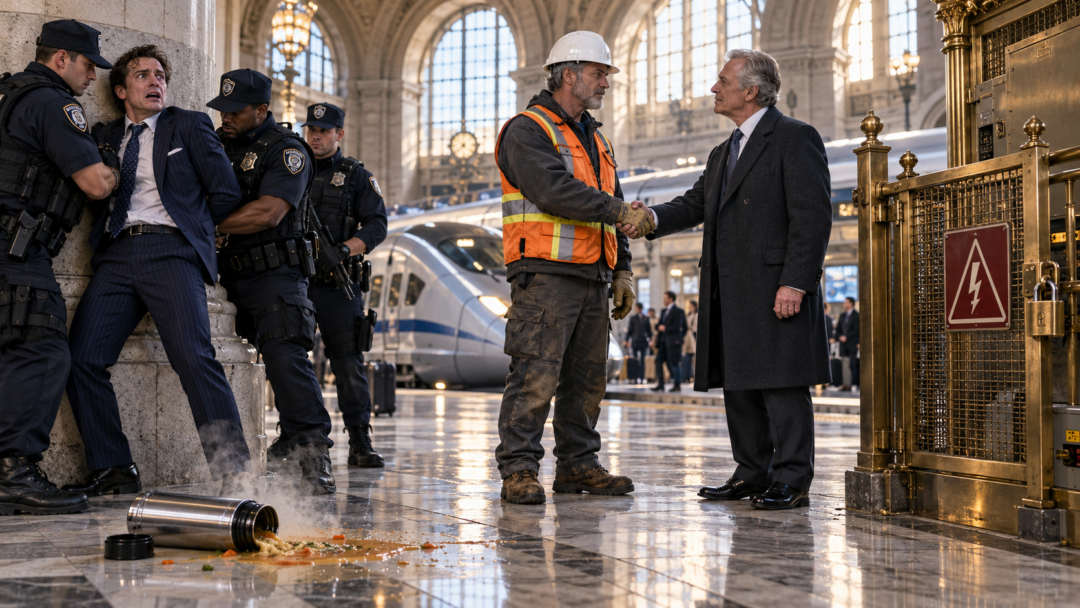
Marcus Reed sat quietly on a weathered oak bench at the head of Platform Four, his back straight as a rail girder. At fifty-two, he possessed the broad, muscular shoulders of an iron rigger and the cold, contemplative eyes of a master mathematician. He wore a heavy high-visibility orange safety vest with retroreflective silver bands over a grease-stained canvas field jacket, steel-toed lineman’s boots with dielectric rubber soles, and a plain white safety hard hat. Beside him on the wooden slats rested an open cardboard sandwich wrapper and a dented stainless-steel thermos filled with steaming chicken noodle soup.
The rhythmic shuffle of commuter traffic was shattered by the frantic, arrogant clatter of hard leather soles slamming across the marble tiles.
“Out of the way, you goddamn tunnel rat! Move your garbage!”
Garrett Vance charged down Platform Four like a torpedo tearing through shallow water. He was thirty-eight, sharp-featured, his face flushed with manic, explosive fury. He wore a tailored three-thousand-dollar navy pinstripe three-piece suit, an Hermes silk tie, and carried a reinforced leather attache case in his left hand. In his right hand, he clutched a gold-plated electronic transit pass.
As Vance reached the bench, he drew back his polished Oxford shoe and violently kicked Marcus’s thermos.
The heavy stainless-steel cylinder flew off the bench, clattering loudly against the marble floor before slamming into a ceramic tile pillar. Steaming hot soup and noodles exploded across the polished stone, splashing over the toes of Marcus’s dielectric work boots.
Marcus did not flinch, nor did he drop the half-eaten sandwich in his hand. He slowly set the food down on the wax paper, wiped his calloused fingers with a clean red shop rag, and turned his head slowly to face the intruder.
His steel-grey eyes looked up at Vance from beneath the brim of his hard hat, radiating the cold, unyielding authority of a man who had commanded bridge reconstruction battalions in the Persian Gulf and inspected high-voltage rail grids from Boston to Washington.
Vance did not pause. He sprinted past the bench toward the end of Platform Four, grabbing the heavy brass maintenance gate that cordoned off the active electrified third-rail express tracks.
The gate was secured with a heavy forged-steel chain and a massive brass master padlock. Bolted to the center of the gate was a luminescent red enamel warning sign that read: DANGER — 750 VOLTS DC THIRD RAIL — HIGH VOLTAGE AUTHORIZED PERSONNEL ONLY.
With an oath of pure, entitled hysteria, Vance grabbed the gate with both hands, shaking the iron bars so violently that the warning sign rattled against the chain links. He reached into his coat pocket, pulled out a chrome twelve-inch steel pry bar, and wedged the blade into the locking hasp.
“Open this gate right now, you deaf bum!” Vance screamed over his shoulder, his voice echoing off the tile vaults. “I have a forty-million-dollar private equity closing at the Union League Club in twelve minutes! The main concourse escalators are blocked! Unlock this maintenance passage immediately, or I will have the railway president fire your entire shift before lunch!”
Marcus stood up slowly. He rose to his full height of six feet two inches, his orange vest catching the harsh overhead platform lights. He took three measured, unhurried strides across the wet marble, his gloved right hand clamping down firmly over the chrome pry bar Vance was holding.
With a slight, effortless contraction of his forearm, Marcus levered the steel tool out of Vance’s grip, letting it clatter harmlessly onto the platform.
“Step away from the gate, son,” Marcus said, his voice a deep, gravelly baritone that rumbled with the terrifying authority of a locomotive engine. “That third rail carries seven hundred and fifty volts of direct current at four thousand amperes. If that pry bar slips and brushes the protective timber cover, it will draw an electric arc that will vaporize your suit and stop your heart in forty milliseconds. Forcing this barrier is a class-three federal transit felony.”
Vance’s face darkened with savage, aristocratic fury. He took an aggressive step forward, shoving his manicured hands violently against Marcus’s heavy canvas chest. “Do you have any idea who I am, you track laborer? I am Garrett Vance, senior managing partner of Meridian Transit Capital! My fund holds the restructuring bonds for this entire dilapidated subway system! I own the tracks you stand on! I can buy your life and have you sweeping platforms in the Bronx for the rest of your miserable days!”
Marcus did not shift his feet by a single fraction of an inch. His expression remained as cold and immovable as a granite bedrock foundation.
He looked down at the puddle of spilled soup beneath their feet. Lying in the broth, dislodged from the false bottom of Vance’s leather attache case when he had kicked the thermos, was a miniature black electronic transmitter with a magnetic antenna, pulsing with a faint blue diode light. Etched into the plastic housing was a railway frequency code: 450.25 MHZ — POSITIVE TRAIN CONTROL BYPASS.
Before Vance could notice the fallen device, the synchronized cadence of heavy boots echoed down the platform colonnade.