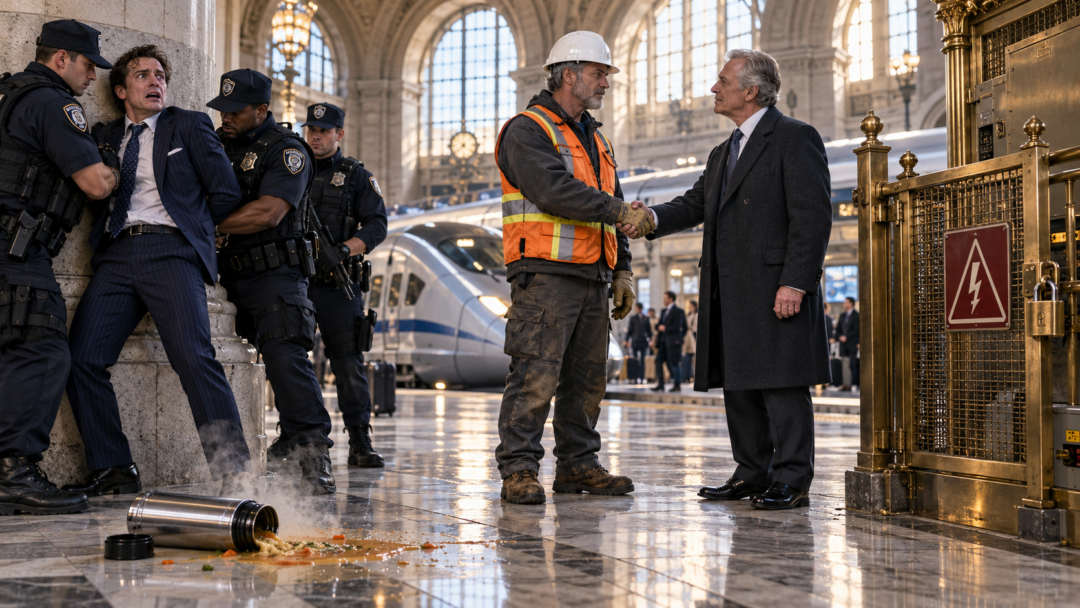
The High Voltage Track Gate In The Terminal And The Chief Inspector
CHAPTER 4: THE BOARDROOM ON PARK AVENUE
At 7:30 AM, the executive conference room on the fifty-second floor of the Meridian Capital Tower on Park Avenue was bathed in the cold, gray light of early morning. Through the floor-to-ceiling plate glass windows, the entire panorama of Manhattan stretched toward the Atlantic, the morning commuter trains crawling like silver caterpillars into the underground tunnels of Grand Central.
Garrett Vance stood at the head of the forty-foot polished granite conference table, wearing a fresh tailored navy suit, holding an espresso cup in his manicured hand. Seated around the table were ten senior investment partners, alongside the Deputy Transportation Commissioner of New York, Arthur Bradley.
“Gentlemen, the market opens in ninety minutes,” Vance began, his voice dripping with smooth, venomous triumph. He tapped a tablet, illuminating an eighty-five-inch digital display showing the credit default swap curve on New York State municipal transportation bonds.
“As we speak, our short positions on state transit bonds stand at three hundred and twenty million dollars,” Vance said, pacing along the glass wall. “At 9:15 AM, the Governor’s high-speed demonstration train will experience a catastrophic traction power collapse inside the Park Avenue tunnel. The signals will go dark, the brakes will lock, and two thousand passengers will be trapped in the smoke for three hours.”
Deputy Commissioner Bradley smiled thinly, sipping his water. “And the media strategy, Garrett?”
“Every major network will receive an emergency briefing from our policy institute twenty minutes after the stall,” Vance announced, his eyes glinting with cold, predatory excitement. “We will declare that the state transit authority is technologically bankrupt, biologically hazardous, and functionally incapable of running a modern rail grid. By noon, the legislature will convene an emergency session to approve our sixty-year privatization lease. We will acquire the entire passenger rail network for pennies on the dollar, retire the municipal debt through federal infrastructure grants, and double the ticket fares by next quarter.”
Bradley nodded in quiet satisfaction. “And the signal maintainer? The old man in Substation Seven who was asking questions?”
Vance waved a dismissive, manicured hand. “He was suspended yesterday. Some broken-down track laborer on Platform Four tried to get in my way this morning, but I kicked his thermos into the dirt and left him in his soup. These transit workers are peasants, Arthur. They understand wrenches and diesel grease. They have no idea how power operates in this city.”
Before Bradley could reply, the secure boardroom telephone on the table began to chime with urgent, piercing shrillness.
Inside the fifty-second-floor boardroom of the Meridian Capital Tower, the morning sun glared off the polished glass facades of midtown, turning the canyon of Park Avenue into a blinding expanse of reflected steel. Garrett Vance took another sip of his double espresso, his fingers tapping an impatient rhythm on the edge of the rosewood conference table.
Deputy Commissioner Arthur Bradley glanced nervously at his watch, adjusting his gold cufflinks with sweaty fingers. “Garrett, if the FRA dispatch center in Philadelphia detects the optical transponder before the express reaches the viaduct, federal inspectors have the statutory authority to halt all train movements into Manhattan under an emergency safety directive. If they stop the train before it enters the tunnel, the media narrative collapses.”
Vance laughed—a sharp, dismissive bark that carried the absolute, unshakable arrogance of a man who believed that capital dictated reality. “The FRA dispatchers are union bureaucrats sitting in a windowless room five hundred miles away, Arthur. They rely on the automated SCADA telemetry. And our software patch feeds their screens a continuous green signal loop until the train crosses the physical trip point at Fifty-Ninth Street. By the time anyone realizes that the track is de-energized, the Governor’s train will be coasting dead in the smoke, and our private emergency rescue locomotives will be the only equipment authorized to enter the tube.”
He pointed a manicured finger toward the window, looking down at the tiny, ant-like figures of commuters pouring out of Grand Central. “In sixty minutes, the state will have no choice but to hand us the keys to the entire network. And those peasants on the platforms will pay whatever price we set just to get home to their suburbs tonight.”
The digital stock tickers on the conference room monitors flickered with erratic fluctuations as the opening bell approached on Wall Street. Deputy Commissioner Bradley leaned against the glass partition, watching the yellow commuter ferries crossing the East River into the morning fog. “Garrett, if this operation fails, the federal transportation inspectors will pull every procurement contract our consortium holds in three states. The Department of Justice will convene a special grand jury before the market closes.”
Vance adjusted his Hermes tie with cold, sociopathic calm. “Nothing will fail, Arthur. We have controlled the financial narrative for three decades. The public will believe whatever the cable news networks report, and by the time the investigation concludes three years from now, our private operating lease will be locked in permanent statutory law. Sit down and pour yourself a coffee. The show is about to begin. In this town, capital buys silence, power rewrites regulations, and the men who pull the levers of finance will always dictate terms to the working classes who build the tracks. We will forge our victory upon the ruins of their public trust, and no one will ever challenge our absolute reign over this entire great city again forever and ever.”