The High Voltage Track Gate In The Terminal And The Chief Inspector
CHAPTER 5: THE ARC FLASH IN THE SWITCH VAULT
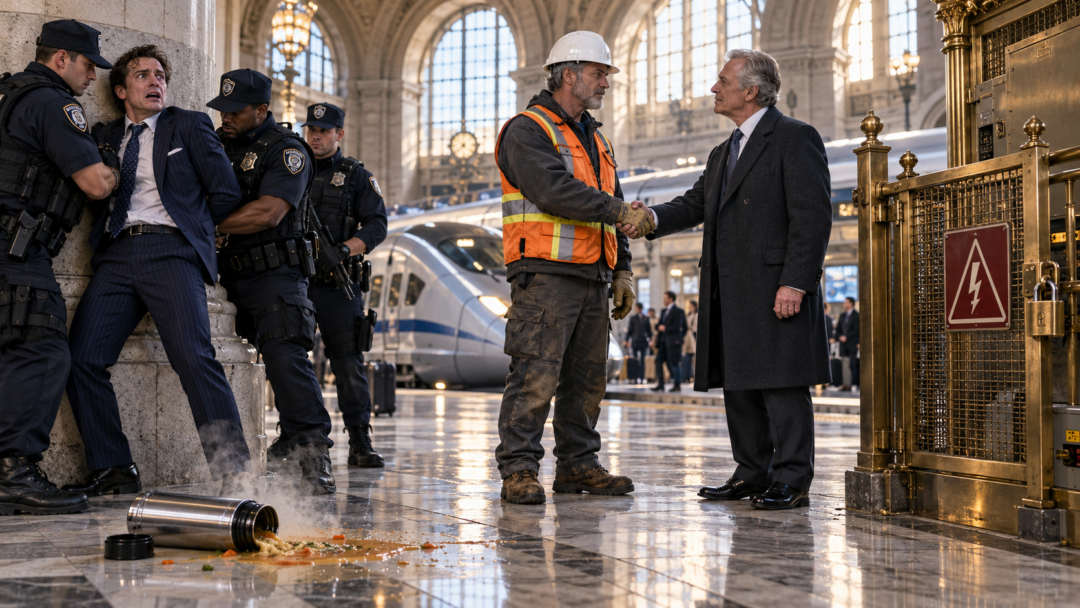
At 8:45 AM, the traction power control room beneath Grand Central was filled with the frantic clicking of automated relay banks. Outside on Platform Four, thousands of morning commuters were beginning to pack the station, waiting for the arrival of the Albany Governor’s Express.
Marcus Reed stood before the master supervisory control console, his hands encased in sixteen-thousand-volt dielectric rubber lineman’s gloves. Beside him stood Frank Kowalski, holding an insulated fiber-optic splicing kit.
“The remote microwave jammer on Interlocking Forty-Two is de-energized, Marcus,” Frank reported, his eyes glued to the optical oscilloscope. “The mechanical derailer has been removed from Track Four, and the track circuit resistance has stabilized at three point two ohms. The rails are clean.”
Suddenly, a violent electrical alarm screamed through the overhead speakers.
The primary traction power telemetry screen flashed blinding crimson: ALARM — HIGH-VOLTAGE SUBSTATION SEVEN BREAKER OVERRIDE — DIRECT CURRENT BUS SHORT.
“Someone is manually jamming the main transformer breaker in Substation Seven!” Frank shouted, his face turning pale. “They’re trying to trigger a three-phase arc flash inside the Forty-Ninth Street vault! If that transformer blows, forty blocks of midtown Manhattan will lose power, and Track Four will go dead in thirty seconds!”
Marcus didn’t hesitate. He grabbed an eight-foot insulated fiberglass rescue hook, bolted through the vault fire door, and sprinted down the narrow concrete maintenance tunnel toward Substation Seven.
He arrived at the transformer vault just as the air began to glow with the terrifying, violet ozone ionization of an impending electrical explosion.
Standing in front of the twelve-foot-tall oil-filled transformer bank was Garrett Vance’s private security chief, holding an eight-foot steel grounding rod, attempting to jam the rod across the primary twenty-seven-thousand-volt copper bus bars to force a catastrophic phase-to-ground fault.
“Step away from the bus!” Marcus roared, his voice cutting through the deafening electrical hum.
The security operative turned, his face illuminated by the dancing violet corona of high-voltage ionization, and swung the steel rod directly toward Marcus’s head.
Marcus moved with the mechanical precision of an electrical lineman who had spent his life respecting high voltage. He brought up his insulated fiberglass rescue hook, deflecting the steel rod away from the live copper bars, then hooked the crook of the pole behind the operative’s neck. With one massive, hydraulic heave of his shoulders, Marcus yanked the saboteur backward, slamming him onto the non-conductive rubber floor matting and pinning him beneath his boots.
With his free hand, Marcus engaged the emergency pneumatic breaker reset.
The heavy magnetic coils clanged shut with a thunderous mechanical crack. The violet ionization vanished, the warning sirens died, and the traction power grid of Grand Central surged back to life with unbroken, seventy-five-volt purity.
The blistering heat radiating from the twelve-foot-tall transformer core in Substation Seven made the air shimmer like a desert highway. Marcus Reed kept his boots firmly planted on the thick dielectric rubber floor matting, his hands gripping the eight-foot fiberglass rescue hook with unyielding leverage as he held the saboteur pinned against the structural column.
The transformer hum was deafening—a terrifying, seventy-decibel fifty-cycle drone that vibrated through the concrete walls and made the fillings in Marcus’s teeth ache. Above their heads, the massive porcelain high-voltage bushings were crowned with dancing, violet halos of St. Elmo’s fire, where the air was ionizing under the extreme electrical field.
“Who supplied the master breaker codes?” Marcus shouted over the roar of the fans, his voice booming with the terrible authority of an engine commander. “The SCADA password for Substation Seven is rotated every twenty-four hours on a hardware token!”
The pinned saboteur gasped for breath, his eyes wide with animal terror as he looked up at the live twenty-seven-thousand-volt copper bus bars barely three feet above his head. “Bradley! Deputy Commissioner Bradley! He gave us the administrative token forty-eight hours ago! He told us the breaker would drop the line automatically without triggering an arc flash! He lied to us!”
Marcus looked at the electrical control panel, where the pneumatic reset valve was hissing softly under thirty pounds of compressed air. He knew that Bradley and Vance had planned to sacrifice this saboteur along with the transformer; an arc flash at twenty-seven thousand volts would have vaporized the operative completely, destroying every physical trace of the sabotage and leaving the state with an unexplainable catastrophic equipment explosion. The corporate vultures didn’t just commodify the railway; they treated their own hired hands as disposable fuel for their greed.
The thick smell of hot transformer oil and ozone slowly cleared from the concrete air of Substation Seven as the ventilation blowers roared back to life. Marcus Reed stood over the secured transformer breaker, his dielectric gloves resting on the manual trip lever, his breathing slow and measured in the cool draft rushing through the opened intake vents.
“The three-phase voltage balance is restored, Marcus,” Frank announced from the monitoring desk, his voice filled with profound relief. “Twenty-seven thousand volts nominal on the primary bus; seven hundred and fifty volts pure DC on the third-rail feeders. The traction substations from Grand Central to Mott Haven are locked and synchronized.” Marcus took off his heavy rubber gloves, wiping his brow with his red shop rag. “The power is holding, Frank. Now let us go up to the platform and meet the man who thought he could buy the third rail. The foundation of this railway was built in sweat, blood, and honor, and no corporate raider will ever break its stride.”