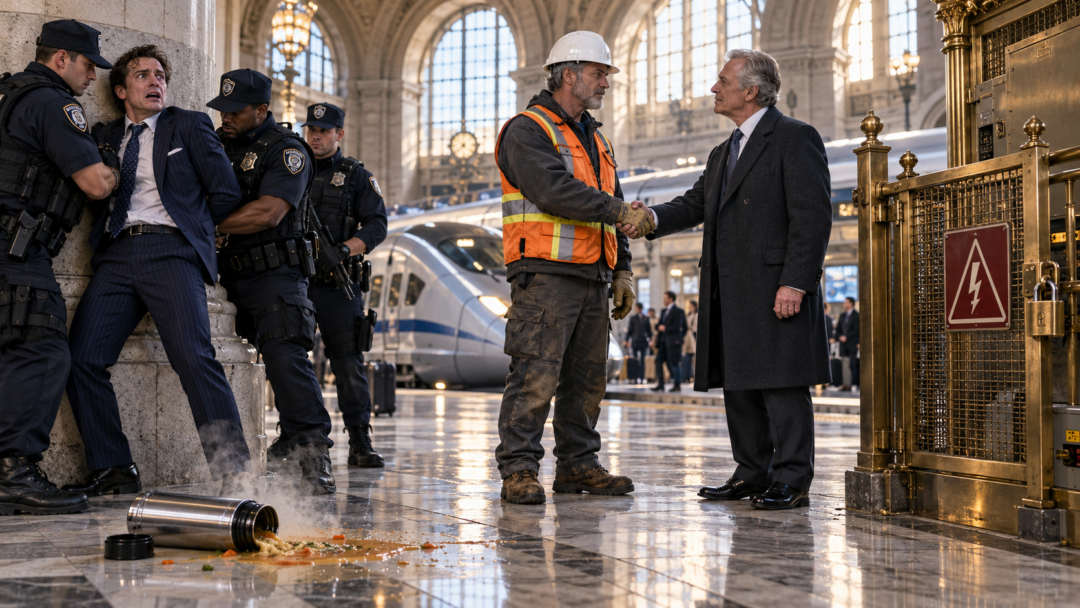
The High Voltage Track Gate In The Terminal And The Chief Inspector
CHAPTER 2: THE SEVERED FIBER IN SUBSTATION SEVEN
Forty minutes before the platform confrontation, Marcus had been eighty feet underground, standing in the subterranean vault of Traction Power Substation Seven beneath Forty-Ninth Street. The air in the cavern smelled of hot transformer oil, ionized copper, and dry cement dust. Towering racks of solid-state silicon rectifiers hummed with a bone-jarring fifty-cycle vibration, converting twenty-seven thousand volts of alternating current from Con Edison into the direct current that powered the third rails of Manhattan.
Beside the central telemetry console stood Frank Kowalski, wearing a faded blue utility jumpsuit, his fifty-eight-year-old face lined with deep exhaustion and grease smudges. In his hands, he held a pair of severed fiber-optic jumper cables, their glass cores sliced cleanly with a diamond cleaver.
“Look at the telemetry logs, Marcus,” Frank said, his voice trembling with quiet fury as he inserted a test probe into the optical terminal. “At 4:00 AM this morning, during the scheduled track inspection window, someone bypassed the auxiliary security portal on the street level. They spliced an unauthorized microwave transponder into the optical bus that communicates with the centralized Positive Train Control interlocking.”
Marcus adjusted his reading glasses, leaning over the glowing green terminal. “The interlocking controls the automatic block signals between Fifty-Ninth Street and Grand Central. If that optical line is compromised, the centralized computer loses real-time position reporting for every train on Tracks One through Six.”
“That’s exactly what they planned,” Frank whispered, wiping sweat from his forehead with the back of a calloused hand. “Yesterday afternoon, when I found the spliced cables and reported them to the operations superintendent, I didn’t get an emergency repair crew. I got two private security guards from Meridian Transit Capital who served me with an immediate administrative suspension. They claimed I was suffering from operational fatigue. They threatened that if I spoke to the Federal Railroad Administration, they would cancel my pension and refer me to the district attorney for criminal negligence.”
Marcus touched the severed glass fibers, his eyes darkening into cold flint. “Meridian Transit Capital doesn’t care about operational fatigue, Frank. They care about triggering a catastrophic fail-safe stop on the morning express line. If three commuter trains are stranded in the Park Avenue tunnel during peak rush hour, the state legislature will vote to approve the emergency privatization bill that hands the entire Northeast passenger corridor to Vance’s consortium.”
“And the Governor’s express?” Frank asked, his hands shaking. “The Governor is scheduled to arrive on Track Four on the morning high-speed demonstration train from Albany at 9:15 AM.”
Marcus pulled the miniature electronic transmitter from his pocket—the one he had recovered from the spilled soup on Platform Four—and placed it flat upon the substation desk.
Frank stared at the device in absolute horror. “That’s an emergency radio-frequency shunt. If someone triggers that transmitter while a train is entering the platform, it overrides the cab signaling system, drops the track voltage to zero, and cuts the pneumatic brake reservoir line.”
“It isn’t an accident, Frank,” Marcus said, his voice dropping into a deadly, quiet register. “It is an act of state-sponsored economic sabotage. And we have thirty minutes before that train enters the tunnel.”
The massive silicon-controlled rectifier banks in Substation Seven hummed with a heavy, magnetic vibration that resonated deep inside Marcus’s chest. The air grew hotter near the high-current bus ducts, radiating the dry, electrical heat of forty thousand amperes surging through solid copper bars. Frank Kowalski wiped a smear of oil from his nose, looking up at the illuminated system schematic on the wall that mapped every track circuit between Grand Central and Harlem-125th Street.
“When my father started on this railroad in 1954, Marcus,” Frank said, his voice husky with emotion, “he worked the manual signal towers along the Harlem River. He had two dozen mechanical levers connected to iron pipe-lines that ran five hundred feet through the gravel. If a lever didn’t latch, you felt the resistance in your shoulders; you knew a switch point was fouled with ice before the train ever hit the signal block. Now, these private equity hedge funds think they can replace a century of institutional muscle memory with remote software patches and outsourced contractors who don’t know the difference between an insulated rail joint and a fishplate.”
Marcus adjusted his hard hat, looking closely at the optical patch panel where the spliced cables hung like severed nerves. “They don’t want efficiency, Frank. They want systemic failure that looks like natural obsolescence. If the public believes that the passenger grid is crumbling under state management, they will surrender the right-of-way without asking who profits from the liquidation. But a railroad is not an algorithm on an investor deck. It is physical steel, moving human beings at ninety miles an hour through the dark, and we are not going to let them burn it down.”
Frank picked up a specialized wire-stripping tool, inspecting the microscopic core of a single-mode glass strand under a portable inspection loupe. “If that optical signal drops out for more than three hundred milliseconds, the central processor automatically drops every track relay into fail-safe mode. The wayside signals drop from clear green to stop-and-proceed red, the automatic speed control clamps down on the train line, and two dozen commuter runs grind to a halt between 125th Street and New Rochelle.”
Marcus leaned over the wiring harness, his calloused hands moving with calibrated certainty. “We will not let them trigger the fail-safe, Frank. We will splice an auxiliary bypass line directly around the hijacked terminal, restoring optical continuity before the Albany train crosses the Bronx interlocking. Hand me the fusion splicer. The railroad runs on our watch, and we will keep the signal green.”