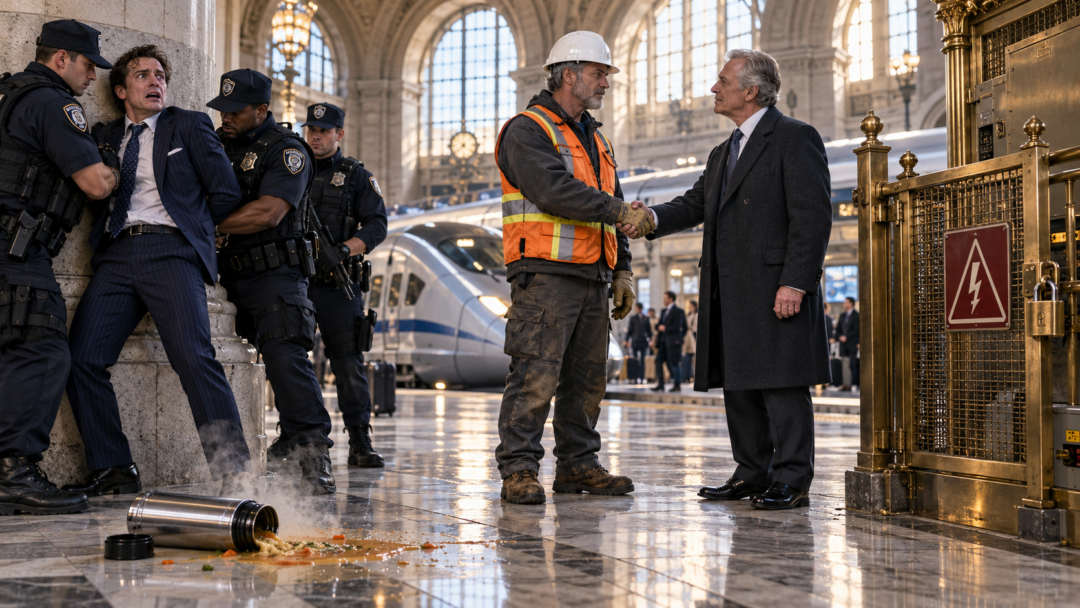
The High Voltage Track Gate In The Terminal And The Chief Inspector
CHAPTER 3: THE DARK TUNNEL OF THE PARK AVENUE VIADUCT
At 1:15 AM, the subterranean rail tunnel beneath Park Avenue was an abyssal cavern of iron and stone. The four main tracks ran parallel through vaulted limestone arches constructed during the Gilded Age, the dark steel rails stretching north toward Harlem beneath thousands of tons of Manhattan bedrock. Every fifty feet, an incandescent work lamp cast a sickly yellow circle across the wooden ties and black ballast gravel.
Marcus walked the center gauge of Track Four, his high-visibility vest reflecting the amber signal lanterns. In his right hand, he carried an insulated fiberglass hot-line stick; on his head, his white hard hat’s high-intensity LED beam pierced the gloom like a scalpel.
Beside him walked Frank Kowalski, carrying a portable track circuit meter.
“The voltage drop is localized right here at Interlocking Forty-Two,” Frank called out, pointing his meter at a switch frog where two tracks converged.
Marcus knelt in the ballast gravel. He ran his beam along the web of the seventy-five-pound rail. Clamped to the inner flange of the high-speed rail was a heavy mechanical derailer—a forged-steel wedge coated in non-reflective black paint, wired to a radio-controlled solenoid actuator.
If a train hit that wedge at sixty miles per hour, the lead locomotive would jump the tracks, shearing the support columns of the Park Avenue tunnel and bringing down the street above.
“Someone paid twenty thousand dollars for that military-grade actuator,” Marcus observed calmly, pulling a pair of insulated cutters from his harness. “It is set to trigger when an automated acoustic signature matches an Acela express locomotive.”
“Step away from the switch, trackman.”
A harsh, grating voice echoed out of the darkness behind them.
Two men stepped out from the shadow of an emergency electrical alcove, dressed in black tactical jumpsuits with ballistic vests. In their hands were suppressed automatic carbines, their red laser sights painting two trembling dots directly onto the center of Marcus’s orange safety vest.
Marcus did not drop his cutters. He slowly stood up, turning his head toward the armed operatives with the steady, unflinching composure of a combat veteran who had walked through minefields.
“You are trespassing in an active federal rail right-of-way,” Marcus said, his voice flat, calm, and terrifyingly close in the damp tunnel. “Under Title Forty-Nine of the United States Code, tampering with an active passenger rail switch is punishable by life imprisonment.”
The lead operative sneered beneath his tactical mask. “Nobody is going to prison, old man. We have orders from Meridian Security to ensure that Interlocking Forty-Two remains locked until the 9:15 Albany express arrives. Drop the tools and get down on your knees.”
Marcus didn’t drop the tools. In one blindingly fast, explosive motion, he swung the nine-foot fiberglass hot-line stick in a wide, sweeping arc. The heavy fiberglass pole struck the lead operative’s carbine with brutal force, knocking the weapon from his hands and sending it clattering into the high-voltage third-rail trough.
A blinding, blue-white electric arc exploded in the tunnel with a deafening roar like a lightning strike. The electrical fireball blinded the second operative, and before he could re-acquire his target, Marcus drove his heavy steel-toed lineman’s boot forward, sweeping the man’s legs from under him and driving him face-down into the crushed ballast gravel.
The damp ballast gravel beneath Marcus’s boots crunched softly as he walked the gauge of Track Four, his flashlight beam illuminating the condensation dripping from the century-old brick ceiling of the Park Avenue viaduct. Every few seconds, the air pressure shifted with a deep, muffled pneumatic wave as express trains on adjacent tracks rushed past in the darkness, their steel flanged wheels screaming against the curved outer rails.
Marcus knelt beside the mechanical derailer, using his tactical inspection mirror to examine the mounting bracket bolted to the base of the rail. The bolts had been torqued with a calibrated pneumatic wrench, their heads sealed with high-strength thread-locking adhesive. Whoever had installed the trap had done so with the clinical, methodical precision of a trained demolition diver.
He unclipped a five-pound cold chisel and an eight-pound brass-faced sledge from his utility pack. Working in the cramped, twenty-four-inch clearance beneath the live third-rail cover board, he struck the mounting bolts with measured, rhythmic blows. Each strike sent bright orange sparks spraying into the black ballast gravel, the sharp ring of hardened steel against steel echoing down the tunnel toward Grand Central. He didn’t rush. On high-voltage tracks, haste was lethal; a single stray blow that touched the energized third-rail conductor would trigger an instantaneous four-thousand-ampere explosion. In eight minutes of surgical labor, the mechanical wedge gave way with a dull, resonant clink, tumbling into the drainage trough. The main line was clear.
The cold mist in the Park Avenue tunnel swirled in the beam of Marcus’s inspection light, smelling of brake shoes, sulfur, and ancient stone. He knelt in the ballast, running his gloved fingers along the newly exposed rail web to verify that the derailing clamp had not gouged the running surface. Even a microscopic nick in the head of a high-speed rail could propagate into a catastrophic transverse fissure under the pounding impact of a hundred-ton locomotive traveling at express speeds.
“The running rail is clean, Marcus,” Frank reported, sliding a magnetic flaw detector along the rail crown. “No micro-cracking, no spalling. The track will take sixty miles an hour without flinching.” Marcus stood up, looking north into the black tunnel where the distant green signal lights shone like emeralds in the gloom. “The train will arrive on time, Frank. Clear the tools into the alcove and signal the dispatcher that Track Four is open for revenue service.”