The High Voltage Track Gate In The Terminal And The Chief Inspector
CHAPTER 7: THE UNBROKEN LINE OF STEEL
At 9:15 AM precisely, a deep, musical two-tone electric locomotive horn echoed through the soaring vaults of Grand Central Terminal.
Emerging from the darkness of the Park Avenue tunnel, gliding smoothly onto Track Four at five miles per hour, was the gleaming blue and silver high-speed Albany Express. The stainless-steel train cars reflected the warm amber chandeliers of the station, their windows clean, their passengers smiling and gathering their luggage as the train came to a perfect, whisper-quiet halt beside Platform Four.
Stepping off the lead executive car was the Governor of New York, surrounded by transit engineers and journalists.
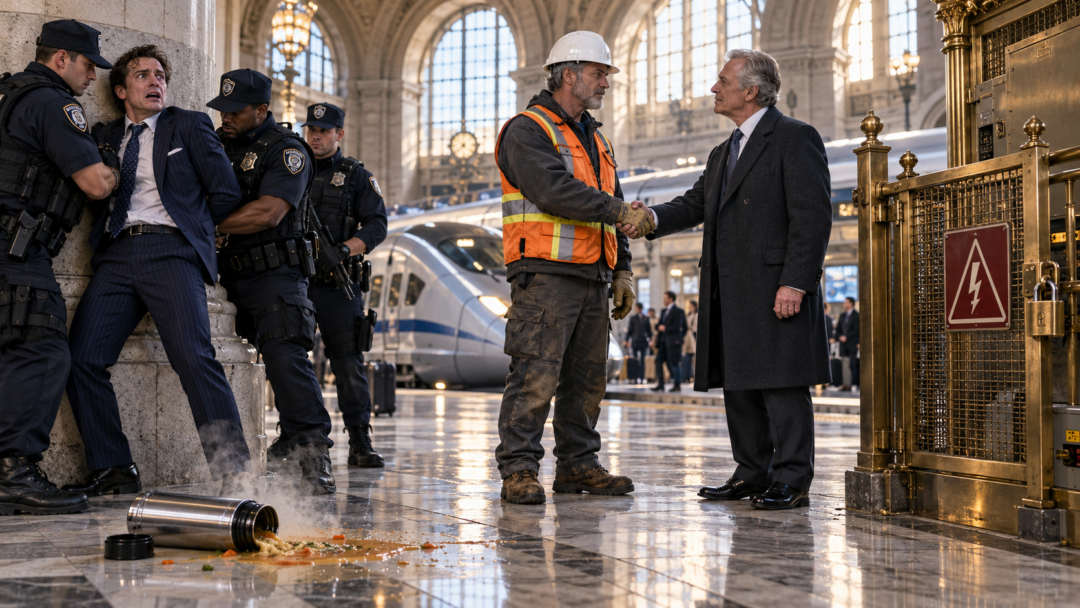
The Governor walked directly to where Marcus Reed stood beside the wooden bench, extending his hand with deep, heartfelt gratitude. “Marcus. CEO Miller briefed me from the cab. You and your men saved thousands of lives this morning, and you saved the public soul of this state.”
Marcus smiled gently, his calloused hand shaking the Governor’s with modest dignity. “We only did our duty, Governor. The tracks belong to the people. It’s our job to keep them safe.”
Beside Marcus stood Frank Kowalski, his uniform clean, his eyes shining with proud tears as CEO Miller personally handed him his official reinstatement certificate as Chief Master Signal Maintainer of the Northeast Corridor for life, with full back pay and a formal public apology from the state transportation board.
“Look at the rails, Marcus,” Frank whispered, looking down at the gleaming silver tracks running true and straight into the dark tunnel. “They couldn’t break them. They couldn’t break a single tie.”
Marcus looked down at the dented stainless-steel thermos on the floor, picking it up and placing it back on the bench. The soup was gone, but the steel of the platform was unbroken, solid and pure beneath his feet.
He walked to the end of Platform Four, leaning against the locked brass gate, watching as thousands of ordinary men and women stepped off the train—teachers, nurses, construction workers, and office clerks—heading into the morning streets of Manhattan to build their lives, raise their families, and pursue their dreams in safety.
Arrogant men with billions in stolen capital believed they could buy the infrastructure of a nation, holding human lives hostage to feed their private greed. But the real strength of the country was not forged in private equity boardrooms; it was forged in the sweat of the trackmen, the courage of the engineers, and the unbroken line of steel that tied the continent together beneath the American sky.
The mid-morning sunlight poured through the magnificent seventy-foot Roman arch windows of Grand Central, casting brilliant shafts of golden light across the bustling marble concourse. Outside on Forty-Second Street, the autumn city moved with its eternal, vibrant rhythm, taxis honking, pedestrians hurrying across crosswalks, while thousands of commuters moved safely through the vaulted gates into the heart of Manhattan.
On Platform Four, the Albany Governor’s Express sat gleaming under the inspection lamps, its high-voltage pantographs extended toward the overhead catenary, its electric traction motors humming in smooth, flawless readiness for the return run.
Frank Kowalski walked down the platform beside Marcus Reed, carrying his leather signal maintainer’s kit, a peaceful, triumphant smile lighting up his weathered face. “The interlocking reports are coming in from Stamford, New Haven, and Boston, Marcus. Every switch point on the corridor is green. Every circuit is holding voltage.”
Marcus nodded slowly, taking a deep breath of the cool, clean terminal air. He looked at the locked brass maintenance gate, where the red high-voltage sign gleamed peacefully in the sunlight.
He had worked these tracks for thirty years, through blizzards, blackouts, and corporate storms. Men like Garrett Vance came and went, with their private jets, their short positions, and their stolen millions, believing they could buy the veins and arteries of the republic. But the tracks did not belong to the financial syndicates. They belonged to the men who laid the steel, the engineers who guarded the signals, and the millions of ordinary citizens whose journeys were bound together in trust.
Marcus adjusted the straps of his orange safety vest, pulled down his white hard hat, and walked slowly toward the inspection stairs leading down to Track One, his watch secure and the line unbroken beneath the American sky.
The heavy electric locomotive of the Albany Express began to discharge its passengers, the platform filling with a joyous tide of families, business travelers, and students arriving in the city for the day’s work. The smell of fresh coffee and roasted nuts from the station concourse drifted across the tracks, mingling with the cool autumn breeze.
Governor David Sterling stepped over to Marcus Reed, placing a hand on the safety director’s canvas shoulder. “The legislature was scheduled to vote on the privatization bill at noon today, Marcus. I have already instructed my counsel to withdraw the bill permanently. This railroad will remain a public trust as long as this state stands.”
Marcus smiled, his weathered face reflecting the warm golden light of the terminal arches. “The tracks don’t ask who owns them, Governor. They only ask for truth, maintenance, and courage. Keep them funded, keep them safe, and the trains will always run.” He adjusted his white hard hat, picked up his dented thermos from the bench, and walked down the platform into the heart of the great station, his duty fulfilled and the line unbroken beneath the American sky.