The Deep Wet Concrete Trench Trapped the Arrogant Mansion Neighbor
CHAPTER 1: THE WARNING STAKE ON OLD HILLSBORO ROAD
The crisp autumn air over Williamson County, Tennessee, smelled of cured timber, wood smoke, and the damp limestone earth of the Harpeth River valley. Along Old Hillsboro Road, southwest of historic Franklin, rolling pastures and centuries-old cedar glades met the sprawling, multimillion-dollar gated estates of Nashville’s executive elite. At Lot 14, where a modest two-acre parcel sat nestled between towering white oaks, the atmosphere was charged with the energetic hum of communal labor.
A large vinyl banner stretched between two timber posts at the front ditch line, bearing bold navy-blue lettering: OPERATION HOMEFRONT DEFENDER — VOLUNTEER BUILD FOR STAFF SERGEANT DANIEL COLE.
Daniel Cole was thirty-one years old, a decorated combat engineer who had lost both legs above the knee to a command-wire improvised explosive device in the Helmand Province of Afghanistan. After three years of agonizing surgeries and rehabilitation at Walter Reed, local veterans’ charities, county first responders, and civic volunteers had banded together to build Daniel, his wife Sarah, and their four-year-old daughter Emma a single-story, ADA-accessible craftsman home tailored for wheelchair independence.
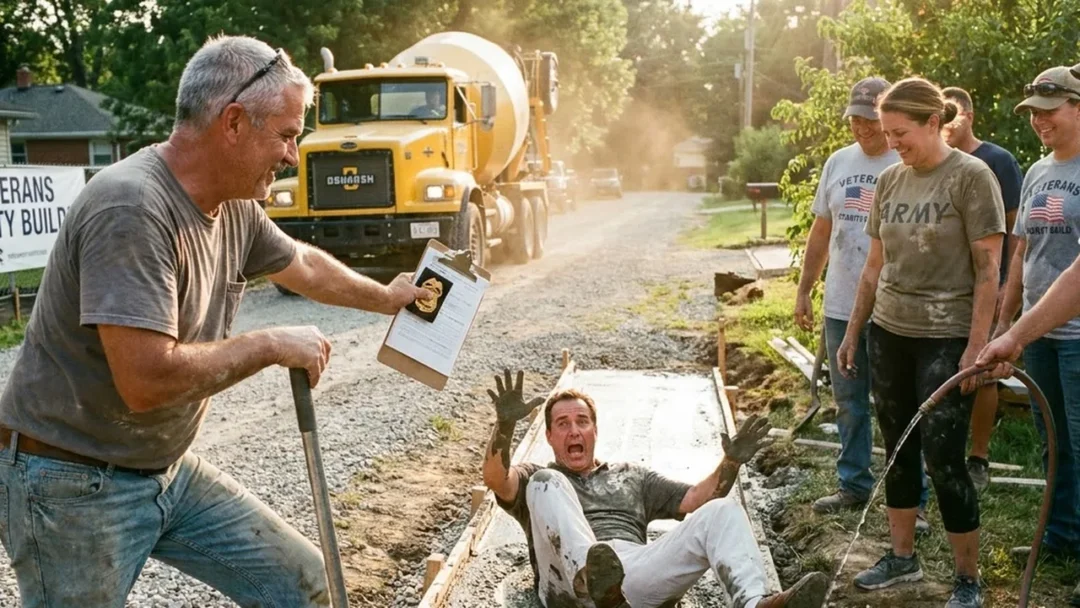
On this sun-drenched Thursday afternoon, the most critical phase of site preparation was underway: the pouring and finishing of the reinforced concrete driveway apron and the specialized deep-culvert drainage ditch required by county storm-water codes to prevent hill runoff from washing out the foundation. Parked legally on the gravel shoulder of the public two-lane road was a massive, bright-yellow ten-yard Oshkosh cement mixer truck. The truck’s heavy diesel engine purred in low gear, its massive steel drum rotating steadily as liquid grey mortar churned down the aluminum chute into the driveway approach.
Working on the ground were twelve men in sweat-stained grey work t-shirts, heavy canvas trousers, and steel-toed rubber boots. Among them was Thomas Vance, fifty-two, a seasoned veteran of thirty years in public safety who currently served as Precinct Commander for the Williamson County Sheriff’s Department. Beside him was Master Sergeant Marcus Bell, an active-duty combat engineer instructor from the Fort Campbell training battalion, wielding a twenty-foot aluminum bull-float to level the wet grey slab.
Stretched across the freshly excavated driveway approach were two lines of bright-yellow fiberglass caution tape, anchored to heavy wooden survey stakes driven deep into the red clay. Attached to the center stake was a high-visibility orange metal warning placard painted in bold reflective letters: CAUTION: 24-INCH DEEP LIQUID CONCRETE SUMP POUR — DO NOT WALK ON APRON — HAZARDOUS DROP.
Then the heavy iron security gates of the adjoining eight-thousand-square-foot neoclassical mansion swung open with a harsh mechanical groan.
Striding down the asphalt private driveway like an enraged monarch was Richard Vance. Fifty-four years old, Richard was the chief operating officer of a multinational pharmaceutical consulting firm and a prominent real estate investor who had fought for six months to block the construction of the veteran’s home through frivolous zoning appeals. Vance wore tailored white linen trousers, a lavender silk golf polo, a cashmere sweater tied over his shoulders, and bespoke two-tone calfskin golf shoes with polished brass eyelets that cost twelve hundred dollars in London.
Vance marched across the property line, his face flushed a furious, mottled shade of crimson, his manicured fingers trembling with theatrical rage.
“Shut that goddamn machine off!” Vance roared, his shrill voice carrying across the construction lot and silencing the clanking of shovels. “Shut that noisy, filthy cement truck down right this instant! Who authorized this commercial eye-sore to park on my street?!”
Thomas Vance paused, leaning his broad, calloused hands on the wooden handle of his finishing trowel, wiping sweat from his graying brow. “Sir, this truck is parked legally on the county right-of-way. We are completing the driveway culvert pour for Daniel Cole’s home. We have two more yards of concrete in the drum and forty minutes before it sets. If we stop the pour now, the cold joint will compromise the structural apron.”
“I don’t give a damn about your cold joint or your sob-story charity project!” Richard Vance screamed, stepping within inches of Thomas’s chest, completely oblivious to the name stenciled in faded black ink on the officer’s dusty work shirt. “Look at my manicured English privet hedge! Your exhaust fumes are drifting through my foliage! That commercial truck is completely blocking the panoramic street view from my front portico! I am entertaining private equity investors from New York on my terrace in two hours!”
Master Sergeant Marcus Bell stepped up, his six-foot-three muscular frame towering over the hedge fund executive, his voice dropping into quiet military discipline. “Sir, you are trespassing on an active construction perimeter. You are standing within the swing radius of heavy machinery without safety gear. Step back to your property line.”
Richard Vance’s eyes bulged with venomous disgust as he looked at Bell’s dusty arms. “Don’t you dare give orders to me, day-laborer trash! I pay more property taxes in a single quarter than you make in three years of digging ditches! I am walking straight over to that mixer, climbing into the cab, and cutting the ignition myself!”
Before anyone could move to block his path, Richard Vance lunged forward with explosive malice. He reached down, snatched Thomas Vance’s polished steel finishing trowel off the timber form, and hurled it thirty feet into the dense blackberry briars along the ditch.
In the same breath, Vance brought his bespoke leather golf shoe back and delivered a violent, sweeping kick into the wooden survey stake holding the bright yellow warning sign. The heavy cedar stake snapped with a sharp crack of splintering wood, sending the orange placard tumbling face-down into the grass.
“Nobody blocks my street!” Vance sneered, turning his back on the workers and taking two arrogant, heavy strides straight past the fallen caution tape toward the smooth, glistening grey surface of the driveway apron.
Across the lot, twelve off-duty police officers and military combat engineers stopped dead in their tracks. Nobody reached out to grab him. Nobody shouted a second warning.
The engineering specifications for the driveway apron were extraordinarily rigorous. Under the Americans with Disabilities Act and Williamson County specialized building standards, a wheelchair-accessible residential transition required a maximum slope gradient of no more than one inch of rise per twelve inches of run, completely free of surface aggregate bumps or uneven seam joints. To achieve that mirror-smooth, high-traction brush finish, the volunteer crew had conducted two slump-cone consistency tests directly from the mixer’s discharge chute, verifying that the water-to-cement ratio sat precisely at zero point four five. Every cubic yard of the commercial mix was reinforced with millions of synthetic micro-polypropylene fibers to prevent surface micro-cracking under heavy emergency vehicle wheel loads.
Thomas Vance and Marcus Bell simply folded their arms across their chests, leaning back against their wooden bull-floats, and watched in deadpan silence as the executive’s expensive leather shoes stepped squarely onto the center of the wet apron.