The Faded Midnight Train Ticket And The Missing Shipping Tycoon
CHAPTER 1: THE TICKET ON THE MEMORIAL PORTRAIT
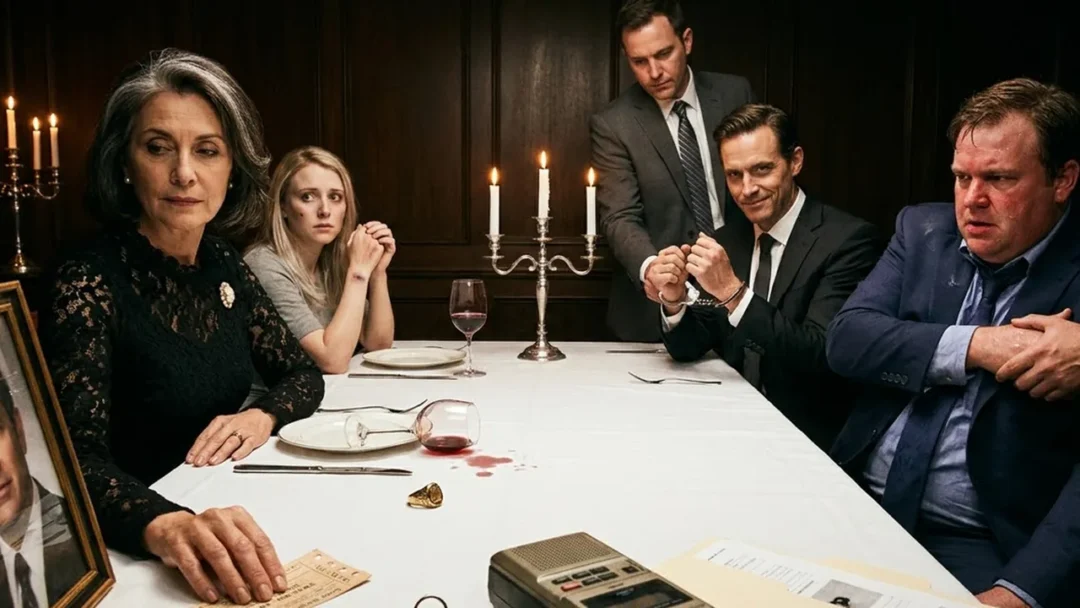
The private Founders Room on the fourth floor of the Duquesne Club was an inner sanctum of Pittsburgh old money. Dark, hand-carved black walnut wainscoting climbed fourteen feet to a beamed oak ceiling, absorbing the low murmur of thirty men and women gathered in black-tie formality around a thirty-foot banquet table draped in Belgian damask linen. Three antique sterling silver candelabras flickered with tall beeswax tapers, casting dancing amber reflections across crystal decanters of twenty-year-old port, heavy silver soup tureens, and gold-rimmed china. At the head of the table, mounted upon an ornate mahogany easel and framed by a heavy sash of black mourning silk, was an oil portrait of Richard Vance, the legendary founder of Vance River Transport, who had supposedly plunged to his watery death off the Fort Pitt Bridge twelve years ago tonight.
Standing at the head of the table, holding a crystal flute of vintage champagne, was Gerald Vance. At thirty-eight, Gerald was the chief executive of the shipping conglomerate, possessing his father’s tall, athletic frame but none of Richard’s working-class warmth. His dark-brown hair was slicked back with pomade, his gray eyes cold and assessing behind an immaculate midnight-navy tuxedo. Beside him sat Hugo Mercer, the firm’s fifty-two-year-old vice president and majority partner—a thickset, ruddy-faced man in an ill-fitting burgundy dinner jacket, his gold pinky ring tapping nervously against the linen cloth as he drained his third glass of scotch.
“Twelve years ago,” Gerald announced, his voice projecting smooth, practiced reverence across the table, “the Monongahela River claimed the visionary who built the barges that powered this valley. Tonight, as we finalize our ten-year modernization bonds, we honor the legacy of Richard Vance. To my father.”
Thirty crystal glasses rose in the candlelight.
Before a single lip could touch the wine, the heavy carved oak doors of the Founders Room swung open without an announcement.
A draft of freezing November rain swept into the heated room, smelling of damp wool, street exhaust, and wet asphalt.
Walking down the center carpet, moving with slow, stately grace, was Irene Vance. At sixty-three, Richard’s widow looked every inch an empress returning to an occupied throne. Her silver-blond hair was styled into a flawless, unyielding chignon, her pale blue eyes steady and clear behind faint, elegant laugh lines. She wore an ankle-length black wool coat over a simple black silk mourning dress, pearl drop earrings, and carried a closed black umbrella with a polished steel ferrule. In her gloved right hand, held delicately between two fingers, was a small slip of faded, yellowed cardstock.
Gerald froze, his champagne flute hovering inches from his lips, his cold gray eyes narrowing with instant fury.
“Mother,” Gerald said, his voice dropping into a razor-sharp whisper that carried across the frozen dining room. “You were not invited to this dinner. The family agreed three years ago that your emotional fragility made corporate memorials inappropriate. Waiter, escort Mrs. Vance down to the street car.”
A tuxedoed club attendant stepped forward from the service sideboard, but Irene did not even glance in his direction. She raised her left hand, and the sheer, immovable authority of her posture made the waiter halt mid-step.
Irene walked directly to the head of the table. She stopped beside the easel holding her late husband’s oil portrait. Slowly, deliberately, she laid the faded yellow cardstock squarely across the gilded bottom frame of the canvas, directly beneath the brass nameplate reading RICHARD VANCE — 1948–2014.
The slip was an antique Pennsylvania Railroad commuter ticket, printed on heavy fibrous paper. Stamped in fading red thermal ink across the top margin was the station origin: Eastbank Station — South Side, Pittsburgh.
And punched through the bottom corner by a conductor’s brass die was the time and date of departure: 12:17 A.M. — NOVEMBER 4, 2014.
“This ticket was punched at midnight, Gerald,” Irene said, her clear, crystalline voice slicing through the heavy silence of the room. “Your official police sworn statement claims that you watched your father’s Lincoln Town Car plunge through the guardrail of the Fort Pitt Bridge into thirty feet of black water at eleven-forty on the night of November third.”
A sharp murmur broke out among the bank presidents and maritime trustees seated around the table. Hugo Mercer’s head snapped up, a bead of sweat breaking across his ruddy forehead, his gold pinky ring freezing against the tablecloth.
Gerald let out a sharp, dismissive bark of laughter, though his knuckles whitened around the stem of his champagne glass. “Mother, this is a pathetic, demented stunt. You found an old commuter stub in a desk drawer and came here to humiliate the board. Anyone could buy a vintage train ticket at an antique shop in the Strip District.”
Gerald lunged forward with his right hand, his fingers clawing to snatch the yellowed ticket from the portrait frame and tear it to shreds.
He never touched the paper.
With the blinding speed of a fencing master, Irene drove the steel ferrule of her closed black umbrella straight down onto the table. The metal tip pinned Gerald’s right wrist to the white damask cloth, pressing with excruciating, focused leverage against the median nerve.
Gerald gasped in shock and pain, his champagne glass overturning, spilling dark crimson Pinot Noir across the linen like a fresh pool of arterial blood.
“Mother! Have you lost your mind?” Gerald snarled, his face contorting as he struggled against the steel tip.
Irene did not blink. She leaned forward until her blue eyes were inches from her son’s pale face.
“It was punched thirty-seven minutes after you reported him dead in the river, Gerald,” Irene whispered, her voice colder than the river itself. “And your father never rode the train alone.”