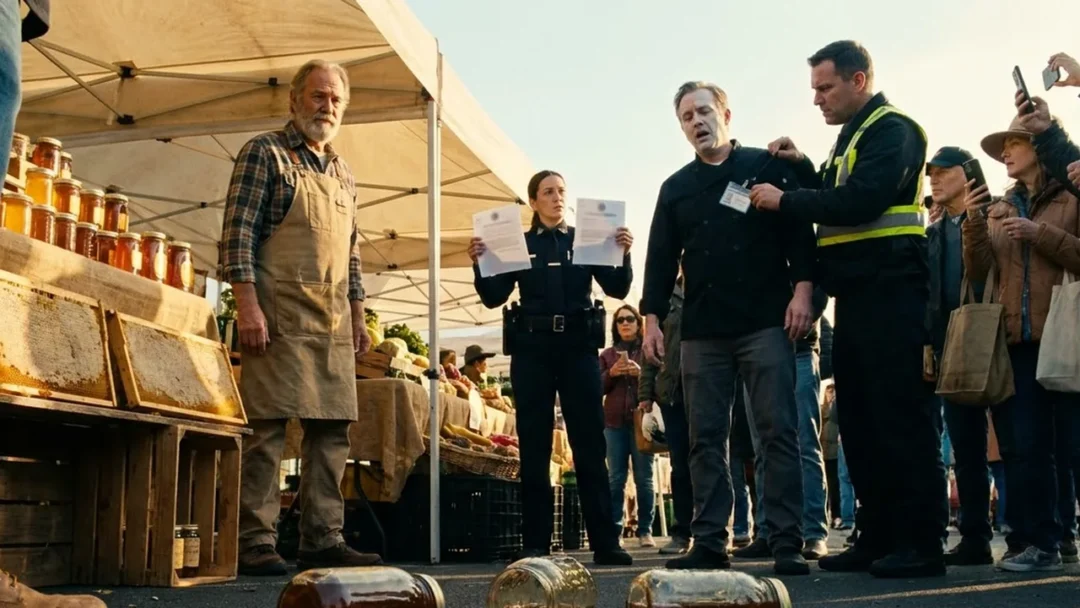
The Pure Amber Honey Jars Beneath The Market Stall Canopy
CHAPTER 1: SHATTERED GLASS ON THE COBBLESTONES
The Saturday morning fog was just beginning to burn off the gray surface of the Willamette River, letting shafts of crisp, golden autumn sunlight pierce through the Victorian cast-iron trusses of the historic Portland Farmers Market pavilion. The damp brick thoroughfare smelled of roasting Colombian dark roast, warm cinnamon hazelnut pastries fresh from the wood ovens, and the unmistakable, intoxicating floral richness of cured wild blackberry and alpine meadow clover. Elijah Thorne stood behind his handcrafted ponderosa pine table, dressed in a clean, ironed blue chambray work shirt and a split-grain canvas apron dusted with bright yellow pollen. At sixty-one years old, Elijah carried the calm, deliberate stillness of an old-country timberman who spent nine months of every year isolated in the high subalpine hollows of Mount Hood, tending two hundred and forty active colonies of Carniolan and Italian honeybees.
Arranged across his raw linen runner in three tiered, mathematically precise ranks were seventy glass pint jars of unheated, raw summer honey. The dense liquid trapped the morning sunlight like liquid topaz, each heavy glass jar bearing an understated, letterpress-printed parchment label: CASCADE CREST APIARIES — HARVESTED JULY 14 — PURE OREGON WILDFLOWER. Beside the jars sat a glass observation hive under a polished brass frame, where hundreds of worker bees crawled over capped brood comb, their quiet, collective vibration buzzing like a gentle current through the wooden tabletop.
Ten paces directly across the brick pedestrian lane stood the lavish double stall of Drake’s Reserve Artisan Provisions. It was a monument to culinary ostentation: slabs of polished white Carrara marble mounted on brushed brass pedestals, velvet-draped display risers, and halogen spotlighting illuminating custom hexagonal Italian jars sealed with hand-dipped gold wax seals. Each jar bore an embossed foil medallion declaring ESTATE TRIPLE-FILTERED MOUNTAIN NECTAR, priced at sixty-five dollars for eight ounces.
Behind that counter stood Lucian Drake. Drake was thirty-four, impeccably groomed, wearing an embroidered black double-breasted executive chef’s coat with crimson silk piping, his hair sculpted with citrus pomade, sporting a trimmed pencil mustache and titanium-rimmed designer spectacles. Over the preceding four months, Drake had aggressively cultivated connections on the municipal market oversight committee, seeking to push out traditional generational growers in order to convert the pavilion into an exclusive, high-rent luxury food boutique.
Seeing a dense crowd of thirty Saturday shoppers gather around Elijah’s humble wooden table, eagerly waiting to taste raw comb honey on biodegradable wooden spoons, Drake’s thin lips tightened into a hard, predatory line. He took a heavy leather-bound portfolio, tossed it onto his marble counter with an intentional clatter, and stepped out into the center of the wet brick walkway.
“Excuse me! Ladies and gentlemen, excuse me!” Drake’s voice rang out with the polished, booming projection of a trained infomercial pitchman, cutting cleanly through the murmur of the market crowd and the distant hiss of espresso machines. Shoppers turned their heads in surprise, several tourists instinctively pulling out their smartphones to capture the sudden commotion.
Drake strode forward until he stood three feet from Elijah’s display, extending an index finger tipped with a manicured nail directly at the amber jars.
“Are you good people seriously paying hard-earned money for this backwoods garbage?” Drake sneered, his eyes sweeping across the circle of shoppers with theatrical disbelief. “Forty dollars for a mason jar of cloudy sugar water? Look at this man! He stands here in work boots pretending to be an honest old mountain beekeeper! It is an absolute, unadulterated fraud! This man doesn’t run two hundred hives; he buys forty-weight industrial corn syrup by the pallet from discount commercial supply yards, boils it down in rusty galvanized stock tanks with brown food dye and artificial clover perfume, and sells it to unsuspecting families at an eight-hundred-percent profit! It’s a disgrace to real certified culinary artisans and an insult to every chef in the Pacific Northwest!”
Elijah did not flinch. His weathered hands, covered in decades of faded bee-sting scars, remained resting lightly on the cedar edge of his table. His blue eyes, clear as mountain creek water, held Drake’s darting gaze with quiet, unshakeable dignity.
“Every single drop of honey on this table came out of the Sandy River watershed, Mr. Drake,” Elijah said, his voice low and measured, yet carrying a resonance that silenced the surrounding whispers. “My grandfather cleared our first bee pasture along the glacier tributaries in 1964. My colonies forage on wild mountain dewberry, subalpine fir honeydew, and riverbed lupine. If you have any legitimate technical questions about our optical refractometer density, enzyme invertase activity, or certified pollen spectrums, my state inspection logs are right here under my balance scale.”
“Your logs are worth as much as toilet paper!” Drake barked, taking an aggressive step into Elijah’s designated stall space. With a violent, deliberate sweep of his right arm, Drake struck three of Elijah’s front-row honey jars.
The heavy glass jars flew off the pine table, hurtling through the air and smashing violently against the damp brick pavement directly at the toes of Elijah’s leather boots. The thick, viscous golden liquid burst outward across the wet cobblestones, mingling with jagged glass shards and splashing Elijah’s denim cuffs. A cloud of pure, concentrated floral perfume—rich with the scent of sun-warmed blackberry blossoms and cedar sap—erupted into the cool autumn air.
A collective gasp of shock and outrage ripped through the assembled crowd. Several mothers pulled their children back from the spraying glass, while two elderly shoppers yelled in protest. Drake stood triumphant over the wreckage, his chest heaving, a vicious smirk playing at the corners of his mouth as he adjusted the cuffs of his chef’s coat.
“There’s your garbage, Thorne!” Drake shouted, pointing down at the puddle with a shaking, manicured hand. “Clean it up! You belong in a holding cell behind the Multnomah County courthouse for commercial fraud, not standing among legitimate food purveyors!”
The pool of shattered glass and dense honey spread three feet across the damp brickwork, shimmering amber in the morning light. The heavy, sweet aroma of mountain clover, wild blackberry brambles, and raw comb wax filled the aisle, so fresh and untainted that several customers in the front row shook their heads in immediate disbelief at Drake’s accusations. A low, angry rumble began to circulate among the market regulars—people who had purchased Elijah’s honey for their children, their tea, and their morning toast for twenty years. A burly carpenter in flannel stepped forward, his fists clenching at his sides, but Elijah raised a single split-leather glove, signaling for patience.
Elijah slowly looked down at the shattered glass and the pool of amber honey soaking into the porous clay brick. He did not curse, nor did his expression betray anger. In the quiet alpine meadows where he spent his days, panic was the fastest way to get stung by ten thousand bees; survival required still hands, steady lungs, and absolute truth. He reached deliberately into the breast pocket of his work shirt, withdrew a folded pink carbon-copy receipt bearing the embossed blue seal of the Oregon Department of Agriculture, and laid it smoothly upon his table.
“Good thing the state compliance officers took custody of sample jars from both of our stalls last Saturday morning, Mr. Drake,” Elijah said softly.
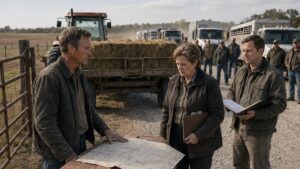
Before Drake could formulate a reply, the crowd parted. Two uniformed compliance inspectors from the Oregon Department of Agriculture Chemical Analysis Division strode into the clearing, flanked by two municipal market marshals. Leading them was Dr. Diane Caldwell, chief food safety chemist for the state laboratory in Salem. She carried a locked aluminum field briefcase and two heavy, tamper-evident evidence folders sealed with fluorescent red security tape.
“Step back from that table right now, Mr. Drake,” Dr. Caldwell commanded, her voice cutting through the pavilion with chilling, clinical authority. “Oregon Department of Agriculture. We have the certified carbon-isotope mass-spectrometry results for both Cascade Crest Apiaries and Drake’s Reserve.”