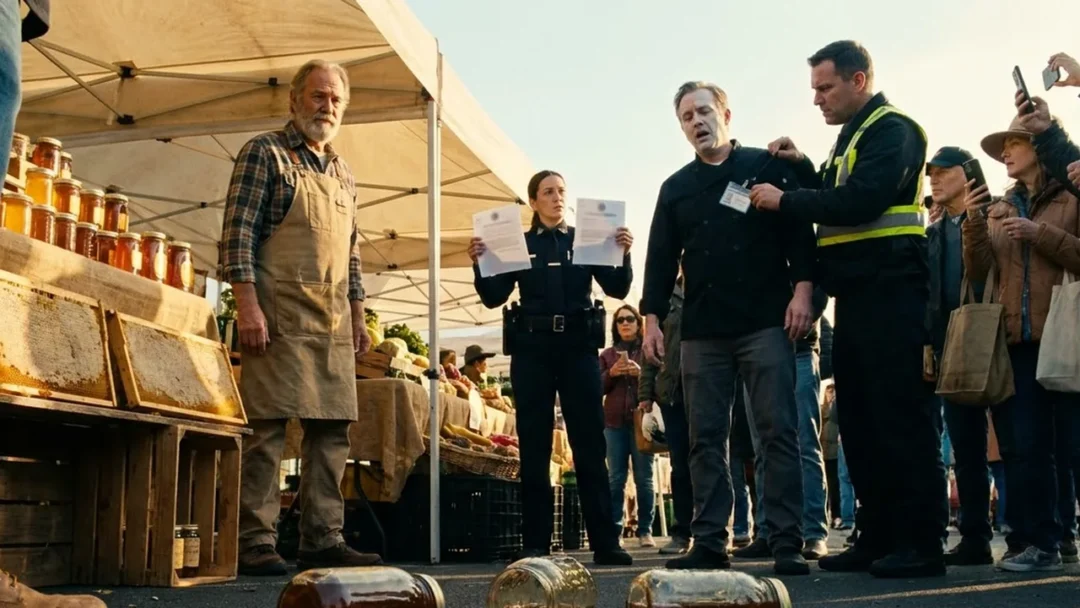
The Pure Amber Honey Jars Beneath The Market Stall Canopy
CHAPTER 3: THE HIVE ON THE EAST BANK
By one o’clock in the afternoon, the rain had returned in earnest, washing across the jagged basalt cliffs of the Columbia River Gorge and sweeping down into Portland in a relentless, wind-whipped deluge. The city smelled of wet asphalt, river mud, and the heavy diesel fumes of the industrial warehouse district along the eastern bank of the Willamette.
Elijah Thorne sat in the passenger seat of Patricia Finch’s green Subaru, his work boots dry now, his hands wrapped around a paper cup of black tea that Patricia had bought him from the market roaster. Through the sweeping windshield wipers, Elijah watched the corrugated iron siding of a sprawling, windowless warehouse perched beside an active railroad spur. Above the loading bays hung a rusted sheet-metal sign: CASCADE COLD STORAGE — UNIT 14.
Parked on the slick asphalt apron outside Bay 3 was an unmarked white commercial box truck with out-of-state plates. Three men in oil-stained gray coveralls and heavy rubber gloves were working with frantic, desperate speed, using an electric pallet jack to shove fifty-five-gallon blue polyethylene chemical drums out of the building and into the dark cargo bed of the truck.
Behind Patricia’s car sat two dark blue unmarked sedans belonging to the Oregon Department of Justice Financial Crimes Unit and three marked Portland Police Bureau cruisers, their roof lights switched off, waiting in the gloom.
“We ran the corporate tax filings during the market lockdown,” Patricia said, holding an unsealed court dossier against the steering wheel. “The lease on this facility isn’t held by Drake’s culinary company. It’s held by an umbrella entity called Pacific Rim Wholesale Logistics. The registered corporate guarantor is Victor Sterling.”
Elijah’s brow knitted with quiet, focused concern. “Sterling? The chairman of the municipal waterfront development committee?”
“The very same,” Patricia replied, her voice simmering with cold fury. “Sterling has spent the last three years trying to condemn the historic farmers market. He calls it an ‘under-performing public asset’ that ought to be razed to make way for a four-hundred-million-dollar luxury condominium and retail tower complex. At the last three city council hearings, Sterling claimed that traditional family farms were a health liability, that unregulated vendors were selling uninspected produce, and that the city needed to replace our open-air stalls with commercial chain tenants. Lucian Drake was his golden boy—the hand-picked ‘curated culinary artist’ who was supposed to prove that modern luxury retail was superior to old dirt farmers like you.”
“They wanted to manufacture a scandal,” Elijah said softly, connecting the pieces in his mind. “If Drake could publicly prove that the oldest beekeeper on the mountain was selling fake syrup, Sterling could stand up before the council on Monday morning and claim the entire market was corrupt.”
“Exactly,” Patricia said. “They weren’t just trying to make a quick buck on counterfeit honey, Elijah. They were trying to steal the whole riverfront from the people of this city.”
A sharp knock sounded on the driver’s side glass. Detective Miller from the county economic fraud division motioned for them to roll the window down.
“Search warrant is verified by the presiding circuit judge,” Miller said, water dripping from the brim of his tactical cap. “We have the perimeter secured. Dr. Caldwell wants you both inside to witness the primary chemical inventory before the state attorney general executes the asset seizure.”
Elijah stepped out into the pouring rain, pulling his oilskin hat low over his forehead. He followed Detective Miller, Patricia, and five armed officers as they advanced up the wet concrete ramp into the cavernous darkness of Bay 3.
As the police team swept into the warehouse with high-intensity tactical flashlights, the three workers loading the truck dropped their pallet jack handles, throwing their hands into the air with shouts of panic.
“Police department! Step away from the pallets and keep your hands visible!” Detective Miller shouted, his voice echoing through the vast, echoing concrete space.
The interior of the building was a nightmare of industrial adulteration. There were no wooden bee frames, no buzzing colonies, no sunlight, and not a single particle of natural beeswax. In the center of the warehouse floor stood four massive, fifteen-hundred-gallon stainless-steel automated blending vats, connected by a maze of braided PVC hoses to high-pressure steam boilers and industrial pumps.
Stacked along the rear wall, stretching twenty feet toward the dark steel rafters, were nearly two hundred fifty-five-gallon blue steel drums. Stenciled across each drum in white industrial spray paint were international shipping codes from an industrial chemical conglomerate in Qingdao, China: REFINED HIGH DEXTROSE LIQUID GLUCOSE — CONFECTIONERY GRADE — NON-ORGANIC.
Beside the blending vats sat an automated packaging line, where conveyor belts were loaded with thousands of empty hexagonal glass jars, stacks of gold wax seals, and pallets of printed labels reading DRAKE’S RESERVE: HARVESTED IN THE CASCADE FOOTHILLS.
Standing in the corner of the mezzanine office, feverishly cramming hard drives and paper files into a leather travel bag, was Lucian Drake. He had traded his chef’s coat for a drenched wool overcoat, but his face was wild, his eyes hollow with the blind terror of a trapped animal.
“Don’t move, Drake!” Detective Miller commanded, bounding up the metal steps of the mezzanine with two officers behind him.
Drake froze, the heavy leather travel bag slipping from his fingers and hitting the steel grating with a heavy, metallic crash. He raised his trembling hands, looking down through the office windows at Elijah Thorne, who stood on the warehouse floor below, looking up at him with unblinking sorrow.
“Lucian,” Dr. Caldwell called up from the floor, shining her flashlight beam directly into an open fifty-pound sack of white crystalline powder sitting beside the main blending valve. “Synthetic beta-fructofuranosidase enzyme. Used to chemically invert sucrose into glucose and fructose to mimic the specific sugar profile of natural nectar.”
Dr. Caldwell dipped a stainless-steel spatula into the chemical powder, her voice chilling the damp warehouse air.
“You weren’t just blending syrup, Mr. Drake. You were manufacturing a sophisticated chemical counterfeit designed specifically to beat routine laboratory screening. That elevates this offense from state consumer fraud to federal felony adulteration with intent to defraud.”