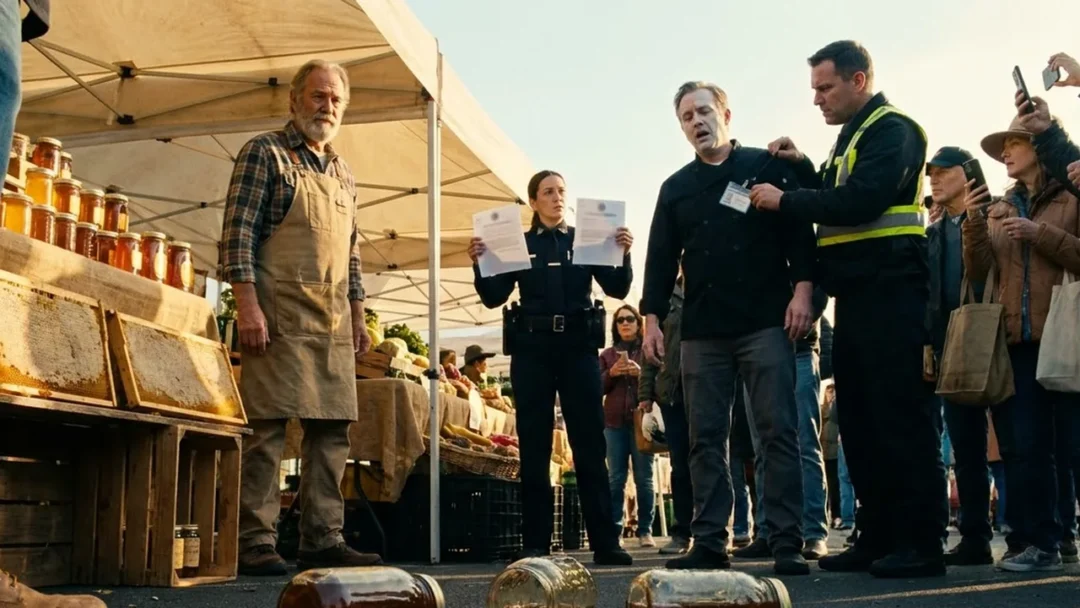
The Pure Amber Honey Jars Beneath The Market Stall Canopy
CHAPTER 6: THE GOLDEN COMB OF CASCADE
Three months later, the deep winter snow had locked the high volcanic passes of Mount Hood in absolute, crystalline silence. The ancient old-growth noble firs and western hemlocks were bowed low under four feet of powdery white pack, their branches sparkling with millions of frost crystals in the brilliant, sharp winter sun.
Up in the Sandy River canyon, ten miles beyond the reach of county snowplows where the glacial water ran swift and dark beneath blue shelves of river ice, the Thorne family apiary rested in peaceful slumber. Two hundred and forty handcrafted cedar hive boxes sat in precise, sheltered rows along the south-facing timber slope, their overhanging gables weighted down with heavy river stones against the Pacific blizzards. Inside the dark, fragrant chambers of the hives, hundreds of thousands of honeybees clustered tightly around their queens, vibrating their flight muscles in a soft, unbroken collective hum that generated an internal sanctuary of ninety-two degrees against the sub-zero mountain cold.
Inside the Thorne homestead cabin, a massive cast-iron woodstove roared with seasoned split cedar, filling the exposed-beam kitchen with a dry, resinous warmth that banished the winter frost from the double-paned windows. The air was rich with the scent of spiced pear cider, roasted hazelnuts, and hot beeswax.
Elijah Thorne sat in his high-backed oak rocking chair beside the hearth, wearing a heavy wool sweater and thick shearling slippers, carefully cleaning the cutting teeth of his manual comb-uncapping knives with an oiled whetstone.
Across the long pine trestle table sat Patricia Finch and Dr. Diane Caldwell, their snow boots drying by the stove pipe, sipping steaming mugs of black tea sweetened with thick spoonfuls of raw summer clover honey.
Resting on the heavy stone mantelpiece above the roaring hearth, polished to a radiant mirror finish between an antique brass honey extractor handle and a 1964 black-and-white photograph of Elijah’s grandfather, sat the municipal bronze plaque: THE MASTER ARTISAN GOLDEN COMB — ELIJAH THORNE — CASCADE CREST APIARIES.
“The Multnomah County Grand Jury returned forty-two felony indictments last Thursday,” Dr. Caldwell said, setting her mug down on a cork coaster with a quiet, satisfied clink. “Victor Sterling and Lucian Drake were charged with federal interstate wire fraud, systematic commercial food adulteration, and criminal racketeering. The federal judge denied bail; their trial is set for March in federal district court.”
“And the warehouse on Water Avenue?” Elijah asked, his whetstone moving in steady, rhythmic strokes along the steel blade.
“The court granted permanent asset forfeiture,” Patricia answered, her face radiant with deep satisfaction. “The building has been deeded to the Oregon Food Bank Network. The city council voted last week to convert the main floor into a certified community commercial kitchen and cooperative processing depot for small family growers. Local apiarists and fruit farmers will have free access to state-certified bottling lines and testing facilities starting this spring.”
Patricia reached into her leather satchel and pulled out an embossed parchment document bearing the emerald-green seal of the Oregon State Beekeepers Association.
“The state university extension program in Corvallis voted unanimously to name their new permanent pollinator research facility after your father, Elijah. The Samuel Thorne Apicultural Laboratory.”
Elijah stopped his whetstone. He reached out with rough, scarred fingers, gently tracing the embossed gold lettering on the parchment. He looked out through the frost-rimmed cabin window toward the silent rows of cedar hives resting on the mountain ridge beneath the towering, snow-capped peak of Mount Hood.
For fifty years, Elijah had watched the relentless, creeping tide of industrial mass production, artificial shortcuts, and corporate greed threaten to swallow the small family farm whole. He had watched neighbors sell their acreage to housing tracts, watched food become a commodity manufactured in chemical vats rather than harvested from living soil, and wondered if the quiet work of his hands would simply vanish into history.
He looked at the amber jar of raw honey sitting on the table, watching the firelight dance through the thick, golden nectar like living embers of summer sun preserved against the winter dark.
“A bee only makes a twelfth of a teaspoon of honey in her entire lifetime,” Elijah murmured softly, his voice gentle and filled with quiet reverence. “She visits two thousand flowers, flies five hundred miles, and wears her wings down to tatters before she dies. She does it because she knows the colony will survive the cold.”
Patricia and Diane smiled in quiet understanding, raising their mugs in a silent, grateful toast to the old beekeeper, the mountain, and the unyielding strength of honest labor.
Outside, the mountain wind whispered softly through the dark, fragrant firs, carrying the quiet, eternal promise of spring across the frozen peaks of the Cascade Range.